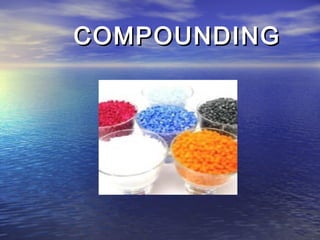
COMPOUNDINGCOMPOUNDING
COMPOUNDING OF PLASTICSCOMPOUNDING OF PLASTICS
• The process ofThe process of mechanical mixingmechanical mixing ofof
variousvarious additivesadditives with plasticswith plastics without anywithout any
chemical reactionchemical reaction
FILLERS / EXTENDERSFILLERS / EXTENDERS
• Organic /inorganic compoundOrganic /inorganic compound
incorporatedincorporated
• Reduce the cost of the fabricated plasticReduce the cost of the fabricated plastic
article per unit weightarticle per unit weight
• Improve hardness,tensileImprove hardness,tensile
stregnth,opacity..stregnth,opacity..
FILLERSFILLERS
• PARTICULARPARTICULAR
• Mainly to reduce theMainly to reduce the
costcost
• Increases hardnessIncreases hardness
but not tensilebut not tensile
strengthstrength
• Eg. AsbestoseEg. Asbestose
increases heatincreases heat
resistanceresistance
• FIBROUSFIBROUS
• Enhance the tensileEnhance the tensile
strengthstrength
• Also called reinforcingAlso called reinforcing
fillersfillers
• Eg.C black to naturalEg.C black to natural
rubber increases T.S.rubber increases T.S.
by 40%by 40%
BINDERSBINDERS
• Hold the constituents of the plastic togetherHold the constituents of the plastic together
• Give the desired properties like plasticityGive the desired properties like plasticity
&electrical insulating properties&electrical insulating properties
• Eg.thermoplastic resins & thermosetting resinsEg.thermoplastic resins & thermosetting resins
PLASTICIZERSPLASTICIZERS
• To improve plasticity & flexibilityTo improve plasticity & flexibility
• To reduce the cracking on the surfaceTo reduce the cracking on the surface
• To reduce the temp.& pressure forTo reduce the temp.& pressure for
mouldingmoulding
• Are less volatile liquidsAre less volatile liquids
• Eg. Dibutyl phthalate,tributyl phosphate..Eg. Dibutyl phthalate,tributyl phosphate..
Plasticizer should be :Plasticizer should be :
• Miscible with polymerMiscible with polymer
• InertInert
• A high molecular weight, high boiling andA high molecular weight, high boiling and
non-volatile substancenon-volatile substance
DisadvantageDisadvantage
Reduce T.S. & chemical resistanceReduce T.S. & chemical resistance
STABILISERSTABILISER
• Compounds added to prevent theCompounds added to prevent the
degradation by air, UV rays & heatdegradation by air, UV rays & heat
• Eg. Phenyl salicylate to polythene, PVC…Eg. Phenyl salicylate to polythene, PVC…
CATALYSTS/CATALYSTS/
ACCELERATORSACCELERATORS
To accelerate theTo accelerate the
condensation ofcondensation of
thermosetting to getthermosetting to get
cross-linked pdt.cross-linked pdt.
Eg.benzoyl peroxideEg.benzoyl peroxide
COLOURANTSCOLOURANTS
To give a colour to the plasticTo give a colour to the plastic
Eg. Organic dyestuffsEg. Organic dyestuffs
LUBRICANTSLUBRICANTS
To make the moulding easierTo make the moulding easier
To impart finish to pdtTo impart finish to pdt
Eg. Oils, waxes, soapes…Eg. Oils, waxes, soapes…
ANTIOXIDANTANTIOXIDANT
• To prevent the oxidative degradationTo prevent the oxidative degradation
• Eg. PBNA (phenyl-beta-naphthylamine)Eg. PBNA (phenyl-beta-naphthylamine)
MOULDINGMOULDING
• MouldingMoulding is the process of manufacturingis the process of manufacturing
by shaping pliable raw material using aby shaping pliable raw material using a
rigid frame or model called arigid frame or model called a patternpattern..
Types of MouldingTypes of Moulding
– Blow mouldingBlow moulding
– Injection mouldingInjection moulding
– Extrusion mouldingExtrusion moulding
– Compression mouldingCompression moulding
– Transfer mouldingTransfer moulding
Compression MouldingCompression Moulding
Blow MouldingBlow Moulding
Process illustrationProcess illustration
• 11. The plastic is fed in granular form into a 'hopper' that. The plastic is fed in granular form into a 'hopper' that
stores it.stores it.
• 22. A large thread is turned by a motor which feeds the. A large thread is turned by a motor which feeds the
granules through a heated section.granules through a heated section.
• 33. In this heated section the granules melt and become a. In this heated section the granules melt and become a
liquid and the liquid is fed into a mould.liquid and the liquid is fed into a mould.
• 44. Air is forced into the mould which forces the plastic to. Air is forced into the mould which forces the plastic to
the sides, giving the shape of the bottle.the sides, giving the shape of the bottle.
• 55.  The mould is then cooled and is removed.  The mould is then cooled and is removed
Blow moulded productsBlow moulded products
2. Injection Moulding2. Injection Moulding
Materials such as
polystyrene, nylon,
polypropylene and polythene
can be used in a process
called injection moulding
The ProcessThe Process
Injection MouldingInjection Moulding
INJECTION MOULDEDINJECTION MOULDED
COMPONENTSCOMPONENTS
EXTRUSION MouldingEXTRUSION Moulding
Extrusion MouldingExtrusion Moulding
EXTRUSION Moulding dieEXTRUSION Moulding die
TUBE EXTRUDEDTUBE EXTRUDED
COMPONENTSCOMPONENTS
Transfer MouldingTransfer Moulding
TRANSFER MOULDEDTRANSFER MOULDED
COMPONENTSCOMPONENTS

Mouldng Chemistry

  • 1.
  • 2.
    COMPOUNDING OF PLASTICSCOMPOUNDINGOF PLASTICS • The process ofThe process of mechanical mixingmechanical mixing ofof variousvarious additivesadditives with plasticswith plastics without anywithout any chemical reactionchemical reaction
  • 3.
    FILLERS / EXTENDERSFILLERS/ EXTENDERS • Organic /inorganic compoundOrganic /inorganic compound incorporatedincorporated • Reduce the cost of the fabricated plasticReduce the cost of the fabricated plastic article per unit weightarticle per unit weight • Improve hardness,tensileImprove hardness,tensile stregnth,opacity..stregnth,opacity..
  • 4.
    FILLERSFILLERS • PARTICULARPARTICULAR • Mainlyto reduce theMainly to reduce the costcost • Increases hardnessIncreases hardness but not tensilebut not tensile strengthstrength • Eg. AsbestoseEg. Asbestose increases heatincreases heat resistanceresistance • FIBROUSFIBROUS • Enhance the tensileEnhance the tensile strengthstrength • Also called reinforcingAlso called reinforcing fillersfillers • Eg.C black to naturalEg.C black to natural rubber increases T.S.rubber increases T.S. by 40%by 40%
  • 5.
    BINDERSBINDERS • Hold theconstituents of the plastic togetherHold the constituents of the plastic together • Give the desired properties like plasticityGive the desired properties like plasticity &electrical insulating properties&electrical insulating properties • Eg.thermoplastic resins & thermosetting resinsEg.thermoplastic resins & thermosetting resins
  • 6.
    PLASTICIZERSPLASTICIZERS • To improveplasticity & flexibilityTo improve plasticity & flexibility • To reduce the cracking on the surfaceTo reduce the cracking on the surface • To reduce the temp.& pressure forTo reduce the temp.& pressure for mouldingmoulding • Are less volatile liquidsAre less volatile liquids • Eg. Dibutyl phthalate,tributyl phosphate..Eg. Dibutyl phthalate,tributyl phosphate..
  • 7.
    Plasticizer should be:Plasticizer should be : • Miscible with polymerMiscible with polymer • InertInert • A high molecular weight, high boiling andA high molecular weight, high boiling and non-volatile substancenon-volatile substance DisadvantageDisadvantage Reduce T.S. & chemical resistanceReduce T.S. & chemical resistance
  • 8.
    STABILISERSTABILISER • Compounds addedto prevent theCompounds added to prevent the degradation by air, UV rays & heatdegradation by air, UV rays & heat • Eg. Phenyl salicylate to polythene, PVC…Eg. Phenyl salicylate to polythene, PVC…
  • 9.
    CATALYSTS/CATALYSTS/ ACCELERATORSACCELERATORS To accelerate theToaccelerate the condensation ofcondensation of thermosetting to getthermosetting to get cross-linked pdt.cross-linked pdt. Eg.benzoyl peroxideEg.benzoyl peroxide COLOURANTSCOLOURANTS To give a colour to the plasticTo give a colour to the plastic Eg. Organic dyestuffsEg. Organic dyestuffs LUBRICANTSLUBRICANTS To make the moulding easierTo make the moulding easier To impart finish to pdtTo impart finish to pdt Eg. Oils, waxes, soapes…Eg. Oils, waxes, soapes…
  • 10.
    ANTIOXIDANTANTIOXIDANT • To preventthe oxidative degradationTo prevent the oxidative degradation • Eg. PBNA (phenyl-beta-naphthylamine)Eg. PBNA (phenyl-beta-naphthylamine)
  • 11.
    MOULDINGMOULDING • MouldingMoulding isthe process of manufacturingis the process of manufacturing by shaping pliable raw material using aby shaping pliable raw material using a rigid frame or model called arigid frame or model called a patternpattern..
  • 12.
    Types of MouldingTypesof Moulding – Blow mouldingBlow moulding – Injection mouldingInjection moulding – Extrusion mouldingExtrusion moulding – Compression mouldingCompression moulding – Transfer mouldingTransfer moulding
  • 13.
  • 14.
  • 15.
    Process illustrationProcess illustration •11. The plastic is fed in granular form into a 'hopper' that. The plastic is fed in granular form into a 'hopper' that stores it.stores it. • 22. A large thread is turned by a motor which feeds the. A large thread is turned by a motor which feeds the granules through a heated section.granules through a heated section. • 33. In this heated section the granules melt and become a. In this heated section the granules melt and become a liquid and the liquid is fed into a mould.liquid and the liquid is fed into a mould. • 44. Air is forced into the mould which forces the plastic to. Air is forced into the mould which forces the plastic to the sides, giving the shape of the bottle.the sides, giving the shape of the bottle. • 55.  The mould is then cooled and is removed.  The mould is then cooled and is removed
  • 16.
    Blow moulded productsBlowmoulded products
  • 17.
    2. Injection Moulding2.Injection Moulding Materials such as polystyrene, nylon, polypropylene and polythene can be used in a process called injection moulding
  • 18.
  • 19.
  • 20.
  • 21.
  • 22.
  • 23.
  • 24.
  • 25.
  • 26.