PVC (POLYVINYL CHLORIDE)
PASTE POLYMER - INDRODUCTION
Date: 16th July 2015
Mohamed Adam.K
(chem.adams@gmail.com)
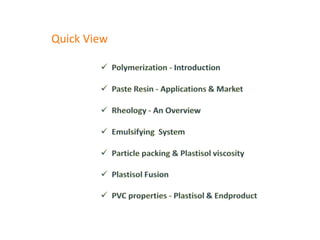
Quick View
Polymerization - Introduction
Polymer: Large chain molecules having high molecular weight
- made up of monomers
Polymerization
m number of
single chains
PVC Particle
Free radical: Highly reactive molecule having an unpaired valency electron
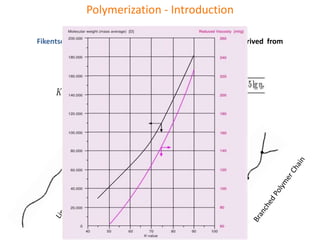
Fikentscher K-Value: Measure of mean molecular weight, derived from
relative viscosity of polymer solutions
Polymerization - Introduction
Suspension polymerisation:
• Monomer soluble free radical initiator
• Dispersion droplet size is large, giving polymer particles of a size greater than about 50 µm
• Particles can be separated by centrifuging or filtering
• Suspending agents - cellulose ethers, polyvinyl alcohol – not true surfactants
• Stirring is required
Emulsion polymerisation:
• Water soluble initiators
• Latex of particles usually of less than 1 µm
• Particles cannot be separated from the aqueous phase by centrifuging or filtering
• Droplet dispersion is normally stable on standing
Microsuspension polymerisations:
• Monomer soluble initiator
• Homogeniser is used to form a dispersion
• Latex particles usually less than 2 µm (sometimes up to 20 µm)
• Needs special separation technique - Spray drying
Polymerization - Introduction
Suspension Polymer Emulsion Polymer Micro-suspension Polymer
Leather Cloth
76%
Textile & Paper
Coatings
0.3%
Tarpaulin
2%
Conveyor belts
3%
Sealants
4%
Mats
8%
Plastisol
3%
Others
4%
Leather Cloth Textile & Paper Coatings Tarpaulin
Conveyor belts Sealants Mats
Plastisol Others
Paste resin applications – Pie chart
2010-11 2011-12 2012-13 2013-14 2014-15 2015-16
Total Demand(Kt) 79 84 103 109 126 134
Domestic Supply (Kt) 44 55 56 69 78 84
Imports (Kt) 35 29 47 40 48 50
Total Demand Growth (%) 14% 6% 23% 5% 15% 7%
0%
5%
10%
15%
20%
25%
0
20
40
60
80
100
120
140
160
Growth(%)
Quantity(Kt)
Year
Paste resin – Supply and Demand
Germany
10%
Korea
44%
Taiwan
18%
U S A
11%
Japan
7%
Others
10%
Avg. Imports - 2015
Germany Korea Taiwan U S A Japan Others
Plastisol: Dispersion of PVC in plasticizer
Rheology: Study of deformation and flow of material
Viscosity-η: Resistance to flow
Shear stress-τ: Force per unit surface area
Shear rate-D: Ratio between the speed difference of two adjacent
layers of a liquid and their distance apart
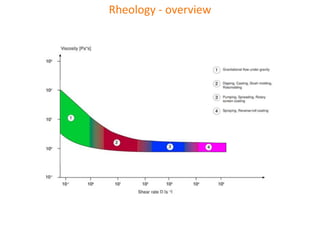
Rheology - overview
Newtonian liquid: Shear stress-τ ∞ Shear rate-D (Proportional)
τ /D = Constant = η (Viscosity)
Glycerine and Water
Non-Newtonian liquid: Shear stress-τ ∞ Shear rate-D (Not Proportional)
Diluted Aq. Starch Solution
Rheology - overview
Pseudoplasticity: Viscosity-η decreases as Shear rate-D increases
Ketchup can have its viscosity reduced by shaking
Toothpaste is a Plastic
Rheology - overview
Dilatancy: Viscosity-η increases as Shear rate-D increases
Cornstarch - Common thickening agent used in cooking
When a force is applied to a 1:2.5 mixture of water and cornstarch,
It acts as a solid and resists the force
Dilatant materials used as a liquid body armor
Thixotropy: Viscosity falls following a prolonged mechanical effort
Rheopexy: Viscosity increases after a prolonged mechanical effort
These effects are reversible
Rheology - overview
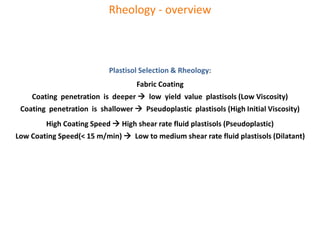
Plastisol Selection & Rheology:
Fabric Coating
Coating penetration is deeper  low yield value plastisols (Low Viscosity)
Coating penetration is shallower  Pseudoplastic plastisols (High Initial Viscosity)
High Coating Speed  High shear rate fluid plastisols (Pseudoplastic)
Low Coating Speed(< 15 m/min)  Low to medium shear rate fluid plastisols (Dilatant)
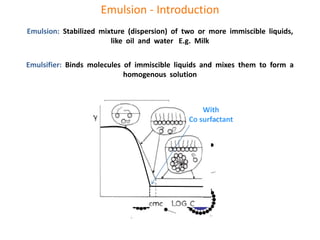
Emulsion: Stabilized mixture (dispersion) of two or more immiscible liquids,
like oil and water E.g. Milk
Emulsifier: Binds molecules of immiscible liquids and mixes them to form a
homogenous solution
Emulsion - Introduction
Critical Micellar Concentration (CMC): Threshold concentration above which surfactant
molecules undergo self-association
Addition of further surfactant above the CMC all goes toward
increasing the number of micelles
Macroscopically homogeneous but microscopically heterogeneous
CMC & Aggregation number decide the number of micelles formed at the start of
polymerisation and hence the ultimate particle size
With
Co surfactant
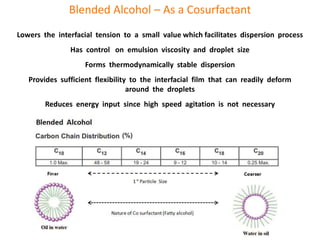
Lowers the interfacial tension to a small value which facilitates dispersion process
Has control on emulsion viscosity and droplet size
Forms thermodynamically stable dispersion
Provides sufficient flexibility to the interfacial film that can readily deform
around the droplets
Reduces energy input since high speed agitation is not necessary
Blended Alcohol – As a Cosurfactant
Secondary Particles - ø: 20 to 60 µm - After Spray Drying
Primary Particles - ø : 0.1 to 2.0 µm - After Polymerisation
Final Resin - ø : 2.0 to 60.0 µm - After Grinding
Secondary particles: Porous and contain internal cavities caused by the rapid evaporation of
water enclosed in the particles during formation (Spray Drying)
MSP Primary Particles: Having Mono-modal PSD that prevents efficient packing of particles
during Spray drying process Produce 2º Particles with high porosity
SEM Images of Resin Particles
Continuous gradation of sizes  Small particles
 Fit into the interstices of the larger particles (efficient packing)
 Releases plasticiser from the interstices between the larger particles
 Comparatively low viscosity plastisol
MSP 1º Particles (Broad uni-modal distribution)  low shear viscosity at low shear rates
Higher shear rates  Breaks efficient packing  Dilatancy
Packing of Resin Particles
• Partial homogenization or homogenization with different pressures & Emulsifier
 Broad PSD
• Proper Emulsifier Type & Quantity  Good Droplet stability
 Spherical particles & No Surface damages
• Residual Emulsifier (Before drying)  Reduces resin Tg / act as Cementing agent
 Forms highly cohesive 2º Particles from spray drying
 Reduces de-agglomeration rate  Reduces viscosity aging and its rate
• Residual Emulsifier  Interact with polymer / plasticiser interface
 Inter-particles repulsion  high viscosities at low shear rates
Towards - pseudoplasticity
S.NO Emulsifier Primary particle size
1 SLS 1 – 3 μ
2 AOS 2 – 5 μ
3 Calsolene Oil 18 – 20 μ
4 Na Dioctyl Sulfo Succinamide 0.2 – 1 μ
5 Ethoxylated Fatty Alcohol 0.2 – 1 μ
Residual Emulsifiers:
•Reduce gloss and clarity
•Not facilitate air release
•Poor heat stability
•Fog formation
•Affect taste/ acceptability in food packing
•Poor compatibility with thermal stabilizer
•Accelerate plateout
• Increasing slurry viscosity  Narrow spray angle  larger droplets  coarser 1º particles
 Reduces the available surface area for plasticiser absorption
 Increases free plasticiser  Depresses shear viscosity
• Increasing atomizer speed  Smaller droplets  highly fused porous 2º Particles
 Absorption and Immobilization of some plasticiser  Swelling
 Increases initial viscosity, Reduces viscosity aging and its rate
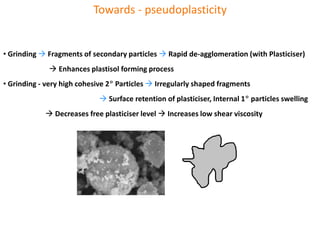
• Grinding  Fragments of secondary particles  Rapid de-agglomeration (with Plasticiser)
 Enhances plastisol forming process
• Grinding - very high cohesive 2º Particles  Irregularly shaped fragments
 Surface retention of plasticiser, Internal 1º particles swelling
 Decreases free plasticiser level  Increases low shear viscosity
PVC / DOP – at 90ºC
PVC / DOP – at 160ºC
PVC / DOP – at 130ºC
PVC / DOP – at 193ºC
Surfactant layer prevents plasticizer adsorption at room temperature
Heating diffuses plasticizer into PVC particles and fuses into a homogeneous material at
higher temperatures
Complete Fusion: Clarity, gloss and mechanical strength of the final composition reaches
the maximum
Stages of Plastisol Fusion
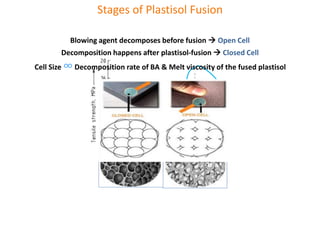
Blowing agent decomposes before fusion  Open Cell
Decomposition happens after plastisol-fusion  Closed Cell
Cell Size ∞ Decomposition rate of BA & Melt viscosity of the fused plastisol
PVC properties - Plastisol & End product
Thank you…
Thank you…
Thank you…
Thank you…
Thank you…
Thank you…
Thank you…

Microsuspension PVC - Introduction

  • 1.
    PVC (POLYVINYL CHLORIDE) PASTEPOLYMER - INDRODUCTION Date: 16th July 2015 Mohamed Adam.K (chem.adams@gmail.com)
  • 2.
  • 3.
    Polymerization - Introduction Polymer:Large chain molecules having high molecular weight - made up of monomers Polymerization m number of single chains PVC Particle Free radical: Highly reactive molecule having an unpaired valency electron
  • 4.
    Fikentscher K-Value: Measureof mean molecular weight, derived from relative viscosity of polymer solutions Polymerization - Introduction
  • 5.
    Suspension polymerisation: • Monomersoluble free radical initiator • Dispersion droplet size is large, giving polymer particles of a size greater than about 50 µm • Particles can be separated by centrifuging or filtering • Suspending agents - cellulose ethers, polyvinyl alcohol – not true surfactants • Stirring is required Emulsion polymerisation: • Water soluble initiators • Latex of particles usually of less than 1 µm • Particles cannot be separated from the aqueous phase by centrifuging or filtering • Droplet dispersion is normally stable on standing Microsuspension polymerisations: • Monomer soluble initiator • Homogeniser is used to form a dispersion • Latex particles usually less than 2 µm (sometimes up to 20 µm) • Needs special separation technique - Spray drying Polymerization - Introduction Suspension Polymer Emulsion Polymer Micro-suspension Polymer
  • 6.
    Leather Cloth 76% Textile &Paper Coatings 0.3% Tarpaulin 2% Conveyor belts 3% Sealants 4% Mats 8% Plastisol 3% Others 4% Leather Cloth Textile & Paper Coatings Tarpaulin Conveyor belts Sealants Mats Plastisol Others Paste resin applications – Pie chart
  • 7.
    2010-11 2011-12 2012-132013-14 2014-15 2015-16 Total Demand(Kt) 79 84 103 109 126 134 Domestic Supply (Kt) 44 55 56 69 78 84 Imports (Kt) 35 29 47 40 48 50 Total Demand Growth (%) 14% 6% 23% 5% 15% 7% 0% 5% 10% 15% 20% 25% 0 20 40 60 80 100 120 140 160 Growth(%) Quantity(Kt) Year Paste resin – Supply and Demand Germany 10% Korea 44% Taiwan 18% U S A 11% Japan 7% Others 10% Avg. Imports - 2015 Germany Korea Taiwan U S A Japan Others
  • 8.
    Plastisol: Dispersion ofPVC in plasticizer Rheology: Study of deformation and flow of material Viscosity-η: Resistance to flow Shear stress-τ: Force per unit surface area Shear rate-D: Ratio between the speed difference of two adjacent layers of a liquid and their distance apart Rheology - overview
  • 9.
    Newtonian liquid: Shearstress-τ ∞ Shear rate-D (Proportional) τ /D = Constant = η (Viscosity) Glycerine and Water Non-Newtonian liquid: Shear stress-τ ∞ Shear rate-D (Not Proportional) Diluted Aq. Starch Solution Rheology - overview
  • 10.
    Pseudoplasticity: Viscosity-η decreasesas Shear rate-D increases Ketchup can have its viscosity reduced by shaking Toothpaste is a Plastic Rheology - overview
  • 11.
    Dilatancy: Viscosity-η increasesas Shear rate-D increases Cornstarch - Common thickening agent used in cooking When a force is applied to a 1:2.5 mixture of water and cornstarch, It acts as a solid and resists the force Dilatant materials used as a liquid body armor Thixotropy: Viscosity falls following a prolonged mechanical effort Rheopexy: Viscosity increases after a prolonged mechanical effort These effects are reversible Rheology - overview Plastisol Selection & Rheology: Fabric Coating Coating penetration is deeper  low yield value plastisols (Low Viscosity) Coating penetration is shallower  Pseudoplastic plastisols (High Initial Viscosity) High Coating Speed  High shear rate fluid plastisols (Pseudoplastic) Low Coating Speed(< 15 m/min)  Low to medium shear rate fluid plastisols (Dilatant)
  • 12.
    Emulsion: Stabilized mixture(dispersion) of two or more immiscible liquids, like oil and water E.g. Milk Emulsifier: Binds molecules of immiscible liquids and mixes them to form a homogenous solution Emulsion - Introduction Critical Micellar Concentration (CMC): Threshold concentration above which surfactant molecules undergo self-association Addition of further surfactant above the CMC all goes toward increasing the number of micelles Macroscopically homogeneous but microscopically heterogeneous CMC & Aggregation number decide the number of micelles formed at the start of polymerisation and hence the ultimate particle size With Co surfactant
  • 13.
    Lowers the interfacialtension to a small value which facilitates dispersion process Has control on emulsion viscosity and droplet size Forms thermodynamically stable dispersion Provides sufficient flexibility to the interfacial film that can readily deform around the droplets Reduces energy input since high speed agitation is not necessary Blended Alcohol – As a Cosurfactant
  • 14.
    Secondary Particles -ø: 20 to 60 µm - After Spray Drying Primary Particles - ø : 0.1 to 2.0 µm - After Polymerisation Final Resin - ø : 2.0 to 60.0 µm - After Grinding Secondary particles: Porous and contain internal cavities caused by the rapid evaporation of water enclosed in the particles during formation (Spray Drying) MSP Primary Particles: Having Mono-modal PSD that prevents efficient packing of particles during Spray drying process Produce 2º Particles with high porosity SEM Images of Resin Particles
  • 15.
    Continuous gradation ofsizes  Small particles  Fit into the interstices of the larger particles (efficient packing)  Releases plasticiser from the interstices between the larger particles  Comparatively low viscosity plastisol MSP 1º Particles (Broad uni-modal distribution)  low shear viscosity at low shear rates Higher shear rates  Breaks efficient packing  Dilatancy Packing of Resin Particles
  • 16.
    • Partial homogenizationor homogenization with different pressures & Emulsifier  Broad PSD • Proper Emulsifier Type & Quantity  Good Droplet stability  Spherical particles & No Surface damages • Residual Emulsifier (Before drying)  Reduces resin Tg / act as Cementing agent  Forms highly cohesive 2º Particles from spray drying  Reduces de-agglomeration rate  Reduces viscosity aging and its rate • Residual Emulsifier  Interact with polymer / plasticiser interface  Inter-particles repulsion  high viscosities at low shear rates Towards - pseudoplasticity S.NO Emulsifier Primary particle size 1 SLS 1 – 3 μ 2 AOS 2 – 5 μ 3 Calsolene Oil 18 – 20 μ 4 Na Dioctyl Sulfo Succinamide 0.2 – 1 μ 5 Ethoxylated Fatty Alcohol 0.2 – 1 μ Residual Emulsifiers: •Reduce gloss and clarity •Not facilitate air release •Poor heat stability •Fog formation •Affect taste/ acceptability in food packing •Poor compatibility with thermal stabilizer •Accelerate plateout • Increasing slurry viscosity  Narrow spray angle  larger droplets  coarser 1º particles  Reduces the available surface area for plasticiser absorption  Increases free plasticiser  Depresses shear viscosity • Increasing atomizer speed  Smaller droplets  highly fused porous 2º Particles  Absorption and Immobilization of some plasticiser  Swelling  Increases initial viscosity, Reduces viscosity aging and its rate • Grinding  Fragments of secondary particles  Rapid de-agglomeration (with Plasticiser)  Enhances plastisol forming process • Grinding - very high cohesive 2º Particles  Irregularly shaped fragments  Surface retention of plasticiser, Internal 1º particles swelling  Decreases free plasticiser level  Increases low shear viscosity
  • 17.
    PVC / DOP– at 90ºC PVC / DOP – at 160ºC PVC / DOP – at 130ºC PVC / DOP – at 193ºC Surfactant layer prevents plasticizer adsorption at room temperature Heating diffuses plasticizer into PVC particles and fuses into a homogeneous material at higher temperatures Complete Fusion: Clarity, gloss and mechanical strength of the final composition reaches the maximum Stages of Plastisol Fusion Blowing agent decomposes before fusion  Open Cell Decomposition happens after plastisol-fusion  Closed Cell Cell Size ∞ Decomposition rate of BA & Melt viscosity of the fused plastisol
  • 18.
    PVC properties -Plastisol & End product
  • 19.
    Thank you… Thank you… Thankyou… Thank you… Thank you… Thank you… Thank you…