MODULE 5
Motivation – Nature, Importance, Theories of
Motivation – Maslow’s Hierarchy of Needs theory,
Douglas McGregor Theory X and Theory Y,
Ouchie’s Theory Z, Herberg’s Two Factor Theory,
Vrooms expectancy Theory. Job Satisfaction
patterns.
What is Motivation?
Motivation is the answer to the question “Why we do what we
do?”. The motivation theories try to figure out what the “M” is in
the equation: “M motivates P” (Motivator motivates the Person).
It is one of most important duty of an Manager /
Administrator / Entrepreneur to motivate people.
It is strongly believed that motivating people with
visionary and shared goals is more favourable than
motivating through tactics, incentives or manipulation
through simple carrot and stick approaches because
motivating with vision is natural whereas the former is
artificial and ephemeral.
Meaning
Motivation is a process of stimulating people to action to
accomplish desired goals.
Definition
Internal and external factors that stimulate desire and energy in
people to be continually interested and committed to a job, role or
subject, or to make an effort to attain a goal.
Motivation results from the interaction of both conscious and
unconscious factors such as the
(1) Intensity of desire or need
(2) Incentive or reward value of the goal, and
(3) Expectations of the individual and of his or her peers.
These factors are the reasons one has for behaving a certain
way. An example is a student that spends extra time studying
for a test because he or she wants a better grade in the class.
Importance of Motivation
– Maximum utilization of factors of production
– Reduced absenteeism
– Sense of belongingness, increase in the efficiency and output.
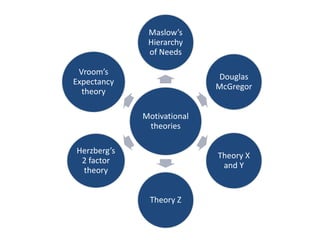
Motivational
theories
Maslow’s
Hierarchy
of Needs
Douglas
McGregor
Theory X
and Y
Theory Z
Herzberg’s
2 factor
theory
Vroom’s
Expectancy
theory
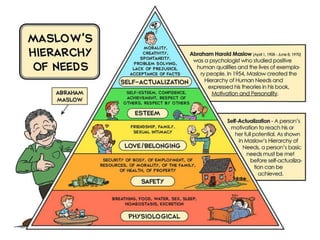
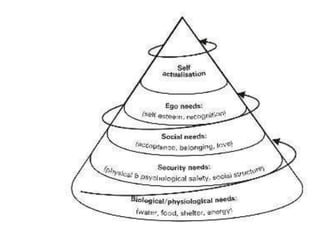
Maslow's Hierarchy of Needs
Dr. Abraham Maslow suggests that Human wants are
never ending, if one want is satisfied another want
emerges in that place, in his research paper titled ‘A
Theory of Human Motivation’ in early 1943.
Deficit and Progression Principles: In order to comprehend the full
meaning of Maslow's theory, it is necessary to understand the
deficit and progression principles.
i) Deficit Principle: According to Maslow, once a need is fairly
well satisfied, ‘it is no Longer a stronger motivator of behaviour’.
People are motivated to satisfy only those needs that are perceived
to be deficient.
ii) Progression Principle: Maslow contends that the five
categories of needs exist in a hierarchy. A need at a given level is
not activated until the need directly below it is fairly well satisfied.
Thus, the person is expected to progress step-by-step up the need
hierarchy.
ANALYSIS
• Maslow has taken a deprivation gratification approach to need
satisfaction .
• That is, he extended that an unfulfilled or deprived need would
activate a person to engage in behaviour that would satisfy or
gratify that need.
• Once one level of need is gratified, the next level of needs will
emerge as the deprived needs seeking to be gratified.
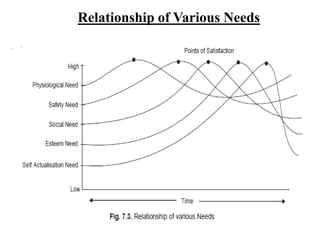
Relationship of Various Needs
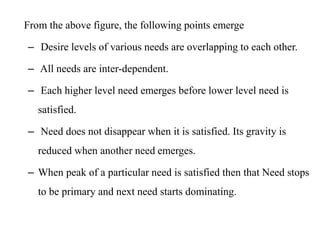
From the above figure, the following points emerge
– Desire levels of various needs are overlapping to each other.
– All needs are inter-dependent.
– Each higher level need emerges before lower level need is
satisfied.
– Need does not disappear when it is satisfied. Its gravity is
reduced when another need emerges.
– When peak of a particular need is satisfied then that Need stops
to be primary and next need starts dominating.
Douglas McGregor
Theory X and Theory Y
Douglas McGregor
Theory X and Theory Y
• Douglas Mc Gregor proposed 2 distinct sets of
assumptions about what motivates people
• One basically negatively labelled Theory X and
other positively labelled Theory Y
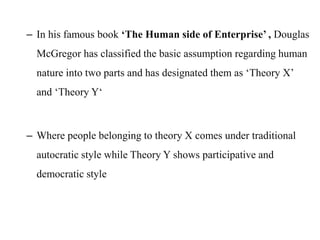
– In his famous book ‘The Human side of Enterprise’ , Douglas
McGregor has classified the basic assumption regarding human
nature into two parts and has designated them as ‘Theory X’
and ‘Theory Y‘
– Where people belonging to theory X comes under traditional
autocratic style while Theory Y shows participative and
democratic style
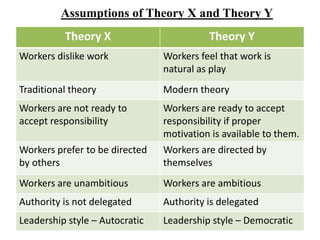
Theory X Theory Y
Workers dislike work Workers feel that work is
natural as play
Traditional theory Modern theory
Workers are not ready to
accept responsibility
Workers are ready to accept
responsibility if proper
motivation is available to them.
Workers prefer to be directed
by others
Workers are directed by
themselves
Workers are unambitious Workers are ambitious
Authority is not delegated Authority is delegated
Leadership style – Autocratic Leadership style – Democratic
Assumptions of Theory X and Theory Y
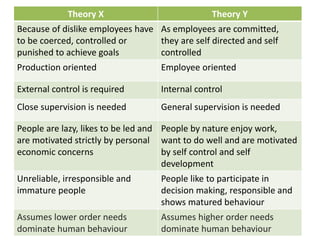
Theory X Theory Y
Because of dislike employees have
to be coerced, controlled or
punished to achieve goals
As employees are committed,
they are self directed and self
controlled
Production oriented Employee oriented
External control is required Internal control
Close supervision is needed General supervision is needed
People are lazy, likes to be led and
are motivated strictly by personal
economic concerns
People by nature enjoy work,
want to do well and are motivated
by self control and self
development
Unreliable, irresponsible and
immature people
People like to participate in
decision making, responsible and
shows matured behaviour
Assumes lower order needs
dominate human behaviour
Assumes higher order needs
dominate human behaviour
Critiques of theory
• The thin line distinction between Theory X and Y gives an
impression that managers accepting Theory X believes in a
carrot stick approach with his employees, while Theory Y
believes in participative approach
• The word autocratic and participative should be opted as
per situation, since the nature of terms reflects the
personality as such
• Theory X & Y persons not necessarily remain the same
forever. They might get interchange as per the situational
demands.
Theory ‘Z’
Theory Z
• William G. Ouchi and L.G. Urwick after making
a comparative study of American and
Japanese management practices proposed
Theory Z in early 80’s
• It is an integrative model, containing the best
of both worlds
• It takes into account the strengths of Japanese
management ( social, cohesion, job security and
concern for employees) as well as American
management (speedy decision making, risk
taking skills, individual autonomy, innovation and
creativity) and proposes a mixed US-Japanese
management system for modern organizations
• Professor William contrasted the American
organizations ( Type A) “Concentration on
individualism” to Japanese organizations
( Type J) termed as “Collectivism”
Features
–Life time employment
–Involvement of employees
–Working environment i.e. stable environment
–Co-ordination
–No formal structures
–Informal control system
–Integrated organization
–Trust(i.e. the existence of trust between employees)
Urwick’s theory Z lays down four essentials
1. Sound bond between organisation and employees
2. Participation of employees in decision making
3. No formal structure of organization
4. Co-ordination of human beings.
Thus theory Z suggest complete change or transformation
of motivational aspects of employees
Herberg’s Two Factor Theory
• Herzberg modified Maslow’s five levels to TWO Factors. Known
as ‘Maintenance Theory of Motivation’, ‘Hygiene Theory’, ‘Two-
factor Theory of Motivation’ or ‘Content theory of Motivation’.
• This theory was given by collecting the responses from 200
accountants and engineers drawn from industries in Pittsburgh
area using ‘Critical incident method’.
• He asked samples to respond to two aspects as follows
Question 1: When did they feel particularly good about
their Job?
Question 2: When did they feel exceptionally bad about
their Job?
• He was the pioneer of the concept of ‘Job enrichment’
The Two Factors
1. Factors leading to job satisfaction are
considered as Motivational factors or Satisfiers
2. Factors leading to job dissatisfaction are called
as Hygiene factors or Maintenance factors or
Content factors
Motivational factors or ‘Satisfiers’
• Herzberg identified some Motivational factors (6) i.e. elements
which are directly related to ‘Doing a Job’
• These factors make people contended and satisfied with their job
• To ensure effective performance managers must enrich employees
work and increase freedom on job
• Motivators are necessary to keep the job satisfaction and
performance high.
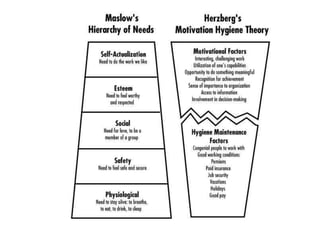
The list of motivating factors include:
• Achievement
• Recognition
• Advancement
• Work itself
• Possibility of growth
• Responsibility
(Note: These factors are similar to the Self-actualisation and
esteem needs of Maslow’s Hierarchy needs)
Hygiene or Maintenance factors
Herzberg identified some Hygiene or Maintenance factors (10) i.e
elements which related with conditions ‘surrounding’ the job.
• Company policy and Administration
• Technical supervision
• Salary
• Status
• Job security
• Personal life
• Inter-personal relations with Supervisors
• Inter-personal relations with Peers
• Inter-personal relations with Subordinates
• Working conditions and Compensation
** These factors are similar to the Physiological needs, Security
needs and Social needs of Maslow’s Hierarchy needs
Comparison of Maslow and Herzberg Models
• Difference No 1 - Herzberg model is the extension of Maslow’s
model. Maslow referred to the Needs (motives) while Herzberg
dealt with Goals (Incentives).
• Difference No 2 – Maslow’s need hierarchy is a sequential
arrangement of needs, while Herzberg’s model does not have any
such Hierarchical arrangement.
• Difference No 3 – Maslow believed that any unsatisfied need,
irrespective of its level of hierarchy can be a potential motivation ,
on the contrary Herzberg believed that only Higher needs serves as
Motivators.
• Difference No 4 –Herzberg theory is based on field-research while
Maslow’s theory is based on Clinical observations (Laboratory-
based findings).
Vroom’s Expectancy Theory
Vrooms expectancy Theory
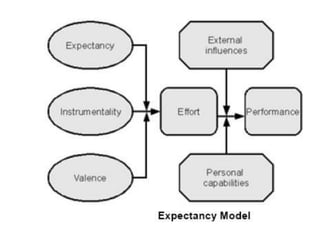
This theory is given by Victor Vroom
• This theory of motivation consists of three main factors:
Expectancy, Instrumentality AND Valence.
• This concept was written and published in the book “Work and
Motivation” by Victor Vroom in 1964
• The theory is based on “ Employees thinking about what they
have to do to be rewarded and how much does the reward mean
to them before they perform their job”
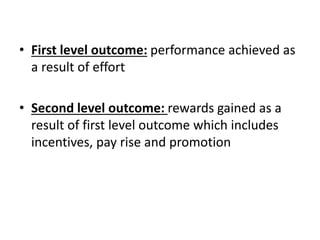
• First level outcome: performance achieved as
a result of effort
• Second level outcome: rewards gained as a
result of first level outcome which includes
incentives, pay rise and promotion
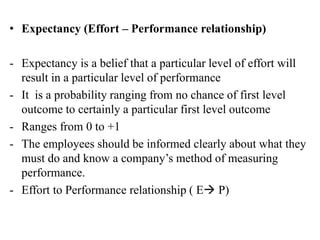
• Expectancy (Effort – Performance relationship)
- Expectancy is a belief that a particular level of effort will
result in a particular level of performance
- It is a probability ranging from no chance of first level
outcome to certainly a particular first level outcome
- Ranges from 0 to +1
- The employees should be informed clearly about what they
must do and know a company’s method of measuring
performance.
- Effort to Performance relationship ( E P)
• Instrumentality:
- This is the perception of an individual that 1st
level outcomes are associated with 2nd level
outcomes
- Ranges from -1 to +1
- Where -1 indicates the attainment of a 2nd
level outcome is less likely if a first level
outcome has occurred
- +1 suggests that the attainment of a 2nd level
outcome is more likely if the 1st level outcome
has been attained
- If there is no relationship between the 1st and
2nd level outcomes, the instrumentality is zero
- The degree to which the individual believes
that performing a particular level will lead to
attainment of desired outcome
- Shows a Performance – Reward relationship
• Valence:
- It is the individuals preference for 2nd level
outcome
- It has values ranging from -1 to +1
- Outcomes with positive valence includes
performing meaningful work, having job
security
- Outcomes with negative valence are things
such as laid-off, discharged for bad behaviour
- Positive outcomes are preferred where as
negative outcomes are avoided
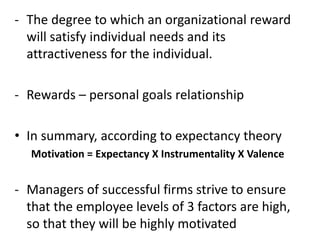
- The degree to which an organizational reward
will satisfy individual needs and its
attractiveness for the individual.
- Rewards – personal goals relationship
• In summary, according to expectancy theory
Motivation = Expectancy X Instrumentality X Valence
- Managers of successful firms strive to ensure
that the employee levels of 3 factors are high,
so that they will be highly motivated
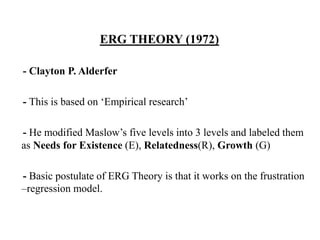
ERG THEORY (1972)
- Clayton P. Alderfer
- This is based on ‘Empirical research’
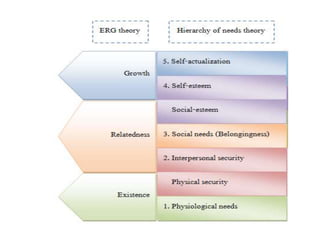
- He modified Maslow’s five levels into 3 levels and labeled them
as Needs for Existence (E), Relatedness(R), Growth (G)
- Basic postulate of ERG Theory is that it works on the frustration
–regression model.
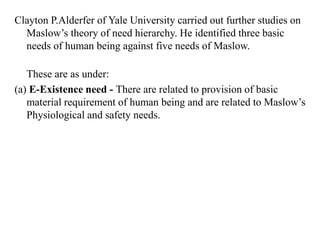
Clayton P.Alderfer of Yale University carried out further studies on
Maslow’s theory of need hierarchy. He identified three basic
needs of human being against five needs of Maslow.
These are as under:
(a) E-Existence need - There are related to provision of basic
material requirement of human being and are related to Maslow’s
Physiological and safety needs.
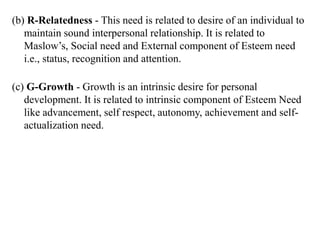
(b) R-Relatedness - This need is related to desire of an individual to
maintain sound interpersonal relationship. It is related to
Maslow’s, Social need and External component of Esteem need
i.e., status, recognition and attention.
(c) G-Growth - Growth is an intrinsic desire for personal
development. It is related to intrinsic component of Esteem Need
like advancement, self respect, autonomy, achievement and self-
actualization need.
Job satisfaction patterns
• Job satisfaction is the collection of feelings and
beliefs people have about their current jobs.
• Job satisfaction is a positive feeling about your
job resulting from an evaluation of its
characteristics.
• Job satisfaction is an important work attitude in
organizational behavior because it affects a
wide range of behaviors and contributes to
workers’ well-being
Job satisfaction theories
• There are numerous theories attempting to
explain job satisfaction, but three conceptual
frameworks seem to be more prominent
- Content Theories
- Process Theories
- Situational Theories
Content Theories
• Content Theories suggests that job satisfaction
occurs when one’s need for growth and self-
actualization are met by the individual’s job
• Abraham Maslow “hierarchy of needs”
Frederick Hertzberg (1974) “two factor
theory”
Process Theories
• Process theories attempt to explain job
satisfaction by looking at expectancies and
values.
• These theory of job satisfaction suggests that
workers’ select their behaviors in order to
meet their needs.
• Adams equity theory and Vroom’s expectancy
theories
Situational Theories
• Situational theories suggest that job
satisfaction is a result of situational
occurences and situational characteristics
Measuring job satisfaction
Single global rating
• All factors combined how
would one rate the job
Summation of job
facets
• Key elements of the job
are identified and rated
for total satisfaction score
Factors leading to job satisfaction
• Effective leadership
• Good manager relationship
• Recognition
• Advancements
• Personal growth
• Feedback and support
• Clear direction and objectives
Factors leading to job dissatisfaction
• Poor pay
• Poor working conditions
• Lack of promotions
• Lack of job security
• Poor benefits offering
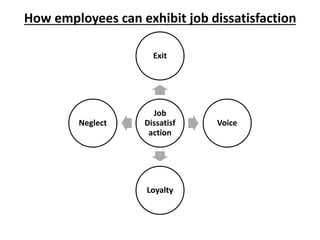
How employees can exhibit job dissatisfaction
Job
Dissatisf
action
Exit
Voice
Loyalty
Neglect

MOTIVATIONS.ppt

  • 1.
    MODULE 5 Motivation –Nature, Importance, Theories of Motivation – Maslow’s Hierarchy of Needs theory, Douglas McGregor Theory X and Theory Y, Ouchie’s Theory Z, Herberg’s Two Factor Theory, Vrooms expectancy Theory. Job Satisfaction patterns.
  • 4.
    What is Motivation? Motivationis the answer to the question “Why we do what we do?”. The motivation theories try to figure out what the “M” is in the equation: “M motivates P” (Motivator motivates the Person). It is one of most important duty of an Manager / Administrator / Entrepreneur to motivate people.
  • 5.
    It is stronglybelieved that motivating people with visionary and shared goals is more favourable than motivating through tactics, incentives or manipulation through simple carrot and stick approaches because motivating with vision is natural whereas the former is artificial and ephemeral.
  • 6.
    Meaning Motivation is aprocess of stimulating people to action to accomplish desired goals. Definition Internal and external factors that stimulate desire and energy in people to be continually interested and committed to a job, role or subject, or to make an effort to attain a goal.
  • 7.
    Motivation results fromthe interaction of both conscious and unconscious factors such as the (1) Intensity of desire or need (2) Incentive or reward value of the goal, and (3) Expectations of the individual and of his or her peers. These factors are the reasons one has for behaving a certain way. An example is a student that spends extra time studying for a test because he or she wants a better grade in the class.
  • 8.
    Importance of Motivation –Maximum utilization of factors of production – Reduced absenteeism – Sense of belongingness, increase in the efficiency and output.
  • 9.
    Motivational theories Maslow’s Hierarchy of Needs Douglas McGregor Theory X andY Theory Z Herzberg’s 2 factor theory Vroom’s Expectancy theory
  • 10.
  • 11.
    Maslow's Hierarchy ofNeeds Dr. Abraham Maslow suggests that Human wants are never ending, if one want is satisfied another want emerges in that place, in his research paper titled ‘A Theory of Human Motivation’ in early 1943.
  • 14.
    Deficit and ProgressionPrinciples: In order to comprehend the full meaning of Maslow's theory, it is necessary to understand the deficit and progression principles. i) Deficit Principle: According to Maslow, once a need is fairly well satisfied, ‘it is no Longer a stronger motivator of behaviour’. People are motivated to satisfy only those needs that are perceived to be deficient. ii) Progression Principle: Maslow contends that the five categories of needs exist in a hierarchy. A need at a given level is not activated until the need directly below it is fairly well satisfied. Thus, the person is expected to progress step-by-step up the need hierarchy.
  • 15.
    ANALYSIS • Maslow hastaken a deprivation gratification approach to need satisfaction . • That is, he extended that an unfulfilled or deprived need would activate a person to engage in behaviour that would satisfy or gratify that need. • Once one level of need is gratified, the next level of needs will emerge as the deprived needs seeking to be gratified.
  • 16.
  • 17.
    From the abovefigure, the following points emerge – Desire levels of various needs are overlapping to each other. – All needs are inter-dependent. – Each higher level need emerges before lower level need is satisfied. – Need does not disappear when it is satisfied. Its gravity is reduced when another need emerges. – When peak of a particular need is satisfied then that Need stops to be primary and next need starts dominating.
  • 18.
  • 19.
    Douglas McGregor Theory Xand Theory Y • Douglas Mc Gregor proposed 2 distinct sets of assumptions about what motivates people • One basically negatively labelled Theory X and other positively labelled Theory Y
  • 20.
    – In hisfamous book ‘The Human side of Enterprise’ , Douglas McGregor has classified the basic assumption regarding human nature into two parts and has designated them as ‘Theory X’ and ‘Theory Y‘ – Where people belonging to theory X comes under traditional autocratic style while Theory Y shows participative and democratic style
  • 21.
    Theory X TheoryY Workers dislike work Workers feel that work is natural as play Traditional theory Modern theory Workers are not ready to accept responsibility Workers are ready to accept responsibility if proper motivation is available to them. Workers prefer to be directed by others Workers are directed by themselves Workers are unambitious Workers are ambitious Authority is not delegated Authority is delegated Leadership style – Autocratic Leadership style – Democratic Assumptions of Theory X and Theory Y
  • 22.
    Theory X TheoryY Because of dislike employees have to be coerced, controlled or punished to achieve goals As employees are committed, they are self directed and self controlled Production oriented Employee oriented External control is required Internal control Close supervision is needed General supervision is needed People are lazy, likes to be led and are motivated strictly by personal economic concerns People by nature enjoy work, want to do well and are motivated by self control and self development Unreliable, irresponsible and immature people People like to participate in decision making, responsible and shows matured behaviour Assumes lower order needs dominate human behaviour Assumes higher order needs dominate human behaviour
  • 23.
    Critiques of theory •The thin line distinction between Theory X and Y gives an impression that managers accepting Theory X believes in a carrot stick approach with his employees, while Theory Y believes in participative approach • The word autocratic and participative should be opted as per situation, since the nature of terms reflects the personality as such • Theory X & Y persons not necessarily remain the same forever. They might get interchange as per the situational demands.
  • 24.
  • 25.
    Theory Z • WilliamG. Ouchi and L.G. Urwick after making a comparative study of American and Japanese management practices proposed Theory Z in early 80’s • It is an integrative model, containing the best of both worlds
  • 26.
    • It takesinto account the strengths of Japanese management ( social, cohesion, job security and concern for employees) as well as American management (speedy decision making, risk taking skills, individual autonomy, innovation and creativity) and proposes a mixed US-Japanese management system for modern organizations • Professor William contrasted the American organizations ( Type A) “Concentration on individualism” to Japanese organizations ( Type J) termed as “Collectivism”
  • 27.
    Features –Life time employment –Involvementof employees –Working environment i.e. stable environment –Co-ordination –No formal structures –Informal control system –Integrated organization –Trust(i.e. the existence of trust between employees)
  • 28.
    Urwick’s theory Zlays down four essentials 1. Sound bond between organisation and employees 2. Participation of employees in decision making 3. No formal structure of organization 4. Co-ordination of human beings. Thus theory Z suggest complete change or transformation of motivational aspects of employees
  • 29.
  • 30.
    Herberg’s Two FactorTheory • Herzberg modified Maslow’s five levels to TWO Factors. Known as ‘Maintenance Theory of Motivation’, ‘Hygiene Theory’, ‘Two- factor Theory of Motivation’ or ‘Content theory of Motivation’. • This theory was given by collecting the responses from 200 accountants and engineers drawn from industries in Pittsburgh area using ‘Critical incident method’.
  • 31.
    • He askedsamples to respond to two aspects as follows Question 1: When did they feel particularly good about their Job? Question 2: When did they feel exceptionally bad about their Job? • He was the pioneer of the concept of ‘Job enrichment’
  • 32.
    The Two Factors 1.Factors leading to job satisfaction are considered as Motivational factors or Satisfiers 2. Factors leading to job dissatisfaction are called as Hygiene factors or Maintenance factors or Content factors
  • 33.
    Motivational factors or‘Satisfiers’ • Herzberg identified some Motivational factors (6) i.e. elements which are directly related to ‘Doing a Job’ • These factors make people contended and satisfied with their job • To ensure effective performance managers must enrich employees work and increase freedom on job • Motivators are necessary to keep the job satisfaction and performance high.
  • 34.
    The list ofmotivating factors include: • Achievement • Recognition • Advancement • Work itself • Possibility of growth • Responsibility (Note: These factors are similar to the Self-actualisation and esteem needs of Maslow’s Hierarchy needs)
  • 35.
    Hygiene or Maintenancefactors Herzberg identified some Hygiene or Maintenance factors (10) i.e elements which related with conditions ‘surrounding’ the job. • Company policy and Administration • Technical supervision • Salary • Status • Job security • Personal life • Inter-personal relations with Supervisors • Inter-personal relations with Peers • Inter-personal relations with Subordinates • Working conditions and Compensation ** These factors are similar to the Physiological needs, Security needs and Social needs of Maslow’s Hierarchy needs
  • 36.
    Comparison of Maslowand Herzberg Models • Difference No 1 - Herzberg model is the extension of Maslow’s model. Maslow referred to the Needs (motives) while Herzberg dealt with Goals (Incentives). • Difference No 2 – Maslow’s need hierarchy is a sequential arrangement of needs, while Herzberg’s model does not have any such Hierarchical arrangement. • Difference No 3 – Maslow believed that any unsatisfied need, irrespective of its level of hierarchy can be a potential motivation , on the contrary Herzberg believed that only Higher needs serves as Motivators. • Difference No 4 –Herzberg theory is based on field-research while Maslow’s theory is based on Clinical observations (Laboratory- based findings).
  • 38.
  • 39.
    Vrooms expectancy Theory Thistheory is given by Victor Vroom • This theory of motivation consists of three main factors: Expectancy, Instrumentality AND Valence. • This concept was written and published in the book “Work and Motivation” by Victor Vroom in 1964 • The theory is based on “ Employees thinking about what they have to do to be rewarded and how much does the reward mean to them before they perform their job”
  • 41.
    • First leveloutcome: performance achieved as a result of effort • Second level outcome: rewards gained as a result of first level outcome which includes incentives, pay rise and promotion
  • 42.
    • Expectancy (Effort– Performance relationship) - Expectancy is a belief that a particular level of effort will result in a particular level of performance - It is a probability ranging from no chance of first level outcome to certainly a particular first level outcome - Ranges from 0 to +1 - The employees should be informed clearly about what they must do and know a company’s method of measuring performance. - Effort to Performance relationship ( E P)
  • 43.
    • Instrumentality: - Thisis the perception of an individual that 1st level outcomes are associated with 2nd level outcomes - Ranges from -1 to +1 - Where -1 indicates the attainment of a 2nd level outcome is less likely if a first level outcome has occurred - +1 suggests that the attainment of a 2nd level outcome is more likely if the 1st level outcome has been attained
  • 44.
    - If thereis no relationship between the 1st and 2nd level outcomes, the instrumentality is zero - The degree to which the individual believes that performing a particular level will lead to attainment of desired outcome - Shows a Performance – Reward relationship
  • 45.
    • Valence: - Itis the individuals preference for 2nd level outcome - It has values ranging from -1 to +1 - Outcomes with positive valence includes performing meaningful work, having job security - Outcomes with negative valence are things such as laid-off, discharged for bad behaviour - Positive outcomes are preferred where as negative outcomes are avoided
  • 46.
    - The degreeto which an organizational reward will satisfy individual needs and its attractiveness for the individual. - Rewards – personal goals relationship • In summary, according to expectancy theory Motivation = Expectancy X Instrumentality X Valence - Managers of successful firms strive to ensure that the employee levels of 3 factors are high, so that they will be highly motivated
  • 47.
    ERG THEORY (1972) -Clayton P. Alderfer - This is based on ‘Empirical research’ - He modified Maslow’s five levels into 3 levels and labeled them as Needs for Existence (E), Relatedness(R), Growth (G) - Basic postulate of ERG Theory is that it works on the frustration –regression model.
  • 49.
    Clayton P.Alderfer ofYale University carried out further studies on Maslow’s theory of need hierarchy. He identified three basic needs of human being against five needs of Maslow. These are as under: (a) E-Existence need - There are related to provision of basic material requirement of human being and are related to Maslow’s Physiological and safety needs.
  • 50.
    (b) R-Relatedness -This need is related to desire of an individual to maintain sound interpersonal relationship. It is related to Maslow’s, Social need and External component of Esteem need i.e., status, recognition and attention. (c) G-Growth - Growth is an intrinsic desire for personal development. It is related to intrinsic component of Esteem Need like advancement, self respect, autonomy, achievement and self- actualization need.
  • 51.
    Job satisfaction patterns •Job satisfaction is the collection of feelings and beliefs people have about their current jobs. • Job satisfaction is a positive feeling about your job resulting from an evaluation of its characteristics. • Job satisfaction is an important work attitude in organizational behavior because it affects a wide range of behaviors and contributes to workers’ well-being
  • 52.
    Job satisfaction theories •There are numerous theories attempting to explain job satisfaction, but three conceptual frameworks seem to be more prominent - Content Theories - Process Theories - Situational Theories
  • 53.
    Content Theories • ContentTheories suggests that job satisfaction occurs when one’s need for growth and self- actualization are met by the individual’s job • Abraham Maslow “hierarchy of needs” Frederick Hertzberg (1974) “two factor theory”
  • 54.
    Process Theories • Processtheories attempt to explain job satisfaction by looking at expectancies and values. • These theory of job satisfaction suggests that workers’ select their behaviors in order to meet their needs. • Adams equity theory and Vroom’s expectancy theories
  • 55.
    Situational Theories • Situationaltheories suggest that job satisfaction is a result of situational occurences and situational characteristics
  • 56.
    Measuring job satisfaction Singleglobal rating • All factors combined how would one rate the job Summation of job facets • Key elements of the job are identified and rated for total satisfaction score
  • 57.
    Factors leading tojob satisfaction • Effective leadership • Good manager relationship • Recognition • Advancements • Personal growth • Feedback and support • Clear direction and objectives
  • 58.
    Factors leading tojob dissatisfaction • Poor pay • Poor working conditions • Lack of promotions • Lack of job security • Poor benefits offering
  • 59.
    How employees canexhibit job dissatisfaction Job Dissatisf action Exit Voice Loyalty Neglect