TQM/QUALITY AWARDS
Overview
• The three fundamental concepts
• The three strong forces
• The three critical processes
• The evolution of total quality
• National and International Quality Awards
Three Fundamental Concepts of
TQM
• Customer focus: internal and external
customers
• Continuous improvement: in manufacturing
and service organizations
• The value of every associate: contributions
of every individual, self-directing work
teams, and improvement teams.
Three Strong Forces
• Alignment: clear vision, clear definitions of
objectives, translation of key objectives
throughout the organization
• Linkage: linking activities across all
functions and departments, reengineering
• Replication: apply similar problem solving
methodology to achieve the same results
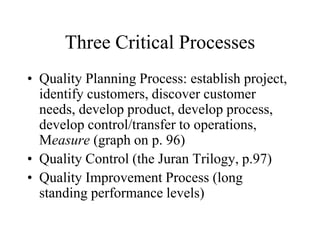
Three Critical Processes
• Quality Planning Process: establish project,
identify customers, discover customer
needs, develop product, develop process,
develop control/transfer to operations,
Measure (graph on p. 96)
• Quality Control (the Juran Trilogy, p.97)
• Quality Improvement Process (long
standing performance levels)
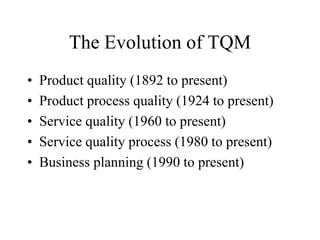
The Evolution of TQM
• Product quality (1892 to present)
• Product process quality (1924 to present)
• Service quality (1960 to present)
• Service quality process (1980 to present)
• Business planning (1990 to present)
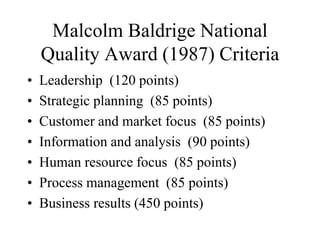
Malcolm Baldrige National
Quality Award (1987) Criteria
• Leadership (120 points)
• Strategic planning (85 points)
• Customer and market focus (85 points)
• Information and analysis (90 points)
• Human resource focus (85 points)
• Process management (85 points)
• Business results (450 points)
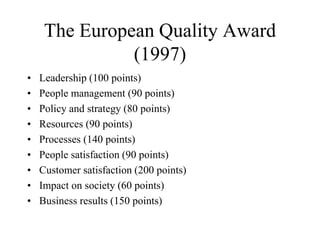
The European Quality Award
(1997)
• Leadership (100 points)
• People management (90 points)
• Policy and strategy (80 points)
• Resources (90 points)
• Processes (140 points)
• People satisfaction (90 points)
• Customer satisfaction (200 points)
• Impact on society (60 points)
• Business results (150 points)
Deming Application Prize
(1951)
• First-level categories: policy, organization and its
management, education and dissemination, quality
information management, analysis, standardization,
control, quality assurance, results, planning
• Second-level categories (examples of policy elements):
management and quality policies, policy generation,
consistency of policies, use of statistical methods, policy
transmission/diffusion, review of policies and results,
relationship between policies and plans.

QualityAwards.ppt

  • 1.
    TQM/QUALITY AWARDS Overview • Thethree fundamental concepts • The three strong forces • The three critical processes • The evolution of total quality • National and International Quality Awards
  • 2.
    Three Fundamental Conceptsof TQM • Customer focus: internal and external customers • Continuous improvement: in manufacturing and service organizations • The value of every associate: contributions of every individual, self-directing work teams, and improvement teams.
  • 3.
    Three Strong Forces •Alignment: clear vision, clear definitions of objectives, translation of key objectives throughout the organization • Linkage: linking activities across all functions and departments, reengineering • Replication: apply similar problem solving methodology to achieve the same results
  • 4.
    Three Critical Processes •Quality Planning Process: establish project, identify customers, discover customer needs, develop product, develop process, develop control/transfer to operations, Measure (graph on p. 96) • Quality Control (the Juran Trilogy, p.97) • Quality Improvement Process (long standing performance levels)
  • 5.
    The Evolution ofTQM • Product quality (1892 to present) • Product process quality (1924 to present) • Service quality (1960 to present) • Service quality process (1980 to present) • Business planning (1990 to present)
  • 6.
    Malcolm Baldrige National QualityAward (1987) Criteria • Leadership (120 points) • Strategic planning (85 points) • Customer and market focus (85 points) • Information and analysis (90 points) • Human resource focus (85 points) • Process management (85 points) • Business results (450 points)
  • 7.
    The European QualityAward (1997) • Leadership (100 points) • People management (90 points) • Policy and strategy (80 points) • Resources (90 points) • Processes (140 points) • People satisfaction (90 points) • Customer satisfaction (200 points) • Impact on society (60 points) • Business results (150 points)
  • 8.
    Deming Application Prize (1951) •First-level categories: policy, organization and its management, education and dissemination, quality information management, analysis, standardization, control, quality assurance, results, planning • Second-level categories (examples of policy elements): management and quality policies, policy generation, consistency of policies, use of statistical methods, policy transmission/diffusion, review of policies and results, relationship between policies and plans.