Motivation 
 Meaning and significance of employee’s 
motivation 
 Motivation process 
 Major motivation theories 
1. Hierarchy of needs theory 
2. Two factor theory 
3. Expectancy theory 
4. Theory x and theory y 
5. Motivation in Islam
1. Defining motivation 
• Motivation is widely studied as a 
psychological concept. The ancient 
Greek who believed that human being 
always sought comfort and pleasure 
and avoided discomfort and pain. Later 
Psychological approaches perceived 
motivation as an instinct and studied as 
a basic psychological concept.
There are many definitions of the 
concept motivation e.g. : 
• Motivation is the process that starts 
with a psychological or psychological 
deficiency that activates behavior 
• The inner state of activates, energizes 
and directs behavior towards goals
The significance of motivation • One of the major effect of 
motivation is on the output of the 
organization which concern both 
quantity and quality . 
• Motivated and satisfied employee 
tend to be more productive, creative 
and committed in their job
• Organization relies heavily on the efficiency of 
staff to make sure it achieves organizational 
goal. If these employees lack of motivation to 
complete work, then the organization would 
face a problem that will lead to disastrous 
consequences 
• Organizations have to admit that the employees 
are the greatest asset no matter how efficient 
the technology and equipment may be, it is no 
match for the effectiveness and efficiency of 
employees.
Motivation process 
Scholars view motivation process 
in a cyclical pattern that consisted 
of three interacting and 
interdependent element: 
1.Need 
2.Deficiency 
3.Action
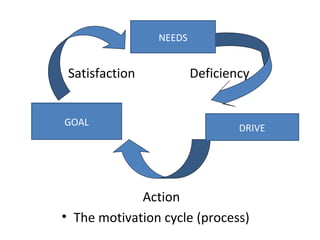
Needs 
NEEDS 
Satisfaction Deficiency 
D 
GOAL DRIVE 
Action 
• The motivation cycle (process)
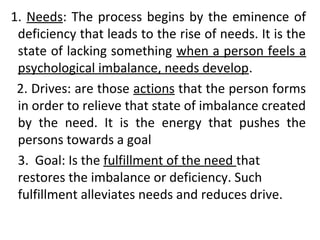
1. Needs: The process begins by the eminence of 
deficiency that leads to the rise of needs. It is the 
state of lacking something when a person feels a 
psychological imbalance, needs develop. 
2. Drives: are those actions that the person forms 
in order to relieve that state of imbalance created 
by the need. It is the energy that pushes the 
persons towards a goal 
3. Goal: Is the fulfillment of the need that 
restores the imbalance or deficiency. Such 
fulfillment alleviates needs and reduces drive.
Major motivation Theories 
Motivation has been studied for many years. As 
a result a wide variety of motivational theory 
have been, some of which are: 
1. Hierarchy of needs theory 
Abraham Maslow reasoned that human needs 
are multiple and that individuals work to satisfy 
those needs in a specific sequence. He also 
noted that noneconomic needs are important to 
people. Maslow asserts that movement from 
two categories through the upper three takes 
place over the life times. Some people never 
satisfy the higher order of needs.
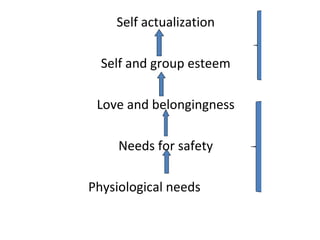
Maslow proposed a Need Hierarchy in 1943 in his 
article a theory of human motivation. There are 5 
set of basic needs arranged in a hierarchy. 
1. Self actualization need: the need for self fulfillment 
2. Self and group esteem need : need for self respect, 
self esteem and the esteem of others 
3. Love and belongingness: need related to affection, 
relation with others and status within group 
4. Needs for safety: need for stable environment 
relatively free from threat 
5. Physiological needs: need for food, sleeps and rest 
etc.
Self actualization 
Self and group esteem 
Love and belongingness 
Needs for safety 
Physiological needs
Maslow is of the opinion that people tend to 
satisfy their needs systematically, starting from 
basic physiological needs then moving up to 
the hierarchy until the particular group is 
satisfied and a person’s behavior will be 
dominated by them. 
• It applies that the hungry person is not going 
to be motivated by the consideration of safety 
and affection until his hunger is satisfied. 
• But, there is an exception in respect to the self 
actualization needs in which satisfaction of this 
needs gives rise to further need for realizing 
one’s potential
• But, this concept is inconclusive. It is 
also claim that the systematic 
movement from one hierarchy to 
another is not consistent form of 
behavior of many person 
• However it does provide a useful 
framework in discussing various level 
of needs people may experience at 
work and the way in which their 
motivation will be met by manager.
2. Two-factor theory 
• Frederick Herzberg’s two-factors or 
motivator-hygiene theory was developed 
independently of the work of Maslow but 
somehow it supports Maslow hierarchy of 
needs. Herzberg focused on two factors of 
job satisfaction and dissatisfaction. 
• It was empirical study of internal worker 
motivation put forth by Frederick Herzberg 
in 1959.
There are five factors called the 
determiners of job satisfaction: 
1. Achievement 
2. Recognition 
3. Work itself 
4. Responsibility 
5. Advancement
Another five factors associated with 
NO job satisfaction: 
• company policy and administration 
• supervision 
• salary 
• interpersonal relationship 
• working condition.
• According to Herzberg, the environmental 
context such as working condition, 
interpersonal relationship and salary served 
as preventive ( for dissatisfaction) they were 
termed as hygiene factors. 
• The job content factors such as achievement, 
advancement and responsibility were termed 
as motivators because they are things that 
motivate people to superior performance.
The differences between two factors 
• The motivators and the hygiene factors are that the 
motivators bring positive satisfaction and the 
hygiene factors are to prevent dissatisfaction. 
• If the motivators are absent from the job, the 
employee will experience dissatisfaction. Even if the 
hygiene factors are available, they themselves could 
not bring job satisfaction. Hygiene factors only 
prevent dissatisfaction and not able to promote job 
satisfaction by themselves.
The contribution of the motivation-Hygiene theory is that 
it helps managers to identify factors inducing positive 
satisfactions and those causing dissatisfaction. It 
developed job enrichment (the design of work that 
contain maximum number of motivators. It put 
attention particularly on the motivation of professional 
group of employee. 
The motivation-hygiene theory assumes that the highly 
motivated employee is not the one who has good salary 
or good working condition but it must be combined 
with achievement, recognition, and other motivators 
associated with the work they perform 
The weakness of the motivation-hygiene theory is that it 
has been less received by the social scientist concerning 
their applicability to non-professional groups.
3. Expectancy theory 
• The expectancy theory developed from the work of 
V.H. Vroom and E.E lawyer in the United States in 
1960. The basic assumption of this theory is that 
an. individual behavior is as the result of 
how he sees the world around him/her. 
• The theory relates to how person perceived the 
relationship between three things 
1. efforts 
2. performance 
3. Rewards 
• The strength of the attraction of particular outcomes 
(reward) is called Valence. The degree of belief 
that particular act will produce outcomes is called 
expectancy.
Valence and expectancy depend on individual 
own perception. For example the prospect of 
promotion can be seen by newly appointed 
employee as an attractive prospect (valence). 
But his expectancy of gaining promotion would be low 
if the promotion depends on the duration of service. 
In such situation performance does not lead to 
reward, so effort in that direction is not seen as 
beneficial. 
The advantage of the expectancy theory is that, it takes a 
comprehensive view of the motivational process.
indicates that individual will act when they have 
reasonable expectancy that their behavior will lead 
to the desired result or outcomes. It stresses the 
importance of individual perception of reality in the 
motivational process. 
It implies that job satisfaction follows effective job 
performance rather than the other way around. 
It has led to development in work re-design, where 
emphasis has been put intrinsic job factors such as 
variety, autonomy, task identity and feedback.
MC Gregor –theory X and theory Y 
• Douglas McGregor, an American social 
psychologist, proposed his famous theory X and 
Y in his book the human side of Enterprise. 
Theory X and theory Y are still referred to 
commonly in the field of motivation
• Whilst recent studies have questioned the rigidity of 
the model, McGregor’s theory X and theory Y 
remains a valid principle from which to develop 
positive motivational style and techniques. McGregor 
X and Y theory remain central to organizational 
development and to improve organizational culture. 
• McGregor maintained that there are two 
fundamental approaches to manage people. Many 
manager tend towards theory x and generally get 
poor result. Enlightened manager use theory y, which 
produces better performance and result, and allows 
people to grow and develop.
Theory X (authoritarian style) 
• Average person dislike work and will avoid it if 
she /he can 
• Therefore most people must be forced with the 
threat of punishment to work towards 
organizational objectives 
• The average person prefers to be directed to 
avoid responsibility, is relatively unambitious 
and wants security above all else.
Theory Y (participative style) 
• Effort in work is as natural as work and play 
• People will apply self-control and self-direction in the 
pursuit of organizational objectives, without external 
control or the threat of punishment 
• Commitment to objective is a functions of rewards 
and associated with their achievement 
• People usually accept and often seek responsibility 
The theory X and theory Y have made their impact 
more in managerial world the weakness of this theory 
is that it only seems as either /or style where as in real 
world, it can be a combination of both
Motivation can be seen as amalgams of all the 
factors in one’s working environment that 
foster either negatively or positively 
productive efforts. 
While there has been consensus about the need 
for motivated employees, the same cannot be 
said about how to induce higher motivation 
among employee.
Different theories and model of motivation 
shows different ways of how to induce higher 
performance among employee but all of them 
pointed that individual behavior/ performance 
arises from some desired goal or end.
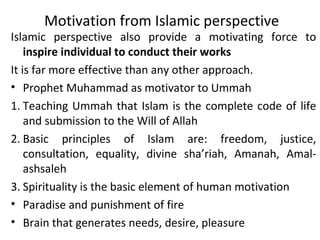
Motivation from Islamic perspective 
Islamic perspective also provide a motivating force to 
inspire individual to conduct their works 
It is far more effective than any other approach. 
• Prophet Muhammad as motivator to Ummah 
1. Teaching Ummah that Islam is the complete code of life 
and submission to the Will of Allah 
2. Basic principles of Islam are: freedom, justice, 
consultation, equality, divine sha’riah, Amanah, Amal-ashsaleh 
3. Spirituality is the basic element of human motivation 
• Paradise and punishment of fire 
• Brain that generates needs, desire, pleasure

The Chapter of Motivation in Public Administration

  • 1.
    Motivation  Meaningand significance of employee’s motivation  Motivation process  Major motivation theories 1. Hierarchy of needs theory 2. Two factor theory 3. Expectancy theory 4. Theory x and theory y 5. Motivation in Islam
  • 2.
    1. Defining motivation • Motivation is widely studied as a psychological concept. The ancient Greek who believed that human being always sought comfort and pleasure and avoided discomfort and pain. Later Psychological approaches perceived motivation as an instinct and studied as a basic psychological concept.
  • 3.
    There are manydefinitions of the concept motivation e.g. : • Motivation is the process that starts with a psychological or psychological deficiency that activates behavior • The inner state of activates, energizes and directs behavior towards goals
  • 4.
    The significance ofmotivation • One of the major effect of motivation is on the output of the organization which concern both quantity and quality . • Motivated and satisfied employee tend to be more productive, creative and committed in their job
  • 5.
    • Organization reliesheavily on the efficiency of staff to make sure it achieves organizational goal. If these employees lack of motivation to complete work, then the organization would face a problem that will lead to disastrous consequences • Organizations have to admit that the employees are the greatest asset no matter how efficient the technology and equipment may be, it is no match for the effectiveness and efficiency of employees.
  • 6.
    Motivation process Scholarsview motivation process in a cyclical pattern that consisted of three interacting and interdependent element: 1.Need 2.Deficiency 3.Action
  • 7.
    Needs NEEDS SatisfactionDeficiency D GOAL DRIVE Action • The motivation cycle (process)
  • 8.
    1. Needs: Theprocess begins by the eminence of deficiency that leads to the rise of needs. It is the state of lacking something when a person feels a psychological imbalance, needs develop. 2. Drives: are those actions that the person forms in order to relieve that state of imbalance created by the need. It is the energy that pushes the persons towards a goal 3. Goal: Is the fulfillment of the need that restores the imbalance or deficiency. Such fulfillment alleviates needs and reduces drive.
  • 9.
    Major motivation Theories Motivation has been studied for many years. As a result a wide variety of motivational theory have been, some of which are: 1. Hierarchy of needs theory Abraham Maslow reasoned that human needs are multiple and that individuals work to satisfy those needs in a specific sequence. He also noted that noneconomic needs are important to people. Maslow asserts that movement from two categories through the upper three takes place over the life times. Some people never satisfy the higher order of needs.
  • 10.
    Maslow proposed aNeed Hierarchy in 1943 in his article a theory of human motivation. There are 5 set of basic needs arranged in a hierarchy. 1. Self actualization need: the need for self fulfillment 2. Self and group esteem need : need for self respect, self esteem and the esteem of others 3. Love and belongingness: need related to affection, relation with others and status within group 4. Needs for safety: need for stable environment relatively free from threat 5. Physiological needs: need for food, sleeps and rest etc.
  • 11.
    Self actualization Selfand group esteem Love and belongingness Needs for safety Physiological needs
  • 12.
    Maslow is ofthe opinion that people tend to satisfy their needs systematically, starting from basic physiological needs then moving up to the hierarchy until the particular group is satisfied and a person’s behavior will be dominated by them. • It applies that the hungry person is not going to be motivated by the consideration of safety and affection until his hunger is satisfied. • But, there is an exception in respect to the self actualization needs in which satisfaction of this needs gives rise to further need for realizing one’s potential
  • 13.
    • But, thisconcept is inconclusive. It is also claim that the systematic movement from one hierarchy to another is not consistent form of behavior of many person • However it does provide a useful framework in discussing various level of needs people may experience at work and the way in which their motivation will be met by manager.
  • 14.
    2. Two-factor theory • Frederick Herzberg’s two-factors or motivator-hygiene theory was developed independently of the work of Maslow but somehow it supports Maslow hierarchy of needs. Herzberg focused on two factors of job satisfaction and dissatisfaction. • It was empirical study of internal worker motivation put forth by Frederick Herzberg in 1959.
  • 15.
    There are fivefactors called the determiners of job satisfaction: 1. Achievement 2. Recognition 3. Work itself 4. Responsibility 5. Advancement
  • 16.
    Another five factorsassociated with NO job satisfaction: • company policy and administration • supervision • salary • interpersonal relationship • working condition.
  • 17.
    • According toHerzberg, the environmental context such as working condition, interpersonal relationship and salary served as preventive ( for dissatisfaction) they were termed as hygiene factors. • The job content factors such as achievement, advancement and responsibility were termed as motivators because they are things that motivate people to superior performance.
  • 18.
    The differences betweentwo factors • The motivators and the hygiene factors are that the motivators bring positive satisfaction and the hygiene factors are to prevent dissatisfaction. • If the motivators are absent from the job, the employee will experience dissatisfaction. Even if the hygiene factors are available, they themselves could not bring job satisfaction. Hygiene factors only prevent dissatisfaction and not able to promote job satisfaction by themselves.
  • 19.
    The contribution ofthe motivation-Hygiene theory is that it helps managers to identify factors inducing positive satisfactions and those causing dissatisfaction. It developed job enrichment (the design of work that contain maximum number of motivators. It put attention particularly on the motivation of professional group of employee. The motivation-hygiene theory assumes that the highly motivated employee is not the one who has good salary or good working condition but it must be combined with achievement, recognition, and other motivators associated with the work they perform The weakness of the motivation-hygiene theory is that it has been less received by the social scientist concerning their applicability to non-professional groups.
  • 20.
    3. Expectancy theory • The expectancy theory developed from the work of V.H. Vroom and E.E lawyer in the United States in 1960. The basic assumption of this theory is that an. individual behavior is as the result of how he sees the world around him/her. • The theory relates to how person perceived the relationship between three things 1. efforts 2. performance 3. Rewards • The strength of the attraction of particular outcomes (reward) is called Valence. The degree of belief that particular act will produce outcomes is called expectancy.
  • 21.
    Valence and expectancydepend on individual own perception. For example the prospect of promotion can be seen by newly appointed employee as an attractive prospect (valence). But his expectancy of gaining promotion would be low if the promotion depends on the duration of service. In such situation performance does not lead to reward, so effort in that direction is not seen as beneficial. The advantage of the expectancy theory is that, it takes a comprehensive view of the motivational process.
  • 22.
    indicates that individualwill act when they have reasonable expectancy that their behavior will lead to the desired result or outcomes. It stresses the importance of individual perception of reality in the motivational process. It implies that job satisfaction follows effective job performance rather than the other way around. It has led to development in work re-design, where emphasis has been put intrinsic job factors such as variety, autonomy, task identity and feedback.
  • 23.
    MC Gregor –theoryX and theory Y • Douglas McGregor, an American social psychologist, proposed his famous theory X and Y in his book the human side of Enterprise. Theory X and theory Y are still referred to commonly in the field of motivation
  • 24.
    • Whilst recentstudies have questioned the rigidity of the model, McGregor’s theory X and theory Y remains a valid principle from which to develop positive motivational style and techniques. McGregor X and Y theory remain central to organizational development and to improve organizational culture. • McGregor maintained that there are two fundamental approaches to manage people. Many manager tend towards theory x and generally get poor result. Enlightened manager use theory y, which produces better performance and result, and allows people to grow and develop.
  • 25.
    Theory X (authoritarianstyle) • Average person dislike work and will avoid it if she /he can • Therefore most people must be forced with the threat of punishment to work towards organizational objectives • The average person prefers to be directed to avoid responsibility, is relatively unambitious and wants security above all else.
  • 26.
    Theory Y (participativestyle) • Effort in work is as natural as work and play • People will apply self-control and self-direction in the pursuit of organizational objectives, without external control or the threat of punishment • Commitment to objective is a functions of rewards and associated with their achievement • People usually accept and often seek responsibility The theory X and theory Y have made their impact more in managerial world the weakness of this theory is that it only seems as either /or style where as in real world, it can be a combination of both
  • 27.
    Motivation can beseen as amalgams of all the factors in one’s working environment that foster either negatively or positively productive efforts. While there has been consensus about the need for motivated employees, the same cannot be said about how to induce higher motivation among employee.
  • 28.
    Different theories andmodel of motivation shows different ways of how to induce higher performance among employee but all of them pointed that individual behavior/ performance arises from some desired goal or end.
  • 29.
    Motivation from Islamicperspective Islamic perspective also provide a motivating force to inspire individual to conduct their works It is far more effective than any other approach. • Prophet Muhammad as motivator to Ummah 1. Teaching Ummah that Islam is the complete code of life and submission to the Will of Allah 2. Basic principles of Islam are: freedom, justice, consultation, equality, divine sha’riah, Amanah, Amal-ashsaleh 3. Spirituality is the basic element of human motivation • Paradise and punishment of fire • Brain that generates needs, desire, pleasure