Motivation
Iriobe ofunre, C.
Redeemer’s University, Ede
iriobeo@run.edu.ng
What is Motivation?
Motivation is something that
moves the person to action
and continues him in the
course of action already
initiated.
Motivation is a psychological feature that induces an individual
to act towards a desired goal
Key Elements
1. Intensity: how hard a person tries
2. Direction: toward beneficial/avoidance goal
3. Persistence: how long a person tries
It is the processes that
account for an individual’s
intensity, direction, and
persistence of effort towards
attaining a goal.
Why are we studying
Motivation?
Motivation is what keeps managers and staff working
towards achieving organisational goal and objective.
It is a reward that elicit the cooperation of members of
an organisation towards a better performance
Why do People leave
Organizations?
Demotivation
Extrinsic
Motivation
Driven by
external reward
i. Salary.
ii. Bonuses/Perks.
iii. Organized activities.
iv. Promotion/Grades.
v. Punishment/Layoffs
Intrinsic Motivation
Driven by internal
rewardi. Learning and Growth opportunity.
ii. Social contact and status.
iii. Curiosity
iv. Respect and Honour.
Types of Motivation
Content Theories of
Motivation:i. Maslow’s Hierarchy of Needs (1943,
1954)
ii. Hertzberg’s Motivator-Hygiene Theory
(1968)
iii. Alderfer’s ERG Theory (1972)
iv. Mc Gregor’s Theory X & Theory Y
(1960)
Process Theories of
Motivation.i. Expectancy Theory, Vroom (1964)
ii. Equity Theory , Adam (1963)
iii. Goal Setting Theory, Edwin A Locke
(1968)
iv. Reinforcement Theory, Skinner(1953)
Theories of
Motivation
Abraham Maslow (1908-1970)
Content Theories:
The content theories find the
answer to what motivates an
individual and is concerned with
individual needs and wants.
Process Theories:
The process theories deal with
“How” the motivation occurs, i.e.
the
process of motivation
Content Theories of
Motivation:
i. Maslow’s Hierarchy of Needs (1943,
1954)
ii. Hertzberg’s Motivator-Hygiene Theory
(1968)
iii. Alderfer’s ERG Theory (1972)
iv. Mc Gregor’s Theory X & Theory Y
• It was proposed by Abraham Maslow in 1943
• Human behavior is goal-directed and motivation
elicits this behaviour.
• In Maslow’s Theory, there are four types of need
that must be satisfied to make an individual
contented.
Maslow – Hierarchy Of Needs
• The needs that their
absence cause tension
are referred to “deficiency
needs”
• We are driven to satisfy
the lower needs but are
drawn to meet the higher
needs.
• Once a need is satisfied
it ceases to be a source
of motivation
Social needs are those related to
interaction with others and may
include: Friendship, Belonging to a
group, Giving and receiving love
External esteem needs are those
such as social status and recognition.
Some esteem needs are: Self-
respect, Achievement, Attention,
Recognition, Reputation
Safety Needs save from the threat of
physical and emotional harm. Such
needs might be fulfilled by: Living in
a safe area, Medical Facilities, Job
security, Law and Order
Physiological Needs are those
required to sustain life, such as: Air,
Water, Food, Sleep
Self-actualization is the summit of Maslow's
hierarchy of needs. It is the quest of
reaching one's full potential as a person.
Self-actualized people tend to have needs
such as: Peace, Truth & Justice,
Knowledge, Meaning of life'
Limitations of Maslow’s
Theory
• The hierarchical arrangement is not always obtainable
in reality.
• No provision for selflessness
• The need priority model may not apply at all times in all
places.
• The Herzberg’s Motivation-Hygiene Theory is given by
Fredrick Herzberg and his associates
• There are two job conditions independent of each other
that affect the behavior differently. (Hygiene factor and
Motivational factors)
• According to Hertzberg, the factors leading to job
satisfaction are “separate and distinct from those that lead
to job dissatisfaction
Herzberg's Motivation-Hygiene Theory
These are a set of job conditions that do not increase motivation however, if
these conditions are taken away, their absence leads to decrease motivation.
Examples include company policy and administration, technical supervision,
job security, working conditions, interpersonal relationship with peers,
subordinates and supervisors, salary, job security, personal life, etc
Hygiene factors
These are factors that motivate employees towards higher performance,
however, their absence does not lead to dissatisfaction. They are known as
satisfiers
Examples include Achievement, Recognition, Advancement, Work-itself,
Possibility of growth and Responsibility
Motivation factors
• It assumes that happy employees are more productive.
Satisfied workers may not actually more productive
than dissatisfied workers.
• It did not consider individual differences in responding to
the two-factors (hygiene and motivating factors)
• What motivates one individual might be a de-motivator
for another individual.
• Not applicable for blue collar workers.
Limitations of Herzbergs
Theory
Maslow’s
vs
Herzberg's
Theory
• It was proposed by Clayton Paul Alderfer
• It is extension of Maslow’s Needs Hierarchy
• Maslow’s five needs are categorized into three
categories, Viz. Existence Needs, Relatedness
Needs, and Growth Needs.
Alderfer’s ERG Theory
Existence Needs: The existence needs comprises of all those
needs that relate to the physiological and safety aspects of
human beings and are a prerequisite for the survival.
Relatedness Needs: The relatedness needs refer to the social
needs, that an individual seeks to establish relationships
with those for whom he cares.
Growth Needs: The growth needs cover Maslow’s self-
actualization needs as well as a part of esteem needs
which are internal to the individual, such as a feeling
of being unique, personnel growth, etc.
• It was proposed by Douglas McGregor
• It explains two contrasting theories about how
managers’ beliefs about what motivates people
affects their management style.
• Theory X & Y refer to two styles of management
– authoritarian (Theory) and participative (Theory
Y).
Mc Gregor’s Theory X & Theory Y
Theory X
Managers tend to assume that people
are unmotivated and dislike work hence,
they need to be prompted through
reward or punishment to make they
complete their assignment.
Theory Y
Managers tend to assume that people are
naturally motivated and ready to work
hence, they use a decentralised,
participative management style. It
promotes trust-based and collaborative
relationship among teams members.
Process Theories of
Motivation.
i. Expectancy Theory, Vroom (1964)
ii. Equity Theory , Adam (1963)
iii. Goal Setting Theory, Edwin A Locke
(1968)
iv. Reinforcement Theory, Skinner(1953)
• It was proposed by Victor. H. Vroom
• An individual selects a certain behavior over the
other behaviors with an expectation of getting a
desired result.
• It has its roots in the cognitive concept.
(individual processes the different elements of
motivation)
Expectancy Theory
The algebraic representation of Vroom’s Expectancy theory
is:
• Motivation (force) = ∑ Expectancy x Instrumentality x
Valence
This theory is built around the concept of valence,
instrumentality, and Expectancy and, therefore, is often called
as VIE theory
• It was proposed by John Stacey Adams
• People expect a balance relationship between their
performance and their rewards
• There are three types of exchange relationships that
arise when an individual input/outcomes are
compared with that of the other persons. (Overpaid
inequity, underpaid and equity)
Equity Theory
Overpaid Inequity:
When an individual’s inputs are less compared to the outcomes
Underpaid Inequity:
When an individual’s inputs are more compared to the outcomes
Equity:
An individual’s inputs equals the outcomes
• It was proposed by Edwin A. Locke
• Goal setting is linked to performance
• A clear, specific and difficult goals are greater
motivating factors than easy, general and vague
goals.
Goal Setting Theory
When employees participate in setting goal, it
increases its acceptability and their involvement.
Self-efficiency
Faith and confidence in
ones self that he/she has the
capacity to perform a task
Outcomes of Goal settings
Goal commitment
An individual is assumed to be
committed to a goal and will not
abandon it.
• It was proposed by B.F. Skinner.
• Peoples’ behaviour is largely determined by its
consequence
• Individual’s behaviour is shaped by controlling the
consequences of the behaviour
Reinforcement Theory
The basic notion underlying reinforcement theory is
that an event is said to be reinforcing if the event
following some behavior makes the behavior more
likely to occur again in the future
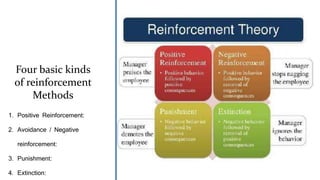
Four basic kinds
of reinforcement
Methods
1. Positive Reinforcement:
2. Avoidance / Negative
reinforcement:
3. Punishment:
4. Extinction:
Thank You

Motivation

  • 1.
    Motivation Iriobe ofunre, C. Redeemer’sUniversity, Ede iriobeo@run.edu.ng
  • 2.
    What is Motivation? Motivationis something that moves the person to action and continues him in the course of action already initiated. Motivation is a psychological feature that induces an individual to act towards a desired goal
  • 3.
    Key Elements 1. Intensity:how hard a person tries 2. Direction: toward beneficial/avoidance goal 3. Persistence: how long a person tries It is the processes that account for an individual’s intensity, direction, and persistence of effort towards attaining a goal.
  • 4.
    Why are westudying Motivation? Motivation is what keeps managers and staff working towards achieving organisational goal and objective. It is a reward that elicit the cooperation of members of an organisation towards a better performance
  • 5.
    Why do Peopleleave Organizations? Demotivation
  • 6.
    Extrinsic Motivation Driven by external reward i.Salary. ii. Bonuses/Perks. iii. Organized activities. iv. Promotion/Grades. v. Punishment/Layoffs Intrinsic Motivation Driven by internal rewardi. Learning and Growth opportunity. ii. Social contact and status. iii. Curiosity iv. Respect and Honour. Types of Motivation
  • 7.
    Content Theories of Motivation:i.Maslow’s Hierarchy of Needs (1943, 1954) ii. Hertzberg’s Motivator-Hygiene Theory (1968) iii. Alderfer’s ERG Theory (1972) iv. Mc Gregor’s Theory X & Theory Y (1960) Process Theories of Motivation.i. Expectancy Theory, Vroom (1964) ii. Equity Theory , Adam (1963) iii. Goal Setting Theory, Edwin A Locke (1968) iv. Reinforcement Theory, Skinner(1953) Theories of Motivation
  • 8.
    Abraham Maslow (1908-1970) ContentTheories: The content theories find the answer to what motivates an individual and is concerned with individual needs and wants. Process Theories: The process theories deal with “How” the motivation occurs, i.e. the process of motivation
  • 9.
    Content Theories of Motivation: i.Maslow’s Hierarchy of Needs (1943, 1954) ii. Hertzberg’s Motivator-Hygiene Theory (1968) iii. Alderfer’s ERG Theory (1972) iv. Mc Gregor’s Theory X & Theory Y
  • 10.
    • It wasproposed by Abraham Maslow in 1943 • Human behavior is goal-directed and motivation elicits this behaviour. • In Maslow’s Theory, there are four types of need that must be satisfied to make an individual contented. Maslow – Hierarchy Of Needs
  • 11.
    • The needsthat their absence cause tension are referred to “deficiency needs” • We are driven to satisfy the lower needs but are drawn to meet the higher needs. • Once a need is satisfied it ceases to be a source of motivation
  • 12.
    Social needs arethose related to interaction with others and may include: Friendship, Belonging to a group, Giving and receiving love External esteem needs are those such as social status and recognition. Some esteem needs are: Self- respect, Achievement, Attention, Recognition, Reputation Safety Needs save from the threat of physical and emotional harm. Such needs might be fulfilled by: Living in a safe area, Medical Facilities, Job security, Law and Order Physiological Needs are those required to sustain life, such as: Air, Water, Food, Sleep Self-actualization is the summit of Maslow's hierarchy of needs. It is the quest of reaching one's full potential as a person. Self-actualized people tend to have needs such as: Peace, Truth & Justice, Knowledge, Meaning of life'
  • 13.
    Limitations of Maslow’s Theory •The hierarchical arrangement is not always obtainable in reality. • No provision for selflessness • The need priority model may not apply at all times in all places.
  • 14.
    • The Herzberg’sMotivation-Hygiene Theory is given by Fredrick Herzberg and his associates • There are two job conditions independent of each other that affect the behavior differently. (Hygiene factor and Motivational factors) • According to Hertzberg, the factors leading to job satisfaction are “separate and distinct from those that lead to job dissatisfaction Herzberg's Motivation-Hygiene Theory
  • 15.
    These are aset of job conditions that do not increase motivation however, if these conditions are taken away, their absence leads to decrease motivation. Examples include company policy and administration, technical supervision, job security, working conditions, interpersonal relationship with peers, subordinates and supervisors, salary, job security, personal life, etc Hygiene factors
  • 16.
    These are factorsthat motivate employees towards higher performance, however, their absence does not lead to dissatisfaction. They are known as satisfiers Examples include Achievement, Recognition, Advancement, Work-itself, Possibility of growth and Responsibility Motivation factors
  • 17.
    • It assumesthat happy employees are more productive. Satisfied workers may not actually more productive than dissatisfied workers. • It did not consider individual differences in responding to the two-factors (hygiene and motivating factors) • What motivates one individual might be a de-motivator for another individual. • Not applicable for blue collar workers. Limitations of Herzbergs Theory
  • 18.
  • 19.
    • It wasproposed by Clayton Paul Alderfer • It is extension of Maslow’s Needs Hierarchy • Maslow’s five needs are categorized into three categories, Viz. Existence Needs, Relatedness Needs, and Growth Needs. Alderfer’s ERG Theory
  • 20.
    Existence Needs: Theexistence needs comprises of all those needs that relate to the physiological and safety aspects of human beings and are a prerequisite for the survival. Relatedness Needs: The relatedness needs refer to the social needs, that an individual seeks to establish relationships with those for whom he cares. Growth Needs: The growth needs cover Maslow’s self- actualization needs as well as a part of esteem needs which are internal to the individual, such as a feeling of being unique, personnel growth, etc.
  • 21.
    • It wasproposed by Douglas McGregor • It explains two contrasting theories about how managers’ beliefs about what motivates people affects their management style. • Theory X & Y refer to two styles of management – authoritarian (Theory) and participative (Theory Y). Mc Gregor’s Theory X & Theory Y
  • 22.
    Theory X Managers tendto assume that people are unmotivated and dislike work hence, they need to be prompted through reward or punishment to make they complete their assignment.
  • 23.
    Theory Y Managers tendto assume that people are naturally motivated and ready to work hence, they use a decentralised, participative management style. It promotes trust-based and collaborative relationship among teams members.
  • 24.
    Process Theories of Motivation. i.Expectancy Theory, Vroom (1964) ii. Equity Theory , Adam (1963) iii. Goal Setting Theory, Edwin A Locke (1968) iv. Reinforcement Theory, Skinner(1953)
  • 25.
    • It wasproposed by Victor. H. Vroom • An individual selects a certain behavior over the other behaviors with an expectation of getting a desired result. • It has its roots in the cognitive concept. (individual processes the different elements of motivation) Expectancy Theory
  • 26.
    The algebraic representationof Vroom’s Expectancy theory is: • Motivation (force) = ∑ Expectancy x Instrumentality x Valence This theory is built around the concept of valence, instrumentality, and Expectancy and, therefore, is often called as VIE theory
  • 27.
    • It wasproposed by John Stacey Adams • People expect a balance relationship between their performance and their rewards • There are three types of exchange relationships that arise when an individual input/outcomes are compared with that of the other persons. (Overpaid inequity, underpaid and equity) Equity Theory
  • 28.
    Overpaid Inequity: When anindividual’s inputs are less compared to the outcomes Underpaid Inequity: When an individual’s inputs are more compared to the outcomes Equity: An individual’s inputs equals the outcomes
  • 29.
    • It wasproposed by Edwin A. Locke • Goal setting is linked to performance • A clear, specific and difficult goals are greater motivating factors than easy, general and vague goals. Goal Setting Theory
  • 30.
    When employees participatein setting goal, it increases its acceptability and their involvement. Self-efficiency Faith and confidence in ones self that he/she has the capacity to perform a task Outcomes of Goal settings Goal commitment An individual is assumed to be committed to a goal and will not abandon it.
  • 31.
    • It wasproposed by B.F. Skinner. • Peoples’ behaviour is largely determined by its consequence • Individual’s behaviour is shaped by controlling the consequences of the behaviour Reinforcement Theory
  • 32.
    The basic notionunderlying reinforcement theory is that an event is said to be reinforcing if the event following some behavior makes the behavior more likely to occur again in the future
  • 33.
    Four basic kinds ofreinforcement Methods 1. Positive Reinforcement: 2. Avoidance / Negative reinforcement: 3. Punishment: 4. Extinction:
  • 34.