WHAT ARE YOUR GOALS IN LIFE?
BACKGROUND
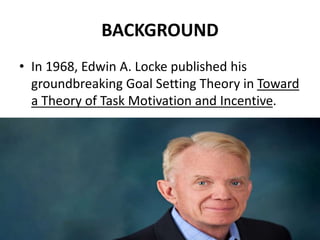
• In 1968, Edwin A. Locke published his
groundbreaking Goal Setting Theory in Toward
a Theory of Task Motivation and Incentive.
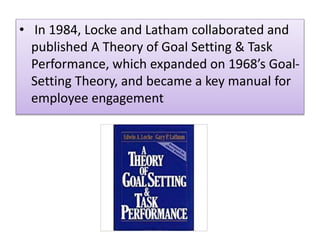
• In 1984, Locke and Latham collaborated and
published A Theory of Goal Setting & Task
Performance, which expanded on 1968’s Goal-
Setting Theory, and became a key manual for
employee engagement
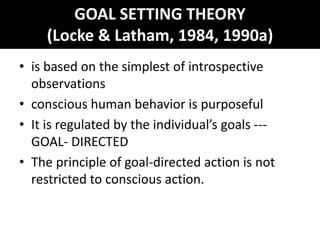
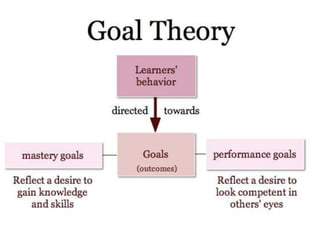
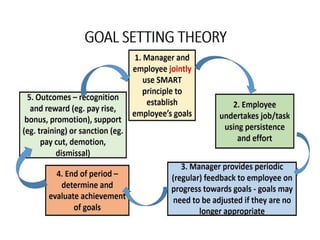
GOAL SETTING THEORY
(Locke & Latham, 1984, 1990a)
• is based on the simplest of introspective
observations
• conscious human behavior is purposeful
• It is regulated by the individual’s goals ---
GOAL- DIRECTED
• The principle of goal-directed action is not
restricted to conscious action.
Binswanger (1990) has shown that goal-directed
action is defined by three attributes:
(1) self-generation: the source of energy is integral
to the organism;
(2) value-significance: the actions not only make
possible but are necessary for an organism’s
survival; and
(3) goal-causation: the resulting action is caused by
a goal. In the case of vegetative action, goal-
directed behavior in the present is caused by
past instances of successful goal-directed action.
• They have the power to conceptualize goals
and set long range purposes (Locke, 1969).
• Purposeful action in human beings is
volitional (Binswanger, 1991).
• We must choose to discover what is beneficial
to their welfare, they must set goals to
achieve it, they must choose the means for
attaining these goals, and then they must
choose to act on the basis of these judgments.
GOAL- SETTING
PRINCIPLES
1. Clarity
• A clear goal can be measured; no room for
misunderstandings;
• Explicit goals with regard to which result is
desired and how it will be measured;
• Comparable to the SMART principles that help to
understand the task, measuring the results and
achieving success.
2. Challenge
• Setting challenging goals demands an accurate balance to
guarantee the right level of challenge. Goals that are either
too easy or too difficult negatively influence the motivation
and decrease performance. The highest level of motivation
is reached when goals are somewhere between easy and
difficult.
• Goals that are too easy or too difficult negatively
impact motivation and may reduce the
performance;The highest level of motivation is
achieved upon the right balance between easy and
difficult.
• When you set next goals, make sure these are challenging yet realistic,
difficult yet achievable. Ask yourself the following questions when setting
goals. Are they challenging enough? Are they significant enough to be
motivating? Are they realistic and achievable?
3. Effort
• Fully understanding and coordinating the set
goals;
• Motivation due to own input when setting goals;
• People have the tendency to work harder for a
goal when they were involved in setting it,
particularly in a team;
• Staying motivated as long as the goal is actually
achievable and is in accordance with the
aspirations of all those involved.
4. Feedback
• In addition to selecting the right goal, you must
also listen to feedback to determine whether
you’re doing it right. This allows you to adjust
the goal and your approach to achieve it.
• Feedback doesn’t necessarily have to come from
other people. Feedback can also come from
within.
• Listening to feedback to check whether you’re
headed in the right direction;
• If necessary, adjusting the goal and approach to
achieve the goal;
5. Task complexity
• Takes into account the complexity of the goals,
given the fact that complexity can influence
morale, productivity and motivation;
• Complex goals can be overwhelming to people;
• Make sure there’s enough time, allowing
everyone enough time to work towards the goal
and improve the performances;
• If necessary, adjusting the complexity and level of
difficulty of the goal.
SUMMARY: Locke and Latham’s five principles of
effective goal setting
(1990)
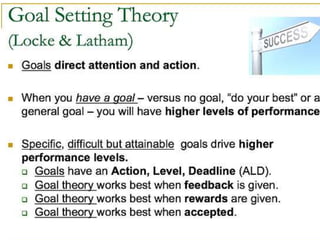
1. Clarity. A goal must be specific and clear.
2. Challenge. An easy or tedious goal is demotivating.
But keep a realistic balance: don’t expect anyone on
your team to spin straw into gold.
3. Commitment. Your employees have to understand
and buy in to the goal from the outset.
4. Feedback. Provide regular feedback throughout the
whole process. This helps to keep the goal on track.
5. Task complexity. Think about realistic timescales, and
break down the process into sub-goals with regular
reviews.
Goal Attributes
1. CONTENT – OUTCOME OF THE TASK
– SPECIFICITY
– DIFFICULTY
2. INTENSITY – RESOURCE REQUIRED TO
ACHIEVE TASK
• Intensity is a broad term referring to the
scope, clarity, mental effort, etc., involved in a
mental process (Rand, 1990).
In A Theory of Goal Setting, Locke and Latham broke
down goals into two main characteristics: CONTENT
AND INTENSITY
• The theory highlighted the importance of
considering the whole journey of completing a
goal and not just the outcome.
• Involves employees in directing the route
taken to complete a task was shown to
increase their motivation to reach the target.
Commitment
• The major aspect of goal intensity that has been
studied in depth is commitment.
• Commitment refers to the degree to which the
individual is attached to the goal, considers it
significant or important, is determined to reach
it, and keeps it in the face of setbacks and
obstacles. It must be stressed, however, that the
feeling of commitment does not automatically
lead one to act in accordance with it.
Goal Choice
• Choice is also affected by the person’s belief
that a given goal is appropriate or desirable.
This can occur when a person is provided with
normative information (Meyer & Gellatly,
1988),role models (Rakestraw & Weiss, 1981),
competition (Mueller, 1983), or pressure
(Andrews & Fart-is, 1972). However, the most
direct method of influencing choice is simply
for an authority figure to assign the goals.
Self-Efficacy
• Self-efficacy, a key concept in Bandura’s (1986)
social-cognitive theory, refers to task-specific
self-confidence.
Goal Mechanism In
Everyday Life
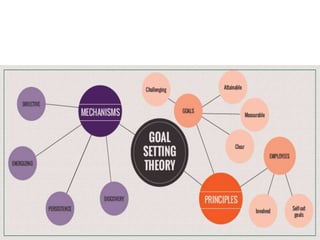
• First, a goal directs activity toward actions which are
relevant to it at the expense of actions which are not
goal-relevant.
• Second, a specific goal regulates effort or energy
expenditure (i.e., intensity) in that people adjust their
effort to the difIiculty level of the task or goal.
• Third, a goal affects persistence (i.e., duration) in
situations where there are no time limits imposed on
people. When time limits are imposed, difficult goals
induce people to work faster or harder. Without time
limits, such goals induce people to work longer
(LaPorte & Nath, 1976).
MAJOR KEYPOINTS:
1. Locke’s primary revelation was around the
power of setting specific and measurable goals,
rather than keeping outcomes general.
2. Locke also demonstrated that the best
way to feel motivated is to push yourself
to do something that you’re not 100%
certain you can achieve.
3. Positive feedback and a sense of personal
achievement are two important aspect of goal-
setting.
In the core of Educational
Administration
APPLICATION TO THE EDUCATIONAL
ADMINISTRATION:
The beauty of Locke’s work is that it doesn’t just
apply to Goal-Setting, but can also be thought of
in terms of other employee engagement drivers.
• The concept of Intensity, and the importance
of consulting employees on the approach to a
goal, highlights a crucial need
for Autonomy in the workplace.
• In order for employees to feel intrinsically
motivated to complete a task, Locke showed
that they need to be involved in its
conception, and afforded a degree of
freedom in how they tackle it.
• Similarly, the value Locke places on setting hard-to-
reach goals can be considered as a way to promote a
sense of Accomplishment.
• By pushing employees outside of their comfort zone,
they are more likely to achieve that overwhelming
sense of pride you get when you outperform your
own expectations.
One final word from Edwin Locke
himself:
• “It is vital to first make sure that employees
have the task-based knowledge and essential
skills to succeed (think Maslow’s basic needs).”
• As soon as they are equipped to start
tackling their targets, managers can maximize
their employees’ potential by following the
key principles of goal-setting.
SUMMARY OF THE THEORY
(1) When given specific, challenging goals,
people spontaneously formulate plans and task
strategies to help reach the goals (Latham &
Baldes, 1975;Latham & Saari 1982).
(2) When a difficult, quantity goal is assigned,
people may lower work quality as an implicit
strategy to attain it (Bavelas & Lee, 1978).
To ensure performance quality, of course, goals
must be set for quality.
(3) On complex tasks:
(a) Goals are more strongly related to
performance when subjects utilize suitable task
strategies than when they do not.
(b) Strategies tend to be more strongly related to
performance than are specific goals (Chesney &
Locke, 1991).
(c) There may be a time lag before the goals
affect performance; this lag may occur because
individuals are learning which task strategies are
effective (Smith et al., 1990; Weldon et al., 1989).
• (4) Trying for specific, challenging goals
may actually hurt performance in certain
circumstances.
IN CONCLUSION:
• The Locke’s Goal-Setting Theory emphasizes
the important relationship between goals and
performance; a goal setting theory of
performance management. It supports
predictions that seem to result in the most
effective performances, when the goals are
specific and challenging, when they are used
to assess the performances and are linked to
feedback.
• Finally, look at the results and ensure commitment
and acceptance. The motivation impact of goals can
be influenced by moderators, such as capability and
self-reliance.
• Additionally, deadlines improve the effectiveness of
goals. Focus on a learning goal leads to higher
performances than an objective and group goal,
where mindset is just as important as individual goal
setting.
References
• Akhtar, M. (2008). What is self-efficacy? Bandura’s 4 sources of efficacy beliefs. Positive Psychology UK.
• Atkinson, J. W. (1958). Motives in fantasy, action, and society: A method of assessment and study.
• Bandura, A., & Jourden, F. J. (1990). Self- regulatory mechanisms governing the impact of social comparison on complex
decision making. Unpublished manuscript, Department of Psychology, Stanford University.
• Bandura, A., & Wood, R. E. (1989). Effect of perceived controllability and performance standards on self-regulation of
complex decision-making. Journal of Personality and Social Psychology, 56, 805-814.
• Beal, M. A. (2017). How Does Goal-Setting Impact Intrinsic Motivation And Does It Help Lead To Enhanced Learning At
The Kindergarten Level?.
• Latham, G. P., Ganegoda, D. B., & Locke, E. A. (2011). Goal‐Setting: A State Theory, but Related to Traits. The
Wiley‐Blackwell Handbook of Individual Differences, 577-587.
• Latham, G. P., & Pinder, C. C. (2005). Work motivation theory and research at the dawn of the twenty-first century. Annu.
Rev. Psychol., 56, 485-516.
• Lee, C., & Earley, P. C. (1992). Comparative peer evaluations of 
• Locke, E. A., & Latham, G. P. (2019). The development of goal-setting theory: A half-century retrospective. Motivation
Science.
• Locke, E. A., & Latham, G. P. (2006). New directions in goal-setting theory. Current directions in psychological science,
15(5), 265-268.
• Locke, E. A., & Latham, G. P. (2002). Building a practically useful theory of goal-setting and task motivation: A 35-year
odyssey. American Psychologist, 57(9), 705.
• Locke, E. A. (1969). What is job satisfaction?. Organizational behavior and human performance, 4(4), 309-336.
Ms. Corpin

Edwin locke goal setting theory

  • 13.
    WHAT ARE YOURGOALS IN LIFE?
  • 21.
    BACKGROUND • In 1968,Edwin A. Locke published his groundbreaking Goal Setting Theory in Toward a Theory of Task Motivation and Incentive.
  • 22.
    • In 1984,Locke and Latham collaborated and published A Theory of Goal Setting & Task Performance, which expanded on 1968’s Goal- Setting Theory, and became a key manual for employee engagement
  • 24.
    GOAL SETTING THEORY (Locke& Latham, 1984, 1990a) • is based on the simplest of introspective observations • conscious human behavior is purposeful • It is regulated by the individual’s goals --- GOAL- DIRECTED • The principle of goal-directed action is not restricted to conscious action.
  • 26.
    Binswanger (1990) hasshown that goal-directed action is defined by three attributes: (1) self-generation: the source of energy is integral to the organism; (2) value-significance: the actions not only make possible but are necessary for an organism’s survival; and (3) goal-causation: the resulting action is caused by a goal. In the case of vegetative action, goal- directed behavior in the present is caused by past instances of successful goal-directed action.
  • 27.
    • They havethe power to conceptualize goals and set long range purposes (Locke, 1969). • Purposeful action in human beings is volitional (Binswanger, 1991). • We must choose to discover what is beneficial to their welfare, they must set goals to achieve it, they must choose the means for attaining these goals, and then they must choose to act on the basis of these judgments.
  • 30.
    GOAL- SETTING PRINCIPLES 1. Clarity •A clear goal can be measured; no room for misunderstandings; • Explicit goals with regard to which result is desired and how it will be measured; • Comparable to the SMART principles that help to understand the task, measuring the results and achieving success.
  • 31.
    2. Challenge • Settingchallenging goals demands an accurate balance to guarantee the right level of challenge. Goals that are either too easy or too difficult negatively influence the motivation and decrease performance. The highest level of motivation is reached when goals are somewhere between easy and difficult. • Goals that are too easy or too difficult negatively impact motivation and may reduce the performance;The highest level of motivation is achieved upon the right balance between easy and difficult. • When you set next goals, make sure these are challenging yet realistic, difficult yet achievable. Ask yourself the following questions when setting goals. Are they challenging enough? Are they significant enough to be motivating? Are they realistic and achievable?
  • 32.
    3. Effort • Fullyunderstanding and coordinating the set goals; • Motivation due to own input when setting goals; • People have the tendency to work harder for a goal when they were involved in setting it, particularly in a team; • Staying motivated as long as the goal is actually achievable and is in accordance with the aspirations of all those involved.
  • 33.
    4. Feedback • Inaddition to selecting the right goal, you must also listen to feedback to determine whether you’re doing it right. This allows you to adjust the goal and your approach to achieve it. • Feedback doesn’t necessarily have to come from other people. Feedback can also come from within. • Listening to feedback to check whether you’re headed in the right direction; • If necessary, adjusting the goal and approach to achieve the goal;
  • 34.
    5. Task complexity •Takes into account the complexity of the goals, given the fact that complexity can influence morale, productivity and motivation; • Complex goals can be overwhelming to people; • Make sure there’s enough time, allowing everyone enough time to work towards the goal and improve the performances; • If necessary, adjusting the complexity and level of difficulty of the goal.
  • 35.
    SUMMARY: Locke andLatham’s five principles of effective goal setting (1990) 1. Clarity. A goal must be specific and clear. 2. Challenge. An easy or tedious goal is demotivating. But keep a realistic balance: don’t expect anyone on your team to spin straw into gold. 3. Commitment. Your employees have to understand and buy in to the goal from the outset. 4. Feedback. Provide regular feedback throughout the whole process. This helps to keep the goal on track. 5. Task complexity. Think about realistic timescales, and break down the process into sub-goals with regular reviews.
  • 36.
    Goal Attributes 1. CONTENT– OUTCOME OF THE TASK – SPECIFICITY – DIFFICULTY 2. INTENSITY – RESOURCE REQUIRED TO ACHIEVE TASK • Intensity is a broad term referring to the scope, clarity, mental effort, etc., involved in a mental process (Rand, 1990).
  • 37.
    In A Theoryof Goal Setting, Locke and Latham broke down goals into two main characteristics: CONTENT AND INTENSITY • The theory highlighted the importance of considering the whole journey of completing a goal and not just the outcome. • Involves employees in directing the route taken to complete a task was shown to increase their motivation to reach the target.
  • 38.
    Commitment • The majoraspect of goal intensity that has been studied in depth is commitment. • Commitment refers to the degree to which the individual is attached to the goal, considers it significant or important, is determined to reach it, and keeps it in the face of setbacks and obstacles. It must be stressed, however, that the feeling of commitment does not automatically lead one to act in accordance with it.
  • 39.
    Goal Choice • Choiceis also affected by the person’s belief that a given goal is appropriate or desirable. This can occur when a person is provided with normative information (Meyer & Gellatly, 1988),role models (Rakestraw & Weiss, 1981), competition (Mueller, 1983), or pressure (Andrews & Fart-is, 1972). However, the most direct method of influencing choice is simply for an authority figure to assign the goals.
  • 40.
    Self-Efficacy • Self-efficacy, akey concept in Bandura’s (1986) social-cognitive theory, refers to task-specific self-confidence.
  • 41.
    Goal Mechanism In EverydayLife • First, a goal directs activity toward actions which are relevant to it at the expense of actions which are not goal-relevant. • Second, a specific goal regulates effort or energy expenditure (i.e., intensity) in that people adjust their effort to the difIiculty level of the task or goal. • Third, a goal affects persistence (i.e., duration) in situations where there are no time limits imposed on people. When time limits are imposed, difficult goals induce people to work faster or harder. Without time limits, such goals induce people to work longer (LaPorte & Nath, 1976).
  • 42.
    MAJOR KEYPOINTS: 1. Locke’sprimary revelation was around the power of setting specific and measurable goals, rather than keeping outcomes general.
  • 43.
    2. Locke alsodemonstrated that the best way to feel motivated is to push yourself to do something that you’re not 100% certain you can achieve.
  • 44.
    3. Positive feedbackand a sense of personal achievement are two important aspect of goal- setting.
  • 45.
    In the coreof Educational Administration
  • 46.
    APPLICATION TO THEEDUCATIONAL ADMINISTRATION: The beauty of Locke’s work is that it doesn’t just apply to Goal-Setting, but can also be thought of in terms of other employee engagement drivers.
  • 48.
    • The conceptof Intensity, and the importance of consulting employees on the approach to a goal, highlights a crucial need for Autonomy in the workplace. • In order for employees to feel intrinsically motivated to complete a task, Locke showed that they need to be involved in its conception, and afforded a degree of freedom in how they tackle it.
  • 49.
    • Similarly, thevalue Locke places on setting hard-to- reach goals can be considered as a way to promote a sense of Accomplishment. • By pushing employees outside of their comfort zone, they are more likely to achieve that overwhelming sense of pride you get when you outperform your own expectations.
  • 50.
    One final wordfrom Edwin Locke himself: • “It is vital to first make sure that employees have the task-based knowledge and essential skills to succeed (think Maslow’s basic needs).” • As soon as they are equipped to start tackling their targets, managers can maximize their employees’ potential by following the key principles of goal-setting.
  • 51.
    SUMMARY OF THETHEORY (1) When given specific, challenging goals, people spontaneously formulate plans and task strategies to help reach the goals (Latham & Baldes, 1975;Latham & Saari 1982). (2) When a difficult, quantity goal is assigned, people may lower work quality as an implicit strategy to attain it (Bavelas & Lee, 1978). To ensure performance quality, of course, goals must be set for quality.
  • 52.
    (3) On complextasks: (a) Goals are more strongly related to performance when subjects utilize suitable task strategies than when they do not. (b) Strategies tend to be more strongly related to performance than are specific goals (Chesney & Locke, 1991). (c) There may be a time lag before the goals affect performance; this lag may occur because individuals are learning which task strategies are effective (Smith et al., 1990; Weldon et al., 1989).
  • 53.
    • (4) Tryingfor specific, challenging goals may actually hurt performance in certain circumstances.
  • 54.
    IN CONCLUSION: • TheLocke’s Goal-Setting Theory emphasizes the important relationship between goals and performance; a goal setting theory of performance management. It supports predictions that seem to result in the most effective performances, when the goals are specific and challenging, when they are used to assess the performances and are linked to feedback.
  • 55.
    • Finally, lookat the results and ensure commitment and acceptance. The motivation impact of goals can be influenced by moderators, such as capability and self-reliance. • Additionally, deadlines improve the effectiveness of goals. Focus on a learning goal leads to higher performances than an objective and group goal, where mindset is just as important as individual goal setting.
  • 59.
    References • Akhtar, M.(2008). What is self-efficacy? Bandura’s 4 sources of efficacy beliefs. Positive Psychology UK. • Atkinson, J. W. (1958). Motives in fantasy, action, and society: A method of assessment and study. • Bandura, A., & Jourden, F. J. (1990). Self- regulatory mechanisms governing the impact of social comparison on complex decision making. Unpublished manuscript, Department of Psychology, Stanford University. • Bandura, A., & Wood, R. E. (1989). Effect of perceived controllability and performance standards on self-regulation of complex decision-making. Journal of Personality and Social Psychology, 56, 805-814. • Beal, M. A. (2017). How Does Goal-Setting Impact Intrinsic Motivation And Does It Help Lead To Enhanced Learning At The Kindergarten Level?. • Latham, G. P., Ganegoda, D. B., & Locke, E. A. (2011). Goal‐Setting: A State Theory, but Related to Traits. The Wiley‐Blackwell Handbook of Individual Differences, 577-587. • Latham, G. P., & Pinder, C. C. (2005). Work motivation theory and research at the dawn of the twenty-first century. Annu. Rev. Psychol., 56, 485-516. • Lee, C., & Earley, P. C. (1992). Comparative peer evaluations of • Locke, E. A., & Latham, G. P. (2019). The development of goal-setting theory: A half-century retrospective. Motivation Science. • Locke, E. A., & Latham, G. P. (2006). New directions in goal-setting theory. Current directions in psychological science, 15(5), 265-268. • Locke, E. A., & Latham, G. P. (2002). Building a practically useful theory of goal-setting and task motivation: A 35-year odyssey. American Psychologist, 57(9), 705. • Locke, E. A. (1969). What is job satisfaction?. Organizational behavior and human performance, 4(4), 309-336.
  • 60.