MOTIVATION
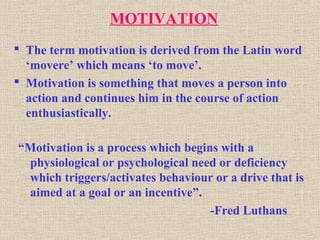
 The term motivation is derived from the Latin word
‘movere’ which means ‘to move’.
 Motivation is something that moves a person into
action and continues him in the course of action
enthusiastically.
“Motivation is a process which begins with a
physiological or psychological need or deficiency
which triggers/activates behaviour or a drive that is
aimed at a goal or an incentive”.
-Fred Luthans
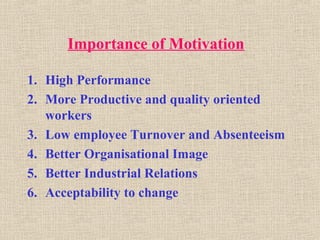
Importance of Motivation
1. High Performance
2. More Productive and quality oriented
workers
3. Low employee Turnover and Absenteeism
4. Better Organisational Image
5. Better Industrial Relations
6. Acceptability to change
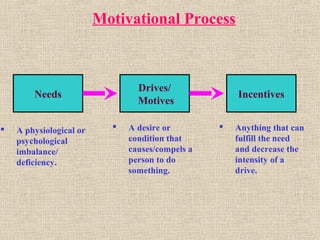
Motivational Process
Needs
 A physiological or
psychological
imbalance/
deficiency.
Drives/
Motives
 A desire or
condition that
causes/compels a
person to do
something.
Incentives
 Anything that can
fulfill the need
and decrease the
intensity of a
drive.
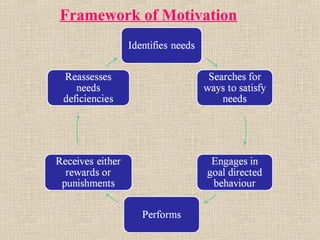
Framework of Motivation
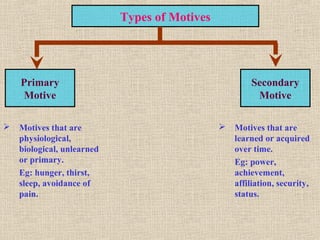
Types of Motives
Primary
Motive
Secondary
Motive
 Motives that are
physiological,
biological, unlearned
or primary.
Eg: hunger, thirst,
sleep, avoidance of
pain.
 Motives that are
learned or acquired
over time.
Eg: power,
achievement,
affiliation, security,
status.
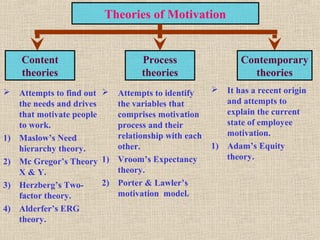
Theories of Motivation
Content
theories
Process
theories
Contemporary
theories
 Attempts to find out
the needs and drives
that motivate people
to work.
1) Maslow’s Need
hierarchy theory.
2) Mc Gregor’s Theory
X & Y.
3) Herzberg’s Two-
factor theory.
4) Alderfer’s ERG
theory.
 Attempts to identify
the variables that
comprises motivation
process and their
relationship with each
other.
1) Vroom’s Expectancy
theory.
2) Porter & Lawler’s
motivation model.
 It has a recent origin
and attempts to
explain the current
state of employee
motivation.
1) Adam’s Equity
theory.
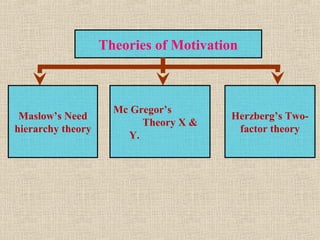
Theories of Motivation
Maslow’s Need
hierarchy theory
Mc Gregor’s
Theory X &
Y.
Herzberg’s Two-
factor theory
Abraham Maslow (1908-1970)
 Maslow developed a need hierarchy theory to explain human
behaviour within an organization.
 The basic aim of this theory was to increase the effectiveness
of human resources which could be achieved by properly
taking care of human needs that motivate people at work.
 According to Maslow, human needs are innumerable and
never ending. When one need is satisfied, another need
emerges in that place.
 Maslow is of the opinion that satisfied needs do not motivate
workers. Only unsatisfied needs induce man to work hard.
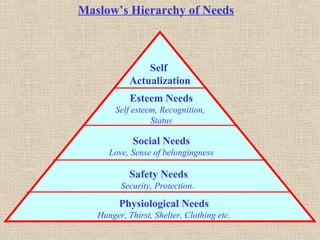
 Maslow says that needs or wants of an individual are satisfied
in an order. Hence he classified needs as lower level needs and
higher level needs and represented it in a hierarchical order.
Maslow’s Hierarchy of Needs
Self
Actualization
Esteem Needs
Self esteem, Recognition,
Status
Social Needs
Love, Sense of belongingness
Safety Needs
Security, Protection.
Physiological Needs
Hunger, Thirst, Shelter, Clothing etc.
 According to this theory, once the needs at a particular level in
the hierarchy are satisfied, they are no longer a motivating
factor. Instead, the needs at the next level in the hierarchy
become the motivators for the individual.
Critical Analysis
 There is no evidence that when one need is satisfied, its
strength decreases.
 The intensity of needs differ with individuals. Some
individuals may have continued need for security even if they
have a permanent job with enormous fringe benefits.
 Every person has to satisfy his needs in some order. But this
order may not follow Maslow’s need hierarchy. Human
behaviour is a compromise of various needs acting
simultaneously.
Herzberg’s Two-factor Theory
 It was developed by psychologist Frederick Herzberg as an
extension of Maslow’s work.
 Herzberg carried out a study to find out the causes for job
satisfaction and job dissatisfaction.
 He interviewed around 200 accountants and engineers
employed by firms in and around Pittsburgh in Pennsylvania.
 Inorder to collect data for his analysis, he used the critical
incident method ie. the respondents were asked to recall the
instances/incidents, when they were highly satisfied with their
work and also those instances when they were highly
dissatisfied with their work.
 Herzberg asked each respondent two basic questions:
1)When did you feel particularly good about your job?
2)When did you feel exceptionally bad about their job?
 Good feelings reported, were associated with job experiences
and job content.
 Bad feelings reported, were associated with surrounding or
peripheral aspects of the job or job context.
 After tabulating these reported positive and negative feelings,
Herzberg came to a conclusion that job satisfiers were
associated with the job content and job dissatisfiers were
related to the job context(aspects that are not directly related
to the job, but had an effect on the work environment).
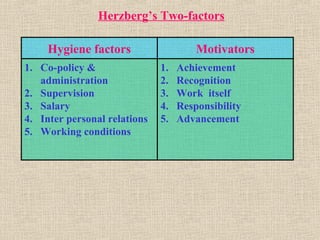
 Herzberg labeled the job satisfiers as motivators or
maintenance factors because they are essential to keep the
employees satisfied and he called the job dissatisfiers as
hygiene factors. The term hygiene refers to factors that are
preventive and in Herzberg’s theory, the hygiene factors are
those that prevent dissatisfaction.
 The motivators and hygiene factors came to be known as
Herzberg’s two-factor theory of motivation.
Hygiene factors Motivators
1. Co-policy &
administration
2. Supervision
3. Salary
4. Inter personal relations
5. Working conditions
1. Achievement
2. Recognition
3. Work itself
4. Responsibility
5. Advancement
Herzberg’s Two-factors
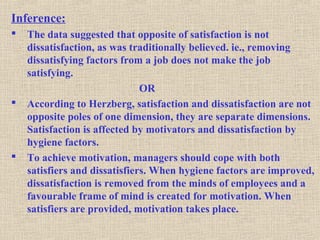
Inference:
 The data suggested that opposite of satisfaction is not
dissatisfaction, as was traditionally believed. ie., removing
dissatisfying factors from a job does not make the job
satisfying.
OR
 According to Herzberg, satisfaction and dissatisfaction are not
opposite poles of one dimension, they are separate dimensions.
Satisfaction is affected by motivators and dissatisfaction by
hygiene factors.
 To achieve motivation, managers should cope with both
satisfiers and dissatisfiers. When hygiene factors are improved,
dissatisfaction is removed from the minds of employees and a
favourable frame of mind is created for motivation. When
satisfiers are provided, motivation takes place.
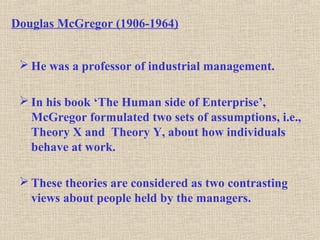
Douglas McGregor (1906-1964)
 He was a professor of industrial management.
 In his book ‘The Human side of Enterprise’,
McGregor formulated two sets of assumptions, i.e.,
Theory X and Theory Y, about how individuals
behave at work.
 These theories are considered as two contrasting
views about people held by the managers.
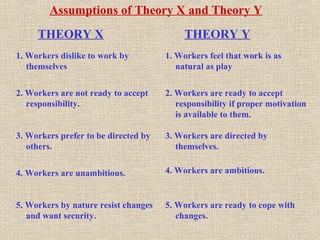
Assumptions of Theory X and Theory Y
THEORY X THEORY Y
1. Workers dislike to work by
themselves
1. Workers feel that work is as
natural as play
2. Workers are not ready to accept
responsibility.
2. Workers are ready to accept
responsibility if proper motivation
is available to them.
3. Workers prefer to be directed by
others.
3. Workers are directed by
themselves.
4. Workers are unambitious. 4. Workers are ambitious.
5. Workers by nature resist changes
and want security.
5. Workers are ready to cope with
changes.
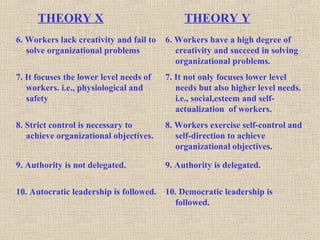
THEORY X THEORY Y
6. Workers lack creativity and fail to
solve organizational problems
6. Workers have a high degree of
creativity and succeed in solving
organizational problems.
7. It focuses the lower level needs of
workers. i.e., physiological and
safety
7. It not only focuses lower level
needs but also higher level needs.
i.e., social,esteem and self-
actualization of workers.
8. Strict control is necessary to
achieve organizational objectives.
8. Workers exercise self-control and
self-direction to achieve
organizational objectives.
9. Authority is not delegated. 9. Authority is delegated.
10. Autocratic leadership is followed. 10. Democratic leadership is
followed.
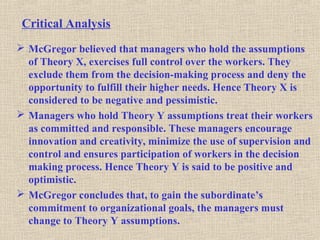
Critical Analysis
 McGregor believed that managers who hold the assumptions
of Theory X, exercises full control over the workers. They
exclude them from the decision-making process and deny the
opportunity to fulfill their higher needs. Hence Theory X is
considered to be negative and pessimistic.
 Managers who hold Theory Y assumptions treat their workers
as committed and responsible. These managers encourage
innovation and creativity, minimize the use of supervision and
control and ensures participation of workers in the decision
making process. Hence Theory Y is said to be positive and
optimistic.
 McGregor concludes that, to gain the subordinate’s
commitment to organizational goals, the managers must
change to Theory Y assumptions.

Motivation glc

  • 1.
    MOTIVATION  The termmotivation is derived from the Latin word ‘movere’ which means ‘to move’.  Motivation is something that moves a person into action and continues him in the course of action enthusiastically. “Motivation is a process which begins with a physiological or psychological need or deficiency which triggers/activates behaviour or a drive that is aimed at a goal or an incentive”. -Fred Luthans
  • 2.
    Importance of Motivation 1.High Performance 2. More Productive and quality oriented workers 3. Low employee Turnover and Absenteeism 4. Better Organisational Image 5. Better Industrial Relations 6. Acceptability to change
  • 3.
    Motivational Process Needs  Aphysiological or psychological imbalance/ deficiency. Drives/ Motives  A desire or condition that causes/compels a person to do something. Incentives  Anything that can fulfill the need and decrease the intensity of a drive.
  • 4.
  • 5.
    Types of Motives Primary Motive Secondary Motive Motives that are physiological, biological, unlearned or primary. Eg: hunger, thirst, sleep, avoidance of pain.  Motives that are learned or acquired over time. Eg: power, achievement, affiliation, security, status.
  • 6.
    Theories of Motivation Content theories Process theories Contemporary theories Attempts to find out the needs and drives that motivate people to work. 1) Maslow’s Need hierarchy theory. 2) Mc Gregor’s Theory X & Y. 3) Herzberg’s Two- factor theory. 4) Alderfer’s ERG theory.  Attempts to identify the variables that comprises motivation process and their relationship with each other. 1) Vroom’s Expectancy theory. 2) Porter & Lawler’s motivation model.  It has a recent origin and attempts to explain the current state of employee motivation. 1) Adam’s Equity theory.
  • 7.
    Theories of Motivation Maslow’sNeed hierarchy theory Mc Gregor’s Theory X & Y. Herzberg’s Two- factor theory
  • 8.
    Abraham Maslow (1908-1970) Maslow developed a need hierarchy theory to explain human behaviour within an organization.  The basic aim of this theory was to increase the effectiveness of human resources which could be achieved by properly taking care of human needs that motivate people at work.  According to Maslow, human needs are innumerable and never ending. When one need is satisfied, another need emerges in that place.  Maslow is of the opinion that satisfied needs do not motivate workers. Only unsatisfied needs induce man to work hard.  Maslow says that needs or wants of an individual are satisfied in an order. Hence he classified needs as lower level needs and higher level needs and represented it in a hierarchical order.
  • 9.
    Maslow’s Hierarchy ofNeeds Self Actualization Esteem Needs Self esteem, Recognition, Status Social Needs Love, Sense of belongingness Safety Needs Security, Protection. Physiological Needs Hunger, Thirst, Shelter, Clothing etc.
  • 10.
     According tothis theory, once the needs at a particular level in the hierarchy are satisfied, they are no longer a motivating factor. Instead, the needs at the next level in the hierarchy become the motivators for the individual. Critical Analysis  There is no evidence that when one need is satisfied, its strength decreases.  The intensity of needs differ with individuals. Some individuals may have continued need for security even if they have a permanent job with enormous fringe benefits.  Every person has to satisfy his needs in some order. But this order may not follow Maslow’s need hierarchy. Human behaviour is a compromise of various needs acting simultaneously.
  • 11.
    Herzberg’s Two-factor Theory It was developed by psychologist Frederick Herzberg as an extension of Maslow’s work.  Herzberg carried out a study to find out the causes for job satisfaction and job dissatisfaction.  He interviewed around 200 accountants and engineers employed by firms in and around Pittsburgh in Pennsylvania.  Inorder to collect data for his analysis, he used the critical incident method ie. the respondents were asked to recall the instances/incidents, when they were highly satisfied with their work and also those instances when they were highly dissatisfied with their work.  Herzberg asked each respondent two basic questions: 1)When did you feel particularly good about your job? 2)When did you feel exceptionally bad about their job?
  • 12.
     Good feelingsreported, were associated with job experiences and job content.  Bad feelings reported, were associated with surrounding or peripheral aspects of the job or job context.  After tabulating these reported positive and negative feelings, Herzberg came to a conclusion that job satisfiers were associated with the job content and job dissatisfiers were related to the job context(aspects that are not directly related to the job, but had an effect on the work environment).  Herzberg labeled the job satisfiers as motivators or maintenance factors because they are essential to keep the employees satisfied and he called the job dissatisfiers as hygiene factors. The term hygiene refers to factors that are preventive and in Herzberg’s theory, the hygiene factors are those that prevent dissatisfaction.  The motivators and hygiene factors came to be known as Herzberg’s two-factor theory of motivation.
  • 13.
    Hygiene factors Motivators 1.Co-policy & administration 2. Supervision 3. Salary 4. Inter personal relations 5. Working conditions 1. Achievement 2. Recognition 3. Work itself 4. Responsibility 5. Advancement Herzberg’s Two-factors
  • 14.
    Inference:  The datasuggested that opposite of satisfaction is not dissatisfaction, as was traditionally believed. ie., removing dissatisfying factors from a job does not make the job satisfying. OR  According to Herzberg, satisfaction and dissatisfaction are not opposite poles of one dimension, they are separate dimensions. Satisfaction is affected by motivators and dissatisfaction by hygiene factors.  To achieve motivation, managers should cope with both satisfiers and dissatisfiers. When hygiene factors are improved, dissatisfaction is removed from the minds of employees and a favourable frame of mind is created for motivation. When satisfiers are provided, motivation takes place.
  • 15.
    Douglas McGregor (1906-1964) He was a professor of industrial management.  In his book ‘The Human side of Enterprise’, McGregor formulated two sets of assumptions, i.e., Theory X and Theory Y, about how individuals behave at work.  These theories are considered as two contrasting views about people held by the managers.
  • 16.
    Assumptions of TheoryX and Theory Y THEORY X THEORY Y 1. Workers dislike to work by themselves 1. Workers feel that work is as natural as play 2. Workers are not ready to accept responsibility. 2. Workers are ready to accept responsibility if proper motivation is available to them. 3. Workers prefer to be directed by others. 3. Workers are directed by themselves. 4. Workers are unambitious. 4. Workers are ambitious. 5. Workers by nature resist changes and want security. 5. Workers are ready to cope with changes.
  • 17.
    THEORY X THEORYY 6. Workers lack creativity and fail to solve organizational problems 6. Workers have a high degree of creativity and succeed in solving organizational problems. 7. It focuses the lower level needs of workers. i.e., physiological and safety 7. It not only focuses lower level needs but also higher level needs. i.e., social,esteem and self- actualization of workers. 8. Strict control is necessary to achieve organizational objectives. 8. Workers exercise self-control and self-direction to achieve organizational objectives. 9. Authority is not delegated. 9. Authority is delegated. 10. Autocratic leadership is followed. 10. Democratic leadership is followed.
  • 18.
    Critical Analysis  McGregorbelieved that managers who hold the assumptions of Theory X, exercises full control over the workers. They exclude them from the decision-making process and deny the opportunity to fulfill their higher needs. Hence Theory X is considered to be negative and pessimistic.  Managers who hold Theory Y assumptions treat their workers as committed and responsible. These managers encourage innovation and creativity, minimize the use of supervision and control and ensures participation of workers in the decision making process. Hence Theory Y is said to be positive and optimistic.  McGregor concludes that, to gain the subordinate’s commitment to organizational goals, the managers must change to Theory Y assumptions.