Group Dynamics
In addition to Groups, types of groups, stages of
group development, group dynamics also include
pitfalls of groups, determinants of group
behaviour, group structuring, Group cohesiveness
and group decision making
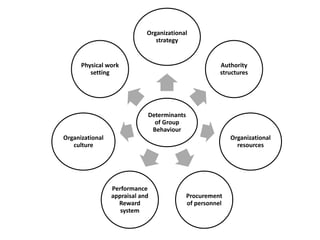
Determinants
of Group
Behaviour
Organizational
strategy
Authority
structures
Organizational
resources
Procurement
of personnel
Performance
appraisal and
Reward
system
Organizational
culture
Physical work
setting
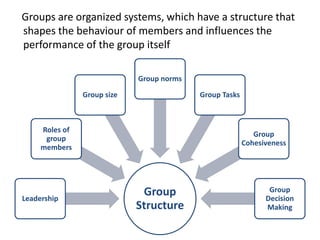
Groups are organized systems, which have a structure that
shapes the behaviour of members and influences the
performance of the group itself
Group
Structure
Leadership
Roles of
group
members
Group size
Group norms
Group Tasks
Group
Cohesiveness
Group
Decision
Making
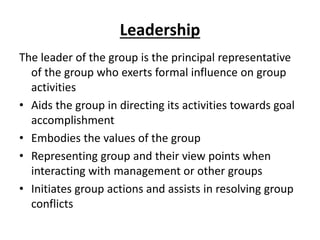
Leadership
The leader of the group is the principal representative
of the group who exerts formal influence on group
activities
• Aids the group in directing its activities towards goal
accomplishment
• Embodies the values of the group
• Representing group and their view points when
interacting with management or other groups
• Initiates group actions and assists in resolving group
conflicts
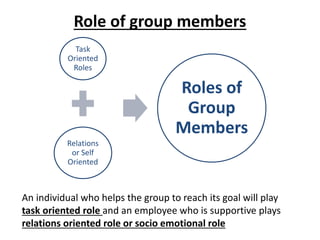
Role of group members
Task
Oriented
Roles
Relations
or Self
Oriented
Roles of
Group
Members
An individual who helps the group to reach its goal will play
task oriented role and an employee who is supportive plays
relations oriented role or socio emotional role
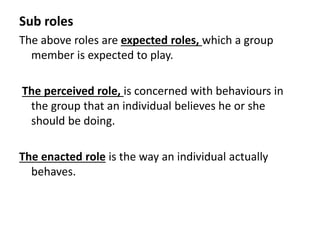
Sub roles
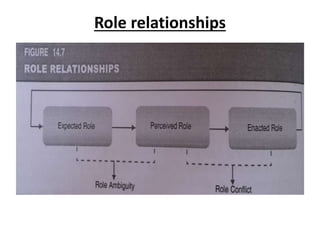
The above roles are expected roles, which a group
member is expected to play.
The perceived role, is concerned with behaviours in
the group that an individual believes he or she
should be doing.
The enacted role is the way an individual actually
behaves.
Role relationships
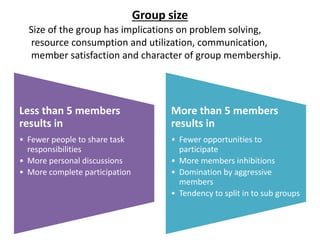
Group size
Size of the group has implications on problem solving,
resource consumption and utilization, communication,
member satisfaction and character of group membership.
Less than 5 members
results in
• Fewer people to share task
responsibilities
• More personal discussions
• More complete participation
More than 5 members
results in
• Fewer opportunities to
participate
• More members inhibitions
• Domination by aggressive
members
• Tendency to split in to sub groups
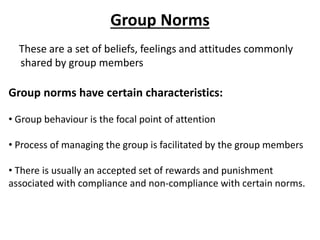
Group Norms
These are a set of beliefs, feelings and attitudes commonly
shared by group members
Group norms have certain characteristics:
• Group behaviour is the focal point of attention
• Process of managing the group is facilitated by the group members
• There is usually an accepted set of rewards and punishment
associated with compliance and non-compliance with certain norms.
Group
Tasks
Timeframe
Task
requirements
Task
objectives
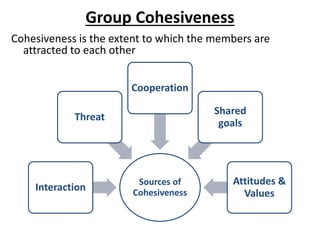
Group Cohesiveness
Cohesiveness is the extent to which the members are
attracted to each other
Sources of
Cohesiveness
Interaction
Threat
Cooperation
Shared
goals
Attitudes &
Values
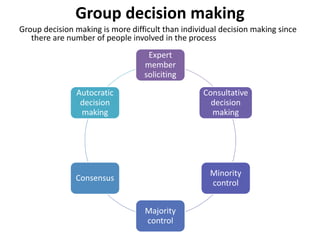
Group decision making
Group decision making is more difficult than individual decision making since
there are number of people involved in the process
Expert
member
soliciting
Consultative
decision
making
Minority
control
Majority
control
Consensus
Autocratic
decision
making
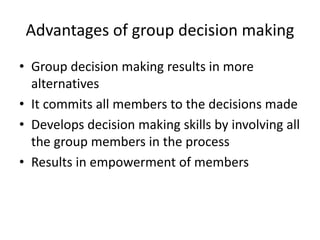
Advantages of group decision making
• Group decision making results in more
alternatives
• It commits all members to the decisions made
• Develops decision making skills by involving all
the group members in the process
• Results in empowerment of members
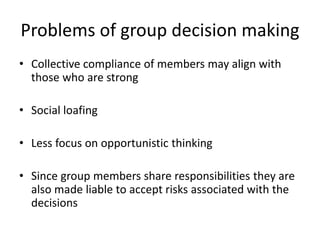
Problems of group decision making
• Collective compliance of members may align with
those who are strong
• Social loafing
• Less focus on opportunistic thinking
• Since group members share responsibilities they are
also made liable to accept risks associated with the
decisions
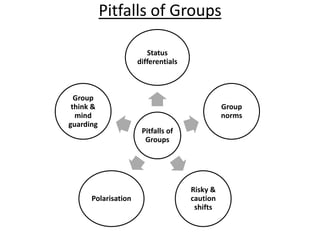
Pitfalls of Groups
Pitfalls of
Groups
Status
differentials
Group
norms
Risky &
caution
shifts
Polarisation
Group
think &
mind
guarding

Group & Team dynamics.pptx

  • 1.
  • 2.
    In addition toGroups, types of groups, stages of group development, group dynamics also include pitfalls of groups, determinants of group behaviour, group structuring, Group cohesiveness and group decision making
  • 3.
  • 4.
    Groups are organizedsystems, which have a structure that shapes the behaviour of members and influences the performance of the group itself Group Structure Leadership Roles of group members Group size Group norms Group Tasks Group Cohesiveness Group Decision Making
  • 5.
    Leadership The leader ofthe group is the principal representative of the group who exerts formal influence on group activities • Aids the group in directing its activities towards goal accomplishment • Embodies the values of the group • Representing group and their view points when interacting with management or other groups • Initiates group actions and assists in resolving group conflicts
  • 6.
    Role of groupmembers Task Oriented Roles Relations or Self Oriented Roles of Group Members An individual who helps the group to reach its goal will play task oriented role and an employee who is supportive plays relations oriented role or socio emotional role
  • 7.
    Sub roles The aboveroles are expected roles, which a group member is expected to play. The perceived role, is concerned with behaviours in the group that an individual believes he or she should be doing. The enacted role is the way an individual actually behaves.
  • 8.
  • 9.
    Group size Size ofthe group has implications on problem solving, resource consumption and utilization, communication, member satisfaction and character of group membership. Less than 5 members results in • Fewer people to share task responsibilities • More personal discussions • More complete participation More than 5 members results in • Fewer opportunities to participate • More members inhibitions • Domination by aggressive members • Tendency to split in to sub groups
  • 10.
    Group Norms These area set of beliefs, feelings and attitudes commonly shared by group members Group norms have certain characteristics: • Group behaviour is the focal point of attention • Process of managing the group is facilitated by the group members • There is usually an accepted set of rewards and punishment associated with compliance and non-compliance with certain norms.
  • 11.
  • 12.
    Group Cohesiveness Cohesiveness isthe extent to which the members are attracted to each other Sources of Cohesiveness Interaction Threat Cooperation Shared goals Attitudes & Values
  • 13.
    Group decision making Groupdecision making is more difficult than individual decision making since there are number of people involved in the process Expert member soliciting Consultative decision making Minority control Majority control Consensus Autocratic decision making
  • 14.
    Advantages of groupdecision making • Group decision making results in more alternatives • It commits all members to the decisions made • Develops decision making skills by involving all the group members in the process • Results in empowerment of members
  • 15.
    Problems of groupdecision making • Collective compliance of members may align with those who are strong • Social loafing • Less focus on opportunistic thinking • Since group members share responsibilities they are also made liable to accept risks associated with the decisions
  • 16.
    Pitfalls of Groups Pitfallsof Groups Status differentials Group norms Risky & caution shifts Polarisation Group think & mind guarding