HEDIS® is a registered trademark of the National Committee for Quality Assurance (NCQA).
HEDIS OPERATIONS
HEALTHCARE OUTCOMES & ANALYSIS
1
HEDIS ® Made Easy
What you really need to know
Disclaimer
“This document is merely a tool for providers and provides a general summary on some limited HEDIS® Program
requirements. This document should not be used as legal advice or expert advice or comprehensive summary of the HEDIS ®

Program. Please refer to ncqa.org for HEDIS ® Program measures and guidelines as well as relevant statutes.
The information provided is in this document is for 2016 HEDIS period and is current at the time this document was created.
NCQA HEDIS ® Program requirements, applicable laws, and L.A. Care’s policy change from time to time, and information and
documents requested from you may also change to comply with these requirements
L.A. Care is not affiliated with NCQA or its HEDIS ®Program and does not receive any financial remuneration from it.”
Learning Goals for Today
 HIPAA
 Learn what HEDIS® is
 What is your role in
HEDIS®?
 Annual HEDIS® Calendar
 Medical Record Requests
 Hybrid HEDIS® Measures
 Questions & Answers
2
Our “1” Simple Goal
• HEDIS® can be
intimidating
• HEDIS® can be nerve
wracking
• HEDIS® can be
frustrating
To make HEDIS® easier
for you!
3
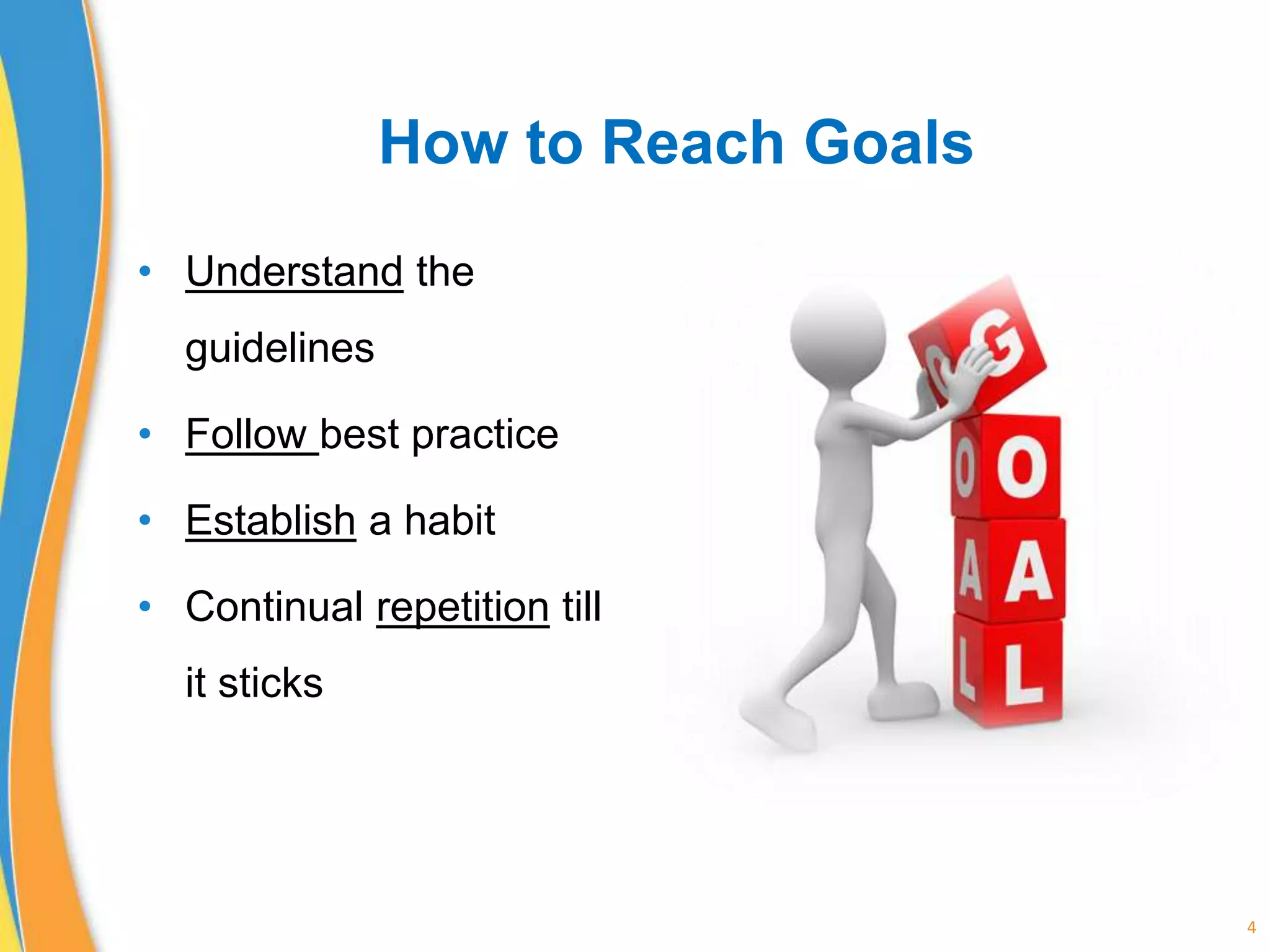
How to Reach Goals
• Understand the
guidelines
• Follow best practice
• Establish a habit
• Continual repetition till
it sticks
4
HIPAA
Under the Health Information
Portability and Accountability Act rule:
 Personal Health Information (PHI)
can be collected and shared with
the Health Plan for quality purposes
 Data collection is permitted
 No further authorization needed
from the patient
5
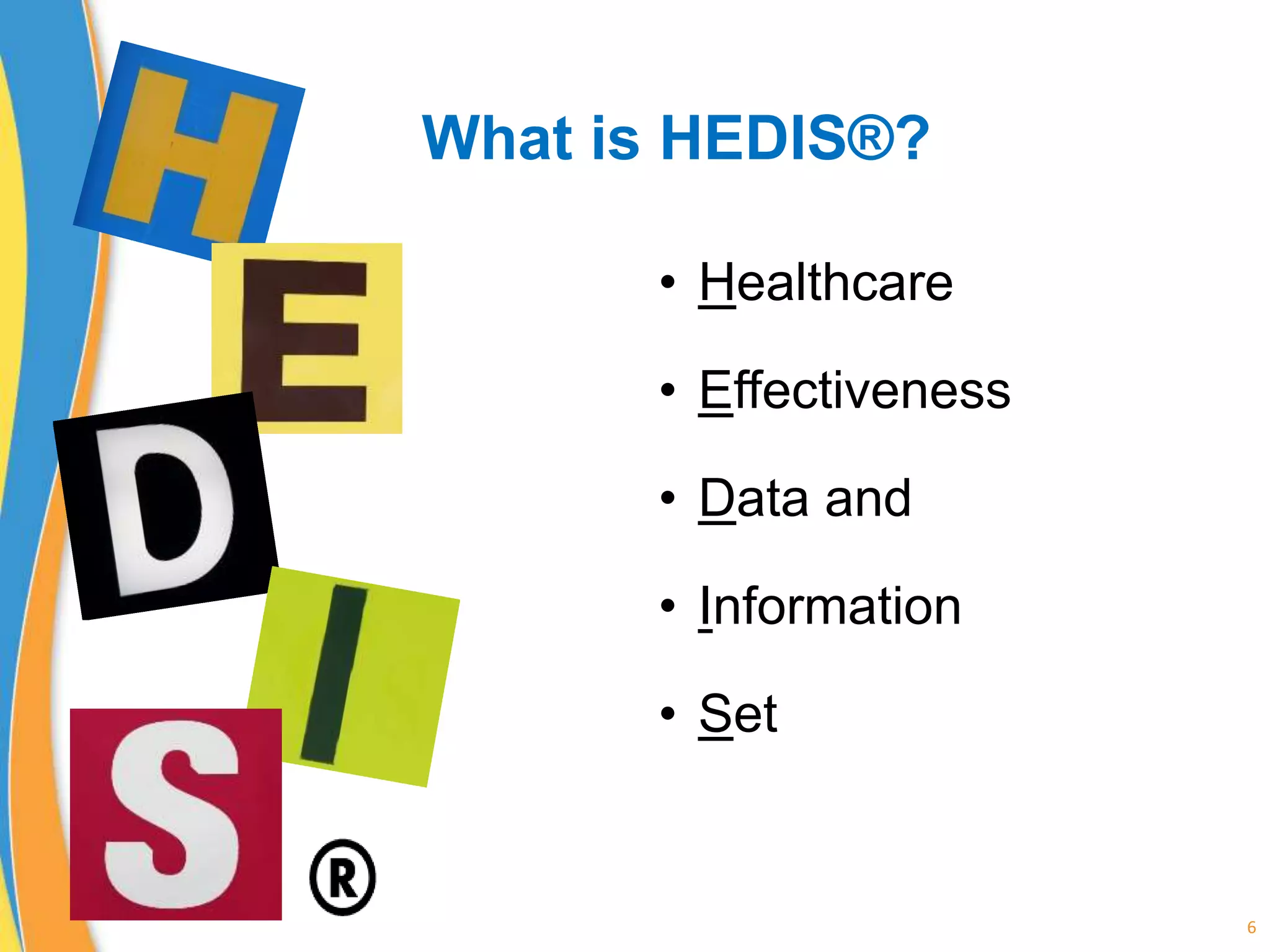
What is HEDIS®?
• Healthcare
• Effectiveness
• Data and
• Information
• Set
6
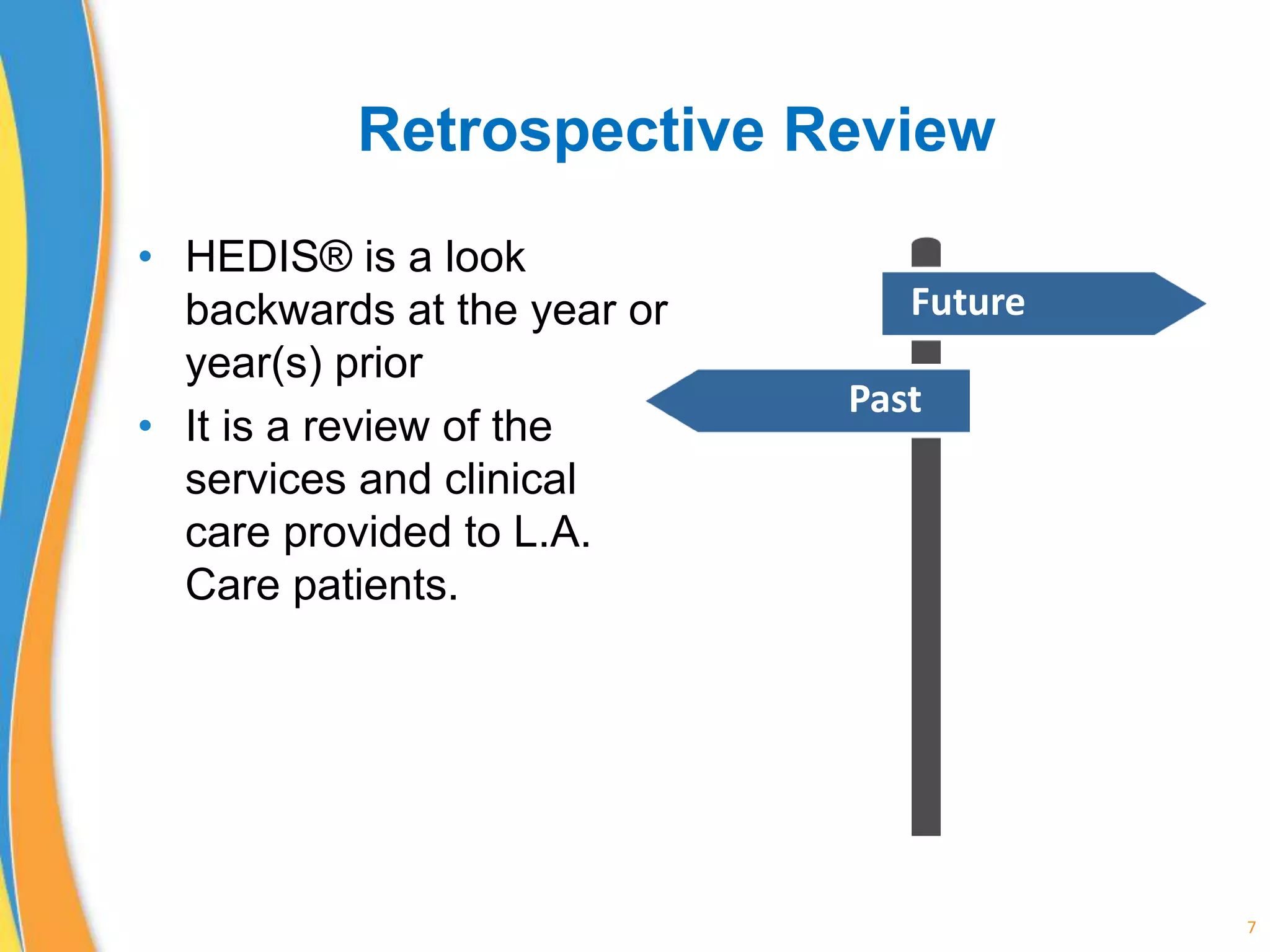
Retrospective Review
• HEDIS® is a look
backwards at the year or
year(s) prior
• It is a review of the
services and clinical
care provided to L.A.
Care patients.
7
Future
Past
HEDIS® HYBRID DATA
HEDIS® hybrid data is a combination of:
1. Administrative data: Data captured from
Claims, Encounters, Pharmacy, and Labs
2. Medical Record review: A validation audit
8
What is your role in HEDIS®?
• Ensure preventative healthcare
screening is done
• Ensure screening is completed
within the right time frame
• Ensure all screenings are
documented in the Medical Record
• Ensure the date of service, date of
birth, and member name are legible
and correct
• Faxing medical records to L.A. Care
within 5 business days of request
9
HEDIS® 2016 CALENDAR
10
Jan – May
June
July - Oct
• Collection of medical
records from Dr. Offices
• Medical records audited by
L.A. Care
• Audit results are compiled
• Audit results are sent to
NCQA
• NCQA releases report card
• NCQA releases new
measures/changes
• Training at doctors’ offices
• Onsite medical record audit
Medical Record Requests
Medical record requests are sent
by fax and include:
• A patient list
• The measure(s) we are
auditing
• Explanation of the minimum
documents needed
11
Frequently Asked Questions
Should I send the entire record?
No, we ask that you only provide what is
needed which is specified on the medical
request form
Who do I contact if I have a question about the
HEDIS® request?
Each fax request sent includes the contact
person’s name and telephone number
12
Turn-Around Time
13
Day turn-around
to fax
Medical Records
to L.A. Care
Hybrid HEDIS® Measures
14
Line of Business Adult Health
Medi-Cal LACC MA ABA Adult BMI Assessment
Medi-Cal LACC MA MMP CBP Controlling High Blood Pressure
Medi-Cal LACC MA CDC Comprehensive Diabetes Care
MA MMP COL Colorectal Cancer Screening
MLTSS MA MMP MRP Medication Reconciliation Post Discharge
Older Adult Health
MA MMP COA Care for the Older Adults
Women's Health
Medi-Cal LACC CCS Cervical Cancer Screening
Medi-Cal FPC Frequency of Prenatal Care
Medi-Cal LACC PPC Prenatal and Postpartum Care
Children and Adolescent Health
Medi-Cal LACC CIS Children Immunization Status
Medi-Cal LACC HPV Human Papillomavirus Vaccine for Female Adolescents
Medi-Cal LACC IMA Immunizations for Adolescents
Medi-Cal LACC WCC
Weight Assessment and Counseling for Nutrition and
Physical Activity for Children/Adolescents
Medi-Cal W34 Well-Child Visits in the 3rd, 4th, 5th & 6th Years of Life
Medi-Cal AWC Adolescent Well-Care Visits
MMP – Cal MediConnect/dual eligible; MA – Medicare Advantage; LACC – Commercial/Marketplace;
MLTSS – Managed Long Term Services and Support
ADULT HEALTH
15
Hybrid HEDIS® MEASURES
Adult BMI
Assessment
(ABA)
16
Documentation must have:
 20 years-of-age and Older: Weight
and BMI value.
 Younger than 20 years-of-age :
Height, Weight, and BMI in
Percentile.
Common Chart Deficiencies:
• Height and/or weight are documented
but there is no calculation of the BMI
• A range was given or threshold to be
met. Each patient must have a distinct
BMI value or %
Ages 18-74
Documentation in 2014/2015
Controlling
High Blood Pressure
(CBP)
17
Documentation must have:
• HTN Diagnosis before June 2015
• Last BP reading of 2015
• You must have the date and result
Common Chart Deficiencies:
• Elevated BP
• Check the patient’s BP at the
beginning and the end of the visit and
document both findings
• Diagnosis date of hypertension is not
clearly documented
A minimum of two notes must be
submitted. 1) HTN Diagnosis 2) BP
reading
The Diagnosis can be from any progress
note, problem list, consult note, hospital
admission or discharge
Ages 18-85
Diagnosis of Hypertension
Blood Pressure Controlled
18-59 <140/90
60-85 with diabetes < 140/90
60-85 without diabetes < 150/90
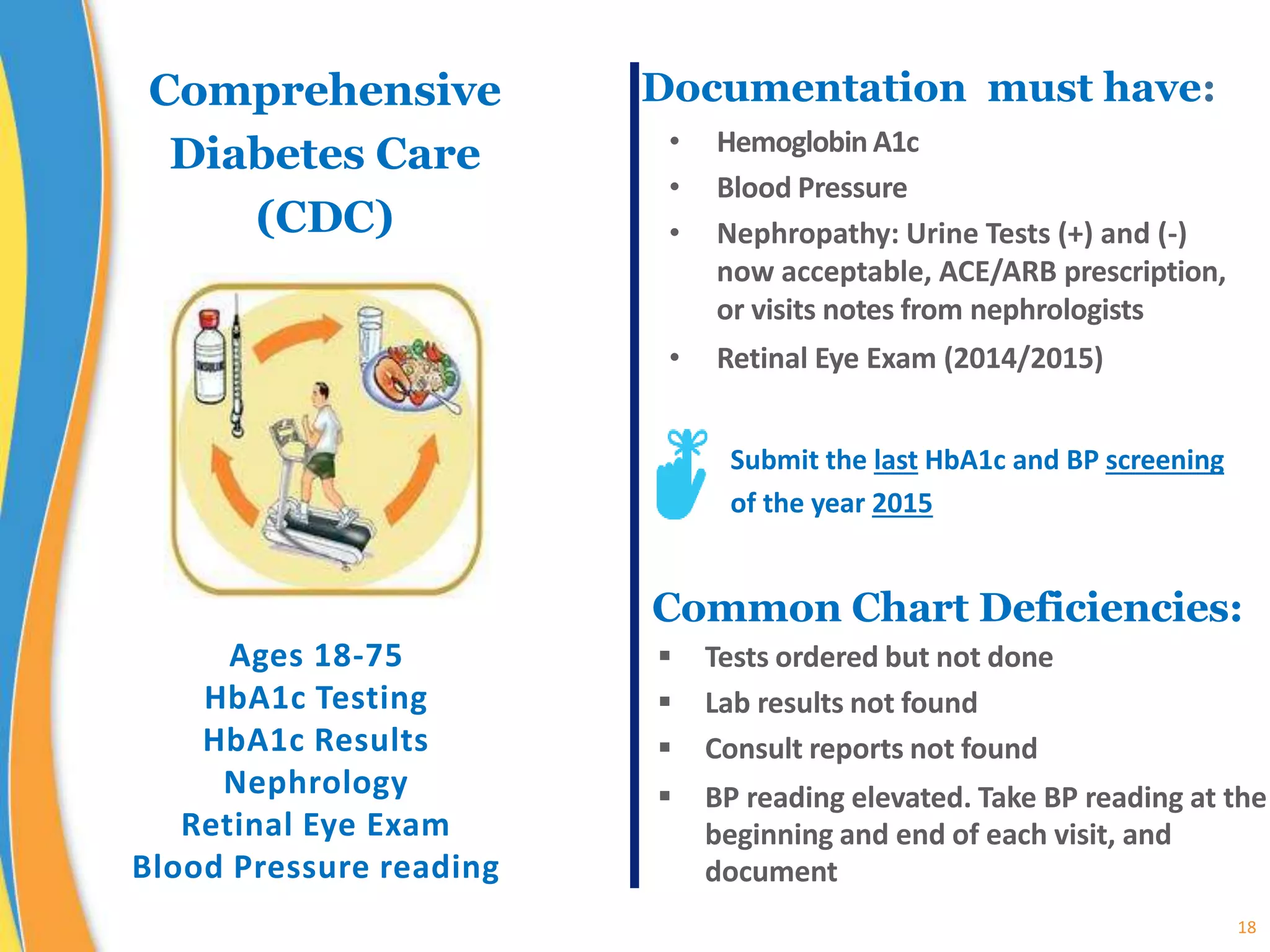
Comprehensive
Diabetes Care
(CDC)
18
Documentation must have:
Common Chart Deficiencies:
 Tests ordered but not done
 Lab results not found
 Consult reports not found
 BP reading elevated. Take BP reading at the
beginning and end of each visit, and
document
• Hemoglobin A1c
• Blood Pressure
• Nephropathy: Urine Tests (+) and (-)
now acceptable, ACE/ARB prescription,
or visits notes from nephrologists
• Retinal Eye Exam (2014/2015)
Submit the last HbA1c and BP screening
of the year 2015
Ages 18-75
HbA1c Testing
HbA1c Results
Nephrology
Retinal Eye Exam
Blood Pressure reading
19
Colorectal Cancer
Screening
(COL)
Documentation must have:
Date and result of one of these screenings:
• Colonoscopy within ten years (2006 -2015)
• Sigmoidoscopy within five years (2011-2015)
• FOBT (in 2015)
Any of the three scenarios pass for FOBT
1. Guaiac FOBT – 3 samples or note that
done
2. Immunochemical FOBT note that it
was done
3. FOBT unknown but documented as
done
Common Chart Deficiencies:
• Not documenting Colorectal screenings in
the health history
• Not providing the health history with the
note and/or test results
• FOBT test performed in an office setting or
performed during a digital rectal exam do
not meet criteria
Ages 50-75
Screening for Colon Cancer
20
Medication Reconciliation
Post-Discharge
(MRP)
Documentation must have:
1. Notation that the medications
prescribed upon discharge were
reconciled with the current medication
in the outpatient record -or-
2. A medication list in a discharge
summary that is present in the
outpatient chart and evidence of a
reconciliation with the current
medications -or-
3. Notation that no medications
were prescribed upon discharge
Ages 18 +
Medication reconciliation
conducted by a prescribing
practitioner, clinical pharmacist or
registered nurse on date of
discharge through 30 days after
discharge (31 days total)
An outpatient visit is not required,
only documentation in the outpatient
record that the medication was reconciled
meets criteria
21
OLDER ADULT HEALTH
Hybrid HEDIS® MEASURES
22
Documentation must have:
1. Advance care planning
Includes a discussion about preferences for
resuscitation, life sustaining treatment and
end of life care. Examples include:
• Advance directives
• Actionable medical orders
• Documentation of care planning
discussion
• Living Will
2. Medication review
Includes at least one (1) medication review
with:
• Presence of a medication list and date
the review was performed or
• Dated notation that the member is not
taking any medication
Review must be by a prescribing
practitioner and/or pharmacist
Care of the Older
Adult
(COA)
Ages 66 +
Advance Care Planning
Medication Review
Functional Status Assessment
Pain Assessment
23
Documentation must have:
3. Functional status assessment
• One (1) functional status assessment and
the date it was performed
• Notation ADLs were assessed, or
• Notation that Instrumental Activity of
Daily Living (IADL) were assessed, or
• Results of assessment using a
standardized tool, or
• Notation that at least 3 of the 4
following were assessed: cognitive
status, ambulation status, hearing,
vision and speech, other functional
independence
The assessments may be done during
separate visits
4. Pain assessment
Documentation of pain assessment and
the date it was performed (Positive or
Negative findings)
Care of the Older Adult
(COA)
(Continued)
24
WOMEN’S HEALTH
Hybrid HEDIS® MEASURES
25
Documentation must have:
• Date and result of cervical cancer
screening test -or-
• Date and result of cervical cancer
screening test and date of HPV test on
the same date of service -or-
• Evidence of hysterectomy with no
residual cervix
Common Chart Deficiencies:
• Pap Smear test results not found in PCP
charts
• Incomplete documentation related to
hysterectomy
Females Ages 21-64 Pap
(2013/2014/2015)
Females Ages 30-64 Pap
with HPV co-testing results
(2011–2015)
Cervical Cancer
Screening
(CCS)
HPV ordered after positive Pap testing
does not count as co-testing
26
Documentation must have:
Date and documentation of all prenatal
visits
Most of this information is found
on the ACOG form
ACOG recommends 14 visits for a
40 week pregnancy
Common Chart Deficiencies:
Must be “unduplicated” prenatal visits.
If there is an office visit and the provider
orders an U/S and labs and they are
done on separate days, all three would
only count as one date of service.
Frequency of Ongoing
Prenatal Care
(FPC)
Live Births Delivered
on or between
11/6/2014 to 11/5/2015
and were continuously
enrolled 42 days prior to delivery
27
Documentation must have:
Prenatal Care: Prenatal visit during the
first trimester or within 42 days of
enrollment
Most information is found on the
ACOG form
Postpartum Care: Post-partum visit within
21-56 days of delivery
Common Chart Deficiencies:
• Prenatal care not done within
timeframe
• No Postpartum care visit
• Incision check for post C-section does
not constitute a postpartum visit
Prenatal and
Postpartum
Care
(PPC)
Live Births Delivered
on or between
11/6/2014 to 11/5/2015
28
CHILD AND ADOLESCENT HEALTH
Hybrid HEDIS® MEASURES
29
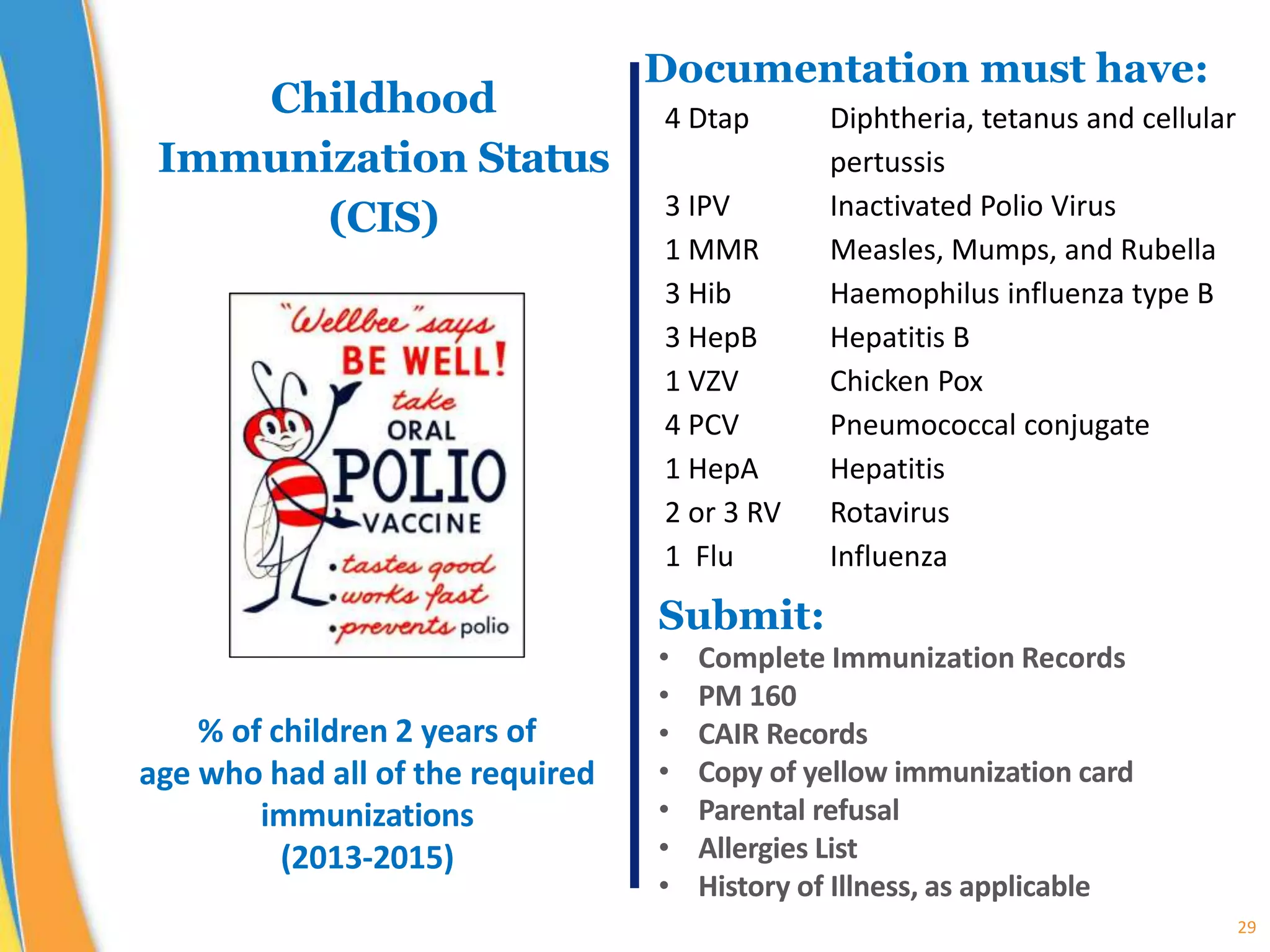
Childhood
Immunization Status
(CIS)
Documentation must have:
Submit:
• Complete Immunization Records
• PM 160
• CAIR Records
• Copy of yellow immunization card
• Parental refusal
• Allergies List
• History of Illness, as applicable
% of children 2 years of
age who had all of the required
immunizations
(2013-2015)
4 Dtap Diphtheria, tetanus and cellular
pertussis
3 IPV Inactivated Polio Virus
1 MMR Measles, Mumps, and Rubella
3 Hib Haemophilus influenza type B
3 HepB Hepatitis B
1 VZV Chicken Pox
4 PCV Pneumococcal conjugate
1 HepA Hepatitis
2 or 3 RV Rotavirus
1 Flu Influenza
30
Common Chart Deficiencies:
• Immunizations received after the 2nd
birthday
• PCP charts do not contain
immunization records if received at
Health Department or school.
• Immunizations records given in the
hospital at birth are not obtained
• No documentation of allergies or
contraindications
• No documentation of parental refusal
Childhood
Immunization Status
(CIS)
(Continued)
If missing any immunizations,
please include:
• Documentation of parental refusal
• Documentation of request for
delayed immunization schedules
• Immunizations given at
health departments
• Immunizations given in the
hospital at birth
• Documentation of
contraindications or allergies
31
Documentation must have:
At least (3) three HPV vaccinations with
different dates of service. Submit:
• MD Progress note, PM 160, Copy of
immunization record, CAIR Record
If immunizations are missing please send:
• Documentation of parental refusal
• Copy of Immunization card
• Patient Contraindications/allergies
Common Chart Deficiencies:
• HPV vaccines administered prior to the 9th
birthday or after the 13thbirthday
• PCP charts do not contain immunization
records if received elsewhere, i.e. Health
Departments and schools.
• Immunizations not documented
• Parental refusal not documented
Human
Papillomavirus Vaccine
(HPV)
Female adolescent
3 doses of the HPV vaccine by age 13
2011 – 2015
between the 9th and 13th birthdays
32
Immunizations for
Adolescents
(IMA)
Documentation must have:
• Date administered and type
• Certificate of immunization
• Notation of anaphylactic reaction
If immunizations are missing please send:
• Documentation of parental refusal
• Patient Contraindications/allergies
Common Chart Deficiencies:
• Immunizations not administered
during timeframes
• Immunization records not found in
the PCP chart or Immunization card
Meningococcal 2013 – 2015
(11th - 13th birthday)
Tdap or Td 2012 – 2015
(10th - 13th birthday)
33
Documentation must have:
BMI date and percentile
Weight date and value
Height date and value
Age growth chart(s)
BMI Value option removed for members
ages 16-17, must be in percentile only
Ages 3-17
Notation in the medical record
Year 2015
Counseling for Nutrition:
Documentation of discussion on diet and
nutrition, checklist, referral to nutritionist,
anticipatory guidance, or weight/ obesity
counseling
Counseling for Physical Activity:
Documentation of discussion on current
physical activities, check list,
counseling/referral , education,
anticipatory guidance, or weight/ obesity
counseling
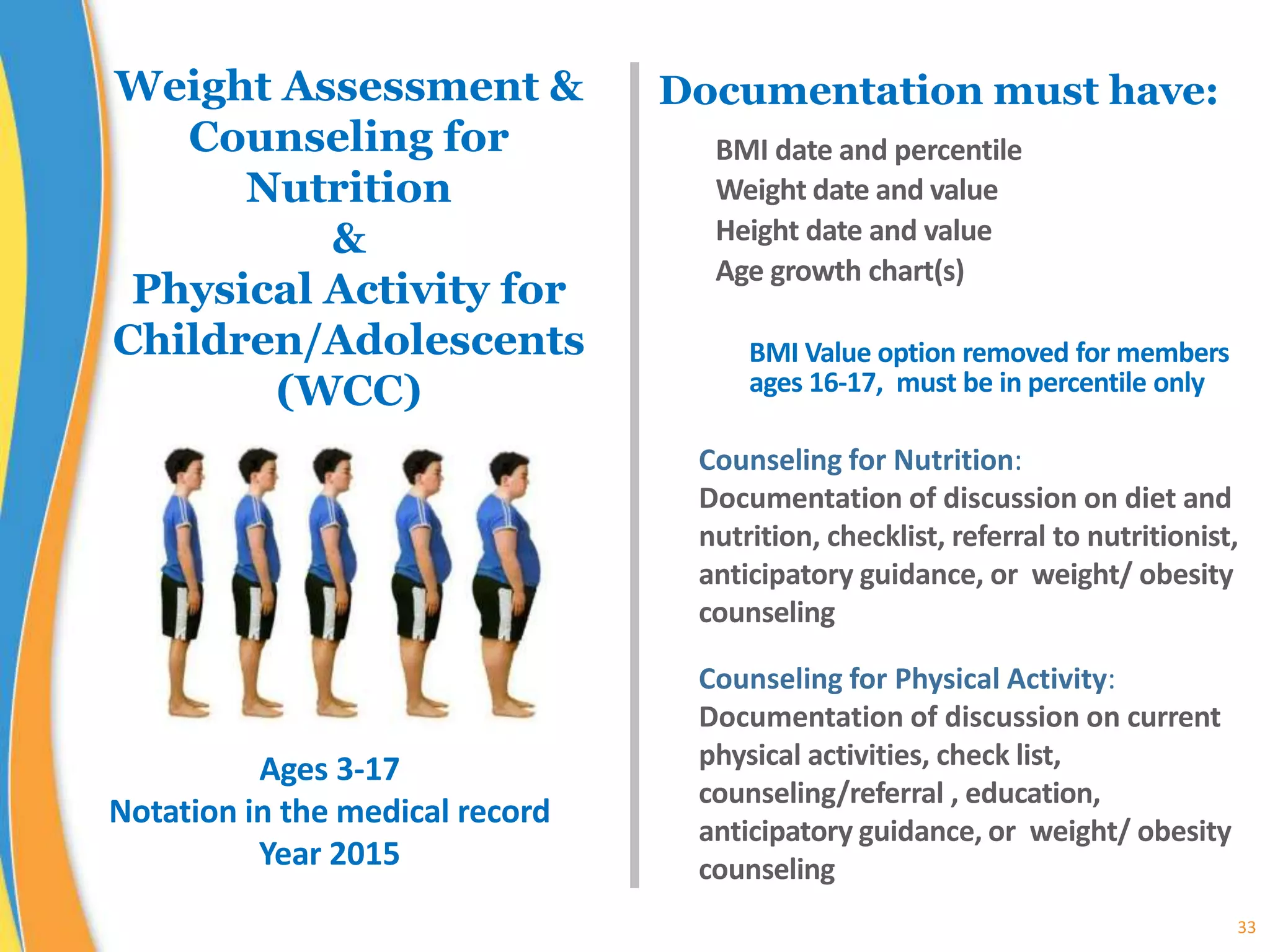
Weight Assessment &
Counseling for
Nutrition
&
Physical Activity for
Children/Adolescents
(WCC)
34
Common Chart
Deficiencies:
 BMI documented as value (number) not
as percentile
 BMI growth charts not submitted
 Anticipatory guidance does not always
address nutrition and physical activity
 Developmental milestones are not
acceptable
 PM 160 forms do not address physical
activity
Weight Assessment &
Counseling for
Nutrition
&
Physical Activity for
Children/Adolescents
(WCC)
35
Well Child Visits in
the 3rd, 4th, 5th & 6th
Years of Life
(W34)
Documentation must have:
• Health history
• Developmental history - physical
• Developmental history - mental
• Physical exam
• Health education/anticipatory guidance
Preventive services may be rendered on
visits other than well-child visits
Common Chart Deficiencies:
• Lack of documentation of required elements
• Children being seen for sick visits andthe
required elements are not addressed
Ages 3 -6 yrs.
At least ONE “Well-Child” visit
with a PCP in 2015
36
Adolescent Well-Child
Visits
(AWC)
Documentation must have:
• Health history
• Developmental history physical
• Developmental history mental
• Physical exam
• Health education/anticipatory guidance
Preventive services may be rendered on
visits other than well-care visits.
Common Chart Deficiencies:
• Lack of documentation of required elements
• Adolescents being seen for sick visits andthe
required elements are not addressed
Ages 12 - 21 yrs.
At least one “Well-Child” visit
with a PCP or an OB/GYN in 2015
37
Let’s See What You’ve Learned
1. What does HEDIS®
Stand for?
2. What is your role in
HEDIS®?
3. Do you need to send the
entire record?
4. What do you do if you
have questions?
38
Got Questions?
Email us at: HEDIS_Ops@lacare.org
Check out our website at:
https://www.lacare.org/providers/provider-resources
Click on:
HEDIS® Resources
For helpful trainings and guides
39
Resources at Your Fingertips
Presentation and Trainings:
HEDIS® Overview Presentation
WCC – Weight Assessment Documentation
HEDIS® Made Easy
Guidance Documents:
HEDIS® 2016 Measure Criteria
HEDIS® at a Glance
HEDIS® Measures Handout
HEDIS® Measures Poster
HEDIS® Office Manager’s Guide
Provider Opportunity Report
HEDIS® Value Set Directory
Question and Answer Period
HEDIS® is a registered trademark of the National Committee for Quality Assurance (NCQA).
HEDIS OPERATIONS HEALTHCARE OUTCOMES & ANALYSIS
40
41
THE END
HEDIS® Made Easy 2016

hedis-made-easy-ppt.pptx

  • 1.
    HEDIS® is aregistered trademark of the National Committee for Quality Assurance (NCQA). HEDIS OPERATIONS HEALTHCARE OUTCOMES & ANALYSIS 1 HEDIS ® Made Easy What you really need to know Disclaimer “This document is merely a tool for providers and provides a general summary on some limited HEDIS® Program requirements. This document should not be used as legal advice or expert advice or comprehensive summary of the HEDIS ® Program. Please refer to ncqa.org for HEDIS ® Program measures and guidelines as well as relevant statutes. The information provided is in this document is for 2016 HEDIS period and is current at the time this document was created. NCQA HEDIS ® Program requirements, applicable laws, and L.A. Care’s policy change from time to time, and information and documents requested from you may also change to comply with these requirements L.A. Care is not affiliated with NCQA or its HEDIS ®Program and does not receive any financial remuneration from it.”
  • 2.
    Learning Goals forToday  HIPAA  Learn what HEDIS® is  What is your role in HEDIS®?  Annual HEDIS® Calendar  Medical Record Requests  Hybrid HEDIS® Measures  Questions & Answers 2
  • 3.
    Our “1” SimpleGoal • HEDIS® can be intimidating • HEDIS® can be nerve wracking • HEDIS® can be frustrating To make HEDIS® easier for you! 3
  • 4.
    How to ReachGoals • Understand the guidelines • Follow best practice • Establish a habit • Continual repetition till it sticks 4
  • 5.
    HIPAA Under the HealthInformation Portability and Accountability Act rule:  Personal Health Information (PHI) can be collected and shared with the Health Plan for quality purposes  Data collection is permitted  No further authorization needed from the patient 5
  • 6.
    What is HEDIS®? •Healthcare • Effectiveness • Data and • Information • Set 6
  • 7.
    Retrospective Review • HEDIS®is a look backwards at the year or year(s) prior • It is a review of the services and clinical care provided to L.A. Care patients. 7 Future Past
  • 8.
    HEDIS® HYBRID DATA HEDIS®hybrid data is a combination of: 1. Administrative data: Data captured from Claims, Encounters, Pharmacy, and Labs 2. Medical Record review: A validation audit 8
  • 9.
    What is yourrole in HEDIS®? • Ensure preventative healthcare screening is done • Ensure screening is completed within the right time frame • Ensure all screenings are documented in the Medical Record • Ensure the date of service, date of birth, and member name are legible and correct • Faxing medical records to L.A. Care within 5 business days of request 9
  • 10.
    HEDIS® 2016 CALENDAR 10 Jan– May June July - Oct • Collection of medical records from Dr. Offices • Medical records audited by L.A. Care • Audit results are compiled • Audit results are sent to NCQA • NCQA releases report card • NCQA releases new measures/changes • Training at doctors’ offices • Onsite medical record audit
  • 11.
    Medical Record Requests Medicalrecord requests are sent by fax and include: • A patient list • The measure(s) we are auditing • Explanation of the minimum documents needed 11
  • 12.
    Frequently Asked Questions ShouldI send the entire record? No, we ask that you only provide what is needed which is specified on the medical request form Who do I contact if I have a question about the HEDIS® request? Each fax request sent includes the contact person’s name and telephone number 12
  • 13.
    Turn-Around Time 13 Day turn-around tofax Medical Records to L.A. Care
  • 14.
    Hybrid HEDIS® Measures 14 Lineof Business Adult Health Medi-Cal LACC MA ABA Adult BMI Assessment Medi-Cal LACC MA MMP CBP Controlling High Blood Pressure Medi-Cal LACC MA CDC Comprehensive Diabetes Care MA MMP COL Colorectal Cancer Screening MLTSS MA MMP MRP Medication Reconciliation Post Discharge Older Adult Health MA MMP COA Care for the Older Adults Women's Health Medi-Cal LACC CCS Cervical Cancer Screening Medi-Cal FPC Frequency of Prenatal Care Medi-Cal LACC PPC Prenatal and Postpartum Care Children and Adolescent Health Medi-Cal LACC CIS Children Immunization Status Medi-Cal LACC HPV Human Papillomavirus Vaccine for Female Adolescents Medi-Cal LACC IMA Immunizations for Adolescents Medi-Cal LACC WCC Weight Assessment and Counseling for Nutrition and Physical Activity for Children/Adolescents Medi-Cal W34 Well-Child Visits in the 3rd, 4th, 5th & 6th Years of Life Medi-Cal AWC Adolescent Well-Care Visits MMP – Cal MediConnect/dual eligible; MA – Medicare Advantage; LACC – Commercial/Marketplace; MLTSS – Managed Long Term Services and Support
  • 15.
  • 16.
    Adult BMI Assessment (ABA) 16 Documentation musthave:  20 years-of-age and Older: Weight and BMI value.  Younger than 20 years-of-age : Height, Weight, and BMI in Percentile. Common Chart Deficiencies: • Height and/or weight are documented but there is no calculation of the BMI • A range was given or threshold to be met. Each patient must have a distinct BMI value or % Ages 18-74 Documentation in 2014/2015
  • 17.
    Controlling High Blood Pressure (CBP) 17 Documentationmust have: • HTN Diagnosis before June 2015 • Last BP reading of 2015 • You must have the date and result Common Chart Deficiencies: • Elevated BP • Check the patient’s BP at the beginning and the end of the visit and document both findings • Diagnosis date of hypertension is not clearly documented A minimum of two notes must be submitted. 1) HTN Diagnosis 2) BP reading The Diagnosis can be from any progress note, problem list, consult note, hospital admission or discharge Ages 18-85 Diagnosis of Hypertension Blood Pressure Controlled 18-59 <140/90 60-85 with diabetes < 140/90 60-85 without diabetes < 150/90
  • 18.
    Comprehensive Diabetes Care (CDC) 18 Documentation musthave: Common Chart Deficiencies:  Tests ordered but not done  Lab results not found  Consult reports not found  BP reading elevated. Take BP reading at the beginning and end of each visit, and document • Hemoglobin A1c • Blood Pressure • Nephropathy: Urine Tests (+) and (-) now acceptable, ACE/ARB prescription, or visits notes from nephrologists • Retinal Eye Exam (2014/2015) Submit the last HbA1c and BP screening of the year 2015 Ages 18-75 HbA1c Testing HbA1c Results Nephrology Retinal Eye Exam Blood Pressure reading
  • 19.
    19 Colorectal Cancer Screening (COL) Documentation musthave: Date and result of one of these screenings: • Colonoscopy within ten years (2006 -2015) • Sigmoidoscopy within five years (2011-2015) • FOBT (in 2015) Any of the three scenarios pass for FOBT 1. Guaiac FOBT – 3 samples or note that done 2. Immunochemical FOBT note that it was done 3. FOBT unknown but documented as done Common Chart Deficiencies: • Not documenting Colorectal screenings in the health history • Not providing the health history with the note and/or test results • FOBT test performed in an office setting or performed during a digital rectal exam do not meet criteria Ages 50-75 Screening for Colon Cancer
  • 20.
    20 Medication Reconciliation Post-Discharge (MRP) Documentation musthave: 1. Notation that the medications prescribed upon discharge were reconciled with the current medication in the outpatient record -or- 2. A medication list in a discharge summary that is present in the outpatient chart and evidence of a reconciliation with the current medications -or- 3. Notation that no medications were prescribed upon discharge Ages 18 + Medication reconciliation conducted by a prescribing practitioner, clinical pharmacist or registered nurse on date of discharge through 30 days after discharge (31 days total) An outpatient visit is not required, only documentation in the outpatient record that the medication was reconciled meets criteria
  • 21.
  • 22.
    22 Documentation must have: 1.Advance care planning Includes a discussion about preferences for resuscitation, life sustaining treatment and end of life care. Examples include: • Advance directives • Actionable medical orders • Documentation of care planning discussion • Living Will 2. Medication review Includes at least one (1) medication review with: • Presence of a medication list and date the review was performed or • Dated notation that the member is not taking any medication Review must be by a prescribing practitioner and/or pharmacist Care of the Older Adult (COA) Ages 66 + Advance Care Planning Medication Review Functional Status Assessment Pain Assessment
  • 23.
    23 Documentation must have: 3.Functional status assessment • One (1) functional status assessment and the date it was performed • Notation ADLs were assessed, or • Notation that Instrumental Activity of Daily Living (IADL) were assessed, or • Results of assessment using a standardized tool, or • Notation that at least 3 of the 4 following were assessed: cognitive status, ambulation status, hearing, vision and speech, other functional independence The assessments may be done during separate visits 4. Pain assessment Documentation of pain assessment and the date it was performed (Positive or Negative findings) Care of the Older Adult (COA) (Continued)
  • 24.
  • 25.
    25 Documentation must have: •Date and result of cervical cancer screening test -or- • Date and result of cervical cancer screening test and date of HPV test on the same date of service -or- • Evidence of hysterectomy with no residual cervix Common Chart Deficiencies: • Pap Smear test results not found in PCP charts • Incomplete documentation related to hysterectomy Females Ages 21-64 Pap (2013/2014/2015) Females Ages 30-64 Pap with HPV co-testing results (2011–2015) Cervical Cancer Screening (CCS) HPV ordered after positive Pap testing does not count as co-testing
  • 26.
    26 Documentation must have: Dateand documentation of all prenatal visits Most of this information is found on the ACOG form ACOG recommends 14 visits for a 40 week pregnancy Common Chart Deficiencies: Must be “unduplicated” prenatal visits. If there is an office visit and the provider orders an U/S and labs and they are done on separate days, all three would only count as one date of service. Frequency of Ongoing Prenatal Care (FPC) Live Births Delivered on or between 11/6/2014 to 11/5/2015 and were continuously enrolled 42 days prior to delivery
  • 27.
    27 Documentation must have: PrenatalCare: Prenatal visit during the first trimester or within 42 days of enrollment Most information is found on the ACOG form Postpartum Care: Post-partum visit within 21-56 days of delivery Common Chart Deficiencies: • Prenatal care not done within timeframe • No Postpartum care visit • Incision check for post C-section does not constitute a postpartum visit Prenatal and Postpartum Care (PPC) Live Births Delivered on or between 11/6/2014 to 11/5/2015
  • 28.
    28 CHILD AND ADOLESCENTHEALTH Hybrid HEDIS® MEASURES
  • 29.
    29 Childhood Immunization Status (CIS) Documentation musthave: Submit: • Complete Immunization Records • PM 160 • CAIR Records • Copy of yellow immunization card • Parental refusal • Allergies List • History of Illness, as applicable % of children 2 years of age who had all of the required immunizations (2013-2015) 4 Dtap Diphtheria, tetanus and cellular pertussis 3 IPV Inactivated Polio Virus 1 MMR Measles, Mumps, and Rubella 3 Hib Haemophilus influenza type B 3 HepB Hepatitis B 1 VZV Chicken Pox 4 PCV Pneumococcal conjugate 1 HepA Hepatitis 2 or 3 RV Rotavirus 1 Flu Influenza
  • 30.
    30 Common Chart Deficiencies: •Immunizations received after the 2nd birthday • PCP charts do not contain immunization records if received at Health Department or school. • Immunizations records given in the hospital at birth are not obtained • No documentation of allergies or contraindications • No documentation of parental refusal Childhood Immunization Status (CIS) (Continued) If missing any immunizations, please include: • Documentation of parental refusal • Documentation of request for delayed immunization schedules • Immunizations given at health departments • Immunizations given in the hospital at birth • Documentation of contraindications or allergies
  • 31.
    31 Documentation must have: Atleast (3) three HPV vaccinations with different dates of service. Submit: • MD Progress note, PM 160, Copy of immunization record, CAIR Record If immunizations are missing please send: • Documentation of parental refusal • Copy of Immunization card • Patient Contraindications/allergies Common Chart Deficiencies: • HPV vaccines administered prior to the 9th birthday or after the 13thbirthday • PCP charts do not contain immunization records if received elsewhere, i.e. Health Departments and schools. • Immunizations not documented • Parental refusal not documented Human Papillomavirus Vaccine (HPV) Female adolescent 3 doses of the HPV vaccine by age 13 2011 – 2015 between the 9th and 13th birthdays
  • 32.
    32 Immunizations for Adolescents (IMA) Documentation musthave: • Date administered and type • Certificate of immunization • Notation of anaphylactic reaction If immunizations are missing please send: • Documentation of parental refusal • Patient Contraindications/allergies Common Chart Deficiencies: • Immunizations not administered during timeframes • Immunization records not found in the PCP chart or Immunization card Meningococcal 2013 – 2015 (11th - 13th birthday) Tdap or Td 2012 – 2015 (10th - 13th birthday)
  • 33.
    33 Documentation must have: BMIdate and percentile Weight date and value Height date and value Age growth chart(s) BMI Value option removed for members ages 16-17, must be in percentile only Ages 3-17 Notation in the medical record Year 2015 Counseling for Nutrition: Documentation of discussion on diet and nutrition, checklist, referral to nutritionist, anticipatory guidance, or weight/ obesity counseling Counseling for Physical Activity: Documentation of discussion on current physical activities, check list, counseling/referral , education, anticipatory guidance, or weight/ obesity counseling Weight Assessment & Counseling for Nutrition & Physical Activity for Children/Adolescents (WCC)
  • 34.
    34 Common Chart Deficiencies:  BMIdocumented as value (number) not as percentile  BMI growth charts not submitted  Anticipatory guidance does not always address nutrition and physical activity  Developmental milestones are not acceptable  PM 160 forms do not address physical activity Weight Assessment & Counseling for Nutrition & Physical Activity for Children/Adolescents (WCC)
  • 35.
    35 Well Child Visitsin the 3rd, 4th, 5th & 6th Years of Life (W34) Documentation must have: • Health history • Developmental history - physical • Developmental history - mental • Physical exam • Health education/anticipatory guidance Preventive services may be rendered on visits other than well-child visits Common Chart Deficiencies: • Lack of documentation of required elements • Children being seen for sick visits andthe required elements are not addressed Ages 3 -6 yrs. At least ONE “Well-Child” visit with a PCP in 2015
  • 36.
    36 Adolescent Well-Child Visits (AWC) Documentation musthave: • Health history • Developmental history physical • Developmental history mental • Physical exam • Health education/anticipatory guidance Preventive services may be rendered on visits other than well-care visits. Common Chart Deficiencies: • Lack of documentation of required elements • Adolescents being seen for sick visits andthe required elements are not addressed Ages 12 - 21 yrs. At least one “Well-Child” visit with a PCP or an OB/GYN in 2015
  • 37.
    37 Let’s See WhatYou’ve Learned 1. What does HEDIS® Stand for? 2. What is your role in HEDIS®? 3. Do you need to send the entire record? 4. What do you do if you have questions?
  • 38.
    38 Got Questions? Email usat: HEDIS_Ops@lacare.org Check out our website at: https://www.lacare.org/providers/provider-resources Click on: HEDIS® Resources For helpful trainings and guides
  • 39.
    39 Resources at YourFingertips Presentation and Trainings: HEDIS® Overview Presentation WCC – Weight Assessment Documentation HEDIS® Made Easy Guidance Documents: HEDIS® 2016 Measure Criteria HEDIS® at a Glance HEDIS® Measures Handout HEDIS® Measures Poster HEDIS® Office Manager’s Guide Provider Opportunity Report HEDIS® Value Set Directory
  • 40.
    Question and AnswerPeriod HEDIS® is a registered trademark of the National Committee for Quality Assurance (NCQA). HEDIS OPERATIONS HEALTHCARE OUTCOMES & ANALYSIS 40
  • 41.

Editor's Notes

  • #2 Hello and welcome to HEDIS® made Easy brought to you by L.A. Care and the L.A. Care HEDIS® Operations and Data team. I’m Dr. Katrina Miller, Medical Director of Informatics and a Family Physician here to tell you   about some things you may need to know about HEDIS®.  You may think about changing this as it is a bit broad statement. Recommend something like “some things you may need to know about HEDIS to respond to requests by L.A. Care.” For more information about HEDIS, you should visit the ncqa website”.   Added the statement “For more information about HEDIS, you should visit the NCQA website at the end.”
  • #3 Our learning goals for today will be to talk about various issues regarding HEDIS® that may concern you in your practice. First off, we’ll talk about privacy issues as they relate to HIPAA. Next up, we’ll learn what HEDIS® stands for and what your role in HEDIS® is. Then, we’ll talk about the HEDIS® Calendar and after that we’ll talk about Medical Record requests that you will receive from L.A. Care. Finally, we’ll go through a review of each selected Hybrid HEDIS® measures.
  • #4 Our one simple goal for today is to make HEDIS® easier for you. We know it can sure be intimidating, nerve-wracking, and frustrating. We just want to make HEDIS® as easy as possible so your office can translate your excellent clinical care into great HEDIS® rates.
  • #5 How can you reach those goals? Number one, understand the HEDIS® guidelines or make sure someone in your office does. Next, follow best clinical practice using evidence based clinical practice guidelines. Establish a habit and establish best clinical practice. And finally, continue repeating best practice so that everybody in your office can begin to follow along.
  • #6 You may be concerned about protected health information as it relates to HEDIS®. But under the Health Insurance Portability and Accountability Act or HIPAA, for HEDIS® purposes data collection is permitted and personal health information or PHI can be shared with the Health Plan for quality purposes. No further authorization is needed from the patient, so when L.A. Care requests medical records for HEDIS® purposes you are free to send it.
  • #7 Now, what is HEDIS®? Well, the acronym stands for Healthcare Effectiveness Data and Information Set. It is a standardized set of performance measurements developed by the National Committee for Quality Assurance (NCQA) to evaluate consumer health care.
  • #8 HEDIS® is a retrospective review or look backwards at the year or year(s) prior depending on the measure. Some measures have only a one year look-back period, while other measures the look-back period can extend up to ten years, like for colorectal cancer screening. It is a review of the services and clinical care provided to L.A. Care members.
  • #9 Each season L.A. Care randomly selects eligible members to participate in HEDIS®. HEDIS® hybrid data is collected using a combination of two methods: Administrative data and medical record review.   Administrative data is captured from claims that have been submitted to L.A. Care, encounter data, prescription and lab information. This type of data can electronically captured by L.A Care.   For the second method, L.A. Care conducts medical record reviews to verify that a test or screening was done and appropriately documented.
  • #10 So, what is your role in HEDIS®? Your primary role is to make sure that all applicable preventive healthcare screenings are completed for each of your patients. Then you want to ensure the tests or screenings are completed within the right time frame. After that, you need to make sure that the tests or screening results are obtained and documented in the Medical Record. Make sure that the date of service, member name, and date of birth are legible and correct. Most importantly, double check to make sure the member name and date of birth matches the name and date of birth on the request form. And finally, if you do get the request from L.A. Care please fax the relevant documents over to us within 5 business days of that request.
  • #11 Here is the HEDIS® 2016 Calendar. From January through May, L.A. Care will be collecting and auditing medical records from offices and clinics.   In June, those audit results are reported to NCQA. NCQA analyzes HEDIS performance rates across Health plans and establishes national benchmarks for quality performance based on Health Plan scores.
  • #12 Medical record requests. It is vitally important that these are processed timely. L.A. Care will fax you a request which will include a patient list that gives details about the patients selected for a particular measure, the measure being audited, and an explanation of the documents needed for the audit.
  • #13 Here are some examples of the questions we frequently receive:   Should you send the entire record? No. You don’t need to send the entire medical record. You only need to fax those documents requested specifically by L.A. Care.   Next, who should you contact if you have a question about the HEDIS® request? The fax request includes the sender’s name and telephone number. You can contact us directly for any questions you may have.
  • #14 As a reminder, the turn-around-time is five business days. So, make sure you respond quickly and fax all pertinent medical records to L.A. Care within that time frame.
  • #15 Now let’s begin our review of selected hybrid HEDIS® measures. We’ve divided these measures into four major categories: Adult Health; Older Adult Health; Women’s Health; and Children and Adolescent Health.
  • #16 Adult Health
  • #17 Adult BMI Assessment. The time frame for this measure is two years. It assesses if our members from 18 to 74 years of age had an outpatient visit and their body mass index was measured, and recorded.   New for 2016, the age criteria for this measure changed from 21 years of age to 20 year of age. So, for persons 20 years of age and older you must submit documentation of weight and BMI value.   For persons 20 years of age and younger you must submit documentation that the member’s height, weight, and BMI in percentile were measured on the same date of service.   Because of this change, it is important that each person in your office understands the new age range parameters and how to differentiate between BMI percentile and BMI value. Another common deficiency that we see is that height and weight are recorded but there is no documentation of BMI. This is an easy fix. Remember to address and discuss BMI at every patient visit and record it at least once a year.
  • #18 Controlling Blood Pressure measures patients ages eighteen through eighty-five with a diagnosis of hypertension and whose BP was adequately controlled during the measurement year.   Adequate control changes depending on your age and health. For most patients, good control means having a systolic pressure less than 140 and diastolic pressure less than 90. However, this changes with age. For patients 60 through 85 years of age without diabetes, the acceptable systolic pressure is less than 150 and diastolic is less than 90.   A common mistake we see during our medical record review is a misperception that if there is one result controlled within the year, the patient is compliant. This is incorrect. The result we accept is the last BP for the year. So, in December if the BP is 130 over 92. The member will be non-compliant for that year based on their diastolic value.   Another helpful tip to remember is, if the patient’s blood pressure is elevated at the beginning of the visit, wait and re-take the blood pressure at the end of the visit and record both readings. We frequently see that the systolic or diastolic readings will be lower and we can use the second reading in the audit.   Also, please make sure you submit a progress note with a confirmed hypertension diagnosis from the beginning of the year, and definitely before June 30. If you don’t have one, then submit the diagnosis from a note from any year prior. These will also pass.
  • #19 Comprehensive Diabetes Care focuses on the type of clinical care provided to diabetic members between the ages of 18 – 75, and if the following screening or lab test was done: Hemoglobin A1c testing and control; Blood pressure control, a BP less than 140 systolic and less than 90 diastolic. Medical attention for nephropathy; and Retinal eye exam. For A1c and urine testing, it is important to make sure that all lab tests are ordered, the patient went to the lab, and the lab test results are part of the medical record. And remember, send the last A1c value of the year.   For blood pressure control, we only accept the last BP taken for the year. To be controlled your patient’s blood pressure must be less than 140 systolic and less than 90 diastolic, and not equal to 90.   This year NCQA changed the rules for urine testing. Now positive and negative tests are both acceptable. We recommend that a urine dipstix be performed during their office visit. Simply record the date and the urine test result in the patient’s chart. It’s that easy. Other documents acceptable to submit for nephrology monitoring include medication orders for ACE/ARB inhibitors and visit notes from the nephrologist.   Routine eye care is important. A retinal screening is required yearly, if your patient has positive retinopathy, and if they are negative for retinopathy, screening is to be done every two years.
  • #20 Colorectal Cancer Screening measures which members from 50 to 75 years of age had appropriate screening for colorectal cancer. Appropriate screening exams include: a Fecal Occult Blood Test, also known as a FOBT or Fit test, a sigmoidoscopy, and a colonoscopy.   A change for this measure in 2016 is the stipulation that any FOBT testing done in the doctor’s office or any stool sample collected by digital rectal exam during the patient visit cannot be used. Make sure this testing is not completed during an office visit .   If at all possible try to have your patient agree to have a colonoscopy or sigmoidoscopy completed. It is not only more reliable it only needs to be completed every ten or five years.   Please make sure all colorectal screenings are documented with the date, the type of test, and the test results.
  • #21 There was another change in HEDIS 2016. For Medication Reconciliation Post-Discharge, the age range was lowered to from 66 to 18 years of age. For these members, medications must be reconciled the date of discharge through 30 days after discharge from any hospital, skilled nursing or rehabilitation facility.   A face-to-face visit is not required. What is required is a note, written in the outpatient record, that the meds prescribed on discharge were reconciled with the member’s current medication list, or a notation that no medications were prescribed upon discharge.   You may also receive a discharge summary sheet that lists the entire patient’s discharge medication. Please place this next to the member’s current medication list. Write a notation indicating the medications were reconciled in the medical record to pass this audit.   Another important fact to remember, is that a doctor is not the only person who can reconcile the meds. Medications can be reconciled by a prescribing practitioner, physician assistant, a pharmacist, or a registered nurse.
  • #22 Care for the older Adult This measure can be summed up in a few simple words, wellness assessment. The COA assessments can be completed at this time plus you can schedule all the preventive health care screenings.   During the patient’s annual visit, check to see if you have a POLST, Living Will, or Resuscitative orders on file. If you do not, each year you must discuss with the patient their alternatives. When transcribing your note, it must state, “discussed with patient” or it will not pass the audit.   Medication review includes at least one review by any prescribing practitioner or pharmacist only. We check for the presence of a medication list and the date the review was performed, or a dated notation that the member is not taking any meds.   A functional screening assessment needs to be performed. This can be an ADL, IADL, or other functional status review. Because NCQA is very specific on what quantifies for each you should review the tool you are using to make sure it meets specifications. If you are not sure, you can call the L.A. Care and request a nurse abstractor validate your tool is compliant.   Also included in this measure is pain assessment. The documentation must include the date the pain assessment was performed and the result of the assessment, positive or negative. Pain rating scales can be used to demonstrate compliance and this includes pictorial scales, pain intensity scales, and visual analogues.
  • #25 Women’s Health
  • #26 Cervical Cancer Screening requires women ages 21 to 64 be screened for cervical cancer. A PAP or PAP with HPV screening must be completed and how frequently your patient may need testing depends on the type of laboratory test ordered or done.   A PAP smear has a look back period of three years, whereas a PAP with HPV co-testing has a look back period of five years.   If your patient is excluded because of total hysterectomy, please ensure this is documented in the surgical history and that no further PAP smears are required.   Make sure results are obtained from the lab, test results reviewed, and placed in the medical record. Many times the lab does not perform HPV testing, even if it is ordered. This affects the time range when another PAP is due, changing it from five years to three.   If documenting in the progress notes, make sure you write the date the PAP was performed, whether it was a PAP or PAP/HPV screening, and if the test was positive or negative.
  • #27 Frequency of Ongoing Prenatal Care measures the frequency of prenatal care visits of live births delivered on or between November 6, 2014 to November 5, 2015. The patient must be continuously enrolled 42 days prior to delivery.   ACOG recommends that women with an uncomplicated pregnancy receive visits every 4 weeks for the first 28 weeks of pregnancy, every 2-3 weeks until 36 weeks of pregnancy and weekly thereafter. For example, ACOG recommends 14 visits for a 40-week pregnancy.   During the medical record review process we validate all prenatal visits, and make sure none are duplicated. Remember if an ultrasound or labs are ordered on the date of the visit and done on separate days, these would only count as one date of service.
  • #28 Prenatal and postpartum care requires a prenatal care visit in the first trimester or within 42 days of enrollment, and postpartum visits within 21 to 56 days of delivery. Like FPC, the patient must have delivered a live birth on or between November 6, 2014 to November 5, 2015.   Most of the information we need is found on the ACOG form, however we may require additional documentation for our review, such as: A progress note or hospital note with the date of delivery. All prenatal and postpartum progress notes. And all lab and ultrasound reports.   The most common chart deficiencies seen are lack of visits, the prenatal care visits were not done within timeframe, there was no postpartum care visit by the patient, or during the postpartum visit only an incision check was completed post C-section.   As a quick reminder, the required documentation post -delivery is “evaluation of weight, BP, breast, and abdomen.” Clearly notate that the visit is “postpartum care” or a “6-week check post-delivery.”
  • #29 Child and Adolescent Health
  • #30 Childhood Immunization Series measures the percentage of children 2 years of age who were immunized prior to their 2nd birthday. Documentation must have the date of service and type of vaccination given. The total number of vaccines per type is specified by NCQA and listed on the PowerPoint presentation.   When you receive our fax request, please forward the patient’s complete immunization record. If the immunization record is incomplete and doses are missing, include additional notes to verify that they were given, such as: the PM 160 form, copy of the yellow immunization card, CAIR records, or progress notes.   If the parents refused to have the child vaccinated, the child is allergic to the vaccine, or the child contracted the illness prior to their 2nd birthday (for example chicken pox), a progress note must be sent to us indicating this. Also, provide any documentation of request or reasons for delays in immunization schedules.
  • #31 The most common chart deficiencies are missing vaccinations because it was given at the hospital, school, or health department, immunizations were given after the 2nd birthday, parental refusal, there was no documentation of allergy or illness, and again no documentation of parental refusal.
  • #32 Human Papillomavirus Vaccine measures female adolescents 13 years of age who received three doses of the HPV vaccine between their 9th and 13th birthday and on different dates of service.   Please forward to L.A. Care your progress notes, PM 160 forms, CAIR record or immunization cards that can validate their inoculation. If the immunizations are missing please send the reason why. This could include: parental refusal, patient contraindications, or an allergy to the vaccine.   Again, the most common chart deficiencies are: Missing vaccinations because it was given at the hospital, school, or health department; Immunizations given prior to the 9th birthday or after the 13th birthday; Parental refusal; and No documentation of patient allergies, or illness.
  • #33 Immunizations for Adolescents   Requirements are that adolescents 13 years of age have one dose of meningococcal vaccine on or between their 11th and 13th birthday, and one Tdap or TD vaccine on or between their 10th and 13th birthday.   Again, please submit documentation of the date and type of vaccine administered with certificate of immunization, or notation of anaphylactic reaction to the vaccine. If immunizations are missing please send documentation of parental refusal or the reason it was not administered. As for all the vaccines, the common chart deficiencies are immunizations given out of timeframe or the immunizations are not documented in the medical record or on the immunization card.
  • #34 Weight Assessment and Counseling for Nutrition and Physical Activity for Children and Adolescents.   This measure is inclusive to patients 3 to 17 years of age who had an outpatient visit with a PCP or OB/GYN during the measurement year, and the documentation in the medical record shows: BMI percentile recorded including height and weight values; Counseling for nutrition; and Counseling for physical activity.   Please note, NCQA made changes to this measure in HEDIS® 2016. The BMI value was removed as an option for patients 16 to 17 years of age. What this means to you, is that BMI must be recorded in percentile for this age group.   Counseling for nutrition includes any documentation of discussion on diet and nutrition, while counseling for physical activity includes any documentation of discussion on current physical activities.   Documentation for both may include checklists, any referrals to a nutritionist, any weight and obesity counseling or anticipatory guidance given.
  • #35 The most common chart deficiencies we see are: BMI documented as value (a number) and not as percentile; BMI growth charts are not submitted or they are incorrectly mapped; and Anticipatory guidance does not always address nutrition and physical activity.   A very important point to remember:   Patient developmental milestones are things that a child can do by a certain age, and these cannot be included and do not count for this measure. PM 160 forms do not address physical activity; as such you must clearly document physical activity counseling in your progress notes.
  • #36 Well-Child Visits in the 3rd, 4th, 5th, and 6th, Years of life.   Refers to patients 3 to 6 years of age who had at least one comprehensive well-care visit with a PCP during the measurement year.   Documentation in the medical record must include a note indicating a visit to the practitioner, the date when the well-care visit occurred, and all of the following: A health history; A physical developmental history; A mental developmental history; A physical exam; and Health education or anticipatory guidance given.   Common chart deficiencies include lack of documentation of required indicators, and children being seen for sick visits only.   Try to make every visit with your patient count. Complete a wellness visit when opportunities present themselves. The indicators for this measure can be captured during a sick visit.
  • #37 Adolescent Well-Child Visits.   Applies to patients 12 to 21 years of age who had at least one comprehensive well-care visit with a PCP or OB/GYN practitioner during the measurement year and the practitioner does not need to be assigned to the patient.   The required documentation is the same as W34 in the previous slide. The medical record must include a note indicating a visit to the practitioner, the date when the well-care visit occurred and all of the following: A health history; A physical developmental history; A mental developmental history; A physical exam; and Health education/anticipatory guidance given.   Again, the most common chart deficiencies include lack of documentation, and children being seen for sick visits only. Remember that a wellness check visit can occur at the same time as the child’s sick visit.
  • #38 We’ve hope that we have made HEDIS® easy for you. So now, let’s see what you’ve learned.   You’ve learned that HEDIS® stands for the Healthcare Effectiveness Data and Information Set and is a standardized set of performance measures developed by NCQA to evaluate the quality of consumer health care.   Your role in HEDIS® is to make sure preventive health care screening is done, it’s completed in the right time frame, and then documented in the medical record.   The medical record must be legible and readable. And, if you receive a fax request from L.A. Care documentation needs to be sent to us within five business days.   Remember, you do not need to send the entire record. Only send the documentation as stated on the Medical Record request form.   And if you have any questions about what to send, just phone the contact telephone number on the fax and ask, a L.A. Care representative is readily available to answer any questions you may have.
  • #39 Remember if you have any questions we are available to assist. Our email address is: HEDIS®_Ops@lacare.org Or check out our website at: https://lacare.org/provider/provider-resources And click on HEDIS Resources for many helpful resources.
  • #40 L.A. Care resources are available to you. You may access our website and download copies, or send us an email. We will gladly send you a copy upon request. We, at L.A. Care, are here to help you succeed.
  • #41 I’m Dr. Katrina Miller and want to personally thank you for participating. Let’s work together for a bright and successful HEDIS® season.   For more information about HEDIS, you should visit the NCQA website at www.ncqa.org.