


Presented By:-
Bhumika(13)
Ahmed(116)
Adil(111)
Sonal(102)
Saurabh(97)
Sr.No Content
1 MEANING AND DEFINITION
2 NATURE OF MOTIVATION
3 PROCESS OF MOTIVATION
4 TYPES OF MOTIVATION
5 MAJOR THEORIES OF MOTIVATION
6 IMPORTANCE OF MOTIVATION
7 MANAGERIAL APPLICATIONS OF MOTIVATION
8 CONCLUSION
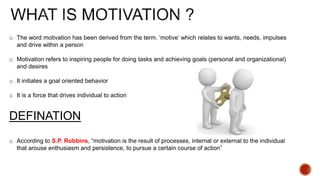
o The word motivation has been derived from the term. ‘motive’ which relates to wants, needs, impulses
and drive within a person
o Motivation refers to inspiring people for doing tasks and achieving goals (personal and organizational)
and desires
o It initiates a goal oriented behavior
o It is a force that drives individual to action
DEFINATION
o According to S.P. Robbins, “motivation is the result of processes, internal or external to the individual
that arouse enthusiasm and persistence, to pursue a certain course of action”
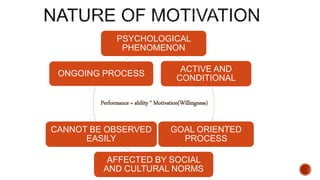
PSYCHOLOGICAL
PHENOMENON
ACTIVE AND
CONDITIONAL
GOAL ORIENTED
PROCESS
AFFECTED BY SOCIAL
AND CULTURAL NORMS
CANNOT BE OBSERVED
EASILY
ONGOING PROCESS
Performance = ability * Motivation(Willingness)
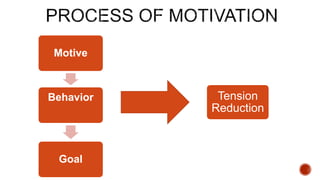
Motive
Behavior
Goal
Tension
Reduction
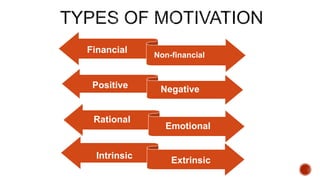
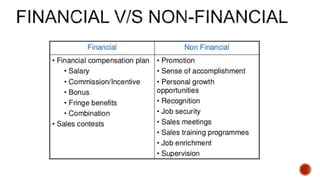
Financial
Non-financial
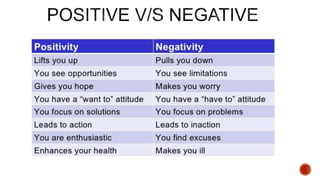
Positive Negative
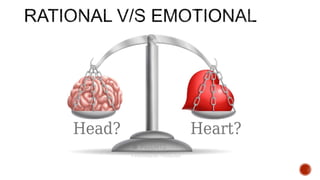
Rational
Emotional
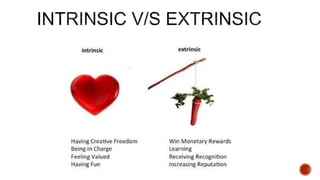
Intrinsic Extrinsic
There are basically 3 major theories of motivation:
Abraham Maslow Frederick Herzberg Douglas McGregor
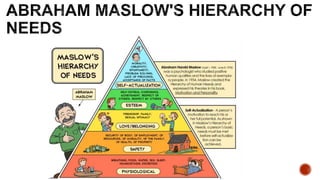
Hierarchy of Needs Motivation and Hygiene Factors Theory X and theory Y
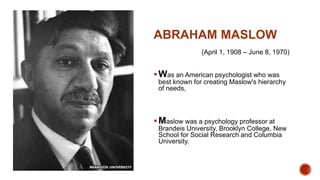
ABRAHAM MASLOW
(April 1, 1908 – June 8, 1970)
Was an American psychologist who was
best known for creating Maslow's hierarchy
of needs,
Maslow was a psychology professor at
Brandeis University, Brooklyn College, New
School for Social Research and Columbia
University.
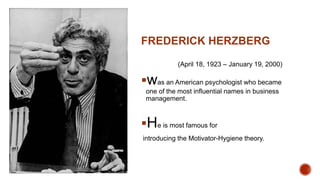
FREDERICK HERZBERG
(April 18, 1923 – January 19, 2000)
was an American psychologist who became
one of the most influential names in business
management.
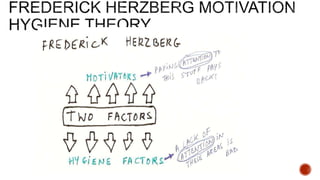
He is most famous for
introducing the Motivator-Hygiene theory.
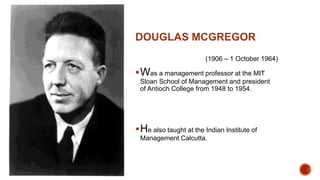
DOUGLAS MCGREGOR
(1906 – 1 October 1964)
Was a management professor at the MIT
Sloan School of Management and president
of Antioch College from 1948 to 1954.
He also taught at the Indian Institute of
Management Calcutta.
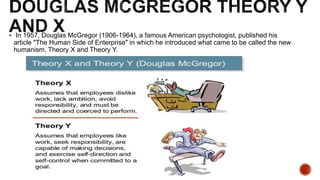
 In 1957, Douglas McGregor (1906-1964), a famous American psychologist, published his
article "The Human Side of Enterprise" in which he introduced what came to be called the new
humanism, Theory X and Theory Y.
 Productive use of Resources.
 Increased efficiency and Output.
 Achievement of Goal.
 Development of friendly Relation.
 Stability in Workforce.
Management
applications
of motivation
concept
Reward
EMPLOYEE
INVOLMENT
PROGRAM MANAGEMENT BY
OBJECTIVE (MBO)
Job
DesignEMPLOYEE
RECOGNITION
PROGRAMS
 Thus it is safe to conclude that motivation plays an integral part of the management system
 Managers seek to keep employees motivated throughout
 Moreover, in today’s world, successful leaders know what they want, have a clear path to
achieving it, and are “driven” by intrinsic rewards. Whether it’s Maslows need for self-
actualization, or Herzberg’s two factor theory leaders are driven by a need for success and
achievement.
Results of motivation
 Willingness to work
 Reduced absenteeism
 Reduced Labor turnover
 Availability of right personnel
 Increase in efficiency and output
 Sense of belongingness
 Improvement upon skills and knowledge
Motivation ob

Motivation ob

  • 1.
  • 2.
    Sr.No Content 1 MEANINGAND DEFINITION 2 NATURE OF MOTIVATION 3 PROCESS OF MOTIVATION 4 TYPES OF MOTIVATION 5 MAJOR THEORIES OF MOTIVATION 6 IMPORTANCE OF MOTIVATION 7 MANAGERIAL APPLICATIONS OF MOTIVATION 8 CONCLUSION
  • 3.
    o The wordmotivation has been derived from the term. ‘motive’ which relates to wants, needs, impulses and drive within a person o Motivation refers to inspiring people for doing tasks and achieving goals (personal and organizational) and desires o It initiates a goal oriented behavior o It is a force that drives individual to action DEFINATION o According to S.P. Robbins, “motivation is the result of processes, internal or external to the individual that arouse enthusiasm and persistence, to pursue a certain course of action”
  • 4.
    PSYCHOLOGICAL PHENOMENON ACTIVE AND CONDITIONAL GOAL ORIENTED PROCESS AFFECTEDBY SOCIAL AND CULTURAL NORMS CANNOT BE OBSERVED EASILY ONGOING PROCESS Performance = ability * Motivation(Willingness)
  • 5.
  • 6.
  • 11.
    There are basically3 major theories of motivation: Abraham Maslow Frederick Herzberg Douglas McGregor Hierarchy of Needs Motivation and Hygiene Factors Theory X and theory Y
  • 12.
    ABRAHAM MASLOW (April 1,1908 – June 8, 1970) Was an American psychologist who was best known for creating Maslow's hierarchy of needs, Maslow was a psychology professor at Brandeis University, Brooklyn College, New School for Social Research and Columbia University.
  • 14.
    FREDERICK HERZBERG (April 18,1923 – January 19, 2000) was an American psychologist who became one of the most influential names in business management. He is most famous for introducing the Motivator-Hygiene theory.
  • 16.
    DOUGLAS MCGREGOR (1906 –1 October 1964) Was a management professor at the MIT Sloan School of Management and president of Antioch College from 1948 to 1954. He also taught at the Indian Institute of Management Calcutta.
  • 17.
     In 1957,Douglas McGregor (1906-1964), a famous American psychologist, published his article "The Human Side of Enterprise" in which he introduced what came to be called the new humanism, Theory X and Theory Y.
  • 18.
     Productive useof Resources.  Increased efficiency and Output.  Achievement of Goal.  Development of friendly Relation.  Stability in Workforce.
  • 19.
  • 20.
     Thus itis safe to conclude that motivation plays an integral part of the management system  Managers seek to keep employees motivated throughout  Moreover, in today’s world, successful leaders know what they want, have a clear path to achieving it, and are “driven” by intrinsic rewards. Whether it’s Maslows need for self- actualization, or Herzberg’s two factor theory leaders are driven by a need for success and achievement. Results of motivation  Willingness to work  Reduced absenteeism  Reduced Labor turnover  Availability of right personnel  Increase in efficiency and output  Sense of belongingness  Improvement upon skills and knowledge