MOTIVATION
DEFINITION
• Motivation is a predisposition to act in a
specific goal directed manner. (Hellriegal
and Slocum)
• Motivation may be defined as the state of
an individual’s perspective which
represents the strength of his or her
propensity to exert effort toward some
particular behavior. (Gibson)
• The term motivation refers to goal directed
behavior. Goal directed the process of
selecting and directing certain actions
among voluntary activities to achieve goals
characterize behavior. (Chung)
• Motives are expressions of a person’s
needs; hence, they are personal and
internal. (Davis)
• Motivation refers to expenditure of effort
toward a goal. (Dubrin)
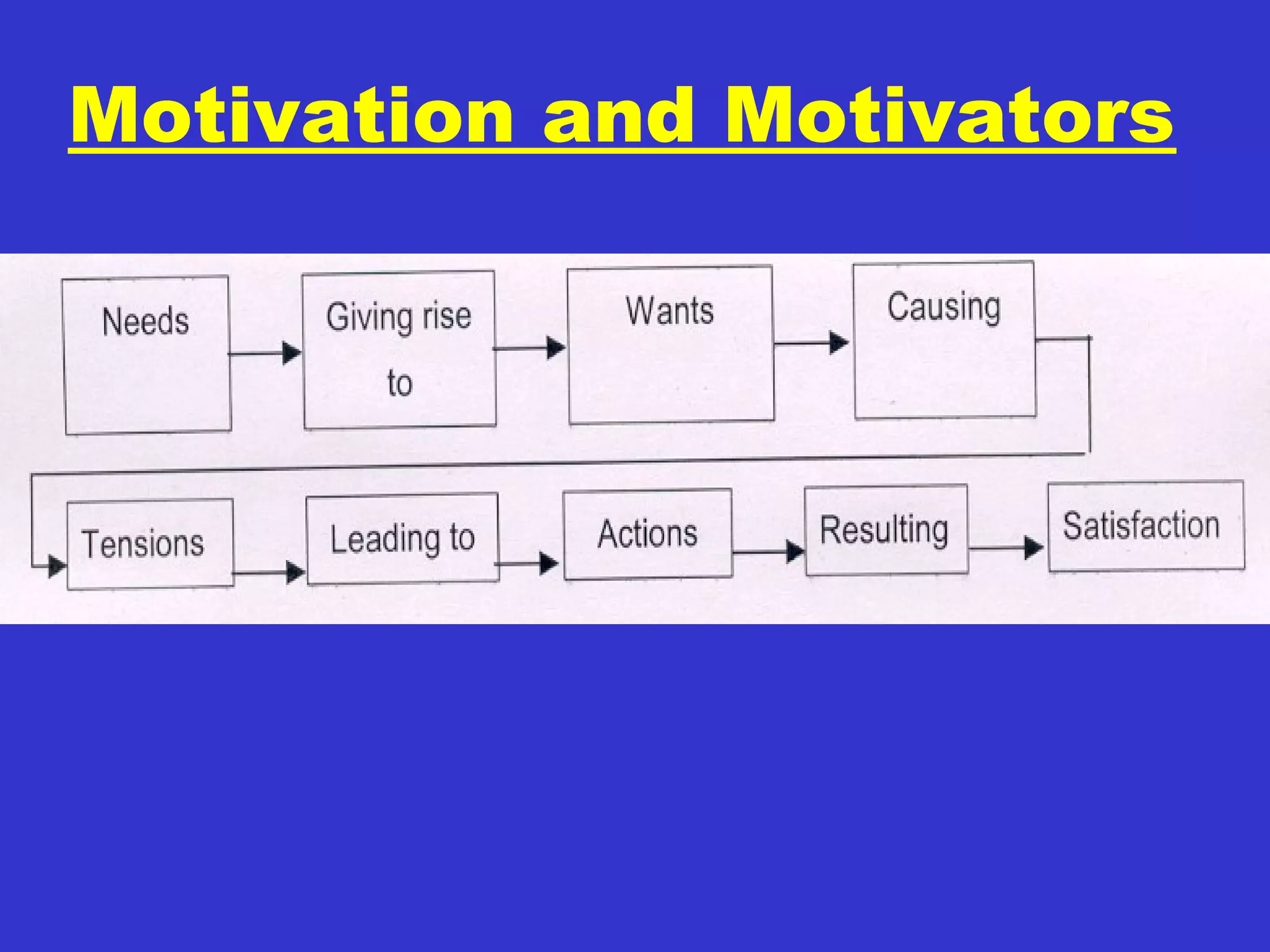
Motivation and Motivators
The Imp of Emp Motivation
• Motivation (the desire to do the job)
• Ability (the cap to do the job)
• The work environment (materials and info
needed to do the job)
Approaches to Motivation
• The Traditional Approach
– Incentive pay system
• The Human Relations Approach
– Strong social needs
– Needs are more imp than money
• The Human Resource Approach
– Contribution of people
Content Perspectives on
Motivation
• The Need Hierarchy Approach
– Maslow hierarchy of Needs
• Biological/Physiological Needs
• Security Needs
• Social Needs
• Esteem Needs
• Self Actualization Needs
– ERG Theory
The Two-Factor Theory
Process Perspectives on Motivation
• Expectancy Theory
– How much we want something
– How likely we think we are to get it
– Four basic assumptions.
• Behavior is determined by a combination of
forces in the indl and the environment.
• People make decisions about their own
behavior in org
• Different people have different types of
needs, desires, and goals
• People make choice from among alternative
plans
• According to this model a manager must
understand what emp want
– Effort to performance expectancy
– Performance to out comes expectancy
– Outcome
– Valence
Equity Theory
• After needs have stimulated the motivation
process and the individual has chosen an
action that is expected to satisfy those needs,
the individual assesses the fairness, or
equity, of the resultant outcome. People are
motivated to seek social equity in the rewards
they receive for performance. Equity is an
individual's belief that the treatment he or she
is receiving is fair relative to the treatment
received by others.
The equity comparison
process
Outcomes(self) ? Outcomes(others)
Inputs(self) = Inputs(others)
Reinforcement perspectives on motivation
• Kind of reinforcement in Organizations
– Positive reinforcement
• Manager observes an emp doing good job and offers praise
the praise
• Serves positively to reinforce the behavior of good work.
– Avoidance
• An emp may come to work on time to avoid a reprimand
• Emp is motivated to perform the behavior of punctuality to
avoid and unpleasant consequence that is likely to follow
tardiness.
– Punishment
• Used by some managers to weaken undesired behaviors
– Extinction
• Can also be used to weaken behavior
• By simply ignoring this behavior and not reinforcing it
• The boss can cause the behavior to subside and eventually
• Providing Reinforcement in Organizations
– Fixed-interval schedule provides reinforcement at fixed
intervals of time, regardless of behavior
– A good example of this schedule is the weekly or monthly
paycheck
– Variable-interval schedule also uses time as the basis for
reinforcement but the time interval varies from one
reinforcement to the next
– Schedule is appropriate for praise other rewards based on
visits or inspections
– When employees do not know when the boss is going to
drop by they tend to maintain a reasonably high level of
effort all the time.
– Fixed –ratio Schedule gives reinforcement after a fixed
number of behaviors
– This results in an even higher level of effort.
– Variable-ratio schedule, most powerful schedule in terms of
maintaining desired behaviors, varies the number of
behaviors needed for each reinforcement
– Emp is motivated to inc the frequency for the desired
behavior
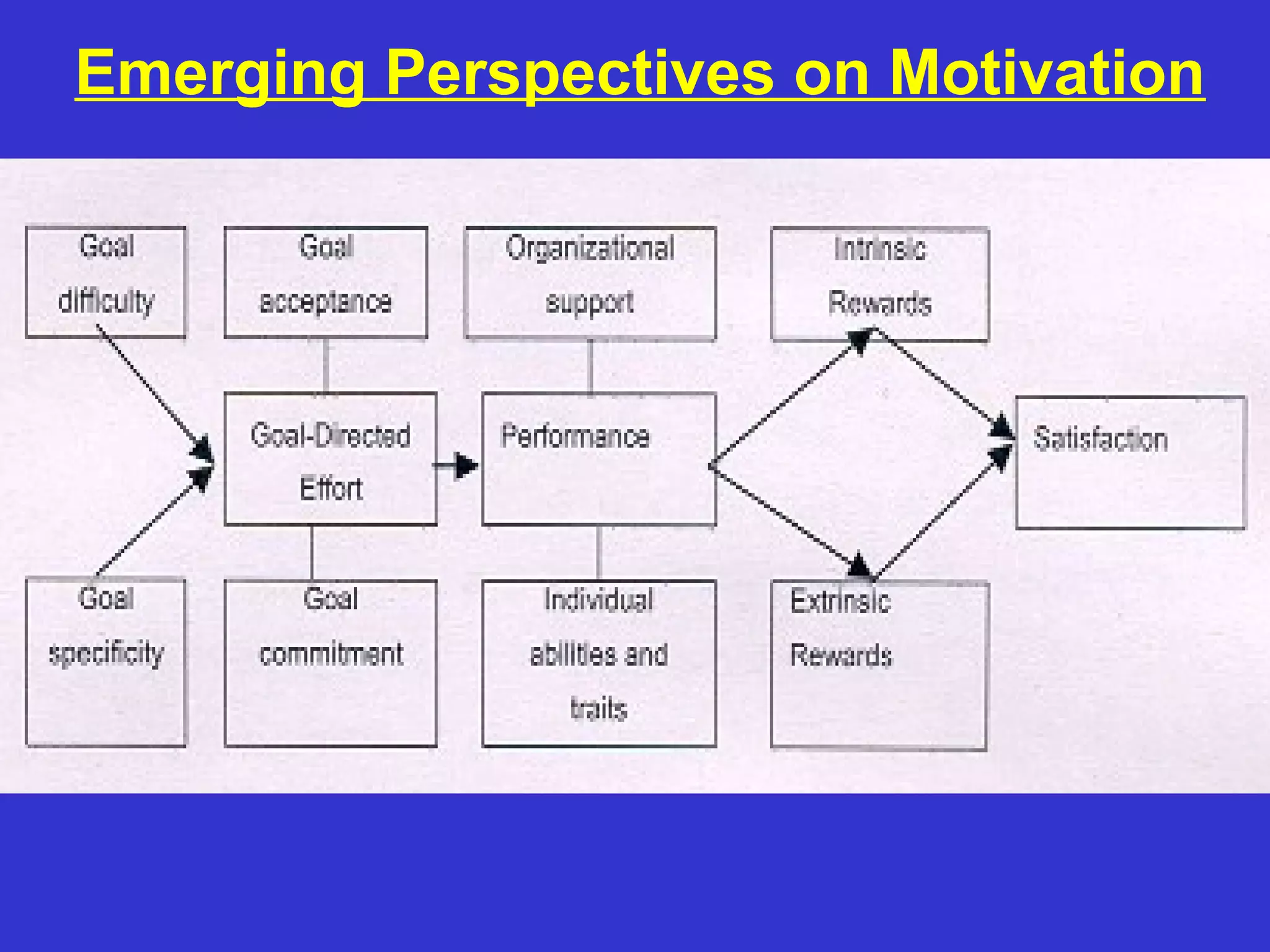
Emerging Perspectives on Motivation
Motivational Strategies
• Behavior modification or OB Mod
– Modified workweek for emp
– Compressed workweek
– Flexible work schedule
• Changing the nature of the task-related
activities of work
• Empowerment and participation to boost
motivation
• Using Reward Systems to Motivate Performance
– Effect of Rewards on Attitude
• Emp satisfaction
• Emp satisfaction is affected by comparisons with
what happens to others.
• Emp often misperceive the rewards of others
• Overall job satisfaction
– Effect of Rewards on Behaviors
• An organization’s primary purpose in giving
rewards is to influence emp behavior
• Extrinsic rewards affect emp satisfaction
– Effect of Rewards on Motivation
• Reward systems are clearly related to the expectancy
theory of motivation
• The effort-to-performance expectancy is strongly
influenced by the performance appraisal that is often a
part of the reward system
• Emp is likely to put forth-extra effort if he or she knows
that performance will be measured and evaluated
– Designing Effective Reward Systems
• The reward system must meet the needs of the indl for
basic nec.
• The rewards should compare favorably with those
offered by other org
• Distribution of rewards within the org must be equitable
• Reward system must recognize that different people
have different needs and choose different paths to
satisfy those needs.
•

Motivation approach,processes and theories

  • 1.
  • 2.
    DEFINITION • Motivation isa predisposition to act in a specific goal directed manner. (Hellriegal and Slocum) • Motivation may be defined as the state of an individual’s perspective which represents the strength of his or her propensity to exert effort toward some particular behavior. (Gibson)
  • 3.
    • The termmotivation refers to goal directed behavior. Goal directed the process of selecting and directing certain actions among voluntary activities to achieve goals characterize behavior. (Chung) • Motives are expressions of a person’s needs; hence, they are personal and internal. (Davis) • Motivation refers to expenditure of effort toward a goal. (Dubrin)
  • 4.
  • 5.
    The Imp ofEmp Motivation • Motivation (the desire to do the job) • Ability (the cap to do the job) • The work environment (materials and info needed to do the job)
  • 6.
    Approaches to Motivation •The Traditional Approach – Incentive pay system • The Human Relations Approach – Strong social needs – Needs are more imp than money • The Human Resource Approach – Contribution of people
  • 7.
    Content Perspectives on Motivation •The Need Hierarchy Approach – Maslow hierarchy of Needs • Biological/Physiological Needs • Security Needs • Social Needs • Esteem Needs • Self Actualization Needs – ERG Theory
  • 8.
  • 9.
    Process Perspectives onMotivation • Expectancy Theory – How much we want something – How likely we think we are to get it – Four basic assumptions. • Behavior is determined by a combination of forces in the indl and the environment. • People make decisions about their own behavior in org • Different people have different types of needs, desires, and goals • People make choice from among alternative plans
  • 10.
    • According tothis model a manager must understand what emp want – Effort to performance expectancy – Performance to out comes expectancy – Outcome – Valence
  • 11.
    Equity Theory • Afterneeds have stimulated the motivation process and the individual has chosen an action that is expected to satisfy those needs, the individual assesses the fairness, or equity, of the resultant outcome. People are motivated to seek social equity in the rewards they receive for performance. Equity is an individual's belief that the treatment he or she is receiving is fair relative to the treatment received by others.
  • 12.
    The equity comparison process Outcomes(self)? Outcomes(others) Inputs(self) = Inputs(others)
  • 13.
    Reinforcement perspectives onmotivation • Kind of reinforcement in Organizations – Positive reinforcement • Manager observes an emp doing good job and offers praise the praise • Serves positively to reinforce the behavior of good work. – Avoidance • An emp may come to work on time to avoid a reprimand • Emp is motivated to perform the behavior of punctuality to avoid and unpleasant consequence that is likely to follow tardiness. – Punishment • Used by some managers to weaken undesired behaviors – Extinction • Can also be used to weaken behavior • By simply ignoring this behavior and not reinforcing it • The boss can cause the behavior to subside and eventually
  • 14.
    • Providing Reinforcementin Organizations – Fixed-interval schedule provides reinforcement at fixed intervals of time, regardless of behavior – A good example of this schedule is the weekly or monthly paycheck – Variable-interval schedule also uses time as the basis for reinforcement but the time interval varies from one reinforcement to the next – Schedule is appropriate for praise other rewards based on visits or inspections – When employees do not know when the boss is going to drop by they tend to maintain a reasonably high level of effort all the time. – Fixed –ratio Schedule gives reinforcement after a fixed number of behaviors – This results in an even higher level of effort. – Variable-ratio schedule, most powerful schedule in terms of maintaining desired behaviors, varies the number of behaviors needed for each reinforcement – Emp is motivated to inc the frequency for the desired behavior
  • 15.
  • 16.
    Motivational Strategies • Behaviormodification or OB Mod – Modified workweek for emp – Compressed workweek – Flexible work schedule • Changing the nature of the task-related activities of work • Empowerment and participation to boost motivation
  • 17.
    • Using RewardSystems to Motivate Performance – Effect of Rewards on Attitude • Emp satisfaction • Emp satisfaction is affected by comparisons with what happens to others. • Emp often misperceive the rewards of others • Overall job satisfaction – Effect of Rewards on Behaviors • An organization’s primary purpose in giving rewards is to influence emp behavior • Extrinsic rewards affect emp satisfaction
  • 18.
    – Effect ofRewards on Motivation • Reward systems are clearly related to the expectancy theory of motivation • The effort-to-performance expectancy is strongly influenced by the performance appraisal that is often a part of the reward system • Emp is likely to put forth-extra effort if he or she knows that performance will be measured and evaluated – Designing Effective Reward Systems • The reward system must meet the needs of the indl for basic nec. • The rewards should compare favorably with those offered by other org • Distribution of rewards within the org must be equitable • Reward system must recognize that different people have different needs and choose different paths to satisfy those needs. •