MEDI-CAPS INSTITUTE OF TECHNOLOGY AND MANAGEMENT

SUBJECT: ORGANAIZATION BEHAVIOUR
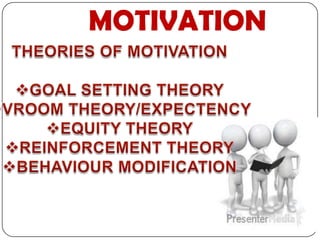
MOTIVATION
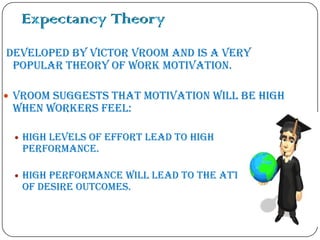
Expectancy Theory
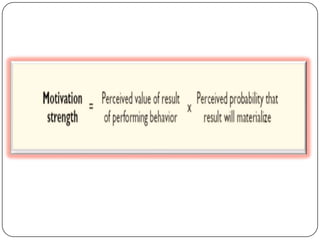
Developed by Victor Vroom and is a very
popular theory of work motivation.
 Vroom suggests that motivation will be high

when workers feel:


High levels of effort lead to high
performance.



High performance will lead to the attainment
of desire outcomes.
Expectancy Theory

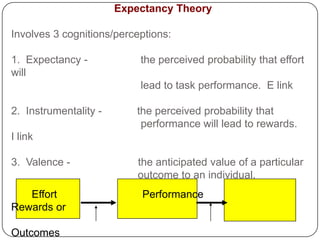
Involves 3 cognitions/perceptions:
1. Expectancy will

the perceived probability that effort
lead to task performance. E link

2. Instrumentality -

the perceived probability that
performance will lead to rewards.
I link
3. Valence Effort
Rewards or
Outcomes

the anticipated value of a particular
outcome to an individual.
Performance
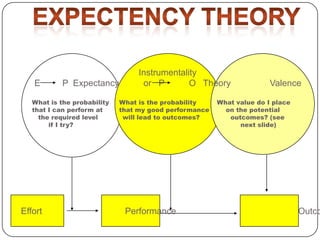
E

P Expectancy

What is the probability
that I can perform at
the required level
if I try?

Effort

Instrumentality
or P
O Theory

What is the probability
that my good performance
will lead to outcomes?

Performance

Valence

What value do I place
on the potential
outcomes? (see
next slide)

Outco
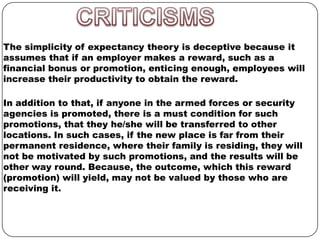
The simplicity of expectancy theory is deceptive because it
assumes that if an employer makes a reward, such as a
financial bonus or promotion, enticing enough, employees will
increase their productivity to obtain the reward.
In addition to that, if anyone in the armed forces or security
agencies is promoted, there is a must condition for such
promotions, that they he/she will be transferred to other
locations. In such cases, if the new place is far from their
permanent residence, where their family is residing, they will
not be motivated by such promotions, and the results will be
other way round. Because, the outcome, which this reward

(promotion) will yield, may not be valued by those who are
receiving it.
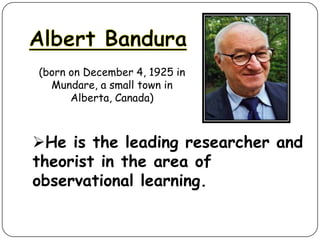
(born on December 4, 1925 in
Mundare, a small town in
Alberta, Canada)

He is the leading researcher and
theorist in the area of
observational learning.
Reinforcement theory of motivation
was proposed by BF Skinner and his
associates.
It states that individual’s
behavior is a function of its
consequences. (based on law of
effect)
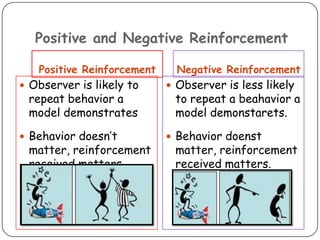
Positive and Negative Reinforcement
Positive Reinforcement

Negative Reinforcement

 Observer is likely to

 Observer is less likely

 Behavior doesn’t

 Behavior doenst

repeat behavior a
model demonstrates

matter, reinforcement
received matters.

to repeat a beahavior a
model demonstarets.
matter, reinforcement
received matters.
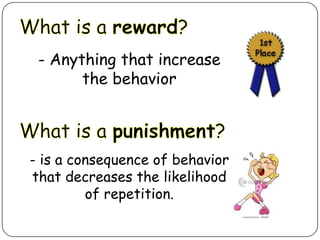
- Anything that increase
the behavior

- is a consequence of behavior
that decreases the likelihood
of repetition.
1.The observer is reinforced by the
model
2. The observer is reinforced by a
third person

3. The imitated behavior itself leads to
reinforcing consequences
4. Consequences of the model’s behavior
affect the observers behavior
vicariously (vicarious reinforcement)
Teaches new behaviors

Increases or decreases the
frequency with which previously
learned behaviors are carried out
Can encourage previously forbidden
behavior
Can increase or decrease similar
behaviors.
The definition of behavioral reinforcement has been circular
since it appears to argue that response strength is
increased by reinforcement and defines reinforcement as
something that increased responses strength .However the
correct usage of reinforcement is that something is a
reinforcer because of its effect on behavior and not the
other way around .It become circular if one says that a
particular stimulus strengthens behavior because it is are
informer and does not explain why a stimulus is producing
that effect on the behavior
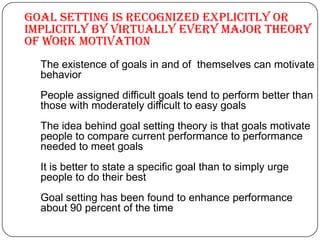
Goal setting is recognized explicitly or
implicitly by virtually every major theory
of work motivation
The existence of goals in and of themselves can motivate
behavior
People assigned difficult goals tend to perform better than
those with moderately difficult to easy goals
The idea behind goal setting theory is that goals motivate
people to compare current performance to performance
needed to meet goals
It is better to state a specific goal than to simply urge
people to do their best
Goal setting has been found to enhance performance
about 90 percent of the time
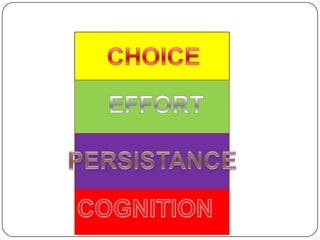
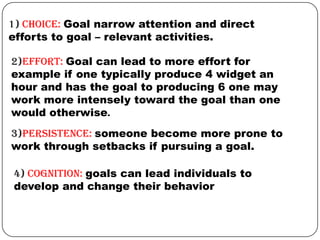
1) CHOICE: Goal narrow attention and direct
efforts to goal – relevant activities.
2)effort: Goal can lead to more effort for
example if one typically produce 4 widget an
hour and has the goal to producing 6 one may
work more intensely toward the goal than one
would otherwise.

3)persistence: someone become more prone to
work through setbacks if pursuing a goal.
4) cognition: goals can lead individuals to
develop and change their behavior
In an organization a goal of a manager may
not align with the goal of the organization as
a whole. In such cases the goal of an
individual may come into direct conflict with
the employing organization
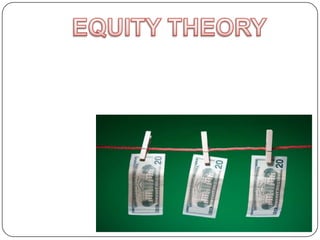
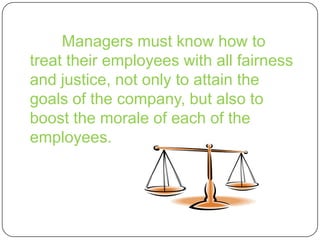
Implication ofmust know how to
Managers Equity Theory
treat their employees with all fairness
and justice, not only to attain the
goals of the company, but also to
boost the morale of each of the
employees.
Equity Theories
 The research evidence on equity theories is generally

strong.
 although it might be a mistake to reduce our

understanding of all interpersonal interactions at
work to a type of social exchange bargaining
 equity theories may provide important insights into

understanding how people believe they are treated
work
 research on equity theories provides important

information on the influence of pay on motivation and
on how people look to others to evaluate whether they
think they are treated fairly
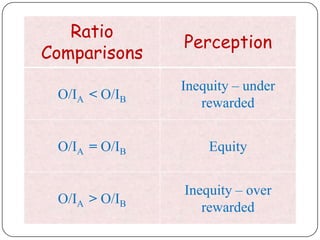
Ratio
Comparisons

Perception

O/IA < O/IB

Inequity – under
rewarded

O/IA = O/IB

Equity

O/IA > O/IB

Inequity – over
rewarded
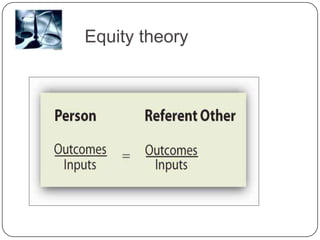
Equity theory
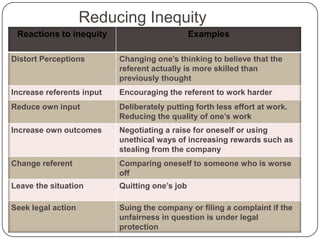
Reducing Inequity
Reactions to inequity

Examples

Distort Perceptions

Changing one’s thinking to believe that the
referent actually is more skilled than
previously thought

Increase referents input

Encouraging the referent to work harder

Reduce own input

Deliberately putting forth less effort at work.
Reducing the quality of one’s work

Increase own outcomes

Negotiating a raise for oneself or using
unethical ways of increasing rewards such as
stealing from the company

Change referent

Comparing oneself to someone who is worse
off

Leave the situation

Quitting one’s job

Seek legal action

Suing the company or filing a complaint if the
unfairness in question is under legal
protection
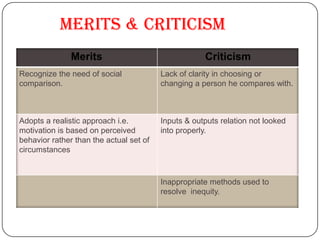
Merits & criticism
Merits

Criticism

Recognize the need of social
comparison.

Lack of clarity in choosing or
changing a person he compares with.

Adopts a realistic approach i.e.
motivation is based on perceived
behavior rather than the actual set of
circumstances

Inputs & outputs relation not looked
into properly.

Inappropriate methods used to
resolve inequity.
What’s Behaviour
Modification?

Interfere positively in the
child’s activities to influence
its thoughts in order to bring
in desirable changes in the
pattern of behaviour
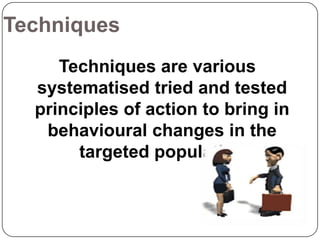
Techniques
Techniques are various
systematised tried and tested
principles of action to bring in
behavioural changes in the
targeted population
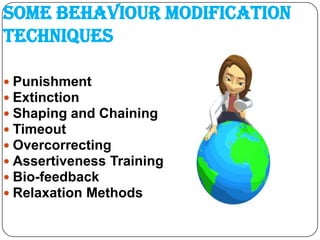
Some Behaviour Modification
techniques
 Punishment
 Extinction
 Shaping and Chaining
 Timeout
 Overcorrecting
 Assertiveness Training
 Bio-feedback
 Relaxation Methods
Extinction
Parents can create behaviour
“extinction” by carefully observing
their child’s behavour and noticing
what reward the child receives for
that inappropriate behaviour.
Punishment
The punishment procedures have
been used with both typical and
atypical developing
children, teenagers, elderly
persons, animals and people
exhibiting different psychological
disorders.
Shaping and Changing
This is a behavioural term that refers
to gradually moulding or training
an organism to perform a specific
response (behaviour) by
reinforcing any response that are
similar to the desired response.
Time Out
Temporarily changing or separating
the child from the environment
where inappropriate behaviour has
occurred.
It’s intended to remove a positive
reinforcement of the undesired
behaviour.
Relaxation Methods
To effectively combat stress, we
need to activate the body’s natural
relaxation response. We can do
this by practicing relaxation
techniques such as deep
breathing, mindful meditation,
rhythmic exercises and YOGA.
SUMMARY
Motivation is an internal feeling
which can be understood only by
manager since he is in close contact
with the employees. Needs, wants
and desires are inter-related and
they are the driving force to act.
These needs can be understood by
the manager and he can frame
motivation plans accordingly.
The End
MOTIVATION KOMAL YADAV

MOTIVATION KOMAL YADAV

  • 1.
    MEDI-CAPS INSTITUTE OFTECHNOLOGY AND MANAGEMENT SUBJECT: ORGANAIZATION BEHAVIOUR
  • 2.
  • 3.
    Expectancy Theory Developed byVictor Vroom and is a very popular theory of work motivation.  Vroom suggests that motivation will be high when workers feel:  High levels of effort lead to high performance.  High performance will lead to the attainment of desire outcomes.
  • 5.
    Expectancy Theory Involves 3cognitions/perceptions: 1. Expectancy will the perceived probability that effort lead to task performance. E link 2. Instrumentality - the perceived probability that performance will lead to rewards. I link 3. Valence Effort Rewards or Outcomes the anticipated value of a particular outcome to an individual. Performance
  • 6.
    E P Expectancy What isthe probability that I can perform at the required level if I try? Effort Instrumentality or P O Theory What is the probability that my good performance will lead to outcomes? Performance Valence What value do I place on the potential outcomes? (see next slide) Outco
  • 7.
    The simplicity ofexpectancy theory is deceptive because it assumes that if an employer makes a reward, such as a financial bonus or promotion, enticing enough, employees will increase their productivity to obtain the reward. In addition to that, if anyone in the armed forces or security agencies is promoted, there is a must condition for such promotions, that they he/she will be transferred to other locations. In such cases, if the new place is far from their permanent residence, where their family is residing, they will not be motivated by such promotions, and the results will be other way round. Because, the outcome, which this reward (promotion) will yield, may not be valued by those who are receiving it.
  • 9.
    (born on December4, 1925 in Mundare, a small town in Alberta, Canada) He is the leading researcher and theorist in the area of observational learning.
  • 10.
    Reinforcement theory ofmotivation was proposed by BF Skinner and his associates. It states that individual’s behavior is a function of its consequences. (based on law of effect)
  • 11.
    Positive and NegativeReinforcement Positive Reinforcement Negative Reinforcement  Observer is likely to  Observer is less likely  Behavior doesn’t  Behavior doenst repeat behavior a model demonstrates matter, reinforcement received matters. to repeat a beahavior a model demonstarets. matter, reinforcement received matters.
  • 12.
    - Anything thatincrease the behavior - is a consequence of behavior that decreases the likelihood of repetition.
  • 13.
    1.The observer isreinforced by the model 2. The observer is reinforced by a third person 3. The imitated behavior itself leads to reinforcing consequences 4. Consequences of the model’s behavior affect the observers behavior vicariously (vicarious reinforcement)
  • 14.
    Teaches new behaviors Increasesor decreases the frequency with which previously learned behaviors are carried out Can encourage previously forbidden behavior Can increase or decrease similar behaviors.
  • 15.
    The definition ofbehavioral reinforcement has been circular since it appears to argue that response strength is increased by reinforcement and defines reinforcement as something that increased responses strength .However the correct usage of reinforcement is that something is a reinforcer because of its effect on behavior and not the other way around .It become circular if one says that a particular stimulus strengthens behavior because it is are informer and does not explain why a stimulus is producing that effect on the behavior
  • 17.
    Goal setting isrecognized explicitly or implicitly by virtually every major theory of work motivation The existence of goals in and of themselves can motivate behavior People assigned difficult goals tend to perform better than those with moderately difficult to easy goals The idea behind goal setting theory is that goals motivate people to compare current performance to performance needed to meet goals It is better to state a specific goal than to simply urge people to do their best Goal setting has been found to enhance performance about 90 percent of the time
  • 20.
    1) CHOICE: Goalnarrow attention and direct efforts to goal – relevant activities. 2)effort: Goal can lead to more effort for example if one typically produce 4 widget an hour and has the goal to producing 6 one may work more intensely toward the goal than one would otherwise. 3)persistence: someone become more prone to work through setbacks if pursuing a goal. 4) cognition: goals can lead individuals to develop and change their behavior
  • 21.
    In an organizationa goal of a manager may not align with the goal of the organization as a whole. In such cases the goal of an individual may come into direct conflict with the employing organization
  • 23.
    Implication ofmust knowhow to Managers Equity Theory treat their employees with all fairness and justice, not only to attain the goals of the company, but also to boost the morale of each of the employees.
  • 24.
    Equity Theories  Theresearch evidence on equity theories is generally strong.  although it might be a mistake to reduce our understanding of all interpersonal interactions at work to a type of social exchange bargaining  equity theories may provide important insights into understanding how people believe they are treated work  research on equity theories provides important information on the influence of pay on motivation and on how people look to others to evaluate whether they think they are treated fairly
  • 25.
    Ratio Comparisons Perception O/IA < O/IB Inequity– under rewarded O/IA = O/IB Equity O/IA > O/IB Inequity – over rewarded
  • 26.
  • 27.
    Reducing Inequity Reactions toinequity Examples Distort Perceptions Changing one’s thinking to believe that the referent actually is more skilled than previously thought Increase referents input Encouraging the referent to work harder Reduce own input Deliberately putting forth less effort at work. Reducing the quality of one’s work Increase own outcomes Negotiating a raise for oneself or using unethical ways of increasing rewards such as stealing from the company Change referent Comparing oneself to someone who is worse off Leave the situation Quitting one’s job Seek legal action Suing the company or filing a complaint if the unfairness in question is under legal protection
  • 28.
    Merits & criticism Merits Criticism Recognizethe need of social comparison. Lack of clarity in choosing or changing a person he compares with. Adopts a realistic approach i.e. motivation is based on perceived behavior rather than the actual set of circumstances Inputs & outputs relation not looked into properly. Inappropriate methods used to resolve inequity.
  • 29.
    What’s Behaviour Modification? Interfere positivelyin the child’s activities to influence its thoughts in order to bring in desirable changes in the pattern of behaviour
  • 30.
    Techniques Techniques are various systematisedtried and tested principles of action to bring in behavioural changes in the targeted population
  • 31.
    Some Behaviour Modification techniques Punishment  Extinction  Shaping and Chaining  Timeout  Overcorrecting  Assertiveness Training  Bio-feedback  Relaxation Methods
  • 32.
    Extinction Parents can createbehaviour “extinction” by carefully observing their child’s behavour and noticing what reward the child receives for that inappropriate behaviour.
  • 33.
    Punishment The punishment procedureshave been used with both typical and atypical developing children, teenagers, elderly persons, animals and people exhibiting different psychological disorders.
  • 34.
    Shaping and Changing Thisis a behavioural term that refers to gradually moulding or training an organism to perform a specific response (behaviour) by reinforcing any response that are similar to the desired response.
  • 35.
    Time Out Temporarily changingor separating the child from the environment where inappropriate behaviour has occurred. It’s intended to remove a positive reinforcement of the undesired behaviour.
  • 36.
    Relaxation Methods To effectivelycombat stress, we need to activate the body’s natural relaxation response. We can do this by practicing relaxation techniques such as deep breathing, mindful meditation, rhythmic exercises and YOGA.
  • 37.
    SUMMARY Motivation is aninternal feeling which can be understood only by manager since he is in close contact with the employees. Needs, wants and desires are inter-related and they are the driving force to act. These needs can be understood by the manager and he can frame motivation plans accordingly.
  • 38.