Motivating for High Performance Chapter 12
Learning Outcomes Illustrate the motivation process.  Explain the performance formula and how to use it.  Discuss the major similarities and differences among the four content motivation theories: hierarchy of needs theory, ERG theory, two-factor theory, and acquired needs theory.  Discuss the major similarities and differences among the three process motivation theories: equity theory, goal-setting theory, and expectancy theory.  Explain the four types of reinforcement.  State the major differences among content, process, and reinforcement theories. After studying this chapter, you should be able to:
Learning Outcomes (cont’d) Define the following  key terms : motivation  acquired needs theory motivation process  process motivation theories performance formula  equity theory content motivation theories  goal-setting theory hierarchy of needs theory  expectancy theory ERG theory  reinforcement theory two-factor theory  giving praise model
Ideas on Management   at Market America What does Market America do to motivate its distributors, and how does it affect performance? How does Market America meet its distributors’ content motivation needs? How does Market America meet its distributors’ process motivation needs? How does Market America use reinforcement theory to motivate its distributors? Will the Market America UnFranchise ®  business model for motivating work in other countries?
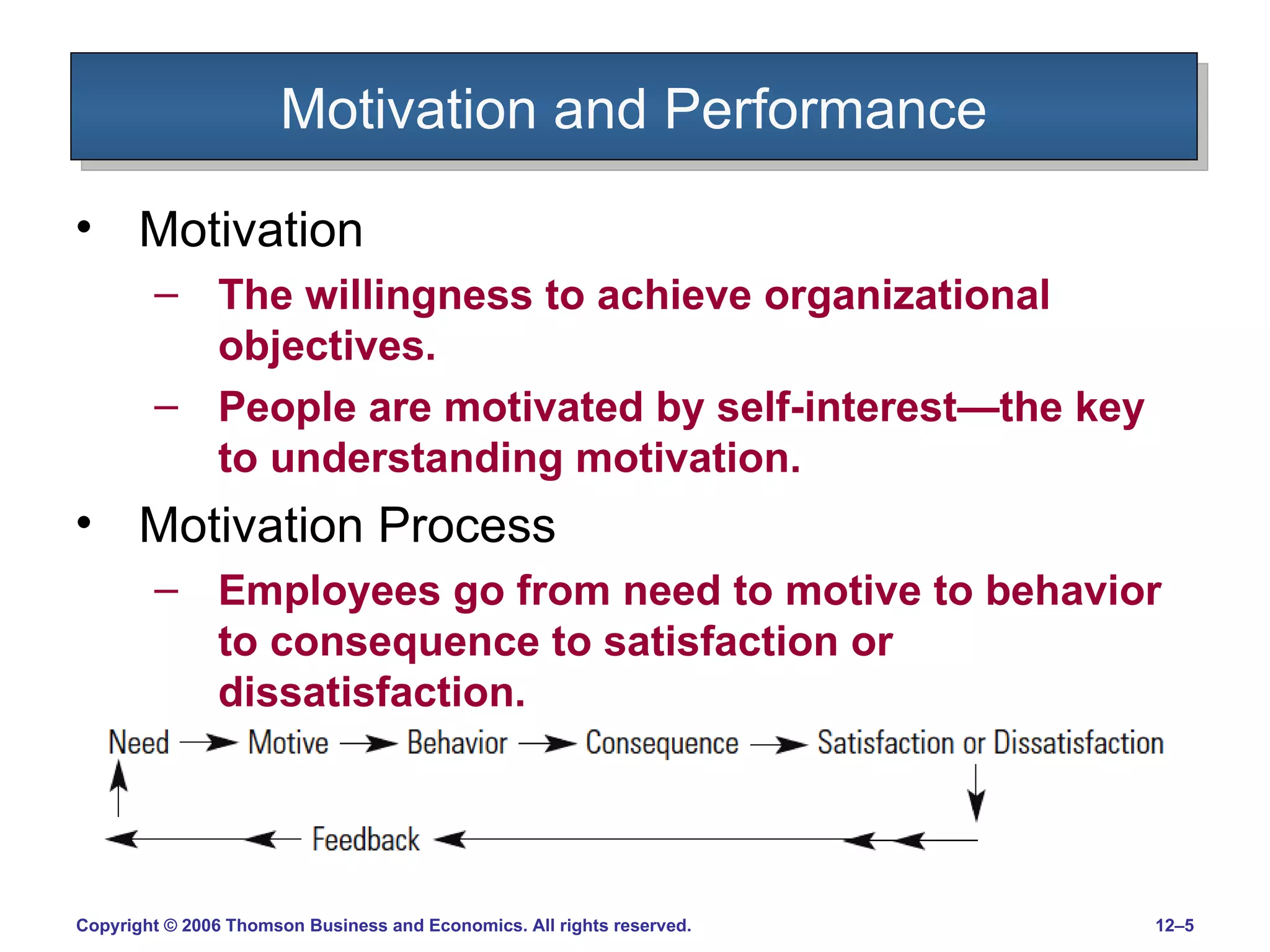
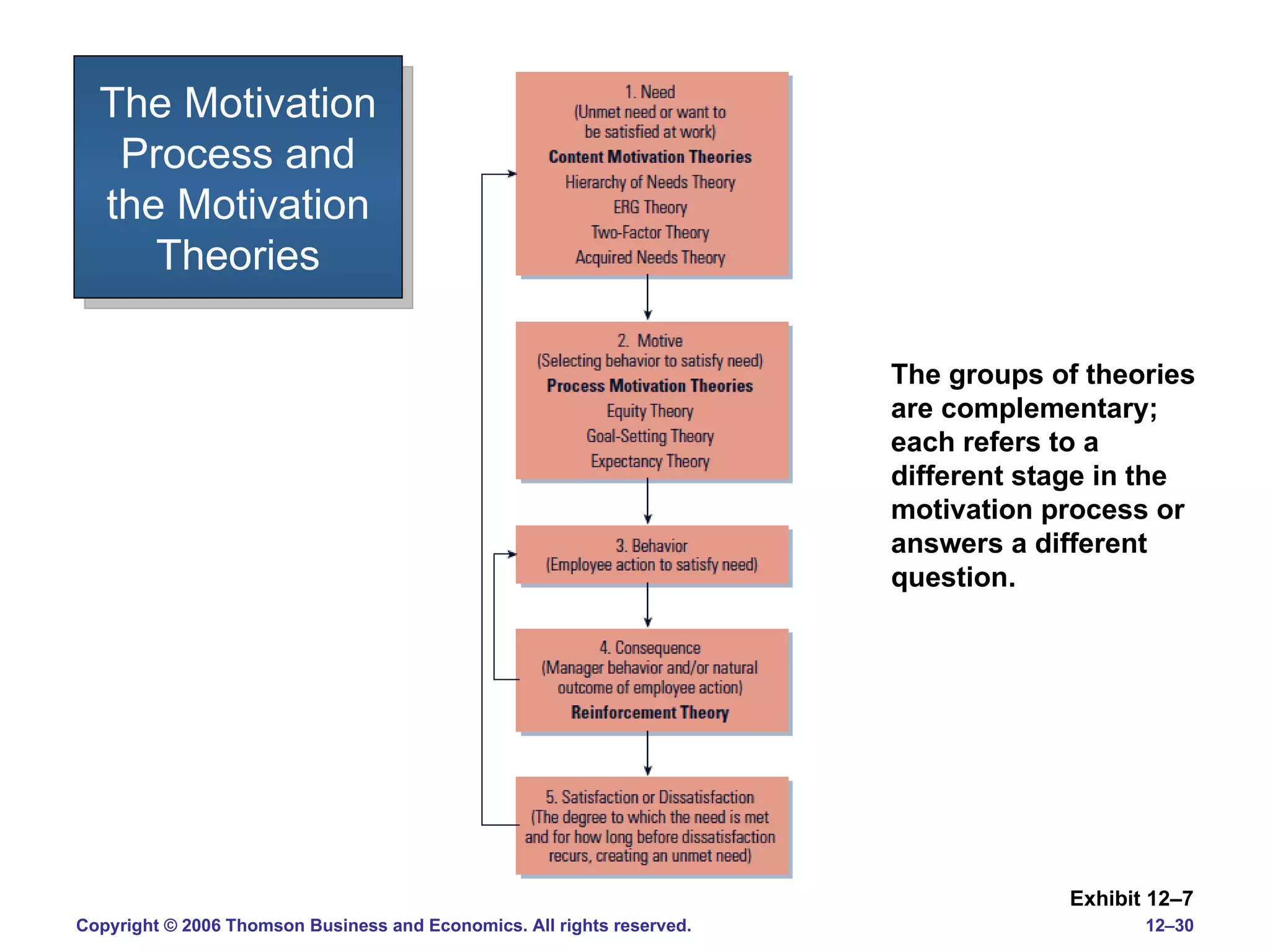
Motivation and Performance Motivation The willingness to achieve organizational objectives. People are motivated by self-interest —the  key to understanding motivation. Motivation Process Employees go from need to motive to behavior to consequence to satisfaction or dissatisfaction.
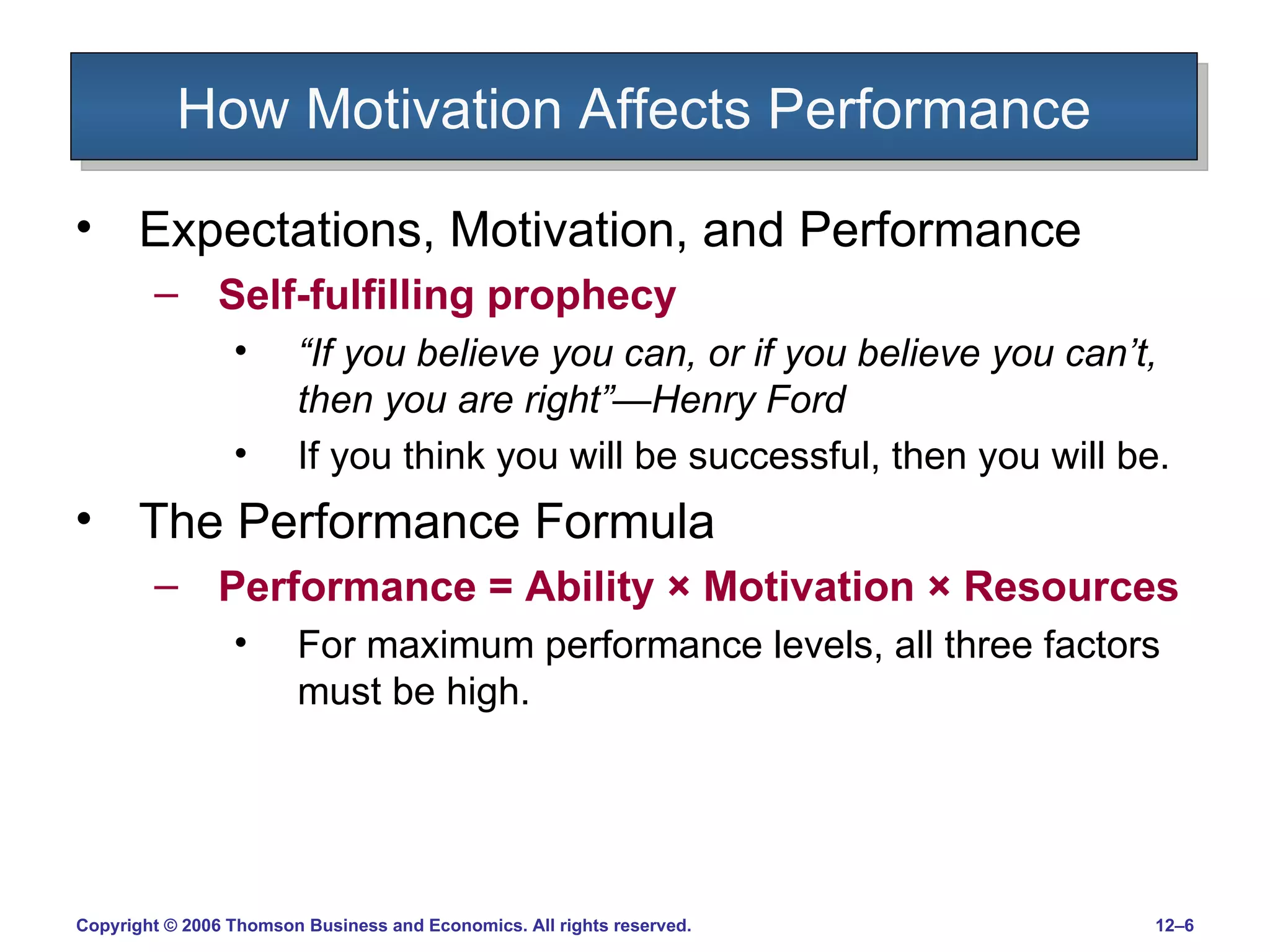
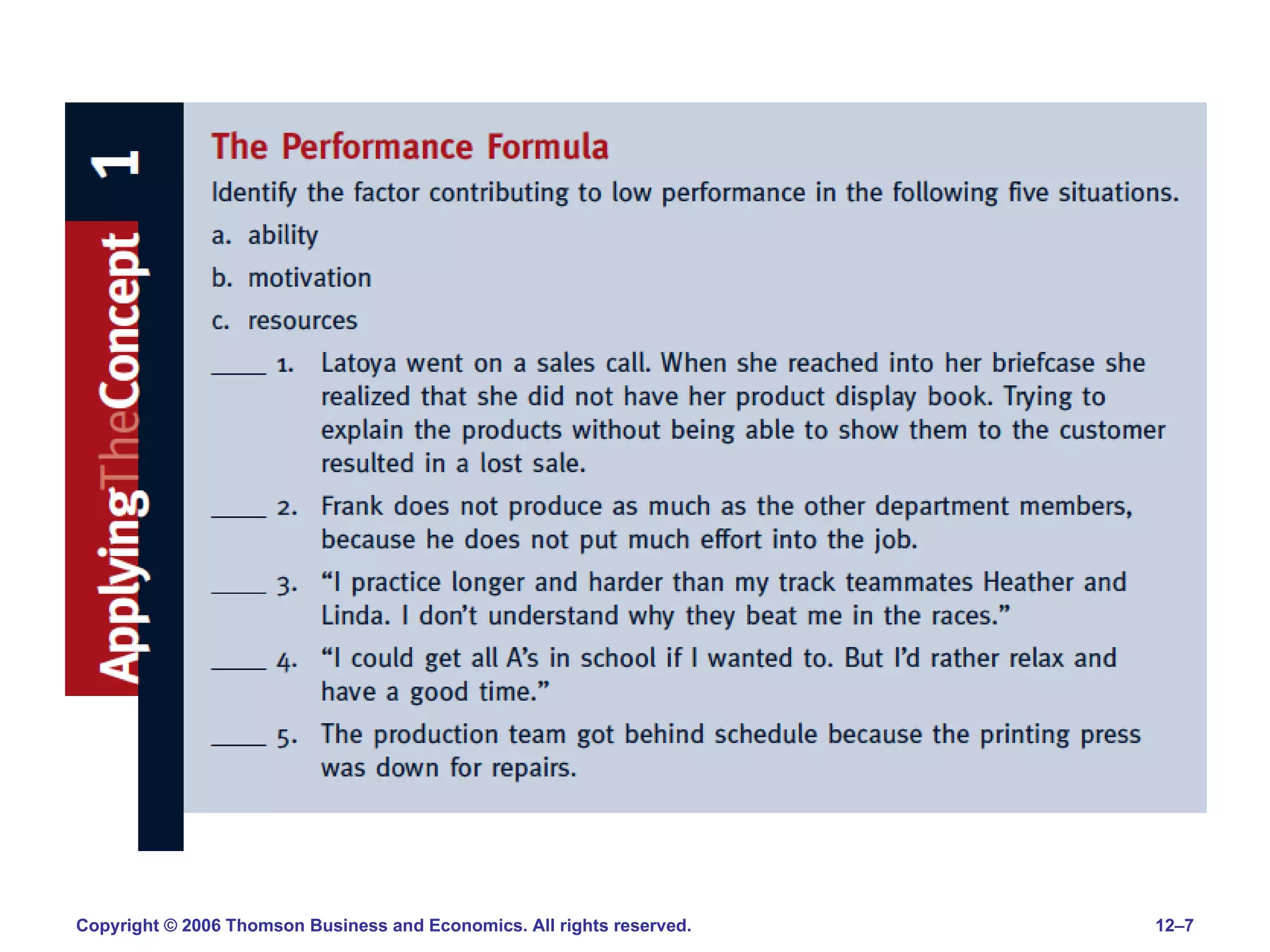
How Motivation Affects Performance Expectations, Motivation, and Performance Self-fulfilling prophecy “ If you believe you can, or if you believe you can’t, then you are right” —Henry Ford If you think you will be successful, then you will be. The Performance Formula Performance = Ability  ×  Motivation  ×  Resources For maximum performance levels, all three factors must be high.
 
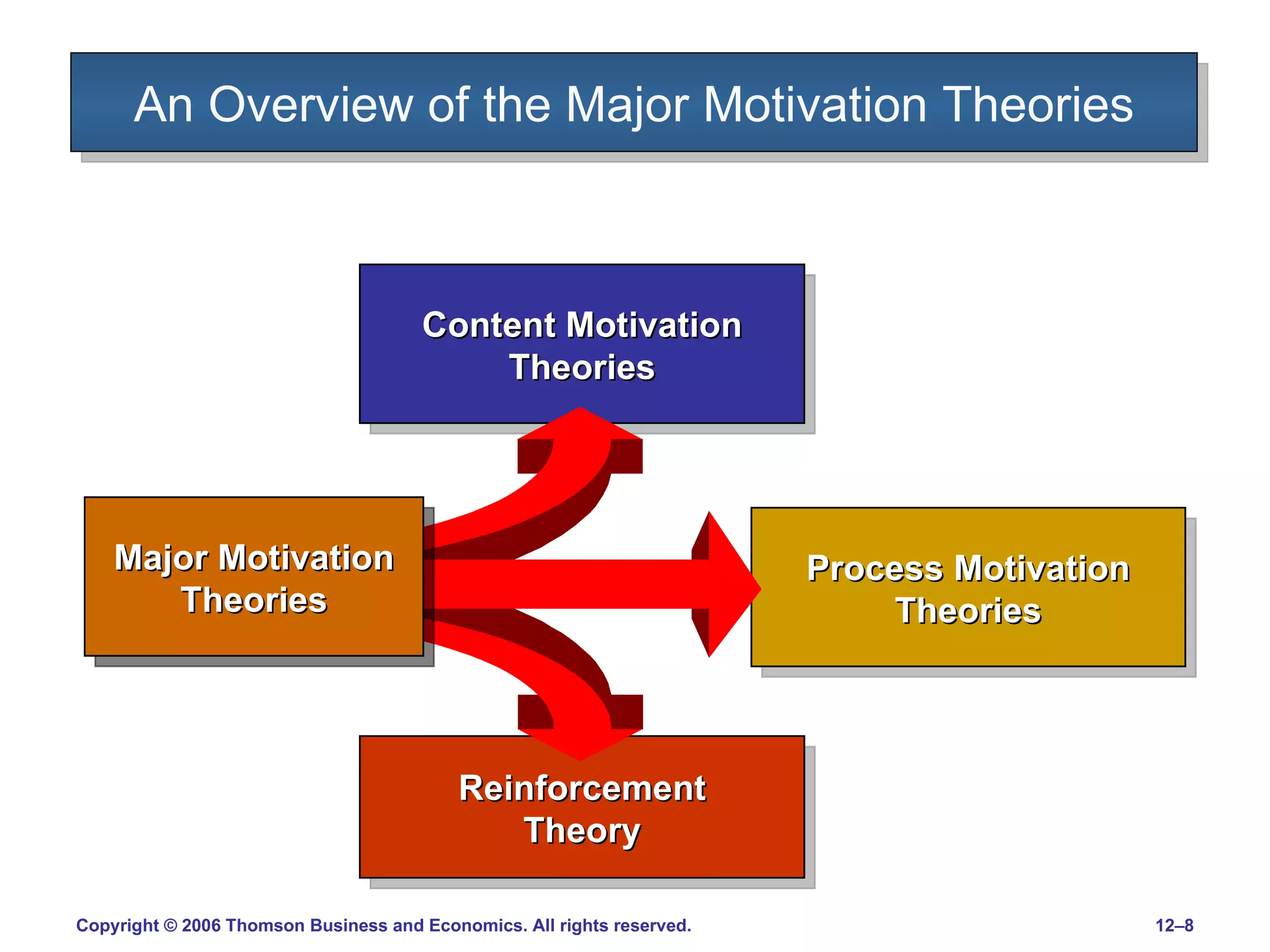
An Overview of the Major Motivation Theories Major Motivation Theories Content Motivation Theories Process Motivation Theories Reinforcement Theory
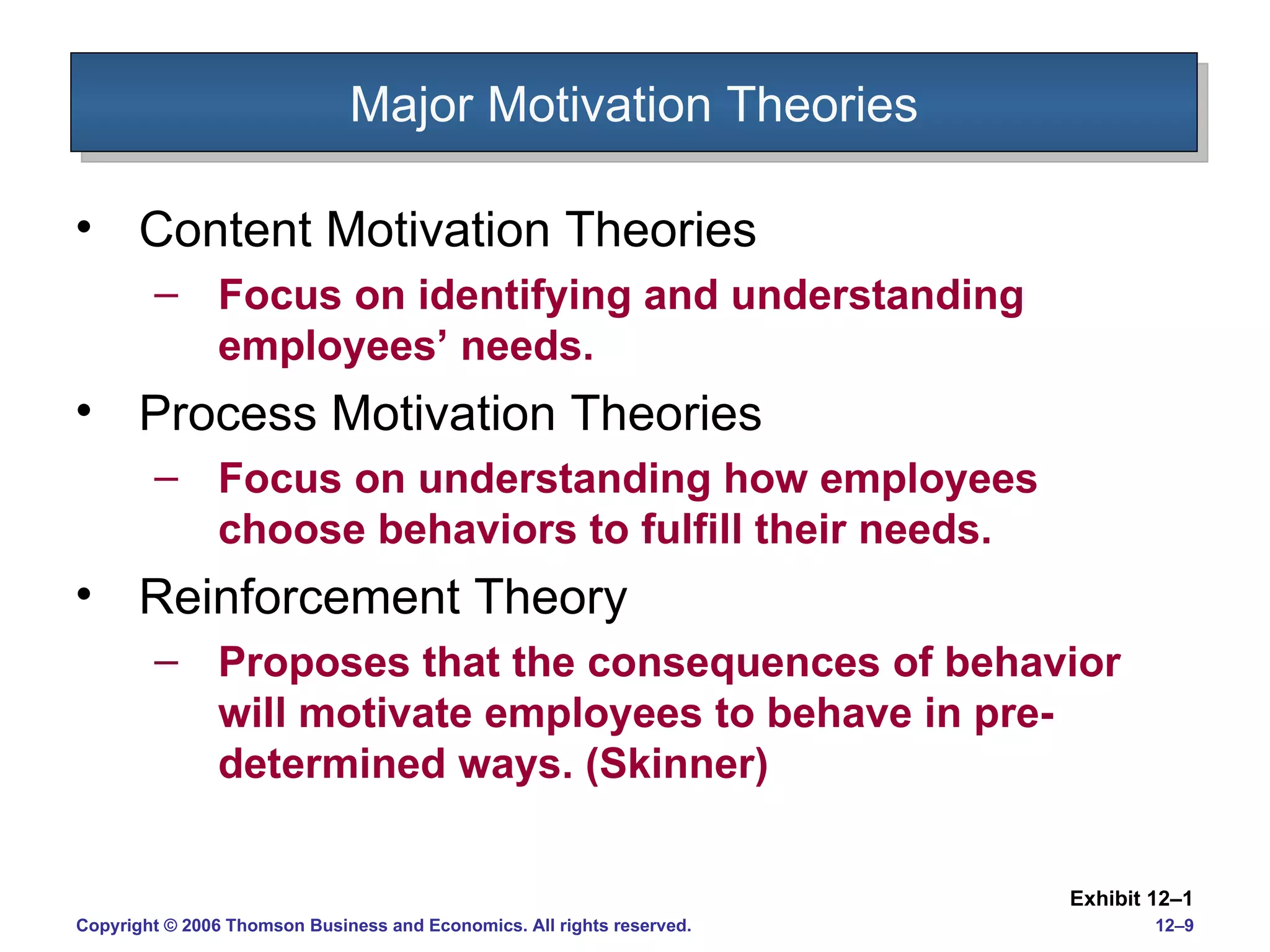
Major Motivation Theories Content Motivation Theories Focus on identifying and understanding employees’ needs. Process Motivation Theories Focus on understanding how employees choose behaviors to fulfill their needs. Reinforcement Theory  Proposes that the consequences of behavior will motivate employees to behave in pre-determined ways. (Skinner) Exhibit 12 –1
Motivation: Content Theories Content Motivation Theories Focus on identifying and understanding employees’ needs. Hierarchy of needs theory ERG theory Two-factor theory Acquired needs theory
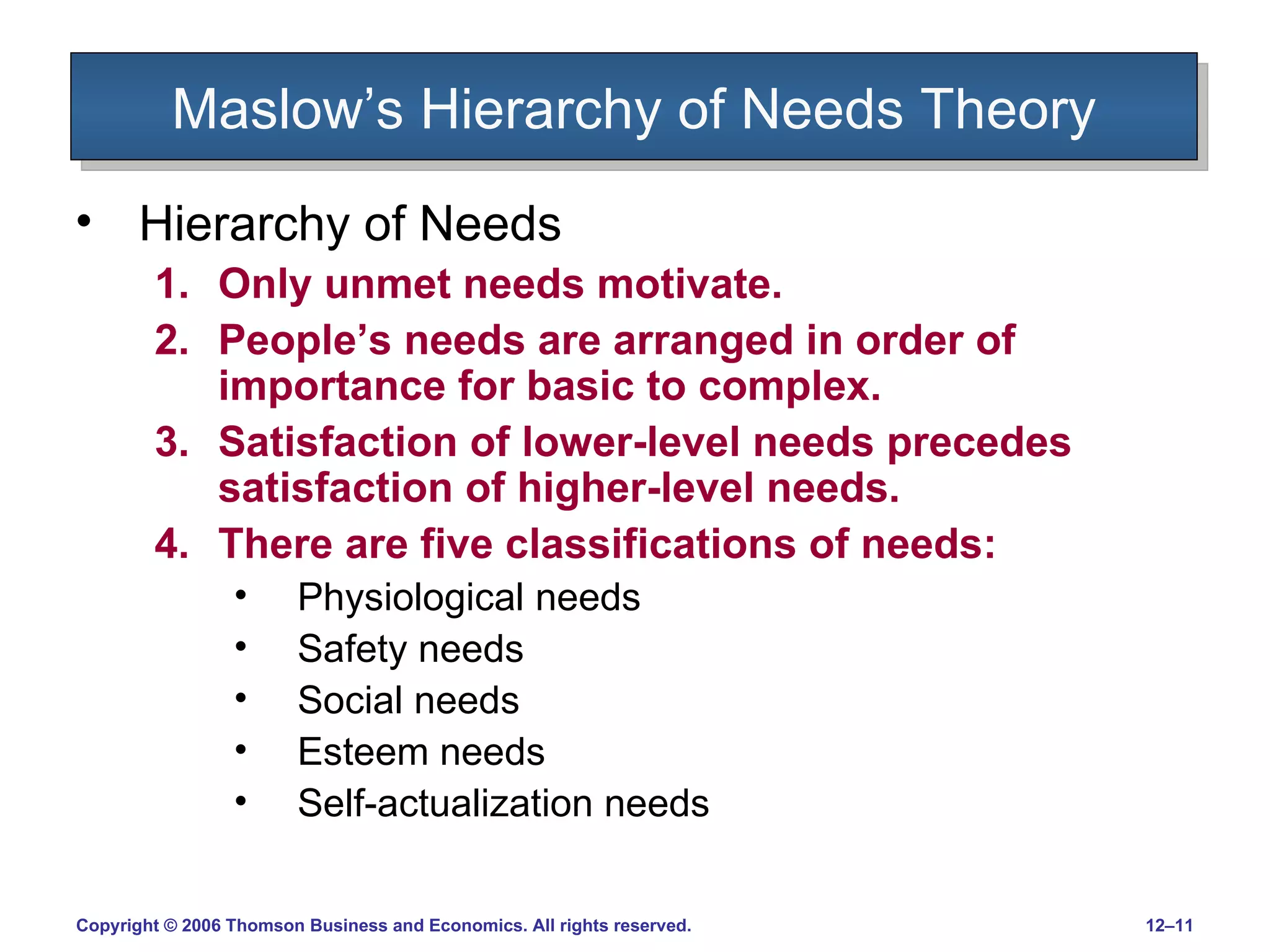
Maslow’s Hierarchy of Needs Theory Hierarchy of Needs Only unmet needs motivate. People’s needs are arranged in order of importance for basic to complex. Satisfaction of lower-level needs precedes satisfaction of higher-level needs. There are five classifications of needs: Physiological needs Safety needs Social needs Esteem needs Self-actualization needs
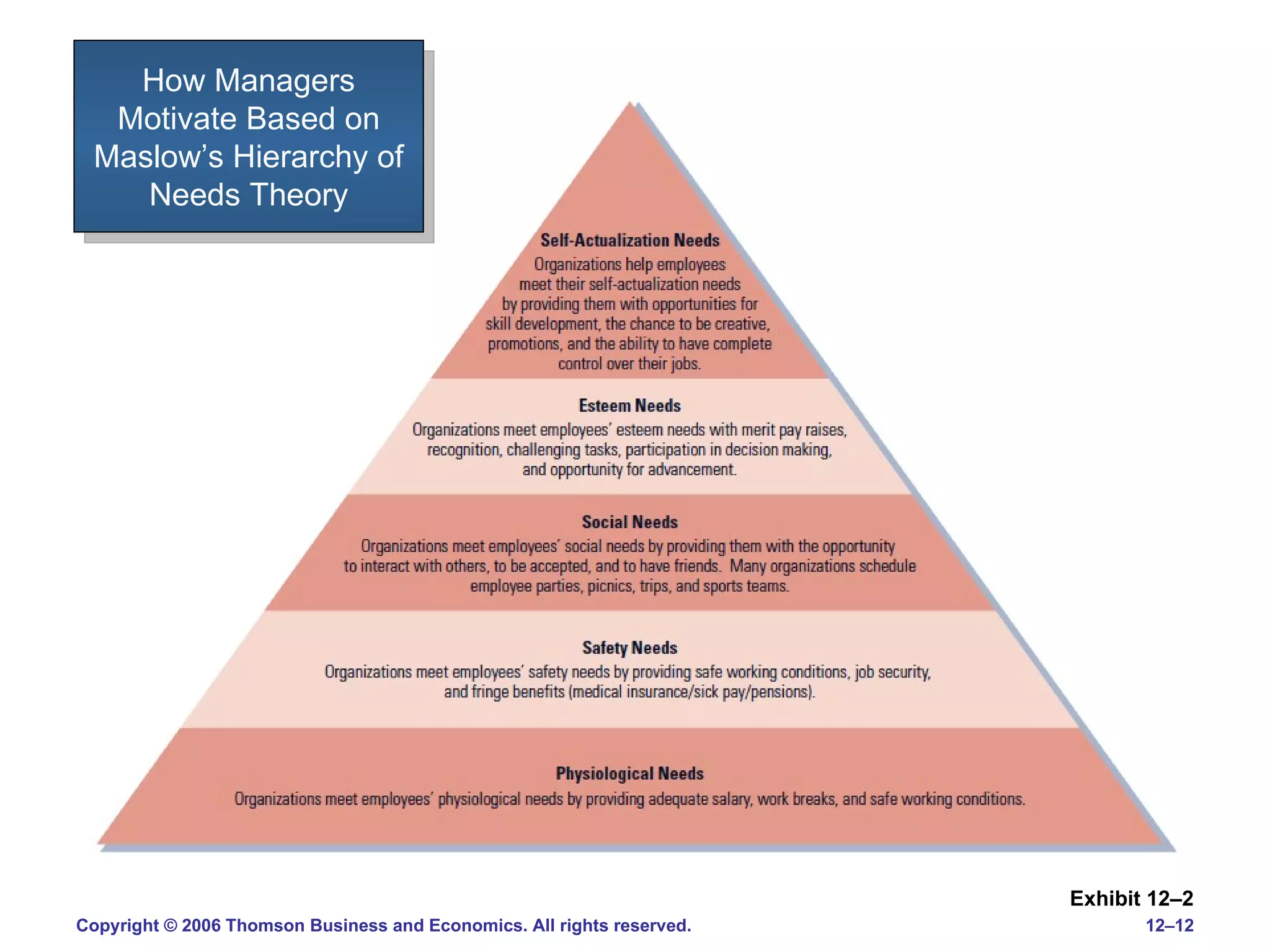
How Managers Motivate Based on Maslow’s Hierarchy of Needs Theory Exhibit 12 – 2
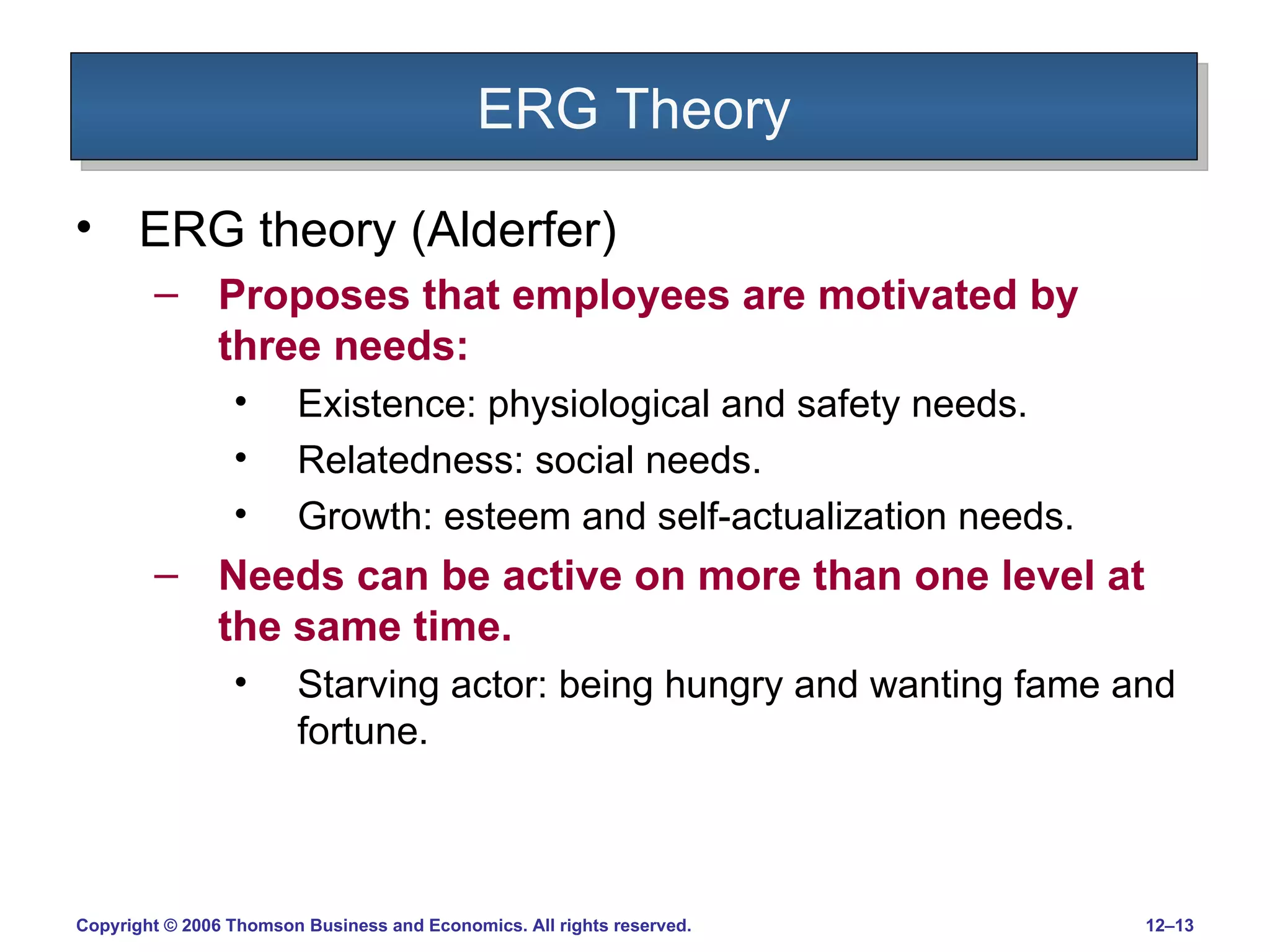
ERG Theory ERG theory (Alderfer) Proposes that employees are motivated by three needs: Existence: physiological and safety needs. Relatedness: social needs. Growth: esteem and self-actualization needs. Needs can be active on more than one level at the same time. Starving actor: being hungry and wanting fame and fortune.
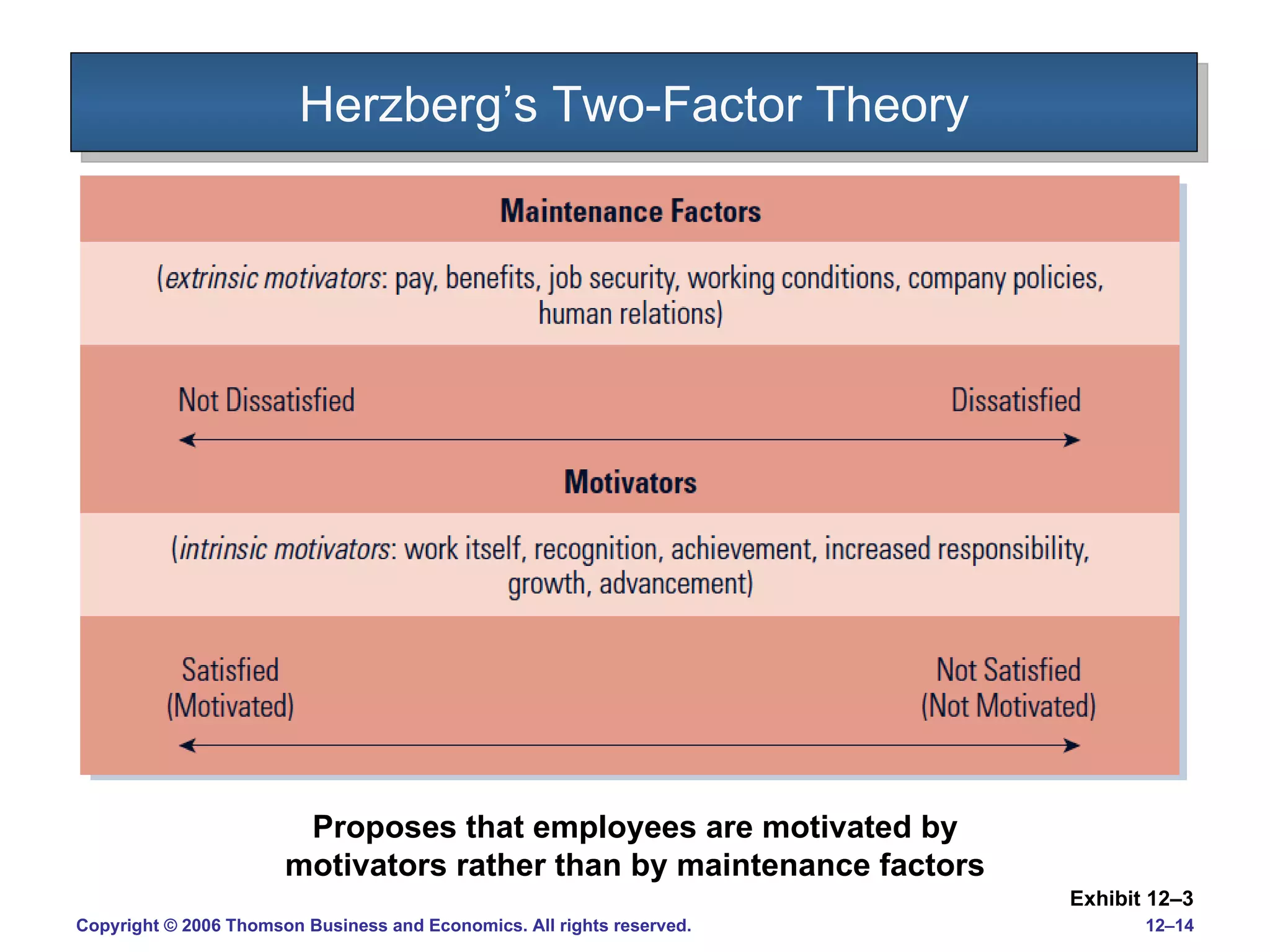
Herzberg’s Two-Factor Theory Exhibit 12 – 3 Proposes that employees are motivated by motivators rather than by maintenance factors
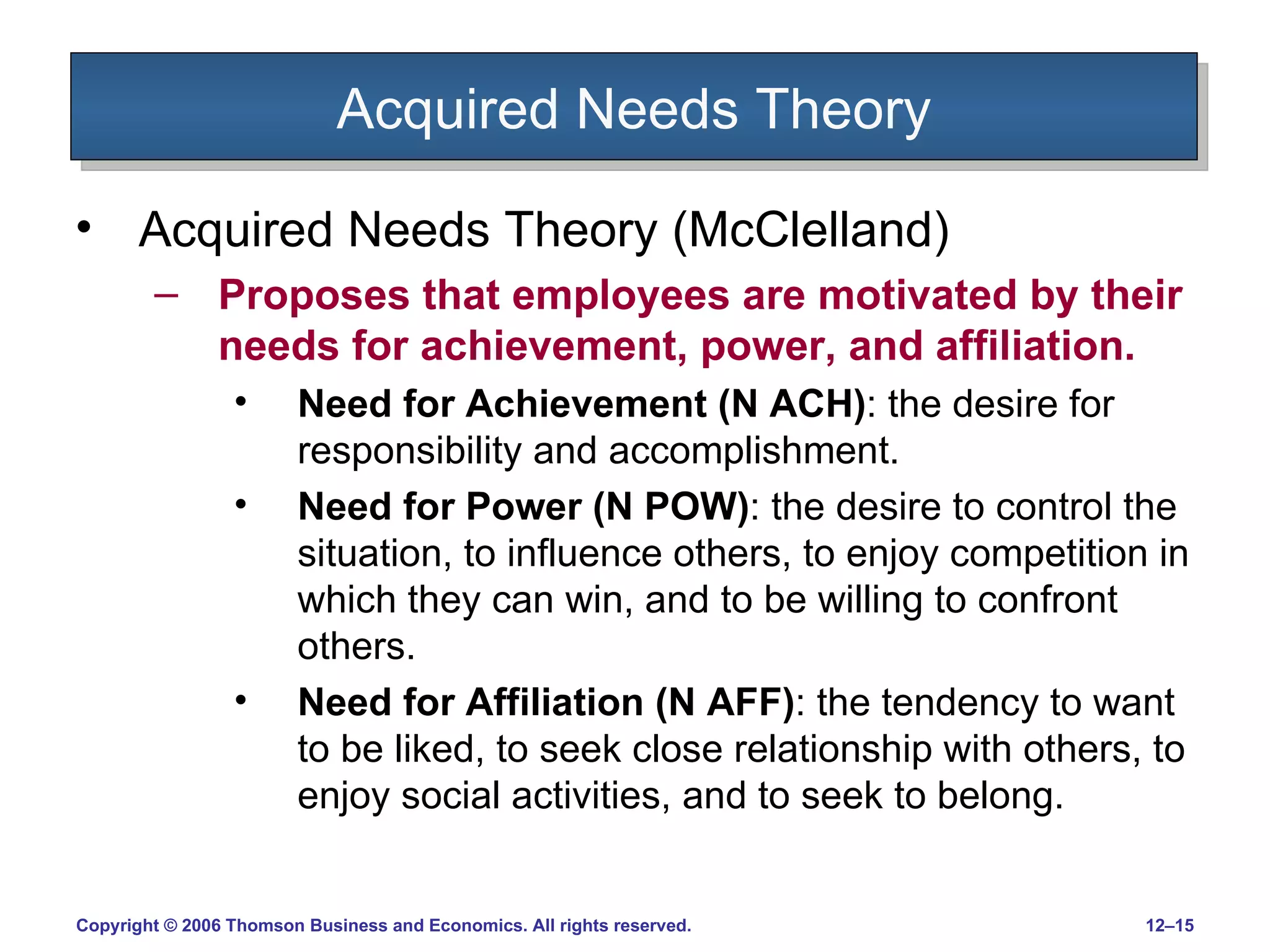
Acquired Needs Theory Acquired Needs Theory (McClelland) Proposes that employees are motivated by their needs for achievement, power, and affiliation. Need for Achievement (N ACH) : the desire for responsibility and accomplishment. Need for Power (N POW) : the desire to control the situation, to influence others, to enjoy competition in which they can win, and to be willing to confront others. Need for Affiliation (N AFF) : the tendency to want to be liked, to seek close relationship with others, to enjoy social activities, and to seek to belong.
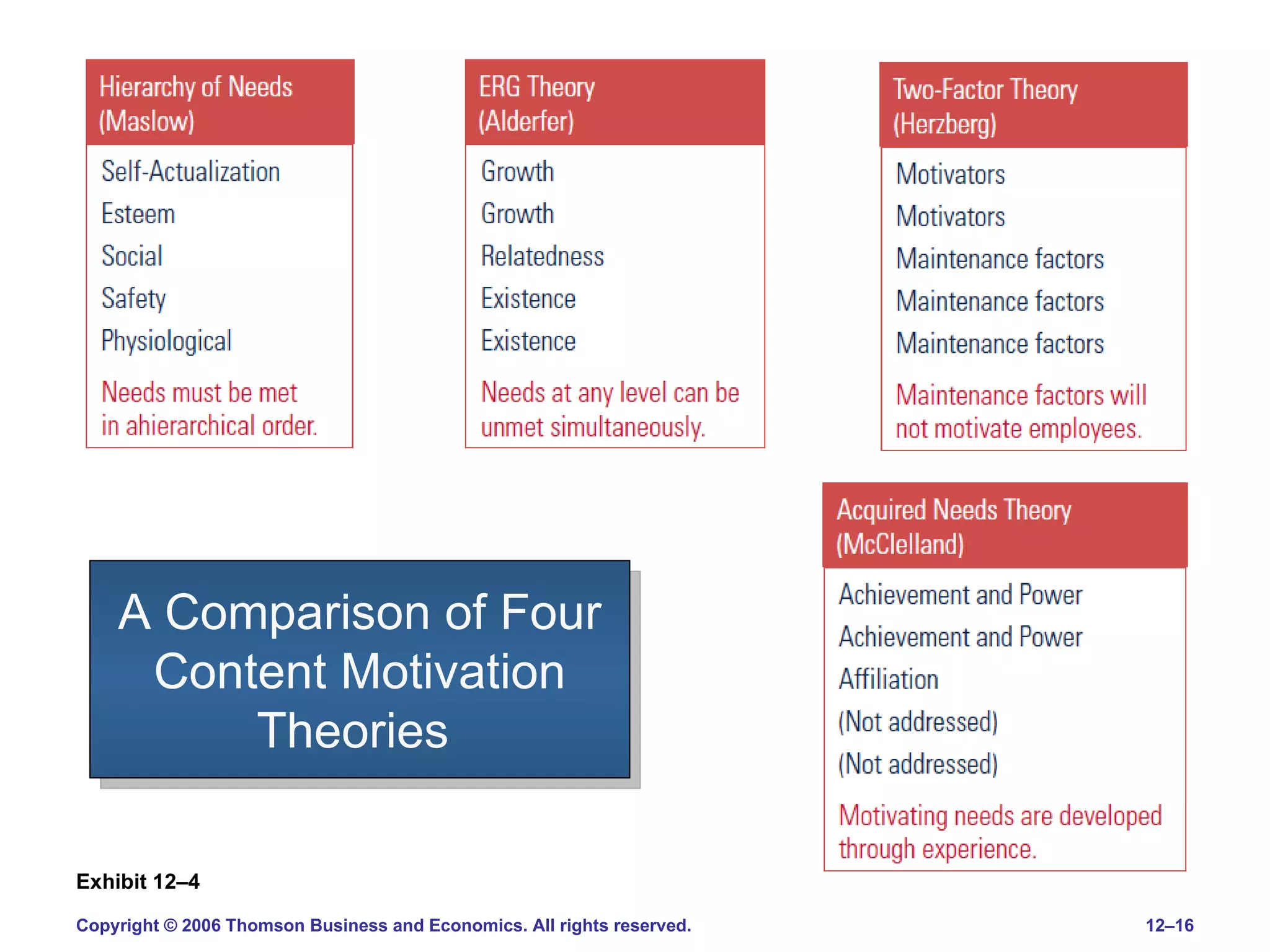
A Comparison of Four Content Motivation Theories  Exhibit 12 – 4
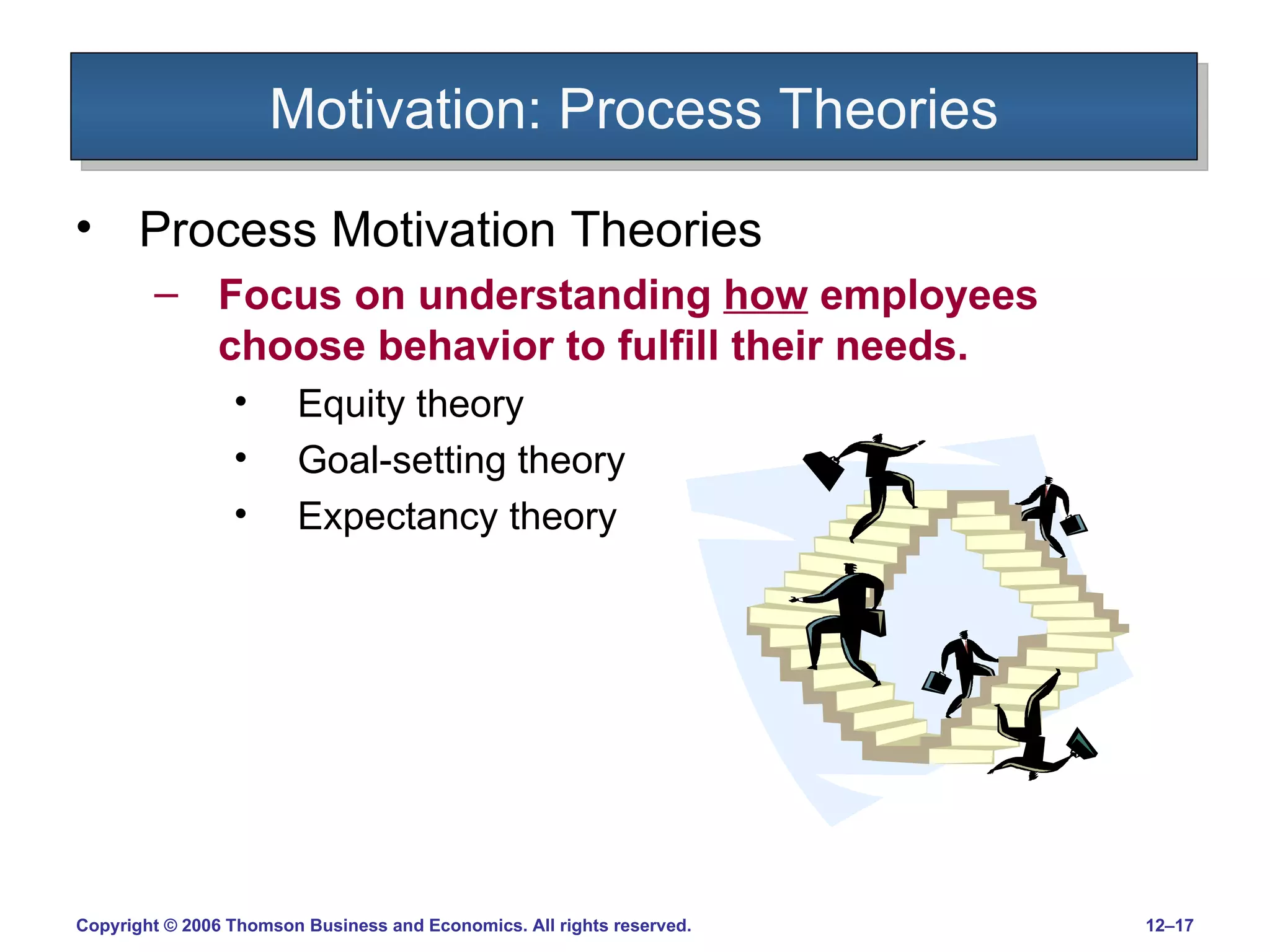
Motivation: Process Theories Process Motivation Theories Focus on understanding  how  employees choose behavior to fulfill their needs. Equity theory Goal-setting theory Expectancy theory
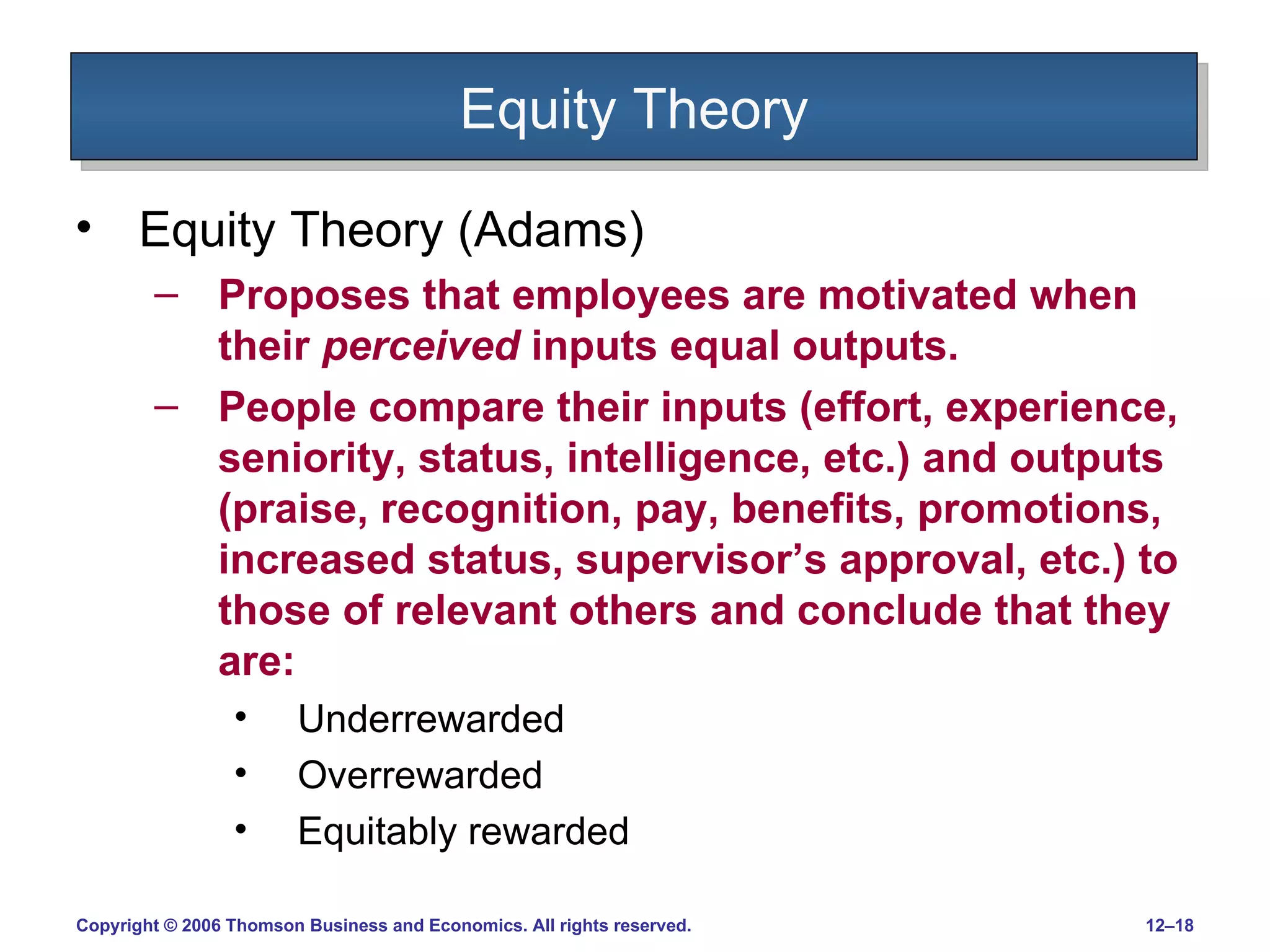
Equity Theory Equity Theory (Adams) Proposes that employees are motivated when their  perceived  inputs equal outputs. People compare their inputs (effort, experience, seniority, status, intelligence, etc.) and outputs (praise, recognition, pay, benefits, promotions, increased status, supervisor’s approval, etc.) to those of relevant others and conclude that they are: Underrewarded Overrewarded Equitably rewarded
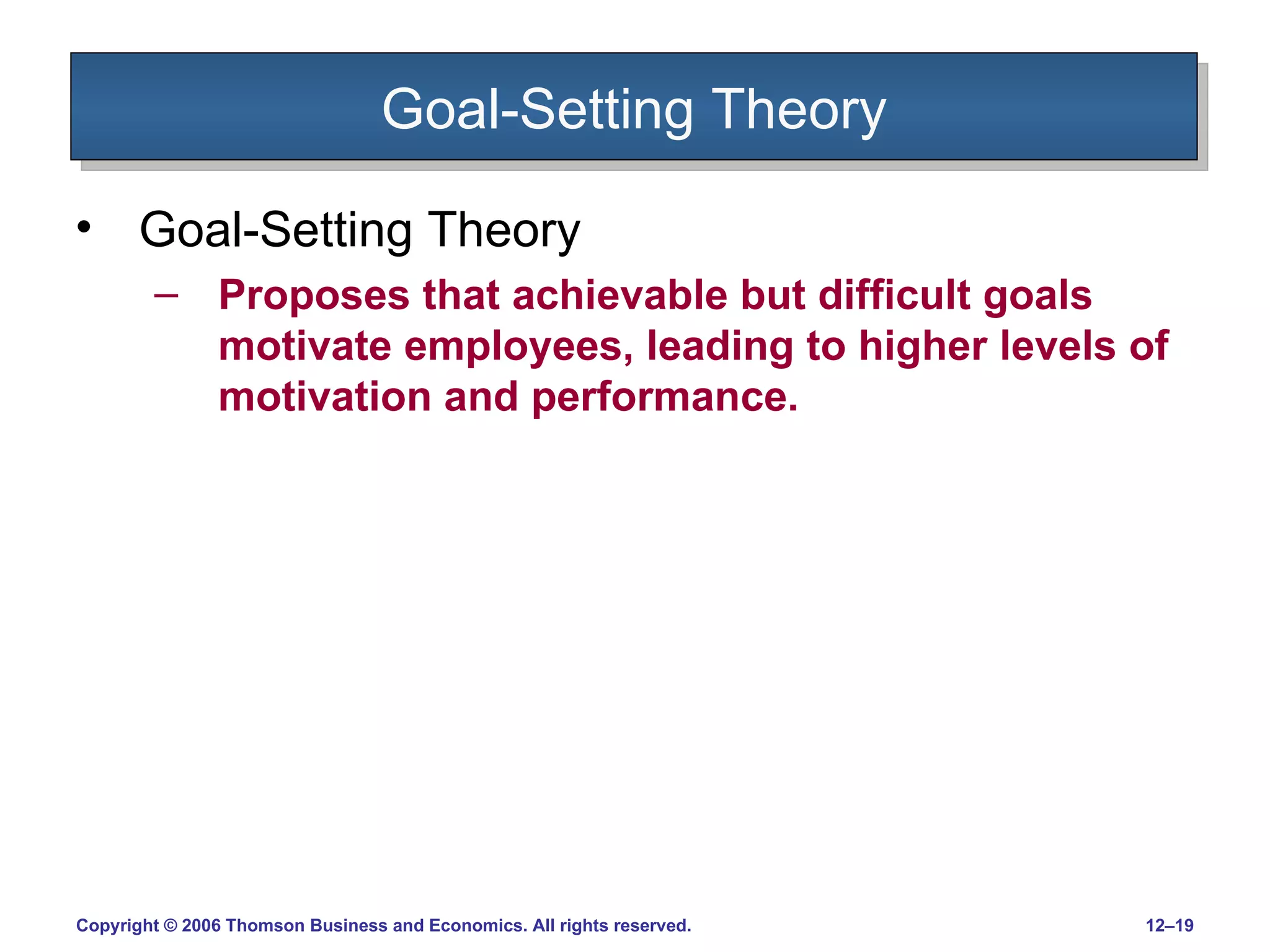
Goal-Setting Theory Goal-Setting Theory Proposes that achievable but difficult goals motivate employees, leading to higher levels of motivation and performance.
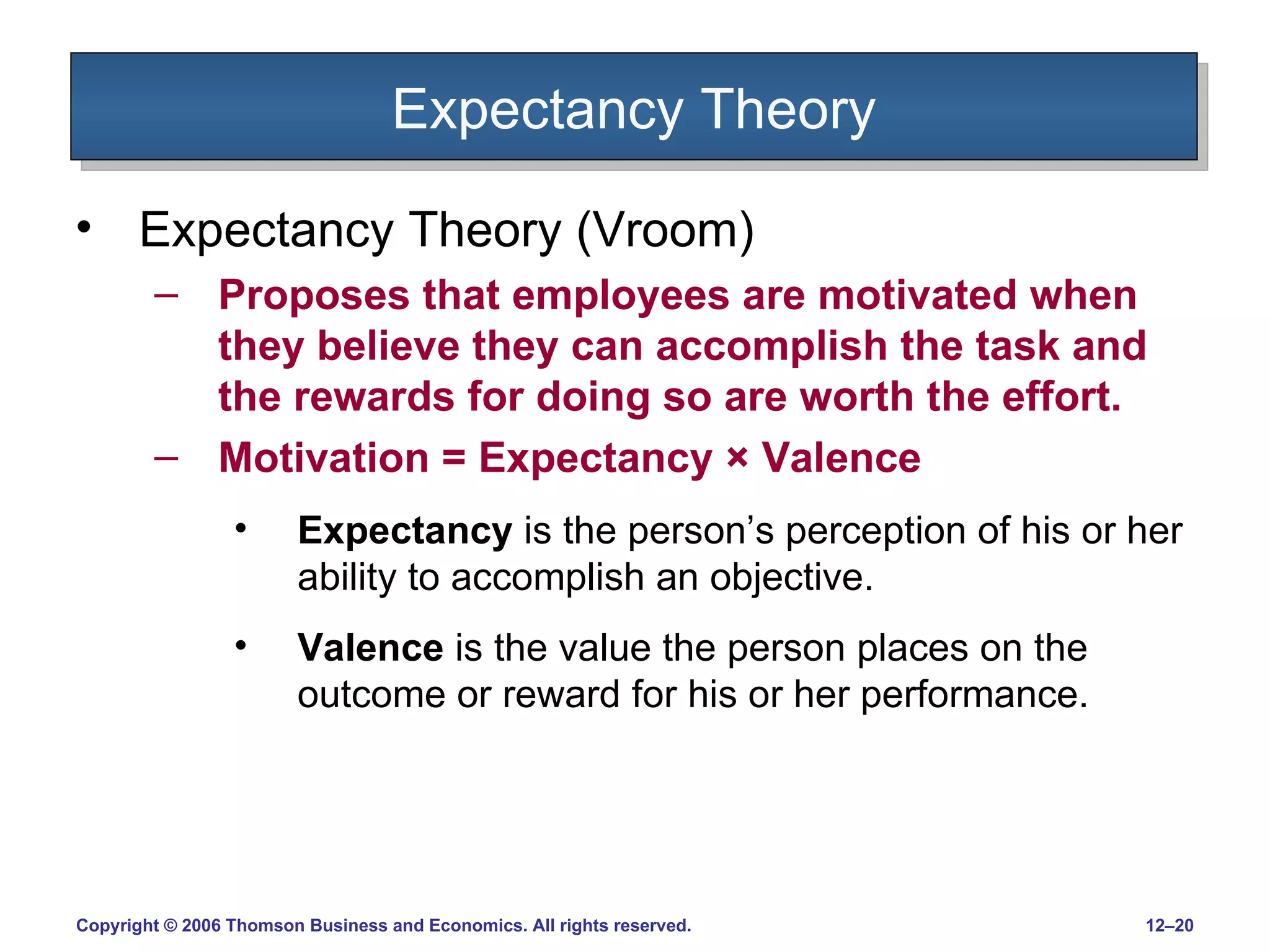
Expectancy Theory Expectancy Theory (Vroom) Proposes that employees are motivated when they believe they can accomplish the task and the rewards for doing so are worth the effort. Motivation = Expectancy  ×  Valence Expectancy  is the person’s perception of his or her ability to accomplish an objective. Valence  is the value the person places on the outcome or reward for his or her performance.
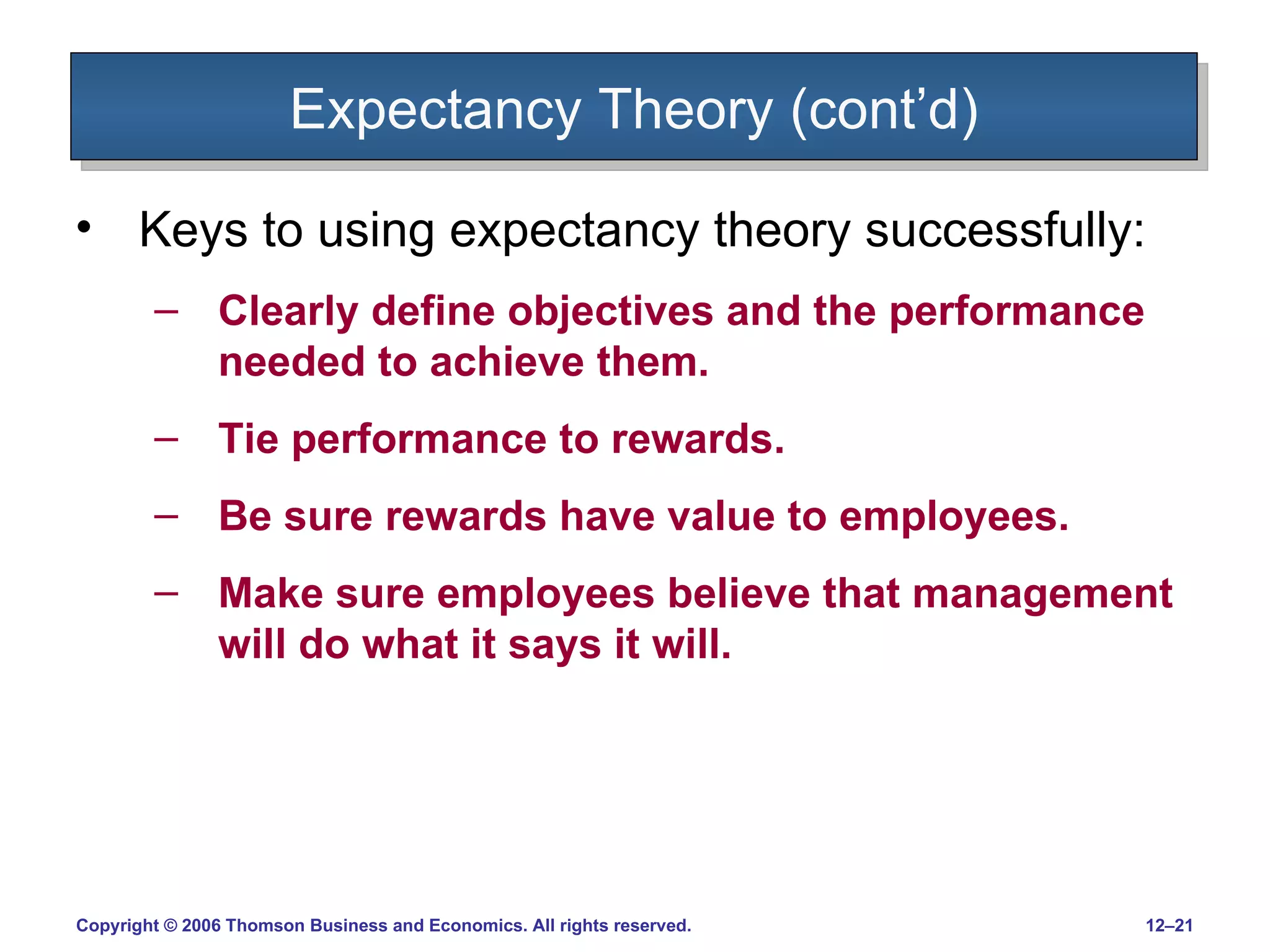
Expectancy Theory (cont’d) Keys to using expectancy theory successfully: Clearly define objectives and the performance needed to achieve them. Tie performance to rewards. Be sure rewards have value to employees. Make sure employees believe that management will do what it says it will.
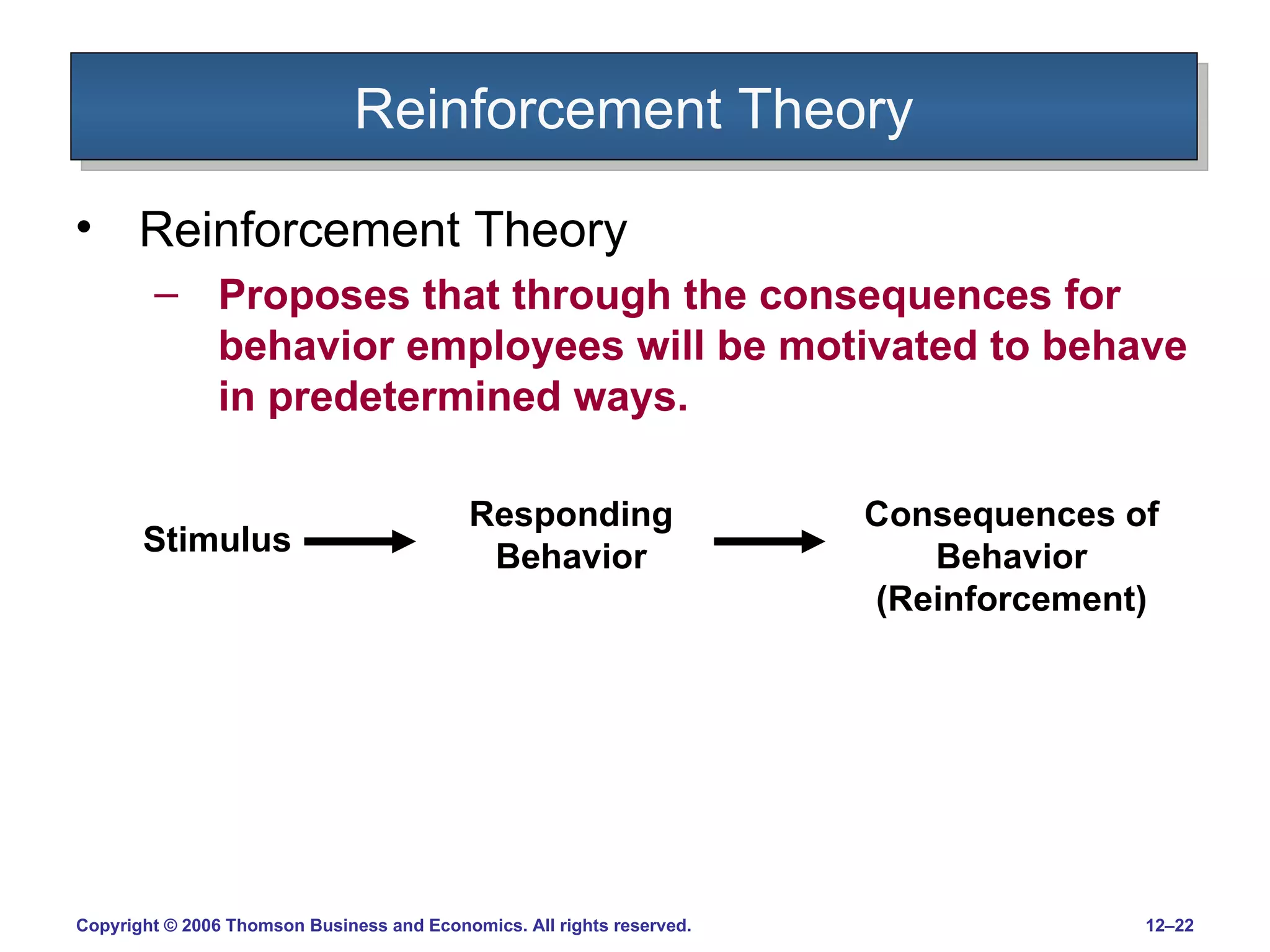
Reinforcement Theory Reinforcement Theory Proposes that through the consequences for behavior employees will be motivated to behave in predetermined ways. Stimulus Responding Behavior Consequences of Behavior (Reinforcement)
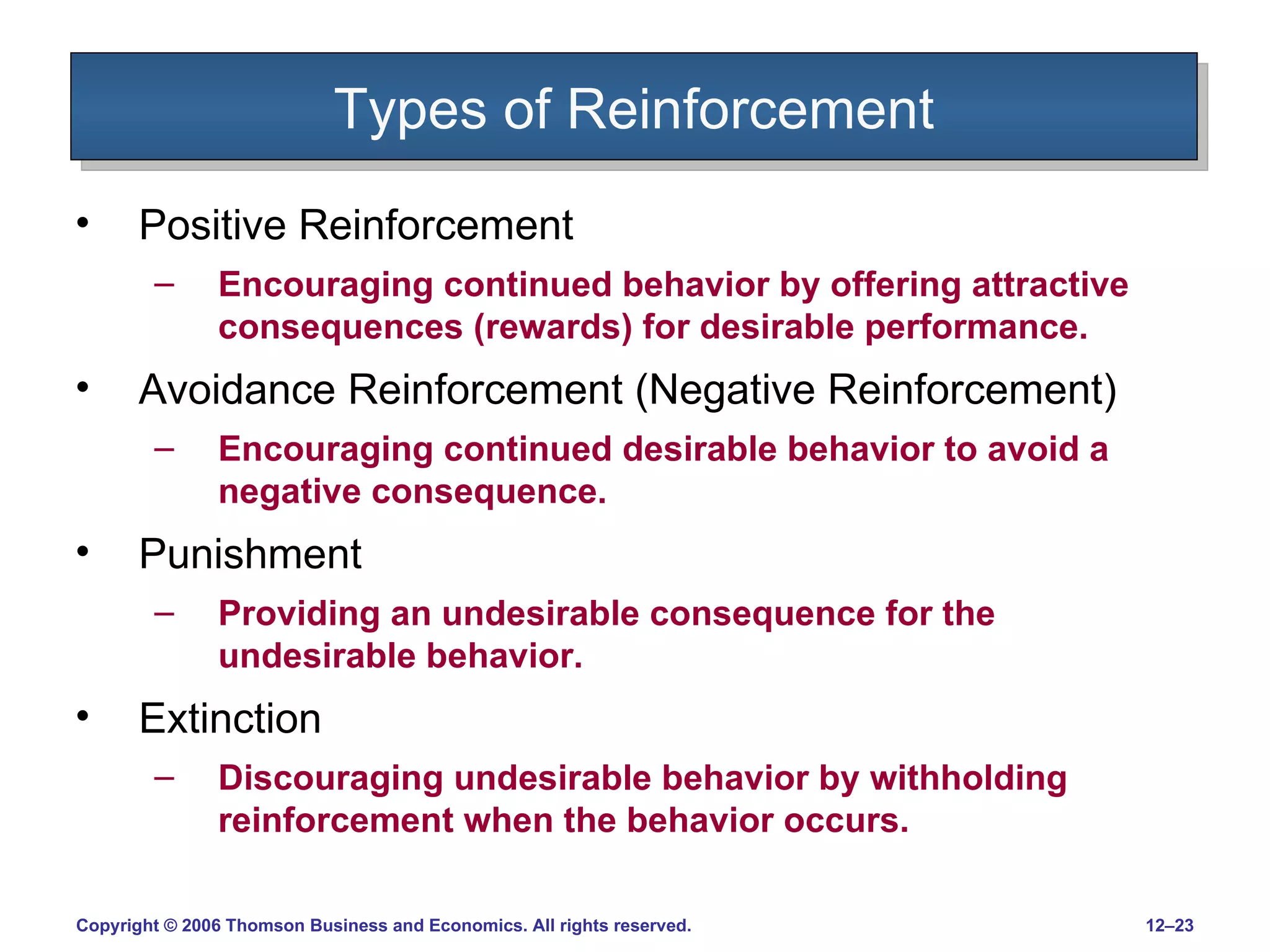
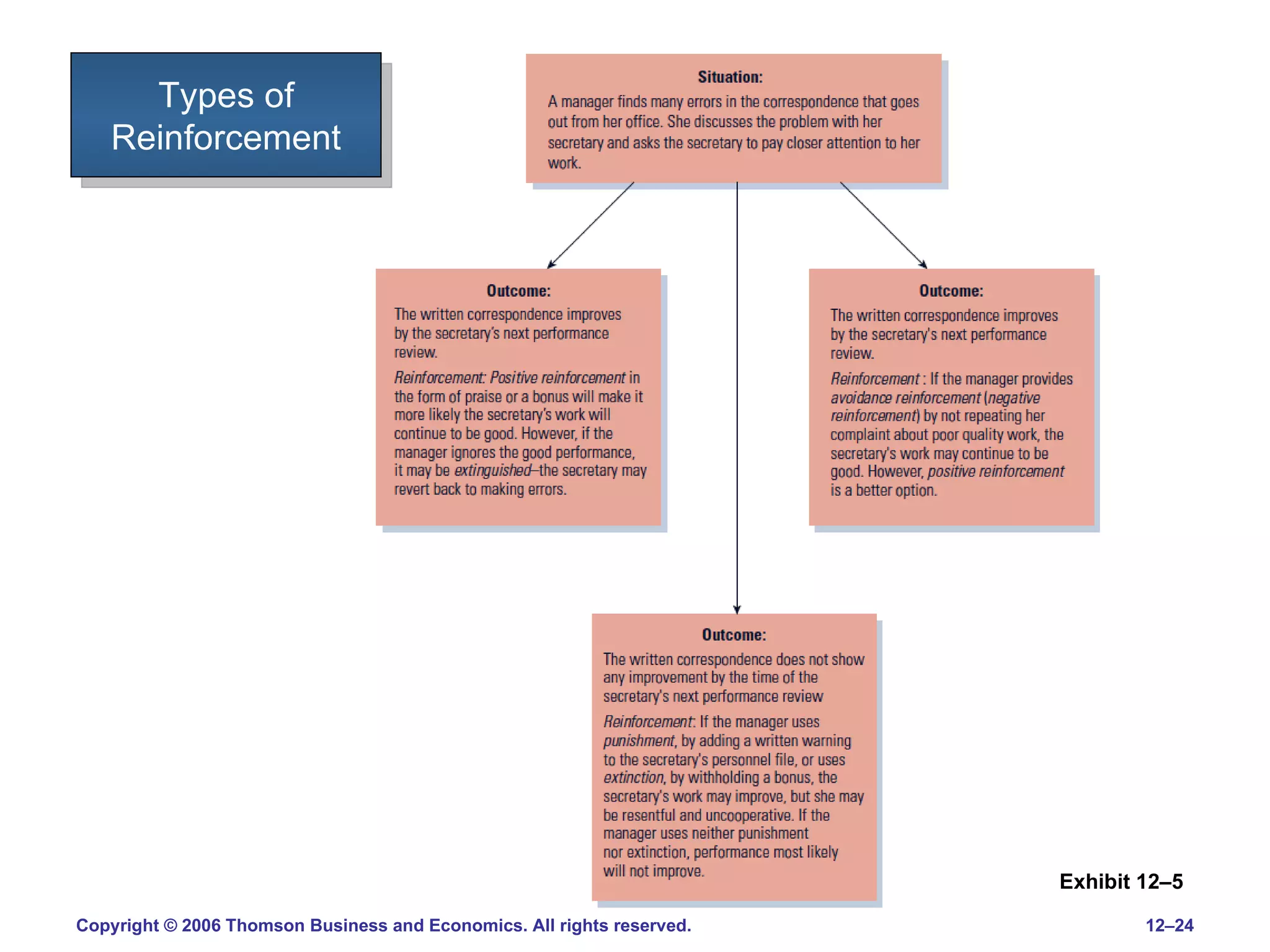
Types of Reinforcement Positive Reinforcement Encouraging continued behavior by offering attractive consequences (rewards) for desirable performance. Avoidance Reinforcement (Negative Reinforcement) Encouraging continued desirable behavior to avoid a negative consequence. Punishment Providing an undesirable consequence for the undesirable behavior. Extinction Discouraging undesirable behavior by withholding reinforcement when the behavior occurs.
Types of Reinforcement Exhibit 12 –5
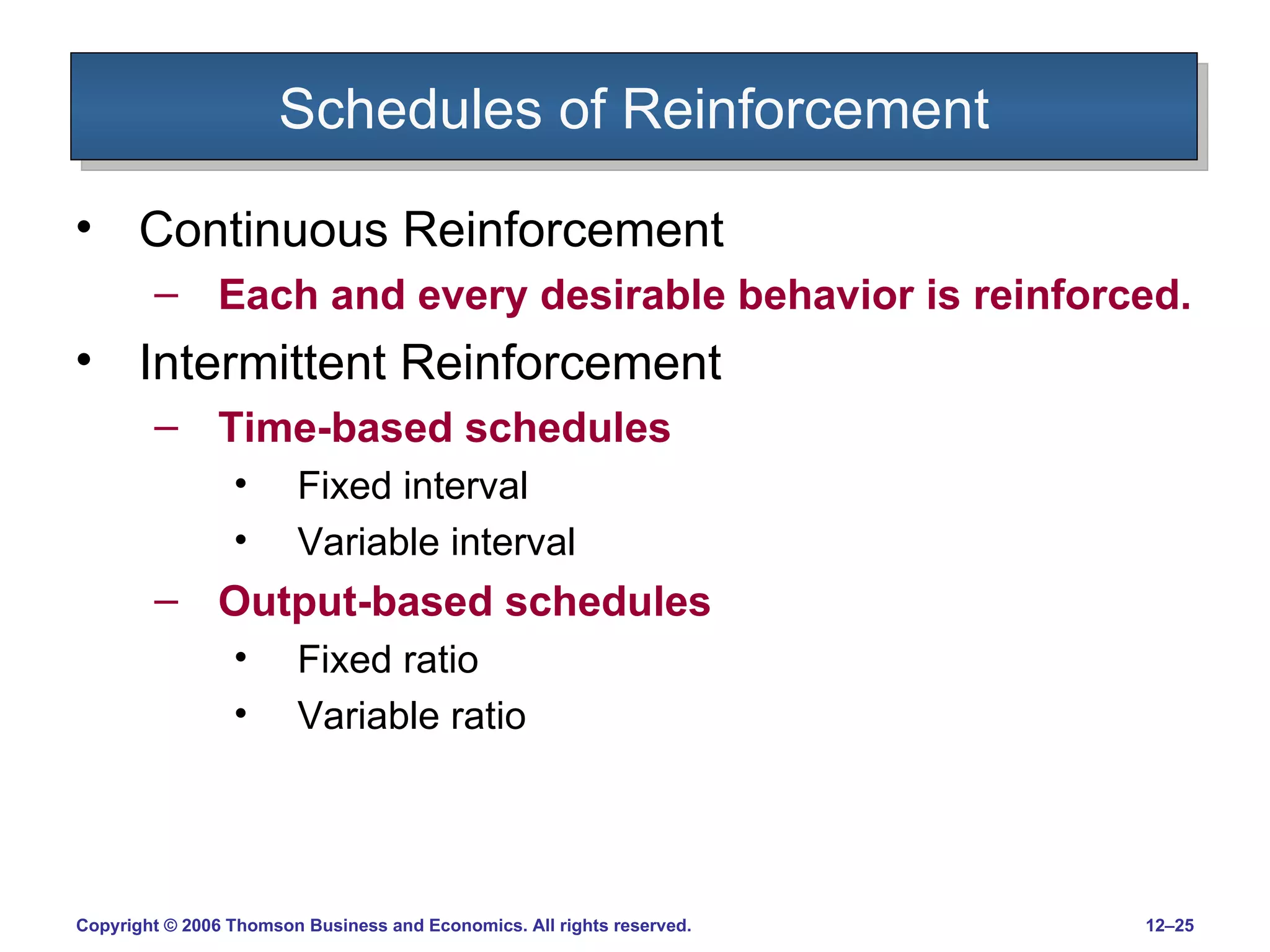
Schedules of Reinforcement Continuous Reinforcement Each and every desirable behavior is reinforced. Intermittent Reinforcement Time-based schedules Fixed interval Variable interval Output-based schedules Fixed ratio Variable ratio
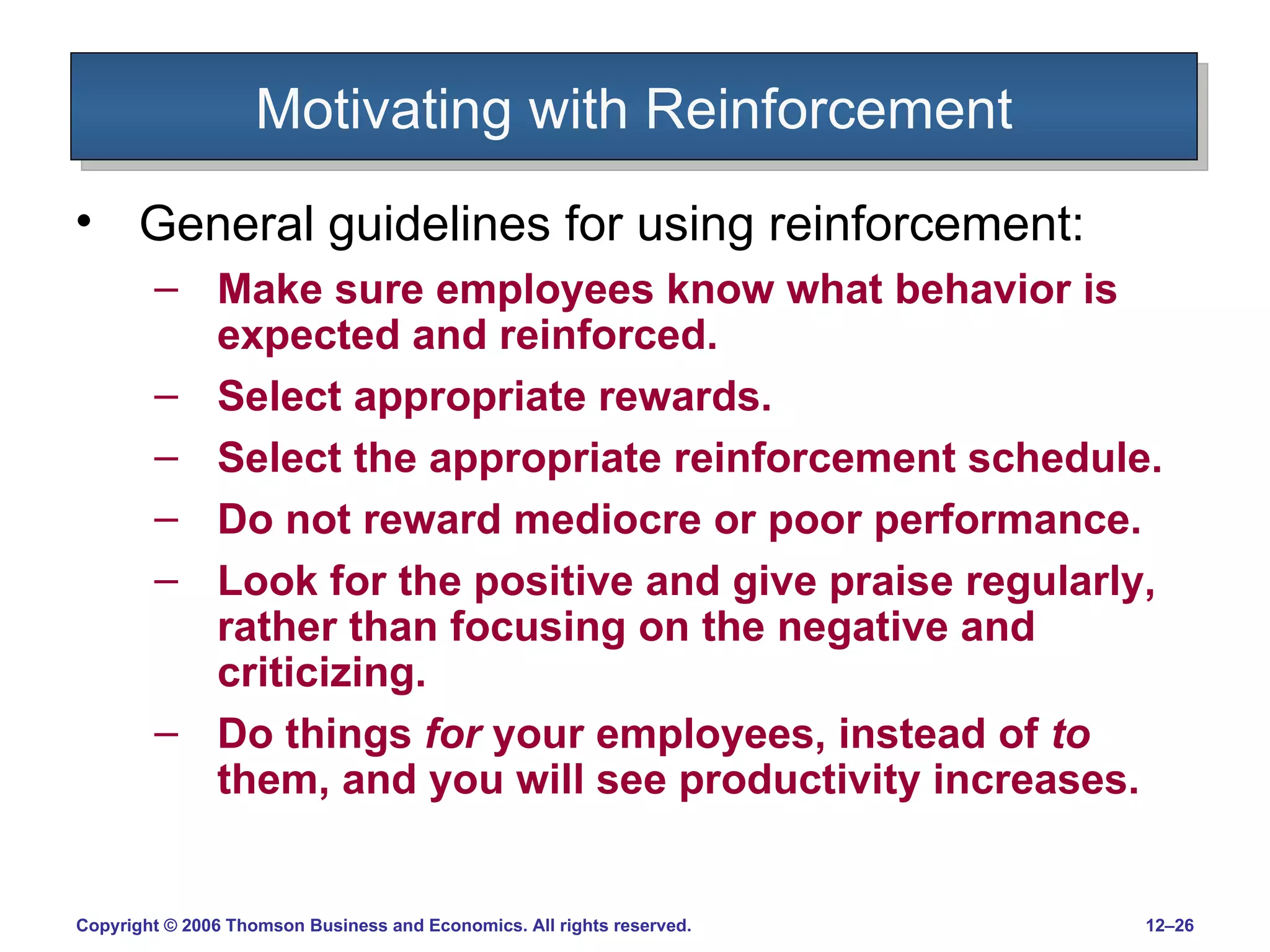
Motivating with Reinforcement General guidelines for using reinforcement: Make sure employees know what behavior is expected and reinforced. Select appropriate rewards.  Select the appropriate reinforcement schedule. Do not reward mediocre or poor performance. Look for the positive and give praise regularly, rather than focusing on the negative and criticizing. Do things  for  your employees, instead of  to  them, and you will see productivity increases.
 
 
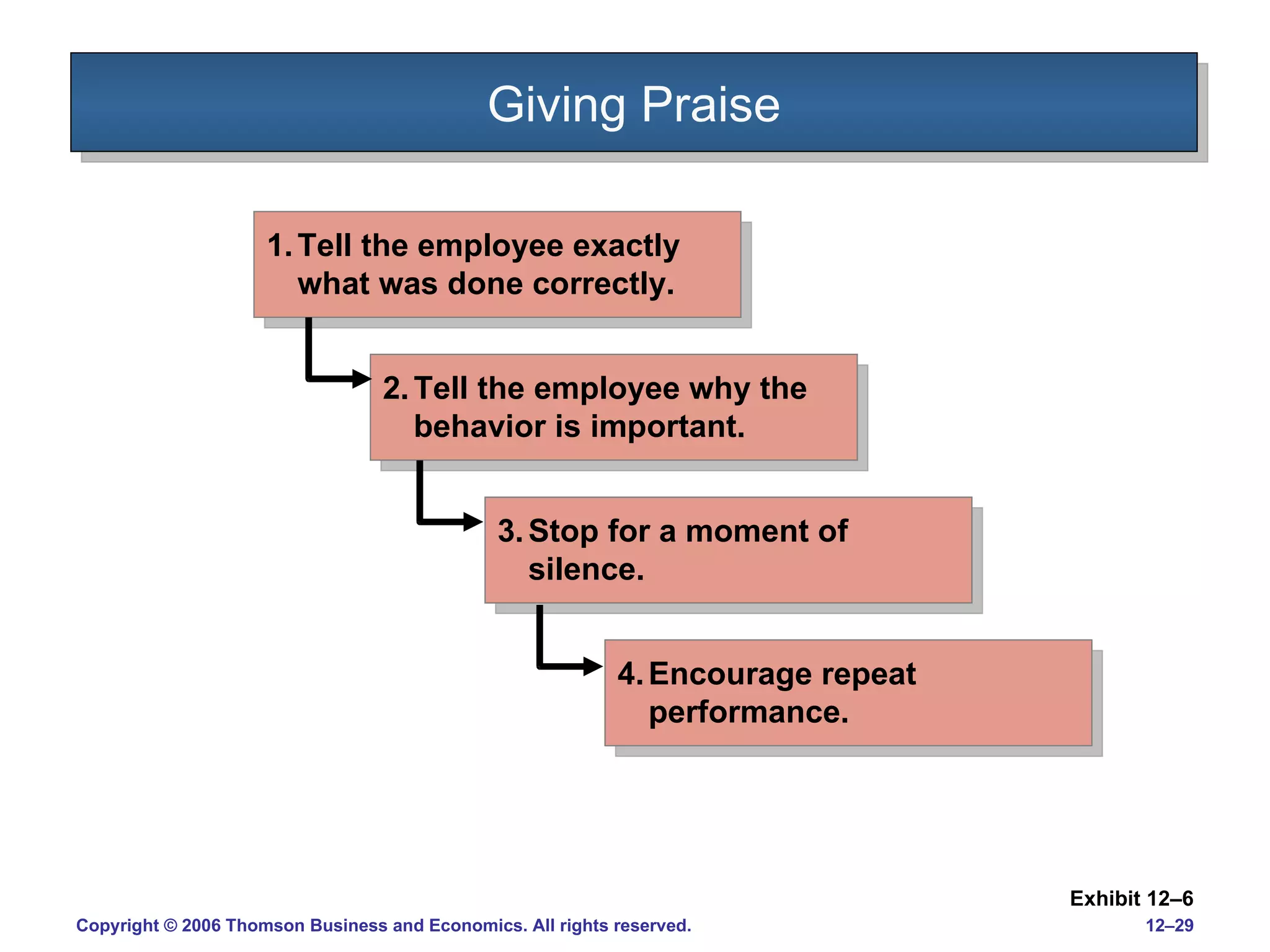
Giving Praise 1. Tell the employee exactly what was done correctly. 2. Tell the employee why the behavior is important. 3. Stop for a moment of silence. 4. Encourage repeat performance. Exhibit 12 –6
The Motivation Process and the Motivation Theories Exhibit 12 –7 The groups of theories are complementary; each refers to a different stage in the motivation process or answers a different question.
Do Motivation Theories Apply Globally? Cultural Differences in Motivation The source of motivation (intrinsic vs. extrinsic) The level of needs on which people focus varies. Individualistic societies tend to value individual  accomplishment; collective societies tend to value group accomplishment and loyalty.
 

Lussier3e ch12

  • 1.
    Motivating for HighPerformance Chapter 12
  • 2.
    Learning Outcomes Illustratethe motivation process. Explain the performance formula and how to use it. Discuss the major similarities and differences among the four content motivation theories: hierarchy of needs theory, ERG theory, two-factor theory, and acquired needs theory. Discuss the major similarities and differences among the three process motivation theories: equity theory, goal-setting theory, and expectancy theory. Explain the four types of reinforcement. State the major differences among content, process, and reinforcement theories. After studying this chapter, you should be able to:
  • 3.
    Learning Outcomes (cont’d)Define the following key terms : motivation acquired needs theory motivation process process motivation theories performance formula equity theory content motivation theories goal-setting theory hierarchy of needs theory expectancy theory ERG theory reinforcement theory two-factor theory giving praise model
  • 4.
    Ideas on Management at Market America What does Market America do to motivate its distributors, and how does it affect performance? How does Market America meet its distributors’ content motivation needs? How does Market America meet its distributors’ process motivation needs? How does Market America use reinforcement theory to motivate its distributors? Will the Market America UnFranchise ® business model for motivating work in other countries?
  • 5.
    Motivation and PerformanceMotivation The willingness to achieve organizational objectives. People are motivated by self-interest —the key to understanding motivation. Motivation Process Employees go from need to motive to behavior to consequence to satisfaction or dissatisfaction.
  • 6.
    How Motivation AffectsPerformance Expectations, Motivation, and Performance Self-fulfilling prophecy “ If you believe you can, or if you believe you can’t, then you are right” —Henry Ford If you think you will be successful, then you will be. The Performance Formula Performance = Ability × Motivation × Resources For maximum performance levels, all three factors must be high.
  • 7.
  • 8.
    An Overview ofthe Major Motivation Theories Major Motivation Theories Content Motivation Theories Process Motivation Theories Reinforcement Theory
  • 9.
    Major Motivation TheoriesContent Motivation Theories Focus on identifying and understanding employees’ needs. Process Motivation Theories Focus on understanding how employees choose behaviors to fulfill their needs. Reinforcement Theory Proposes that the consequences of behavior will motivate employees to behave in pre-determined ways. (Skinner) Exhibit 12 –1
  • 10.
    Motivation: Content TheoriesContent Motivation Theories Focus on identifying and understanding employees’ needs. Hierarchy of needs theory ERG theory Two-factor theory Acquired needs theory
  • 11.
    Maslow’s Hierarchy ofNeeds Theory Hierarchy of Needs Only unmet needs motivate. People’s needs are arranged in order of importance for basic to complex. Satisfaction of lower-level needs precedes satisfaction of higher-level needs. There are five classifications of needs: Physiological needs Safety needs Social needs Esteem needs Self-actualization needs
  • 12.
    How Managers MotivateBased on Maslow’s Hierarchy of Needs Theory Exhibit 12 – 2
  • 13.
    ERG Theory ERGtheory (Alderfer) Proposes that employees are motivated by three needs: Existence: physiological and safety needs. Relatedness: social needs. Growth: esteem and self-actualization needs. Needs can be active on more than one level at the same time. Starving actor: being hungry and wanting fame and fortune.
  • 14.
    Herzberg’s Two-Factor TheoryExhibit 12 – 3 Proposes that employees are motivated by motivators rather than by maintenance factors
  • 15.
    Acquired Needs TheoryAcquired Needs Theory (McClelland) Proposes that employees are motivated by their needs for achievement, power, and affiliation. Need for Achievement (N ACH) : the desire for responsibility and accomplishment. Need for Power (N POW) : the desire to control the situation, to influence others, to enjoy competition in which they can win, and to be willing to confront others. Need for Affiliation (N AFF) : the tendency to want to be liked, to seek close relationship with others, to enjoy social activities, and to seek to belong.
  • 16.
    A Comparison ofFour Content Motivation Theories Exhibit 12 – 4
  • 17.
    Motivation: Process TheoriesProcess Motivation Theories Focus on understanding how employees choose behavior to fulfill their needs. Equity theory Goal-setting theory Expectancy theory
  • 18.
    Equity Theory EquityTheory (Adams) Proposes that employees are motivated when their perceived inputs equal outputs. People compare their inputs (effort, experience, seniority, status, intelligence, etc.) and outputs (praise, recognition, pay, benefits, promotions, increased status, supervisor’s approval, etc.) to those of relevant others and conclude that they are: Underrewarded Overrewarded Equitably rewarded
  • 19.
    Goal-Setting Theory Goal-SettingTheory Proposes that achievable but difficult goals motivate employees, leading to higher levels of motivation and performance.
  • 20.
    Expectancy Theory ExpectancyTheory (Vroom) Proposes that employees are motivated when they believe they can accomplish the task and the rewards for doing so are worth the effort. Motivation = Expectancy × Valence Expectancy is the person’s perception of his or her ability to accomplish an objective. Valence is the value the person places on the outcome or reward for his or her performance.
  • 21.
    Expectancy Theory (cont’d)Keys to using expectancy theory successfully: Clearly define objectives and the performance needed to achieve them. Tie performance to rewards. Be sure rewards have value to employees. Make sure employees believe that management will do what it says it will.
  • 22.
    Reinforcement Theory ReinforcementTheory Proposes that through the consequences for behavior employees will be motivated to behave in predetermined ways. Stimulus Responding Behavior Consequences of Behavior (Reinforcement)
  • 23.
    Types of ReinforcementPositive Reinforcement Encouraging continued behavior by offering attractive consequences (rewards) for desirable performance. Avoidance Reinforcement (Negative Reinforcement) Encouraging continued desirable behavior to avoid a negative consequence. Punishment Providing an undesirable consequence for the undesirable behavior. Extinction Discouraging undesirable behavior by withholding reinforcement when the behavior occurs.
  • 24.
    Types of ReinforcementExhibit 12 –5
  • 25.
    Schedules of ReinforcementContinuous Reinforcement Each and every desirable behavior is reinforced. Intermittent Reinforcement Time-based schedules Fixed interval Variable interval Output-based schedules Fixed ratio Variable ratio
  • 26.
    Motivating with ReinforcementGeneral guidelines for using reinforcement: Make sure employees know what behavior is expected and reinforced. Select appropriate rewards. Select the appropriate reinforcement schedule. Do not reward mediocre or poor performance. Look for the positive and give praise regularly, rather than focusing on the negative and criticizing. Do things for your employees, instead of to them, and you will see productivity increases.
  • 27.
  • 28.
  • 29.
    Giving Praise 1.Tell the employee exactly what was done correctly. 2. Tell the employee why the behavior is important. 3. Stop for a moment of silence. 4. Encourage repeat performance. Exhibit 12 –6
  • 30.
    The Motivation Processand the Motivation Theories Exhibit 12 –7 The groups of theories are complementary; each refers to a different stage in the motivation process or answers a different question.
  • 31.
    Do Motivation TheoriesApply Globally? Cultural Differences in Motivation The source of motivation (intrinsic vs. extrinsic) The level of needs on which people focus varies. Individualistic societies tend to value individual accomplishment; collective societies tend to value group accomplishment and loyalty.
  • 32.