1
Principles of Management
Lecture-7
Managing Employee Motivation and
Performance
Nigar Sultana
Lecturer
Faculty of Business Studies
2
Learning Objectives
After studying this chapter, you should be able to:
 Characterize the nature of motivation, including its
importance and basic historical perspectives.
 Identify and describe the major content perspectives on
motivation.
 Identify and describe the major process perspectives on
motivation.
 Describe reinforcement perspectives on motivation.
 Identify and describe popular motivational strategies.
 Describe the role of organizational reward systems in
motivation.
3
Chapter Outline
 The Nature of Motivation
 The Importance of
Motivation in the
Workplace
 Historical Perspectives on
Motivation
 Content Perspectives on
Motivation
 The Need Hierarchy
Approach
 The Two-Factor Theory
 Individual Human Needs
 Process Perspectives on
Motivation
 Expectancy Theory
 Equity Theory
 Goal-Setting Theory
 Reinforcement Perspectives
on Motivation
 Kinds of Reinforcement in
Organizations
 Providing Reinforcement
in Organizations
 Popular Motivational
Strategies
 Empowerment and
Participation
 New Forms of Working
Arrangements
 Using Reward Systems to
Motivate Performance
 Effects of Organization
Rewards
 Designing Effective
Reward Systems
4
The Nature of Motivation
 Motivation
 The set of forces that cause people to behave in
certain ways.
 The goal of managers is to maximize desired
behaviors and minimize undesirable behaviors.
 Key Elements
1. Intensity: how hard a person tries
2. Direction: toward beneficial goal
3. Persistence: how long a person tries
Motivation
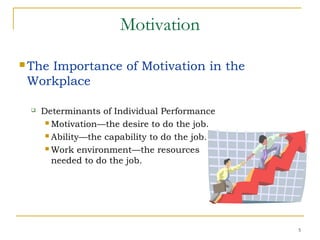
 The Importance of Motivation in the
Workplace
 Determinants of Individual Performance
 Motivation—the desire to do the job.
 Ability—the capability to do the job.
 Work environment—the resources
needed to do the job.
5
6
7
8
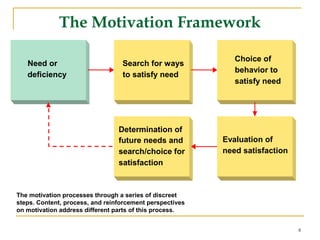
The Motivation Framework
Search for ways
to satisfy need
Choice of
behavior to
satisfy need
Determination of
future needs and
search/choice for
satisfaction
Evaluation of
need satisfaction
Need or
deficiency
The motivation processes through a series of discreet
steps. Content, process, and reinforcement perspectives
on motivation address different parts of this process.
9
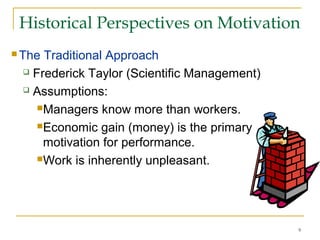
Historical Perspectives on Motivation
 The Traditional Approach
 Frederick Taylor (Scientific Management)
 Assumptions:
Managers know more than workers.
Economic gain (money) is the primary
motivation for performance.
Work is inherently unpleasant.
Historical Perspectives on Motivation
 The Human Relations Approach
 Emphasized the role of social processes in the
workplace.
 Assumptions:
Employees want to feel useful and important.
Employees have strong social needs, more
important than money.
Maintaining the appearance of employee
participation is important.
10
11
Historical Perspectives on Motivation
(cont’d)
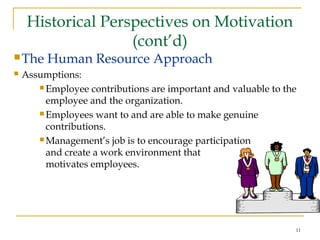
The Human Resource Approach
 Assumptions:
 Employee contributions are important and valuable to the
employee and the organization.
 Employees want to and are able to make genuine
contributions.
 Management’s job is to encourage participation
and create a work environment that
motivates employees.
12
Content Perspectives on Motivation
Content Perspectives
 Approaches to motivation that try to answer
the question, “What factors in the workplace
motivate people?”
Content Perspectives of Motivation
 Maslow’s Hierarchy of Needs
 Aldefer’s ERG Theory
 Herzberg’s Two-Factor Theory
 McClelland’s Achievement,
Power, and Affiliation Needs
13
Content Perspectives on Motivation (cont’d)
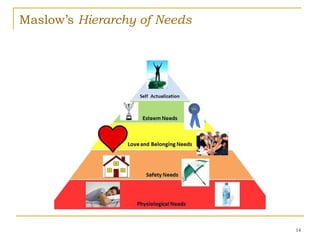
 Maslow’s Hierarchy of Needs
 People must, in a hierarchical order, satisfy five
groups of needs:
Physiological needs for basic survival and
biological function.
Security needs for a safe physical and emotional
environment.
Belongingness needs for love and affection.
Esteem needs for positive self-image/self-respect
and recognition and respect from others.
Self-actualization needs for realizing one’s
potential for personal growth and development.
Maslow’s Hierarchy of Needs
14
15
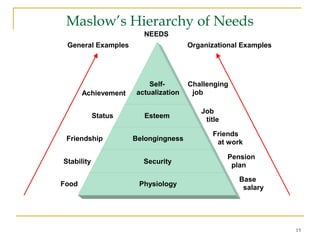
Maslow’s Hierarchy of Needs
Self-
actualization
Esteem
Belongingness
Security
PhysiologyFood
Achievement
Status
Friendship
Stability
Job
Friends
Pension
Base
NEEDS
General Examples Organizational Examples
job
Challenging
title
at work
plan
salary
Maslow’s Hierarchy of Needs
16
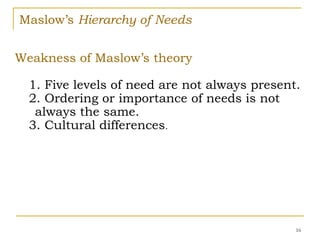
Weakness of Maslow’s theory
1. Five levels of need are not always present.
2. Ordering or importance of needs is not
always the same.
3. Cultural differences.
17
Content Perspectives on Motivation (cont’d)
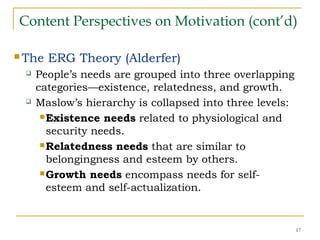
 The ERG Theory (Alderfer)
 People’s needs are grouped into three overlapping
categories—existence, relatedness, and growth.
 Maslow’s hierarchy is collapsed into three levels:
Existence needs related to physiological and
security needs.
Relatedness needs that are similar to
belongingness and esteem by others.
Growth needs encompass needs for self-
esteem and self-actualization.
Content Perspectives on Motivation (cont’d)
 ERG theory assumes that:
Multiple needs can be operative at one
time (there is no absolute hierarchy of
needs).
If a need is unsatisfied, a person will
regress to a lower-level need and pursue
that need (frustration-regression).
18
Content Perspectives on Motivation (cont’d)
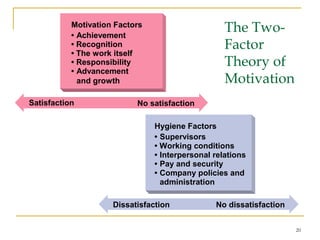
The Two-Factor Theory (Herzberg)
 People’s satisfaction and dissatisfaction are
influenced by two independent sets of factors—
motivation factors and hygiene factors.
 Theory assumes that job satisfaction and job
dissatisfaction are on two distinct continuums:
Motivational factors (work content) are on a
continuum that ranges from satisfaction to no
satisfaction.
Hygiene factors (work environment) are on a
separate continuum that ranges from
dissatisfaction to no dissatisfaction.
19
20
The Two-
Factor
Theory of
Motivation
Satisfaction No satisfaction
Motivation Factors
• Achievement
• Recognition
• The work itself
• Responsibility
• Advancement
and growth
Dissatisfaction No dissatisfaction
Hygiene Factors
• Supervisors
• Working conditions
• Interpersonal relations
• Pay and security
• Company policies and
administration
© 2005 Prentice Hall Inc. All rights reserved. 6–21
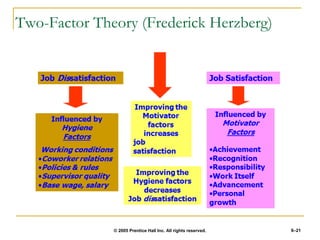
Two-Factor Theory (Frederick Herzberg)
22
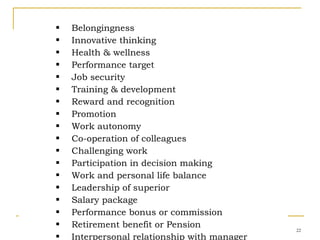
 Belongingness
 Innovative thinking
 Health & wellness
 Performance target
 Job security
 Training & development
 Reward and recognition
 Promotion
 Work autonomy
 Co-operation of colleagues
 Challenging work
 Participation in decision making
 Work and personal life balance
 Leadership of superior
 Salary package
 Performance bonus or commission
 Retirement benefit or Pension
 Interpersonal relationship with manager
The Two-Factor Theory (Herzberg)
23
Motivation is a two-step process:
 Ensuring that the hygiene factors are not
deficient and not blocking motivation.
 Giving employees the opportunity to
experience motivational factors through
job enrichment.
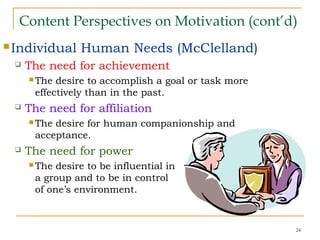
24
Content Perspectives on Motivation (cont’d)
Individual Human Needs (McClelland)
 The need for achievement
 The desire to accomplish a goal or task more
effectively than in the past.
 The need for affiliation
 The desire for human companionship and
acceptance.
 The need for power
 The desire to be influential in
a group and to be in control
of one’s environment.
25
Process Perspectives on Motivation
 Process Perspectives
 Approaches to motivation that focus on why
people choose certain behavioral options to
satisfy their needs and how they evaluate their
satisfaction after they have attained their goals.
 Process Perspectives of Motivation
 Expectancy Theory
 Equity Theory
 Goal-Setting Theory
26
Expectancy Theory
 Motivation depends on how much we want something and how
likely we are to get it.
 Assumes that:
 Behavior is determined by a combination of personal and
environmental forces.
 People make decisions about their own behavior in
organizations.
 Different people have different types of needs, desires, and
goals.
 People choose among alternatives of behaviors in selecting
one that leads to a desired outcome.
 Motivation leads to effort, when combined with ability and
environmental factors, that results in performance which, in
turn, leads to various outcomes that have value (valence) to
employees.
Elements of Expectancy Theory
 Effort-to-Performance Expectancy
 The employee’s perception of the probability that effort will lead
to a high level of performance.
 Performance-to-Outcome Expectancy
 The employee’s perception of the probability that performance
will lead to a specific outcome—the consequence or reward
for behaviors in an organizational setting.
 Valence
 An index of how much an individual values a particular
outcome.
 It is the attractiveness of the outcome to the individual.
Attractive outcomes have positive valences and unattractive
outcomes have negative valences.
Outcomes to which an individual is indifferent have zero
valences.
27
28
Process Perspectives on Motivation (cont’d)
 For motivated behavior to occur:
Both effort-to-performance expectancy and
performance-to-outcome expectancy probabilities
must be greater than zero.
The sum of the valences must be greater than zero.
29
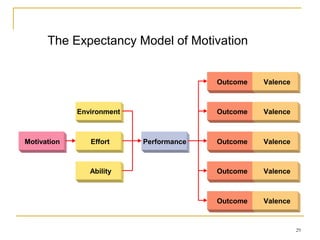
The Expectancy Model of Motivation
Environment
Motivation Effort Performance
Ability
Outcome
Outcome
Outcome
Valence
Outcome Valence
Outcome Valence
Valence
Valence
© 2005 Prentice Hall Inc. All
rights reserved. 6–30
Equity Theory
Referent
Comparisons:
Self-inside
Self-outside
Other-inside
Other-outside
Referent
Comparisons:
Self-inside
Self-outside
Other-inside
Other-outside
Individuals compare their job inputs and outcomes
with those of others and then respond to eliminate
any inequities.
© 2005 Prentice Hall Inc. All
rights reserved. 6–31
Equity Theory (cont’d)
Choices for dealing with inequity:
1. Change inputs (slack off)
2. Change outcomes (increase output)
3. Distort/change perceptions of self
4. Distort/change perceptions of others
5. Choose a different referent person
6. Leave the field (quit the job)
Choices for dealing with inequity:
1. Change inputs (slack off)
2. Change outcomes (increase output)
3. Distort/change perceptions of self
4. Distort/change perceptions of others
5. Choose a different referent person
6. Leave the field (quit the job)
© 2005 Prentice Hall Inc. All
rights reserved. 6–32
Equity Theory (cont’d)
Propositions relating to inequitable pay:
1. Over rewarded hourly employees produce
more than equitably rewarded employees.
2. Over rewarded piece-work employees
produce less, but do higher quality piece
work.
3. Under rewarded hourly employees produce
lower quality work.
4. Under rewarded employees produce larger
quantities of lower-quality piece work than
equitably rewarded employees
Propositions relating to inequitable pay:
1. Over rewarded hourly employees produce
more than equitably rewarded employees.
2. Over rewarded piece-work employees
produce less, but do higher quality piece
work.
3. Under rewarded hourly employees produce
lower quality work.
4. Under rewarded employees produce larger
quantities of lower-quality piece work than
equitably rewarded employees
33
Goal-Setting Theory
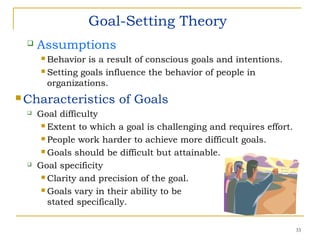
 Assumptions
 Behavior is a result of conscious goals and intentions.
 Setting goals influence the behavior of people in
organizations.
 Characteristics of Goals
 Goal difficulty
 Extent to which a goal is challenging and requires effort.
 People work harder to achieve more difficult goals.
 Goals should be difficult but attainable.
 Goal specificity
 Clarity and precision of the goal.
 Goals vary in their ability to be
stated specifically.
34
Reinforcement Perspectives on Motivation
 Kinds of Reinforcement in Organizations
 Positive reinforcement
 Strengthens behavior with rewards or positive outcomes after
a desired behavior is performed.
 Avoidance
 Strengthens behavior by avoiding unpleasant consequences
that would result if the behavior is not performed.
 Punishment
 Weakens undesired behavior by using negative outcomes or
unpleasant consequences when the behavior is performed.
 Extinction
 Weakens undesired behavior by simply ignoring or not
reinforcing that behavior.
35
Popular Motivational Strategies
Empowerment and Participation
 Empowerment
 The process of enabling workers to set their own work
goals, make decisions, and solve problems within their
sphere of influence.
 Participation
 The process of giving employees a voice in making
decisions about their work.
 Areas of Participation for Employees
 Making decisions about their jobs.
 Decisions about administrative matters (e.g., work
schedules).
 Participating in decision making about broader issues of
product quality.
36
Using Reward Systems to Motivate
Performance
Reward System
 The formal and informal mechanisms by which employee
performance is defined, evaluated, and rewarded.
Effects of Organizational Rewards
 Effect of Rewards on Attitudes
 Satisfaction is influenced by how much is received and
how much the person thinks should have been received.
 Satisfaction is affected by comparison with others.
 The rewards of others are often misperceived.
 Overall job satisfaction is affected by employee
satisfaction with intrinsic and extrinsic rewards.
37
Effects of Organizational Rewards (cont’d)
 Effect of Rewards on Behaviors
 Extrinsic rewards affect employee satisfaction and
reduce turnover.
 Rewards influence patterns of attendance and
absenteeism.
 Employees tend to work harder for rewards based on
performance.
 Effect of Rewards on Motivation
 Employees will work harder when performance will be
measured.
 Employees will work harder if
performance is closely followed
by rewards.
38

Managing employee motivation and performence

  • 1.
    1 Principles of Management Lecture-7 ManagingEmployee Motivation and Performance Nigar Sultana Lecturer Faculty of Business Studies
  • 2.
    2 Learning Objectives After studyingthis chapter, you should be able to:  Characterize the nature of motivation, including its importance and basic historical perspectives.  Identify and describe the major content perspectives on motivation.  Identify and describe the major process perspectives on motivation.  Describe reinforcement perspectives on motivation.  Identify and describe popular motivational strategies.  Describe the role of organizational reward systems in motivation.
  • 3.
    3 Chapter Outline  TheNature of Motivation  The Importance of Motivation in the Workplace  Historical Perspectives on Motivation  Content Perspectives on Motivation  The Need Hierarchy Approach  The Two-Factor Theory  Individual Human Needs  Process Perspectives on Motivation  Expectancy Theory  Equity Theory  Goal-Setting Theory  Reinforcement Perspectives on Motivation  Kinds of Reinforcement in Organizations  Providing Reinforcement in Organizations  Popular Motivational Strategies  Empowerment and Participation  New Forms of Working Arrangements  Using Reward Systems to Motivate Performance  Effects of Organization Rewards  Designing Effective Reward Systems
  • 4.
    4 The Nature ofMotivation  Motivation  The set of forces that cause people to behave in certain ways.  The goal of managers is to maximize desired behaviors and minimize undesirable behaviors.  Key Elements 1. Intensity: how hard a person tries 2. Direction: toward beneficial goal 3. Persistence: how long a person tries
  • 5.
    Motivation  The Importanceof Motivation in the Workplace  Determinants of Individual Performance  Motivation—the desire to do the job.  Ability—the capability to do the job.  Work environment—the resources needed to do the job. 5
  • 6.
  • 7.
  • 8.
    8 The Motivation Framework Searchfor ways to satisfy need Choice of behavior to satisfy need Determination of future needs and search/choice for satisfaction Evaluation of need satisfaction Need or deficiency The motivation processes through a series of discreet steps. Content, process, and reinforcement perspectives on motivation address different parts of this process.
  • 9.
    9 Historical Perspectives onMotivation  The Traditional Approach  Frederick Taylor (Scientific Management)  Assumptions: Managers know more than workers. Economic gain (money) is the primary motivation for performance. Work is inherently unpleasant.
  • 10.
    Historical Perspectives onMotivation  The Human Relations Approach  Emphasized the role of social processes in the workplace.  Assumptions: Employees want to feel useful and important. Employees have strong social needs, more important than money. Maintaining the appearance of employee participation is important. 10
  • 11.
    11 Historical Perspectives onMotivation (cont’d) The Human Resource Approach  Assumptions:  Employee contributions are important and valuable to the employee and the organization.  Employees want to and are able to make genuine contributions.  Management’s job is to encourage participation and create a work environment that motivates employees.
  • 12.
    12 Content Perspectives onMotivation Content Perspectives  Approaches to motivation that try to answer the question, “What factors in the workplace motivate people?” Content Perspectives of Motivation  Maslow’s Hierarchy of Needs  Aldefer’s ERG Theory  Herzberg’s Two-Factor Theory  McClelland’s Achievement, Power, and Affiliation Needs
  • 13.
    13 Content Perspectives onMotivation (cont’d)  Maslow’s Hierarchy of Needs  People must, in a hierarchical order, satisfy five groups of needs: Physiological needs for basic survival and biological function. Security needs for a safe physical and emotional environment. Belongingness needs for love and affection. Esteem needs for positive self-image/self-respect and recognition and respect from others. Self-actualization needs for realizing one’s potential for personal growth and development.

  • 14.
  • 15.
    15 Maslow’s Hierarchy ofNeeds Self- actualization Esteem Belongingness Security PhysiologyFood Achievement Status Friendship Stability Job Friends Pension Base NEEDS General Examples Organizational Examples job Challenging title at work plan salary
  • 16.
    Maslow’s Hierarchy ofNeeds 16 Weakness of Maslow’s theory 1. Five levels of need are not always present. 2. Ordering or importance of needs is not always the same. 3. Cultural differences.
  • 17.
    17 Content Perspectives onMotivation (cont’d)  The ERG Theory (Alderfer)  People’s needs are grouped into three overlapping categories—existence, relatedness, and growth.  Maslow’s hierarchy is collapsed into three levels: Existence needs related to physiological and security needs. Relatedness needs that are similar to belongingness and esteem by others. Growth needs encompass needs for self- esteem and self-actualization.
  • 18.
    Content Perspectives onMotivation (cont’d)  ERG theory assumes that: Multiple needs can be operative at one time (there is no absolute hierarchy of needs). If a need is unsatisfied, a person will regress to a lower-level need and pursue that need (frustration-regression). 18
  • 19.
    Content Perspectives onMotivation (cont’d) The Two-Factor Theory (Herzberg)  People’s satisfaction and dissatisfaction are influenced by two independent sets of factors— motivation factors and hygiene factors.  Theory assumes that job satisfaction and job dissatisfaction are on two distinct continuums: Motivational factors (work content) are on a continuum that ranges from satisfaction to no satisfaction. Hygiene factors (work environment) are on a separate continuum that ranges from dissatisfaction to no dissatisfaction. 19
  • 20.
    20 The Two- Factor Theory of Motivation SatisfactionNo satisfaction Motivation Factors • Achievement • Recognition • The work itself • Responsibility • Advancement and growth Dissatisfaction No dissatisfaction Hygiene Factors • Supervisors • Working conditions • Interpersonal relations • Pay and security • Company policies and administration
  • 21.
    © 2005 PrenticeHall Inc. All rights reserved. 6–21 Two-Factor Theory (Frederick Herzberg)
  • 22.
    22  Belongingness  Innovativethinking  Health & wellness  Performance target  Job security  Training & development  Reward and recognition  Promotion  Work autonomy  Co-operation of colleagues  Challenging work  Participation in decision making  Work and personal life balance  Leadership of superior  Salary package  Performance bonus or commission  Retirement benefit or Pension  Interpersonal relationship with manager
  • 23.
    The Two-Factor Theory(Herzberg) 23 Motivation is a two-step process:  Ensuring that the hygiene factors are not deficient and not blocking motivation.  Giving employees the opportunity to experience motivational factors through job enrichment.
  • 24.
    24 Content Perspectives onMotivation (cont’d) Individual Human Needs (McClelland)  The need for achievement  The desire to accomplish a goal or task more effectively than in the past.  The need for affiliation  The desire for human companionship and acceptance.  The need for power  The desire to be influential in a group and to be in control of one’s environment.
  • 25.
    25 Process Perspectives onMotivation  Process Perspectives  Approaches to motivation that focus on why people choose certain behavioral options to satisfy their needs and how they evaluate their satisfaction after they have attained their goals.  Process Perspectives of Motivation  Expectancy Theory  Equity Theory  Goal-Setting Theory
  • 26.
    26 Expectancy Theory  Motivationdepends on how much we want something and how likely we are to get it.  Assumes that:  Behavior is determined by a combination of personal and environmental forces.  People make decisions about their own behavior in organizations.  Different people have different types of needs, desires, and goals.  People choose among alternatives of behaviors in selecting one that leads to a desired outcome.  Motivation leads to effort, when combined with ability and environmental factors, that results in performance which, in turn, leads to various outcomes that have value (valence) to employees.
  • 27.
    Elements of ExpectancyTheory  Effort-to-Performance Expectancy  The employee’s perception of the probability that effort will lead to a high level of performance.  Performance-to-Outcome Expectancy  The employee’s perception of the probability that performance will lead to a specific outcome—the consequence or reward for behaviors in an organizational setting.  Valence  An index of how much an individual values a particular outcome.  It is the attractiveness of the outcome to the individual. Attractive outcomes have positive valences and unattractive outcomes have negative valences. Outcomes to which an individual is indifferent have zero valences. 27
  • 28.
    28 Process Perspectives onMotivation (cont’d)  For motivated behavior to occur: Both effort-to-performance expectancy and performance-to-outcome expectancy probabilities must be greater than zero. The sum of the valences must be greater than zero.
  • 29.
    29 The Expectancy Modelof Motivation Environment Motivation Effort Performance Ability Outcome Outcome Outcome Valence Outcome Valence Outcome Valence Valence Valence
  • 30.
    © 2005 PrenticeHall Inc. All rights reserved. 6–30 Equity Theory Referent Comparisons: Self-inside Self-outside Other-inside Other-outside Referent Comparisons: Self-inside Self-outside Other-inside Other-outside Individuals compare their job inputs and outcomes with those of others and then respond to eliminate any inequities.
  • 31.
    © 2005 PrenticeHall Inc. All rights reserved. 6–31 Equity Theory (cont’d) Choices for dealing with inequity: 1. Change inputs (slack off) 2. Change outcomes (increase output) 3. Distort/change perceptions of self 4. Distort/change perceptions of others 5. Choose a different referent person 6. Leave the field (quit the job) Choices for dealing with inequity: 1. Change inputs (slack off) 2. Change outcomes (increase output) 3. Distort/change perceptions of self 4. Distort/change perceptions of others 5. Choose a different referent person 6. Leave the field (quit the job)
  • 32.
    © 2005 PrenticeHall Inc. All rights reserved. 6–32 Equity Theory (cont’d) Propositions relating to inequitable pay: 1. Over rewarded hourly employees produce more than equitably rewarded employees. 2. Over rewarded piece-work employees produce less, but do higher quality piece work. 3. Under rewarded hourly employees produce lower quality work. 4. Under rewarded employees produce larger quantities of lower-quality piece work than equitably rewarded employees Propositions relating to inequitable pay: 1. Over rewarded hourly employees produce more than equitably rewarded employees. 2. Over rewarded piece-work employees produce less, but do higher quality piece work. 3. Under rewarded hourly employees produce lower quality work. 4. Under rewarded employees produce larger quantities of lower-quality piece work than equitably rewarded employees
  • 33.
    33 Goal-Setting Theory  Assumptions Behavior is a result of conscious goals and intentions.  Setting goals influence the behavior of people in organizations.  Characteristics of Goals  Goal difficulty  Extent to which a goal is challenging and requires effort.  People work harder to achieve more difficult goals.  Goals should be difficult but attainable.  Goal specificity  Clarity and precision of the goal.  Goals vary in their ability to be stated specifically.
  • 34.
    34 Reinforcement Perspectives onMotivation  Kinds of Reinforcement in Organizations  Positive reinforcement  Strengthens behavior with rewards or positive outcomes after a desired behavior is performed.  Avoidance  Strengthens behavior by avoiding unpleasant consequences that would result if the behavior is not performed.  Punishment  Weakens undesired behavior by using negative outcomes or unpleasant consequences when the behavior is performed.  Extinction  Weakens undesired behavior by simply ignoring or not reinforcing that behavior.
  • 35.
    35 Popular Motivational Strategies Empowermentand Participation  Empowerment  The process of enabling workers to set their own work goals, make decisions, and solve problems within their sphere of influence.  Participation  The process of giving employees a voice in making decisions about their work.  Areas of Participation for Employees  Making decisions about their jobs.  Decisions about administrative matters (e.g., work schedules).  Participating in decision making about broader issues of product quality.
  • 36.
    36 Using Reward Systemsto Motivate Performance Reward System  The formal and informal mechanisms by which employee performance is defined, evaluated, and rewarded. Effects of Organizational Rewards  Effect of Rewards on Attitudes  Satisfaction is influenced by how much is received and how much the person thinks should have been received.  Satisfaction is affected by comparison with others.  The rewards of others are often misperceived.  Overall job satisfaction is affected by employee satisfaction with intrinsic and extrinsic rewards.
  • 37.
    37 Effects of OrganizationalRewards (cont’d)  Effect of Rewards on Behaviors  Extrinsic rewards affect employee satisfaction and reduce turnover.  Rewards influence patterns of attendance and absenteeism.  Employees tend to work harder for rewards based on performance.  Effect of Rewards on Motivation  Employees will work harder when performance will be measured.  Employees will work harder if performance is closely followed by rewards.
  • 38.