Job Analysis
Josephin Dyna.G
12MD032
Overview
•
•
•
•
•
•

What is job analysis?
How can be used in the organization?
Methods of job analysis
How it works?
Example
Conclusion
What is job analysis?
•A
systematic
approach
to
collect information about a job
such as tasks, responsibilities
and the skills required to
perform those tasks.
• An important part of Human
Resources (HR) planning.
How can it be used in
the organization?
• Job analysis assists HR in
determining:
–
–
–
–
–
–

Necessity of the job
Equipment needed
Skills required
Supervision
Working conditions
Management/employee interaction
How can it be used in
your organization?
• Recruiting

– Keyword searches on resumes that
match job requirements.

•
•
•
•

Selection
Appraisal
Salaries and Incentives
Training and Development
How can it be used in
your organization?
• Job analysis can also:

– Help the company remain profitable
and competitive
– Help the company keep up with
technology
– Prevent employees from being
overworked
– Help the company stay
in compliance with
government regulations
What is analyzed?
– Work activities
– Working conditions
• Supervisors
• Location
• Schedule

– Machines and equipment
What is analyzed?
(cntd.)
– Job performance
• Operations
• Standards
• Time

– Experience, training, and skills
– Supervision and promotion
patterns
– Products/services completed
Who is involved in the
job analysis?
–
–
–
–
–

Management
Supervisors
Job analysts
Unions
Consultants
Methods of Job Analysis
• Observation
• Interview
– Individual
– Group

• Questionnaires
•
•
•

– PAQ

Diary
Technical Conference
Critical Incident Technique
Methods of Job Analysis
• Observation Method

– Analyst observes incumbent
–
–

• Directly
• Videotape

Useful when job is fairly routine
Workers may not perform to
expectations
Methods of Job Analysis
• Interview Method
– Individual

• Several workers are interviewed
individually
• The answers are consolidated into a
single job analysis

– Group

• Employees are interviewed
simultaneously
• Group conflict may cause this method
to be ineffective
Methods of Job Analysis
• Questionnaires

– Employees answer questions about
the job’s tasks and responsibilities
– Each question is answered using a
scale that rates the importance of
each task
Methods of Job Analysis
• Questionnaires (ctnd.)

– Position Analysis Questionnaire
(PAQ)

• A structured, behavioral questionnaire
• 194 items in 6 categories
–
–
–
–
–
–

Information input
Mental processes
Work output
Relationships
Job context
Other characteristics
Methods of Job Analysis
• Diary Method

– Employees record information into
diaries of their daily tasks
• Eg : Record the time it takes to
complete tasks

– Must be over a period of several
weeks or months
Methods of Job Analysis
• Technical Conference Method

– Uses experts to gather information
about job characteristics
Methods of Job Analysis
• Critical Incident Technique (CIT)

– Takes past incidents of good and
bad behavior
– Organizes incidents into categories
that match the job they are related
to
How It Works
• Conducting the job analysis

– Know the purpose
– Gather Information about jobs to
be analyzed
• Books
• Charts
• Trade union literature
• Government agency literature

– Use employee input
How It Works
• Conducting the job analysis
(ctnd.)

– Choose an efficient method of
collecting information
– Gather information from
employee/supervisor about the job
– Draft a job description
– Obtain supervisor approval
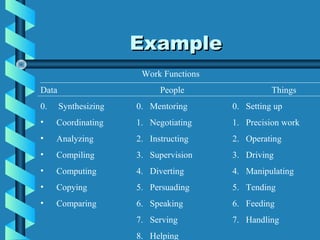
Example
Work Functions
Data

People

Things

0.

Synthesizing

0. Mentoring

0. Setting up

•

Coordinating

1. Negotiating

1. Precision work

•

Analyzing

2. Instructing

2. Operating

•

Compiling

3. Supervision

3. Driving

•

Computing

4. Diverting

4. Manipulating

•

Copying

5. Persuading

5. Tending

•

Comparing

6. Speaking

6. Feeding

7. Serving

7. Handling

8. Helping
Conclusion
• Job analysis is an effective
approach
to
gathering
information about jobs.
• There are 6 popular techniques
to conducting job analyses.
• Job analysis is directly related
to nearly every function of
Human Resource departments
in organizations.

Job analysis

  • 1.
  • 2.
    Overview • • • • • • What is jobanalysis? How can be used in the organization? Methods of job analysis How it works? Example Conclusion
  • 3.
    What is jobanalysis? •A systematic approach to collect information about a job such as tasks, responsibilities and the skills required to perform those tasks. • An important part of Human Resources (HR) planning.
  • 4.
    How can itbe used in the organization? • Job analysis assists HR in determining: – – – – – – Necessity of the job Equipment needed Skills required Supervision Working conditions Management/employee interaction
  • 5.
    How can itbe used in your organization? • Recruiting – Keyword searches on resumes that match job requirements. • • • • Selection Appraisal Salaries and Incentives Training and Development
  • 6.
    How can itbe used in your organization? • Job analysis can also: – Help the company remain profitable and competitive – Help the company keep up with technology – Prevent employees from being overworked – Help the company stay in compliance with government regulations
  • 7.
    What is analyzed? –Work activities – Working conditions • Supervisors • Location • Schedule – Machines and equipment
  • 8.
    What is analyzed? (cntd.) –Job performance • Operations • Standards • Time – Experience, training, and skills – Supervision and promotion patterns – Products/services completed
  • 9.
    Who is involvedin the job analysis? – – – – – Management Supervisors Job analysts Unions Consultants
  • 10.
    Methods of JobAnalysis • Observation • Interview – Individual – Group • Questionnaires • • • – PAQ Diary Technical Conference Critical Incident Technique
  • 11.
    Methods of JobAnalysis • Observation Method – Analyst observes incumbent – – • Directly • Videotape Useful when job is fairly routine Workers may not perform to expectations
  • 12.
    Methods of JobAnalysis • Interview Method – Individual • Several workers are interviewed individually • The answers are consolidated into a single job analysis – Group • Employees are interviewed simultaneously • Group conflict may cause this method to be ineffective
  • 13.
    Methods of JobAnalysis • Questionnaires – Employees answer questions about the job’s tasks and responsibilities – Each question is answered using a scale that rates the importance of each task
  • 14.
    Methods of JobAnalysis • Questionnaires (ctnd.) – Position Analysis Questionnaire (PAQ) • A structured, behavioral questionnaire • 194 items in 6 categories – – – – – – Information input Mental processes Work output Relationships Job context Other characteristics
  • 15.
    Methods of JobAnalysis • Diary Method – Employees record information into diaries of their daily tasks • Eg : Record the time it takes to complete tasks – Must be over a period of several weeks or months
  • 16.
    Methods of JobAnalysis • Technical Conference Method – Uses experts to gather information about job characteristics
  • 17.
    Methods of JobAnalysis • Critical Incident Technique (CIT) – Takes past incidents of good and bad behavior – Organizes incidents into categories that match the job they are related to
  • 18.
    How It Works •Conducting the job analysis – Know the purpose – Gather Information about jobs to be analyzed • Books • Charts • Trade union literature • Government agency literature – Use employee input
  • 19.
    How It Works •Conducting the job analysis (ctnd.) – Choose an efficient method of collecting information – Gather information from employee/supervisor about the job – Draft a job description – Obtain supervisor approval
  • 20.
    Example Work Functions Data People Things 0. Synthesizing 0. Mentoring 0.Setting up • Coordinating 1. Negotiating 1. Precision work • Analyzing 2. Instructing 2. Operating • Compiling 3. Supervision 3. Driving • Computing 4. Diverting 4. Manipulating • Copying 5. Persuading 5. Tending • Comparing 6. Speaking 6. Feeding 7. Serving 7. Handling 8. Helping
  • 21.
    Conclusion • Job analysisis an effective approach to gathering information about jobs. • There are 6 popular techniques to conducting job analyses. • Job analysis is directly related to nearly every function of Human Resource departments in organizations.

Editor's Notes

  • #4 Most tasks performed by HR are directly involved with job analysis.
  • #5 Using job analysis, HR can determine whether a job is necessary to the company. They can also decide how many supervisors are necessary. The amount of interaction between employees and management, as well as the amount of information flow throughout the company, is important to the HR department.
  • #6 The HR department can use job analysis in the recruitment process to target applicants who are qualified for the job. They can use key words to search for items that match the job description. In the selection process, applicants are given tests, such as personality tests, that help recruiters select the appropriate applicant for the job. Salaries can be set according to the level of skills involved with the job. Job analysis also helps to determine the amount and types of training that will be required. If skill gaps are apparent after doing the analysis, training programs can be instituted to correct the problems.
  • #7 Rotate jobs among employees to prevent boredom. Being aware of particular jobs can be an insight into whether the company needs to make technological changes to remain competitive. Job analyses can also help companies to defend themselves against legal actions taken because of discrimination, etc.
  • #8 Job analysis is not only important to determine the activities performed in the job itself, but also to determine what kind of conditions the employee will have to work in, and whether these conditions would be able to accommodate a person with a handicap, etc. This way the company could avoid discrimination lawsuits and be in compliance with the Americans with Disabilities Act.
  • #9 The actual products made, or services given, can be analyzed to determine the actual worth to the company of a particular job.
  • #10 Job incumbents are the employees holding the jobs to be analyzed. Consultants may be hired but are not always necessary.
  • #11 PAQ is the Position Analysis Questionnaire, which contains questions about information that applies to any job.
  • #12 If the observation method is used to analyze a job, then all tasks involved with that job must be observable within a certain amount of time. Thus, jobs such as managerial positions are difficult to observe using this method. Also, if the workers are aware that they are being observed, they may feel under pressure and will not perform their tasks to their actual capabilities.
  • #13 The interview method requires that all employees are asked the same questions in the same order. The individual interview method is useful to obtain a group consensus about the job.
  • #14 Not all jobs are the same, so questionnaires may overlook certain aspects of the job. Also, follow-up methods are not usually organized to gather extra information. Computerized versions of questionnaires can be very expensive.
  • #15 PAQ questions are either rated on a 5 point scale or are checked if they apply. The questions concern where and how employees obtain information, how they make decisions, how they relate to co-workers and managers, how they actually perform the job physically and socially, and other miscellaneous items.
  • #16 This method can be very expensive because of the time it takes to complete it.
  • #17 The technical conference method can be useful but sometimes look beyond the scope of the employees’ perspectives of their jobs.
  • #18 The CIT is helpful in illustrating to an employee what kind of behavior is required for the job.
  • #19 Job analysts should collect as much information as possible about the job before actually performing the job analysis. The information can be collected from the sources mentioned on the slide. Employees should be involved in the job analysis as much as possible.
  • #20 Job analysts should choose the most effective, least expensive method they can. They must have supervisor or management approval before drafting the final job description.
  • #21 Each job is coded using an aspect from each column.