

PRESENTATION TOPIC
ON
MOTIVATION
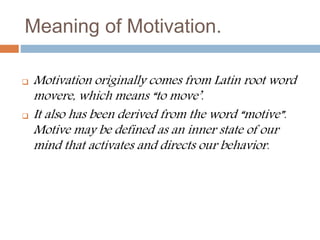
Meaning of Motivation.
 Motivation originally comes from Latin root word
movere, which means “to move’.
 It also has been derived from the word “motive”.
Motive may be defined as an inner state of our
mind that activates and directs our behavior.
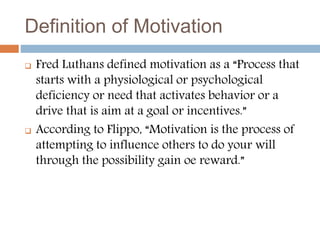
Definition of Motivation
 Fred Luthans defined motivation as a “Process that
starts with a physiological or psychological
deficiency or need that activates behavior or a
drive that is aim at a goal or incentives.”
 According to Flippo, “Motivation is the process of
attempting to influence others to do your will
through the possibility gain oe reward.”
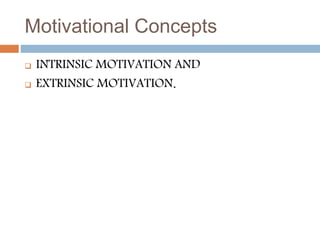
Motivational Concepts
 INTRINSIC MOTIVATION AND
 EXTRINSIC MOTIVATION.
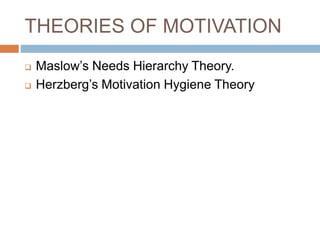
THEORIES OF MOTIVATION
 Maslow’s Needs Hierarchy Theory.
 Herzberg’s Motivation Hygiene Theory
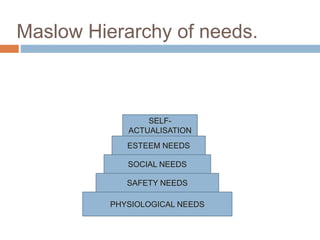
Maslow Hierarchy of needs.
SELF-
ACTUALISATION
ESTEEM NEEDS
SOCIAL NEEDS
SAFETY NEEDS
PHYSIOLOGICAL NEEDS
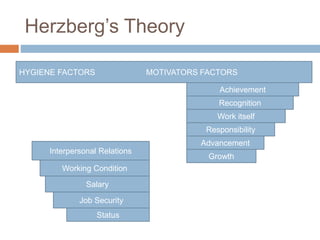
Herzberg’s Theory
HYGIENE FACTORS MOTIVATORS FACTORS
Achievement
Recognition
Work itself
Responsibility
Advancement
Growth
Interpersonal Relations
Working Condition
Salary
Job Security
Status
Difference between Maslow and
Herzberg’s theories
 Maslow’s motivation theory is based on the
hierarchy of needs, according to this theory, only
unsatisfied needs motivate individuals.
But, Herzberg’s motivation theory is
base on hygiene and motivational factors.
According to him hygiene factors prevent job
dissatisfaction but do not provide motivation to
workers.
CONCLUSION
 Motivation is the set of processes that arouse, direct
and maintain human behavior toward attaining some
goal.
 Motivated employees contribute to organizational
results by producing more in quantity and quality. In
turn, employees get more remuneration in return of
their higher contribution to organizational
performance.
“If we compare management with driving, while the
organization is vehicle, then motivation is the power
or fuel that makes the vehicle moving”.
Motivation

Motivation

  • 1.
  • 2.
    Meaning of Motivation. Motivation originally comes from Latin root word movere, which means “to move’.  It also has been derived from the word “motive”. Motive may be defined as an inner state of our mind that activates and directs our behavior.
  • 3.
    Definition of Motivation Fred Luthans defined motivation as a “Process that starts with a physiological or psychological deficiency or need that activates behavior or a drive that is aim at a goal or incentives.”  According to Flippo, “Motivation is the process of attempting to influence others to do your will through the possibility gain oe reward.”
  • 4.
    Motivational Concepts  INTRINSICMOTIVATION AND  EXTRINSIC MOTIVATION.
  • 5.
    THEORIES OF MOTIVATION Maslow’s Needs Hierarchy Theory.  Herzberg’s Motivation Hygiene Theory
  • 6.
    Maslow Hierarchy ofneeds. SELF- ACTUALISATION ESTEEM NEEDS SOCIAL NEEDS SAFETY NEEDS PHYSIOLOGICAL NEEDS
  • 7.
    Herzberg’s Theory HYGIENE FACTORSMOTIVATORS FACTORS Achievement Recognition Work itself Responsibility Advancement Growth Interpersonal Relations Working Condition Salary Job Security Status
  • 8.
    Difference between Maslowand Herzberg’s theories  Maslow’s motivation theory is based on the hierarchy of needs, according to this theory, only unsatisfied needs motivate individuals. But, Herzberg’s motivation theory is base on hygiene and motivational factors. According to him hygiene factors prevent job dissatisfaction but do not provide motivation to workers.
  • 9.
    CONCLUSION  Motivation isthe set of processes that arouse, direct and maintain human behavior toward attaining some goal.  Motivated employees contribute to organizational results by producing more in quantity and quality. In turn, employees get more remuneration in return of their higher contribution to organizational performance. “If we compare management with driving, while the organization is vehicle, then motivation is the power or fuel that makes the vehicle moving”.