Prepared by Dr. Nasir Hussein
MotivationMotivation
The word motivation comes from the Latin word ‘ movere’,The word motivation comes from the Latin word ‘ movere’,
which means to move.which means to move.
Motivation is the set of forces that cause people to behave inMotivation is the set of forces that cause people to behave in
certain ways.certain ways.
Such kind of forces are drives, desires, needs, wishes, aims,Such kind of forces are drives, desires, needs, wishes, aims,
goals, wants.goals, wants.
Motivation is the basic psychological process because it dealsMotivation is the basic psychological process because it deals
with human behaviors.with human behaviors.
Motivation means an individual’s needs, desire and conceptsMotivation means an individual’s needs, desire and concepts
that causes him or her to act in a particular manner.that causes him or her to act in a particular manner.
MotivationMotivation
Motivation is the process that starts with aMotivation is the process that starts with a
psychological or physiological deficiency or need thatpsychological or physiological deficiency or need that
activates a behavior or a drive that is aimed at a goalactivates a behavior or a drive that is aimed at a goal
or incentive.or incentive.
It may be defined as the state of an individual’sIt may be defined as the state of an individual’s
perspective which represents the strength of hisperspective which represents the strength of his
propensity to exert effort towards some particualrpropensity to exert effort towards some particualr
behavior.behavior.
Motivation is the factors that cause, channel andMotivation is the factors that cause, channel and
sustain an individual’s behavior.sustain an individual’s behavior.
Motivation processMotivation process
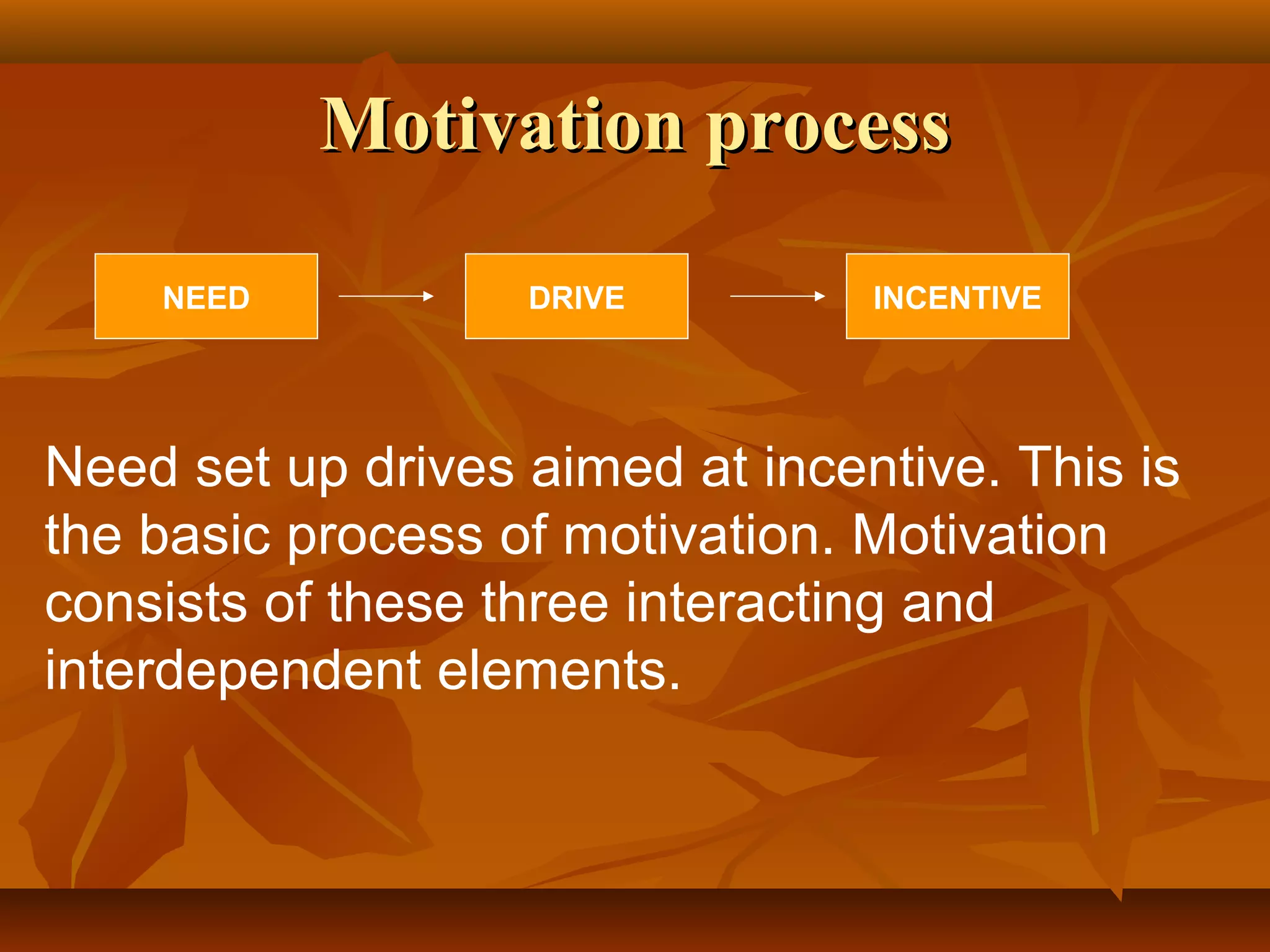
NEED DRIVE INCENTIVE
Need set up drives aimed at incentive. This is
the basic process of motivation. Motivation
consists of these three interacting and
interdependent elements.
NeedNeed
Needs are created whenever there is aNeeds are created whenever there is a
physiological or psychological imbalance.physiological or psychological imbalance.
For exampleFor example
A need exists when cells in the body deprived ofA need exists when cells in the body deprived of
food and water or when the personality isfood and water or when the personality is
deprived of other people who serve as friends ordeprived of other people who serve as friends or
companion.companion.
DrivesDrives
Drive are set up to alleviate needs.Drive are set up to alleviate needs.
A physiological drive can be simply defined as aA physiological drive can be simply defined as a
deficiency with direction.deficiency with direction.
Physiological and philological drives are actionPhysiological and philological drives are action
oriented and provide an energizing thrust towardoriented and provide an energizing thrust toward
reaching an incentive. They are the very heart ofreaching an incentive. They are the very heart of
the motivational process.the motivational process.
For exampleFor example
Needs for food and water are translated into theNeeds for food and water are translated into the
hunger and thirst drive and the need for friendshunger and thirst drive and the need for friends
becomes a drive for affection.becomes a drive for affection.
IncentivesIncentives
At the end of the motivation process is theAt the end of the motivation process is the
incentive or goal defined as anything that willincentive or goal defined as anything that will
alleviate the need and reduce a drive.alleviate the need and reduce a drive.
For exampleFor example
Eating food, drinking water and obtaining friendsEating food, drinking water and obtaining friends
will alleviate the need and reduce or cut off thewill alleviate the need and reduce or cut off the
drive.drive.
MotivatingMotivating
from managerial perspectivefrom managerial perspective
From managerial perspectiveFrom managerial perspective
Motivating is the management process of influencingMotivating is the management process of influencing
peoples behavior based on this knowledge of “Whatpeoples behavior based on this knowledge of “What
makes people tick.makes people tick.
An employee may choose to work as hard as possible orAn employee may choose to work as hard as possible or
to do as little as possible. The goal for the manager is toto do as little as possible. The goal for the manager is to
maximize the likelihood of the first behavior andmaximize the likelihood of the first behavior and
minimize the likelihood of the second behavior.minimize the likelihood of the second behavior.
Motivating processMotivating process
from managerial perspectivefrom managerial perspective
NEED DRIVE INCENTIVE
MOTIVATING
ACTION
SATISFACTION
Factors of motivationFactors of motivation
 The motivatorThe motivator
 The person being motivatedThe person being motivated
Characteristic of motivationCharacteristic of motivation
 Motivation is a psychological conceptMotivation is a psychological concept
 Motivation is created from aim.Motivation is created from aim.
 Human want is the basis of motivation.Human want is the basis of motivation.
 Man is the key point of motivation.Man is the key point of motivation.
 Motivation is an unending processMotivation is an unending process
 Motivation maybe financial or non financialMotivation maybe financial or non financial
 Motivation is the strength of workMotivation is the strength of work
 Motivation is different from mental strengthMotivation is different from mental strength
 Man as a whole motivatedMan as a whole motivated
Importance of motivation inImportance of motivation in
ManagementManagement
Managers should understand the central role thatManagers should understand the central role that
motivation plays in determining employees jobmotivation plays in determining employees job
performance.performance.
Motivation deals with human behavior.Motivation deals with human behavior.
Individual behavior is a complex phenomenon.Individual behavior is a complex phenomenon.
Thus motivation is important because of itsThus motivation is important because of its
significance as a determination of performancesignificance as a determination of performance
and because of its intangible character.and because of its intangible character.
Importance of motivating inImportance of motivating in
managementmanagement
 Creation of desire of workCreation of desire of work
 Increase in productivityIncrease in productivity
 Increase in job satisfactionIncrease in job satisfaction
 Appropriate use of factors.Appropriate use of factors.
 Maximum use of human potentials and talents.Maximum use of human potentials and talents.
 It encourages initiatives and development.It encourages initiatives and development.
IncentiveIncentive
Incentive is the means that influence peopleIncentive is the means that influence people
to do certain job.to do certain job.
Managers provide incentive to motivateManagers provide incentive to motivate
people to work effectively and efficiently topeople to work effectively and efficiently to
achieve organizational goals.achieve organizational goals.
Incentive Used In motivationIncentive Used In motivation
 Higher wages and salaryHigher wages and salary
 BonusBonus
 PrizePrize
 Profit distributionProfit distribution
 Promotion arrangementPromotion arrangement
 Job securityJob security
 Job satisfaction,Job satisfaction,
 Promotion,Promotion,
 Recognition of workRecognition of work
Incentive Used In motivationIncentive Used In motivation
 Social statusSocial status
 Good supervisionGood supervision
 Award titlesAward titles
 Friendly leadershipFriendly leadership
 Give responsibilityGive responsibility
 Personal power and rights.Personal power and rights.
 Fair working environment.Fair working environment.
 attractive work.attractive work.
 Democratic managementDemocratic management
 Opportunity to do constructive workOpportunity to do constructive work
 Participation in managementParticipation in management
Relationship between motivation andRelationship between motivation and
productivityproductivity
 P= m ( A + K)P= m ( A + K)
 Where P= performance,Where P= performance,
 M= motivationM= motivation
 A =abilityA =ability
 K =KnowledgeK =Knowledge
Theories of motivationTheories of motivation
 Participation theoryParticipation theory
 Interaction theoryInteraction theory
 Pattern theoryPattern theory
 Achievement Expectation theoryAchievement Expectation theory
 Theory of need HierarchyTheory of need Hierarchy
 Theory X and YTheory X and Y
 Herz-berg,s Duel factor theoryHerz-berg,s Duel factor theory
 ERG theory of needsERG theory of needs
 Theory ZTheory Z
Maslow’s hierarchy ofMaslow’s hierarchy of
needsneeds
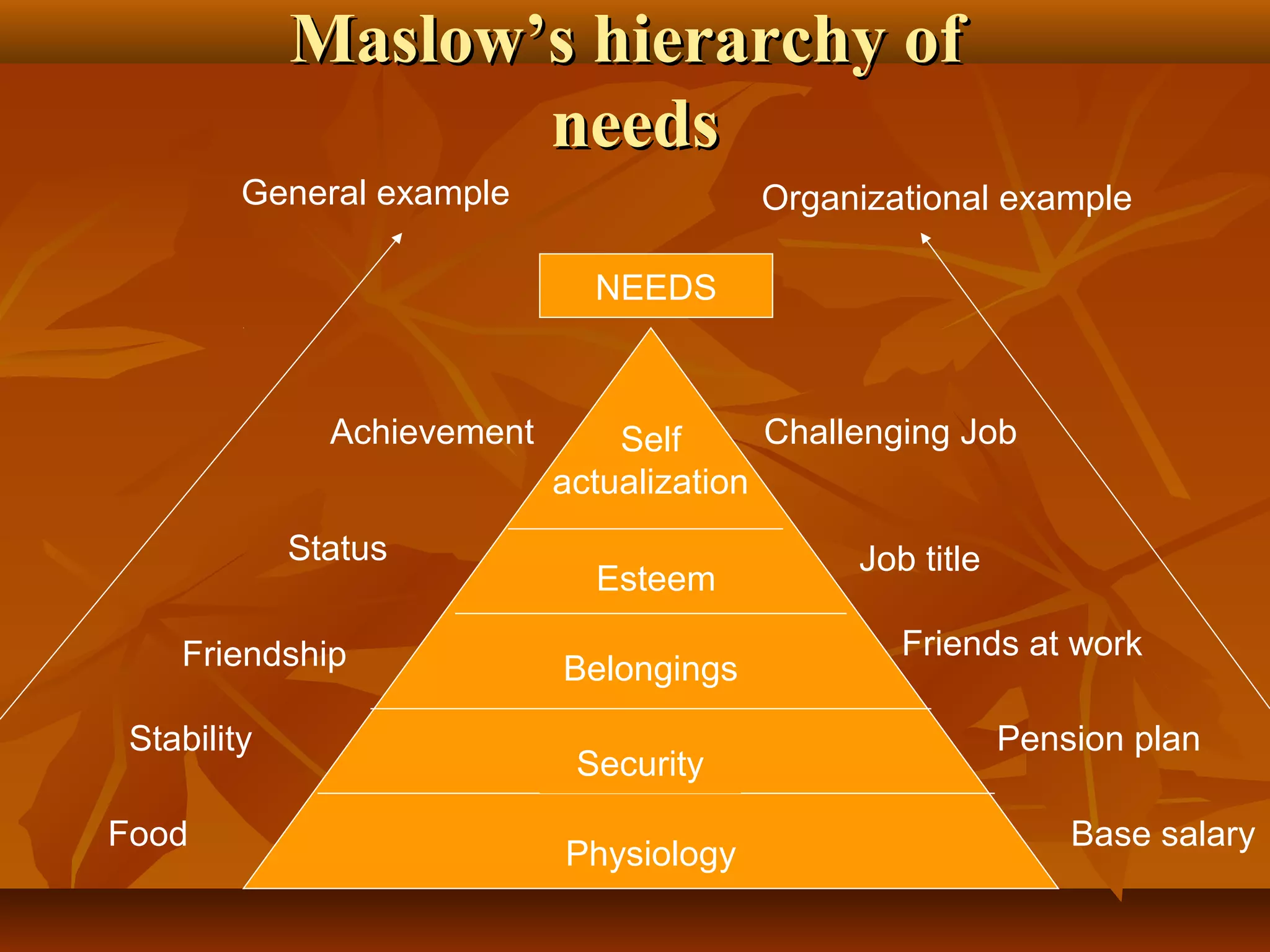
Maslow’s hierarchy of needs is the theory of motivationMaslow’s hierarchy of needs is the theory of motivation
that people are motivated to meet five types of needsthat people are motivated to meet five types of needs
which can be ranked in a hierarchy in the followingwhich can be ranked in a hierarchy in the following
orderorder
Physiological needs.Physiological needs.
Security or safety needs.Security or safety needs.
Belongings or social needs.Belongings or social needs.
Esteem needs.Esteem needs.
Self actualization.Self actualization.
Maslow’s hierarchy ofMaslow’s hierarchy of
needsneeds
Physiology
Security
Belongings
Esteem
Self
actualization
General example Organizational example
NEEDS
Achievement
Status
Friendship
Stability
Food
Challenging Job
Job title
Friends at work
Pension plan
Base salary
Psychology NeedsPsychology Needs
At the bottom of the Hierarchy is the PhysicalAt the bottom of the Hierarchy is the Physical
needs-things like food, sex, air that represents theneeds-things like food, sex, air that represents the
basic issues of survival and biological functions.basic issues of survival and biological functions.
In organizations these needs are generallyIn organizations these needs are generally
satisfied by adequate wages and the workingsatisfied by adequate wages and the working
environment itself.environment itself.
Security needsSecurity needs
The security needs for a secure Physical andThe security needs for a secure Physical and
emotional environment.emotional environment.
The desire for housing and clothing and the needThe desire for housing and clothing and the need
to be free from worry about maney and jobto be free from worry about maney and job
security.security.
In the working place security needs can beIn the working place security needs can be
satisfied by job continuity, adequate insurancesatisfied by job continuity, adequate insurance
and retirement benefits.and retirement benefits.
Belonging needsBelonging needs
Belonging needs relate to social process. TheyBelonging needs relate to social process. They
include the need for love and affection.include the need for love and affection.
Belonging needs are satisfied for most people byBelonging needs are satisfied for most people by
family and community relationships outsidefamily and community relationships outside
work and friendships on the job.work and friendships on the job.
Esteem needsEsteem needs
Esteem needs comprise two different sets ofEsteem needs comprise two different sets of
needsneeds
The need for positive self-image and self-The need for positive self-image and self-
respectrespect
The need for recognition and respect fromThe need for recognition and respect from
othersothers
A manager can help address these needs byA manager can help address these needs by
providing job titles, comfortable ofices orproviding job titles, comfortable ofices or
rewards as appropriate.rewards as appropriate.
Self-actualization needSelf-actualization need
At the top of the hierarchy are the self-At the top of the hierarchy are the self-
actualization needs. These needs involveactualization needs. These needs involve
realizing one’s potential for continued growthrealizing one’s potential for continued growth
and individual development. To address suchand individual development. To address such
kind of needs managers could give employees akind of needs managers could give employees a
chance to participate in making decisions in theirchance to participate in making decisions in their
work.work.
 Once a lower order need is satisfied, anotherOnce a lower order need is satisfied, another
one emerges. People satisfy first of all theirone emerges. People satisfy first of all their
basic needs for survival.basic needs for survival.
 A satisfied need will no longer motivate aA satisfied need will no longer motivate a
person.person.
 Only unsatisfied need motivates a person.Only unsatisfied need motivates a person.
 CriticismsCriticisms
 Hierarchy of needs may not be the same forHierarchy of needs may not be the same for
everyone.everyone.
 A person often seems to work on satisfyingA person often seems to work on satisfying
several needs at once.several needs at once.
Theory X and YTheory X and Y
Douglas McGregor proposed two distinct viewsDouglas McGregor proposed two distinct views
of human beingsof human beings
 Theory XTheory X
Theory YTheory Y
ERG theoryERG theory
 Alderfer developed this theory.Alderfer developed this theory.
 According to him, needs are of three types:According to him, needs are of three types:
 Existence need: Physiological desires such asExistence need: Physiological desires such as
foods and water and work related materialsfoods and water and work related materials
such as pay, friend benefits and workingsuch as pay, friend benefits and working
conditions.conditions.
 Relatedness need: Relationships with others.Relatedness need: Relationships with others.
 Growth needs. Creativity and innovation.Growth needs. Creativity and innovation.
 Alderfer argues that people can be concerned withAlderfer argues that people can be concerned with
more than one need category at the same time.more than one need category at the same time.
 ERG theory is more flexible since the needs of aERG theory is more flexible since the needs of a
person may occur in a different order.person may occur in a different order.
 Alderfer assumes that when higher needs areAlderfer assumes that when higher needs are
frustrated, lower needs will return even though thyefrustrated, lower needs will return even though thye
are already satisfied.are already satisfied.
 On the other hand, Maslow felt that a need, once met,On the other hand, Maslow felt that a need, once met,
lost its power to motivate behavior. Alderfer saw thatlost its power to motivate behavior. Alderfer saw that
people moving up and down the hierarchy of needspeople moving up and down the hierarchy of needs
from time to time and from situation to situation.from time to time and from situation to situation.
Theory XTheory X
Theory X is the assumption that employeesTheory X is the assumption that employees
dislike work, are lazy, dislike responsibility anddislike work, are lazy, dislike responsibility and
must be forced to perform.must be forced to perform.
Theory XTheory X
 Employees inherently dislike work andEmployees inherently dislike work and
whenever possible will attempt to avoid it.whenever possible will attempt to avoid it.
 Since employees dislike work they must beSince employees dislike work they must be
forced, controlled and threatened withforced, controlled and threatened with
punishment to achieve goals.punishment to achieve goals.
 Employees will avoid responsibilities and seekEmployees will avoid responsibilities and seek
formal direction whenever possibleformal direction whenever possible
Theory YTheory Y
Theory Y is the assumption that employees likeTheory Y is the assumption that employees like
work, are creative, seek responsibility and canwork, are creative, seek responsibility and can
exercise self direction.exercise self direction.
Two-factor theory of HerzbergTwo-factor theory of Herzberg
 It is a theory of motivation that suggest that people’sIt is a theory of motivation that suggest that people’s
satisfaction and dissatisfaction are influenced by twosatisfaction and dissatisfaction are influenced by two
independent set of factors:independent set of factors:
 motivators factors ( achievement, recognition, workmotivators factors ( achievement, recognition, work
itself, responsibility, advancement and growth) anditself, responsibility, advancement and growth) and
 hygiene factors ( supervisors, working conditions,hygiene factors ( supervisors, working conditions,
pay, company policies and administration).pay, company policies and administration).
 Hygiene factors are related to job context, in whichHygiene factors are related to job context, in which
work was conducted.work was conducted.
 Motivation factors are related to job content.Motivation factors are related to job content.
 A manager who tries to motivate an employee using onlyA manager who tries to motivate an employee using only
hygiene factors such as pay and good working conditions willhygiene factors such as pay and good working conditions will
likely not succeed.likely not succeed.
 To motivate employees and produce a high level ofTo motivate employees and produce a high level of
satisfaction, managers must offer motivation factors.satisfaction, managers must offer motivation factors.
 Satisfaction and dissatisfaction are at opposite ends of a singleSatisfaction and dissatisfaction are at opposite ends of a single
continuum. People mighty be satisfied, dissatisfied orcontinuum. People mighty be satisfied, dissatisfied or
somewhere in between.somewhere in between.
 The presence of hygiene factors will not lead to satisfactionThe presence of hygiene factors will not lead to satisfaction
but their absence may lead to dissatisfaction. By providingbut their absence may lead to dissatisfaction. By providing
hygiene factors managers do not stimulate motivation buthygiene factors managers do not stimulate motivation but
merely ensure that employees are ‘not dissatisfied’.merely ensure that employees are ‘not dissatisfied’.
 The presence of motivators will lead to satisfaction and theirThe presence of motivators will lead to satisfaction and their
absence will lead to ‘no satisfaction.absence will lead to ‘no satisfaction.
 Work dissatisfaction and satisfaction arise from two differentWork dissatisfaction and satisfaction arise from two different
sets of factors.sets of factors.
Theory yTheory y
 People do not naturally dislike work; work is aPeople do not naturally dislike work; work is a
natural part of their life.natural part of their life.
 People are internally motivated to reachPeople are internally motivated to reach
objectives to which they are committedobjectives to which they are committed
 People will both seek and accept responsibilityPeople will both seek and accept responsibility
under favorable conditionsunder favorable conditions
People have the capacity to be innovative inPeople have the capacity to be innovative in
solving organizational problems.solving organizational problems.
 People are brightPeople are bright
Reinforcement theoryReinforcement theory
 It is an approach to motivation based on the idea thatIt is an approach to motivation based on the idea that
behavior with positive consequences tends to bebehavior with positive consequences tends to be
repeated, while behavior with negative consequencesrepeated, while behavior with negative consequences
tends not to be repeated.tends not to be repeated.
 It is developed by B.F. Skinner.It is developed by B.F. Skinner.
 Consequences of past behavior affect future actions.Consequences of past behavior affect future actions.
 Behavior modification uses reinforcement theory toBehavior modification uses reinforcement theory to
change human behavior. There are many methods ofchange human behavior. There are many methods of
behavior modification.behavior modification.
 Positive reinforcement. Use of positive consequencesPositive reinforcement. Use of positive consequences
( pay raise or praise) to encourage desirable( pay raise or praise) to encourage desirable
behavior.behavior.
 Avoidance learning. Here persons changeAvoidance learning. Here persons change
behavior to avoid unpleasant consequencesbehavior to avoid unpleasant consequences
such as criticism or poor evaluation.such as criticism or poor evaluation.
 Punishment. The application of negativePunishment. The application of negative
consequences to stop or correct improperconsequences to stop or correct improper
behavior. Examples are reduced pay orbehavior. Examples are reduced pay or
dismissal.dismissal.

Motivation

  • 1.
    Prepared by Dr.Nasir Hussein
  • 2.
    MotivationMotivation The word motivationcomes from the Latin word ‘ movere’,The word motivation comes from the Latin word ‘ movere’, which means to move.which means to move. Motivation is the set of forces that cause people to behave inMotivation is the set of forces that cause people to behave in certain ways.certain ways. Such kind of forces are drives, desires, needs, wishes, aims,Such kind of forces are drives, desires, needs, wishes, aims, goals, wants.goals, wants. Motivation is the basic psychological process because it dealsMotivation is the basic psychological process because it deals with human behaviors.with human behaviors. Motivation means an individual’s needs, desire and conceptsMotivation means an individual’s needs, desire and concepts that causes him or her to act in a particular manner.that causes him or her to act in a particular manner.
  • 3.
    MotivationMotivation Motivation is theprocess that starts with aMotivation is the process that starts with a psychological or physiological deficiency or need thatpsychological or physiological deficiency or need that activates a behavior or a drive that is aimed at a goalactivates a behavior or a drive that is aimed at a goal or incentive.or incentive. It may be defined as the state of an individual’sIt may be defined as the state of an individual’s perspective which represents the strength of hisperspective which represents the strength of his propensity to exert effort towards some particualrpropensity to exert effort towards some particualr behavior.behavior. Motivation is the factors that cause, channel andMotivation is the factors that cause, channel and sustain an individual’s behavior.sustain an individual’s behavior.
  • 4.
    Motivation processMotivation process NEEDDRIVE INCENTIVE Need set up drives aimed at incentive. This is the basic process of motivation. Motivation consists of these three interacting and interdependent elements.
  • 5.
    NeedNeed Needs are createdwhenever there is aNeeds are created whenever there is a physiological or psychological imbalance.physiological or psychological imbalance. For exampleFor example A need exists when cells in the body deprived ofA need exists when cells in the body deprived of food and water or when the personality isfood and water or when the personality is deprived of other people who serve as friends ordeprived of other people who serve as friends or companion.companion.
  • 6.
    DrivesDrives Drive are setup to alleviate needs.Drive are set up to alleviate needs. A physiological drive can be simply defined as aA physiological drive can be simply defined as a deficiency with direction.deficiency with direction. Physiological and philological drives are actionPhysiological and philological drives are action oriented and provide an energizing thrust towardoriented and provide an energizing thrust toward reaching an incentive. They are the very heart ofreaching an incentive. They are the very heart of the motivational process.the motivational process. For exampleFor example Needs for food and water are translated into theNeeds for food and water are translated into the hunger and thirst drive and the need for friendshunger and thirst drive and the need for friends becomes a drive for affection.becomes a drive for affection.
  • 7.
    IncentivesIncentives At the endof the motivation process is theAt the end of the motivation process is the incentive or goal defined as anything that willincentive or goal defined as anything that will alleviate the need and reduce a drive.alleviate the need and reduce a drive. For exampleFor example Eating food, drinking water and obtaining friendsEating food, drinking water and obtaining friends will alleviate the need and reduce or cut off thewill alleviate the need and reduce or cut off the drive.drive.
  • 8.
    MotivatingMotivating from managerial perspectivefrommanagerial perspective From managerial perspectiveFrom managerial perspective Motivating is the management process of influencingMotivating is the management process of influencing peoples behavior based on this knowledge of “Whatpeoples behavior based on this knowledge of “What makes people tick.makes people tick. An employee may choose to work as hard as possible orAn employee may choose to work as hard as possible or to do as little as possible. The goal for the manager is toto do as little as possible. The goal for the manager is to maximize the likelihood of the first behavior andmaximize the likelihood of the first behavior and minimize the likelihood of the second behavior.minimize the likelihood of the second behavior.
  • 9.
    Motivating processMotivating process frommanagerial perspectivefrom managerial perspective NEED DRIVE INCENTIVE MOTIVATING ACTION SATISFACTION
  • 10.
    Factors of motivationFactorsof motivation  The motivatorThe motivator  The person being motivatedThe person being motivated
  • 11.
    Characteristic of motivationCharacteristicof motivation  Motivation is a psychological conceptMotivation is a psychological concept  Motivation is created from aim.Motivation is created from aim.  Human want is the basis of motivation.Human want is the basis of motivation.  Man is the key point of motivation.Man is the key point of motivation.  Motivation is an unending processMotivation is an unending process  Motivation maybe financial or non financialMotivation maybe financial or non financial  Motivation is the strength of workMotivation is the strength of work  Motivation is different from mental strengthMotivation is different from mental strength  Man as a whole motivatedMan as a whole motivated
  • 12.
    Importance of motivationinImportance of motivation in ManagementManagement Managers should understand the central role thatManagers should understand the central role that motivation plays in determining employees jobmotivation plays in determining employees job performance.performance. Motivation deals with human behavior.Motivation deals with human behavior. Individual behavior is a complex phenomenon.Individual behavior is a complex phenomenon. Thus motivation is important because of itsThus motivation is important because of its significance as a determination of performancesignificance as a determination of performance and because of its intangible character.and because of its intangible character.
  • 13.
    Importance of motivatinginImportance of motivating in managementmanagement  Creation of desire of workCreation of desire of work  Increase in productivityIncrease in productivity  Increase in job satisfactionIncrease in job satisfaction  Appropriate use of factors.Appropriate use of factors.  Maximum use of human potentials and talents.Maximum use of human potentials and talents.  It encourages initiatives and development.It encourages initiatives and development.
  • 14.
    IncentiveIncentive Incentive is themeans that influence peopleIncentive is the means that influence people to do certain job.to do certain job. Managers provide incentive to motivateManagers provide incentive to motivate people to work effectively and efficiently topeople to work effectively and efficiently to achieve organizational goals.achieve organizational goals.
  • 15.
    Incentive Used InmotivationIncentive Used In motivation  Higher wages and salaryHigher wages and salary  BonusBonus  PrizePrize  Profit distributionProfit distribution  Promotion arrangementPromotion arrangement  Job securityJob security  Job satisfaction,Job satisfaction,  Promotion,Promotion,  Recognition of workRecognition of work
  • 16.
    Incentive Used InmotivationIncentive Used In motivation  Social statusSocial status  Good supervisionGood supervision  Award titlesAward titles  Friendly leadershipFriendly leadership  Give responsibilityGive responsibility  Personal power and rights.Personal power and rights.  Fair working environment.Fair working environment.  attractive work.attractive work.  Democratic managementDemocratic management  Opportunity to do constructive workOpportunity to do constructive work  Participation in managementParticipation in management
  • 17.
    Relationship between motivationandRelationship between motivation and productivityproductivity  P= m ( A + K)P= m ( A + K)  Where P= performance,Where P= performance,  M= motivationM= motivation  A =abilityA =ability  K =KnowledgeK =Knowledge
  • 18.
    Theories of motivationTheoriesof motivation  Participation theoryParticipation theory  Interaction theoryInteraction theory  Pattern theoryPattern theory  Achievement Expectation theoryAchievement Expectation theory  Theory of need HierarchyTheory of need Hierarchy  Theory X and YTheory X and Y  Herz-berg,s Duel factor theoryHerz-berg,s Duel factor theory  ERG theory of needsERG theory of needs  Theory ZTheory Z
  • 19.
    Maslow’s hierarchy ofMaslow’shierarchy of needsneeds Maslow’s hierarchy of needs is the theory of motivationMaslow’s hierarchy of needs is the theory of motivation that people are motivated to meet five types of needsthat people are motivated to meet five types of needs which can be ranked in a hierarchy in the followingwhich can be ranked in a hierarchy in the following orderorder Physiological needs.Physiological needs. Security or safety needs.Security or safety needs. Belongings or social needs.Belongings or social needs. Esteem needs.Esteem needs. Self actualization.Self actualization.
  • 20.
    Maslow’s hierarchy ofMaslow’shierarchy of needsneeds Physiology Security Belongings Esteem Self actualization General example Organizational example NEEDS Achievement Status Friendship Stability Food Challenging Job Job title Friends at work Pension plan Base salary
  • 21.
    Psychology NeedsPsychology Needs Atthe bottom of the Hierarchy is the PhysicalAt the bottom of the Hierarchy is the Physical needs-things like food, sex, air that represents theneeds-things like food, sex, air that represents the basic issues of survival and biological functions.basic issues of survival and biological functions. In organizations these needs are generallyIn organizations these needs are generally satisfied by adequate wages and the workingsatisfied by adequate wages and the working environment itself.environment itself.
  • 22.
    Security needsSecurity needs Thesecurity needs for a secure Physical andThe security needs for a secure Physical and emotional environment.emotional environment. The desire for housing and clothing and the needThe desire for housing and clothing and the need to be free from worry about maney and jobto be free from worry about maney and job security.security. In the working place security needs can beIn the working place security needs can be satisfied by job continuity, adequate insurancesatisfied by job continuity, adequate insurance and retirement benefits.and retirement benefits.
  • 23.
    Belonging needsBelonging needs Belongingneeds relate to social process. TheyBelonging needs relate to social process. They include the need for love and affection.include the need for love and affection. Belonging needs are satisfied for most people byBelonging needs are satisfied for most people by family and community relationships outsidefamily and community relationships outside work and friendships on the job.work and friendships on the job.
  • 24.
    Esteem needsEsteem needs Esteemneeds comprise two different sets ofEsteem needs comprise two different sets of needsneeds The need for positive self-image and self-The need for positive self-image and self- respectrespect The need for recognition and respect fromThe need for recognition and respect from othersothers A manager can help address these needs byA manager can help address these needs by providing job titles, comfortable ofices orproviding job titles, comfortable ofices or rewards as appropriate.rewards as appropriate.
  • 25.
    Self-actualization needSelf-actualization need Atthe top of the hierarchy are the self-At the top of the hierarchy are the self- actualization needs. These needs involveactualization needs. These needs involve realizing one’s potential for continued growthrealizing one’s potential for continued growth and individual development. To address suchand individual development. To address such kind of needs managers could give employees akind of needs managers could give employees a chance to participate in making decisions in theirchance to participate in making decisions in their work.work.
  • 26.
     Once alower order need is satisfied, anotherOnce a lower order need is satisfied, another one emerges. People satisfy first of all theirone emerges. People satisfy first of all their basic needs for survival.basic needs for survival.  A satisfied need will no longer motivate aA satisfied need will no longer motivate a person.person.  Only unsatisfied need motivates a person.Only unsatisfied need motivates a person.  CriticismsCriticisms  Hierarchy of needs may not be the same forHierarchy of needs may not be the same for everyone.everyone.  A person often seems to work on satisfyingA person often seems to work on satisfying several needs at once.several needs at once.
  • 27.
    Theory X andYTheory X and Y Douglas McGregor proposed two distinct viewsDouglas McGregor proposed two distinct views of human beingsof human beings  Theory XTheory X Theory YTheory Y
  • 28.
    ERG theoryERG theory Alderfer developed this theory.Alderfer developed this theory.  According to him, needs are of three types:According to him, needs are of three types:  Existence need: Physiological desires such asExistence need: Physiological desires such as foods and water and work related materialsfoods and water and work related materials such as pay, friend benefits and workingsuch as pay, friend benefits and working conditions.conditions.  Relatedness need: Relationships with others.Relatedness need: Relationships with others.  Growth needs. Creativity and innovation.Growth needs. Creativity and innovation.
  • 29.
     Alderfer arguesthat people can be concerned withAlderfer argues that people can be concerned with more than one need category at the same time.more than one need category at the same time.  ERG theory is more flexible since the needs of aERG theory is more flexible since the needs of a person may occur in a different order.person may occur in a different order.  Alderfer assumes that when higher needs areAlderfer assumes that when higher needs are frustrated, lower needs will return even though thyefrustrated, lower needs will return even though thye are already satisfied.are already satisfied.  On the other hand, Maslow felt that a need, once met,On the other hand, Maslow felt that a need, once met, lost its power to motivate behavior. Alderfer saw thatlost its power to motivate behavior. Alderfer saw that people moving up and down the hierarchy of needspeople moving up and down the hierarchy of needs from time to time and from situation to situation.from time to time and from situation to situation.
  • 30.
    Theory XTheory X TheoryX is the assumption that employeesTheory X is the assumption that employees dislike work, are lazy, dislike responsibility anddislike work, are lazy, dislike responsibility and must be forced to perform.must be forced to perform.
  • 31.
    Theory XTheory X Employees inherently dislike work andEmployees inherently dislike work and whenever possible will attempt to avoid it.whenever possible will attempt to avoid it.  Since employees dislike work they must beSince employees dislike work they must be forced, controlled and threatened withforced, controlled and threatened with punishment to achieve goals.punishment to achieve goals.  Employees will avoid responsibilities and seekEmployees will avoid responsibilities and seek formal direction whenever possibleformal direction whenever possible
  • 32.
    Theory YTheory Y TheoryY is the assumption that employees likeTheory Y is the assumption that employees like work, are creative, seek responsibility and canwork, are creative, seek responsibility and can exercise self direction.exercise self direction.
  • 33.
    Two-factor theory ofHerzbergTwo-factor theory of Herzberg  It is a theory of motivation that suggest that people’sIt is a theory of motivation that suggest that people’s satisfaction and dissatisfaction are influenced by twosatisfaction and dissatisfaction are influenced by two independent set of factors:independent set of factors:  motivators factors ( achievement, recognition, workmotivators factors ( achievement, recognition, work itself, responsibility, advancement and growth) anditself, responsibility, advancement and growth) and  hygiene factors ( supervisors, working conditions,hygiene factors ( supervisors, working conditions, pay, company policies and administration).pay, company policies and administration).  Hygiene factors are related to job context, in whichHygiene factors are related to job context, in which work was conducted.work was conducted.  Motivation factors are related to job content.Motivation factors are related to job content.
  • 34.
     A managerwho tries to motivate an employee using onlyA manager who tries to motivate an employee using only hygiene factors such as pay and good working conditions willhygiene factors such as pay and good working conditions will likely not succeed.likely not succeed.  To motivate employees and produce a high level ofTo motivate employees and produce a high level of satisfaction, managers must offer motivation factors.satisfaction, managers must offer motivation factors.  Satisfaction and dissatisfaction are at opposite ends of a singleSatisfaction and dissatisfaction are at opposite ends of a single continuum. People mighty be satisfied, dissatisfied orcontinuum. People mighty be satisfied, dissatisfied or somewhere in between.somewhere in between.  The presence of hygiene factors will not lead to satisfactionThe presence of hygiene factors will not lead to satisfaction but their absence may lead to dissatisfaction. By providingbut their absence may lead to dissatisfaction. By providing hygiene factors managers do not stimulate motivation buthygiene factors managers do not stimulate motivation but merely ensure that employees are ‘not dissatisfied’.merely ensure that employees are ‘not dissatisfied’.  The presence of motivators will lead to satisfaction and theirThe presence of motivators will lead to satisfaction and their absence will lead to ‘no satisfaction.absence will lead to ‘no satisfaction.  Work dissatisfaction and satisfaction arise from two differentWork dissatisfaction and satisfaction arise from two different sets of factors.sets of factors.
  • 35.
    Theory yTheory y People do not naturally dislike work; work is aPeople do not naturally dislike work; work is a natural part of their life.natural part of their life.  People are internally motivated to reachPeople are internally motivated to reach objectives to which they are committedobjectives to which they are committed  People will both seek and accept responsibilityPeople will both seek and accept responsibility under favorable conditionsunder favorable conditions People have the capacity to be innovative inPeople have the capacity to be innovative in solving organizational problems.solving organizational problems.  People are brightPeople are bright
  • 36.
    Reinforcement theoryReinforcement theory It is an approach to motivation based on the idea thatIt is an approach to motivation based on the idea that behavior with positive consequences tends to bebehavior with positive consequences tends to be repeated, while behavior with negative consequencesrepeated, while behavior with negative consequences tends not to be repeated.tends not to be repeated.  It is developed by B.F. Skinner.It is developed by B.F. Skinner.  Consequences of past behavior affect future actions.Consequences of past behavior affect future actions.  Behavior modification uses reinforcement theory toBehavior modification uses reinforcement theory to change human behavior. There are many methods ofchange human behavior. There are many methods of behavior modification.behavior modification.  Positive reinforcement. Use of positive consequencesPositive reinforcement. Use of positive consequences ( pay raise or praise) to encourage desirable( pay raise or praise) to encourage desirable behavior.behavior.
  • 37.
     Avoidance learning.Here persons changeAvoidance learning. Here persons change behavior to avoid unpleasant consequencesbehavior to avoid unpleasant consequences such as criticism or poor evaluation.such as criticism or poor evaluation.  Punishment. The application of negativePunishment. The application of negative consequences to stop or correct improperconsequences to stop or correct improper behavior. Examples are reduced pay orbehavior. Examples are reduced pay or dismissal.dismissal.