PRESENTATION
ON
SUBMITTED BY-
MITHISAR BASUMATARY
NIT SILCHAR
Brand Positioning
• Brand Positioning can be defined as an activity of
creating a brand offer in such a manner that it occupies a
distinctive place and value in the target customer’s mind.
• Brand Positioning involves identifying and determining
points of similarity and difference.
• Positioning is the base for developing and increasing the
required knowledge and perceptions of the customers.
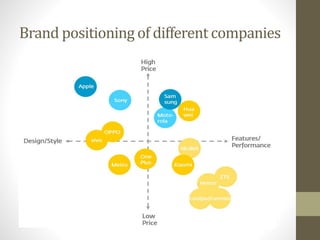
Brand positioning of different companies
Determiningthe frame of reference
Marketers need to know:
• Who the target consumer is?
• Who the main competitors are?
• How the brand is similar to the competitors?
• How the brand is different?
Developing the positioning statement
• Segmentation : Dividing a broad market into segments.
• Targeting: Selecting the segment or target market.
• Positioning: Placing the brand in the target market.
Issues in implementing brand
positioning
• Establishing category membership.
• Choosing the point of parities and point of difference.
• Communicating the point of parities and point of
difference.
• Updating positioning over time.
Types of Positioning concepts
• Functional- Stresses on features/ benefits.
• Symbolic- Stresses on the emotional aspects.
• Experiential- Delivering and communicating the
firm’s proposed experience.
Approaches to positioning
• Positioning against a competitor.
 Seven-up: The Un-cola
• Positioning within a category.
 Volvo: safety
• Positioning according to product benefit.
 Colgate: Whitening
• Positioning according to product attribute.
 Dove: moisturiser
Continue..
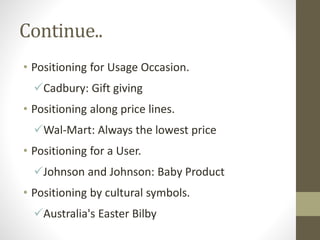
• Positioning for Usage Occasion.
Cadbury: Gift giving
• Positioning along price lines.
Wal-Mart: Always the lowest price
• Positioning for a User.
Johnson and Johnson: Baby Product
• Positioning by cultural symbols.
Australia's Easter Bilby
Brand Positioning Errors
• Under positioning.
• Over positioning.
• Confused positioning.
• Double Positioning.
Brand positioning

Brand positioning

  • 1.
  • 2.
    Brand Positioning • BrandPositioning can be defined as an activity of creating a brand offer in such a manner that it occupies a distinctive place and value in the target customer’s mind. • Brand Positioning involves identifying and determining points of similarity and difference. • Positioning is the base for developing and increasing the required knowledge and perceptions of the customers.
  • 3.
    Brand positioning ofdifferent companies
  • 4.
    Determiningthe frame ofreference Marketers need to know: • Who the target consumer is? • Who the main competitors are? • How the brand is similar to the competitors? • How the brand is different?
  • 5.
    Developing the positioningstatement • Segmentation : Dividing a broad market into segments. • Targeting: Selecting the segment or target market. • Positioning: Placing the brand in the target market.
  • 6.
    Issues in implementingbrand positioning • Establishing category membership. • Choosing the point of parities and point of difference. • Communicating the point of parities and point of difference. • Updating positioning over time.
  • 7.
    Types of Positioningconcepts • Functional- Stresses on features/ benefits. • Symbolic- Stresses on the emotional aspects. • Experiential- Delivering and communicating the firm’s proposed experience.
  • 8.
    Approaches to positioning •Positioning against a competitor.  Seven-up: The Un-cola • Positioning within a category.  Volvo: safety • Positioning according to product benefit.  Colgate: Whitening • Positioning according to product attribute.  Dove: moisturiser
  • 9.
    Continue.. • Positioning forUsage Occasion. Cadbury: Gift giving • Positioning along price lines. Wal-Mart: Always the lowest price • Positioning for a User. Johnson and Johnson: Baby Product • Positioning by cultural symbols. Australia's Easter Bilby
  • 10.
    Brand Positioning Errors •Under positioning. • Over positioning. • Confused positioning. • Double Positioning.

Editor's Notes

  • #9 Positioning against a competitor. e.g. Hungry Jack's tastes better (with implicit assumption 'better than the market leader, McDonald's) Positioning within a category. e.g. Within the prestige car category, Volvo is the safe alternative Positioning according to product benefit. e.g. Toothpaste with whitening or Tartar control (or both) Positioning according to product attribute. e.g. Dove is one-quarter moisturiser
  • #10 Positioning for Usage Occasion. e.g. Cadbury Roses Chocolates—for gift giving or saying 'Thank-you' Positioning along price lines. e.g. a luxury brand or premium brand, an economy brand Positioning for a User. e.g. Johnson and Johnson range of baby products (No Tears Shampoo) Positioning by cultural symbols. e.g. Australia's Easter Bilby (as a culturally appropriate alternative to the Easter Bunny)
  • #11 Under positioning- This is a scenario in which the customer’s have a blurred and unclear idea of the brand. Over positioning- This is a scenario in which the customers have too much awareness of the brand. Confused positioning- This is a scenario in which the customers have a confused opinion of the brand. Double Positioning- This is a scenario in which customers do not accept the claims of a brand.