Definition Of Motivation
         Motivation:
 

   The act or process of
       stimulating to
    action, providing an
        incentive or
  motive, especially for an
             act.
Motivation:
The word motivation has been derived from the word
‘motive’ which means any idea, need or emotion that prompts
man into action.
The core of management –by Rensis Likert.
Motivation is important function which every manger
performs for actuating the people to work for accomplishment
of objectives of the organization.
Higher motivation leads to job satisfaction of the workers
which can reduce absenteeism, turnover, and labour unrest.
Motivation will foster team spirit among the workers and
increase     their     loyalty     to the     work     group.
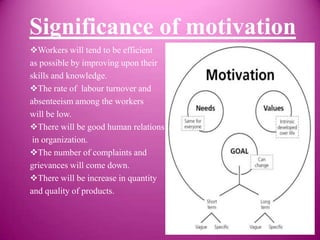
Significance of motivation
Workers will tend to be efficient
as possible by improving upon their
skills and knowledge.
The rate of labour turnover and
absenteeism among the workers
will be low.
There will be good human relations
 in organization.
The number of complaints and
grievances will come down.
There will be increase in quantity
and quality of products.
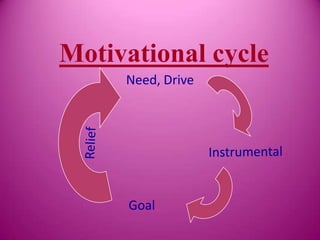
Motivational cycle
     Need, Drive


     Goal
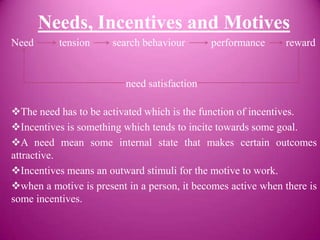
Needs, Incentives and Motives
Need      tension      search behaviour       performance     reward


                          need satisfaction

The need has to be activated which is the function of incentives.
Incentives is something which tends to incite towards some goal.
A need mean some internal state that makes certain outcomes
attractive.
Incentives means an outward stimuli for the motive to work.
when a motive is present in a person, it becomes active when there is
some incentives.
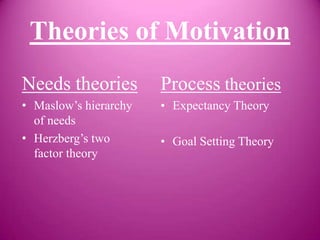
Theories of Motivation
Needs theories         Process theories
• Maslow’s hierarchy   • Expectancy Theory
  of needs
• Herzberg’s two       • Goal Setting Theory
  factor theory
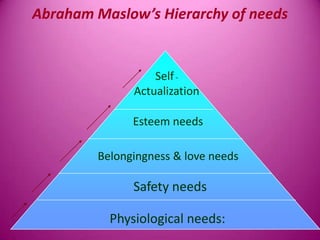
Abraham Maslow’s Hierarchy of needs


                  Self -
              Actualization

              Esteem needs

        Belongingness & love needs

              Safety needs

          Physiological needs:
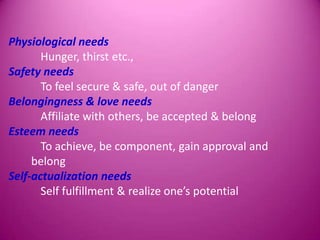
Physiological needs
       Hunger, thirst etc.,
Safety needs
       To feel secure & safe, out of danger
Belongingness & love needs
       Affiliate with others, be accepted & belong
Esteem needs
       To achieve, be component, gain approval and
     belong
Self-actualization needs
       Self fulfillment & realize one’s potential
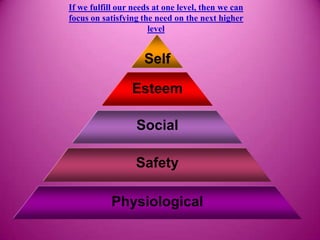
If we fulfill our needs at one level, then we can
focus on satisfying the need on the next higher
                      level


                     Self

                 Esteem

                   Social

                  Safety

            Physiological
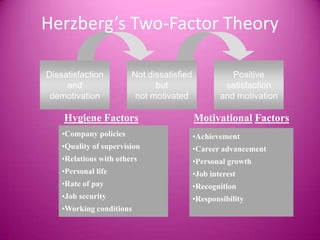
Herzberg’s Two-Factor Theory

Dissatisfaction         Not dissatisfied              Positive
     and                      but                   satisfaction
 demotivation            not motivated             and motivation

    Hygiene Factors                        Motivational Factors
    •Company policies                      •Achievement
    •Quality of supervision                •Career advancement
    •Relations with others                 •Personal growth
    •Personal life                         •Job interest
    •Rate of pay                           •Recognition
    •Job security                          •Responsibility
    •Working conditions
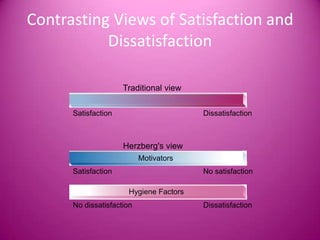
Contrasting Views of Satisfaction and
           Dissatisfaction

                     Traditional view

      Satisfaction                      Dissatisfaction


                     Herzberg's view
                           Motivators
      Satisfaction                      No satisfaction

                      Hygiene Factors
      No dissatisfaction                Dissatisfaction
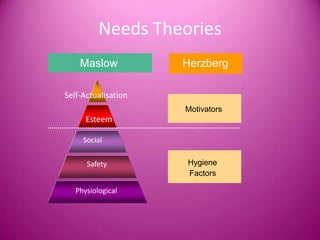
Needs Theories
    Maslow           Herzberg

Self-Actualisation
                     Motivators
      Esteem

     Social


      Safety         Hygiene
                     Factors

   Physiological
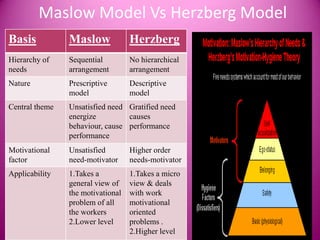
Maslow Model Vs Herzberg Model
Basis           Maslow             Herzberg
Hierarchy of    Sequential         No hierarchical
needs           arrangement        arrangement
Nature          Prescriptive       Descriptive
                model              model
Central theme   Unsatisfied need Gratified need
                energize         causes
                behaviour, cause performance
                performance
Motivational    Unsatisfied        Higher order
factor          need-motivator     needs-motivator
Applicability   1.Takes a          1.Takes a micro
                general view of    view & deals
                the motivational   with work
                problem of all     motivational
                the workers        oriented
                2.Lower level      problems .
                                   2.Higher level
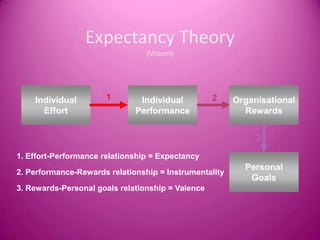
Expectancy Theory
                                 (Vroom)


    Individual         1       Individual          2    Organisational
      Effort                  Performance                 Rewards


                                                             3

1. Effort-Performance relationship = Expectancy
                                                          Personal
2. Performance-Rewards relationship = Instrumentality
                                                           Goals
3. Rewards-Personal goals relationship = Valence
How Expectancy Theory Works

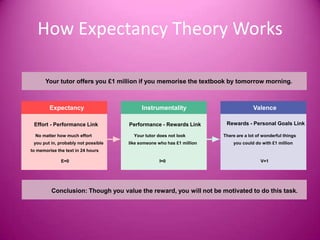
      Your tutor offers you £1 million if you memorise the textbook by tomorrow morning.


        Expectancy                         Instrumentality                           Valence

 Effort - Performance Link           Performance - Rewards Link         Rewards - Personal Goals Link

  No matter how much effort            Your tutor does not look        There are a lot of wonderful things
 you put in, probably not possible   like someone who has £1 million       you could do with £1 million
to memorise the text in 24 hours

              E=0                                 I=0                                   V=1


         Conclusion: Though you value the reward, you will not be motivated to do this task.
Motivation


       Direction


Intensity    Persistence
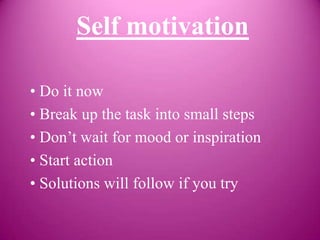
Self motivation

• Do it now
• Break up the task into small steps
• Don’t wait for mood or inspiration
• Start action
• Solutions will follow if you try
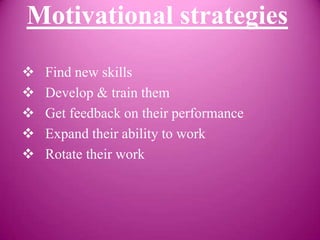
Motivational strategies
   Find new skills
   Develop & train them
   Get feedback on their performance
   Expand their ability to work
   Rotate their work
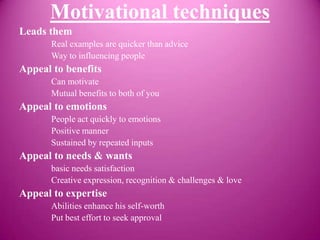
Motivational techniques
Leads them
      Real examples are quicker than advice
      Way to influencing people
Appeal to benefits
      Can motivate
      Mutual benefits to both of you
Appeal to emotions
      People act quickly to emotions
      Positive manner
      Sustained by repeated inputs
Appeal to needs & wants
      basic needs satisfaction
      Creative expression, recognition & challenges & love
Appeal to expertise
      Abilities enhance his self-worth
      Put best effort to seek approval
Begin with the end in mind
     What are your talents?
What is your ultimate career goal?
What can you achieve in 2 years?
 What are your personal goals?


      By:-Tanu Jaswal

Presentation on motivation

  • 2.
    Definition Of Motivation Motivation:  The act or process of stimulating to action, providing an incentive or motive, especially for an act.
  • 3.
    Motivation: The word motivationhas been derived from the word ‘motive’ which means any idea, need or emotion that prompts man into action. The core of management –by Rensis Likert. Motivation is important function which every manger performs for actuating the people to work for accomplishment of objectives of the organization. Higher motivation leads to job satisfaction of the workers which can reduce absenteeism, turnover, and labour unrest. Motivation will foster team spirit among the workers and increase their loyalty to the work group.
  • 4.
    Significance of motivation Workerswill tend to be efficient as possible by improving upon their skills and knowledge. The rate of labour turnover and absenteeism among the workers will be low. There will be good human relations in organization. The number of complaints and grievances will come down. There will be increase in quantity and quality of products.
  • 5.
    Motivational cycle Need, Drive Goal
  • 6.
    Needs, Incentives andMotives Need tension search behaviour performance reward need satisfaction The need has to be activated which is the function of incentives. Incentives is something which tends to incite towards some goal. A need mean some internal state that makes certain outcomes attractive. Incentives means an outward stimuli for the motive to work. when a motive is present in a person, it becomes active when there is some incentives.
  • 7.
    Theories of Motivation Needstheories Process theories • Maslow’s hierarchy • Expectancy Theory of needs • Herzberg’s two • Goal Setting Theory factor theory
  • 8.
    Abraham Maslow’s Hierarchyof needs Self - Actualization Esteem needs Belongingness & love needs Safety needs Physiological needs:
  • 9.
    Physiological needs Hunger, thirst etc., Safety needs To feel secure & safe, out of danger Belongingness & love needs Affiliate with others, be accepted & belong Esteem needs To achieve, be component, gain approval and belong Self-actualization needs Self fulfillment & realize one’s potential
  • 10.
    If we fulfillour needs at one level, then we can focus on satisfying the need on the next higher level Self Esteem Social Safety Physiological
  • 11.
    Herzberg’s Two-Factor Theory Dissatisfaction Not dissatisfied Positive and but satisfaction demotivation not motivated and motivation Hygiene Factors Motivational Factors •Company policies •Achievement •Quality of supervision •Career advancement •Relations with others •Personal growth •Personal life •Job interest •Rate of pay •Recognition •Job security •Responsibility •Working conditions
  • 12.
    Contrasting Views ofSatisfaction and Dissatisfaction Traditional view Satisfaction Dissatisfaction Herzberg's view Motivators Satisfaction No satisfaction Hygiene Factors No dissatisfaction Dissatisfaction
  • 13.
    Needs Theories Maslow Herzberg Self-Actualisation Motivators Esteem Social Safety Hygiene Factors Physiological
  • 14.
    Maslow Model VsHerzberg Model Basis Maslow Herzberg Hierarchy of Sequential No hierarchical needs arrangement arrangement Nature Prescriptive Descriptive model model Central theme Unsatisfied need Gratified need energize causes behaviour, cause performance performance Motivational Unsatisfied Higher order factor need-motivator needs-motivator Applicability 1.Takes a 1.Takes a micro general view of view & deals the motivational with work problem of all motivational the workers oriented 2.Lower level problems . 2.Higher level
  • 15.
    Expectancy Theory (Vroom) Individual 1 Individual 2 Organisational Effort Performance Rewards 3 1. Effort-Performance relationship = Expectancy Personal 2. Performance-Rewards relationship = Instrumentality Goals 3. Rewards-Personal goals relationship = Valence
  • 16.
    How Expectancy TheoryWorks Your tutor offers you £1 million if you memorise the textbook by tomorrow morning. Expectancy Instrumentality Valence Effort - Performance Link Performance - Rewards Link Rewards - Personal Goals Link No matter how much effort Your tutor does not look There are a lot of wonderful things you put in, probably not possible like someone who has £1 million you could do with £1 million to memorise the text in 24 hours E=0 I=0 V=1 Conclusion: Though you value the reward, you will not be motivated to do this task.
  • 17.
    Motivation Direction Intensity Persistence
  • 18.
    Self motivation • Doit now • Break up the task into small steps • Don’t wait for mood or inspiration • Start action • Solutions will follow if you try
  • 19.
    Motivational strategies  Find new skills  Develop & train them  Get feedback on their performance  Expand their ability to work  Rotate their work
  • 20.
    Motivational techniques Leads them Real examples are quicker than advice Way to influencing people Appeal to benefits Can motivate Mutual benefits to both of you Appeal to emotions People act quickly to emotions Positive manner Sustained by repeated inputs Appeal to needs & wants basic needs satisfaction Creative expression, recognition & challenges & love Appeal to expertise Abilities enhance his self-worth Put best effort to seek approval
  • 21.
    Begin with theend in mind What are your talents? What is your ultimate career goal? What can you achieve in 2 years? What are your personal goals? By:-Tanu Jaswal