GROUP MEMBER:
Mohammad Talha Inayat
Mohammad Taj-Uddin
Saad Mazhar
PRESENTATION
MOTIVATION
1
Definition
Motivation is a process which
begins with a physiological or
psychological need or deficiency
which triggers behavior or a
drive that is aimed at a goal or
an incentive.
Why people get UNMOTIVATED
 Repetitive Failure
 Less Support
 LessAvailability of Resources
 Getting JOB where you don’t have interest.
 Family problems
Theories of Motivation
Some important theories:
 Maslow’s Hierarchy of NeedsTheory
 Elton Mayo
 Herzberg’s Motivation-Hygiene theory
Maslow’s Hierarchy of Needs
Theory
 Works on the assumption that the behaviour of
individuals at a particular moment is usually
determined by their strongest need.
 Based on hypothesis that within every human being
there exists a hierarchy of five needs.
Maslow’s Hierarchy of Needs
Theory(contd)
Five needs:
1. Physiological : Basic needs of hunger, thirst, shelter, sex and
other body needs.
 2. Safety: security and protection from physical and emotional
harm
 3. Social: affection, belongingness, acceptance and friendship
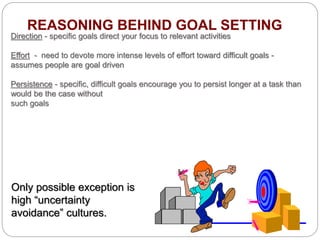
REASONING BEHIND GOAL SETTING
Direction - specific goals direct your focus to relevant activities
Effort - need to devote more intense levels of effort toward difficult goals -
assumes people are goal driven
Persistence - specific, difficult goals encourage you to persist longer at a task than
would be the case without
such goals
Only possible exception is
high “uncertainty
avoidance” cultures.
Herzberg’s Motivation-Hygiene theory
Based on the conclusion that people have two
different categories of needs:
 o Hygiene factors
o Motivating factors
Fredrick Herzberg
Hygiene Factor Motivators
 Supervision
 Salary
 Relationship with
others
 Working Condition
(Worker will take these
thing for Granted)
 Achievement
 Responsibilities
 The work itself
 Advancement
 Job Rotation (Shifting
Job on temporary
Basis)
Motivation as a Form of Learning:
The Law of Effect
 Behavior that leads
toward rewards tends to
be repeated
 Behavior that tends to
lead toward no rewards
or toward punishment
tends to be avoided
Reinforcers Which Strengthen Behavior: What
managers can do to increase the probability of behavior in
the future
a. Positive reinforcement--rewards contingent on exhibiting the correct behavior.
b. Avoidance Learning—withholding something unpleasant when a desired
behavior is engaged in (e.g., an annoying alarm is avoided when a machine is used
properly, not operating in reverse). Or, using social learning, noticing how engaging
in some behavior avoids an unpleasant outcome (e.g., arrive on time and the boss
does not yell). Text: Negative reinforcement
Reinforcers Which Weaken Behavior:
What managers can do to decrease the probability of
behavior in the future
a. Punishment--administering unpleasant
consequences
following an undesirable behavior.
b. Extinction--when there are no rewards for a
behavior which was previously rewarded.
Motivation

Motivation

  • 2.
    GROUP MEMBER: Mohammad TalhaInayat Mohammad Taj-Uddin Saad Mazhar PRESENTATION MOTIVATION
  • 3.
    1 Definition Motivation is aprocess which begins with a physiological or psychological need or deficiency which triggers behavior or a drive that is aimed at a goal or an incentive.
  • 4.
    Why people getUNMOTIVATED  Repetitive Failure  Less Support  LessAvailability of Resources  Getting JOB where you don’t have interest.  Family problems
  • 6.
    Theories of Motivation Someimportant theories:  Maslow’s Hierarchy of NeedsTheory  Elton Mayo  Herzberg’s Motivation-Hygiene theory
  • 7.
    Maslow’s Hierarchy ofNeeds Theory  Works on the assumption that the behaviour of individuals at a particular moment is usually determined by their strongest need.  Based on hypothesis that within every human being there exists a hierarchy of five needs.
  • 8.
    Maslow’s Hierarchy ofNeeds Theory(contd) Five needs: 1. Physiological : Basic needs of hunger, thirst, shelter, sex and other body needs.  2. Safety: security and protection from physical and emotional harm  3. Social: affection, belongingness, acceptance and friendship
  • 10.
    REASONING BEHIND GOALSETTING Direction - specific goals direct your focus to relevant activities Effort - need to devote more intense levels of effort toward difficult goals - assumes people are goal driven Persistence - specific, difficult goals encourage you to persist longer at a task than would be the case without such goals Only possible exception is high “uncertainty avoidance” cultures.
  • 11.
    Herzberg’s Motivation-Hygiene theory Basedon the conclusion that people have two different categories of needs:  o Hygiene factors o Motivating factors
  • 12.
    Fredrick Herzberg Hygiene FactorMotivators  Supervision  Salary  Relationship with others  Working Condition (Worker will take these thing for Granted)  Achievement  Responsibilities  The work itself  Advancement  Job Rotation (Shifting Job on temporary Basis)
  • 14.
    Motivation as aForm of Learning: The Law of Effect  Behavior that leads toward rewards tends to be repeated  Behavior that tends to lead toward no rewards or toward punishment tends to be avoided
  • 15.
    Reinforcers Which StrengthenBehavior: What managers can do to increase the probability of behavior in the future a. Positive reinforcement--rewards contingent on exhibiting the correct behavior. b. Avoidance Learning—withholding something unpleasant when a desired behavior is engaged in (e.g., an annoying alarm is avoided when a machine is used properly, not operating in reverse). Or, using social learning, noticing how engaging in some behavior avoids an unpleasant outcome (e.g., arrive on time and the boss does not yell). Text: Negative reinforcement
  • 16.
    Reinforcers Which WeakenBehavior: What managers can do to decrease the probability of behavior in the future a. Punishment--administering unpleasant consequences following an undesirable behavior. b. Extinction--when there are no rewards for a behavior which was previously rewarded.