PRESENTATION ON
LINE AND BRAND EXTENSION
Submitted By:
Mithisar
NIT Silchar
LINE EXTENSIONS
 The product line is now far more representative of
customers’ varying quantity needs.
 It suggests the presence of usage segmentation.
 Customers differs in terms of their usage
quantities.
 The brand has to fill the whole spectrum with
products as per the needs of various segments.
EXAMPLE
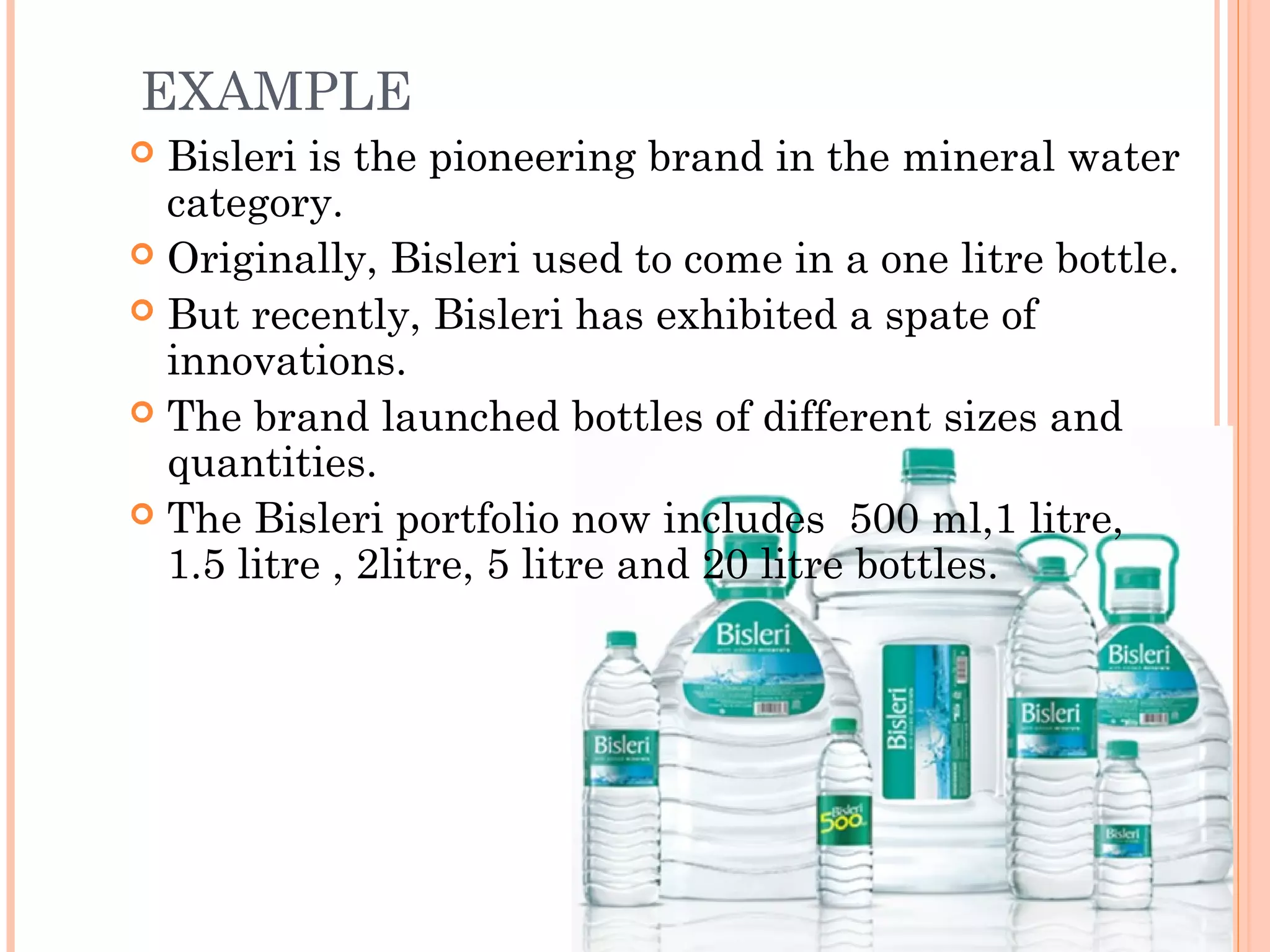
 Bisleri is the pioneering brand in the mineral water
category.
 Originally, Bisleri used to come in a one litre bottle.
 But recently, Bisleri has exhibited a spate of
innovations.
 The brand launched bottles of different sizes and
quantities.
 The Bisleri portfolio now includes 500 ml,1 litre,
1.5 litre , 2litre, 5 litre and 20 litre bottles.
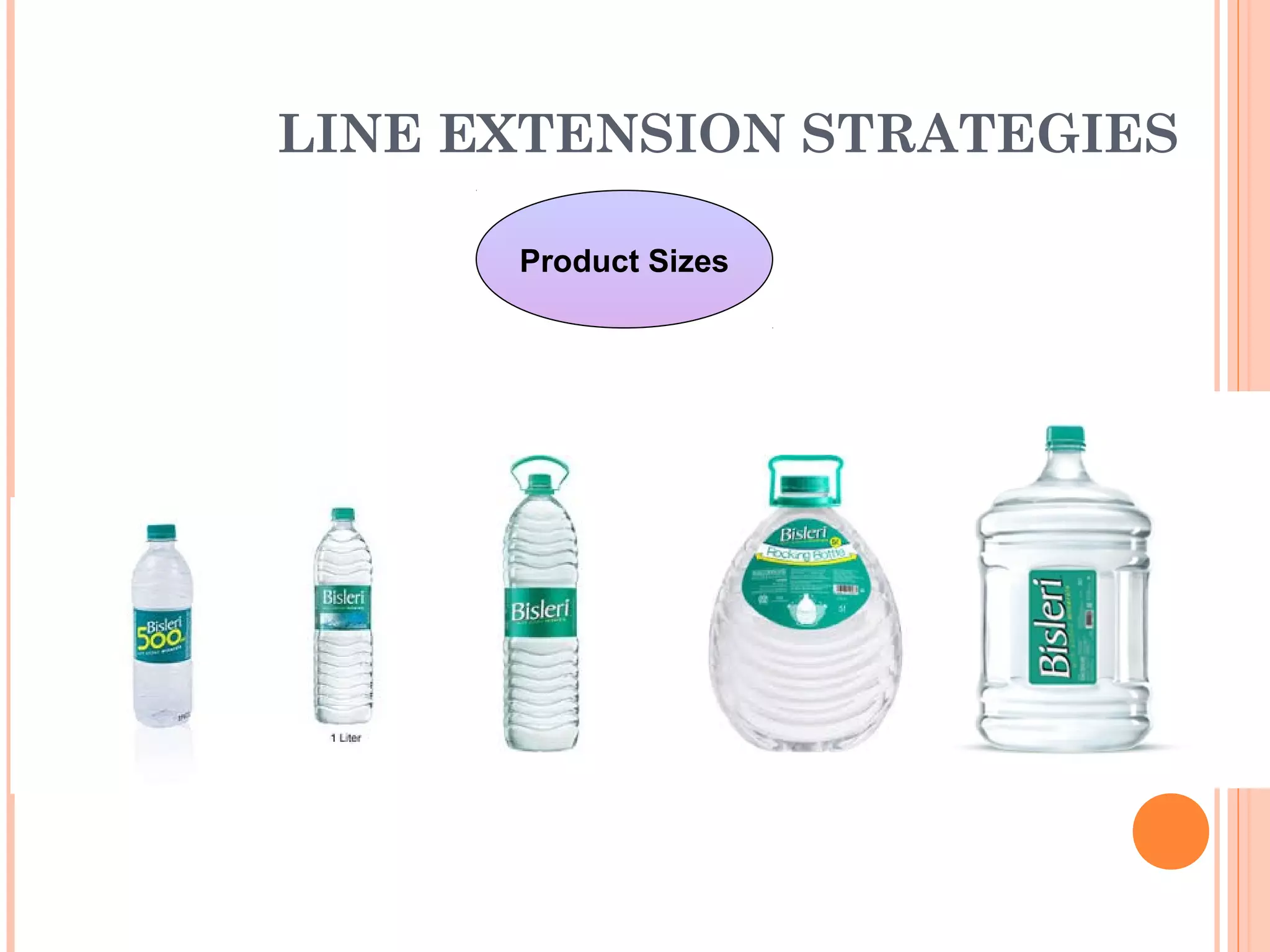
LINE EXTENSION STRATEGIES
Product Sizes
Colours
Flavours
Ingredients
Form
WHY LINE EXTENSIONS?
 In most of the product categories including fast
moving consumer goods, consumer durables and
services, line extension has been the name of the
game.
 It is an expansionist move.
 The firms seem to seek growth more vigorously.
NINE PROMINENT REASONS………
 Customer Segmentation
 Customer need for variety
 Pricing Breadth
 Capacity Utilization
 Quick gains
 Competitive Reasons
 Trade Demands
 Counter Competition
 Image Benefits
LINE EXTENSION RISKS
There are several dangers associated with line
extensions.
Line Confusion - Marketers sometimes add
products to their line without sound logic and
reasoning, without any clear role and goal. This
may confuse the customers and the retailers and
will affect the brand’s owner company in the long
run.
LINE EXTENSION RISKS…
 Encourage Variety seeking – Brand loyalty is
every marketers dream. By line extension,
customers practice and become the habitant of
variety seeking. Hence it influence brand
switching behaviours. The loyalty is thus
weakened.
LINE EXTENSION RISKS…
 Success Myopia – An idea may be a grand
enough to be converted into a full-fledged
independent brand. But the lure of extension
seems to be so strong that the ideas are brought
into the market as line extensions. This implies
loss of a winning asset in the long-term.
LINE EXTENSION RISKS…
 Strained relations - When the lines expand,
marketers tend to pressurize their trade partners
such as wholesalers and retailers to carry the
complete line in accordance with their wishes.
The pressure appears to be applied more
intensely at the retail level. The marketers seek
adequate shelf space, promotion and information.
But at the retailers end, it brings confusion and
chaos.
 The result is the strained relations between
the marketer and the retailer.
BRAND EXTENSIONS
 Using an existing brand name to promote a
product in a different category, is Brand
Extension.
 The key difference between line and brand
extension is the product category.
 In line extension the product category remains
constant whereas in brand extensions product
category is a variable.
EXAMPLE
 Ponds - Cold cream, Shampoo, Tooth paste,
Moisturizing lotion, Talc & Face wash.
 LG – Television, Refrigerators, Computer
monitors, Microwaves, Air Conditioners,
Washing Machines & Mobile phones.
 Park Avenue – Shirts, Shaving cream, Jeans,
Belts, Perfumes, Soaps & Razors.
FACTORS IN BRAND EXTENSION
 Cost of New launches
 Promotional Efficiency
 Consumer Benefits
 Feedback effects
 Returns
ADVANTAGES OF BRAND
EXTENSIONS
 Improve brand image.
 Increase the probability of gaining
distribution and trial.
 Reduce costs of introductory & follow-up
marketing programs (save 40-80%).
 Avoid costs of developing a new brand.
 Allow for packaging & labeling efficiencies.
DISADVANTAGES OF BRAND
EXTENSIONS
 Can confuse or frustrate consumers.
 Can encounter retailer resistance.
 Can fail & hurt parent brand image.
 Can dilute brand meaning.

Line and brand extension

  • 1.
    PRESENTATION ON LINE ANDBRAND EXTENSION Submitted By: Mithisar NIT Silchar
  • 2.
    LINE EXTENSIONS  Theproduct line is now far more representative of customers’ varying quantity needs.  It suggests the presence of usage segmentation.  Customers differs in terms of their usage quantities.  The brand has to fill the whole spectrum with products as per the needs of various segments.
  • 3.
    EXAMPLE  Bisleri isthe pioneering brand in the mineral water category.  Originally, Bisleri used to come in a one litre bottle.  But recently, Bisleri has exhibited a spate of innovations.  The brand launched bottles of different sizes and quantities.  The Bisleri portfolio now includes 500 ml,1 litre, 1.5 litre , 2litre, 5 litre and 20 litre bottles.
  • 4.
  • 5.
  • 6.
  • 7.
    WHY LINE EXTENSIONS? In most of the product categories including fast moving consumer goods, consumer durables and services, line extension has been the name of the game.  It is an expansionist move.  The firms seem to seek growth more vigorously.
  • 8.
    NINE PROMINENT REASONS……… Customer Segmentation  Customer need for variety  Pricing Breadth  Capacity Utilization  Quick gains  Competitive Reasons  Trade Demands  Counter Competition  Image Benefits
  • 9.
    LINE EXTENSION RISKS Thereare several dangers associated with line extensions. Line Confusion - Marketers sometimes add products to their line without sound logic and reasoning, without any clear role and goal. This may confuse the customers and the retailers and will affect the brand’s owner company in the long run.
  • 10.
    LINE EXTENSION RISKS… Encourage Variety seeking – Brand loyalty is every marketers dream. By line extension, customers practice and become the habitant of variety seeking. Hence it influence brand switching behaviours. The loyalty is thus weakened.
  • 11.
    LINE EXTENSION RISKS… Success Myopia – An idea may be a grand enough to be converted into a full-fledged independent brand. But the lure of extension seems to be so strong that the ideas are brought into the market as line extensions. This implies loss of a winning asset in the long-term.
  • 12.
    LINE EXTENSION RISKS… Strained relations - When the lines expand, marketers tend to pressurize their trade partners such as wholesalers and retailers to carry the complete line in accordance with their wishes. The pressure appears to be applied more intensely at the retail level. The marketers seek adequate shelf space, promotion and information. But at the retailers end, it brings confusion and chaos.  The result is the strained relations between the marketer and the retailer.
  • 13.
    BRAND EXTENSIONS  Usingan existing brand name to promote a product in a different category, is Brand Extension.  The key difference between line and brand extension is the product category.  In line extension the product category remains constant whereas in brand extensions product category is a variable.
  • 14.
    EXAMPLE  Ponds -Cold cream, Shampoo, Tooth paste, Moisturizing lotion, Talc & Face wash.  LG – Television, Refrigerators, Computer monitors, Microwaves, Air Conditioners, Washing Machines & Mobile phones.  Park Avenue – Shirts, Shaving cream, Jeans, Belts, Perfumes, Soaps & Razors.
  • 15.
    FACTORS IN BRANDEXTENSION  Cost of New launches  Promotional Efficiency  Consumer Benefits  Feedback effects  Returns
  • 16.
    ADVANTAGES OF BRAND EXTENSIONS Improve brand image.  Increase the probability of gaining distribution and trial.  Reduce costs of introductory & follow-up marketing programs (save 40-80%).  Avoid costs of developing a new brand.  Allow for packaging & labeling efficiencies.
  • 17.
    DISADVANTAGES OF BRAND EXTENSIONS Can confuse or frustrate consumers.  Can encounter retailer resistance.  Can fail & hurt parent brand image.  Can dilute brand meaning.