Designing Training &
Learning Sessions
Training & Development
Designing Training Sessions2
Discussions: Designing Training Sessions &
Learning sessions
Following were reactions of participants at end of training.
• Taught what I wanted to learn
• Taught what I felt I needed to learn
• Helped me actively participate in the session
• Provided practical problems to solve
• Related my new knowledge with my past experiences
• Provided an informal environment
• Used a variety of training programs
Answer the questions in the next slide:
Designing Training Sessions3
Questions:
1. Whether principles of adult learning were followed
Yes No
2. How Successful was training in transfer of skill,
Knowledge, attitude:
100% 75% 50% Less than
50%
Skill
Knowledge
Attitude
Designing Training Sessions4
Types of Employees
Employees may be classified in four categories based
on two dimensions – Performance & Potential
Deadwood Workhorses Stars
Problem
children
Incompetent,
unsatisfactory
& wholly
unsuitable for
job.
Low potential
for growth
Have reached
their peak of
performance in
light of limited
capacity.
People of high
potential who
are performing
at the highest
level of their
potential.
Who have
great potential
and genuine
capacities but
working below
capacity.
T & D activities to be designed for employees in light of
this.
What is Training Design?
Training design phase relates to
preparing blueprint for training
5 Designing Training Sessions
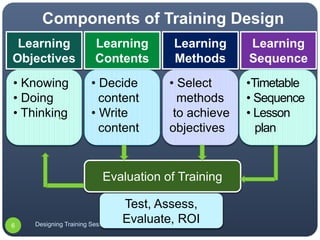
Designing Training Sessions6
Learning
Objectives
Learning
Contents
Learning
Methods
Learning
Sequence
• Knowing
• Doing
• Thinking
• Decide
content
• Write
content
• Select
methods
to achieve
objectives
•Timetable
• Sequence
• Lesson
plan
Evaluation of Training
Test, Assess,
Evaluate, ROI
Components of Training Design
Designing Training Sessions7
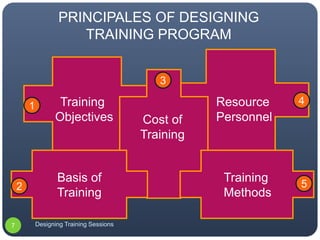
PRINCIPALES OF DESIGNING
TRAINING PROGRAM
Training
Objectives
Basis of
Training
Cost of
Training
Resource
Personnel
Training
Methods
3
1 4
52
Designing Training Sessions8
Who will the learners be?
What are the individual differences?
What are their expectations?
What style of training will they respond well?
Will activities be effective, enjoyable, efficient?
Review & integrate learning principles
Proper mixture & balance of training methods
Consider pre-entry requirement
Other considerations:
Designing Training Sessions9
PREPARING TRAINING PROGRAM
Designing Training Sessions10
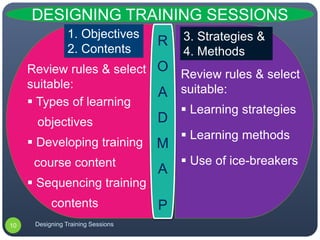
DESIGNING TRAINING SESSIONS
3. Strategies &
4. Methods
1. Objectives
2. Contents
Review rules & select
suitable:
 Types of learning
objectives
 Developing training
course content
 Sequencing training
contents
Review rules & select
suitable:
 Learning strategies
 Learning methods
 Use of ice-breakers
R
O
A
D
M
A
P
Designing Learning Activities:
Revise & refine
Pilot
Does it contribute to a balanced program
Is it effective, enjoyable & efficient
Generate exercise that makes them it to do
What do you want them to do in the course
What needs to be learned
Designing Training Sessions12
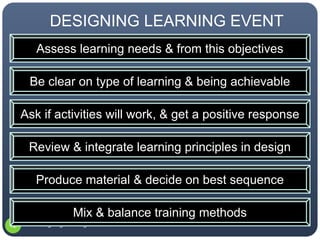
DESIGNING LEARNING EVENT
Assess learning needs & from this objectives
Be clear on type of learning & being achievable
Ask if activities will work, & get a positive response
Review & integrate learning principles in design
Produce material & decide on best sequence
Mix & balance training methods
Designing Training Sessions13
DESIGNING LEARNING EVENT
Ascertain range & depth of learning & time available
Prepare a knowledge & skill breakdown
Consider pre-entry requirements
Consideration for practicalities
Discuss design with those whose support is needed
Publish dates well in advance
Designing Training Sessions14
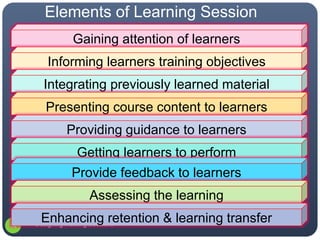
Gaining attention of learners
Informing learners training objectives
Integrating previously learned material
Presenting course content to learners
Providing guidance to learners
Getting learners to perform
Provide feedback to learners
Assessing the learning
Enhancing retention & learning transfer
Elements of Learning Session
Designing Training Sessions15
COMMON ERRORS IN DESIGN
Teach him to Learn
Designing Training Sessions16
“Teach him gently, but do not cudgel him
Because only the test of fire makes fine
steel
Let him have the courage to be impatient
Let him have patience to be brave
Teach him always to have sublime faith in
himself
Because then he will always have sublime
faith in mankind”
[From Abraham Lincoln’s Letter]
Designing Training Sessions17

Training & Development - Designing Training Sessions

  • 1.
    Designing Training & LearningSessions Training & Development
  • 2.
    Designing Training Sessions2 Discussions:Designing Training Sessions & Learning sessions Following were reactions of participants at end of training. • Taught what I wanted to learn • Taught what I felt I needed to learn • Helped me actively participate in the session • Provided practical problems to solve • Related my new knowledge with my past experiences • Provided an informal environment • Used a variety of training programs Answer the questions in the next slide:
  • 3.
    Designing Training Sessions3 Questions: 1.Whether principles of adult learning were followed Yes No 2. How Successful was training in transfer of skill, Knowledge, attitude: 100% 75% 50% Less than 50% Skill Knowledge Attitude
  • 4.
    Designing Training Sessions4 Typesof Employees Employees may be classified in four categories based on two dimensions – Performance & Potential Deadwood Workhorses Stars Problem children Incompetent, unsatisfactory & wholly unsuitable for job. Low potential for growth Have reached their peak of performance in light of limited capacity. People of high potential who are performing at the highest level of their potential. Who have great potential and genuine capacities but working below capacity. T & D activities to be designed for employees in light of this.
  • 5.
    What is TrainingDesign? Training design phase relates to preparing blueprint for training 5 Designing Training Sessions
  • 6.
    Designing Training Sessions6 Learning Objectives Learning Contents Learning Methods Learning Sequence •Knowing • Doing • Thinking • Decide content • Write content • Select methods to achieve objectives •Timetable • Sequence • Lesson plan Evaluation of Training Test, Assess, Evaluate, ROI Components of Training Design
  • 7.
    Designing Training Sessions7 PRINCIPALESOF DESIGNING TRAINING PROGRAM Training Objectives Basis of Training Cost of Training Resource Personnel Training Methods 3 1 4 52
  • 8.
    Designing Training Sessions8 Whowill the learners be? What are the individual differences? What are their expectations? What style of training will they respond well? Will activities be effective, enjoyable, efficient? Review & integrate learning principles Proper mixture & balance of training methods Consider pre-entry requirement Other considerations:
  • 9.
  • 10.
    Designing Training Sessions10 DESIGNINGTRAINING SESSIONS 3. Strategies & 4. Methods 1. Objectives 2. Contents Review rules & select suitable:  Types of learning objectives  Developing training course content  Sequencing training contents Review rules & select suitable:  Learning strategies  Learning methods  Use of ice-breakers R O A D M A P
  • 11.
    Designing Learning Activities: Revise& refine Pilot Does it contribute to a balanced program Is it effective, enjoyable & efficient Generate exercise that makes them it to do What do you want them to do in the course What needs to be learned
  • 12.
    Designing Training Sessions12 DESIGNINGLEARNING EVENT Assess learning needs & from this objectives Be clear on type of learning & being achievable Ask if activities will work, & get a positive response Review & integrate learning principles in design Produce material & decide on best sequence Mix & balance training methods
  • 13.
    Designing Training Sessions13 DESIGNINGLEARNING EVENT Ascertain range & depth of learning & time available Prepare a knowledge & skill breakdown Consider pre-entry requirements Consideration for practicalities Discuss design with those whose support is needed Publish dates well in advance
  • 14.
    Designing Training Sessions14 Gainingattention of learners Informing learners training objectives Integrating previously learned material Presenting course content to learners Providing guidance to learners Getting learners to perform Provide feedback to learners Assessing the learning Enhancing retention & learning transfer Elements of Learning Session
  • 15.
  • 16.
    Teach him toLearn Designing Training Sessions16 “Teach him gently, but do not cudgel him Because only the test of fire makes fine steel Let him have the courage to be impatient Let him have patience to be brave Teach him always to have sublime faith in himself Because then he will always have sublime faith in mankind” [From Abraham Lincoln’s Letter]
  • 17.