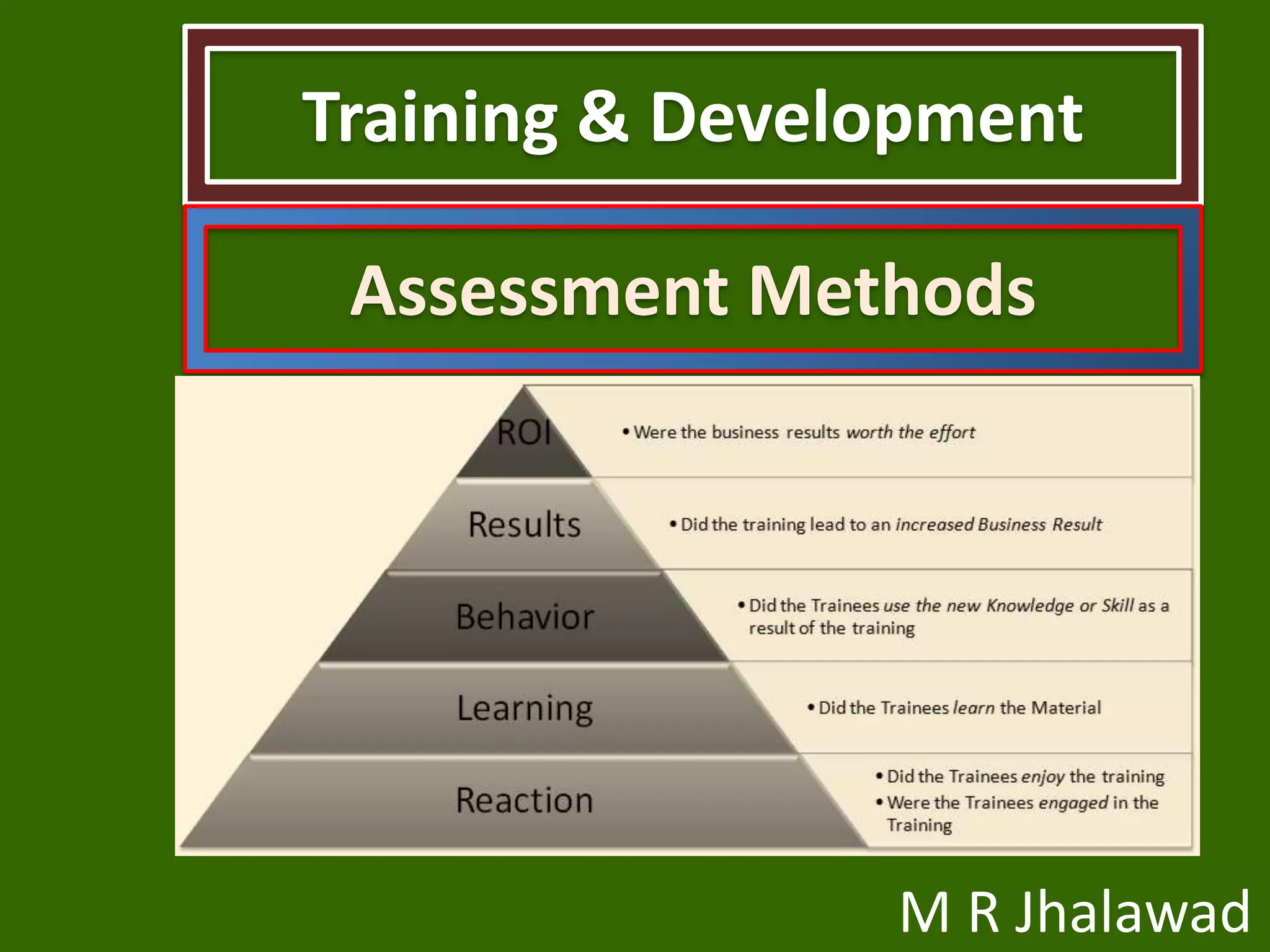
Training & Development
Assessment Methods
M R Jhalawad
Evaluation Methods 2
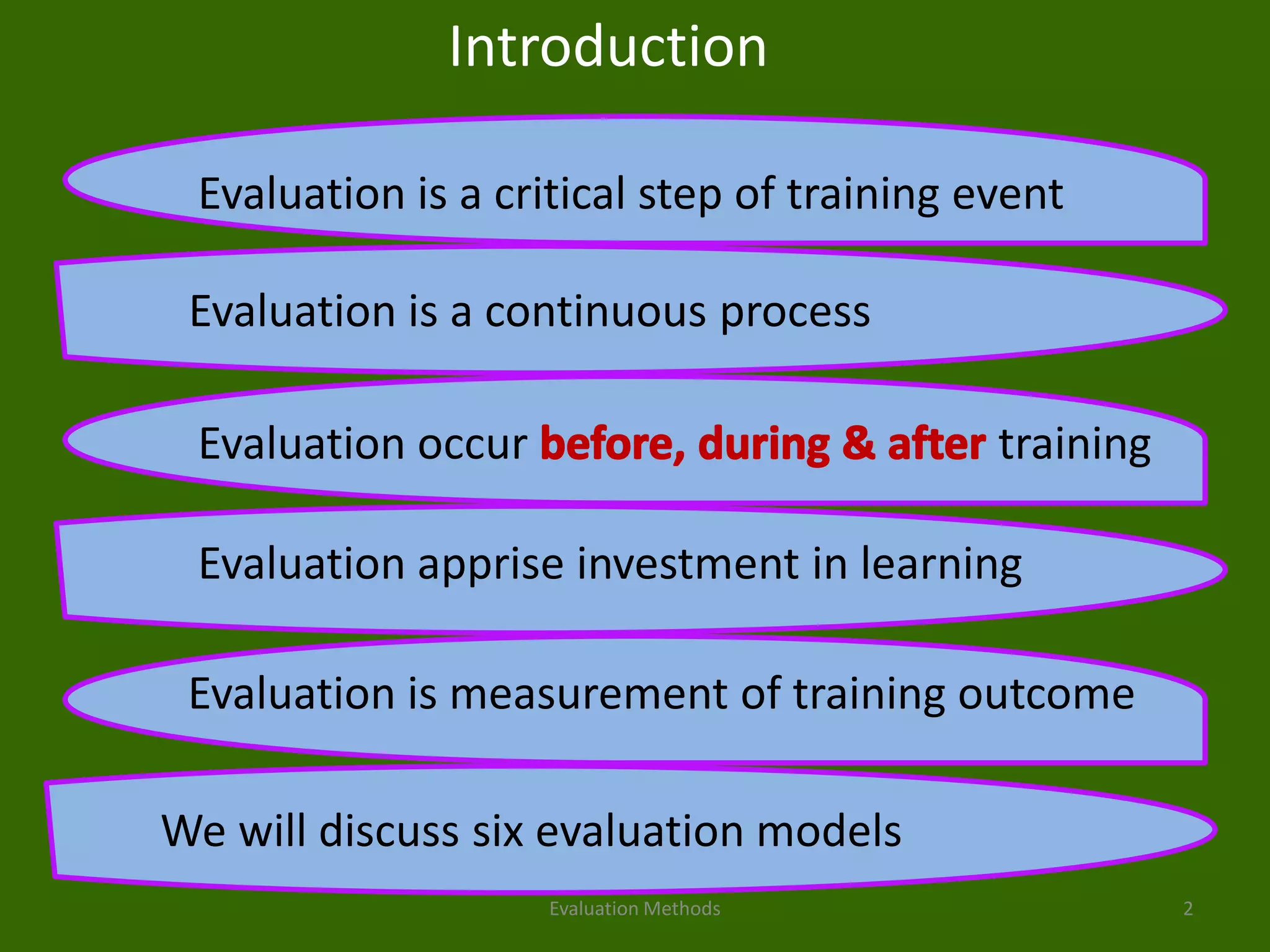
Evaluation is a continuous process
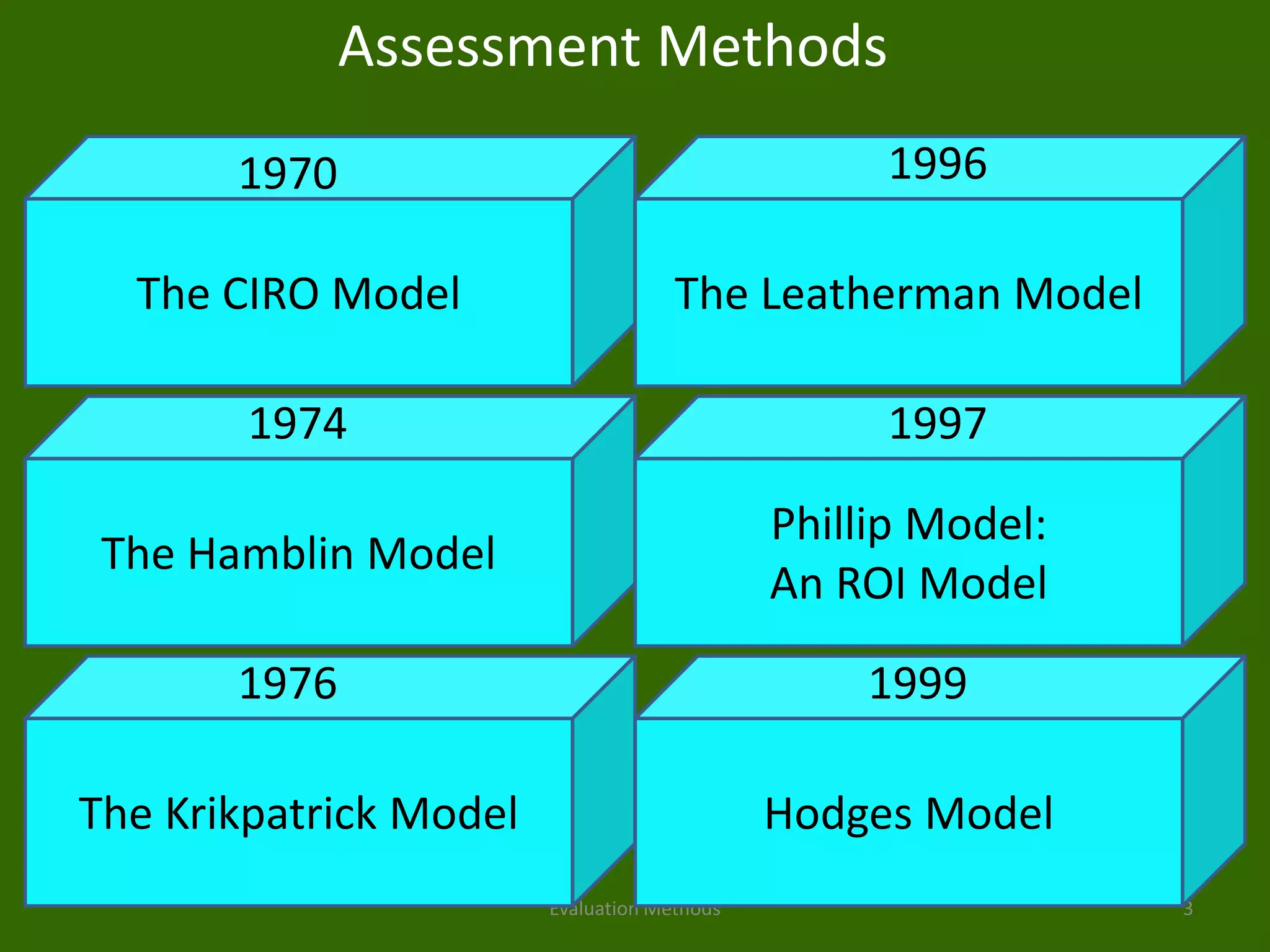
We will discuss six evaluation models
Introduction
Evaluation is a critical step of training event
Evaluation occur training
Evaluation apprise investment in learning
Evaluation is measurement of training outcome
Evaluation Methods 3
The CIRO Model The Leatherman Model
The Hamblin Model
Phillip Model:
An ROI Model
The Krikpatrick Model Hodges Model
1970 1996
1974 1997
1976 1999
Assessment Methods
Evaluation Methods 4
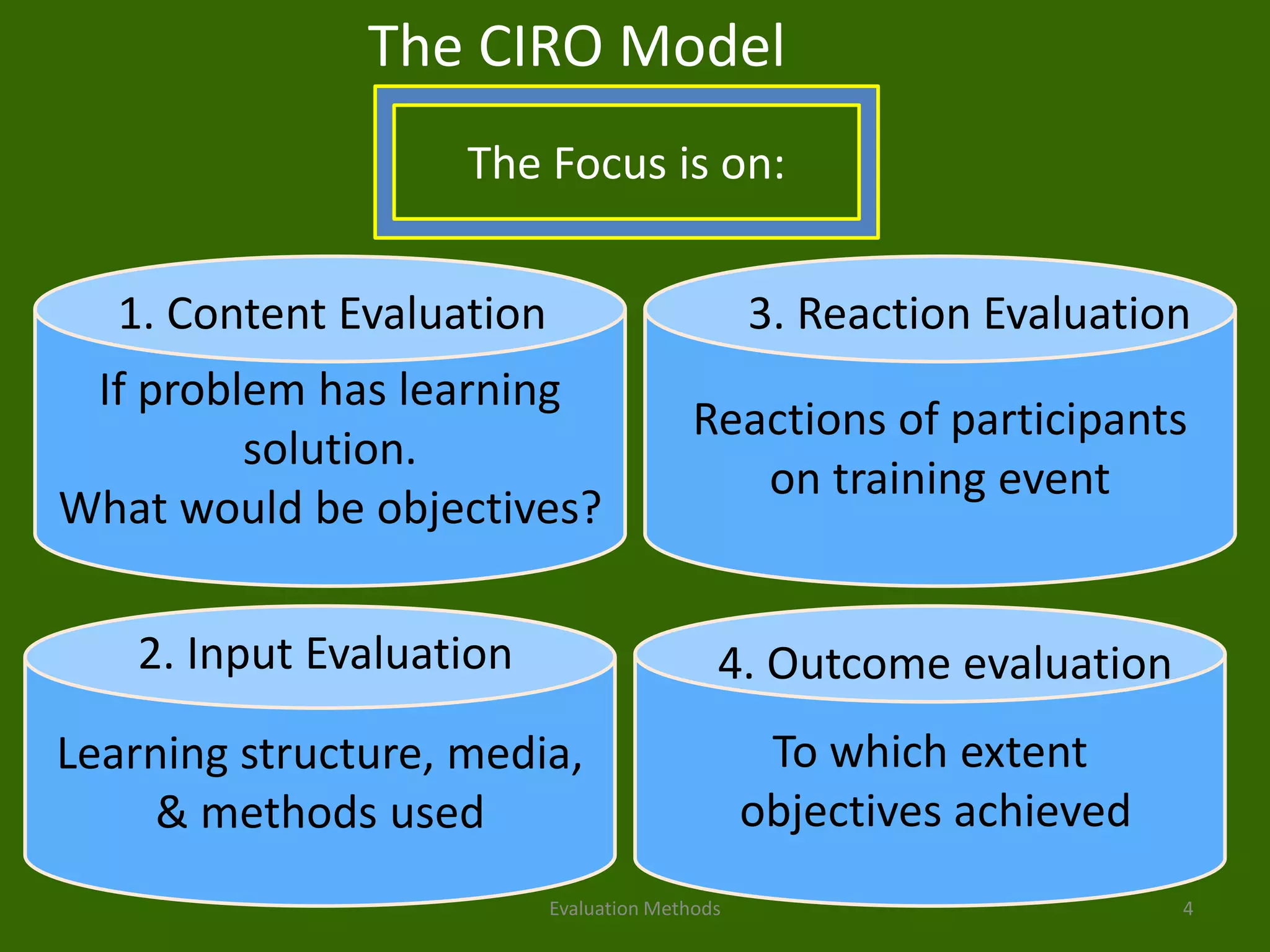
The CIRO Model
The Focus is on:
If problem has learning
solution.
What would be objectives?
Learning structure, media,
& methods used
Reactions of participants
on training event
To which extent
objectives achieved
1. Content Evaluation
2. Input Evaluation
3. Reaction Evaluation
4. Outcome evaluation
Evaluation Methods 5
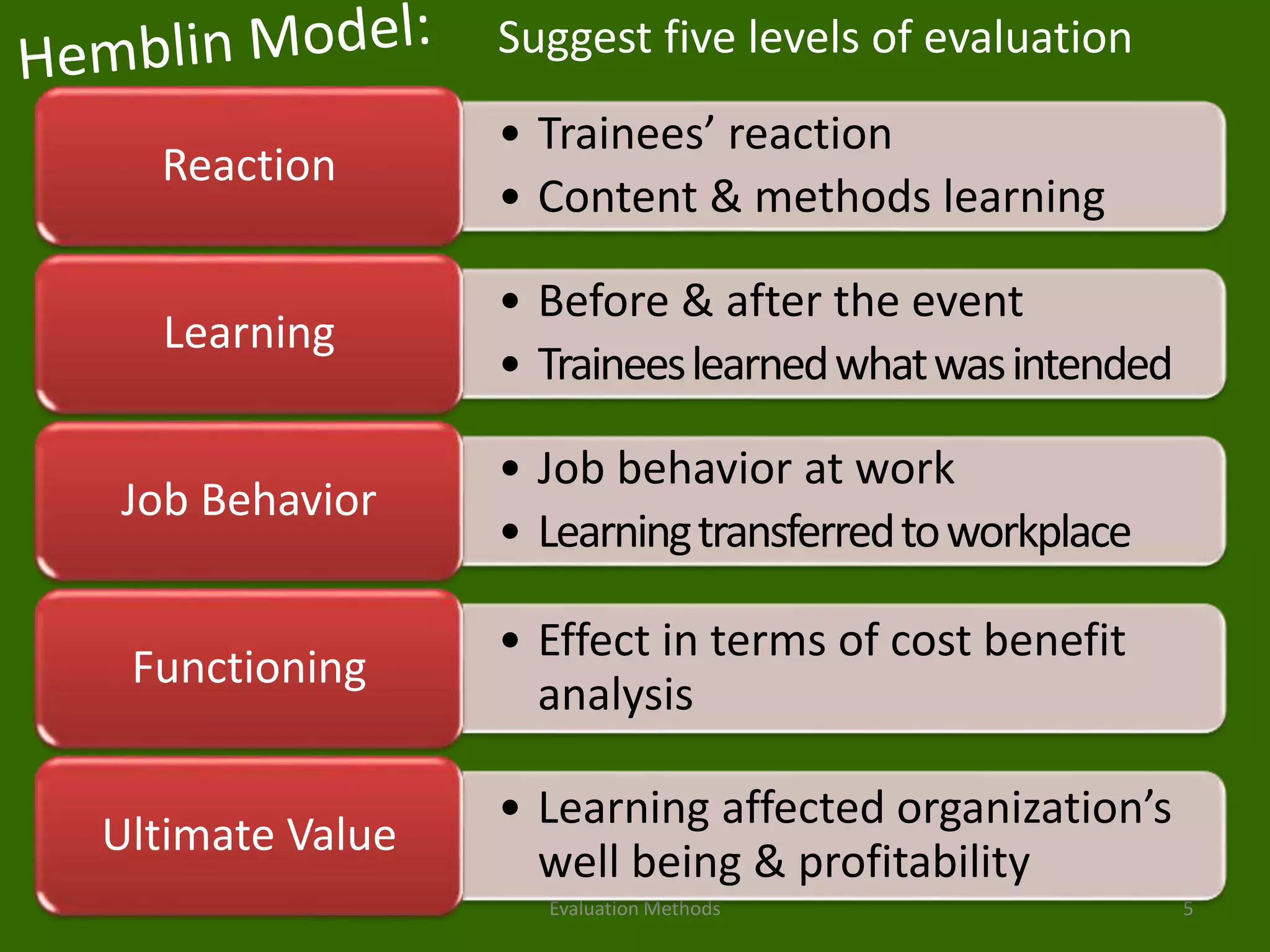
• Trainees’ reaction
• Content & methods learning
Reaction
• Before & after the event
• Traineeslearnedwhatwasintended
Learning
• Job behavior at work
• Learningtransferredtoworkplace
Job Behavior
• Effect in terms of cost benefit
analysis
Functioning
• Learning affected organization’s
well being & profitability
Ultimate Value
Suggest five levels of evaluation
Evaluation Methods 6
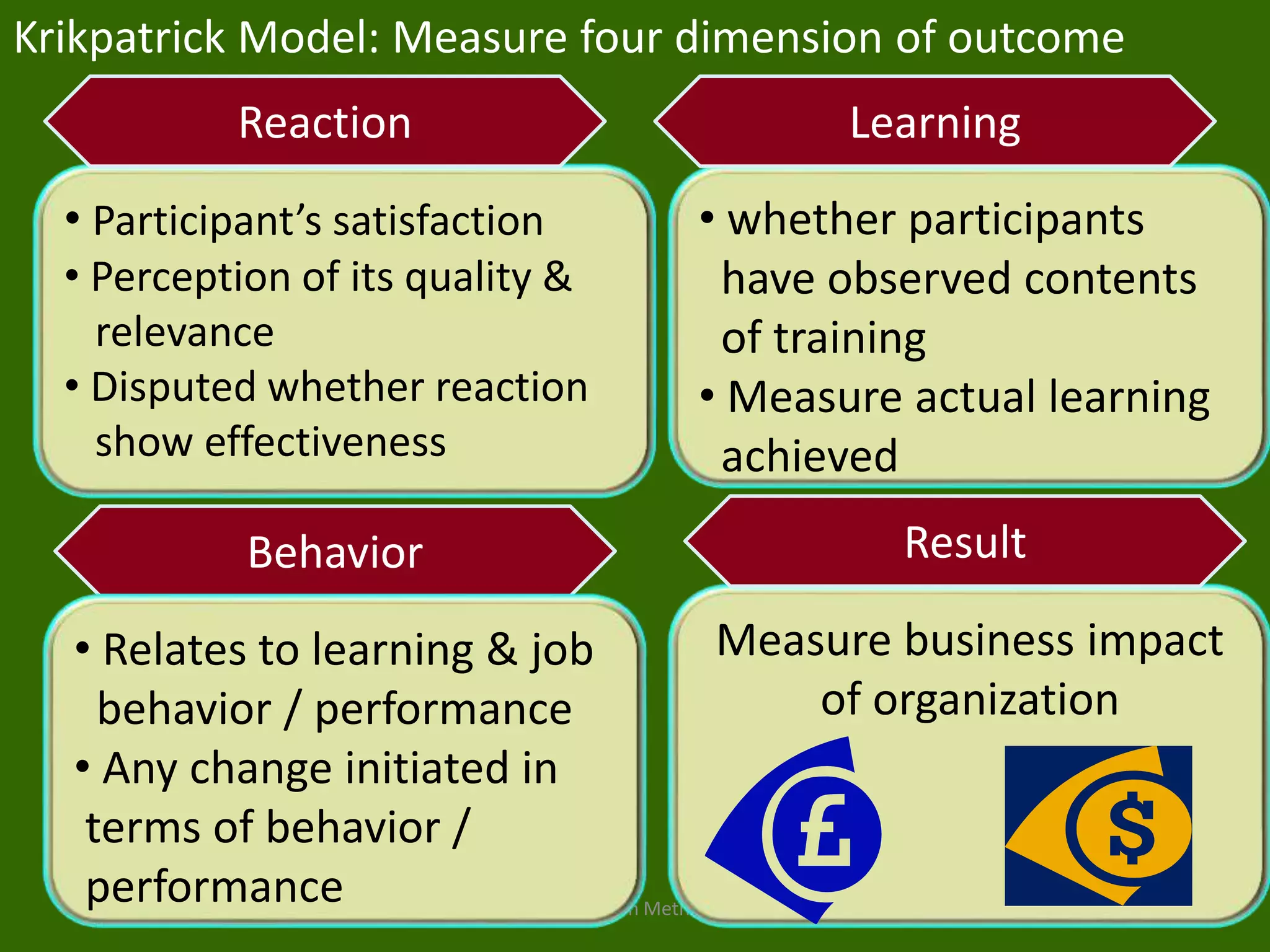
• Participant’s satisfaction
• Perception of its quality &
relevance
• Disputed whether reaction
show effectiveness
Reaction
• whether participants
have observed contents
of training
• Measure actual learning
achieved
Learning
Behavior
• Relates to learning & job
behavior / performance
• Any change initiated in
terms of behavior /
performance
Measure business impact
of organization
Result
Krikpatrick Model: Measure four dimension of outcome
Evaluation Methods 7
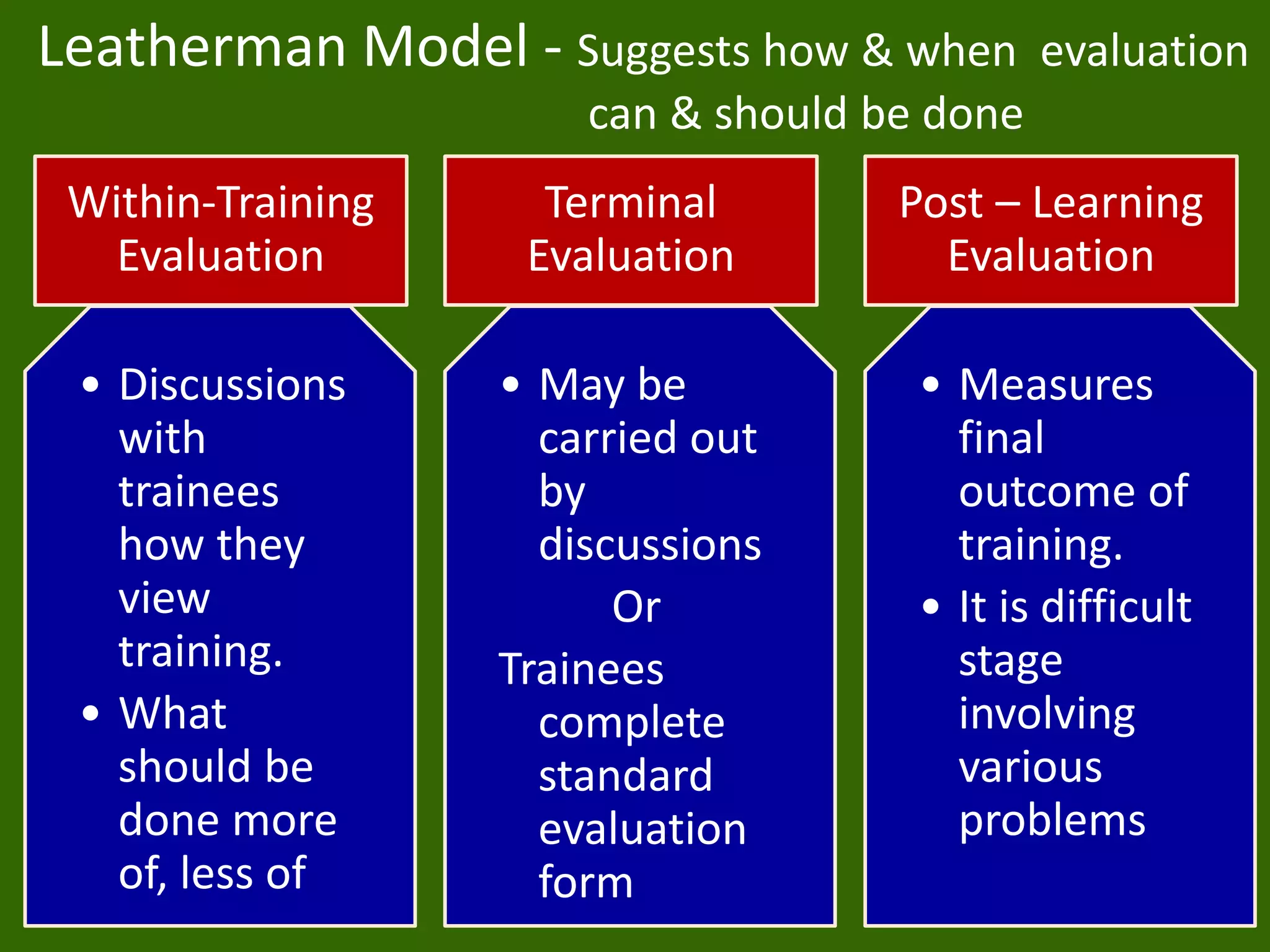
Leatherman Model - Suggests how & when evaluation
can & should be done
Within-Training
Evaluation
• Discussions
with
trainees
how they
view
training.
• What
should be
done more
of, less of
Terminal
Evaluation
• May be
carried out
by
discussions
Or
Trainees
complete
standard
evaluation
form
Post – Learning
Evaluation
• Measures
final
outcome of
training.
• It is difficult
stage
involving
various
problems
Evaluation Methods 8
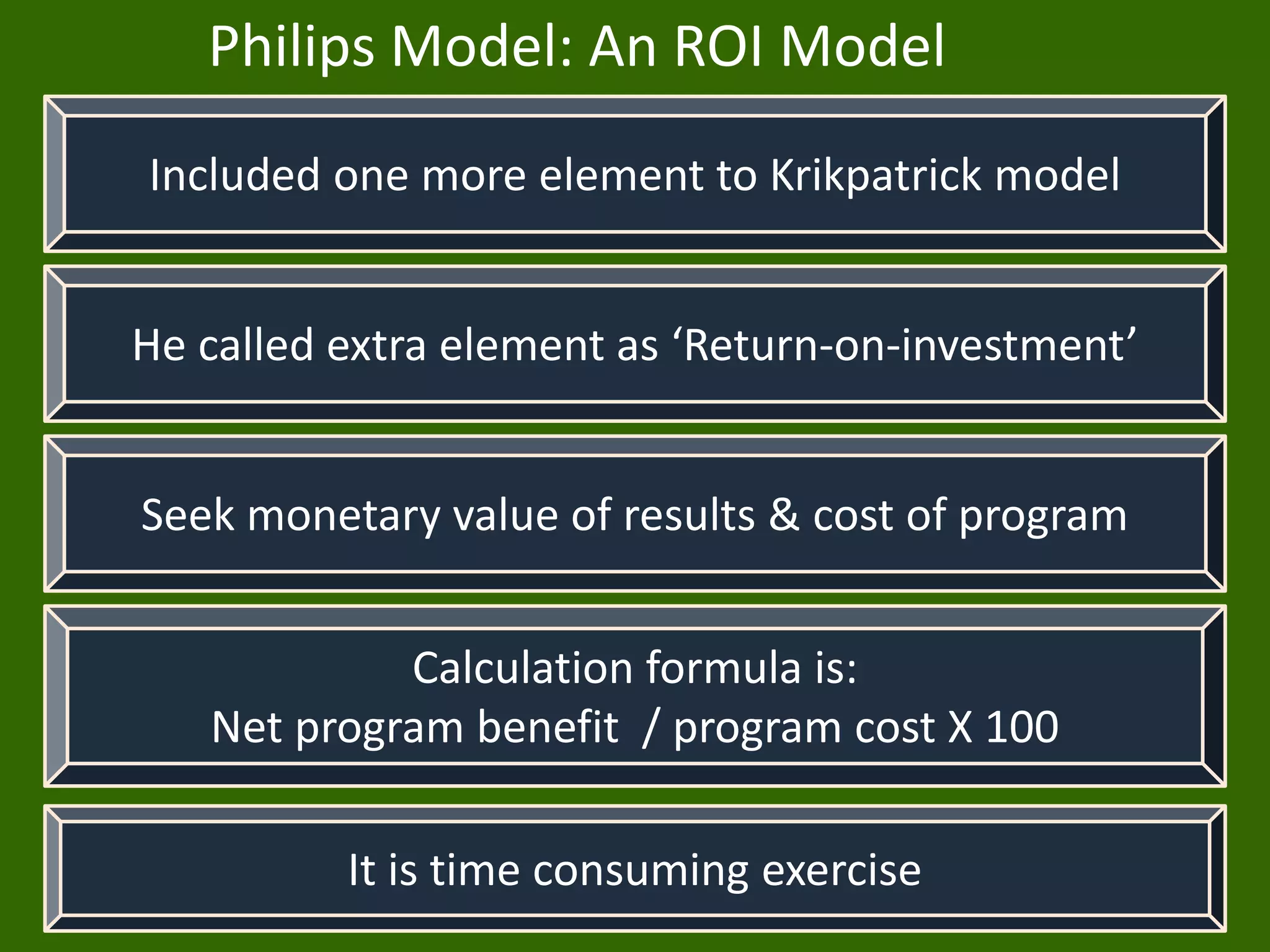
Philips Model: An ROI Model
Included one more element to Krikpatrick model
He called extra element as ‘Return-on-investment’
Seek monetary value of results & cost of program
Calculation formula is:
Net program benefit / program cost X 100
It is time consuming exercise
Evaluation Methods 9
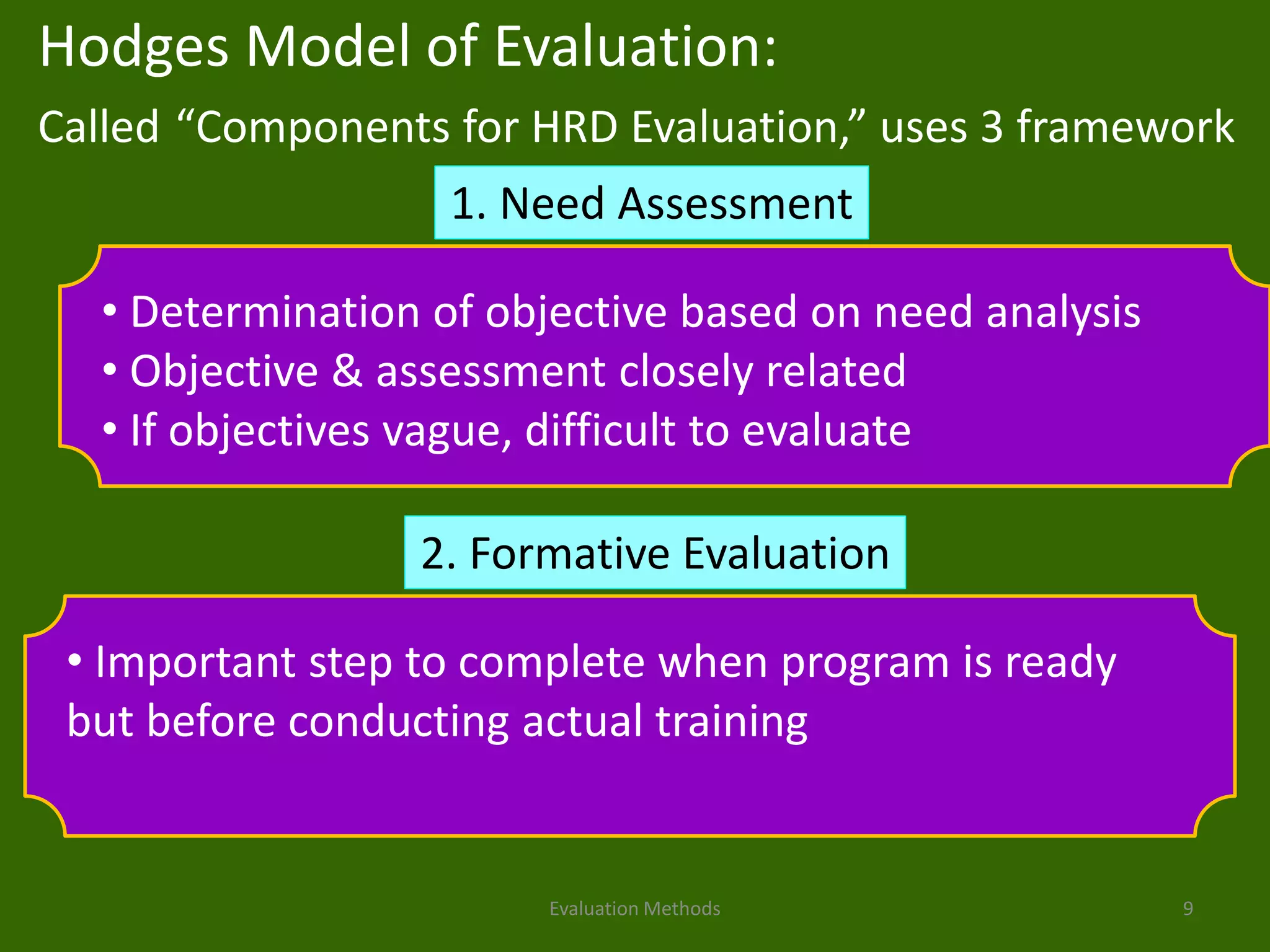
Hodges Model of Evaluation:
Called “Components for HRD Evaluation,” uses 3 framework
1. Need Assessment
• Determination of objective based on need analysis
• Objective & assessment closely related
• If objectives vague, difficult to evaluate
2. Formative Evaluation
• Important step to complete when program is ready
but before conducting actual training
Evaluation Methods 10
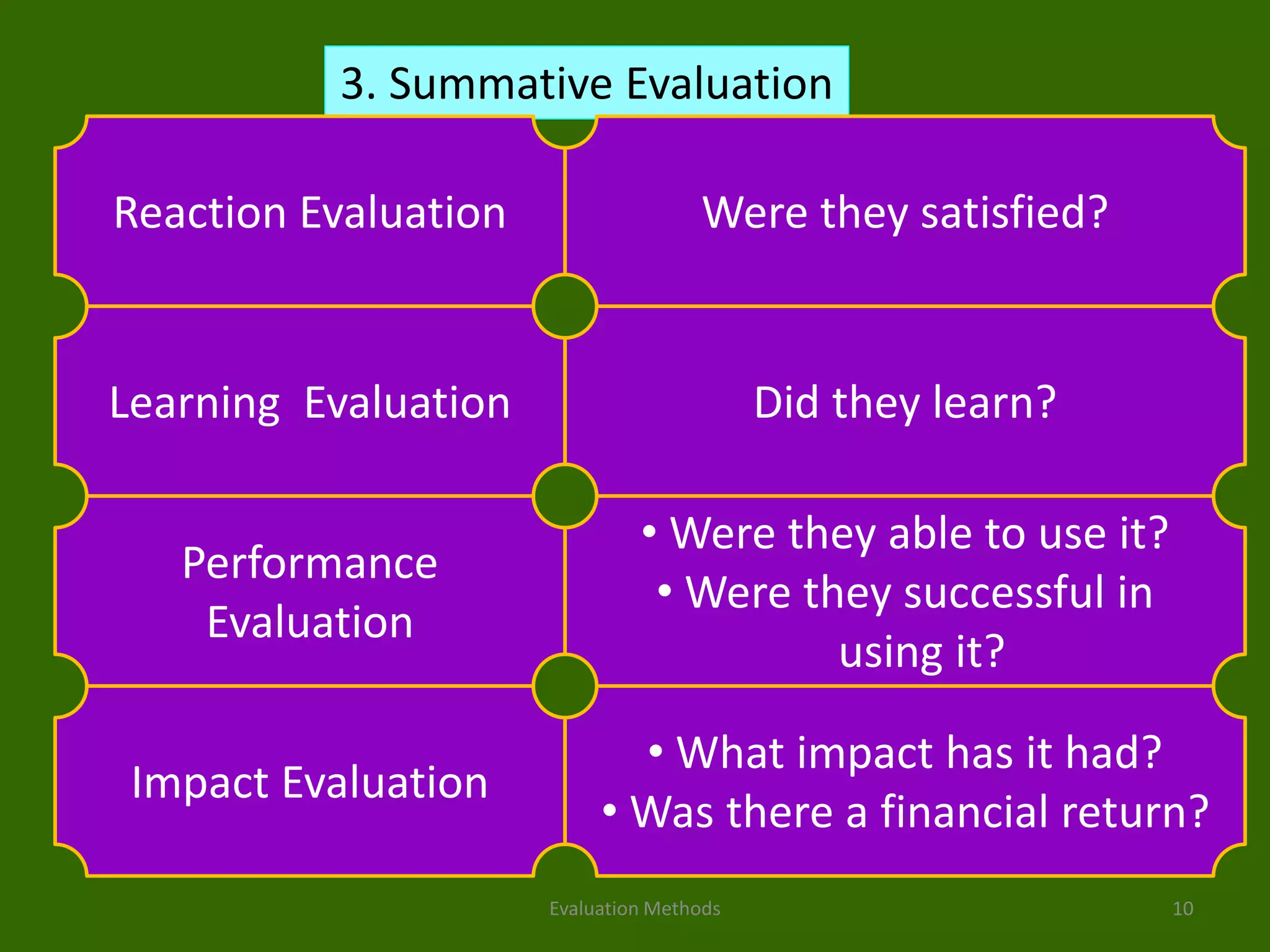
3. Summative Evaluation
Reaction Evaluation Were they satisfied?
Learning Evaluation
Performance
Evaluation
Did they learn?
• Were they able to use it?
• Were they successful in
using it?
Impact Evaluation
• What impact has it had?
• Was there a financial return?
Evaluation Methods 11
An Example of Reaction Evaluation Questionnaire
Title of Training / Development program:_______________________
Trainer[s]: ________________ Date: ______________
Participant: ______________________ Dept: ____________
Que. 1 To what extent do you agree with the following statement
Answer on a scale of 1 to 5. [5 strongly Agree, 1 strongly Disagree
It was a good use of my time 1 2 3 4 5
The content was relevant to me
The objectives were clearly stated
Stated training objective were fully
achieved
I was encouraged to actively
participate in the training
Training methods were effective
Evaluation Methods 12
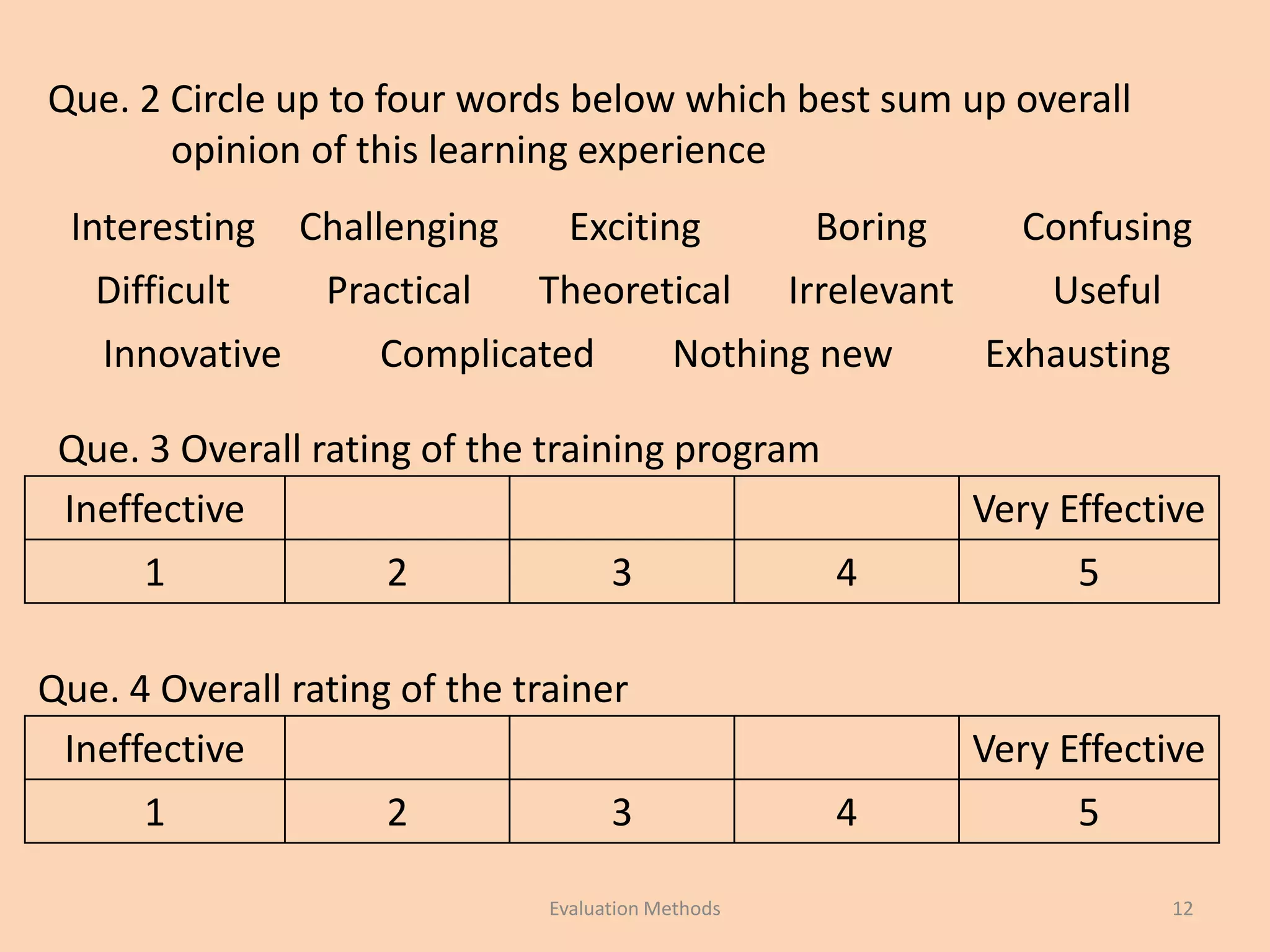
Que. 2 Circle up to four words below which best sum up overall
opinion of this learning experience
Interesting Challenging Exciting Boring Confusing
Difficult Practical Theoretical Irrelevant Useful
Innovative Complicated Nothing new Exhausting
Que. 3 Overall rating of the training program
Ineffective Very Effective
1 2 3 4 5
Ineffective Very Effective
1 2 3 4 5
Que. 4 Overall rating of the trainer
MANAGEMENT LESSON
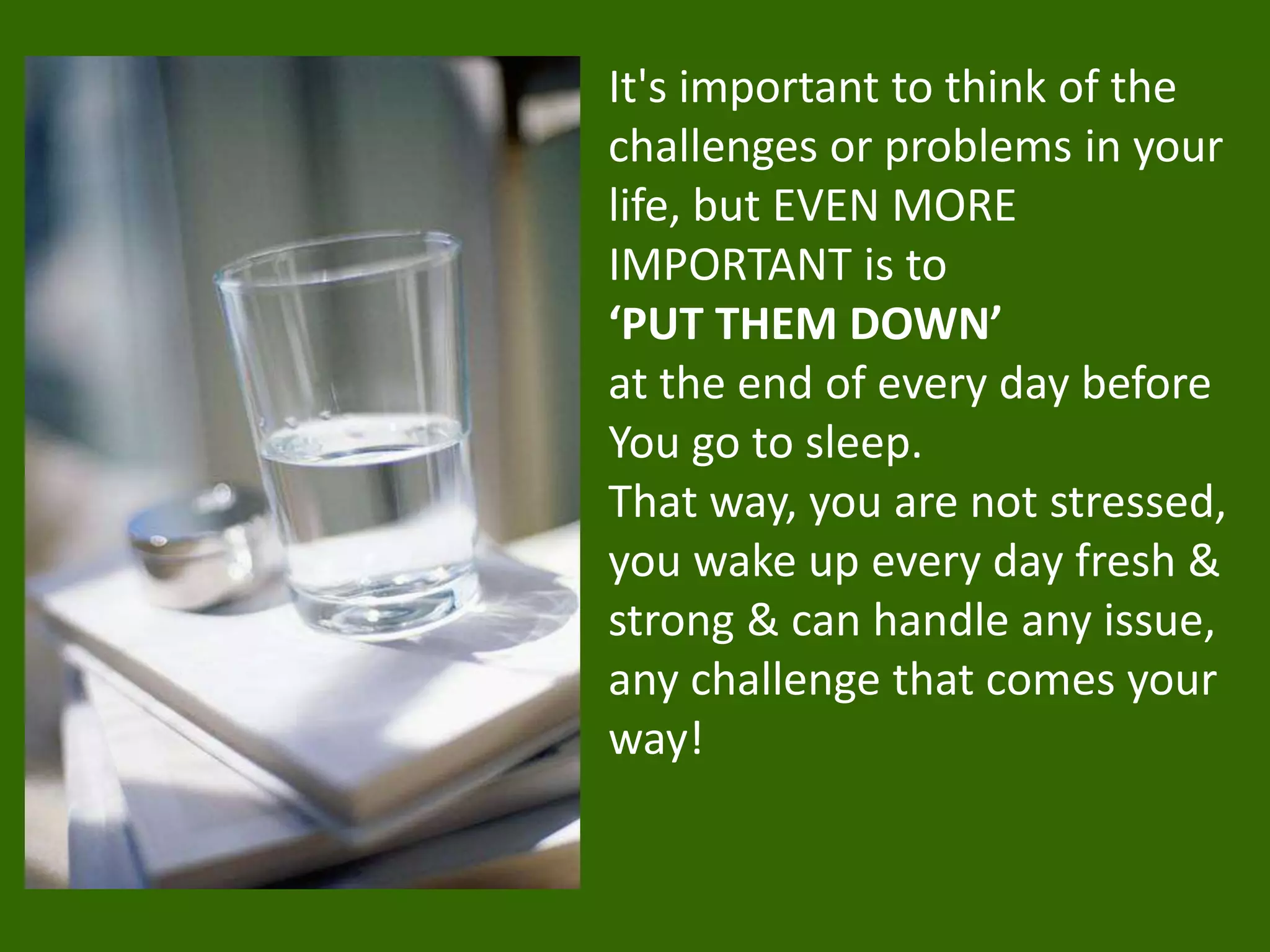
PUT THE GLASS DOWN
Study this small story.
Hope that makes a
BIG change in YOU.
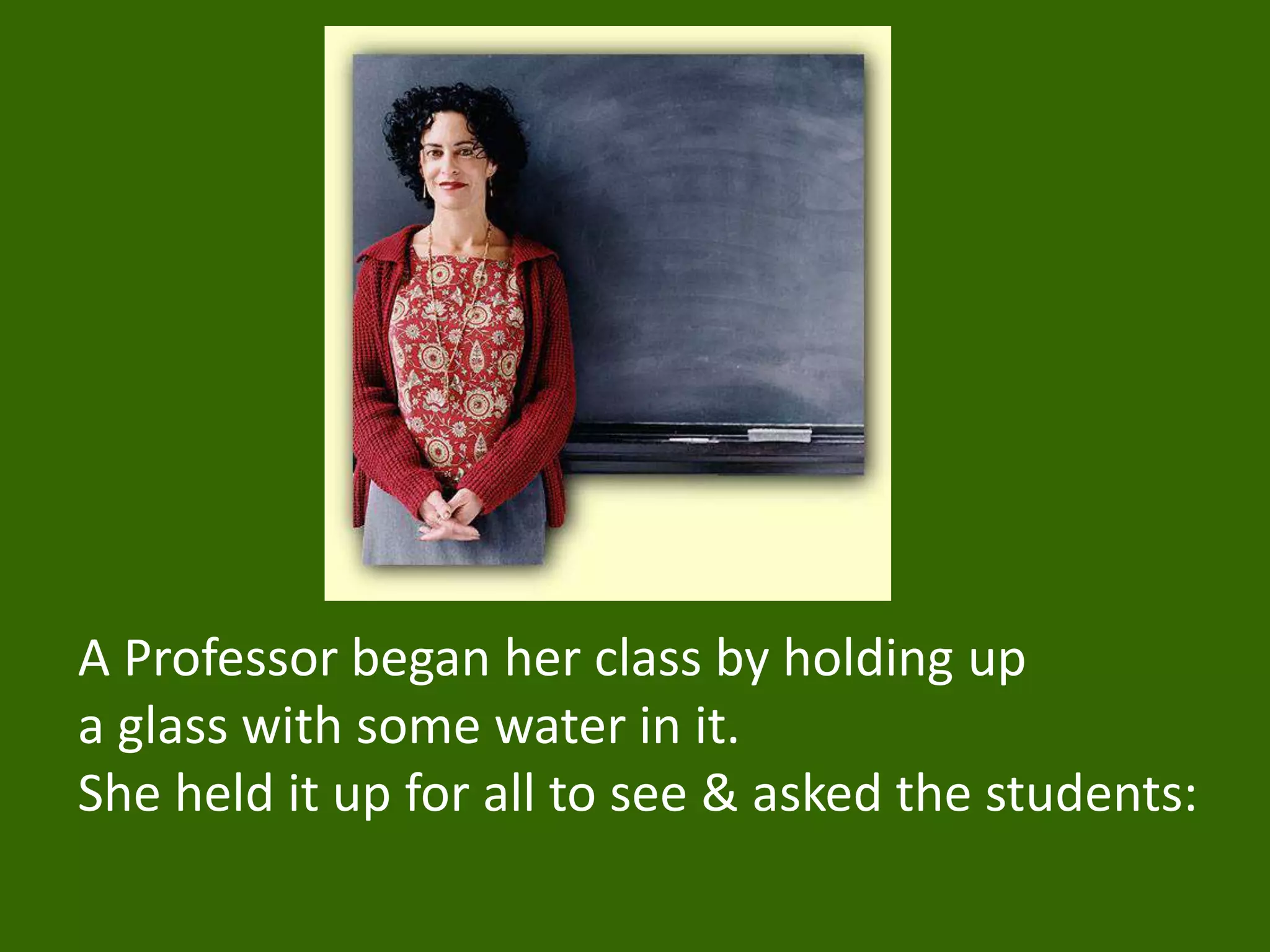
A Professor began her class by holding up
a glass with some water in it.
She held it up for all to see & asked the students:
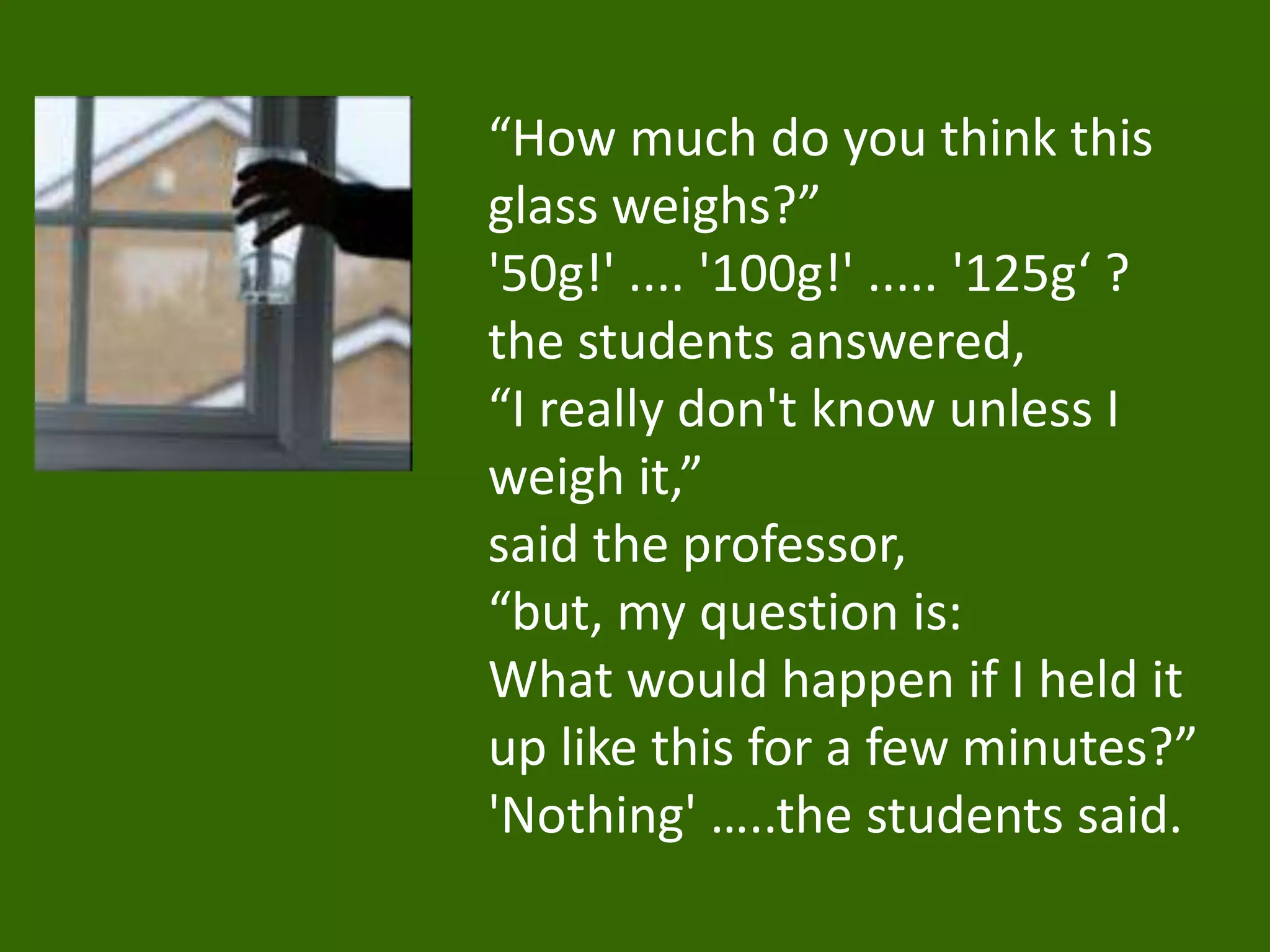
“How much do you think this
glass weighs?”
'50g!' .... '100g!' ..... '125g‘ ?
the students answered,
“I really don't know unless I
weigh it,”
said the professor,
“but, my question is:
What would happen if I held it
up like this for a few minutes?”
'Nothing' …..the students said.
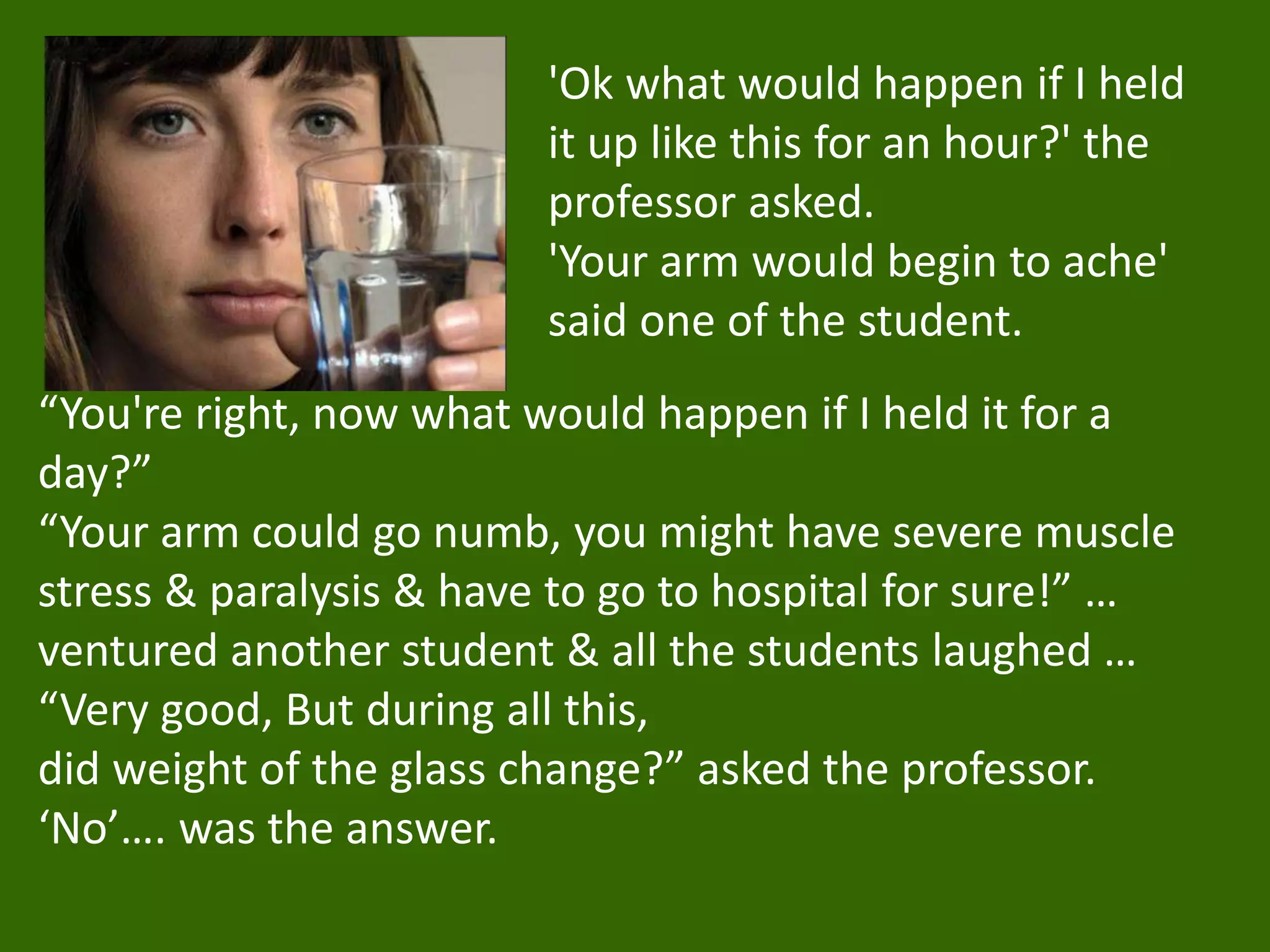
'Ok what would happen if I held
it up like this for an hour?' the
professor asked.
'Your arm would begin to ache'
said one of the student.
“You're right, now what would happen if I held it for a
day?”
“Your arm could go numb, you might have severe muscle
stress & paralysis & have to go to hospital for sure!” …
ventured another student & all the students laughed …
“Very good, But during all this,
did weight of the glass change?” asked the professor.
‘No’…. was the answer.
“Then what caused the arm ache &
the muscle stress?”
The students were puzzled.
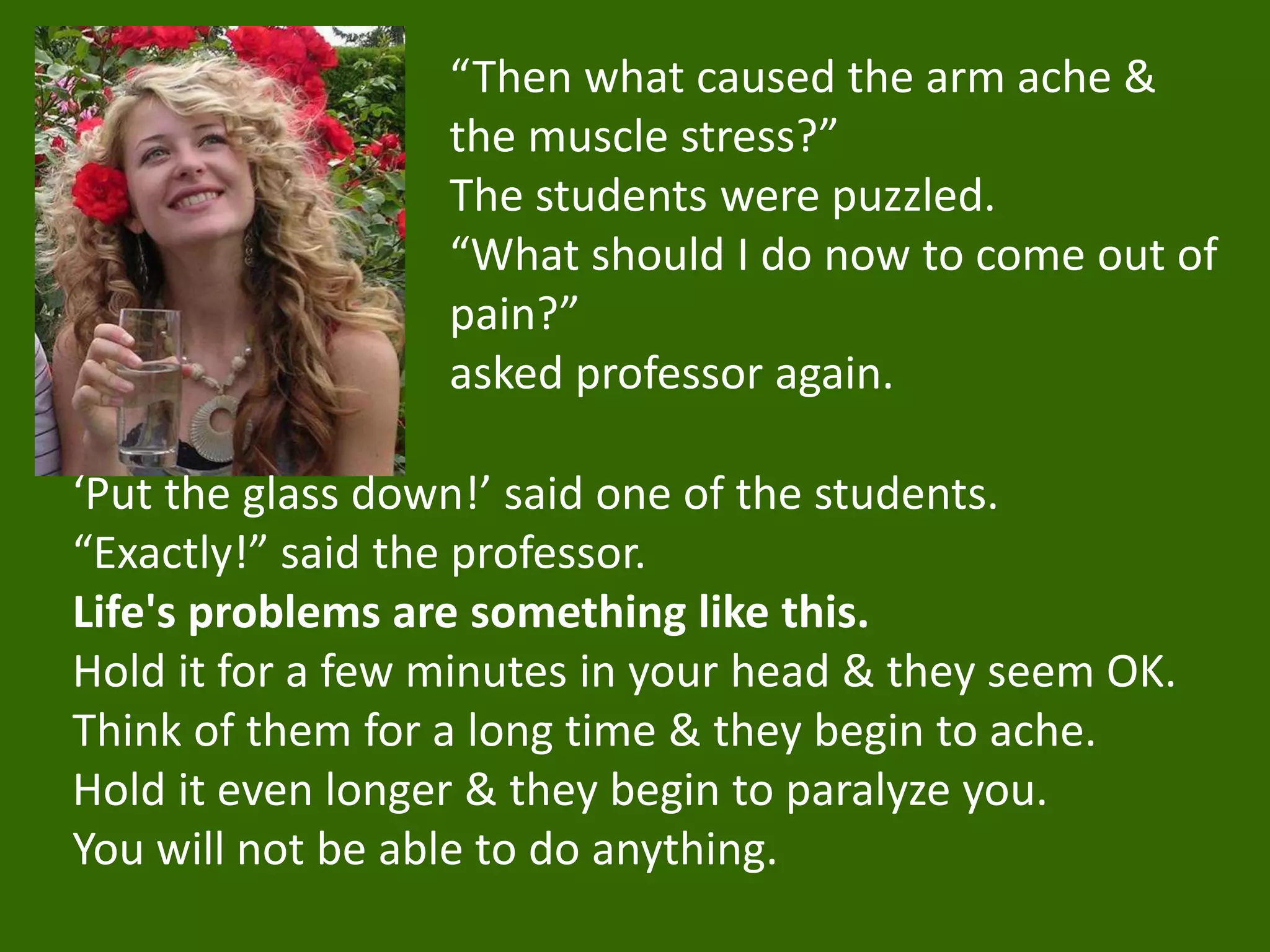
“What should I do now to come out of
pain?”
asked professor again.
‘Put the glass down!’ said one of the students.
“Exactly!” said the professor.
Life's problems are something like this.
Hold it for a few minutes in your head & they seem OK.
Think of them for a long time & they begin to ache.
Hold it even longer & they begin to paralyze you.
You will not be able to do anything.
It's important to think of the
challenges or problems in your
life, but EVEN MORE
IMPORTANT is to
‘PUT THEM DOWN’
at the end of every day before
You go to sleep.
That way, you are not stressed,
you wake up every day fresh &
strong & can handle any issue,
any challenge that comes your
way!
So, When you go home today, Remember my
friends to …
Evaluation Methods 21

Training & Development - Assessment Methods

  • 1.
  • 2.
    Evaluation Methods 2 Evaluationis a continuous process We will discuss six evaluation models Introduction Evaluation is a critical step of training event Evaluation occur training Evaluation apprise investment in learning Evaluation is measurement of training outcome
  • 3.
    Evaluation Methods 3 TheCIRO Model The Leatherman Model The Hamblin Model Phillip Model: An ROI Model The Krikpatrick Model Hodges Model 1970 1996 1974 1997 1976 1999 Assessment Methods
  • 4.
    Evaluation Methods 4 TheCIRO Model The Focus is on: If problem has learning solution. What would be objectives? Learning structure, media, & methods used Reactions of participants on training event To which extent objectives achieved 1. Content Evaluation 2. Input Evaluation 3. Reaction Evaluation 4. Outcome evaluation
  • 5.
    Evaluation Methods 5 •Trainees’ reaction • Content & methods learning Reaction • Before & after the event • Traineeslearnedwhatwasintended Learning • Job behavior at work • Learningtransferredtoworkplace Job Behavior • Effect in terms of cost benefit analysis Functioning • Learning affected organization’s well being & profitability Ultimate Value Suggest five levels of evaluation
  • 6.
    Evaluation Methods 6 •Participant’s satisfaction • Perception of its quality & relevance • Disputed whether reaction show effectiveness Reaction • whether participants have observed contents of training • Measure actual learning achieved Learning Behavior • Relates to learning & job behavior / performance • Any change initiated in terms of behavior / performance Measure business impact of organization Result Krikpatrick Model: Measure four dimension of outcome
  • 7.
    Evaluation Methods 7 LeathermanModel - Suggests how & when evaluation can & should be done Within-Training Evaluation • Discussions with trainees how they view training. • What should be done more of, less of Terminal Evaluation • May be carried out by discussions Or Trainees complete standard evaluation form Post – Learning Evaluation • Measures final outcome of training. • It is difficult stage involving various problems
  • 8.
    Evaluation Methods 8 PhilipsModel: An ROI Model Included one more element to Krikpatrick model He called extra element as ‘Return-on-investment’ Seek monetary value of results & cost of program Calculation formula is: Net program benefit / program cost X 100 It is time consuming exercise
  • 9.
    Evaluation Methods 9 HodgesModel of Evaluation: Called “Components for HRD Evaluation,” uses 3 framework 1. Need Assessment • Determination of objective based on need analysis • Objective & assessment closely related • If objectives vague, difficult to evaluate 2. Formative Evaluation • Important step to complete when program is ready but before conducting actual training
  • 10.
    Evaluation Methods 10 3.Summative Evaluation Reaction Evaluation Were they satisfied? Learning Evaluation Performance Evaluation Did they learn? • Were they able to use it? • Were they successful in using it? Impact Evaluation • What impact has it had? • Was there a financial return?
  • 11.
    Evaluation Methods 11 AnExample of Reaction Evaluation Questionnaire Title of Training / Development program:_______________________ Trainer[s]: ________________ Date: ______________ Participant: ______________________ Dept: ____________ Que. 1 To what extent do you agree with the following statement Answer on a scale of 1 to 5. [5 strongly Agree, 1 strongly Disagree It was a good use of my time 1 2 3 4 5 The content was relevant to me The objectives were clearly stated Stated training objective were fully achieved I was encouraged to actively participate in the training Training methods were effective
  • 12.
    Evaluation Methods 12 Que.2 Circle up to four words below which best sum up overall opinion of this learning experience Interesting Challenging Exciting Boring Confusing Difficult Practical Theoretical Irrelevant Useful Innovative Complicated Nothing new Exhausting Que. 3 Overall rating of the training program Ineffective Very Effective 1 2 3 4 5 Ineffective Very Effective 1 2 3 4 5 Que. 4 Overall rating of the trainer
  • 13.
  • 14.
    Study this smallstory. Hope that makes a BIG change in YOU.
  • 15.
    A Professor beganher class by holding up a glass with some water in it. She held it up for all to see & asked the students:
  • 16.
    “How much doyou think this glass weighs?” '50g!' .... '100g!' ..... '125g‘ ? the students answered, “I really don't know unless I weigh it,” said the professor, “but, my question is: What would happen if I held it up like this for a few minutes?” 'Nothing' …..the students said.
  • 17.
    'Ok what wouldhappen if I held it up like this for an hour?' the professor asked. 'Your arm would begin to ache' said one of the student. “You're right, now what would happen if I held it for a day?” “Your arm could go numb, you might have severe muscle stress & paralysis & have to go to hospital for sure!” … ventured another student & all the students laughed … “Very good, But during all this, did weight of the glass change?” asked the professor. ‘No’…. was the answer.
  • 18.
    “Then what causedthe arm ache & the muscle stress?” The students were puzzled. “What should I do now to come out of pain?” asked professor again. ‘Put the glass down!’ said one of the students. “Exactly!” said the professor. Life's problems are something like this. Hold it for a few minutes in your head & they seem OK. Think of them for a long time & they begin to ache. Hold it even longer & they begin to paralyze you. You will not be able to do anything.
  • 19.
    It's important tothink of the challenges or problems in your life, but EVEN MORE IMPORTANT is to ‘PUT THEM DOWN’ at the end of every day before You go to sleep. That way, you are not stressed, you wake up every day fresh & strong & can handle any issue, any challenge that comes your way!
  • 20.
    So, When yougo home today, Remember my friends to …
  • 21.