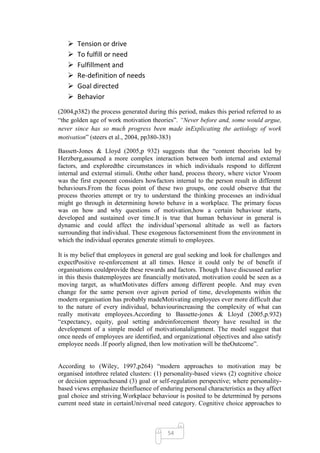
1
1.1Employee Motivation


                                   Introduction

An issue which usually generates a great deal of attention from most managers,
administrators and those involved in Human Resources Management is the issue of
how to successfully motivate employee. While it is true that aspects like staff
recruitment, controlling, managing, leading, and many more are of great importance
to the success of an organization, Employee Motivation is generally considered a core
element in running a successful business.

In the organizational setting the word ―Motivation‖ is used to describe the drive
thatimpels an individual to work. A truly motivated person is one who ―wants‖
towork .Both employees and employers are interested in understanding motivation
if employees know what strengthens and what weakens their motivation, they
canoften perform more effectively to find more satisfaction in their job. Employers
wantto know what motivates their employees so that they can get them to work
harder.Theconcept of motivation implies that people choose the path of action they
follow.When behavioral scientists use the word motivation, they think of its
somethingsteaming from within the person technically, the term motivation has its
origin inthe Latin word ―mover‖ which means ―to move‖. Thus the word motivation
standsfor movement. If a manager truly understands his subordinate‘s motivation, he
can channel their―inner state‖ towards command goals, i.e., goals, shared by both the
individual andthe organization. It is a well known fact that human beings have great
potential butthey do not use it fully, when motivation is absent. Motivation factor are
thosewhich make people give more than a fair day‘s work and that is usually only
aboutsixty-five percent of a person‘s capacity .Obviously , every manager should
bereleasing hundred percent of an individual‘s to maximize performance for
achievingorganizational goals and at the same to enable the individual to develop
hispotential and gain satisfaction. Thus every manager should have both interest
andconcern about how to enable people to perform task willingly and to the best
of their ability.At one time, employees were considered just another input into the


                                            2
production of goods and services. What perhaps changed this way of thinking about
employeeswas research, referred to as the Hawthorne Studies, conducted by Elton
Mayo from1924 to 1932 This study found employees are not motivated solelyby
money and employee behavior is linked to their attitudes.

TheHawthorne Studies began the human relations approach to management,
wherebythe needs and motivation of employees become the primary focus of
managers.


1.2Definition of Motivation


    Motivation is a process that starts with a physiological or psychological
     deficiency or need that activates behavior or a drive that aimed at a goal or an
     incentive.
    "The only way to get people to like working hard is to motivate them. Today,
     people must understand why they're working hard. Every individual in an
     organization is motivated by something different." -Rick Pitino
    ―Employee motivation is a reflection of the level of energy, commitment, and
     creativity that a company's workers bring to their jobs.‖
    "Psychological forces that determine the direction of a person's behavior in an
     organization, a person's level of effort and a person's level of persistence."- G.
     Jones and J. George from the book "Contemporary Management."

Basics about Motivation

   1. Motivating employees starts with motivating yourself it‘s amazing how, if you
      hate your job, it seems like everyone else does, too. If you are very stressed
      out, it seems like everyone else is, too. Enthusiasm is contagious. If you're
      enthusiastic about your job, it's much easier for others to be, too. Also,
      if you‘re doing a good job of taking care of yourself and your own job, you'll
      have much clearer perspective on how others are doing in theirs. A great place
      to start learning about motivation is to start understanding your own
      motivations. The key to helping to motivate your employees is to understand
      what motivates them. So what motivates you? Consider, for example, time
      with family, recognition, a job well done, service, learning, etc. How your job
      is configured to support your own motivations? What can you do to better
      motivate yourself?


   2. Always work to align goals of the organization with goals of employees as
      mentioned above, employees can be all fired up about their work and be
      working very hard. However, if the results of their work don't contribute to the


                                          3
goals of the organization, then the organization is not any better off than if the
       employees were sitting on their hands -- maybe worse off! Therefore, it's
       critical that managers and supervisors know what they want from their
       employees. These preferences should be worded in terms of goals for the
       organization. Identifying the goals for the organization is usually done during
       strategic planning. Whatever steps you take to support the motivation of your
       employees (various steps are suggested below), ensure that employees have
       strong input to identifying their goals and that these goals are aligned with
       goals of the organization. (Goals should be worded to be ―SMARTER".


   3. Key to supporting the motivation of your employees understands what
      motivates each of them each person is motivated by different things. Whatever
      steps you take to support the motivation of your employees, they should first
      include finding out what it is that really motivates each of your employees.
      You can find this out by asking them, listening to them and observing them.


   4. Recognize that supporting employee motivation is a process, not at ask
      Organizations change all the time, as do people. Indeed, it is an ongoing
      process to sustain an environment where each employee can strongly motivate
      themselves. If you look at sustaining employee motivation as an ongoing
      process, then you'll be much more fulfilled and motivated yourself.


   5. Support employee motivation by using organizational systems (for example,
      policies and procedures)--don't just count on good intentions don‘t just count
      on cultivating strong interpersonal relationships with employees to help
      motivate them. The nature of these relationships can change greatly, for
      example, during times of stress. Instead, use reliable and comprehensive
      systems in the workplace to help motivate employees.


For example, establish compensation systems, employee performance systems,
organizational policies and procedures, etc., to support employee motivation. Also,
establishing various systems and structures helps ensure clear understanding and
equitable treatment of employees.

1.3 Importance of Motivation
Motivation is a very important for an organization because of the following benefits it
provides:-

    Puts human resources into action

Every concern requires physical, financial and human resources to accomplish the
goals. It is through motivation that the human resources can be utilized by making full
use of it. This can be done by building willingness in employees to work. This will
help the enterprise in securing best possible utilization of resources.


                                           4
 Improves level of efficiency of employees

The level of a subordinate or a employee does not only depend upon his qualifications
and abilities. For getting best of his work performance, the gap between ability and
willingness has to be filled which helps in improving the level of performance of
subordinates. This will result into-

    Increase in productivity,
    Reducing cost of operations, and
    Improving overall efficiency.

Leads to achievement of organizational goals

The goals of an enterprise can be achieved only when the following factors take place
:-

      There is best possible utilization of resources,
      There is a co-operative work environment,
      The employees are goal-directed and they act in a purposive manner,
      Goals can be achieved if co-ordination and co-operation takes place
       simultaneously which can be effectively done through motivation.

    Buildsfriendly relationship

Motivation is an important factor which brings employees satisfaction. This can be
done by keeping into mind and framing an incentive plan for the benefit of the
employees. This could initiate the following things:

    Monetary and non-monetary incentives,
    Promotion opportunities for employees,
    Disincentives for inefficient employees.

In order to build a cordial, friendly atmosphere in a concern, the above steps should
be taken by a manager. This would help in:

    Effective co-operation which brings stability,
    Industrial dispute and unrest in employees will reduce,
    The employees will be adaptable to the changes and there will be no resistance
     to the change,
    This will help in providing a smooth and sound concern in which individual
     interests will coincide with the organizational interests,
    This will result in profit maximization through increased productivity.

    Leadsto stability of work force

Stability of workforce is very important from the point of view of reputation and
goodwill of a concern. The employees can remain loyal to the enterprise only when
they have a feeling of participation in the management. The skills and efficiency of


                                          5
employees will always be of advantage to employees as well as employees. This will
lead to a good public image in the market which will attract competent and qualified
people into a concern. As it is said, ―Old is gold‖ which suffices with the role of
motivation here, the older the people, more the experience and their adjustment into a
concern which can be of benefit to the enterprise.

1.4What motivates employees?

Every person has a different reason for going to work. These reasons are as individual
as whichever person you may ask. But all of the reasons for working share a common
thread. We all obtain something from work we need.

There is much discussion about the value of extrinsic motivation (monetary and other
material rewards) versus intrinsic motivation where people re driven by what‘s inside
them. not by the trappings of success.

Whereas I recognize how critical extrinsic motivation is–we all need to be rewarded
fairly for the job that we do-in my experience the most effective factors relating to
employee motivation are related to intrinsic motivation:

1. Empowerment: Feeling trusted and empowered is a tremendous motivator.

2. Growth: Feeling that they are growing and developing personally

3. Inclusion: ‗To belong‘ is a fundamental need, whether as a member of a family,
peer group, network, team or company. It‘s human nature to want to be on the inside,
not the outside.

4. Purpose: Today people care more about what happens tomorrow, and want to
contribute to ensuring the future of our children, and the health of our communities
and planet.

5. Trust: the fabric that holds it all together and makes it real.

Framework of motivation

The framework comprises six steps:-

   1) Motivation process begins with the individual‘s needs. Needs are
      teltdeprivations which the individual experiences at a given time and act as
      energizers. These needs may be psychological (e.g., the needs for recognition),
      physiological (e.g., the needs for water, air or foods) or social (e.g., the needs
      for friendship).
   2) Motivation is goal directed.
   3) A goal is a specific result that the individual wants to achieve. Anemployee‘s
      goal are often driving forces and accomplishing those goals cansignificantly
      reduce needs.


                                             6
4) Promotions and raises are two of the ways that organizations seek tomaintain
      desirable behavior. They are signals to employees that their needs
      foradvancement and recognition and their behaviors are appropriate.
   5) Once the employee have received either rewards or punishments.
   6) They reassess their needs.

The Role of Motivation:

Why do we need motivated employees?

The answer is survival. Motivated employees are needed in our rapidly changing
workplaces. Motivatedemployees help organizations survive. Motivated employees
are more productive. To be effective, managers need to understand what motivates
employees within thecontext of the roles they perform. Of all the functions a manager
performs, motivating employees is arguably the most complex. This is due, in part, to
the factthat what motivates employee‘s changes constantly. For example, research
suggests that as employees' income increases, moneybecomes less of a motivator
(Kovach, 1987). Also, as employees get older,interesting work becomes more of a
motivator.

Mechanism of motivation
Motivation is the process that starts with physiological or psychological deficiency
orneed that activate behavior or a drive that is aimed at a goal or incentive.

The following diagram depicts the motivation process.

Mechanism of Motivation

Needs Drives Goal

Deprivation Deprivation Reduction

With of Drives

Direction

Thus, the key to understanding motivation lies in the meaning of, and
relationshipbetween needs, drives and goals Needs: Needs are created whenever there
is a physiological or psychologicalimbalance For example: A need exists when cells
in the body are deprived of foodand water or when the personality is deprived of other
people who serve friends orcompanions. Although psychological may be based on a
deficiency, sometimes theyare not. For instant, and individuals with a strong need to
get ahead may have ahistory of consistent success·Drives: ―Drives (Or motives) are
set up to alleviate needs. Psychological needs canbe simply defined as a deficiency
with direction. Physiological or psychologicaldrives are action – oriented and provide
energizing thrust towards reaching anincentive or goals. They are at the very heart of
the motivational process. Theneeds for food and water are translated into hunger and


                                          7
thrust drives, and the needfor friend becomes a drives affiliation. Thus, drive is a
psychological state whichmoves an individual satisfying need· Goals: At the end of
the motivational cycle is the goal or incentive. It is anythingthat wills that will
alleviate a need and reduce a drive. Thus, attaining a goal willtend to restore
physiological or psychological balance and will reduce or cut off thedrive. Eating
food, drinking water and obtaining friends will tend to restore thebalance and reduce
the corresponding drives food, water and friends are theincentive are the goals in this
example.

1.5Types of Motivation
There are many types of motivation.

Motivational techniques have been experienced by every person from birth. We learn
behavior through motivation. We live our whole lives because of motivation. The
question that remains however is this: What motivation should a person have? This is
important because our motivation decides our behavior. Some types of motivation are
more effective than others. However, the perfect motivation for you can only be
decided by one person: YOU .

Why do people do what they do? Why do we go on everyday, living our lives and
trying to find justification for our existence? Some people think that they can find
purpose in the things that motivate them. Others just see the motivation and react
automatically.


There is no one thing that motivates people to perform certain actions. People are
different, so it follows that their motivations have to be different. Here are some types
of motivation :


     Achievement –


This is the motivation of a person to attain goals. The longing for achievement is
inherent in every man, but not all persons look to achievement as their motivation.
They are motivated by a goal. In order to attain that goal, they are willing to go as far
as possible. The complexity of the goal is determined by a person's perception.

To us, the terms "simple" and "complex" are purely relative. What one person thinks
is an easy goal to accomplish may seem to be impossible to another person. However,
if your motivation is achievement, you will find that your goals will grow increasingly
complex as time goes by       .


                                            8
 Socialization –


Some people consider socialization to be their main motivation for actions. This is
especially evident in the situation of peer pressure. Some people are willing to do
anything to be treated as an equal within a group structure. The idea of being accepted
among a group of people is their motivation for doing certain things.


     Incentive motivation –


This motivation involves rewards. People who believe that they will receive rewards
for doing something are motivated to do everything they can to reach a certain goal.
While achievement motivation is focused on the goal itself, incentive motivation is
driven by the fact that the goal will give people benefits. Incentive motivation is used
in companies through bonuses and other types of compensation for additional work.

By offering incentives, companies hope to raise productivity and motivate their
employees to work harder   .


     Fear motivation –


When incentives do not work, people often turn to fear and punishment as the next
tools. Fear motivation involves pointing out various consequences if someone does
not follow a set of prescribed behavior. This is often seen in companies as working
hand-in-hand with incentive motivation. Workers are often faced with a reward and
punishment system, wherein they are given incentives if they accomplish a certain
goal, but they are given punishments when they disobey certain policies.


     Change motivation-


Sometimes people do things just to bring about changes within their immediate
environment. Change motivation is often the cause of true progress. People just
become tired of how things are and thus, think of ways to improve it.

     Natural Motivations-


                                           9
Motivation is the most common type of motivation and happens the most often. It is
the motivation people get when naturally motivated.


     Fear motivations-

Fear Motivation happens often within the workforce when under pressure to complete
a task.

     Booster motivations-

Booster Motivations is normally selfdriven to overcome a task you have set yourself.


1.6Methods of Motivation


There are as many different methods of motivating employees today as there are
companies operating in the global business environment. Still, some strategies are
prevalent across all organizations striving to improve employee motivation. The best
employee motivation efforts will focus on what the employees deem to be important.
It may be that employees within the same department of the same organization will
have different motivators. Many organizations today find that flexibility in job design
and reward systems has resulted in employees' increased longevity with the company,
improved productivity, and better morale.


    Empowerment - Giving employees more responsibility and decision-making
     authority increases their realm of control over the tasks for which they are held
     responsible and better equips them to carry out those tasks. As a result,
     feelings of frustration arising from being held accountable for something one
     does not have the resources to carry out are diminished. Energy is diverted
     from self-preservation to improved task accomplishment.


    Creativity And Innovation - At many companies, employees with creative
     ideas do not express them to management for fear that their input will be
     ignored or ridiculed. Company approval and toeing the company line have
     become so ingrained in some working environments that both the employee
     and the organization suffer. When the power to create in the organization is
     pushed down from the top to line personnel, employees who know a job,
     product, or service best are given the opportunity to use their ideas to improve
     it. The power to create motivates employees and benefits the organization in
     having a more flexible work force, using more wisely the experience of its
     employees, and increasing the exchange of ideas and information among


                                          10
employees and departments. These improvements also create an openness to
       change that can give a company the ability to respond quickly to market
       changes and sustain a first mover advantage in the marketplace.


    Learning - If employees are given the tools and the opportunities to
     accomplish more, most will take on the challenge. Companies can motivate
     employees to achieve more by committing to perpetual enhancement of
     employee skills. Accreditation and licensing programs for employees are an
     increasingly popular and effective way to bring about growth in employee
     knowledge and motivation. Often, these programs improve employees'
     attitudes toward the client and the company, while bolstering self-confidence.
     Supporting this assertion, an analysis of factors which influence motivation-to-
     learn found that it is directly related to the extent to which training participants
     believe that such participation will affect their job or career utility. In other
     words, if the body of knowledge gained can be applied to the work to be
     accomplished, then the acquisition of that knowledge will be a worthwhile
     event for the employee and employer.


    Quality Of Life - The number of hours worked each week by American
     workers is on the rise, and many families have two adults working those
     increased hours. Under these circumstances, many workers are left wondering
     how to meet the demands of their lives beyond the workplace. Often, this
     concern occurs while at work and may reduce an employee's productivity and
     morale.


Companies that have instituted flexible employee arrangements have gained
motivated       employees whose productivity has increased. Programs incorporating
flextime, condensed workweeks, or job sharing, for example, have been successful in
focusing overwhelmed employees toward the work to be done and away from the
demands of their private lives. All motivation ultimately comes from within a person.

    Monetary Incentive - For all the championing of alternative motivators,
     money still occupies a major place in the mix of motivators. The sharing of a
     company's profits gives incentive to employees to produce a quality product,
     perform a quality service, or improve the quality of a process within the
     company. What benefits the company directly benefits the employee.
     Monetary and other rewards are being given to employees for generating cost-
     savings or process-improving ideas, to boost productivity and reduce
     absenteeism. Money is effective when it is directly tied to an employee's ideas
     or accomplishments. Nevertheless, if not coupled with other, nonmonetary
     motivators, its motivating effects are short-lived. Further, monetary incentives
     can prove counterproductive if not made available to all members of the
     organization.


    Other Incentives - Study after study has found that the most effective
     motivators of workers are nonmonetary. Monetary systems are insufficient


                                           11
motivators, in part because expectations often exceed results and because
       disparity between salaried individuals may divide rather than unite employees.
       Proven nonmonetary positive motivators foster team spirit and include
       recognition, responsibility, and advancement. Managers, who recognize the
       "small wins" of employees, promote participatory environments, and treat
       employees with fairness and respect will find their employees to be more
       highly motivated. One company's managers brainstormed to come up with 30
       powerful rewards that cost little or nothing to implement. The most effective
       rewards, such as letters of commendation and time off from work, enhanced
       personal fulfillment and self-respect. Over the longer term, sincere praise and
       personal gestures are far more effective and more economical than awards of
       money alone. In the end, a program that combines monetary reward systems
       and satisfies intrinsic, self-actualizing needs may be the most potent employee
       motivator.

  1.7Factors for Lack of Motivation in the Workplace
A drop in staff motivation can become contagious if the cause is not identified and
addressed. Management needs to be conscious of employee motivation, and that
means being able to identify the factors that cause a lack of motivation in the
workplace. Become familiar with the factors that can degrade staff motivation and
design plans to combat these productivity killers.

Rumors

The important thing to remember about rumors is that they are not always wrong.
Some rumors have basis in fact, but that does not make them good for employee
morale. An employee that hears a rumor that she may be laid off experiences an
instant drop in motivation. To deal with the problem of rumors in the workplace, it is
important for management to share important information with the staff in a timely
manner. This helps employees to feel confident that management will address rumors
and encourages staff members to wait on information from the company before acting
on a rumor.

Inadequate Job Skills

Employees are motivated to succeed at jobs for which they feel prepared and properly
trained. Before moving an employee into a position of greater responsibility or before
allowing any changes to an employee's job duties, be certain that employee has had
the training needed to get started. Putting an employee in a position where she feels
she has inadequate job skills will erode the employee's confidence and stifle any
motivation to succeed.

Goal Flaws

Employees are not motivated by the notion that their hard work will make company
owners and executives rich, the more internalized a company's goals sound, the less
motivated employees are to fulfill those goals. The company needs to focus on the
customer and give employees a chance to feel as though it has done something
substantial to help the customer. For example, develop a referral program that


                                          12
encourages customers that have recently purchased products to recommend other
people that your sales professionals can call on. The company and sales staff benefit
from the increase in business, but the sales staff also gets to see the appreciation of
past clients in the form of potential new business.

Overwork

Employees that are overworked are likely to lose motivation regardless of how much
overtime pay they are receiving. If you know a period is coming where extra hours
will need to be worked, develop a schedule in advance and give your employees
ample warning so they can make preparations in their personal life. Make sure the
staff schedule still allows employees to spend time with their families and get away
from the stress of working too much.


  1.8Techniques of Employee Motivation

Here are some motivations techniques that will help to get staff re-energised and
engaged at work. To begin with, make sure you have the right conditions in place so
that your work culture supports motivation.

Make sure you offer:

√ Fair pay and conditions

√ A comfortable, safe, working environment

√ Opportunities for employees to socialize and make friends

√ clearly defined work responsibilities and goals

√ Education and training opportunities

√ Career opportunities

As a manager, you play a key role in building on a solid foundation and motivating
employees. Remember that 70% of people leave their boss, not the company.

So what can you do to make sure that employees are switched on at work?

Here are some practical motivation techniques that you can use to improve motivation
in your workplace:


                                          13
1. Treat Employees as Individuals

Do you make assumptions about what motivates your employees? Some are likely to
be career focused, but others may see their work as a place to make friends and earn
money.Find out what motivates employees outside of work. Some enjoy a challenge
such as a sporting activity; others may like to be on committees so they can use their
organizational skills. Use their innate talents in the workplace where possible to keep
them motivated. Set goals which stretch their abilities. Make goals SMART - specific,
measurable, achievable, relevant and timeframed.

Treat Employees with Respect

Get to know your employees on a personal level, and offer support when needed, even
if it is only to listen to their concerns.Ask your employees for their opinions where
possible, for example if you are changing systems or introducing new equipment.
Being involved in decision making is one of the best motivation techniques.Catch
your employees doing something well and praise them - and if you do this in front of
others, it makes the employee feel even better. Giving employees recognition for their
efforts will motivate them to repeat the process.

Provide Opportunities for Employee Learning and Development

Encourage a learning climate, through structured on-the-job training programmes, job
transfers, inter-disciplinary projects and support for further education. Aim to have
your employees constantly learning new skills and gaining new knowledge. This will
reduce the level of stagnation that can easily occur in a business.Promote from within
where feasible - and invest the time and support in developing employees so they can
take on new opportunities.Some managers worry that by offering a high level of
training to employees, they may leave the business for better opportunities elsewhere.
Remember this allows other employees to rise up and take their place! Also the word
will spread that you are a good employer - which may encourage a higher caliber of
external job applicants.

Make the Workplace a Fun Place

Having fun is one of the best motivation techniques. And small things can make all
the difference..

√ bringing sweets to team meetings

√ sharing non-business news through e.g. newsletters

√ arranging activities such as lunchtime yoga sessions


                                          14
√ surprising employees with a birthday cake

√ asking the employees for their opinion on what would make the workplace a fun
place!


Morale Boosters

Measuring Morale

There's only one way to know how good morale really is in your company: ask the
people who work there.

Street Smarts: The Tournament

Morale took a real beating this fall. But there's nothing that lifts the spirits like
some friendly competition.

Revving Up the "P" Word (Productivity)

Though productivity is often defined in numbers, it relies very heavily upon people
and their attitudes.

Leading in Hard Times

CEOs offer 10 tips for leading your company through bleak times.

Non-Cash Incentives


Low-Cost Ways to Build Employee Commitment

Consider the power of the five I's.

It Takes More than Pay to Keep Good Workers

Companies are finding a number of ways to expand responsiveness and flexibility
beyond traditional compensation programs to retain top employees.

Incentives for All Generations

The one-size-fits-all approach no longer suits today's multigenerational workplaces.
Check this list of desired perks for mature workers, baby boomers, Gen Xers, and
more.


                                         15
Winter Holiday Rewards

The hectic holiday season is the time to show off a well-thought-out reward strategy
that helps yourworkforce stay motivated and focused.


Perks You Can Afford

In this classic Inc. article, take a look at some unique employee benefits that can help
you create an environment your workers won't want to leave.

Motivation by Compensation


Trust but VerifyIn addition to providing valuable information on the company's 20
restaurants, the Noodles & Co. secret shopper program is used as a motivational tool.

The Store that Stark Built

Not only does every employee at Debra's Natural Gourmet have a management role,
in a move unheard of in retail, profits are shared amongst the team.

In a Former Life: Alan Schultz

This CEO learned a valuable lesson during his past life as a steelworker: A company
should compensate its sales force based on fair and reachable short-term goals.

Hands On: Showing Up

Are your workers not in the habit of showing up every day? Try instituting a bonus
system to encourage perfect attendance.

Turn Motivation Inside Out

Inside sales teams often go unrecognized and unrewarded. To motivate them and
build a winning sales team all around, reward sales support staffers with commissions,
too.

Goals, Roles, Pay, and Performance

If you've promised goal-based compensation, you need to clearly communicate roles,
goals, and paths; otherwise, you may end up with disgruntled employees.

Turbo charger Your Bonus Plan

Take a regular bonus plan and add a kicker—an increase in the payout if certain
targets are met.


                                           16
1.9Theories of Motivation

Overview

At a simple level, it seems obvious that people do things, such as go to work, in order
to get stuff they want and to avoid stuff they don't want. Why exactly they want what
they do and don't want what they don't is still something a mystery. It's a black box
and it hasn't been fully penetrated.

Overall, the basic perspective on motivation looks something like this:


In other words, you have certain needs or wants (these terms will be used
interchangeably), and this causes you to do certain things (behavior), which satisfy
those needs (satisfaction), and this can then change which needs/wants are primary
(either intensifying certain ones, or allowing you to move on to other ones).

A variation on this model, particularly appropriate from an experimenter's or
manager's point of view, would be to add a box labeled "reward" between "behavior"
and "satisfaction". So that subjects (or employees), who have certain needs do certain
things (behavior), which then get them rewards set up by the experimenter or manager
(such as raises or bonuses), which satisfy the needs, and so on.


Theories of Motivation are as follows:-

Aldermen’s ERG theory

Adorer classifies needs into three categories, also ordered hierarchically:

       growth needs (development of competence and realization of potential)
       relatedness needs (satisfactory relations with others)
       existence needs (physical well-being)

This is very similar to Maslow -- can be seen as just collapsing into three tiers. But
maybe a bit more rational. For example, in Adorer‘s model, sex does not need to be in
the bottom category as it is in Maslow's model, since it is not crucial to (the
individual's) existence. (Remember, this about individual motivation, not species'
survival.) So by moving sex, this theory does not predict that people have to have sex
before they can think about going to school, like Maslow's theory does.


                                           17
Adorer believed that as you start satisfying higher needs, they become more intense
(e.g., the power you get the more you want power), like an addiction.

Do any of these theories have anything useful to say for managing businesses? Well,
if true, they suggest that

       Not everyone is motivated by the same things. It depends where you are in the
       hierarchy (think of it as a kind of personal development scale)
       The needs hierarchy probably mirrors the organizational hierarchy to a certain
       extent: top managers are more likely to motivated by self-actualization/growth
       needs than existence needs. (but try telling Bill Clinton that top executives are
       not motivated by sex and cheeseburgers...)

       McClelland’s Theory of Needs:
According to David McClelland, regardless of culture or gender, people are driven by
three motives:
   • Achievement,

   • Affiliation, and

   • Influence.

Since McClelland's first experiments, over 1,000 studies relevant to achievement
motivation have been conducted. These studies strongly support the theory.
   • Achievement: The need for achievement is characterized by the wish to take
       responsibility for finding solutions to problems, master complex tasks, set goals, get
       feedback on level of success.
   • Affiliation: The need for affiliation is characterized by a desire to belong, an
       enjoyment of teamwork, a concern about interpersonal relationships, and a need
       to reduce uncertainty.
   • Power: The need for power is characterized by a drive to control and influence
       others, a need to win arguments, a need to persuade and prevail


According to McClelland, the presence of these motives or drives in an individual
indicates a predisposition to behave in certain ways. Therefore, from a manager's
perspective, recognizing which need is dominant in any particular individual affects the
way in which that person can be motivated.

Summary: People with achievement motives are motivated by standards of excellence,
delineated roles and responsibilities and concrete, timely feedback. Those with affiliation
motives are motivated when they can accomplish things with people they know and trust.
And the power motive is activated when people are allowed to have an impact, impress
those in power, or beat competitors.


                                             18
Cognitive Evaluation Theory

This theory suggests that there are actually two motivation systems: intrinsic and
extrinsic that corresponds to two kinds of motivators:

       Intrinsic motivators: Achievement, responsibility and competence. motivators
       that come from the actual performance of the task or job -- the intrinsic
       interest of the work.
       Extrinsic: pay, promotion, feedback, working conditions -- things that come
       from a person's environment, controlled by others.

One or the other of these may be a more powerful motivator for a given
individual.Intrinsically motivated individuals perform for their own achievement and
satisfaction. If they come to believe that they are doing some job because of the pay
or the working conditions or some other extrinsic reason, they begin to lose
motivation.

The belief is that the presence of powerful extrinsic motivators can actually reduce a
person's intrinsic motivation, particularly if the extrinsic motivators are perceived by
the person to be controlled by people. In other words, a boss who is always dangling
this reward or that stick will turn off the intrinsically motivated people.

Note that the intrinsic motivators tend to be higher on the Maslow hierarchy.

       Two Factor Theory (Herzberg)

Two-factor Theory: Herzberg's Two Factor Theory, also known as the Motivation-
Hygiene Theory, was derived from a study designed to test the concept that people have
two sets of needs:
1. Their needs as animals to avoid pain
2. Their needs as humans to grow psychologically

Herzberg‘ study Herzberg's study consisted of a series of interviews that sought to elicit
responses to the questions:

(1) Recall a time when you felt exceptionally good about your job. Why did you feel
that way about the job? Did this feeling affect your job performance in any way?
Did this feeling have an impact on your personal relationships or your well- being?

(2) Recall a time on the job that resulted in negative feelings? Describe the sequence
of events that resulted in these negative feelings.

(3)Research Results: it appeared from the research, that the things making people
happy on the job and those making them unhappy had two separate themes.


                                            19
(1) Satisfaction (Motivation): Five factors stood out as strong determiners of job
satisfaction:
                       • Achievement

                       • Recognition

                       • Work Itself

                       • Responsibility

                       • Advancement


The last three factors were found to be most important for bringing about lasting changes
of attitude. It should be noted, that recognition refers to recognition for achievement as
opposed to recognition in the human relations sense.


(2) Dissatisfaction (Hygiene): The determinants of job dissatisfaction were found to be:

• Company Policy

            • Administrative Policies

            • Supervision

            • Salary

            • Interpersonal Relations

            • Working Conditions

From the results Herzberg concluded that the replies people gave when they felt good
about their jobs were significantly different from the replies given when they felt bad.
Certain characteristics tend to be consistently related to job satisfaction and others to job
dissatisfaction. Intrinsic factors, such as work itself, responsibility and achievement seem
to be related to job satisfaction. Respondents who felt good about their work tended to
attribute these factors to themselves. On the other dissatisfied respondents tended to cite
extrinsic factors such as supervision, pay, company policies and working condition.
Herzberg proposed that his findings indicated the existence of a dual continuum: the
opposite of ―satisfaction‖ is ―No satisfaction‖ and the opposite of ―Dissatisfaction‖ is ―No
Dissatisfaction.

According to Herzberg, the factors leading to Job satisfaction are separate and distinct
form those that lead to job dissatisfaction. Therefore, managers who seek to eliminate
factors that can create job dissatisfaction may bring about peace but not necessarily
motivation. They will be placating their workforce rather than motivating them. As a
result, conditions surrounding the job such as quality of supervision, pay , company
policies, physical working conditions relations with others and job security were
characterized by Herzberg as hygiene factors, when they‘re adequate, people will not be
dissatisfied ; neither will they be satisfied. If we want to motivate people on their jobs,
Herzberg suggested emphasizing factors associated with the work itself or to outcomes


                                             20
directly derived form it, such as promotional opportunities, opportunities for personal
growth, recognition, responsibility and achievement. These are the characteristics that
people find intrinsically rewarding.


       Reinforcement Theory:


This theory focuses its attention as to what controls behaviour. In contrast to goal setting
theory, which is cognitive approach focus attention on what initiates behaviour?
Behaviour, as per cognitive approach is initiated by internal events. Reinforcement theory
argues that behaviour is reinforced and controlled by external events. The classical
conditioning proposed by Pavlov which we have already studied in our earlier lessons
explains this in a better way.

       Equity Theory

Suppose employee A gets a 20% raise and employee B gets a 10% raise. Will both be
motivated as a result? Will A be twice as motivated? Will be B be negatively
motivated?

Equity theory says that it is not the actual reward that motivates, but the perception,
and the perception is based not on the reward in isolation, but in comparison with the
efforts that went into getting it, and the rewards and efforts of others. If everyone got
a 5% raise, B is likely to feel quite pleased with her raise, even if she worked harder
than everyone else. But if A got an even higher raise, B perceives that she worked just
as hard as A, she will be unhappy.

In other words, people's motivation results from a ratio of ratios: a person compares
the ratio of reward to effort with the comparable ratio of reward to effort that they
think others are getting.

Of course, in terms of actually predicting how a person will react to a given
motivator, this will get pretty complicated:

   1. People do not have complete information about how others are rewarded. So
      they are going on perceptions, rumors, inferences.
   2. Some people are more sensitive to equity issues than others
   3. Some people are willing to ignore short-term inequities as long as they expect
      things to work out in the long-term.


                                             21
Expectancy Theory (Vroom)

This theory is meant to bring together many of the elements of previous theories. It
combines the perceptual aspects of equity theory with the behavioral aspects of the
other theories. Basically, it comes down to this "equation":

M = E*I*V

Or

Motivation = expectancy * instrumentality * valence

M (motivation) is the amount a person will be motivated by the situation they find
themselves in. It is a function of the following.

E (expectancy) = the person's perception that effort will result in performance. In
other words, the person's assessment of the degree to which effort actually correlates
with performance.

I (instrumentality) = the person's perception that performance will be
rewarded/punished. I.e., the person's assessment of how well the amount of reward
correlates with the quality of performance. (Note here that the model is phrased in
terms of extrinsic motivation, in that it asks 'what are the chances I'm going to get
rewarded if I do good job?'. But for intrinsic situations, we can think of this as asking
'how good will I feel if I can pull this off?').

V (valence) = the perceived strength of the reward or punishment that will result from
the performance. If the reward is small, the motivation will be small, even if
expectancy and instrumentality are both perfect (high).

        Theory of “X” and Theory of “Y”:
Douglas McGregor observed two diametrically opposing viewpoints of managers about
their employees, one is negative called ―Theory of X‖ and one is positive called ―Theory
of Y‖
     a) Theory of X : Following are the assumptions of managers who believe in the
         ―Theory of X‖ in regard to their employees.
           • Employees dislike work; if possible avoid the same
           • Employees must be coerced, controlled or threatened to do the work
           • Employees avoid responsibilities and seek formal direction
           • Most employees consider security of job, most important of all other factors
              in the job and have very little ambition
     b) Theory of Y: Following are the assumptions of managers who believe in the
        ―Theory of Y‖ in regard to their employees.


                                           22
• Employees love work as play or rest
           • Employees are self directed and self controlled and committed to the
              organizational objectives
           • Employees accept and seek responsibilities
           • Innovative spirit is not confined to managers alone, some employees also
               possess it.

Theory of X assumes Maslow‘s lower level needs dominate in employees. Whereas
Theory of Y, assumes Maslow‘s higher level needs dominate in employees.

       Self-Determination Theory

Self-Determination Theory (SDT) is closely related to Maslow's Theory with the
exception SDT suggests that people do not operate on auto-pilot... Instead, they rely
heavily on nourishment and support from their social environment to function
effectively.

SDT presupposes that all people have a built-in tendency toward growth and
development...that they strive to master challenges and to integrate their experiences
into a coherent sense of self.

According to Self-Determination Theory there are three concepts that affect
motivation:

Autonomy - Separateness... "I can do it myself"

Competence Feedback - Approval and Acknowledgment from significant others

Relatedness - Connectedness... "I'm not alone"


                                           23
1.10        Challenges of Motivation

Motivation seems to be a simple function of management in books, but in practice it is
more challenging.

The reasons for motivation being challenging job are as follows:

One of the main reasons of motivation being a challenging job is due to the changing
workforce. The employees become a part of their organization with various needs and
expectations. Different employees have different beliefs, attitudes, values,
backgrounds and thinking. But all the organizations are not aware of the diversity in
their workforce and thus are not aware and clear about different ways of motivating
their diverse workforce.

Employees motives cannot be seen, they can only be presumed. Suppose, there are
two employees in a team showing varying performance despite being of same age
group, having same educational qualifications and same work experience. The reason
being what motivates one employee may not seem motivating to other.

Motivation of employees becomes challenging especially when the organizations
have considerably changed the job role of the employees, or have lessened the
hierarchy levels of hierarchy, or have chucked out a significant number of employees
in the name of down-sizing or right-sizing. Certain firms have chosen to hire and fire
and paying for performance strategies nearly giving up motivational efforts. These
strategies are unsuccessful in making an individual overreach himself.

The vigorous nature of needs also pose challenge to a manager in motivating his
subordinates. This is because an employee at a certain point of time has diverse needs
and expectations. Also, these needs and expectations keep on changing and might also
clash with each other. For instance-the employees who spend extra time at work for
meeting their needs for accomplishment might discover that the extra time spent by
them clash with their social needs and with the need for affiliation.

Work Motivation

Craig Pindar ―echoing the basic definition of motivation, define it as follows:―Work
motivation is a set of energetic force that originate both within as well asbeyond and
individuals being, to initiate work – related behavior, and to determine its form,
direction, intensity, and duration.‖While general motivation is concerned with effort
towards any goal, StephenRobbins narrow the focus to organizational goals in order
to reflect singular interesting work related behavior the effort element is a measure of
intensity. The needmeans some internal state that makes certain outcomes appear
attractive. Andunsatisfied need creates tension that stimulates drives within the


                                           24
individual. Thisdrives general a search behavior to find particular goals, if attend, will
satisfied theneeds and lead to the reduction of tension.


Integrated Model of Work Motivation
The integrated model of work motivation, by Locke and Latham, forms the theory
foundation for this study.

The model shows that a person‘s needs affect his values and personality, which affect
his choice of goals and his satisfaction or dissatisfaction, determining his actions. A
person‘s choice of goals can be understood through the study of goal theory. Goal
effects are enhanced by goal moderators. Goals affect performance while performance
determines rewards.


The elements of the model and the various related theories will be discussed in depth.


Maslow’s needs hierarchy


The first item in the integrated model is ‗needs‘, since motivation starts with needs

 This theory was proposed by Abraham Maslow and is based on the assumption that
people are motivated by a series of five universal needs. These needs are ranked,
according to the order in which they influence human behavior, in hierarchical
fashion

Physiological needs are deemed to be the lowest- level needs. These needs include
the needs such as food & water.
So long as physiological needs are unsatisfied, they exist as a driving or
motivating force in a person's life. A hungry person has a felt need. This felt need
sets up both psychological and physical tensions that manifest themselves in overt
behaviors directed at reducing those tensions (getting something to eat). Once the
hunger is sated, the tension is reduced, and the need for food ceases to motivate. At
this point (assuming that other physiological requirements are also satisfied) the next
higher order need becomes the motivating need.
Thus, safety needs -- the needs for shelter and security -- become the motivators of
human behavior.
Safety needs include a desire for security, stability, dependency, protection, freedom
from fear and anxiety, and a need for structure, order, and law.. In the workplace this
needs translates into a need for at least a minimal degree of employment security; the


                                            25
knowledge that we cannot be fired on a whim and that appropriate levels of effort and
productivity will ensure continued employment.
Social needs include the need for belongingness and love.
 Generally, as gregarious creatures, human have a need to belong. In the workplace,
this need may be satisfied by an ability to interact with one's coworkers and perhaps
to be able to work collaboratively with these colleagues.
 After social needs have been satisfied, ego and esteem needs become the motivating
needs.
 Esteem needs include the desire for self-respect, self-esteem, and the esteem of
others. When focused externally, these needs also include the desire for reputation,
prestige, status, fame, glory, dominance, recognition, attention, importance, and
appreciation.
The highest need in Maslow's hierarchy is that of self-actualization; the need for self-
realization, continuous self-development, and the process of becoming all that a
person is capable of becoming.
The key to Maslow‘s theory is that once a particular level of need is satisfied, it then
stops being a motivating force. The person then seeks a higher level of need
satisfaction. The theory also indicates that money‘s power to motivate a person is
limited.
Maslow‘s theory can be a useful tool for managers in determining the kinds of
rewards that could be effective in motivating employees. The key is to recognize
every employee as an individual and also to remember that employees‘ needs differ
from time to time. Therefore it is the manager‘s duty to regularly reassess the
employees


Goal choice: Vroom’s VIE theory


As the integrated model indicates, one‘s values and personality contribute to Goal
choice, which is influenced by incentives and self-efficacy. The way in which goals,
rewards or outcomes affect motivation is encompassed in Vroom‘s theory.

Vroom developed a complex mathematical model to explain motivation in the
workplace , known as the expectancy theory. It is one of the most widely accepted
motivational theories. Although there has been criticism of the expectancy theory, the
proof is still supportive of the theory.

Expectancy theory explains how rewards lead to behaviour by focusing on internal
cognitive states that lead to motivation. The theory assumes that people think about
what they are doing, what they are getting, and its worth. The idea of this theory is
that the individual will be motivated when he or she believes that their behaviour will


                                           26
lead to desired rewards or outcomes. If the individual does not believe that his or her
behaviour will lead to the desired outcomes or rewards, he or she will not be
motivated to perform. Also, if he or she does not want the outcomes or rewards, then
he or she will not be motivated to perform the behaviour. Vroom‘s theory posits that
motivation is a mathematical function of three types of cognitions. The equation as
following:

Motivation = Expectancy × (Valences × Instrumentalities)


 Three major elements that determine a person‘s motivation are: valence, which is
defined as the measure of the value of the outcome of work (Edwards, 1999:385);
expectancy, which is one‘s belief about the possibility of a particular outcome; and
instrumentality, the probability belief linking one outcome to another.

Expectancy theory explains that an employee is willing to perform with a high level
of effort when he or she believes that this will lead to desired rewards.


This theory is well accepted for two main reasons. Firstly, it is logical to think that
employees will not be motivated by things they do not wish to have. Secondly, this
theory works in conjunction with the other motivational theories. For instance,
recognition is also pointed out by Herzberg‘s theory, while status is mentioned by
Maslow.


Goal theory: Goal choice


Goal theory also affects one‘s choice of goals. Goal-setting theory is probably the
theory of motivation that has been most useful to psychologists. The principles of the
theory have been widely used in organizations.

 Locke suggests that the intentions people have play an important role in formulating
their behavioral patterns. The basic idea of goal-setting theory is thus that people‘s
behaviour is motivated by their intentions, objectives and goals. According to the
theory, a goal is what an individual wants to achieve or attain goals are a major source
of motivation, so goal setting is an important part of most motivational programmes
and managerial methods of motivating employees. Goals can be specific or general,
difficult or easy. Specific goals lead to better performance; difficult goals, when
accepted, will lead to even better performance. In this theory, the specificity of the
goal acts as an internal stimulus. However, it is difficult for goals to direct employees‘
behaviour unless they receive feedback. Feedback regarding goals will result in higher


                                            27
performance than when the feedback is absent. In other words, employees do best
when they receive feedback on how well they are heading towards their goals.
Feedback shows employees the difference between what they have done and what
they want to achieve. Self-generated feedback, where employees monitor their own
progress, has proven to be a more powerful motivator than externally generated
feedback.

On the other hand, some evidence shows that the more difficult the goal, the greater
the sense of accomplishment and achievement the employee feels when the goal is
achieved.

Thus employees might tend to be more motivated to achieve difficult goals than easy
ones, even if the probability of achievement is low. In this case, the manager should
direct the employee in the right direction for achieving the difficult goal in order to
prevent cheating, unethical behaviour or the falsification of performance measures.

Goal-setting studies point out that goals motivate employees for several reasons.
Firstly, a goal directs an employee‘s attention to a specific target, so the employee
exerts efforts in a specific direction toward achieving that specific target. Secondly, a
challenge goal, which requires repeated effort, encourages persistence. Lastly,
because the goal creates a gap between the reality and the desired, it fosters the
creation of strategies and courses of action.

Although researchers have proved that goal-setting theory can be effective, some
researchers have begun to notice its limitations. Yearta et al. point out that most goal-
setting studies involve single goals, and that when goals are more than one and are
more complex or difficult, performance is poorer.

Enriching goal-setting theory with time

Time is an important factor in people‘s lives, both at and outside work. Time is
significant to one‘s past and present experiences, and also to one‘s future plans and
life expectations. Work motivation theories have, however, generally failed to
incorporate time as an important variable that affects one‘s motivation to work. As
discussed previously, goal-setting theory states that expectancy, instrumentality, and
valence will be high if goals are difficult, challenging, specific and achievable. The
theory further states that one‘s commitment is important to maximize the relationship
between goal and performance. Finally, timely feedback is necessary for successful
attainment of the goal.

One time-related issue that is discussed in goal-setting theory is that of a deadline,
which defines when the task needs to be completed. The idea is that a deadline serves
as a tool for time control and increases the motivational effect of goals. In other
words, when the available time is longer than needed to complete the task, the
individual tends to slow down activity to fill the available time. In contrast, when the
deadline is closer, one tends to work faster (Fried &Slowik, 2004:407). Research has


                                           28
found that insufficient time before a deadline can lead to less effective performance,
especially when performing complex tasks.

An important issue that also needs to be addressed is how time affects the choice and
selection of multiple goals and how these goals relate to each other across time.
Finally, goal-setting theory suggests that people work longer on challenging goals. A
number of studies have supported this suggestion. However, similar to other
motivational theories, goal-setting theory has failed to address the potential effect that
time has on the major components of the theory - goal difficulty, goal attainability,and
goal specificity.

Time and goal difficulty: The idea that difficult and challenging goals lead to higher
work motivation and performance than simpler goals, as long as they are attainable,
may not always be true, but it may be contingent on the time context in which the
particular goal is being performed. Control theory suggests that behaviour is
complicated and can be explained by hierarchies of feedback loops.In such
hierarchies, performing one goal successfully may be part of the input to a higher
order goal. For example, in the workplace, employees may use clock time as a basis
for performing sequential goals that have different levels of difficulty. They may
work hard for less challenging goals if they see the accomplishment of these simpler
goals as a step in performing more challenging and difficult goals inthe future.

Time and the attainability of goals: Goal-setting theory states that for goals to be
motivational, they must not only be challenging and specific but also achievable.
Again, the relationship between goal achievability and employee motivation and
effort may be influenced by time. Employees may be given risky goals with a low
possibility of achievement, which would cause low employee motivation. For
example, an individual might be asked to be involved in innovative operations, where
both the processes of achieving a product and the time frame are uncertain. The
probability of successfully producing a new product is obviously.

Goal moderators

The effects of goals on motivation are enhanced by goal moderators. Locke and
Latham have identified the following four goal moderators: feedback; commitment;
ability; and task complexity.

Feedback

Research has shown that goal setting without the presence of feedback is ineffective.

Goal setting and feedback together lead to improved performance. Goals direct one‘s
actions while feedback tracks the progress of those actions in relation to the goal.
When an individual works towards a goal and is told that he is behind schedule, he
tends to work harder, hence performance is improved; whereas an individual who is
told that he is on target tends not to improve performance.


                                            29
Commitment

Challenging goals lead to high performance only if the individual commits to them.
An individual‘s commitment tends to decline as goal difficulty increases, so
performance decreases rather than increases. There are at least four factors affecting
goal commitment: legitimate power or authority; peers influence; individual‘s
expectancy; and rewards or incentives:

  Authority: Jones and George (2003:48) define authority as ―the power to hold people
accountable for their actions and to make decisions concerning the use of
organizational resources‖. Authority gives managers the right to achieve
organizational goals through directing and controlling employee behaviour. Goals that
are assigned by the person with authority over the individual tend to become the
individual‘s personal goals. With regard to commitment, there is no difference
between goals assigned by the authority figure and goals set by the individual in a
participative manner, providing the goals are reasonably explained and the individual
is supported by the authority figure.

Peer influence: Peer influence, especially peer pressure and modeling, also affects
goal commitment. Peer pressure is known to encourage commitment. Strong group
norms also induce commitment, giving little difference in productivity among group
members. There will be higher commitment to individual goals if both group goals
and individual goals are assigned for a group task than if only individual goals are
assigned.

Expectancy: The individual‘s expectancy of being able to reach the goal or perform at
a high level affects commitment. According to Vroom‘s expectancy theory, goals that
are moderate or easy are more likely to be accepted than goals that are difficult,
although a high degree of commitment can be engaged for a short time for goals that
are hard to reach. Individuals usually prefer moderate goals.

However, the employee might still be motivated to achieve a difficult goal if two
conditions are met: firstly, the connection between rewards and achieving the difficult
goal is clear; secondly, the reward for achieving the goal is large. The choice of goals
can also be influenced by previous or current goals assigned.

Rewards or incentives: Goal commitment is high when an individual works to achieve
a goal that is seen as instrumental in gaining other valued outcomes. Verbal appraisal
is found to be especially powerful in motivating. Commitment is measured to be
higher when a reward is offered for partial success than when only full success is
rewarded.


                                           30
Ability

Obviously, whether a person is capable of meeting a goal or not is determined by his
or her ability. Goal-setting studies have proved that the relation between goal
difficulty and performance can be limited by a person‘s ability. There is also evidence
that goal setting has a stronger effect on people with higher ability than on people
with lower ability.

Task complexity

There are three dimensions of task complexity: component complexity, meaning the
elements in the task; coordinative complexity, meaning the number and nature of the
relationships between the elements; and dynamic complexity, meaning the number
and types of elements and the relationships between them over time.

Research has found that the effect of goals is significantly larger with less complex
tasks than with more complex tasks. Evidence shows that with highly complex tasks,
the individual who has no previous experience and is told to perform well rather than
told to ‗do your best‘, may perform poorly.

In summary, a specific challenging goal can be attained the best when the individual
has the ability, is committed to the goal, gets feedback on progression in relation to
the goal and has high expectancy to perform the task well, and the task is simple.

Goal and efficacy mechanisms: mediators

Goals also affect performance through their effects on mediators: direction, effort,
persistence and, indirectly, task strategies. Wood and Locke define three mediators or
mechanisms that help the individual to attain goals: direction of attention; effort; and
persistence. These correspond to the three attributes for motivated action: direction,
intensity and duration.

This simply means that an individual can perform better if he or she pays attention to
the task, puts effort into it and persists over a period of time. Goals direct an
individual's attention to the task or activities specified by the goal, with the result that
he or she will focus less on the goal‘s irrelevant tasks or activities. With regard to
task persistence, when an individual is given a goal, he or she will most likely
continue working until the goal is reached. If there are no time limits to achieving the
goal, the individual will work longer for a harder goal than for an easier goal. The
individual will also spend more time preparing to perform if the goal requires a high-
performance standard than if it requires a low-performance standard.

Goals can also influence performance indirectly by motivating the individual to
develop task-specific strategies. There are, broadly speaking, two types of task-
specific strategies:


                                             31
• Stored task-specific strategies. These are learned either through instructions given or
through practice. Such strategies can be performed automatically when the individual
performs similar or relevant tasks.

• New task-specific strategies. When stored task-specific strategies fail as a result of a
task being new or differences in task situations, the individual will develop new-task
specific strategies to adapt and to cope with the new situation. There is no guarantee
that the individual will always choose the right or appropriate task strategies, but
goals may guide the individual.

Performance and outcomes
There are three basic types of objective outcome measurements in the workplace that
canbe used to guide performance: quality of production, for instance the amount
produced orthe number of mistakes; money, such as profit and loss; and time,
including attendance and deadlines for tasks. When objective outcome measurements
are not available, behavioural measurements can be used. These can be made by
observing the individual. If desired behaviours are demonstrated frequently, desirable
outcomes will be attained more easily.

Rewards
When rewards are given to those who achieve high performance, they can become an
important instrument to encourage the continuance of the desired behaviour. In the
workplace, external rewards include incentives, benefits and other monetary forms of
rewards. Such external rewards are often used as motivators by managers. However,
Herzberg argues that motivation comes from work itself and these external rewards
are merely just satisfiers or dissatisfies. Managers who feel that their employees have
a lack of motivation should reassess the reward systems being used in the company.
Managers must maintain a balance between the employee‘s base pay, benefits and
other external rewards. These provide employees with a reward programme that is
fair, competitive and measurement-based. Once employees are motivated, they will be
able to fulfill the customers‘ needs and together achieve the company‘s goals (Bowen,
2000:182).

  However, not all rewards are external. Internal rewards can occur as a result of a
sense of accomplishment, attaining a level of excellence and success or making
progress towards a goal. Higher satisfaction is experienced when the success is
attributed to the individual her or himself rather than to external factors. Difficult
goals may lead to higher levels of satisfaction than easier goals because they are
attained less frequently. Research has been done on how rewards affect employee
performance.


                                            32
Attribution theory

According to Locke and Latham‘s model, attribution theory should also be considered
when studying performance. Attribution theory suggests that motivation is a response
by the individual to a self-perception of their behaviour. Its emphasis is on the ways
that the attributions an individual makes about his or her own or other‘s performance,
affect that individual‘s subsequent choices and actions. Attribution theory does not
identify the actual cause of the behaviour; it provides the cause of the behaviour from
the perceiver‘s point of view (Martin, 1998:49). Kelley is credited with developing
the theory of attribution that provides views of the attribution process (Miner,
2005:187). Co-variation is the central principle of Kelley‘s theory. A causal
relationship exists between two events when they occur at the same time. If a
particular outcome only occurs when a specific situation exists, then the situation is
said to co-vary with the effect. Kelley suggests that individuals tend to identify co-
variance relationships through a number of ways:

• Distinctiveness. Did the behaviour only occur when performing this specific task
and not others?

• Consistency. How consistent is this behaviour with the other behaviour of the
individual?

• Consensus. Is the behaviour unique to this individual or has it been widespread
among others?

Later, Weiner developed a framework to distinguish different types of attribution and
therefore appropriate response behaviours: the individual‘s ability; the individual‘s
effort level; the difficulty of the task to be performed; and luck.

Achievement-motivated individuals attribute their success to their effort and hard
work and their failures to their not having tried hard enough. If they fail, they tend to
try again because they believe that they can succeed with greater efforts. In contrast,
individuals with a low need for achievement see effort and hard work as irrelevant.
They attribute their own failures to other factors and view their success as due to luck
or the easiness of the task.

Limitations of the integrated model
The numerous limitations of the integrated model of work motivation by Locke and

Latham should be considered:


                                           33
 Some arrows are omitted to limit cognitive-perceptual overload. For example,
     the relationship between perceived justice and goal commitment is omitted,
     while there is no indication that personality can affect job satisfaction.
    There are several theories not fully elaborated, aside from goal theory. For
     example, there are sub-theories and complexities involved in procedural
     justice.
    Ability, knowledge and skills, abbreviated as KAS, are significant to
     performance. They are the abilities needed to perform, yet they are not shown
     in the model.
    The model focuses on conscious motivation and leaves out the sub-conscious.
    The model does not take doubtful or highly limited theoriesintoconsideration.


1.11     Recent Development of Work Motivation


Introduction

While theoretical development on work motivation may have declined in recent years,
the world of work has changed dramatically and rapidly. It has described the
enormous changes the world of work is going through, and includes factors
influencing the motivation of today‘s employees, to serve as guidelines for
management today.

Changes in the world of work


     Changes in the organization


The above section describes the changes that are reshaping today‘s economy. These
changes have also affected today‘s organizations. Understanding these changes could
help managers to minimize the negative effects and to capitalize on the positive
effects that the changes are having on the company.


     Externalization of risks


Companies in the 1960s and 1970s owned and controlled the business as much as they
could. IBM was one of the examples. To maintain maximum control over the
operation, the company created centralized departments to monitor the decisions
made by the lower management levels. Two of the disadvantages of this strategy are
exposure to business risks and inflexibility. To overcome this, companies today
externalize risks by outsourcing. Outsourcing occurs when a company contracts
outside companies to provide resources or services. However, the company should


                                        34
take care not to lose its strategic skills or advantages. With outsourcing, companies
are able to focus on their strengths and emphasize their core competencies.
Companies have now recognized the importance of leasing or buying services or
products from other companies when striving to meet cost-reduction and growth
objectives


     Work flexibility


As Locke and Latham indicate in their integrated model of work motivation, it is
important to understand employees‘ needs. Flexible benefit programmes, flexible
working hours, family-friendly programmes and bonus pay are designed to motivate
employees to be satisfied and become high performers. Working-time flexibility
refers to management‘s use of variable working hours to meet the company‘s
demands. The practice of flexible working is becoming more popular for economic,
industrial and social reasons. The growing globalization requires companies to
operate in different time zones around the clock; customers are demanding later
opening hours and greater accessibility, especially from the service and retail sectors;
competitive pressures in the manufacturing sectors require expensive equipment to
operate for the maximum period to save costs; and there is a stronger need for both
men and women to balance their family and work. There has been a great deal written
and spoken about work and life balance in recent years. Research suggests that
helping employees to balance their work and family life can result in better
performance; increase productivity and reduce absenteeism; while the company can
recruit and retain skilled employees more easily.


     Teamwork


Effective teamwork has been a key factor in business success. Today, a lot of
managers use teams to solve problems, generate ideas and complete jobs. Teamwork
offers opportunities for job enrichment, gives autonomy to employees, decreases the
workload of supervisors and may also enhance performance on difficulty or
complicated tasks .Team is defined by Thiagarajan and Parker as ―a group of people
with a high degree of interdependence geared toward the achievement of a goal or the
completion of a task‖. Employees working in teams help to increase flexibility in
companies. A recent survey shows that 73 percent of the companies in the United
States have some of their employees working in teams. Employees lose sight of the
big picture when they are divided into departments. When employees work in teams,
both horizontal and vertical hierarchical barriers are broken down, allowing the
company to respond faster to changes and permitting better coordination in activities
between departments. Since unclear ormisleading directions usually cause team


                                           35
failure, managers need to communicate the vision, mission and the values clearly to
the employees when organizing teams.


     Multiculturalism


Multiculturalism is another issue that is reshaping the workforce. Globalization has
encouraged immigration. Workforce diversity is changing companies today and the
workforce will become even more diverse in the next twenty years. Diversity seems to
be growing in the business world, although it has always been there. Having a variety
of different talents to use and being able to improve market understanding are some of
the main benefits of managing diversity. Cross-cultural teams can create problems in
terms of language differences and the different ways of communicating, but can also
be more creative.

    Downsizing


Another issue to be addressed is downsizing. Downsizing is a management practice in
which companies reduce the size of a company by laying off employees. The focus
may be monetary costs, time costs, or technological costs. This management strategy
has becoming popular, but management‘s motivation for this is not always obvious.
Some critics believe that downsizing is a way for management to show the
stockholders that there is a need to keep costs down. Supporters of this strategy argue
that employee reductions are needed to maintain competitiveness in the fast-changing
global marketplace. Companies are strategically reducing operations that are over-
employed while increasing employees in areas that add value. Downsizing is likely to
have some undesirable outcomes as it affects employees‘ morale, motivation and
productivity; service delivery, because of the loss of skilled employees; and
departmental planning. Many people who have been laid off by big companies choose
to start their own businesses. Purchasing a franchise allows them to run their own
businesses with less risk because of the support provided by the franchiser. When
companies are busy downsizing, they are in fact also facing a labour shortage. The
employees who are being laid off do not have the skills that the companies need to be
competitive. Lawler identifies the two powerful forces that are causing the increasing
shortage of knowledge-skilled employees: workforce demographics and education.
Many developed countries, for example, Japan, Italy and Germany, are experiencing a
high percentage of their workforce entering or having already entered the age of
retirement. This shift is a result of both low birth rates and longer life expectancies.
Although some of the retirees can still stay in the workforce, they do not necessarily
have the up-to-date knowledge to meet the needs of the companies. The second force
comes from a lack of education. The schooling system is not producing enough well-
educated students to perform the type of work required in today‘s business world,
especially people who can do technical and engineering work. The importance of a


                                           36
highly skilled workforce must not be undervalued. In the old business environment,
many jobs did not need to be performed by highly skilled employees, so the need for
the highly talented was limited. However, the situation is different now with the
challenges that technology has brought. The growth of knowledge and technology and
the demands for an educated workforce will definitely continue to grow.


     Changes in today‘s employees


The changes that have reshaped the economy and the organisation have redefined the
term employee.

The term multi-skilling implies a higher level of flexibility for a job in a company.
This happens usually in activities which require unskilled to skilled or technical
expertise. In the past, companies were stable and it was preferable for employees to
have a narrow set of specific skills in order to perform repetitive tasks. Today,
companies need employees with multiple skills to handle a variety of job tasks, rather
than specialists. The more skills an employee has, the better he or she can help the
company to achieve its goals and the more valuable he or she is in the job market. As
mentioned earlier, being a team player has becoming increasingly important for
companies that organize around teams. Therefore skills such as problem solving,
group decision-making skills, conflict-solving skills and interpersonal skills are
especially needed to contribute to high-performance teams. Effective managers should
communicate the company‘s vision, goals, and business strategy with the team and
link these with the team‘s mission. This gives the team members clear direction,
purpose and security. Team members perform best when they know what is expected
from them and what they can expect from the company.

The changing world of work implies longer working hours, less family time and more
stress. To keep costs low, companies have been downsizing and re-engineering,
causing many employees to work harder in order to stay in their company. Also,
companies delegate more tasks to the highly skilled employees, usually resulting in
stress for the employees. Employees often struggle to cope with the pressure and
stress due to an increased amount of work and to high levels of insecurity. This could
also cause alienation. Alienation implies a feeling of powerlessness, meaninglessness
and even social isolation.

The changes in the world of work have also brought changes to people‘s attitudes
towards work. Krech and Crutchfield define attitude as ―an enduring organisation of
motivational, emotional, perceptual and cognitive processes with respect to some
aspect of the individual‘s world‖. There are numerous theories and models that have
been developed on attitudes in general and particularly on work. Katz and Kahn
suggest that attitudes and motivation are intertwined. Motivation needs to be
maintained by the managers to create a working environment where employees will
have positive attitudes. People‘s values and attitudes towards work have changed in


                                          37
today‘s world. Many people no longer want long term relationships with
organizations. On average, people used to have three or four jobs during their careers,
but this is now increasing as people become more mobile. To decrease the turnover
rate, managers should understand what employees are looking for in their jobs.


Recent Developments of Work Motivation Approaches
The newer theorists, after research and interviews, have come up with new ideas of
motivation for today‘s employees. There are a variety of factors regarded by different
theorists as motivational..

Belief system of motivation

Thad Green, a university professor who established his own company, used Vroom‘s
expectancy theory) as a foundation for training unemployed people to develop the
skills they needed to keep productive jobs. Green simplified Vroom‘s expectancy
theory by removing the mathematics. Instead of saying that people have expectations
that determine motivation at work, Green simply says that people have beliefs. Also,
instead of measuring expectations in the form of probabilities, Green measures beliefs
on a simple ten-point rating scale. He calls the theory the Belief system of motivation
and performance. Working with people in his own company, Green has turned
Vroom‘s theoretical model into an application model. He proved that there is a critical
connection between motivation and performance. Green points out: ―Employees are
the best source of solutions to their own motivation and performance problems.
Managing is a shared responsibility. It takes more than offering people what they
want to unleash their motivation to perform‖.

The Belief system of motivation and performance explains how people determine the
level of effort they put into work and how well they will perform. All these decisions
originate from a process or chain of events: effort leads to performance which leads to
outcomes and results in satisfaction (Green, 2000:5). Green has identified three
beliefs: confidence, trust and satisfaction. These beliefs are the key to motivating
employees, so all three should be put into effect.

The first belief is confidence, which deals with the relationship between employee
effort and performance. One must believe that the effort one is capable of giving will
lead to the expected performance (Green, 2000:6). The second belief, trust, deals with
the relationship between performance and outcomes. Employees must believe and
trust that managers will give them what their performance deserves, for instance,
rewards, promotions or personal thanks for a job well done. In this case managers
must keep their word before diminishing an employee‘s trust. However, this trust in
an appropriate reward can sometimes be a problem in the workplace: performance is
not easy to measure; it is not easy to tie outcomes to performance; there are not
always desirable outcomes; and sometimes employees expect outcomes based on their


                                          38
effort rather than on their performance (Green, 2000:9). Lastly, the satisfaction belief
deals with the relationship between outcomes and satisfaction. The outcome given by
the manager for completion of the job should satisfy the employee. Managers must
realize that the same outcomes do not always satisfy every employee.Green points out
that most motivation theories assume that performance reaches its peak when
employees are offered something they want, as they will work hard in order to
achieve it. The other side of the tactic is to offer something that employees do not
want, such as unemployment, so employees will work hard to avoid it.Research has
proved that the belief system works. As a result of this system, managers become
more effective leaders; employees are more motivated; the performance of
individuals, teams and the organisation improves; workers find greater job
satisfaction; teamwork is strengthened; management of changes runs more smoothly;
downsizing works; and turnarounds are more successful.

Understanding of employee motivation

Lindner points out in his journal, Understanding employee motivation, that for a
company to survive, it is important to keep the employees motivated. Motivating
employees is known as one of the most complex functions a manager can perform,
owing to the fact that these motives change. For instance, when an employee gets
older, interesting work could become more important than other factors, or when an
employee‘s salary increases, money becomes less of a motivator.

Research was done by James Lindner to examine the importance of certain motivation
factors, using a descriptive survey method, at the Piketon Research and Extension
Centre and Enterprise Centre at the Ohio State University. The target group was asked
to rank the factors from the most motivating to the least motivating. The following
reflects the order the respondents gave from most to least motivating:


• Interesting work. Managers can motivate employees through interesting work. Work
can be interesting when jobs are well designed and when specific goals are specified.


• Good wages. Companies attempt to increase employee motivation and performance
by linking incentive pay to increases in performance. In studies of motivation,
compensation has always been and certainly still is an important motivator, but not
the only one. Money itself cannot guarantee productivity among employees. As
Herzberg mentions, money can only be a short-term satisfier


• Appreciation of work well done. This can be achieved through giving the employees
feedback, recognition, reward and promotion. The need for appreciation for a job well


                                           39
done from the managers can be more important than the need for a payrise for today‘s
employees.


• Job security. As mentioned earlier, companies lay off employees, downsize, and re-
engineer to save costs and to be competitive. Companies can increase employee
motivation by giving certain levels of job security.


• Good working conditions. Working conditions are a primary concern ofManagement
as they can determine employees‘ performance and productivity.


• Personal loyalty to employees. The instability of employment reflects a change in
employers‘ views towards the employment relationship. Motivating employees
through loyalty can be done by sharing information and celebrating successes, which
give the employees a sense of ownership. Celebration can help to bring employees
and the company closer together, hence improving the relationship.


• Tactful discipline. In this case, managers attempt to keep the employees‘
performance at acceptable levels by using discipline.


• Sympathetic help with personal problems. Showing interest in employees and their
needs is an essential step in establishing positive relationships. Managers get their
work done through employees. If managers do not know what employees need, they
may also not know what motivates them.


• Promotions and growth in the company. Training and development help growth in a
company. Both the employees and the company benefit, not just in the present, but
also in the future.


• Feeling of being in on things. This can be done through empowerment –
encouraging decision-making among employees. Empowerment is so
importantbecause a company needs its employees‘ knowledge, experience and skills
andtheir commitment to the company.


                                         40
CARE model for motivating employees

With studies in motivation and retention, Glanz (2002:31) developed a CARE model
that assists managers in motivating and retaining employees. CARE is an acronym
made up from the words:


    Creative communication: Research done by Runzheimer International found
     that the average manager spends 80 percent of his or her time communicating.
     Glanz explains that effective communication contributes to a healthy and
     cooperative work environment. Managers must therefore be open and honest
     in their communications with employees.


    Atmosphere and appreciation: In all the current research on what motivates
     employees and keeps them productive, appreciation is always one of the top
     three desires. Nelson also mentions that a feeling of appreciation and
     recognition is important.


    Respect and reason for being: When managers focus on employees as
     individuals, they begin to treat the employees with respect. Managers need to
     learn about employees and their strengths. Employees now search for the
     meaning of their work, and the reason for being at work. As O‘Reilly III and
     Pfeffer state, ―To the extent that any organisation can truly unleash the hidden
     value in its people, it will increase its chance of success‖. Empathy and
     enthusiasm: To value employees more as human beings is important in today‘s
     motivation management. When companies care for employees‘ personal needs
     and help to provide the resources to fulfill these needs, employees are loyal
     and therefore more motivated. Managers must thus constantly assess the needs
     of their employees and understand what they want in order to keep them
     motivated.


                                         41
1.12      Changes in the world of work


     Changes in the organization
The above section describes the changes that are reshaping today‘s economy. These
changes have also affected today‘s organizations. Understanding these changes could
help managers to minimize the negative effects and to capitalize on the positive
effects that the changes are having on the company.

     Externalization of risks
Companies in the 1960s and 1970s owned and controlled the business as much as they
could. IBM was one of the examples. To maintain maximum control over the
operation, the company created centralized departments to monitor the decisions
made by the lower management levels. Two of the disadvantages of this strategy are
exposure to business risks and inflexibility. To overcome this, companies today
externalize risks by outsourcing. Outsourcing occurs when a company contracts
outside companies to provide resources or services. However, the company should
take care not to lose its strategic skills or advantages. With outsourcing, companies
are able to focus on their strengths and emphasize their core competencies.
Companies have now recognized the importance of leasing or buying services or
products from other companies when striving to meet cost-reduction and growth
objectives.

     Work flexibility
As Locke and Latham indicate in their integrated model of work motivation, it is
important to understand employees‘ needs. Flexible benefit programmers, flexible
working hours, family-friendly programmers and bonus pay are designed to motivate
employees to be satisfied and become high performers. Working-time flexibility
refers to management‘s use of variable working hours to meet the company‘s
demands. The practice of flexible working is becoming more popular for economic,
industrial and social reasons. The growing globalization requires companies to
operate in different time zones around the clock; customers are demanding later
opening hours and greater accessibility, especially from the service and retail sectors;
competitive pressures in the manufacturing sectors require expensive equipment to


                                           42
operate for the maximum period to save costs; and there is a stronger need for both
men and women to balance their family and work. There has been a great deal written
and spoken about work and life balance in recent years. Research suggests that
helping employees to balance their work and family life can result in better
performance; increase productivity and reduce absenteeism; while the company can
recruit and retain skilled employees more easily.

     Teamwork
Effective teamwork has been a key factor in business success. Today, a lot of
managers use teams to solve problems, generate ideas and complete jobs. Teamwork
offers opportunities for job enrichment, gives autonomy to employees, decreases the
workload of supervisors and may also enhance performance on difficulty or
complicated tasks .Team is defined by Thiagarajan and Parker as ―a group of people
with a high degree of interdependence geared toward the achievement of a goal or the
completion of a task‖. Employees working in teams help to increase flexibility in
companies. A recent survey shows that 73 percent of the companies in the United
States have some of their employees working in teams. Employees lose sight of the
big picture when they are divided into departments. When employees work in teams,
both horizontal and vertical hierarchical barriers are broken down, allowing the
company to respond faster to changes and permitting better coordination in activities
between departments. Since unclear or misleading directions usually cause team
failure, managers need to communicate the vision, mission and the values clearly to
the employees when organizing teams.

    Downsizing
Another issue to be addressed is downsizing. Downsizing is a management practice in
which companies reduce the size of a company by laying off employees. The focus
may be monetary costs, time costs, or technological costs. This management strategy
has becoming popular, but management‘s motivation for this is not always obvious.
Some critics believe that downsizing is a way for management to show the
stockholders that there is a need to keep costs down. Supporters of this strategy argue
that employee reductions are needed to maintain competitiveness in the fast-changing
global marketplace. Companies are strategically reducing operations that are over-
employed while increasing employees in areas that add value. Downsizing is likely to


                                          43
have some undesirable outcomes as it affects employees‘ morale,
motivation and productivity; service delivery, because of the loss of
skilled employees; and departmental planning. Many people who have been laid off
by big companies choose to start their own businesses. Purchasing a franchise allows
them to run their own businesses with less risk because of the support provided by the
franchiser. When companies are busy downsizing, they are in fact also facing a labour
shortage. The employees who are being laid off do not have the skills that the
companies need to be competitive. Lawler identifies the two powerful forces that are
causing the increasing shortage of knowledge-skilled employees: workforce
demographics and education. Many developed countries, for example, Japan, Italy
and Germany, are experiencing a high percentage of their workforce entering or
having already entered the age of retirement. This shift is a result of both low birth
rates and longer life expectancies. Although some of the retirees can still stay in the
workforce, they do not necessarily have the up-to-date knowledge to meet the needs
of the companies. The second force comes from a lack of education. The schooling
system is not producing enough well-educated students to perform the type of work
required in today‘s business world, especially people who can do technical and
engineering work. The importance of a highly skilled workforce must not be
undervalued. In the old business environment, many jobs did not need to be
performed by highly skilled employees, so the need for the highly talented was
limited. However, the situation is different now with the challenges that technology
has brought. The growth of knowledge and technology and the demands for an
educated workforce will definitely continue to grow.

     Changes in today’s employees
The changes that have reshaped the economy and the organisation have redefined the
term employee. The term multi-skilling implies a higher level of flexibility for a job
in a company. This happens usually in activities which require unskilled to skilled or
technical expertise. In the past, companies were stable and it was preferable for
employees to have a narrow set of specific skills in order to perform repetitive tasks.
Today, companies need employees with multiple skills to handle a variety of job
tasks, rather than specialists. The more skills an employee has, the better he or she can
help the company to achieve its goals and the more valuable he or she is in the job


                                           44
market. As mentioned earlier, being a team player has becoming increasingly
important for companies that organize around teams. Therefore skills such as problem
solving, group decision-making skills, conflict-solving skills and interpersonal skills
are especially needed to contribute to high-performance teams. Effective managers
should communicate the company‘s vision, goals, and business strategy with the team
and link these with the team‘s mission. This gives the team members clear direction,
purpose and security. Team members perform best when they know what is expected
from them and what they can expect from the company.

The changing world of work implies longer working hours, less family time and more
stress. To keep costs low, companies have been downsizing and re-engineering,
causing many employees to work harder in order to stay in their company. Also,
companies delegate more tasks to the highly skilled employees, usually resulting in
stress for the employees. Employees often struggle to cope with the pressure and
stress due to an increased amount of work and to high levels of insecurity. This could
also cause alienation. Alienation implies a feeling of powerlessness, meaninglessness
and even social isolation.

The changes in the world of work have also brought changes to people‘s attitudes
towards work. Krech and Crutchfield define attitude as ―an enduring organisation of
motivational, emotional, perceptual and cognitive processes with respect to some
aspect of the individual‘s world‖. There are numerous theories and models that have
been developed on attitudes in general and particularly on work. Katz and Kahn
suggest that attitudes and motivation are intertwined. Motivation needs to be
maintained by the managers to create a working environment where employees will
have positive attitudes. People‘s values and attitudes towards work have changed in
today‘s world. Many people no longer want long term relationships with
organizations. On average, people used to have three or four jobs during their careers,
but this is now increasing as people become more mobile. To decrease the turnover
rate, managers should understand what employees are looking for in their jobs.


                                          45
1.13 Ten ways to motivate today’s employees
Every theorist and manager has his or her own way of motivating employees. There
are 10 ways to motivate today‘s employees they are:


    Give personal thanks to employees for a job well done in verbal form, in
     writing, or both, in a timely manner and sincerely.


    Be willing to take time to communicate with the employees.


    Provide feedback on the performance of each individual employee, the
     department and the whole organisation.


    Create a work environment that is open, trusting and creative.


    Provide information on the company and how the person fits in with the
     overall plan, in other words, be transparent.


    Encourage decision making among the employees.


    Create a sense of ownership in the work and the work environment.


    Provide recognition and reward, and promote employees based on their
     performance.


    Create a learning organisation and a partnership with each employee.


    Celebrate the successes of the company, the department and the individuals in
     it.


                                        46
(2)RESEARCH METHODOLOGY


Title
The study on employees‘ motivation among the 40 employees of madhurdiary

SIGNIFICANCE OF THE STUDY

Employee motivation is central to many aspects of industrial and organizational
development the individual performance and growth in the organization influenced by
varied function constant changing environment have also an influence on individual at
personal level According to scientific management employee motivation is based on
most pragmatic an essential pessimistic philosophy that man is maintained by money.
The individual involvement, loyalty, dedication to job and organization seed to be low
key affair, the loyalty, dedication and involvement leads to organization effectiveness
productivity as well as individual growth and enhancement. Employee motivation is
commonly measured in seven areas that is physical, salary and perks, promotion,
policy, job security, work interest, relation, welfare facilities. Studying employee
motivation which influence and determine human behavior in worth because
ultimately all the aspects related to employee motivation ultimately leads to good
industrial relationship enhances inter personal relation ultimately leads to increase
productivity and growth of the organization.

Thus the study is an attempt to explore various factor which can affect industrial
development especially related to employee motivation which can be helpful to all
those and especially industrial social workers to find out effective measures and
solution to deal with the loopholes and obstacles in gaining effective work.

OBJECTIVE OF THE STUDY

        To study the level of employee motivation

        Tostudy level of financial motivation non financial motivation

        Tostudy how supervisor can influence motivation

        To know what are the de-motivation factor in madhurdary


                                           47
SAMPLING METHOD
Researcher has selected respondents randomly that is why simple random sampling
method is used.

SAMPLE SIZE
Sample of present study consists 40 respondents of various departments of madhur
Dairy

RESEARCH DESIGN
This study is exploratory and descriptive in nature.

VARIABLES
(1). Independent: Sex, age, income

(2). Dependant: Employee motivation.

TOOLS OF DATA COLLECTION
Primary tool: Interview schedule

Secondary tool: library, books, journals, internet, news paper, magazines

OPERATIONAL DEFINITION
Specter (1997) defines employee motivation simply as ―the degree to which people
like their jobs.‖

LIMITATION OF THE SUTDY
Time constraint was one of the limitations during the data collection.

Responses received were not free from respondent biases because of their
apprehension that it might affect their career.


                                            48
CHAPTERISATION
The presentation of report is divided into the following chapters:


CHAPTER-1 INTRODUCTION &RESEARCH METHODOLOGY

In chapter 1 introduction part given a information about concept, factors which affects
to employee motivation, causes, measuring of employee motivation, importance,
theories of employee motivation

CHAPTER-2 REVIEW OF LITERATURE

Review of literature also refers by research for to get brief review and appraisal of the
related studies and to see what present study contributes more knowledge further in
the areas under study.

CHAPTER-3 RESEARCH SETTING

This chapter also has given a information about the universe of study, the area in
which researcher done study and related information.

CHAPTER-4 DATA ANALYSIS AND INTERPRETATION

It is a main aspect of study, it indicates the analysis of data and interpreted and on that
basis researcher come at the finding and suggestion for subjective study.

CHAPTER-5 SUGGESTIONS&CONCLUSIONS.

These chapter indicates the results of the study, and given a recommendation for the
purpose of reduce problems, effective work, improvement in some area like on
production related, policy, rules, provided adequate facilities etc, and last conclusion
covers the all over summary of the study.


                                            49
50
In this section I will describe and explain the concepts, models and theories that are relevantin
the field of motivation and necessary to facilitate a comprehensive analysis andUnderstanding
of the research question .It may be useful to conceptualize the term financialMotivation and
what its concepts are. A broader definition of motivation will be introduced.

What is motivation?

According to Greenberg and Baron (2000 p190) this definition could be divided into
three main parts. The first part looks at arousal that deals with the drive, or energy
behind Individual (s) action. People turn to be guided by their interest in making a
good impressionOnothers, doing interesting work and being successful in what they
do. The second partreferring to the choice people make and the direction their
behavior takes. The last part dealswith maintaining behavior clearly defining how
long people have to persist at attempting tomeet their goals.
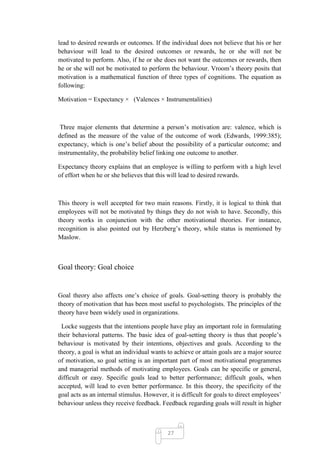
Kreitner (1995), Buford, Bodleian&Linder (1995), Higgins (1994) all cited in Linder
(1998,p3) defined motivation as ―the psychological process that gives behavior
purpose andDirection, a predisposition to behave in a purposive manner to achieve
specific unmet needs,An unsatisfied need, and the will to achieve, respectively.Young
(2000, p1) suggest that motivation can be defined in a variety of ways, depending
onWho you ask .Ask some one on the street, you may get a response like ―its what
drives us‖or―its what make us do the things we do.‖ Therefore motivation is the force
within anindividualthat account for the level, direction, and persistence of effort
expended atwork.z10Halepota (2005, p16) defines motivation as ―a persons active
participation and commitments achieve the prescribed results.‖Halepota further
presents that the concept of motivation isabstract because different strategies produce
different results at different times and there is nosingle strategy that can produce
guaranteed favourable results all the times.‖According to Antonioni (1999, p29), ―the
amount of effort people are willing to put in theirWork depends on the degree to
which they feel their motivational needs will be satisfied. Onthe other hand,
individuals become de-motivated if they feel something in the
organizationPreventsthem from attaining good outcomes.

It can be observed from the above definitions that, motivation in general, is more or
lessbasically concern with factors or events that moves, leads, and drives certain
human action orInaction over a given period of time given the prevailing conditions.
Furthermore thedefinitions suggest that there need to be an‖ invisible force‖ to push
people to do something inreturn. It could also be deduced from the definition that
having a motivated work force orcreating an environment in which high levels of
motivation are maintained remains challenge for today‘s management. This challenge
may emanate from the simple fact that motivation is not a fixed trait –as it could
change with changes in personal, psychological,financialorsocial factors.For this
thesis, the definition of motivation by Greenberg & Baron (2003) is adopted, as it
ismore realistic and simple as it considers the individual and his performance.
Greenberg&Baron defines motivation as:


                                               51
―The set of processes that arouse, direct, and maintain human behavior towards
attaining some goal‖. (Greenberg &Baron, 2003, p190)Bassett-Jones &Lloyd (2005,
p931) presents that two views of human nature underlay earlyresearch intoemployee
motivation. The first view focuses on Taylorism, which viewedpeople as basically
lazy and work –shy‖, and thus held that these set of employees can onlybemotivated
by external stimulation. The second view was based on Hawthorn findings, whichheld
the view that employees are motivated to work well for ―its own sake‖ as well as for
thesocial and monetary benefits this type of motivation according to this school was
internallymotivated.

Motivation theories

Even though much research been conducted on the field of financial motivation and
manyresearchers and writers have proposed theories on the concept of financial
motivation, and itsrole in enhancing employee‘s performance in every organization
some of these models havebeen widely used and accepted by today‘s organizations
leaders. In this thesis discussion onsome of the motivational theories will include
Alders (ERG theory), Maslow (Need theory),Vrooms (Expectancy theory), Adams
(Social equity theory), Taylor (productivity theory),Herzberg (Two factor theory),
Mac Gregory (theory X and Y), Geogpales (path goal theory) and skinner (Reward
theory). To better understand this discussion a summary of the theories is presented
and an indebt discussion on Maslow and ERG theories on which I base my thesis
overlooked.

Alder asserts in his Existence relatedness and growth theory commonly known as the
ERGtheory that there are three basic human needs: Existence, relatedness and growth,
which mustbe meet by an employee to enable him, increase performance.Maslow
(1943) suggests that human needs can be classified into five categories and that these
categories can be arranged in a hierarchy of importance. These include physiological,
security, belongings, esteem and self-actualization needs. According to him a person
is motivated first and foremost to satisfy physiological needs. As long as the
employees remain unsatisfied, they turn to be motivated only to fulfill them. When
physiological needs aresatisfied they cease to act as primary motivational factors and
the individual moves ―up‖ thehierarchy and seek to satisfy security needs. This
process continues untfinallyselfactualisationneeds are satisfied. According to Maslow
the rationale is quite simple because employees‘ who are too hungry or too ill to work
will hardly be able to make much acontribution to productivity hence difficulties in
meeting organizational goals. Vroom (1964) proposes that people are motivated by
how much they want something andhow likely they think they are to get it he suggest
that motivation leads to efforts and theefforts combined with employees ability
together with environment factors which interplay‘s resulting to performance. This
performance interns lead to various outcomes, each of whichhas an associated value
called Valence.

Adams (1965) on his part suggests that people are motivated to seek social equity in
theRewards they receive for high performance. According to him the outcome from
job includes; pay, recognition, promotion, social relationship and intrinsic reward .to
get these rewards various inputs needs to be employed by the employees to the job as
time, experience, efforts, education and loyalty. He suggests that, people tend to view
their outcomes and inputs as aratio and then compare these ratios with others and turn


                                          52
to become motivated if this ratio is high.Taylor (1911) observed the soldering by
employees, which is a situation whereby workers work less than full capacity. He
argued that soldering occurs due to the fact employee‘s fear that performing high will
lead to increasing productivity, which might cause them to lose their jobs. This slow
paces of work where promoted by faulty systems however this situation is not what
prevails with contemporary employees who organizations evaluate them through their
performance.

Herzberg suggested that there are factors in a job, which causes satisfaction. These he
calledIntrinsic factors (motivators) and other factor he refers to as dissatisfies
(hygiene factors).According to him if the motivational factors are met, the employee
becomes motivated andhence performs higher. Mac Gregory suggested that there
exist two sets of employees (lazy and ambitious employees) with lazy employees
representing theory X, hard and ambitious workers representing Y. According to him
the lazy employee should be motivated to increase performance in an
organizationGeogopalaus path Goal theory of motivation states that, if a worker sees
high productivity as a path leading to the attainment of one or more of his personal
goals, he will turn to be a high Producer. But if he sees low productivity as the path
leading to the attainment of his goal hewill turn to be a low producer and hence needs
to be motivated.

This discussion on the above motivational theories explains the fact that the concept
ofEmployee‘s motivation has been a critical factor addressed by previous authors as
what determines the core competence of every organization in achieving a
competitive position.Skinner who propounded that any behavior that is rewarded
tends to be repeated supportedThisview. The term motivation has been used in
numerous and often contradictory ways. Presently there appears to be some
agreements that the crucial thread that distinguishes employee‘sMotivated behaviors‘
from other behavior is that it is goal directed behavior, Bindra (2000P223) argues that
the core of motivating individuals lays in the goal-directaspectofbehaviour.Jones
suggested ―motivation is concern with how behavior gets started, is energized,
isSustained, is directed, is stopped and what kind of subjective re-action is present in
the organization while this is going on. The Jones statement can be converted into a
diagramWhich shows the employee motivational process as it influences
performance.

The process of employee’s motivation

Search
The figure illustrates that the process begins because of tension within drives or needs
of anemployee. Next there is a search within the company or groups or within
employee tofulfilhis desires. When the employee is satisfied with his financial
motivation he redefines his desires and needs and the process is initiated again.These
groups of researchers were over the years divided into what was later labeled
theContentand process theories of motivation. According to steers, mowday&Shapiro


                                           53
   Tension or drive
      To fulfill or need
      Fulfillment and
      Re-definition of needs
      Goal directed
      Behavior
(2004,p382) the process generated during this period, makes this period referred to as
―the golden age of work motivation theories‖. “Never before and, some would argue,
never since has so much progress been made inExplicating the aetiology of work
motivation‖ (steers et al., 2004, pp380-383)

Bassett-Jones & Lloyd (2005,p 932) suggests that the ―content theorists led by
Herzberg,assumed a more complex interaction between both internal and external
factors, and exploredthe circumstances in which individuals respond to different
internal and external stimuli. Onthe other hand, process theory, where victor Vroom
was the first exponent considers howfactors internal to the person result in different
behaviours.From the focus point of these two groups, one could observe that the
process theories attempt or try to understand the thinking processes an individual
might go through in determining howto behave in a workplace. The primary focus
was on how and why questions of motivation,how a certain behaviour starts,
developed and sustained over time.It is true that human behaviour in general is
dynamic and could affect the individual‘spersonal altitude as well as factors
surrounding that individual. These exogenous factorseminent from the environment in
which the individual operates generate stimuli to employees.

It is my belief that employees in general are goal seeking and look for challenges and
expectPositive re-enforcement at all times. Hence it could only be of benefit if
organisations couldprovide these rewards and factors. Though I have discussed earlier
in this thesis thatemployees are financially motivated, motivation could be seen as a
moving target, as whatMotivates differs among different people. And may even
change for the same person over agiven period of time, developments within the
modern organisation has probably madeMotivating employees ever more difficult due
to the nature of every individual, behaviourincreasing the complexity of what can
really motivate employees.According to Bassette-jones & Lloyd (2005,p.932)
―expectancy, equity, goal setting andreinforcement theory have resulted in the
development of a simple model of motivationalalignment. The model suggest that
once needs of employees are identified, and organizational objectives and also satisfy
employee needs .If poorly aligned, then low motivation will be theOutcome‖.


According to (Wiley, 1997,p264) ―modern approaches to motivation may be
organised intothree related clusters: (1) personality-based views (2) cognitive choice
or decision approachesand (3) goal or self-regulation perspective; where personality-
based views emphasize theinfluence of enduring personal characteristics as they affect
goal choice and striving.Workplace behaviour is posited to be determined by persons
current need state in certainUniversal need category. Cognitive choice approaches to


                                          54
work motivation emphasize twodeterminant of choice and action; expectations, and
subjective valuation of the consequencesassociated with each alternative. These
expectancy value theories are intended to predict anindividual choice or decision.
Goal framework to work motivation emphasis the factors thatinfluence goal striving
which focuses on the relationship between goals and work behavior.
The assumption is that an employee‘s conscious intentions (goals) are primary
determines ofTask-related motivation since goals directs their thoughts and action‖.
It is worth noting that an in-depth review of all the different theories mentioned
above, isbeyond the scope of this thesis. However, the personality-based perspective
of workmotivation within which Maslow need theory of motivation and Alders ERG
theory falls willprovide the main support and serve as a foundation for the research
reported in this thesis.Specifically, as organisational scholars have paid a great deal of
attention to the idea thatpeople are motivated to use their jobs as mechanisms for
satisfying their needs. This thesisintend to use Maslows hierarchy of need theory of
motivation as a foundation to identify thefactors that motivate today‘s employees, and
in the process determine a ranking order offactors that motivates these employees, the
original Maslow theory will be looked at moredetail hereof.

History and Explanation of Maslow‘s Hierarchy of Need
Theory

The ―motivation to work‖ published by Maslow probably provided the field of
organizationalbehaviour and management with a new way of looking at employees
job altitudes orbehaviours in understanding how humans are motivated. Probably the
best-knownConceptualization of human needs in organizations has been proposed by
this theory. AbrahamMaslow was a clinical psychologist, who introduced his theory
based on personal judgmentwhich was generally known as the need hierarchy theory.
According to him if people grew inan environment in which their needs are not met,
they will be unlikely to function as healthyindividuals or well-adjusted individuals.
This idea was later applied to organizations deemphasize the idea that unless
employees get their needs met on the job, they will not function‘s effectively as
possible.

Specifically Maslow theorised that people have five types of needs and that these are
activated in a hierarchical manner. This means that these needs are aroused in a
specific order from lowest to highest, such that the lowest-order need must be fulfilled
before the next orderneed is triggered and the process continues. If you look t this in
a motivational point of vieMaslow‘s theory says that a need can never be fully met,
but a need that is almost fulfilleddoes not longer motivate. According to Maslow you
need to know where a person is on theHierarchical pyramid in order to motivate
him/her. Then you need to focus on meeting thatperson‘s needs at that level (Robbins
2001)According to Greenberg and Baron (2003,p192) the five needs identified by
Maslowcorresponds with the three needs of Alderfers ERG theory. Where as Maslow
theory specifiesthat the needs be activated in order from lowest to highest Alder‘s
theory specifies that theneeds can be activated in any order. His approach is much
simpler than Maslows. Alder specifies that there exist three main needs as opposed to
five postulated by Maslow. Thishuman basic needs include existence, relatedness and
growth. These needs according to Alderneed not necessarily activated in any specific
order and may be activated at any time.According to him Existence needs corresponds


                                            55
to Maslow‘s physiological needs and safetyneeds. Relatedness needs corresponds to
Maslow‘s social needs and growth needs correspondsto esteem and self-actualization
needs by MaslowBelow is a summary of these needs that in this thesis are divided
into Deficiency needs(Psychological, safety, social needs) and Growth needs (esteem,
self-actualization needs).Factors Explanation

� Physiological needs are the need at the bottom of the triangle and include the lowest
orderneed and most basic. This includes the need to satisfy the fundamental biological
drivessuch as food, air, water and shelter. According to Maslow organizations must
provideemployees with a salary that enable them to afford adequate living conditions.
Therationale here is that any hungry employee will hardly be able to make much of
anycontribution to his organization.

� Safety needs this occupies the second level of needs. Safety needs are activated
afterPhysiological needs are met. They refer to the need for a secure working
environment freefrom any threats or harms. Organizations can provide these need by
providing employeeswith safety working equipment e.g. hardhats, health insurance
plans, fire protection etc.The rationale is that employees working in an environment
free of harm do their jobsWithout fear of harm.

� Social needs: This represents the third level of needs. They are activated after safety
needsare met. Social needs refer to the need to be affiliated that is (the needed to be
loved andaccepted by other people). To meet these needs organisations encourage
employeesParticipation in social events such as picnics, organisations bowling etc

� Esteem needs this represents the fourth level of needs. It includes the need for self-
respectand approval of others. Organisations introduce awards banquets to recognize
distinguished achievements

� Self-actualization: This occupies the last level at the top of the triangle. This refers
to theneed to become all that one is capable of being to develop ones fullest potential.
Therationale here holds to the point that self-actualised employees represent valuable
assets tothe organization human resource.Most research on the application of need
theory found that although lower-level managers areable to satisfy only their
deficiency needs on the jobs, managers at the top level ofOrganizations are able to
satisfy both their deficiency and growth needs (Greenberg &Baron2003 p.194) this
view was supported by Shipley & Kelly (1988, p.18)Shipley & Kelly (1988, p.18)
argue that as ―need satisfaction is an attitude, and that it isperfectly possible for a
worker to be satisfied with his/her need, but not be motivated theReverse of which
holds equally true. Hence, need satisfaction and motivation are notsynonymous and
both need fulfillment and un- fulfillment can have negative as well as
positiveinfluence on motivation


Organizational /managerial Applications of Maslow’s Need theory


                                            56
The greatest value of Maslow‘s need theory lies in the practical implications it has for
everyManagement of organizations (Greenberg & Baron 2003 p.195). The rationale
behind thetheory lies on the fact that it‘s able to suggest to managers how they can
make theiremployees or subordinates become self-actualized. This is because self-
actualized employeesare likely to work at their maximum creative potentials.
Therefore it is important to makeemployees meet this stage by helping meet their
need organisations can take the followingStrategies to attain this stage

� Recognize      employee‘s      accomplishments:      Recognizing       employee‘s
accomplishments is animportant way to make them satisfy their esteem needs. This
could take the form ofawards, plagues etc.. According to (Greenberg & Baron 2003,
p197) research carried outin GTE Data services in Temple Terrace, Florida shows that
awards are given toemployees who develop ways of improving customer‘s
satisfaction or businessperformance. But it should be noted that according to
Greenberg &Baron awards areeffective at enhancing esteem only when they are
clearly linked to desired behaviours.Awards that are too general fail to meet this
specification.

� Provide financial security: Financial security is an important type of safety need. So
Organizations to motivate their employees need to make them financially secured by
involving them in profit sharing of the organization. In a research carried out with
AT&Tand Wang showed that 50% of their employees received financial
outplacement servicesto assist laid-off employees in securing new jobs.

� Provide opportunities to socialize: Socializations is one of the factors that keep
employeesfeel the spirit of working as a team. When employees work as a team they
tend to increasetheir performance. Research conducted on IBM shows that it holds a
―family day‖ picniceach spring near its Armonk, New York headquarters.

� Promote a healthy work force: Companies can help in keeping theirEmployees
physiological needs by providing incentives to keep them healthy both in healthand
mentally. In a research carried out at the Hershey Foods Corporation and Southern
California Edison Company showed that Employees are provided with insurance
rebates withhealth lifestyles while extra premiums were given to those with risk habits
like smoking.


Criticisms of Maslow’s Need theory of motivation

Maslow proposed that if people grew up in an environment in which their needs are
not meet,they would be unlikely to function healthy, well-adjusted individuals.
Research testingMaslow‘s theory has supported the distinction between the
deficiencies and growth needs butShowed that not all people are able to satisfy their
higher-order needs on the job. Accordingthe results of the research managers from
higher echelons of organizations are able to satisfyboth their growth and deficiency
needs lower level managers are able to satisfy only theirdeficiency needs on the job.
Maslow‘s theory has not received a great deal of support withrespect to specific
notion it proposes (Greenberg &Baron 2003, p195). To them this model is theorized
to be especially effective in describing the behavior of individuals who are high
ingrowths need strength because employees who are different to the idea of increasing


                                           57
their growth will not realize any physiological reaction to their jobs.Centers &Bgental
(1966, .193) in their carried out among a cross-section of the Working population in
Los Angeles, posited survey ―background factors, altitudes and aspirations affects
workers needs, expectations and situation assessment‖. According to Graham
&Messner (1998, p.196) there are generally three major criticisms directed to the need
theoryand other content theories of motivation. (A) There is scant empirical data to
support their conclusions, (b) they assume employees are basically alike, and (c) they
are not theories of motivation at all, but rather theories of job satisfaction. This was
supported by the views ofNadler & Lawler (1979) in Graham &Messner (2000, p
188).Nadler & Lawler (1979) cited in Graham &Messner (2000, p.198) where also
critical of theneed theory of motivation. They argue that the theory makes the
following unrealisticassumptions about employees in general that: (a) all employees
are alike (b) all situations arealike and that (c) there is only one best way to meet
needs. Another critic to this view wasBasset-Jones & Lloyd (2004, p 961).Basset-
Jones & Lloyd (2004, p 961) presents that in general, critics of the need theory
arguethat it is as a result of the natural feeling of employees to take credit for needs
met and dissatisfaction on needs not met.Nonetheless and regardless of the heavy
criticism levied at the hierarchy of need theory, IBelieve that this theory has a made a
significant contribution in the field of organizational behavior and management
especially in the area of employee motivation and remains attractive to both
researchers and managers alike. The incorporation of the need theory intothe work
environment today could be as a result of the contributions made so far by
MaslowsHierarchy of need theory.

Empirical studies on employee motivation using the original and
Adapted Maslow’s model

If any person has to come up with the question that is there any need for
employeesmotivation? The answer to this type of question of-course should be
simple-the basic survival of every organization be it public or private limited before,
today and in the foreseeable future lies in how well its work force is motivated to
meet the objectives of the organization. This explains why the human resource
department in today‘s organization is became a focus of its core functions. I think that
motivated employees are needed in this rapidly Business world where the principal-
agent conflict is the issue confronting most managers. Most organisationsnow
consider their human resources as their most valuable assets (a strategic or
competitive advantage). Therefore, in order to effectively and efficiently utilize this
strategic asset, I believe managers and the organization as a whole, must be able and
willing to understand and hopefully provide the factors that motivate its employees
within the context of the roles and duties they perform. This is because highly
motivated employees are the cause of high productivity levels and hence higher
profits for the organization. Having noted this rationale the next question one may ask
are what factors motivated today‘s employees‖?

According to Wiley (1997, p265) at some point during our lives, virtually every
person may have to work. He claims that working is such a common phenomenon that
the question ―whatMotivates people to work is seldom asked. Wiley went on to say
that ―we are much moreLikely to wonder why people climb mountains or commit
suicide than to question themotivational basis of their work‖,. Therefore, exploring
the altitudes that employees holdconcerning factors that motivate them to work is


                                           58
important to creating an environment thatencourages employee motivation.From the
much amount of literature available on employee motivation, it is clearly evidentthat a
lot of surveys regarding employees and what motivates them have been undertaking.
These employee motivation surveys have been conducted in many different job
situations,among different categories of employees using different research methods
and applications.One of the very first survey to be conducted was on industrial
workers by (Hershey &Blanchard, 1969) over the years, similar or different survey
employees have been carried outsee (Kovach, 1987, 1993) (Wiley, 1995), (Lindner,
1998, 1999)According to a research carried out by Kovach on industrial employees
who were asked torank ten ―job rewards‖ factors based on personal preferences where
the value 1 representedmost preferred and 10 being the least preferred. The results
were as follows (1) fullAppreciation of work done (2) feeling of being (3)
sympathetic help with personal problems(4) Job security (5) Good wages and salaries
(6) interesting work (7) promotion & Growth (8)employee‘s loyalty (9) Good
working conditions (10) tactful disciplineDuring the periods of (1946, 1981 & 1986)
when employee surveys were carried out,Supervisors were at the time asked to rank
job rewards, as they taught employees would rankthem. The rankings by the
supervisors were relatively consistent for each of the years. Theserankings were as
follows: (1) Good wages (2) Job security (3) promotion and Growth (4)working
conditions (5) interesting work (6) personal loyalty to employees (7) tactfuldiscipline
(8) full appreciation (9) sympathetic help with personal problems (10) recognition
(Kovach 1987 p.49-54)The results from the supervisor survey indicated that their
ranking had not changed over theStudy period with regards their collective perception
of factors that motivate employees. Thisshows that they had a very inaccurate
perception of what motivates employees but also thatthey did not realise the
importance of the need theoryIn a survey by Wiley (1997, p.278) in which
approximately 550 questionnaires wereAdministered to person employed at different
industries and divided into 5 subgroups, orCategories namely: (occupation, gender,
income levels, employment status and age) they wereasked to rank 10 factors
according to the level of importance each is in motivating them toperform best with
the most important factor ranked 1 and the least important ranked 10th. Thesurvey
concluded with the following collective rank order by respondents: (1) Good wages
(2)full appreciation of work done (3) job security (4) promotion (5) interesting work
(6)company loyalty to employees (7) Good working conditions (8) tactful discipline
(9)recognition (10) sympathetic help with personal problems

The results from a representative sample of the labour force in seven different
countries byHarpaz (1991 p.75) showed that the two most dominant work goals were
―interesting work ―and Good wages‖; He further concluded that these two factors
were consistent across differentOrganizational levels, between genders and age
groups.Quinn (1997) also cited in Harpaz (1991 p.311) concluded, ―When the ratings
of twenty threejob related factors (including the need factors) were carried out, the
conclusion reached wasthat no single factor was pre-eminently important‖. He further
pointed out that, ―The mostaspect of the worker job was that of sufficient resources to
perform a task. From the abovestudies presented so far, the rankings by different
subgroups have shown semantic differencesin the importance placed on different
motivational factors. For example (Kovach, 1987,Wiley, 1997 and Harpaz, 1990)
.The discrepancies in these research findings supportsNelsons (2001, p.2) positional
view that ―what motivates employees differs and may changefor the same employee
over time‖.It is appropriate at this level to give a brief summary of the previous


                                          59
researches in this thesis.Even though the original need hierarchy theory was presented
some 50 years ago, some of itsif not all factors remain of significant importance to
employees today. The large number ofearlier and recent studies investigating
employee motivation using sometimes the original ormodified version of Maslow‘s
theory, may continue the appreciation of this theory and theissue of employee
motivation. The literature also shows that where the original theory waslacking (short
comings or criticised for), has been greatly taken into consideration.
Researchers have taken issues such as differences in gender, age, income, culture &
countriesetc and how these may affect or influence employee work motivation
extensively. Thecommonality between these previous researches is the agreement that
certain factors are moreimportant as motivational factors than others and that these
factors may change from oneemployee to another. These previous studies have also
been taken using different methods,from surveys, questionnaires, face-face
interviews, but their outcomes have not differedsignificantly. A possible explanation
could be due to the fact that even though these studieswere carried out using different
methods and target population, the motivator‘s factors remainsame. The literature
used in this thesis covers a wide range of time period, highly relevant anduseful for
addressing the purpose of this thesis


                                          60
61
1 HISTORY OF MADHUR DAIRY


The gandhinagar district co-operative milk producers’ union ltd. Was established and
registered on 06/02/1971 under Gujarat state co-operative act,1961 by some prominent co-
operators of gandhinagar district with limited members and limited societies with 3000 LDP
procurement of milk.

            The first OWN processing plant was setup in 1983 at capital of Gujarat state,
gandhinagar city with the help of IDA and NDDB with the capacity of 30000 LDP of milk
processing plant. In 1992-93, they 1st began a movement of arranging village level meeting
to convince primary milk producer at their door step and it was a great moment.In 1996 the
plant capacity is expected up to 60000 LPD and than 2002-03 the plant capacity is again
expanded 200000 LPD. In 2000-01 approximately 100 villages were covered from the
district.     In 2003-04, there was change in the chairman & Mr. Rana occupied the
chairmanship.


                                              62
2        MISSION & VISION


   1. Mission is to pay maximum prices to milk producers.
   2. Provide maximum customer satisfaction by quality of milk product diversification.


2.1 AWARDS & PRIZES


1994-95:-      Best productivity performance award by national productivity council for
               liquid milk plant

1994-95:-      Award for best performance

1994-95:-      UdhyogRant award

    Kohinoor of Indiaaward presented from the Indian economic development &
       research association New Delhi (India) in 2008.
    Rastriyasanmanpurskar with gold wedal – 2008.
    BhaztiyaudhyogRatna award – 2008.
    Lifetime achievement award for industrial development – 2008.
    Bharat Gaurav award -2008.
    International achieves award -2008.
    Rajiv Gandhi shiromahi award -2009.


3 OBJECTIVES
       To provide maximum services to customers
       To monitor the process to ensure the environ safety.
To provide necessary resources required for management system to prove excellence


                                            63
UNIT AT GLANCE LOCATION SELECTION:

Registration:-

        6-2-1971

Location:-

        Madhur Dairy

        Sector-25

        GIDC
        To provide maximum services to milk producers
        Gandhinagar

Pin:-382023

Form of Organization:-

                 Co-Operation Unit

Type Of-Unit:-

        Milk Processing Unit

Registration No:-

                 108707

Number of Members:-

                 532


                                           64
BOARD OF DIRECTORS:-

   Dr. RanaShankarsinh R.                    Chairman

    Mr. GohilmanujiHemtuji                          Director

    Mr. ThakorAtajiKacharaji                        Director

    Mr. BiholaRaghusinhKalusinh              Director

    Mr. ThakorKesharbenShendhaji                    Director

    Mr. ThakorTarabenGovindji                Director

    Mr. ParelMadhubenHashmukhbhai            Director

    Mr. MakwanaBhikhajiHamirji               Director

    Mr. Desai VirambhaiGovindbhai                   Director

    Mr. Patel HanshabenRamanbhai                    Director

    Mrs. ChaudhariDashrathbhaiMotibhai       Director

    Mrs. Patel JashvantbhaiGangarambhai      Director

    Mr. A. K. Dhagadh (Rep.-GCMMF)           Director

    Mr. M. C. Shah             (Rep.-NDDB)   Director

    Mr. ROHIT. Mehta                              Managing Director


                                        65
BANKERS OF MADHUR DAIRY


 1. Panjab National Bank( Gandhinagar)
 2. Ahmedabad Dist Co. Op. Bank.(Savings A/C, Patnagar)
 3. Ahmedabad Dist. Co. Op. Bank ( Current A/C, Patnagar)
 4. Ahmedabad Dist. Co. Op. Bank ( Head Office )
 5.   Bank Of Baroda ( Vidhansabha Branch)
 6. Ahmedabad Dist. Co. Op. Bank ( Gandhinagar Branch)
 7. Ahmedabad Dist. Co. Op. Bank ( Chandkheda Branch)
 8 State Bank Of India


                                         66
4    ORGANISATION CHART OF MADHUR DAIRY


                                        CHAIRMAN


                                         B.O.D


                                      GENERAL MANAGER


  PRODUCTION            MARKETING                       H.R                 FINANCE

  DEPARTMENT           DEPARTMENTT                 DEPARTMENT          DEPARTMENT

  PRODUCTION           MKG. MANAGER                                     FINANCE

 MANAGER                                                                MANAGER
                         ASSIST.
                        MARKETING                    CLEARK
A.G.M         R.M.I
                        MANAGER                                    ASSIST.FINANCE

SUPERVISOR                                                           MANAGER
                       SALES MANAGER              ASSIST.
             WORKERS
                                                 MANAGER
 WORKER                                                         ACCONTANT

                                                                                 CLEARK

  HELPER                                                           CLEARK


                                        67
WHAT IS PRODUCTION?

       Production management is the process which combines and transforms various
      resources used in production subsystem of the organization into value added product/
      services in a controlled manner as per the policy of the organization.
                 Production function therefore is that part of an organization which ix
concerned with the transformation of a range of input the require outputs having the
requisite quality level.


MEANING: The meaning of the term “Production “and “Production management
“should be noted carefully.

According to EDWOOD BUFFA ―Production is process by which goods and services are
created.


           Production management is the process of planning organizing, directing and
           controlling the activities of the production function is the conversion of raw material
           into finished products.
           According to EDWOOD BUFFA, “Production management deals with decision
           making related to production processes so that the resulting good or services is
           produced, according to specification, in the amount and by the schedule demanded
           and at minimum cost.


                     It explains the following important, aspects of production
management.


A) It is a decision making managerial function.
B) Decisions are made, regarding the production processes required for converting the raw
    materials into finished products.
The production or out-put should be according to specification in the quantities specified as
per the schedule and minimum


                                                 68
PRODUCTION DEPARTMENT CHART


PRODUCTION PROCESS


                       69
RAW MATERIAL

After collecting of milk laboratories check the fats and SNF of milk. So their some raw
material requirements are Milk, Salt, Acids, and some other chemicals.


PASTEURIZATION

After collecting, checking and conducting the laboratory test the Pasteurizing process is
conducted. The milk is passed through these Pasteurizing Machines with help of Water
Pumps. Here the milk is heated at 80 to 82 degree Celsius for 15 seconds after that it is
cooled at 4 degree Celsius. By this method they destroy the bacteria present in the raw milk.
After this process some milk goes to the separate machines and remaining to the packing
machine.

This method was invented by a scientist called JAMES PASTUE that’s why this process is
known as Pasteurization.


SEPARATION

Separation machine separates two kinds of the products: skimmed milk and cream. This milk
is taken to the tanks. The milk in every tank has different proportion of SNF.

Whenever the milk is needed from tank it is tested in the laboratory and the deficit
proportion fat is added by mixing Cream.


PACKING PROCESS


                                               70
Now in this necessary fats and SNF are added and packed in pouches of 500ml. The packed
pouches are kept in the basket. The milk goes to the packing machines through pipes. At
sporadic interval sample of pouches are weighed on the electronic weighing machine.

STORAGE

After packing various pouches the dairy has to store the fresh and packed milk. The milk
pouches are then taken to the cold storage under the temperature of 8 to 10 degree Celsius.
It is maintained with the help of fans having silicon chips. The pouches are stored here for
the whole night and in morning they are distribute


5PRODUCTS OF MADHUR DAIRY
[1]   MADHUR Milk:-


                                             71
 Full Cream
           Standard
           Tond
           Cow Milk
           Flavored Milk
[2]   MADHUR Sweets:-
           Penda
           Chocolate Barfi
           Rajvadi Penda
           RajvadiHalvo
           Mohanthad
           Magas
           Kajukatri
           KajuBarfi
[3]   MADHUR Ghee:

            Buffalo Ghee
            Cow Ghee
            MadhurChhash
[4]     MADHUR Ice cream:

            Vanilla
            KajuDrax
            Butter Scotch
            KesarPista
            Strawberry
            Cone
            Candy


 COLD STORAGE


                              72
In this plant the excess milk is packed. The milk cannot be distributed in to the whole sellers
at a time because it takes time reach out and beside the time at which milk is to be made
available to the customers is also to be considered. Therefore during the gap the milk is
stored in a cold storage of the unit. The temperature in the cold storage range from 5 degree
to 10 degree Celsius and in the night the milk is dispatched in the trucks.


MANUFACTURING PROCESS OF GHEE


          In this process, it involves the milling of butter milk and boiling in
the ghee cattle at 107 degree processes it. Then it is to be balanced in tanks.
After this filling in presehling tank.
         The process of ghee is clarified at first stage; the fasting of ghee is taken place at
this stage. After this is going to pack and it is dispatch to G.C.M.M.F. from the dairy.

                              The process of melting the

                            white butter in melting bowl.


                                Process of boiling butter

                                       in ghee kettle

                                     (105c. to 107c.)


                                               73
Balance tank


                           Clarification


                              Tasting


                              Packing


                              Storage


                             Dispatch
             Madhur Dairy is able to produce 15 TPD Ghee.


ICE-CREAM PROCESS:-


                                  74
Boil milk in high temperature and add sugar in the milkAfter boiling process
add GMC and CMC powder to minting           thickness.When milk become cool then cream,
flavors and nuts are added.Then this mixture is put in to refrigerators for freezing process at
-18 c


QUALITY POLICY OF MADHUR DAIRY

                                              75
Madhur Dairy is committed to...


        Improve life style of member milk producers
        Achieve highest customer satisfaction by consistent supply of good quality, safe
       milk and milk products.


MADHR Dairy Achieves this by…

        Strengthening Co-Operative structure
        Up gradation of processes and application of innovative techniques
        Providing milk products and services par-excellence for total customer satisfaction.
       Implementation of innovative welfare schemes and services for socioeconomic
       development of milk products.
        Application of eco-friendly processes and operations.
        Development of motivated, dedicated and devoted work force.


                                             76
77
Personal information

Table no-5.1. Table show gender wise distribution of respondent


             Gender            Frequency              Percentage (%)

              Male                31                       77.5


             Female                9                       22.5


                                       Gender
                                 0% 0%


                         23%

                                                                           male
                                                                           female


                                                77%


Above table shows that 77% percent (n=31) respondent belongs to a male-group of
percent   23% (n=9)


                                           78
Table no-5.2 Table show age wise distribution of respondent.


                      Age           Frequency        Percentage (%)

             18 to 25 years             8                  20

             26 to 35 years            15                 37.5

             36 to 45 years            11                 27.5

             Above 45 years             6                  15

                 Total                 40                 100


                                  percentage of age


                            15%
                                             20%

                                                                    18 to 25 years
                                                                    26 to 35 years
                                                                    36 to 45 years
                  27.5%
                                                                    Above 45 years

                                             37.5%


      Above table shows that 20% percent (n=08) respondent belongs to age-group
      of 18 -25, 37.5% percent (n=15) belongs to age-group of 26-35, 27.5% percent
      (n=11) belongs to age-group of 36-45 while 15%percent (n=6) belongs to age-
      group of above 45 years.


                                        79
Table no-5.3 Table shows the educational qualification of the respondent.

               Education          Frequency           Percentage (%)

                  S.S.S                   18                    45%

                 H.S.C                    6                     15%

               Graduate                   10                    25%

             Post Graduate                1                     2.5%

                 Other                    5                    12.5%

                  Total                   40                   100%


                                  Education

               2.5%       13%
                                                                   S.S.S
                                                                   H.S.C
                                         45%
                                                                   Graduate
                  22.5%
                                                                   Post Graduate
                                                                       Other
                            15%


       Above table shows that 45% percent (n=18) respondent had their educational
qualification up to primary level, 15% percent (n=6) respondent had their educational
qualification up to secondary level, 22.5% percent (n=10) respondent had their
educational qualification up to higher secondary level, 12.5%percent (n=5)
respondent had their educational qualification up to graduation level while 05%
percent (n=2) respondent had their educational qualification up to post graduate level.


                                           80
Table no- 5.4 Table shows the work of span of the respondent.


     experience           Frequency        Percentage (%)

     1 – 5 years                14               35%

     6 – 10 years               12               30%

    11 – 15 years               9               22.5%

   Above 15 years               5               12.5%

        Total                   40              100%


                Percentage work of span

                    14%


                                      35%                    1 – 5 years

         23%
                                                             6 – 10 years
                                                             11 – 15 years
                                                             Above 15 years


                          30%


Above table shows that 35% percent (n=14) respondent belongs to age-group
of 1 – 5years, 30% percent (n=12) belongs to age-group of 6 – 10 years,
22.5% percent (n=9) belongs to age-group of 11 – 15 years, while
12.5%percent (n=5) belongs to age-group of above 15 years.


                                      81
Table no- 5.5 Table shows present salary and incriment of the respondent.

             Employee response      Frequency         Percentage (%)

                Strongly agree                4                 10%

                       Agree              27                   67.5%

                  Uncertain                   3                 7.5%

                   Disagree                   4                 10%

              Strongly disagree               2                  5%


                   Total                  40                    100%


           percentage ofpresent salary and incriment

                               5% 10%
                        10%
                                                                Strongly agree
                 8%                                             Agree
                                                                Uncertain
                                                                Disagree
                                                                Strongly disagree
                                   67%


Above table shows that 10% percent (n=4) respondent with strongly agree, 67.5%
percent (n=27) respondent with agree, 7.5% percent (n=3) respondent with
uncertain,10% percent (n=4) respondent with disagree,5% percent (n=2) respondent
with strongly agree.


                                         82
Table no-5.6 Table shows financial or financially related reward system in my
organization.

            Employee response          Frequency      Percentage (%)

                 Strongly agree               2                5%

                     Agree                    22              55%

                   Uncertain                  5              12.5%

                    Disagree                  8               20%

                Strongly disagree             3               7.5%

                     Total                    40             100%


                percentage of financial or financially
                      related reward system

                               8% 5%
                                                               Strongly agree
                    20%                                        Agree
                                                               Uncertain
                                                               Disagree
                     12%               55%
                                                               Strongly disagree


 Above table shows that 5% percent (n=2) respondent with strongly agree,
55%percent (n=22) respondent with agree, 12.5%percent (n=5) respondent with
uncertain,20% percent (n=8) respondent with disagree,7.5% percent (n=3) respondent
with strongly disagree.


                                         83
Table no- 5.7 Table shows working conditions are clean,pleasant& safe of
respondent.

 Employee response            Frequency              Percentage%

   Strongly agree                 67.5                   65.5%

        Agree                     27.5                   27.5%

      Uncertain                    0                      0%

       Disagree                    5                      5%

  Strongly disagree                0                      0%

        Total                     40                    100%


            working conditions are clean,pleasant &
                     safe of respondent.
                          0% 0%
                           5%
                                                                 Strongly agree
                   28%                                           Agree
                                                                 Uncertain
                                                                 Disagree
                                         67%
                                                                 Strongly disagree


Above table shows that 67.5% percent (n=27) respondent with strongly agree,
27.5%percent (n=11) respondent with agree, 0%percent (n=0) respondent with
uncertain,5% percent (n=2) respondent with disagree,0% percent (n=0) respondent
with strongly disagree.


                                           84
Table no-5.8 Table shows welfare facilities provided by the company.


           Employee response              Frequency    Percentage (%)

              Strongly agree                 11            27.5%

                  Agree                      25            62.5%

                Uncertain                     1             2.5%

                 Disagree                     3             7.5%

            Strongly disagree                 0             0%

                  Total                           40         100%


                   percentage of walfere facilities
                                     0%
                     3%
                                8%

                                            27%                    Strongly agree
                                                                   Agree
                                                                   Uncertain
                                                                   Disagree
                                                                   Strongly agree
                          62%


Above table shows that 27.5% percent (n=11) respondent with strongly agree,
62.5%percent (n=25) respondent with agree, 2.5%percent (n=1) respondent with
uncertain,7.5% percent (n=3) respondent with disagree,0% percent (n=0) respondent
with strongly disagree.


                                            85
Table no-5.9 Table shows policies and procedures of respondent.

             Employee response         Frequency       Percentage (%)

                Strongly agree               10              25%

                     Agree                   22              55%

                   Uncertain                 3               7.5%

                   Disagree                  5              12.5%

               Strongly disagree             0               0%

                       total                 40             100%


              percentage ofpolicies and procedures
                                 0%

                          13%
                                      25%                       Strongly agree
                  7%
                                                                Agree
                                                                Uncertain
                                                                Disagree
                                                                Strongly disagree
                           55%


Above table shows that 25% percent (n=10) respondent with strongly agree,
55%percent (n=22) respondent with agree, 7.5%percent (n=3) respondent with
uncertain,12.5% percent (n=5) respondent with disagree,0% percent) respondents
with strongly disagree.


                                        86
Table no 5.10 Table shows relation with my superior peer and subordinates of
Respondent.

                Employee response            Frequency      Percentage(%)

                   Strongly agree                34               85%

                        Agree                    6                15%

                       Uncertain                 0                0%

                       Disagree                  0                0%

                  Strongly disagree              0                0%

                         total                   40              100%


              policies and procedures of respondent
                  0%         0% 0%


                       15%
                                                                Strongly agree
                                                                Agree
                                                                Uncertain
                                                                Disagree
                                                                Strongly disagree
                                      85%


Above table shows that 85% percent (n=34) respondent with strongly agree,
15%percent (n=6) respondent with agree, 0%percent uncertain, disagree, strongly
disagree.


                                            87
Table no 5.11 Table shows supervisor take interest in our problem, well being
future

                 Employee response            Frequency    Percentage(%)

                    Strongly agree                7            17.5%

                        Agree                     30           75.5%

                       Uncertain                  3              7%

                       Disagree                   0              0%

                   Strongly disagree              0             0%

                         total                    40           100%


          superviser take intrest in our problem, well
                         being future
                          0% 0% 0%

                             8%
                                       17%
                                                                   Strongly agree
                                                                   Agree
                                                                   Uncertain
                                                                   Disagree
                                                                   Strongly disagree
                           75%


Above table shows that17% percent (n=7) respondent with strongly agree,
75%percent (n=35) respondent with agree, 8%percent (n=3) respondent with
uncertain,0%percent , disagree, strongly disagree.


                                             88
Table no 5.12 Table shows setting and achieving challenging goal

                 Employee response              Frequency   Percentage(%)

                      Strongly agree                5          12.5%

                          Agree                     29         72.5%

                        Uncertain                   04          10%

                         Disagree                   02          05%

                     Strongly disagree              0             0

                          Total                     40          100%


              setting and achieving challenging goal
                                    0%
                                5%
                                         12%
                         10%
                                                                   Strongly agree
                                                                   Agree
                                                                   Uncertain
                                                                   Disagree
                                                                   Strongly disagree

                                     73%


Above table shows that 12% percent (n=5) respondent with strongly agree,
73%percent (n=29) respondent with agree, 10%percent (n=4) respondent with
uncertain5% percent (n=2) respondent with disagree,0% percent) respondents with
strongly disagree.


                                               89
Table no 5.13 Table shows recognized and praised for my good performance

                 Employee response                Frequency   Percentage(%)

                      Strongly agree                  5          12.5%

                            Agree                     25         62.5%

                           Uncertain                  03          7.5%

                           Disagree                   07         17.5%

                     Strongly disagree                0            0

                             total                    40         100%


                recognized and praised for my good
                           performance
                                      0%

                                           12%
                             17%
                                                                    Strongly agree
                                                                    Agree
                      8%
                                                                    Uncertain
                                                                    Disagree
                                                                    Strongly disagree
                                           63%


Above table shows that 12% percent (n=5) respondent with strongly agree,
62%percent (n=25) respondent with agree, 8%percent (n=3) respondent with
uncertain18% percent (n=7) respondent with disagree,0% percent) respondents with
strongly disagree.

Table no 5.14 Table show performance appraisal &career development effective
system


                                                 90
Employee response          Frequency       Percentage(%)

                   Strongly agree              3                7.5%

                         Agree                 23               57.5%

                       Uncertain               0                 0%

                       Disagree                12                30%

                  Strongly disagree            2                05%

                         Total                 40               100%

.

                  performance appraisal &career
                  development effective system

                                 5% 7%

                                                                   Strongly agree
                   30%                                             Agree
                                                                   Uncertain
                                                                   Disagree
                                         58%                       Strongly disagree
                  0%


Above table shows that 8% percent (n=3) respondent with strongly agree, 58%percent
(n=23) respondent with agree, 0%percent respondent with uncertain30% percent
(n=12) respondent with disagree,5% percent(n=2) respondents with strongly disagree.


Table no 5.15 Table show job has enough learning opportunities which will help
me in career advancement


                                          91
Employee response              Frequency   Percentage(%)

                    Strongly agree                 10            25%

                           Agree                   23           57.5%

                          Uncertain                03           7.5%

                          Disagree                 04            10%

                   Strongly disagree                0            0%

                           Total                   40           100%


           job has enough learning opportunities
          which will help me in career advancement
                                     0%

                               10%
                          8%              25%                      Strongly agree
                                                                   Agree
                                                                   Uncertain
                                                                   Disagree
                                                                   Strongly disagree
                               58%


Above table shows that 25% percent (n=10) respondent with strongly agree,
58%percent (n=23) respondent with agree, 8%percent (n=3) respondent with
uncertain10% percent (n=4) respondent with disagree,0% percent(n=0) respondents
with strongly disagree.


Table no 5.16 Table show right opportunities in this organization for my personal
growth and promotion


                                           92
Employee response               Frequency   Percentage (%)

                    Strongly agree                   5           12.5%

                           Agree                     31          77.5%

                      Uncertain                      0            0%

                          Disagree                   04           10%

                   Strongly disagree                 0            0%

                           Total                     40          100%


          Right opportunities in this organization for
             my personal growth and promotion
                                     0%
                          0%
                               10%        12%
                                                                    Strongly agree
                                                                    Agree
                                                                    Uncertain
                                                                    Disagree
                                                                    Strongly disagree
                               78%


Above table shows that 13% percent (n=5) respondent with strongly agree,
77.5%percent (n=31) respondent with agree, 0%percent (n=0) respondent with
uncertain10% percent (n=4) respondent with disagree,0% percent(n=0) respondents
with strongly disagree.


Table no 5.17 Table show organization helps me in all possible way to know my


                                                93
Employee response               Frequency   Percentage (%)

                    Strongly agree                   8            20%

                           Agree                    28            70%

                      Uncertain                      1           2.5%

                          Disagree                  03           7.5%

                   Strongly disagree                 0            0%

                           Total                    40           100%


         organization helps me in all possible way to
                          know my
                                      0%
                          4%
                                 8%
                                           20%
                                                                    Strongly agree
                                                                    Agree
                                                                    Uncertain
                                                                    Disagree
                                                                    Strongly disagree
                               70%


Above table shows that 20% percent (n=8) respondent with strongly agree,
70%percent (n=28) respondent with agree, 2.5%percent (n=1) respondent with
uncertain7.5% percent (n=3) respondent with disagree,0% percent(n=0) respondents
with strongly disagree.


Table no 5.18 Table show organization we are a given a chance to our present our
ideas & the same is give due weight age in decision making


                                             94
Employee response         Frequency       Percentage (%)

                   Strongly agree              0                 0%

                       Agree                  22                55%

                     Uncertain                 0                 0%

                      Disagree                10                25%

                  Strongly disagree            8                20%

                       Total                  40               100%


         organization we are a given a chance to our
          present our ideas & the same is give due
               weight age in decision making
                                 0%


                         20%                                       Strongly agree
                                                                   Agree
                                                                   Uncertain
                                       55%
                      25%                                          Disagree
                                                                   Strongly disagree


                            0%


            Above table shows that 0% percent (n=0) respondent with strongly agree,
55%percent (n=22) respondent with agree, 0%percent (n=0) respondent with
uncertain25% percent (n=10) respondent with disagree, 20% percent (n=8)
respondents with strongly disagree.


Table no 5.19 Table show management of our calls for active participation of the
employee in the dat to day function of the organization


                                        95
Employee response             Frequency   Percentage (%)

                   Strongly agree                10             25%

                       Agree                     25            62.5%

                     Uncertain                    5            12.5%

                      Disagree                    0             0%

                  Strongly disagree               0             0%

                       Total                     40            100%


              management of our calls for active
          participation of the employee in the dat to
                day function of the organization
                                0% 0%

                           12%
                                        25%                        Strongly agree
                                                                   Agree
                                                                   Uncertain
                                                                   Disagree
                                                                   Strongly disagree
                          63%


Above table shows that 25% percent (n=10) respondent with strongly agree,
62%percent (n=25) respondent with agree, 13%percent (n=5) respondent with
uncertain0% percent (n=0) respondent with disagree, 0% percent (n=0) respondents
with strongly disagree.

Table no 5.20 Table show prestige of my organization outside company is good


                                          96
Employee response          Frequency      Percentage (%)

                   Strongly agree              4                10%

                       Agree                   36               90%

                     Uncertain                 0                0%

                      Disagree                 0                0%

                  Strongly disagree            0                0%

                       Total                   40              100%


               prestige of my organization outside
                         company is good
                         0% 0% 0%

                                    10%
                                                                   Strongly agree
                                                                   Agree
                                                                   Uncertain
                                                                   Disagree
                                                                   Strongly disagree
                          90%


Above table shows that10 % percent (n=4) respondent with strongly agree,
90%percent (n=36) respondent with agree, 0%percent (n=0) respondent with
uncertain0% percent (n=0) respondent with disagree, 0% percent (n=0) respondents
with strongly disagree.


Table no 5.21 Table shows I am getting maximum pleasure from my work


                                          97
Employee response         Frequency       Percentage (%)

                   Strongly agree             28                70%

                         Agree                 7               17.5%

                     Uncertain                 0                 0%

                        Disagree               5               12.5%

                  Strongly disagree            0                 0%

                         Total                40               100%


           I am getting maximum pleasure from my
                            work
                                   0%

                   0%      13%
                                                                   Strongly agree
                                                                   Agree
                   19%
                                                                   Uncertain
                                                                   Disagree
                                        70%                        Strongly disagree


Above table shows that70 % percent (n=28) respondent with strongly agree,
17%percent (n=7) respondent with agree, 0%percent (n=0) respondent with
uncertain12.5% percent (n=5) respondent with disagree, 0% percent (n=0)
respondents with strongly disagree.

Table no 5.22 Table shows added authority and responsibility to present job will be
more interesting and rewarding


                                        98
Employee response             Frequency   Percentage (%)

                   Strongly agree                10             25%

                       Agree                     22             55%

                     Uncertain                   05            12.5%

                      Disagree                   03             7.5%

                  Strongly disagree               0             0%

                       Total                     40            100%


            added authority and responsibility to
           present job will be more interesting and
                          rewarding
                                   0%

                              8%
                                        25%                        Strongly agree
                       12%
                                                                   Agree
                                                                   Uncertain
                                                                   Disagree
                                                                   Strongly disagree
                             55%


Above table shows that25 % percent (n=10) respondent with strongly agree,
55%percent (n=22) respondent with agree, 12.5%percent (n=5) respondent with
uncertain7.5% percent (n=5) respondent with disagree, 0% percent (n=0) respondents
with strongly disagree

Table no 5.23 Table shows authority to encourage juniors is quite common in my
organization


                                          99
Employee response              Frequency   Percentage (%)

                    Strongly agree                  7          17.5%

                        Agree                       25         62.5%

                      Uncertain                     0            0%

                      Disagree                      05         12.5%

                  Strongly disagree                 03          7.5%

                        Total                       40         100%


             authority to encourage juniors is quite
                 common in my organization

                             8%
                                        17%
                      12%                                          Strongly agree
               0%                                                  Agree
                                                                   Uncertain
                                                                   Disagree
                                                                   Strongly disagree
                                  63%


Above table shows that17 % percent (n=7) respondent with strongly agree,
62%percent (n=25) respondent with agree, 0%percent (n=0) respondent with
uncertain13% percent (n=5) respondent with disagree, 8% percent (n=3) respondents
with strongly disagree

Table no 5.24 Table shows job contet and responsibilities are appropriate


                                              100
Employee response                  Frequency   Percentage (%)

                   Strongly agree                       7          17.5%

                         Agree                          25         62.5%

                     Uncertain                          2           5%

                      Disagree                          04          10%

                  Strongly disagree                     02          5%

                         Total                          40         100%


                job contet and responsibilities are
                           appropriate

                                 5%
                         10%                17%
                                                                      Strongly agree
                    5%
                                                                      Agree
                                                                      Uncertain
                                                                      Disagree
                                                                      Strongly disagree
                                      63%


       Above table shows that17 % percent (n=7) respondent with strongly agree,
62%percent (n=25) respondent with agree, 5%percent (n=2) respondent with
uncertain10% percent (n=4) respondent with disagree, 5% percent (n=2) respondents
with strongly disagree


Table no 5.25 Table shows organization tries to make the job more challenging
which prevents us from getting bored on the job


                                                  101
Employee response                  Frequency   Percentage (%)

                 Strongly agree                        8          20%

                     Agree                             23        57.5%

                   Uncertain                           3         7.5%

                    Disagree                           04         10%

                Strongly disagree                      02         5%

                     Total                             40        100%


          organization tries to make the job more
         challenging which prevents us from getting
                      bored on the job

                                5%
                          10%              20%                          Strongly agree
                     8%                                                 Agree
                                                                        Uncertain
                                                                        Disagree
                                                                        Strongly disagree
                                     58%


      Above table shows that20 % percent (n=8) respondent with strongly agree,
57%percent (n=23) respondent with agree, 8%percent (n=3) respondent with
uncertain10% percent (n=4) respondent with disagree, 5% percent (n=2) respondents
with strongly disagree


Table no 5.26 Table shows appropriate work is given to me according to my skill
and potential

              Employee response                  Frequency   Percentage (%)


                                                 102
Strongly agree                 4             10%

                     Agree                      20            50%

                   Uncertain                    2              5%

                    Disagree                    8             20%

                Strongly disagree               6             15%

                     Total                      40            100%


          Appropriate work is given to me according
                  to my skill and potential

                             15%    10%
                                                                    Strongly agree
                                                                    Agree
                  20%                                               Uncertain
                                                                    Disagree
                                          50%                       Strongly disagree
                        5%


  Above table shows that10 % percent (n=4) respondent with strongly agree,
50%percent (n=20) respondent with agree, 5%percent (n=2) respondent with
uncertain20% percent (n=8) respondent with disagree, 15% percent (n=6) respondents
with strongly disagree


Table no 5.27 Table shows leadership also influences the level of motivation


                                          103
Employee response         Frequency       Percentage (%)

                 Strongly agree                3             7.5%

                     Agree                   17              42.5%

                   Uncertain                   3             7.5%

                    Disagree                 15              37.5%

                Strongly disagree              2              5%

                     Total                   40              100%


             leadership also influences the level of
                           motivation

                               5% 8%

                                                                    Strongly agree
                                                                    Agree
                   38%                                              Uncertain
                                         42%                        Disagree
                                                                    Strongly disagree

                             7%


  Above table shows that7 % percent (n=3) respondent with strongly agree,
42%percent (n=17) respondent with agree, 8%percent (n=2) respondent with
uncertain38% percent (n=8) respondent with disagree, 5% percent (n=2) respondents
with strongly disagree


                                       104
105
1 Findings

1. Personal information.

 Most of respondent 37.5 % (n=15) were belongs to age-group of 26 -35 Years,
 Most of respondent 45 % (n=18) had their educational qualification up to
   s.s.c,
 Majority of the respondent 35 % (n=14) works in span of (1-5) years.


2. Employee motivation information
 Majority of respondent 67.5% (n=27) agree whit present salary and increment.
 Majority of respondent 55% (n=222) agree whit financially related reward
   system
 Majority of respondent 67.5 % (n=27) were strongly agree with working
   condition.
 Majority of respondent 62.5 % (n=25) were agree with welfare facilities
   and.27.5 % (n=11) were strongly agree with welfare facilities
 Majority of respondent 85 % (n=34) were relation with superior peers and
   subordinates are good.
 Majority of respondent 75.5% (n=30) were supervisors take interest in our
   problem.
 Majority of respondent 72.5 % (n=29) were enjoy setting and achieving
   challenging goal.
 Majority of respondent 62.5% (n=25) were recognized and praised for my
   good performance.
 Most of respondent 57.5 % (n=23) clear and effective system of performance
   appraisal & career development.
 Majority of respondent 77.5% (n=31) agree whit right opportunities in this
   organization for my personal growth and promotion.
 Majority of respondent 70% (n=28) were organization helps me in all possible
   20%(n=8)organization helps me in all possible .
 Majority of respondent 62.5% (n=25) agree and 25% (n=10) strongly agree
   for management of our calls for active participation of the employee in the day
   to day functions of the organization


                                     106
 Most of respondent 90 % (n=36) agree and 10% (n=4) strongly agree were
   organization outside company is good.
 Majority of respondent 70 % (n=28)I am getting maximum pleasure from my
   work
 Majority of respondent 55% (n=22) were added authority and responsibility to
   present job will be more interesting and rewarding.
 Most of respondent 62.5% (n=25) delegation of authority to encourage juniors
   is quits common in my organization.
 Most of respondent 62.5% (n=25) were my job content and responsibilities are
   appropriate for me.
 Majority of respondent 75% (n=30) were appropriate work is given to me
   according to my skill and potential
 Most of respondent 42.5% (n=17) were agree and 37.5% (n=15) for disagree
   leadership also influences the level of motivation.


                                      107
2Suggestions


 In the Madhur dray employees feel that the salary structure is very
good but give amount is not satisfactory. 55%of the employees are
satisfied by their salary and increment, financial reward. as it is very
low rate
The higher number of employees (85%) has given strongly agree. It
means in madhur dray the belongingness o employees are very good.
They have a good relationship with everyone.
65% of employees are satisfied with recognition programs and
performance appraisal system. But 35%of the employee is still feeling
that the performance appraisal system and recognition programmer
are not proper. Hence HR department should know why the
employees are not satisfied whit the performance appraisal system and
which type of recognition program me they want in future.
 The higher numbers of employees have given positive response but
still there is scope for improvement.


The HR department should make the job more challenging. Exciting
and meaningful by the factor like goal setting. Creative work. Job
rotation. Skill diversity.


                                108
3CONCLUSION


Motivation is an aspect which covers almost all the employee from the managing
directors to his peon. The motivation is a live issue for all.


Motivation is psychological concept. Motivation is not a cause but rather the effect or
result of many going awry. Motivation drifters from person to person, industry to
industry, level of education age, nature of work etc. Motivation may be range from
very high to very low.


By this study it is clear that various faction which influences motivation and
productivity of the employees each as Social Security measures, welfare facilities,
salary status, Bonus, heath condition, shift system and recognition of work are getting
much importance.

Several approaches to motivation are available. Early theories are too simplistic in
their approach towards motivation. The content theories. Maslow‘s need hierarchy.
Herzberg‘s two-factor model and alder‘s erg approach are very popular


To conclude employee motivation plays very important role in every organization.
Good employee motivation helps to success of the organization. Unless an employee
has poor motivation if always a possibility of employee disharmony and also affect
some thrumming of the organization.


From the financial and nonfinancial reward system make motivation in complete
picture. Form this we learn that how we applied the concept of motivation for the
progressive result of company


                                          109
110
1Executive Summary
I have done my major project on Employee Motivation and for doing research work I
chosemadhur dray, Gadhinagar. I would like to start with the introduction of the topic.

      Definition of Employee Motivation
Motivation is a process that starts with a physiological or psychological deficiency or
need that activates behavior or a drive that aimed at a goal or an incentive.

―Employee motivation is a reflection of the level of energy, commitment, and
creativity that a company's workers bring to their jobs.‖

I included Basics of Motivation, Framework of Motivation, Role of Motivation,
Types of Motivation, Methods of Motivation, Factors showing lack of Motivation,
Techniques of employee Motivation. Various Theories of Motivation are also
included:

    McClelland‘s Theory
    Herzberg Two factor Theory
    Vroom‘s Expectancy Theory
    Self Determination Theory
    Reinforcement Theory
    Equity Theory

Then Work Motivation is also included which is the important part of employee
motivation as the employees are needed to be motivated at work. Work Motivation
:- Craig Pindar ―echoing the basic definition of motivation, define it as follows:―Work
motivation is a set of energetic force that originate both within as well as beyond and
individuals being, to initiate work – related behavior, and to determine its form,
direction, intensity, and duration.‖ Various other aspects of work motivation are
included which are:

    Integrated model of work Motivation which includes various theories of
       motivation such as Maslow Theory, Vroom‘s VIE theory, Goal setting
       Theory.


                                           111
 Changes in the world of work like changes in the organization, Downsizing,
       Team work, Work Flexibility and Changes in today‘s employees.
    Recent Development in work Motivation Approaches which includes Linder‘s
       understanding of employees, CARE model of Motivation and
    Ways to increase employee Motivation.

As I mentioned earlier I have done research in Madhuar dray and would like to
mention few lines about the company. Madhuar dray began with a vision to support
the country‘s drive towards self sufficiency and import substitution in 1970. is the
preferred business partner of Madhar dray and Amul dray .


    About Research Methodology: -               Research methodology is a collective
       term for the structured process of conducting research. There are many
       different methodologies used in various types of research and the term is
       usually considered to include research design, data gathering and data
       analysis.
    Convenience Sampling: - As I have to the research for my major project,
       Idid my research by using Convenience sampling: -Convenience sampling is
       a non-probability sampling technique where subjects are selected because of
       their convenient accessibility and proximity to the researcher. The subjects are
       selected just because they are easiest to recruit for the study and the researcher
       did not consider selecting subjects that are representative of the entire
       population.
       I prepared a questionnaire on Employee Motivation for 40 respondents of the
       company and send it through mail as we did not have permission to go in the
       industry. It was little difficult for me as I have to communicate through mail
       and telephone. But our supervisor was really helpful and really guided us very
       well. We got the information that we needed for our major project. I would
       really like to thank our supervisor for giving his co-operation and valuable
       time. It was a good experience for me as I came to know how to do and apply
       research for my project.


                                          112
2 BIBLIOGRAPHY

BOOKS
K. Aswathapa (2000)               :(Human Resource Management & Personnel
                                  Management) Text & Cases Published by
                                  TataMcGraw-Hill, New Delhi.

Stephen Robins(2004)             (Organizational Behavior)

MamoriaGanka(Dynamics of Industrial Relations) Himalaya

                                  Publication House

M.P.Gorpade&P.K.Ghosh(Industrial Psychology)


DISSERTATIONS

 Employees’ motivation among employees (2008)

Hitesh parmar (m.s.w)

Employees’ motivationand morale

(Gujarat viddhapith)

A study of motivation and leadership

  (jyoti m patel) (m.s.w)

(Gujarat viddhapith)

Website

www.sitehr.com

                            www.yahoo.com

                            www.google.com


                                       113
3ANNEXURE - II
                    INTERVIEW SCHEDULE


         DEPARTMENT OF LABOUR WALFERE

              SCHOOL OF SOCIAL SCIENCE

                   GUJARAT UNIVERSITY

                         AHMEDABAD.


 SUB:- THE STUDY OF THE EMPLOYEE MOTIVATION AMONG THE
               EMPLOYEE OF MADHUAR DARIY.


         RESEARCH GUIDE                 RESEARCHER NAME


         Prof. Dr. Sujatha Sony                     Sandip Patel


                                  114
EMPLOYEES SURVEY QUESTIONNAIRE

ON

                   MOTIVATION
As a part of my dissertation, I am conducting a research on motivation.
This questionnaire is part of the research project & I solicit your co-
operation for the same. I assure that the information will be used for
academic purpose only and shall be kept confidential.

   (1) Name:
   (2) Sex:     male [ ] female [                 ]
   (3) Age:
   (4) Designation:
   (5) Education:
       a. Ssc            [ ]
       b. Hsc            [ ]
       c. Graduate [ ]
       d. Post graduate [ ]
       e. Other:         [ ]

   (6) Work on span:
       1 to 5 years         [       ]
       6 to 10 years            [       ]
       11 to 15 years           [       ]
       More than 15 years   [       ]

   (7) I am satisfied with the present salary and increment given to me.
           1) Strongly agree        [ ]
           2) Agree                 [ ]
           3) Uncertain             [ ]
           4) Disagree              [ ]
           5) Strongly disagree [ ]

   (8) I think that financial or financially related reward system in my
       organization is fair and satisfactory.
            1) Strongly agree        [ ]
            2) Agree                 [ ]
            3) Uncertain             [ ]
            4) Disagree              [ ]
            5) Strongly disagree      [ ]


                                            115
(9) I feel that working conditions are clean, pleasant & safe in my
       organization.
             1) Strongly agree        [ ]
             2) Agree                  [ ]
             3) Uncertain            [ ]
             4) Disagree              [ ]
             5) Strongly disagree     [ ]

(10) I feel that my welfare facilities provided by the company are
adequate and provide satisfaction to me.

           1)   Strongly agree      [     ]
           2)   Agree               [     ]
           3)   Uncertain           [     ]
           4)   Disagree            [     ]
           5)   Strongly disagree   [     ]

    (11) I am aware with policies and procedures to the company and I
find that satisfactory.

           1)   Strongly agree      [     ]
           2)   Agree               [     ]
           3)   Uncertain           [     ]
           4)   Disagree            [     ]
           5)   Strongly disagree    [     ]

    (12) My relation with my superior peers and subordinates are good.

           1)   Strongly agree      [     ]
           2)   Agree               [     ]
           3)   Uncertain           [     ]
           4)   Disagree            [     ]
           5)   Strongly disagree   [     ]

    (13) Supervisors take interest in our problem, well being and feature.

           1)   Strongly agree      [     ]
           2)   Agree               [     ]
           3)   Uncertain           [     ]
           4)   Disagree            [     ]
           5)   Strongly disagree    [     ]


                                    116
(14) I enjoy setting and achieving challenging goal.

           1)   Strongly agree      [        ]
           2)   Agree                   [         ]
           3)   Uncertain               [         ]
           4)   Disagree                 [         ]
           5)   Strongly disagree   [         ]

(15) I am recognized and praised for my good performance.

           1)   Strongly agree      [         ]
           2)   Agree                   [        ]
           3)   Uncertain               [        ]
           4)   Disagree                [        ]
           5)   Strongly disagree       [        ]

  (16) There is a clear and effective system of performance appraisal &
career development.

           1)   Strongly agree      [         ]
           2)   Agree                   [        ]
           3)   Uncertain               [        ]
           4)   Disagree                [        ]
           5)   Strongly disagree       [        ]

   (17) I feel that my job has enough learning opportunities which will
help me in career advancement.

           1)   Strongly agree      [         ]
           2)   Agree                   [        ]
           3)   Uncertain               [        ]
           4)   Disagree                [        ]
           5)   Strongly disagree       [        ]

   (18) I think there are right opportunities in this organization for my
personal growth and promotion.

           1)   Strongly agree      [         ]
           2)   Agree                   [        ]
           3)   Uncertain               [        ]
           4)   Disagree                [        ]
           5)   Strongly disagree       [        ]


                                        117
(19) My organization helps me in all possible way to know my
abilities, capabilities, present performance and prospect for improvement.

           1)   Strongly agree      [     ]
           2)   Agree               [     ]
           3)   Uncertain           [     ]
           4)   Disagree            [     ]
           5)   Strongly disagree   [     ]

    (20) In our organization we are a given a chance to our present our
ideas & the same is given due weight age in decision making.

           1)   Strongly agree      [     ]
           2)   Agree               [     ]
           3)   Uncertain           [     ]
           4)   Disagree            [     ]
           5)   Strongly disagree   [     ]

(21) The management of our calls for active participation of the employees
in the day to day functions of the organization.

           1)   Strongly agree      [     ]
           2)   Agree               [     ]
           3)   Uncertain           [     ]
           4)   Disagree            [     ]
           5)   Strongly disagree   [     ]

    (22)The prestige of my organization outside company is good.

           1)   Strongly agree      [     ]
           2)   Agree               [     ]
           3)   Uncertain           [     ]
           4)   Disagree            [     ]
           5)   Strongly disagree   [     ]

    (23) I feel that I am getting maximum pleasure from my work.

           1)   Strongly agree      [     ]
           2)   Agree               [     ]
           3)   Uncertain           [     ]
           4)   Disagree            [     ]
           5)   Strongly disagree   [     ]


                                    118
(24) I feel that the added authority and responsibility to present job will be
more interesting and rewarding.

           1)   Strongly agree       [     ]
           2)   Agree                [     ]
           3)   Uncertain            [     ]
           4)   Disagree             [     ]
           5)   Strongly disagree    [     ]

     (25) Delegation of authority to encourage juniors is quite common in
my organization.

           1)   Strongly agree       [     ]
           2)   Agree                [     ]
           3)   Uncertain            [     ]
           4)   Disagree             [     ]
           5)   Strongly disagree    [     ]

      (26) My job content and responsibilities are appropriate ( not over
loaded or not under loaded) for me.

           1)   Strongly agree       [     ]
           2)   Agree                [     ]
           3)   Uncertain            [      ]
           4)   Disagree             [     ]
           5)   Strongly disagree    [     ]

     (27)My organization tries to make the job more challenging which
prevents us from gel ting bored on the job.

           1) Strongly agree          [     ]
           2) Agree                  [     ]
           3) Uncertain               [ ]
           4) Disagree               [ ]
           5) Strongly disagree      [ ]

      (28) I think that appropriate work is given to me according to my
skill and potential.

           1)   Strongly agree       [     ]
           2)   Agree                [     ]
           3)   Uncertain            [     ]
           4)   Disagree             [     ]
           5)   Strongly disagree    [     ]


                                     119
(29)I believe that leadership also influences the level of motivation.

      1)   Strongly agree      [      ]
      2)   Agree                [     ]
      3)   Uncertain            [     ]
      4)   Disagree             [     ]
      5)   Strongly disagree    [     ]


            PATEL SANDIP . G
                                                       ROLL NO.22
                                                       M.L.W(SR)


                                120
s


    121

employee motivation

  • 1.
  • 2.
    1.1Employee Motivation Introduction An issue which usually generates a great deal of attention from most managers, administrators and those involved in Human Resources Management is the issue of how to successfully motivate employee. While it is true that aspects like staff recruitment, controlling, managing, leading, and many more are of great importance to the success of an organization, Employee Motivation is generally considered a core element in running a successful business. In the organizational setting the word ―Motivation‖ is used to describe the drive thatimpels an individual to work. A truly motivated person is one who ―wants‖ towork .Both employees and employers are interested in understanding motivation if employees know what strengthens and what weakens their motivation, they canoften perform more effectively to find more satisfaction in their job. Employers wantto know what motivates their employees so that they can get them to work harder.Theconcept of motivation implies that people choose the path of action they follow.When behavioral scientists use the word motivation, they think of its somethingsteaming from within the person technically, the term motivation has its origin inthe Latin word ―mover‖ which means ―to move‖. Thus the word motivation standsfor movement. If a manager truly understands his subordinate‘s motivation, he can channel their―inner state‖ towards command goals, i.e., goals, shared by both the individual andthe organization. It is a well known fact that human beings have great potential butthey do not use it fully, when motivation is absent. Motivation factor are thosewhich make people give more than a fair day‘s work and that is usually only aboutsixty-five percent of a person‘s capacity .Obviously , every manager should bereleasing hundred percent of an individual‘s to maximize performance for achievingorganizational goals and at the same to enable the individual to develop hispotential and gain satisfaction. Thus every manager should have both interest andconcern about how to enable people to perform task willingly and to the best of their ability.At one time, employees were considered just another input into the 2
  • 3.
    production of goodsand services. What perhaps changed this way of thinking about employeeswas research, referred to as the Hawthorne Studies, conducted by Elton Mayo from1924 to 1932 This study found employees are not motivated solelyby money and employee behavior is linked to their attitudes. TheHawthorne Studies began the human relations approach to management, wherebythe needs and motivation of employees become the primary focus of managers. 1.2Definition of Motivation  Motivation is a process that starts with a physiological or psychological deficiency or need that activates behavior or a drive that aimed at a goal or an incentive.  "The only way to get people to like working hard is to motivate them. Today, people must understand why they're working hard. Every individual in an organization is motivated by something different." -Rick Pitino  ―Employee motivation is a reflection of the level of energy, commitment, and creativity that a company's workers bring to their jobs.‖  "Psychological forces that determine the direction of a person's behavior in an organization, a person's level of effort and a person's level of persistence."- G. Jones and J. George from the book "Contemporary Management." Basics about Motivation 1. Motivating employees starts with motivating yourself it‘s amazing how, if you hate your job, it seems like everyone else does, too. If you are very stressed out, it seems like everyone else is, too. Enthusiasm is contagious. If you're enthusiastic about your job, it's much easier for others to be, too. Also, if you‘re doing a good job of taking care of yourself and your own job, you'll have much clearer perspective on how others are doing in theirs. A great place to start learning about motivation is to start understanding your own motivations. The key to helping to motivate your employees is to understand what motivates them. So what motivates you? Consider, for example, time with family, recognition, a job well done, service, learning, etc. How your job is configured to support your own motivations? What can you do to better motivate yourself? 2. Always work to align goals of the organization with goals of employees as mentioned above, employees can be all fired up about their work and be working very hard. However, if the results of their work don't contribute to the 3
  • 4.
    goals of theorganization, then the organization is not any better off than if the employees were sitting on their hands -- maybe worse off! Therefore, it's critical that managers and supervisors know what they want from their employees. These preferences should be worded in terms of goals for the organization. Identifying the goals for the organization is usually done during strategic planning. Whatever steps you take to support the motivation of your employees (various steps are suggested below), ensure that employees have strong input to identifying their goals and that these goals are aligned with goals of the organization. (Goals should be worded to be ―SMARTER". 3. Key to supporting the motivation of your employees understands what motivates each of them each person is motivated by different things. Whatever steps you take to support the motivation of your employees, they should first include finding out what it is that really motivates each of your employees. You can find this out by asking them, listening to them and observing them. 4. Recognize that supporting employee motivation is a process, not at ask Organizations change all the time, as do people. Indeed, it is an ongoing process to sustain an environment where each employee can strongly motivate themselves. If you look at sustaining employee motivation as an ongoing process, then you'll be much more fulfilled and motivated yourself. 5. Support employee motivation by using organizational systems (for example, policies and procedures)--don't just count on good intentions don‘t just count on cultivating strong interpersonal relationships with employees to help motivate them. The nature of these relationships can change greatly, for example, during times of stress. Instead, use reliable and comprehensive systems in the workplace to help motivate employees. For example, establish compensation systems, employee performance systems, organizational policies and procedures, etc., to support employee motivation. Also, establishing various systems and structures helps ensure clear understanding and equitable treatment of employees. 1.3 Importance of Motivation Motivation is a very important for an organization because of the following benefits it provides:-  Puts human resources into action Every concern requires physical, financial and human resources to accomplish the goals. It is through motivation that the human resources can be utilized by making full use of it. This can be done by building willingness in employees to work. This will help the enterprise in securing best possible utilization of resources. 4
  • 5.
     Improves levelof efficiency of employees The level of a subordinate or a employee does not only depend upon his qualifications and abilities. For getting best of his work performance, the gap between ability and willingness has to be filled which helps in improving the level of performance of subordinates. This will result into-  Increase in productivity,  Reducing cost of operations, and  Improving overall efficiency. Leads to achievement of organizational goals The goals of an enterprise can be achieved only when the following factors take place :-  There is best possible utilization of resources,  There is a co-operative work environment,  The employees are goal-directed and they act in a purposive manner,  Goals can be achieved if co-ordination and co-operation takes place simultaneously which can be effectively done through motivation.  Buildsfriendly relationship Motivation is an important factor which brings employees satisfaction. This can be done by keeping into mind and framing an incentive plan for the benefit of the employees. This could initiate the following things:  Monetary and non-monetary incentives,  Promotion opportunities for employees,  Disincentives for inefficient employees. In order to build a cordial, friendly atmosphere in a concern, the above steps should be taken by a manager. This would help in:  Effective co-operation which brings stability,  Industrial dispute and unrest in employees will reduce,  The employees will be adaptable to the changes and there will be no resistance to the change,  This will help in providing a smooth and sound concern in which individual interests will coincide with the organizational interests,  This will result in profit maximization through increased productivity.  Leadsto stability of work force Stability of workforce is very important from the point of view of reputation and goodwill of a concern. The employees can remain loyal to the enterprise only when they have a feeling of participation in the management. The skills and efficiency of 5
  • 6.
    employees will alwaysbe of advantage to employees as well as employees. This will lead to a good public image in the market which will attract competent and qualified people into a concern. As it is said, ―Old is gold‖ which suffices with the role of motivation here, the older the people, more the experience and their adjustment into a concern which can be of benefit to the enterprise. 1.4What motivates employees? Every person has a different reason for going to work. These reasons are as individual as whichever person you may ask. But all of the reasons for working share a common thread. We all obtain something from work we need. There is much discussion about the value of extrinsic motivation (monetary and other material rewards) versus intrinsic motivation where people re driven by what‘s inside them. not by the trappings of success. Whereas I recognize how critical extrinsic motivation is–we all need to be rewarded fairly for the job that we do-in my experience the most effective factors relating to employee motivation are related to intrinsic motivation: 1. Empowerment: Feeling trusted and empowered is a tremendous motivator. 2. Growth: Feeling that they are growing and developing personally 3. Inclusion: ‗To belong‘ is a fundamental need, whether as a member of a family, peer group, network, team or company. It‘s human nature to want to be on the inside, not the outside. 4. Purpose: Today people care more about what happens tomorrow, and want to contribute to ensuring the future of our children, and the health of our communities and planet. 5. Trust: the fabric that holds it all together and makes it real. Framework of motivation The framework comprises six steps:- 1) Motivation process begins with the individual‘s needs. Needs are teltdeprivations which the individual experiences at a given time and act as energizers. These needs may be psychological (e.g., the needs for recognition), physiological (e.g., the needs for water, air or foods) or social (e.g., the needs for friendship). 2) Motivation is goal directed. 3) A goal is a specific result that the individual wants to achieve. Anemployee‘s goal are often driving forces and accomplishing those goals cansignificantly reduce needs. 6
  • 7.
    4) Promotions andraises are two of the ways that organizations seek tomaintain desirable behavior. They are signals to employees that their needs foradvancement and recognition and their behaviors are appropriate. 5) Once the employee have received either rewards or punishments. 6) They reassess their needs. The Role of Motivation: Why do we need motivated employees? The answer is survival. Motivated employees are needed in our rapidly changing workplaces. Motivatedemployees help organizations survive. Motivated employees are more productive. To be effective, managers need to understand what motivates employees within thecontext of the roles they perform. Of all the functions a manager performs, motivating employees is arguably the most complex. This is due, in part, to the factthat what motivates employee‘s changes constantly. For example, research suggests that as employees' income increases, moneybecomes less of a motivator (Kovach, 1987). Also, as employees get older,interesting work becomes more of a motivator. Mechanism of motivation Motivation is the process that starts with physiological or psychological deficiency orneed that activate behavior or a drive that is aimed at a goal or incentive. The following diagram depicts the motivation process. Mechanism of Motivation Needs Drives Goal Deprivation Deprivation Reduction With of Drives Direction Thus, the key to understanding motivation lies in the meaning of, and relationshipbetween needs, drives and goals Needs: Needs are created whenever there is a physiological or psychologicalimbalance For example: A need exists when cells in the body are deprived of foodand water or when the personality is deprived of other people who serve friends orcompanions. Although psychological may be based on a deficiency, sometimes theyare not. For instant, and individuals with a strong need to get ahead may have ahistory of consistent success·Drives: ―Drives (Or motives) are set up to alleviate needs. Psychological needs canbe simply defined as a deficiency with direction. Physiological or psychologicaldrives are action – oriented and provide energizing thrust towards reaching anincentive or goals. They are at the very heart of the motivational process. Theneeds for food and water are translated into hunger and 7
  • 8.
    thrust drives, andthe needfor friend becomes a drives affiliation. Thus, drive is a psychological state whichmoves an individual satisfying need· Goals: At the end of the motivational cycle is the goal or incentive. It is anythingthat wills that will alleviate a need and reduce a drive. Thus, attaining a goal willtend to restore physiological or psychological balance and will reduce or cut off thedrive. Eating food, drinking water and obtaining friends will tend to restore thebalance and reduce the corresponding drives food, water and friends are theincentive are the goals in this example. 1.5Types of Motivation There are many types of motivation. Motivational techniques have been experienced by every person from birth. We learn behavior through motivation. We live our whole lives because of motivation. The question that remains however is this: What motivation should a person have? This is important because our motivation decides our behavior. Some types of motivation are more effective than others. However, the perfect motivation for you can only be decided by one person: YOU . Why do people do what they do? Why do we go on everyday, living our lives and trying to find justification for our existence? Some people think that they can find purpose in the things that motivate them. Others just see the motivation and react automatically. There is no one thing that motivates people to perform certain actions. People are different, so it follows that their motivations have to be different. Here are some types of motivation :  Achievement – This is the motivation of a person to attain goals. The longing for achievement is inherent in every man, but not all persons look to achievement as their motivation. They are motivated by a goal. In order to attain that goal, they are willing to go as far as possible. The complexity of the goal is determined by a person's perception. To us, the terms "simple" and "complex" are purely relative. What one person thinks is an easy goal to accomplish may seem to be impossible to another person. However, if your motivation is achievement, you will find that your goals will grow increasingly complex as time goes by . 8
  • 9.
     Socialization – Somepeople consider socialization to be their main motivation for actions. This is especially evident in the situation of peer pressure. Some people are willing to do anything to be treated as an equal within a group structure. The idea of being accepted among a group of people is their motivation for doing certain things.  Incentive motivation – This motivation involves rewards. People who believe that they will receive rewards for doing something are motivated to do everything they can to reach a certain goal. While achievement motivation is focused on the goal itself, incentive motivation is driven by the fact that the goal will give people benefits. Incentive motivation is used in companies through bonuses and other types of compensation for additional work. By offering incentives, companies hope to raise productivity and motivate their employees to work harder .  Fear motivation – When incentives do not work, people often turn to fear and punishment as the next tools. Fear motivation involves pointing out various consequences if someone does not follow a set of prescribed behavior. This is often seen in companies as working hand-in-hand with incentive motivation. Workers are often faced with a reward and punishment system, wherein they are given incentives if they accomplish a certain goal, but they are given punishments when they disobey certain policies.  Change motivation- Sometimes people do things just to bring about changes within their immediate environment. Change motivation is often the cause of true progress. People just become tired of how things are and thus, think of ways to improve it.  Natural Motivations- 9
  • 10.
    Motivation is themost common type of motivation and happens the most often. It is the motivation people get when naturally motivated.  Fear motivations- Fear Motivation happens often within the workforce when under pressure to complete a task.  Booster motivations- Booster Motivations is normally selfdriven to overcome a task you have set yourself. 1.6Methods of Motivation There are as many different methods of motivating employees today as there are companies operating in the global business environment. Still, some strategies are prevalent across all organizations striving to improve employee motivation. The best employee motivation efforts will focus on what the employees deem to be important. It may be that employees within the same department of the same organization will have different motivators. Many organizations today find that flexibility in job design and reward systems has resulted in employees' increased longevity with the company, improved productivity, and better morale.  Empowerment - Giving employees more responsibility and decision-making authority increases their realm of control over the tasks for which they are held responsible and better equips them to carry out those tasks. As a result, feelings of frustration arising from being held accountable for something one does not have the resources to carry out are diminished. Energy is diverted from self-preservation to improved task accomplishment.  Creativity And Innovation - At many companies, employees with creative ideas do not express them to management for fear that their input will be ignored or ridiculed. Company approval and toeing the company line have become so ingrained in some working environments that both the employee and the organization suffer. When the power to create in the organization is pushed down from the top to line personnel, employees who know a job, product, or service best are given the opportunity to use their ideas to improve it. The power to create motivates employees and benefits the organization in having a more flexible work force, using more wisely the experience of its employees, and increasing the exchange of ideas and information among 10
  • 11.
    employees and departments.These improvements also create an openness to change that can give a company the ability to respond quickly to market changes and sustain a first mover advantage in the marketplace.  Learning - If employees are given the tools and the opportunities to accomplish more, most will take on the challenge. Companies can motivate employees to achieve more by committing to perpetual enhancement of employee skills. Accreditation and licensing programs for employees are an increasingly popular and effective way to bring about growth in employee knowledge and motivation. Often, these programs improve employees' attitudes toward the client and the company, while bolstering self-confidence. Supporting this assertion, an analysis of factors which influence motivation-to- learn found that it is directly related to the extent to which training participants believe that such participation will affect their job or career utility. In other words, if the body of knowledge gained can be applied to the work to be accomplished, then the acquisition of that knowledge will be a worthwhile event for the employee and employer.  Quality Of Life - The number of hours worked each week by American workers is on the rise, and many families have two adults working those increased hours. Under these circumstances, many workers are left wondering how to meet the demands of their lives beyond the workplace. Often, this concern occurs while at work and may reduce an employee's productivity and morale. Companies that have instituted flexible employee arrangements have gained motivated employees whose productivity has increased. Programs incorporating flextime, condensed workweeks, or job sharing, for example, have been successful in focusing overwhelmed employees toward the work to be done and away from the demands of their private lives. All motivation ultimately comes from within a person.  Monetary Incentive - For all the championing of alternative motivators, money still occupies a major place in the mix of motivators. The sharing of a company's profits gives incentive to employees to produce a quality product, perform a quality service, or improve the quality of a process within the company. What benefits the company directly benefits the employee. Monetary and other rewards are being given to employees for generating cost- savings or process-improving ideas, to boost productivity and reduce absenteeism. Money is effective when it is directly tied to an employee's ideas or accomplishments. Nevertheless, if not coupled with other, nonmonetary motivators, its motivating effects are short-lived. Further, monetary incentives can prove counterproductive if not made available to all members of the organization.  Other Incentives - Study after study has found that the most effective motivators of workers are nonmonetary. Monetary systems are insufficient 11
  • 12.
    motivators, in partbecause expectations often exceed results and because disparity between salaried individuals may divide rather than unite employees. Proven nonmonetary positive motivators foster team spirit and include recognition, responsibility, and advancement. Managers, who recognize the "small wins" of employees, promote participatory environments, and treat employees with fairness and respect will find their employees to be more highly motivated. One company's managers brainstormed to come up with 30 powerful rewards that cost little or nothing to implement. The most effective rewards, such as letters of commendation and time off from work, enhanced personal fulfillment and self-respect. Over the longer term, sincere praise and personal gestures are far more effective and more economical than awards of money alone. In the end, a program that combines monetary reward systems and satisfies intrinsic, self-actualizing needs may be the most potent employee motivator. 1.7Factors for Lack of Motivation in the Workplace A drop in staff motivation can become contagious if the cause is not identified and addressed. Management needs to be conscious of employee motivation, and that means being able to identify the factors that cause a lack of motivation in the workplace. Become familiar with the factors that can degrade staff motivation and design plans to combat these productivity killers. Rumors The important thing to remember about rumors is that they are not always wrong. Some rumors have basis in fact, but that does not make them good for employee morale. An employee that hears a rumor that she may be laid off experiences an instant drop in motivation. To deal with the problem of rumors in the workplace, it is important for management to share important information with the staff in a timely manner. This helps employees to feel confident that management will address rumors and encourages staff members to wait on information from the company before acting on a rumor. Inadequate Job Skills Employees are motivated to succeed at jobs for which they feel prepared and properly trained. Before moving an employee into a position of greater responsibility or before allowing any changes to an employee's job duties, be certain that employee has had the training needed to get started. Putting an employee in a position where she feels she has inadequate job skills will erode the employee's confidence and stifle any motivation to succeed. Goal Flaws Employees are not motivated by the notion that their hard work will make company owners and executives rich, the more internalized a company's goals sound, the less motivated employees are to fulfill those goals. The company needs to focus on the customer and give employees a chance to feel as though it has done something substantial to help the customer. For example, develop a referral program that 12
  • 13.
    encourages customers thathave recently purchased products to recommend other people that your sales professionals can call on. The company and sales staff benefit from the increase in business, but the sales staff also gets to see the appreciation of past clients in the form of potential new business. Overwork Employees that are overworked are likely to lose motivation regardless of how much overtime pay they are receiving. If you know a period is coming where extra hours will need to be worked, develop a schedule in advance and give your employees ample warning so they can make preparations in their personal life. Make sure the staff schedule still allows employees to spend time with their families and get away from the stress of working too much. 1.8Techniques of Employee Motivation Here are some motivations techniques that will help to get staff re-energised and engaged at work. To begin with, make sure you have the right conditions in place so that your work culture supports motivation. Make sure you offer: √ Fair pay and conditions √ A comfortable, safe, working environment √ Opportunities for employees to socialize and make friends √ clearly defined work responsibilities and goals √ Education and training opportunities √ Career opportunities As a manager, you play a key role in building on a solid foundation and motivating employees. Remember that 70% of people leave their boss, not the company. So what can you do to make sure that employees are switched on at work? Here are some practical motivation techniques that you can use to improve motivation in your workplace: 13
  • 14.
    1. Treat Employeesas Individuals Do you make assumptions about what motivates your employees? Some are likely to be career focused, but others may see their work as a place to make friends and earn money.Find out what motivates employees outside of work. Some enjoy a challenge such as a sporting activity; others may like to be on committees so they can use their organizational skills. Use their innate talents in the workplace where possible to keep them motivated. Set goals which stretch their abilities. Make goals SMART - specific, measurable, achievable, relevant and timeframed. Treat Employees with Respect Get to know your employees on a personal level, and offer support when needed, even if it is only to listen to their concerns.Ask your employees for their opinions where possible, for example if you are changing systems or introducing new equipment. Being involved in decision making is one of the best motivation techniques.Catch your employees doing something well and praise them - and if you do this in front of others, it makes the employee feel even better. Giving employees recognition for their efforts will motivate them to repeat the process. Provide Opportunities for Employee Learning and Development Encourage a learning climate, through structured on-the-job training programmes, job transfers, inter-disciplinary projects and support for further education. Aim to have your employees constantly learning new skills and gaining new knowledge. This will reduce the level of stagnation that can easily occur in a business.Promote from within where feasible - and invest the time and support in developing employees so they can take on new opportunities.Some managers worry that by offering a high level of training to employees, they may leave the business for better opportunities elsewhere. Remember this allows other employees to rise up and take their place! Also the word will spread that you are a good employer - which may encourage a higher caliber of external job applicants. Make the Workplace a Fun Place Having fun is one of the best motivation techniques. And small things can make all the difference.. √ bringing sweets to team meetings √ sharing non-business news through e.g. newsletters √ arranging activities such as lunchtime yoga sessions 14
  • 15.
    √ surprising employeeswith a birthday cake √ asking the employees for their opinion on what would make the workplace a fun place! Morale Boosters Measuring Morale There's only one way to know how good morale really is in your company: ask the people who work there. Street Smarts: The Tournament Morale took a real beating this fall. But there's nothing that lifts the spirits like some friendly competition. Revving Up the "P" Word (Productivity) Though productivity is often defined in numbers, it relies very heavily upon people and their attitudes. Leading in Hard Times CEOs offer 10 tips for leading your company through bleak times. Non-Cash Incentives Low-Cost Ways to Build Employee Commitment Consider the power of the five I's. It Takes More than Pay to Keep Good Workers Companies are finding a number of ways to expand responsiveness and flexibility beyond traditional compensation programs to retain top employees. Incentives for All Generations The one-size-fits-all approach no longer suits today's multigenerational workplaces. Check this list of desired perks for mature workers, baby boomers, Gen Xers, and more. 15
  • 16.
    Winter Holiday Rewards Thehectic holiday season is the time to show off a well-thought-out reward strategy that helps yourworkforce stay motivated and focused. Perks You Can Afford In this classic Inc. article, take a look at some unique employee benefits that can help you create an environment your workers won't want to leave. Motivation by Compensation Trust but VerifyIn addition to providing valuable information on the company's 20 restaurants, the Noodles & Co. secret shopper program is used as a motivational tool. The Store that Stark Built Not only does every employee at Debra's Natural Gourmet have a management role, in a move unheard of in retail, profits are shared amongst the team. In a Former Life: Alan Schultz This CEO learned a valuable lesson during his past life as a steelworker: A company should compensate its sales force based on fair and reachable short-term goals. Hands On: Showing Up Are your workers not in the habit of showing up every day? Try instituting a bonus system to encourage perfect attendance. Turn Motivation Inside Out Inside sales teams often go unrecognized and unrewarded. To motivate them and build a winning sales team all around, reward sales support staffers with commissions, too. Goals, Roles, Pay, and Performance If you've promised goal-based compensation, you need to clearly communicate roles, goals, and paths; otherwise, you may end up with disgruntled employees. Turbo charger Your Bonus Plan Take a regular bonus plan and add a kicker—an increase in the payout if certain targets are met. 16
  • 17.
    1.9Theories of Motivation Overview Ata simple level, it seems obvious that people do things, such as go to work, in order to get stuff they want and to avoid stuff they don't want. Why exactly they want what they do and don't want what they don't is still something a mystery. It's a black box and it hasn't been fully penetrated. Overall, the basic perspective on motivation looks something like this: In other words, you have certain needs or wants (these terms will be used interchangeably), and this causes you to do certain things (behavior), which satisfy those needs (satisfaction), and this can then change which needs/wants are primary (either intensifying certain ones, or allowing you to move on to other ones). A variation on this model, particularly appropriate from an experimenter's or manager's point of view, would be to add a box labeled "reward" between "behavior" and "satisfaction". So that subjects (or employees), who have certain needs do certain things (behavior), which then get them rewards set up by the experimenter or manager (such as raises or bonuses), which satisfy the needs, and so on. Theories of Motivation are as follows:- Aldermen’s ERG theory Adorer classifies needs into three categories, also ordered hierarchically: growth needs (development of competence and realization of potential) relatedness needs (satisfactory relations with others) existence needs (physical well-being) This is very similar to Maslow -- can be seen as just collapsing into three tiers. But maybe a bit more rational. For example, in Adorer‘s model, sex does not need to be in the bottom category as it is in Maslow's model, since it is not crucial to (the individual's) existence. (Remember, this about individual motivation, not species' survival.) So by moving sex, this theory does not predict that people have to have sex before they can think about going to school, like Maslow's theory does. 17
  • 18.
    Adorer believed thatas you start satisfying higher needs, they become more intense (e.g., the power you get the more you want power), like an addiction. Do any of these theories have anything useful to say for managing businesses? Well, if true, they suggest that Not everyone is motivated by the same things. It depends where you are in the hierarchy (think of it as a kind of personal development scale) The needs hierarchy probably mirrors the organizational hierarchy to a certain extent: top managers are more likely to motivated by self-actualization/growth needs than existence needs. (but try telling Bill Clinton that top executives are not motivated by sex and cheeseburgers...) McClelland’s Theory of Needs: According to David McClelland, regardless of culture or gender, people are driven by three motives: • Achievement, • Affiliation, and • Influence. Since McClelland's first experiments, over 1,000 studies relevant to achievement motivation have been conducted. These studies strongly support the theory. • Achievement: The need for achievement is characterized by the wish to take responsibility for finding solutions to problems, master complex tasks, set goals, get feedback on level of success. • Affiliation: The need for affiliation is characterized by a desire to belong, an enjoyment of teamwork, a concern about interpersonal relationships, and a need to reduce uncertainty. • Power: The need for power is characterized by a drive to control and influence others, a need to win arguments, a need to persuade and prevail According to McClelland, the presence of these motives or drives in an individual indicates a predisposition to behave in certain ways. Therefore, from a manager's perspective, recognizing which need is dominant in any particular individual affects the way in which that person can be motivated. Summary: People with achievement motives are motivated by standards of excellence, delineated roles and responsibilities and concrete, timely feedback. Those with affiliation motives are motivated when they can accomplish things with people they know and trust. And the power motive is activated when people are allowed to have an impact, impress those in power, or beat competitors. 18
  • 19.
    Cognitive Evaluation Theory Thistheory suggests that there are actually two motivation systems: intrinsic and extrinsic that corresponds to two kinds of motivators: Intrinsic motivators: Achievement, responsibility and competence. motivators that come from the actual performance of the task or job -- the intrinsic interest of the work. Extrinsic: pay, promotion, feedback, working conditions -- things that come from a person's environment, controlled by others. One or the other of these may be a more powerful motivator for a given individual.Intrinsically motivated individuals perform for their own achievement and satisfaction. If they come to believe that they are doing some job because of the pay or the working conditions or some other extrinsic reason, they begin to lose motivation. The belief is that the presence of powerful extrinsic motivators can actually reduce a person's intrinsic motivation, particularly if the extrinsic motivators are perceived by the person to be controlled by people. In other words, a boss who is always dangling this reward or that stick will turn off the intrinsically motivated people. Note that the intrinsic motivators tend to be higher on the Maslow hierarchy. Two Factor Theory (Herzberg) Two-factor Theory: Herzberg's Two Factor Theory, also known as the Motivation- Hygiene Theory, was derived from a study designed to test the concept that people have two sets of needs: 1. Their needs as animals to avoid pain 2. Their needs as humans to grow psychologically Herzberg‘ study Herzberg's study consisted of a series of interviews that sought to elicit responses to the questions: (1) Recall a time when you felt exceptionally good about your job. Why did you feel that way about the job? Did this feeling affect your job performance in any way? Did this feeling have an impact on your personal relationships or your well- being? (2) Recall a time on the job that resulted in negative feelings? Describe the sequence of events that resulted in these negative feelings. (3)Research Results: it appeared from the research, that the things making people happy on the job and those making them unhappy had two separate themes. 19
  • 20.
    (1) Satisfaction (Motivation):Five factors stood out as strong determiners of job satisfaction: • Achievement • Recognition • Work Itself • Responsibility • Advancement The last three factors were found to be most important for bringing about lasting changes of attitude. It should be noted, that recognition refers to recognition for achievement as opposed to recognition in the human relations sense. (2) Dissatisfaction (Hygiene): The determinants of job dissatisfaction were found to be: • Company Policy • Administrative Policies • Supervision • Salary • Interpersonal Relations • Working Conditions From the results Herzberg concluded that the replies people gave when they felt good about their jobs were significantly different from the replies given when they felt bad. Certain characteristics tend to be consistently related to job satisfaction and others to job dissatisfaction. Intrinsic factors, such as work itself, responsibility and achievement seem to be related to job satisfaction. Respondents who felt good about their work tended to attribute these factors to themselves. On the other dissatisfied respondents tended to cite extrinsic factors such as supervision, pay, company policies and working condition. Herzberg proposed that his findings indicated the existence of a dual continuum: the opposite of ―satisfaction‖ is ―No satisfaction‖ and the opposite of ―Dissatisfaction‖ is ―No Dissatisfaction. According to Herzberg, the factors leading to Job satisfaction are separate and distinct form those that lead to job dissatisfaction. Therefore, managers who seek to eliminate factors that can create job dissatisfaction may bring about peace but not necessarily motivation. They will be placating their workforce rather than motivating them. As a result, conditions surrounding the job such as quality of supervision, pay , company policies, physical working conditions relations with others and job security were characterized by Herzberg as hygiene factors, when they‘re adequate, people will not be dissatisfied ; neither will they be satisfied. If we want to motivate people on their jobs, Herzberg suggested emphasizing factors associated with the work itself or to outcomes 20
  • 21.
    directly derived formit, such as promotional opportunities, opportunities for personal growth, recognition, responsibility and achievement. These are the characteristics that people find intrinsically rewarding. Reinforcement Theory: This theory focuses its attention as to what controls behaviour. In contrast to goal setting theory, which is cognitive approach focus attention on what initiates behaviour? Behaviour, as per cognitive approach is initiated by internal events. Reinforcement theory argues that behaviour is reinforced and controlled by external events. The classical conditioning proposed by Pavlov which we have already studied in our earlier lessons explains this in a better way. Equity Theory Suppose employee A gets a 20% raise and employee B gets a 10% raise. Will both be motivated as a result? Will A be twice as motivated? Will be B be negatively motivated? Equity theory says that it is not the actual reward that motivates, but the perception, and the perception is based not on the reward in isolation, but in comparison with the efforts that went into getting it, and the rewards and efforts of others. If everyone got a 5% raise, B is likely to feel quite pleased with her raise, even if she worked harder than everyone else. But if A got an even higher raise, B perceives that she worked just as hard as A, she will be unhappy. In other words, people's motivation results from a ratio of ratios: a person compares the ratio of reward to effort with the comparable ratio of reward to effort that they think others are getting. Of course, in terms of actually predicting how a person will react to a given motivator, this will get pretty complicated: 1. People do not have complete information about how others are rewarded. So they are going on perceptions, rumors, inferences. 2. Some people are more sensitive to equity issues than others 3. Some people are willing to ignore short-term inequities as long as they expect things to work out in the long-term. 21
  • 22.
    Expectancy Theory (Vroom) Thistheory is meant to bring together many of the elements of previous theories. It combines the perceptual aspects of equity theory with the behavioral aspects of the other theories. Basically, it comes down to this "equation": M = E*I*V Or Motivation = expectancy * instrumentality * valence M (motivation) is the amount a person will be motivated by the situation they find themselves in. It is a function of the following. E (expectancy) = the person's perception that effort will result in performance. In other words, the person's assessment of the degree to which effort actually correlates with performance. I (instrumentality) = the person's perception that performance will be rewarded/punished. I.e., the person's assessment of how well the amount of reward correlates with the quality of performance. (Note here that the model is phrased in terms of extrinsic motivation, in that it asks 'what are the chances I'm going to get rewarded if I do good job?'. But for intrinsic situations, we can think of this as asking 'how good will I feel if I can pull this off?'). V (valence) = the perceived strength of the reward or punishment that will result from the performance. If the reward is small, the motivation will be small, even if expectancy and instrumentality are both perfect (high). Theory of “X” and Theory of “Y”: Douglas McGregor observed two diametrically opposing viewpoints of managers about their employees, one is negative called ―Theory of X‖ and one is positive called ―Theory of Y‖ a) Theory of X : Following are the assumptions of managers who believe in the ―Theory of X‖ in regard to their employees. • Employees dislike work; if possible avoid the same • Employees must be coerced, controlled or threatened to do the work • Employees avoid responsibilities and seek formal direction • Most employees consider security of job, most important of all other factors in the job and have very little ambition b) Theory of Y: Following are the assumptions of managers who believe in the ―Theory of Y‖ in regard to their employees. 22
  • 23.
    • Employees lovework as play or rest • Employees are self directed and self controlled and committed to the organizational objectives • Employees accept and seek responsibilities • Innovative spirit is not confined to managers alone, some employees also possess it. Theory of X assumes Maslow‘s lower level needs dominate in employees. Whereas Theory of Y, assumes Maslow‘s higher level needs dominate in employees. Self-Determination Theory Self-Determination Theory (SDT) is closely related to Maslow's Theory with the exception SDT suggests that people do not operate on auto-pilot... Instead, they rely heavily on nourishment and support from their social environment to function effectively. SDT presupposes that all people have a built-in tendency toward growth and development...that they strive to master challenges and to integrate their experiences into a coherent sense of self. According to Self-Determination Theory there are three concepts that affect motivation: Autonomy - Separateness... "I can do it myself" Competence Feedback - Approval and Acknowledgment from significant others Relatedness - Connectedness... "I'm not alone" 23
  • 24.
    1.10 Challenges of Motivation Motivation seems to be a simple function of management in books, but in practice it is more challenging. The reasons for motivation being challenging job are as follows: One of the main reasons of motivation being a challenging job is due to the changing workforce. The employees become a part of their organization with various needs and expectations. Different employees have different beliefs, attitudes, values, backgrounds and thinking. But all the organizations are not aware of the diversity in their workforce and thus are not aware and clear about different ways of motivating their diverse workforce. Employees motives cannot be seen, they can only be presumed. Suppose, there are two employees in a team showing varying performance despite being of same age group, having same educational qualifications and same work experience. The reason being what motivates one employee may not seem motivating to other. Motivation of employees becomes challenging especially when the organizations have considerably changed the job role of the employees, or have lessened the hierarchy levels of hierarchy, or have chucked out a significant number of employees in the name of down-sizing or right-sizing. Certain firms have chosen to hire and fire and paying for performance strategies nearly giving up motivational efforts. These strategies are unsuccessful in making an individual overreach himself. The vigorous nature of needs also pose challenge to a manager in motivating his subordinates. This is because an employee at a certain point of time has diverse needs and expectations. Also, these needs and expectations keep on changing and might also clash with each other. For instance-the employees who spend extra time at work for meeting their needs for accomplishment might discover that the extra time spent by them clash with their social needs and with the need for affiliation. Work Motivation Craig Pindar ―echoing the basic definition of motivation, define it as follows:―Work motivation is a set of energetic force that originate both within as well asbeyond and individuals being, to initiate work – related behavior, and to determine its form, direction, intensity, and duration.‖While general motivation is concerned with effort towards any goal, StephenRobbins narrow the focus to organizational goals in order to reflect singular interesting work related behavior the effort element is a measure of intensity. The needmeans some internal state that makes certain outcomes appear attractive. Andunsatisfied need creates tension that stimulates drives within the 24
  • 25.
    individual. Thisdrives generala search behavior to find particular goals, if attend, will satisfied theneeds and lead to the reduction of tension. Integrated Model of Work Motivation The integrated model of work motivation, by Locke and Latham, forms the theory foundation for this study. The model shows that a person‘s needs affect his values and personality, which affect his choice of goals and his satisfaction or dissatisfaction, determining his actions. A person‘s choice of goals can be understood through the study of goal theory. Goal effects are enhanced by goal moderators. Goals affect performance while performance determines rewards. The elements of the model and the various related theories will be discussed in depth. Maslow’s needs hierarchy The first item in the integrated model is ‗needs‘, since motivation starts with needs This theory was proposed by Abraham Maslow and is based on the assumption that people are motivated by a series of five universal needs. These needs are ranked, according to the order in which they influence human behavior, in hierarchical fashion Physiological needs are deemed to be the lowest- level needs. These needs include the needs such as food & water. So long as physiological needs are unsatisfied, they exist as a driving or motivating force in a person's life. A hungry person has a felt need. This felt need sets up both psychological and physical tensions that manifest themselves in overt behaviors directed at reducing those tensions (getting something to eat). Once the hunger is sated, the tension is reduced, and the need for food ceases to motivate. At this point (assuming that other physiological requirements are also satisfied) the next higher order need becomes the motivating need. Thus, safety needs -- the needs for shelter and security -- become the motivators of human behavior. Safety needs include a desire for security, stability, dependency, protection, freedom from fear and anxiety, and a need for structure, order, and law.. In the workplace this needs translates into a need for at least a minimal degree of employment security; the 25
  • 26.
    knowledge that wecannot be fired on a whim and that appropriate levels of effort and productivity will ensure continued employment. Social needs include the need for belongingness and love. Generally, as gregarious creatures, human have a need to belong. In the workplace, this need may be satisfied by an ability to interact with one's coworkers and perhaps to be able to work collaboratively with these colleagues. After social needs have been satisfied, ego and esteem needs become the motivating needs. Esteem needs include the desire for self-respect, self-esteem, and the esteem of others. When focused externally, these needs also include the desire for reputation, prestige, status, fame, glory, dominance, recognition, attention, importance, and appreciation. The highest need in Maslow's hierarchy is that of self-actualization; the need for self- realization, continuous self-development, and the process of becoming all that a person is capable of becoming. The key to Maslow‘s theory is that once a particular level of need is satisfied, it then stops being a motivating force. The person then seeks a higher level of need satisfaction. The theory also indicates that money‘s power to motivate a person is limited. Maslow‘s theory can be a useful tool for managers in determining the kinds of rewards that could be effective in motivating employees. The key is to recognize every employee as an individual and also to remember that employees‘ needs differ from time to time. Therefore it is the manager‘s duty to regularly reassess the employees Goal choice: Vroom’s VIE theory As the integrated model indicates, one‘s values and personality contribute to Goal choice, which is influenced by incentives and self-efficacy. The way in which goals, rewards or outcomes affect motivation is encompassed in Vroom‘s theory. Vroom developed a complex mathematical model to explain motivation in the workplace , known as the expectancy theory. It is one of the most widely accepted motivational theories. Although there has been criticism of the expectancy theory, the proof is still supportive of the theory. Expectancy theory explains how rewards lead to behaviour by focusing on internal cognitive states that lead to motivation. The theory assumes that people think about what they are doing, what they are getting, and its worth. The idea of this theory is that the individual will be motivated when he or she believes that their behaviour will 26
  • 27.
    lead to desiredrewards or outcomes. If the individual does not believe that his or her behaviour will lead to the desired outcomes or rewards, he or she will not be motivated to perform. Also, if he or she does not want the outcomes or rewards, then he or she will not be motivated to perform the behaviour. Vroom‘s theory posits that motivation is a mathematical function of three types of cognitions. The equation as following: Motivation = Expectancy × (Valences × Instrumentalities) Three major elements that determine a person‘s motivation are: valence, which is defined as the measure of the value of the outcome of work (Edwards, 1999:385); expectancy, which is one‘s belief about the possibility of a particular outcome; and instrumentality, the probability belief linking one outcome to another. Expectancy theory explains that an employee is willing to perform with a high level of effort when he or she believes that this will lead to desired rewards. This theory is well accepted for two main reasons. Firstly, it is logical to think that employees will not be motivated by things they do not wish to have. Secondly, this theory works in conjunction with the other motivational theories. For instance, recognition is also pointed out by Herzberg‘s theory, while status is mentioned by Maslow. Goal theory: Goal choice Goal theory also affects one‘s choice of goals. Goal-setting theory is probably the theory of motivation that has been most useful to psychologists. The principles of the theory have been widely used in organizations. Locke suggests that the intentions people have play an important role in formulating their behavioral patterns. The basic idea of goal-setting theory is thus that people‘s behaviour is motivated by their intentions, objectives and goals. According to the theory, a goal is what an individual wants to achieve or attain goals are a major source of motivation, so goal setting is an important part of most motivational programmes and managerial methods of motivating employees. Goals can be specific or general, difficult or easy. Specific goals lead to better performance; difficult goals, when accepted, will lead to even better performance. In this theory, the specificity of the goal acts as an internal stimulus. However, it is difficult for goals to direct employees‘ behaviour unless they receive feedback. Feedback regarding goals will result in higher 27
  • 28.
    performance than whenthe feedback is absent. In other words, employees do best when they receive feedback on how well they are heading towards their goals. Feedback shows employees the difference between what they have done and what they want to achieve. Self-generated feedback, where employees monitor their own progress, has proven to be a more powerful motivator than externally generated feedback. On the other hand, some evidence shows that the more difficult the goal, the greater the sense of accomplishment and achievement the employee feels when the goal is achieved. Thus employees might tend to be more motivated to achieve difficult goals than easy ones, even if the probability of achievement is low. In this case, the manager should direct the employee in the right direction for achieving the difficult goal in order to prevent cheating, unethical behaviour or the falsification of performance measures. Goal-setting studies point out that goals motivate employees for several reasons. Firstly, a goal directs an employee‘s attention to a specific target, so the employee exerts efforts in a specific direction toward achieving that specific target. Secondly, a challenge goal, which requires repeated effort, encourages persistence. Lastly, because the goal creates a gap between the reality and the desired, it fosters the creation of strategies and courses of action. Although researchers have proved that goal-setting theory can be effective, some researchers have begun to notice its limitations. Yearta et al. point out that most goal- setting studies involve single goals, and that when goals are more than one and are more complex or difficult, performance is poorer. Enriching goal-setting theory with time Time is an important factor in people‘s lives, both at and outside work. Time is significant to one‘s past and present experiences, and also to one‘s future plans and life expectations. Work motivation theories have, however, generally failed to incorporate time as an important variable that affects one‘s motivation to work. As discussed previously, goal-setting theory states that expectancy, instrumentality, and valence will be high if goals are difficult, challenging, specific and achievable. The theory further states that one‘s commitment is important to maximize the relationship between goal and performance. Finally, timely feedback is necessary for successful attainment of the goal. One time-related issue that is discussed in goal-setting theory is that of a deadline, which defines when the task needs to be completed. The idea is that a deadline serves as a tool for time control and increases the motivational effect of goals. In other words, when the available time is longer than needed to complete the task, the individual tends to slow down activity to fill the available time. In contrast, when the deadline is closer, one tends to work faster (Fried &Slowik, 2004:407). Research has 28
  • 29.
    found that insufficienttime before a deadline can lead to less effective performance, especially when performing complex tasks. An important issue that also needs to be addressed is how time affects the choice and selection of multiple goals and how these goals relate to each other across time. Finally, goal-setting theory suggests that people work longer on challenging goals. A number of studies have supported this suggestion. However, similar to other motivational theories, goal-setting theory has failed to address the potential effect that time has on the major components of the theory - goal difficulty, goal attainability,and goal specificity. Time and goal difficulty: The idea that difficult and challenging goals lead to higher work motivation and performance than simpler goals, as long as they are attainable, may not always be true, but it may be contingent on the time context in which the particular goal is being performed. Control theory suggests that behaviour is complicated and can be explained by hierarchies of feedback loops.In such hierarchies, performing one goal successfully may be part of the input to a higher order goal. For example, in the workplace, employees may use clock time as a basis for performing sequential goals that have different levels of difficulty. They may work hard for less challenging goals if they see the accomplishment of these simpler goals as a step in performing more challenging and difficult goals inthe future. Time and the attainability of goals: Goal-setting theory states that for goals to be motivational, they must not only be challenging and specific but also achievable. Again, the relationship between goal achievability and employee motivation and effort may be influenced by time. Employees may be given risky goals with a low possibility of achievement, which would cause low employee motivation. For example, an individual might be asked to be involved in innovative operations, where both the processes of achieving a product and the time frame are uncertain. The probability of successfully producing a new product is obviously. Goal moderators The effects of goals on motivation are enhanced by goal moderators. Locke and Latham have identified the following four goal moderators: feedback; commitment; ability; and task complexity. Feedback Research has shown that goal setting without the presence of feedback is ineffective. Goal setting and feedback together lead to improved performance. Goals direct one‘s actions while feedback tracks the progress of those actions in relation to the goal. When an individual works towards a goal and is told that he is behind schedule, he tends to work harder, hence performance is improved; whereas an individual who is told that he is on target tends not to improve performance. 29
  • 30.
    Commitment Challenging goals leadto high performance only if the individual commits to them. An individual‘s commitment tends to decline as goal difficulty increases, so performance decreases rather than increases. There are at least four factors affecting goal commitment: legitimate power or authority; peers influence; individual‘s expectancy; and rewards or incentives: Authority: Jones and George (2003:48) define authority as ―the power to hold people accountable for their actions and to make decisions concerning the use of organizational resources‖. Authority gives managers the right to achieve organizational goals through directing and controlling employee behaviour. Goals that are assigned by the person with authority over the individual tend to become the individual‘s personal goals. With regard to commitment, there is no difference between goals assigned by the authority figure and goals set by the individual in a participative manner, providing the goals are reasonably explained and the individual is supported by the authority figure. Peer influence: Peer influence, especially peer pressure and modeling, also affects goal commitment. Peer pressure is known to encourage commitment. Strong group norms also induce commitment, giving little difference in productivity among group members. There will be higher commitment to individual goals if both group goals and individual goals are assigned for a group task than if only individual goals are assigned. Expectancy: The individual‘s expectancy of being able to reach the goal or perform at a high level affects commitment. According to Vroom‘s expectancy theory, goals that are moderate or easy are more likely to be accepted than goals that are difficult, although a high degree of commitment can be engaged for a short time for goals that are hard to reach. Individuals usually prefer moderate goals. However, the employee might still be motivated to achieve a difficult goal if two conditions are met: firstly, the connection between rewards and achieving the difficult goal is clear; secondly, the reward for achieving the goal is large. The choice of goals can also be influenced by previous or current goals assigned. Rewards or incentives: Goal commitment is high when an individual works to achieve a goal that is seen as instrumental in gaining other valued outcomes. Verbal appraisal is found to be especially powerful in motivating. Commitment is measured to be higher when a reward is offered for partial success than when only full success is rewarded. 30
  • 31.
    Ability Obviously, whether aperson is capable of meeting a goal or not is determined by his or her ability. Goal-setting studies have proved that the relation between goal difficulty and performance can be limited by a person‘s ability. There is also evidence that goal setting has a stronger effect on people with higher ability than on people with lower ability. Task complexity There are three dimensions of task complexity: component complexity, meaning the elements in the task; coordinative complexity, meaning the number and nature of the relationships between the elements; and dynamic complexity, meaning the number and types of elements and the relationships between them over time. Research has found that the effect of goals is significantly larger with less complex tasks than with more complex tasks. Evidence shows that with highly complex tasks, the individual who has no previous experience and is told to perform well rather than told to ‗do your best‘, may perform poorly. In summary, a specific challenging goal can be attained the best when the individual has the ability, is committed to the goal, gets feedback on progression in relation to the goal and has high expectancy to perform the task well, and the task is simple. Goal and efficacy mechanisms: mediators Goals also affect performance through their effects on mediators: direction, effort, persistence and, indirectly, task strategies. Wood and Locke define three mediators or mechanisms that help the individual to attain goals: direction of attention; effort; and persistence. These correspond to the three attributes for motivated action: direction, intensity and duration. This simply means that an individual can perform better if he or she pays attention to the task, puts effort into it and persists over a period of time. Goals direct an individual's attention to the task or activities specified by the goal, with the result that he or she will focus less on the goal‘s irrelevant tasks or activities. With regard to task persistence, when an individual is given a goal, he or she will most likely continue working until the goal is reached. If there are no time limits to achieving the goal, the individual will work longer for a harder goal than for an easier goal. The individual will also spend more time preparing to perform if the goal requires a high- performance standard than if it requires a low-performance standard. Goals can also influence performance indirectly by motivating the individual to develop task-specific strategies. There are, broadly speaking, two types of task- specific strategies: 31
  • 32.
    • Stored task-specificstrategies. These are learned either through instructions given or through practice. Such strategies can be performed automatically when the individual performs similar or relevant tasks. • New task-specific strategies. When stored task-specific strategies fail as a result of a task being new or differences in task situations, the individual will develop new-task specific strategies to adapt and to cope with the new situation. There is no guarantee that the individual will always choose the right or appropriate task strategies, but goals may guide the individual. Performance and outcomes There are three basic types of objective outcome measurements in the workplace that canbe used to guide performance: quality of production, for instance the amount produced orthe number of mistakes; money, such as profit and loss; and time, including attendance and deadlines for tasks. When objective outcome measurements are not available, behavioural measurements can be used. These can be made by observing the individual. If desired behaviours are demonstrated frequently, desirable outcomes will be attained more easily. Rewards When rewards are given to those who achieve high performance, they can become an important instrument to encourage the continuance of the desired behaviour. In the workplace, external rewards include incentives, benefits and other monetary forms of rewards. Such external rewards are often used as motivators by managers. However, Herzberg argues that motivation comes from work itself and these external rewards are merely just satisfiers or dissatisfies. Managers who feel that their employees have a lack of motivation should reassess the reward systems being used in the company. Managers must maintain a balance between the employee‘s base pay, benefits and other external rewards. These provide employees with a reward programme that is fair, competitive and measurement-based. Once employees are motivated, they will be able to fulfill the customers‘ needs and together achieve the company‘s goals (Bowen, 2000:182). However, not all rewards are external. Internal rewards can occur as a result of a sense of accomplishment, attaining a level of excellence and success or making progress towards a goal. Higher satisfaction is experienced when the success is attributed to the individual her or himself rather than to external factors. Difficult goals may lead to higher levels of satisfaction than easier goals because they are attained less frequently. Research has been done on how rewards affect employee performance. 32
  • 33.
    Attribution theory According toLocke and Latham‘s model, attribution theory should also be considered when studying performance. Attribution theory suggests that motivation is a response by the individual to a self-perception of their behaviour. Its emphasis is on the ways that the attributions an individual makes about his or her own or other‘s performance, affect that individual‘s subsequent choices and actions. Attribution theory does not identify the actual cause of the behaviour; it provides the cause of the behaviour from the perceiver‘s point of view (Martin, 1998:49). Kelley is credited with developing the theory of attribution that provides views of the attribution process (Miner, 2005:187). Co-variation is the central principle of Kelley‘s theory. A causal relationship exists between two events when they occur at the same time. If a particular outcome only occurs when a specific situation exists, then the situation is said to co-vary with the effect. Kelley suggests that individuals tend to identify co- variance relationships through a number of ways: • Distinctiveness. Did the behaviour only occur when performing this specific task and not others? • Consistency. How consistent is this behaviour with the other behaviour of the individual? • Consensus. Is the behaviour unique to this individual or has it been widespread among others? Later, Weiner developed a framework to distinguish different types of attribution and therefore appropriate response behaviours: the individual‘s ability; the individual‘s effort level; the difficulty of the task to be performed; and luck. Achievement-motivated individuals attribute their success to their effort and hard work and their failures to their not having tried hard enough. If they fail, they tend to try again because they believe that they can succeed with greater efforts. In contrast, individuals with a low need for achievement see effort and hard work as irrelevant. They attribute their own failures to other factors and view their success as due to luck or the easiness of the task. Limitations of the integrated model The numerous limitations of the integrated model of work motivation by Locke and Latham should be considered: 33
  • 34.
     Some arrowsare omitted to limit cognitive-perceptual overload. For example, the relationship between perceived justice and goal commitment is omitted, while there is no indication that personality can affect job satisfaction.  There are several theories not fully elaborated, aside from goal theory. For example, there are sub-theories and complexities involved in procedural justice.  Ability, knowledge and skills, abbreviated as KAS, are significant to performance. They are the abilities needed to perform, yet they are not shown in the model.  The model focuses on conscious motivation and leaves out the sub-conscious.  The model does not take doubtful or highly limited theoriesintoconsideration. 1.11 Recent Development of Work Motivation Introduction While theoretical development on work motivation may have declined in recent years, the world of work has changed dramatically and rapidly. It has described the enormous changes the world of work is going through, and includes factors influencing the motivation of today‘s employees, to serve as guidelines for management today. Changes in the world of work  Changes in the organization The above section describes the changes that are reshaping today‘s economy. These changes have also affected today‘s organizations. Understanding these changes could help managers to minimize the negative effects and to capitalize on the positive effects that the changes are having on the company.  Externalization of risks Companies in the 1960s and 1970s owned and controlled the business as much as they could. IBM was one of the examples. To maintain maximum control over the operation, the company created centralized departments to monitor the decisions made by the lower management levels. Two of the disadvantages of this strategy are exposure to business risks and inflexibility. To overcome this, companies today externalize risks by outsourcing. Outsourcing occurs when a company contracts outside companies to provide resources or services. However, the company should 34
  • 35.
    take care notto lose its strategic skills or advantages. With outsourcing, companies are able to focus on their strengths and emphasize their core competencies. Companies have now recognized the importance of leasing or buying services or products from other companies when striving to meet cost-reduction and growth objectives  Work flexibility As Locke and Latham indicate in their integrated model of work motivation, it is important to understand employees‘ needs. Flexible benefit programmes, flexible working hours, family-friendly programmes and bonus pay are designed to motivate employees to be satisfied and become high performers. Working-time flexibility refers to management‘s use of variable working hours to meet the company‘s demands. The practice of flexible working is becoming more popular for economic, industrial and social reasons. The growing globalization requires companies to operate in different time zones around the clock; customers are demanding later opening hours and greater accessibility, especially from the service and retail sectors; competitive pressures in the manufacturing sectors require expensive equipment to operate for the maximum period to save costs; and there is a stronger need for both men and women to balance their family and work. There has been a great deal written and spoken about work and life balance in recent years. Research suggests that helping employees to balance their work and family life can result in better performance; increase productivity and reduce absenteeism; while the company can recruit and retain skilled employees more easily.  Teamwork Effective teamwork has been a key factor in business success. Today, a lot of managers use teams to solve problems, generate ideas and complete jobs. Teamwork offers opportunities for job enrichment, gives autonomy to employees, decreases the workload of supervisors and may also enhance performance on difficulty or complicated tasks .Team is defined by Thiagarajan and Parker as ―a group of people with a high degree of interdependence geared toward the achievement of a goal or the completion of a task‖. Employees working in teams help to increase flexibility in companies. A recent survey shows that 73 percent of the companies in the United States have some of their employees working in teams. Employees lose sight of the big picture when they are divided into departments. When employees work in teams, both horizontal and vertical hierarchical barriers are broken down, allowing the company to respond faster to changes and permitting better coordination in activities between departments. Since unclear ormisleading directions usually cause team 35
  • 36.
    failure, managers needto communicate the vision, mission and the values clearly to the employees when organizing teams.  Multiculturalism Multiculturalism is another issue that is reshaping the workforce. Globalization has encouraged immigration. Workforce diversity is changing companies today and the workforce will become even more diverse in the next twenty years. Diversity seems to be growing in the business world, although it has always been there. Having a variety of different talents to use and being able to improve market understanding are some of the main benefits of managing diversity. Cross-cultural teams can create problems in terms of language differences and the different ways of communicating, but can also be more creative.  Downsizing Another issue to be addressed is downsizing. Downsizing is a management practice in which companies reduce the size of a company by laying off employees. The focus may be monetary costs, time costs, or technological costs. This management strategy has becoming popular, but management‘s motivation for this is not always obvious. Some critics believe that downsizing is a way for management to show the stockholders that there is a need to keep costs down. Supporters of this strategy argue that employee reductions are needed to maintain competitiveness in the fast-changing global marketplace. Companies are strategically reducing operations that are over- employed while increasing employees in areas that add value. Downsizing is likely to have some undesirable outcomes as it affects employees‘ morale, motivation and productivity; service delivery, because of the loss of skilled employees; and departmental planning. Many people who have been laid off by big companies choose to start their own businesses. Purchasing a franchise allows them to run their own businesses with less risk because of the support provided by the franchiser. When companies are busy downsizing, they are in fact also facing a labour shortage. The employees who are being laid off do not have the skills that the companies need to be competitive. Lawler identifies the two powerful forces that are causing the increasing shortage of knowledge-skilled employees: workforce demographics and education. Many developed countries, for example, Japan, Italy and Germany, are experiencing a high percentage of their workforce entering or having already entered the age of retirement. This shift is a result of both low birth rates and longer life expectancies. Although some of the retirees can still stay in the workforce, they do not necessarily have the up-to-date knowledge to meet the needs of the companies. The second force comes from a lack of education. The schooling system is not producing enough well- educated students to perform the type of work required in today‘s business world, especially people who can do technical and engineering work. The importance of a 36
  • 37.
    highly skilled workforcemust not be undervalued. In the old business environment, many jobs did not need to be performed by highly skilled employees, so the need for the highly talented was limited. However, the situation is different now with the challenges that technology has brought. The growth of knowledge and technology and the demands for an educated workforce will definitely continue to grow.  Changes in today‘s employees The changes that have reshaped the economy and the organisation have redefined the term employee. The term multi-skilling implies a higher level of flexibility for a job in a company. This happens usually in activities which require unskilled to skilled or technical expertise. In the past, companies were stable and it was preferable for employees to have a narrow set of specific skills in order to perform repetitive tasks. Today, companies need employees with multiple skills to handle a variety of job tasks, rather than specialists. The more skills an employee has, the better he or she can help the company to achieve its goals and the more valuable he or she is in the job market. As mentioned earlier, being a team player has becoming increasingly important for companies that organize around teams. Therefore skills such as problem solving, group decision-making skills, conflict-solving skills and interpersonal skills are especially needed to contribute to high-performance teams. Effective managers should communicate the company‘s vision, goals, and business strategy with the team and link these with the team‘s mission. This gives the team members clear direction, purpose and security. Team members perform best when they know what is expected from them and what they can expect from the company. The changing world of work implies longer working hours, less family time and more stress. To keep costs low, companies have been downsizing and re-engineering, causing many employees to work harder in order to stay in their company. Also, companies delegate more tasks to the highly skilled employees, usually resulting in stress for the employees. Employees often struggle to cope with the pressure and stress due to an increased amount of work and to high levels of insecurity. This could also cause alienation. Alienation implies a feeling of powerlessness, meaninglessness and even social isolation. The changes in the world of work have also brought changes to people‘s attitudes towards work. Krech and Crutchfield define attitude as ―an enduring organisation of motivational, emotional, perceptual and cognitive processes with respect to some aspect of the individual‘s world‖. There are numerous theories and models that have been developed on attitudes in general and particularly on work. Katz and Kahn suggest that attitudes and motivation are intertwined. Motivation needs to be maintained by the managers to create a working environment where employees will have positive attitudes. People‘s values and attitudes towards work have changed in 37
  • 38.
    today‘s world. Manypeople no longer want long term relationships with organizations. On average, people used to have three or four jobs during their careers, but this is now increasing as people become more mobile. To decrease the turnover rate, managers should understand what employees are looking for in their jobs. Recent Developments of Work Motivation Approaches The newer theorists, after research and interviews, have come up with new ideas of motivation for today‘s employees. There are a variety of factors regarded by different theorists as motivational.. Belief system of motivation Thad Green, a university professor who established his own company, used Vroom‘s expectancy theory) as a foundation for training unemployed people to develop the skills they needed to keep productive jobs. Green simplified Vroom‘s expectancy theory by removing the mathematics. Instead of saying that people have expectations that determine motivation at work, Green simply says that people have beliefs. Also, instead of measuring expectations in the form of probabilities, Green measures beliefs on a simple ten-point rating scale. He calls the theory the Belief system of motivation and performance. Working with people in his own company, Green has turned Vroom‘s theoretical model into an application model. He proved that there is a critical connection between motivation and performance. Green points out: ―Employees are the best source of solutions to their own motivation and performance problems. Managing is a shared responsibility. It takes more than offering people what they want to unleash their motivation to perform‖. The Belief system of motivation and performance explains how people determine the level of effort they put into work and how well they will perform. All these decisions originate from a process or chain of events: effort leads to performance which leads to outcomes and results in satisfaction (Green, 2000:5). Green has identified three beliefs: confidence, trust and satisfaction. These beliefs are the key to motivating employees, so all three should be put into effect. The first belief is confidence, which deals with the relationship between employee effort and performance. One must believe that the effort one is capable of giving will lead to the expected performance (Green, 2000:6). The second belief, trust, deals with the relationship between performance and outcomes. Employees must believe and trust that managers will give them what their performance deserves, for instance, rewards, promotions or personal thanks for a job well done. In this case managers must keep their word before diminishing an employee‘s trust. However, this trust in an appropriate reward can sometimes be a problem in the workplace: performance is not easy to measure; it is not easy to tie outcomes to performance; there are not always desirable outcomes; and sometimes employees expect outcomes based on their 38
  • 39.
    effort rather thanon their performance (Green, 2000:9). Lastly, the satisfaction belief deals with the relationship between outcomes and satisfaction. The outcome given by the manager for completion of the job should satisfy the employee. Managers must realize that the same outcomes do not always satisfy every employee.Green points out that most motivation theories assume that performance reaches its peak when employees are offered something they want, as they will work hard in order to achieve it. The other side of the tactic is to offer something that employees do not want, such as unemployment, so employees will work hard to avoid it.Research has proved that the belief system works. As a result of this system, managers become more effective leaders; employees are more motivated; the performance of individuals, teams and the organisation improves; workers find greater job satisfaction; teamwork is strengthened; management of changes runs more smoothly; downsizing works; and turnarounds are more successful. Understanding of employee motivation Lindner points out in his journal, Understanding employee motivation, that for a company to survive, it is important to keep the employees motivated. Motivating employees is known as one of the most complex functions a manager can perform, owing to the fact that these motives change. For instance, when an employee gets older, interesting work could become more important than other factors, or when an employee‘s salary increases, money becomes less of a motivator. Research was done by James Lindner to examine the importance of certain motivation factors, using a descriptive survey method, at the Piketon Research and Extension Centre and Enterprise Centre at the Ohio State University. The target group was asked to rank the factors from the most motivating to the least motivating. The following reflects the order the respondents gave from most to least motivating: • Interesting work. Managers can motivate employees through interesting work. Work can be interesting when jobs are well designed and when specific goals are specified. • Good wages. Companies attempt to increase employee motivation and performance by linking incentive pay to increases in performance. In studies of motivation, compensation has always been and certainly still is an important motivator, but not the only one. Money itself cannot guarantee productivity among employees. As Herzberg mentions, money can only be a short-term satisfier • Appreciation of work well done. This can be achieved through giving the employees feedback, recognition, reward and promotion. The need for appreciation for a job well 39
  • 40.
    done from themanagers can be more important than the need for a payrise for today‘s employees. • Job security. As mentioned earlier, companies lay off employees, downsize, and re- engineer to save costs and to be competitive. Companies can increase employee motivation by giving certain levels of job security. • Good working conditions. Working conditions are a primary concern ofManagement as they can determine employees‘ performance and productivity. • Personal loyalty to employees. The instability of employment reflects a change in employers‘ views towards the employment relationship. Motivating employees through loyalty can be done by sharing information and celebrating successes, which give the employees a sense of ownership. Celebration can help to bring employees and the company closer together, hence improving the relationship. • Tactful discipline. In this case, managers attempt to keep the employees‘ performance at acceptable levels by using discipline. • Sympathetic help with personal problems. Showing interest in employees and their needs is an essential step in establishing positive relationships. Managers get their work done through employees. If managers do not know what employees need, they may also not know what motivates them. • Promotions and growth in the company. Training and development help growth in a company. Both the employees and the company benefit, not just in the present, but also in the future. • Feeling of being in on things. This can be done through empowerment – encouraging decision-making among employees. Empowerment is so importantbecause a company needs its employees‘ knowledge, experience and skills andtheir commitment to the company. 40
  • 41.
    CARE model formotivating employees With studies in motivation and retention, Glanz (2002:31) developed a CARE model that assists managers in motivating and retaining employees. CARE is an acronym made up from the words:  Creative communication: Research done by Runzheimer International found that the average manager spends 80 percent of his or her time communicating. Glanz explains that effective communication contributes to a healthy and cooperative work environment. Managers must therefore be open and honest in their communications with employees.  Atmosphere and appreciation: In all the current research on what motivates employees and keeps them productive, appreciation is always one of the top three desires. Nelson also mentions that a feeling of appreciation and recognition is important.  Respect and reason for being: When managers focus on employees as individuals, they begin to treat the employees with respect. Managers need to learn about employees and their strengths. Employees now search for the meaning of their work, and the reason for being at work. As O‘Reilly III and Pfeffer state, ―To the extent that any organisation can truly unleash the hidden value in its people, it will increase its chance of success‖. Empathy and enthusiasm: To value employees more as human beings is important in today‘s motivation management. When companies care for employees‘ personal needs and help to provide the resources to fulfill these needs, employees are loyal and therefore more motivated. Managers must thus constantly assess the needs of their employees and understand what they want in order to keep them motivated. 41
  • 42.
    1.12 Changes in the world of work  Changes in the organization The above section describes the changes that are reshaping today‘s economy. These changes have also affected today‘s organizations. Understanding these changes could help managers to minimize the negative effects and to capitalize on the positive effects that the changes are having on the company.  Externalization of risks Companies in the 1960s and 1970s owned and controlled the business as much as they could. IBM was one of the examples. To maintain maximum control over the operation, the company created centralized departments to monitor the decisions made by the lower management levels. Two of the disadvantages of this strategy are exposure to business risks and inflexibility. To overcome this, companies today externalize risks by outsourcing. Outsourcing occurs when a company contracts outside companies to provide resources or services. However, the company should take care not to lose its strategic skills or advantages. With outsourcing, companies are able to focus on their strengths and emphasize their core competencies. Companies have now recognized the importance of leasing or buying services or products from other companies when striving to meet cost-reduction and growth objectives.  Work flexibility As Locke and Latham indicate in their integrated model of work motivation, it is important to understand employees‘ needs. Flexible benefit programmers, flexible working hours, family-friendly programmers and bonus pay are designed to motivate employees to be satisfied and become high performers. Working-time flexibility refers to management‘s use of variable working hours to meet the company‘s demands. The practice of flexible working is becoming more popular for economic, industrial and social reasons. The growing globalization requires companies to operate in different time zones around the clock; customers are demanding later opening hours and greater accessibility, especially from the service and retail sectors; competitive pressures in the manufacturing sectors require expensive equipment to 42
  • 43.
    operate for themaximum period to save costs; and there is a stronger need for both men and women to balance their family and work. There has been a great deal written and spoken about work and life balance in recent years. Research suggests that helping employees to balance their work and family life can result in better performance; increase productivity and reduce absenteeism; while the company can recruit and retain skilled employees more easily.  Teamwork Effective teamwork has been a key factor in business success. Today, a lot of managers use teams to solve problems, generate ideas and complete jobs. Teamwork offers opportunities for job enrichment, gives autonomy to employees, decreases the workload of supervisors and may also enhance performance on difficulty or complicated tasks .Team is defined by Thiagarajan and Parker as ―a group of people with a high degree of interdependence geared toward the achievement of a goal or the completion of a task‖. Employees working in teams help to increase flexibility in companies. A recent survey shows that 73 percent of the companies in the United States have some of their employees working in teams. Employees lose sight of the big picture when they are divided into departments. When employees work in teams, both horizontal and vertical hierarchical barriers are broken down, allowing the company to respond faster to changes and permitting better coordination in activities between departments. Since unclear or misleading directions usually cause team failure, managers need to communicate the vision, mission and the values clearly to the employees when organizing teams.  Downsizing Another issue to be addressed is downsizing. Downsizing is a management practice in which companies reduce the size of a company by laying off employees. The focus may be monetary costs, time costs, or technological costs. This management strategy has becoming popular, but management‘s motivation for this is not always obvious. Some critics believe that downsizing is a way for management to show the stockholders that there is a need to keep costs down. Supporters of this strategy argue that employee reductions are needed to maintain competitiveness in the fast-changing global marketplace. Companies are strategically reducing operations that are over- employed while increasing employees in areas that add value. Downsizing is likely to 43
  • 44.
    have some undesirableoutcomes as it affects employees‘ morale, motivation and productivity; service delivery, because of the loss of skilled employees; and departmental planning. Many people who have been laid off by big companies choose to start their own businesses. Purchasing a franchise allows them to run their own businesses with less risk because of the support provided by the franchiser. When companies are busy downsizing, they are in fact also facing a labour shortage. The employees who are being laid off do not have the skills that the companies need to be competitive. Lawler identifies the two powerful forces that are causing the increasing shortage of knowledge-skilled employees: workforce demographics and education. Many developed countries, for example, Japan, Italy and Germany, are experiencing a high percentage of their workforce entering or having already entered the age of retirement. This shift is a result of both low birth rates and longer life expectancies. Although some of the retirees can still stay in the workforce, they do not necessarily have the up-to-date knowledge to meet the needs of the companies. The second force comes from a lack of education. The schooling system is not producing enough well-educated students to perform the type of work required in today‘s business world, especially people who can do technical and engineering work. The importance of a highly skilled workforce must not be undervalued. In the old business environment, many jobs did not need to be performed by highly skilled employees, so the need for the highly talented was limited. However, the situation is different now with the challenges that technology has brought. The growth of knowledge and technology and the demands for an educated workforce will definitely continue to grow.  Changes in today’s employees The changes that have reshaped the economy and the organisation have redefined the term employee. The term multi-skilling implies a higher level of flexibility for a job in a company. This happens usually in activities which require unskilled to skilled or technical expertise. In the past, companies were stable and it was preferable for employees to have a narrow set of specific skills in order to perform repetitive tasks. Today, companies need employees with multiple skills to handle a variety of job tasks, rather than specialists. The more skills an employee has, the better he or she can help the company to achieve its goals and the more valuable he or she is in the job 44
  • 45.
    market. As mentionedearlier, being a team player has becoming increasingly important for companies that organize around teams. Therefore skills such as problem solving, group decision-making skills, conflict-solving skills and interpersonal skills are especially needed to contribute to high-performance teams. Effective managers should communicate the company‘s vision, goals, and business strategy with the team and link these with the team‘s mission. This gives the team members clear direction, purpose and security. Team members perform best when they know what is expected from them and what they can expect from the company. The changing world of work implies longer working hours, less family time and more stress. To keep costs low, companies have been downsizing and re-engineering, causing many employees to work harder in order to stay in their company. Also, companies delegate more tasks to the highly skilled employees, usually resulting in stress for the employees. Employees often struggle to cope with the pressure and stress due to an increased amount of work and to high levels of insecurity. This could also cause alienation. Alienation implies a feeling of powerlessness, meaninglessness and even social isolation. The changes in the world of work have also brought changes to people‘s attitudes towards work. Krech and Crutchfield define attitude as ―an enduring organisation of motivational, emotional, perceptual and cognitive processes with respect to some aspect of the individual‘s world‖. There are numerous theories and models that have been developed on attitudes in general and particularly on work. Katz and Kahn suggest that attitudes and motivation are intertwined. Motivation needs to be maintained by the managers to create a working environment where employees will have positive attitudes. People‘s values and attitudes towards work have changed in today‘s world. Many people no longer want long term relationships with organizations. On average, people used to have three or four jobs during their careers, but this is now increasing as people become more mobile. To decrease the turnover rate, managers should understand what employees are looking for in their jobs. 45
  • 46.
    1.13 Ten waysto motivate today’s employees Every theorist and manager has his or her own way of motivating employees. There are 10 ways to motivate today‘s employees they are:  Give personal thanks to employees for a job well done in verbal form, in writing, or both, in a timely manner and sincerely.  Be willing to take time to communicate with the employees.  Provide feedback on the performance of each individual employee, the department and the whole organisation.  Create a work environment that is open, trusting and creative.  Provide information on the company and how the person fits in with the overall plan, in other words, be transparent.  Encourage decision making among the employees.  Create a sense of ownership in the work and the work environment.  Provide recognition and reward, and promote employees based on their performance.  Create a learning organisation and a partnership with each employee.  Celebrate the successes of the company, the department and the individuals in it. 46
  • 47.
    (2)RESEARCH METHODOLOGY Title The studyon employees‘ motivation among the 40 employees of madhurdiary SIGNIFICANCE OF THE STUDY Employee motivation is central to many aspects of industrial and organizational development the individual performance and growth in the organization influenced by varied function constant changing environment have also an influence on individual at personal level According to scientific management employee motivation is based on most pragmatic an essential pessimistic philosophy that man is maintained by money. The individual involvement, loyalty, dedication to job and organization seed to be low key affair, the loyalty, dedication and involvement leads to organization effectiveness productivity as well as individual growth and enhancement. Employee motivation is commonly measured in seven areas that is physical, salary and perks, promotion, policy, job security, work interest, relation, welfare facilities. Studying employee motivation which influence and determine human behavior in worth because ultimately all the aspects related to employee motivation ultimately leads to good industrial relationship enhances inter personal relation ultimately leads to increase productivity and growth of the organization. Thus the study is an attempt to explore various factor which can affect industrial development especially related to employee motivation which can be helpful to all those and especially industrial social workers to find out effective measures and solution to deal with the loopholes and obstacles in gaining effective work. OBJECTIVE OF THE STUDY To study the level of employee motivation Tostudy level of financial motivation non financial motivation Tostudy how supervisor can influence motivation To know what are the de-motivation factor in madhurdary 47
  • 48.
    SAMPLING METHOD Researcher hasselected respondents randomly that is why simple random sampling method is used. SAMPLE SIZE Sample of present study consists 40 respondents of various departments of madhur Dairy RESEARCH DESIGN This study is exploratory and descriptive in nature. VARIABLES (1). Independent: Sex, age, income (2). Dependant: Employee motivation. TOOLS OF DATA COLLECTION Primary tool: Interview schedule Secondary tool: library, books, journals, internet, news paper, magazines OPERATIONAL DEFINITION Specter (1997) defines employee motivation simply as ―the degree to which people like their jobs.‖ LIMITATION OF THE SUTDY Time constraint was one of the limitations during the data collection. Responses received were not free from respondent biases because of their apprehension that it might affect their career. 48
  • 49.
    CHAPTERISATION The presentation ofreport is divided into the following chapters: CHAPTER-1 INTRODUCTION &RESEARCH METHODOLOGY In chapter 1 introduction part given a information about concept, factors which affects to employee motivation, causes, measuring of employee motivation, importance, theories of employee motivation CHAPTER-2 REVIEW OF LITERATURE Review of literature also refers by research for to get brief review and appraisal of the related studies and to see what present study contributes more knowledge further in the areas under study. CHAPTER-3 RESEARCH SETTING This chapter also has given a information about the universe of study, the area in which researcher done study and related information. CHAPTER-4 DATA ANALYSIS AND INTERPRETATION It is a main aspect of study, it indicates the analysis of data and interpreted and on that basis researcher come at the finding and suggestion for subjective study. CHAPTER-5 SUGGESTIONS&CONCLUSIONS. These chapter indicates the results of the study, and given a recommendation for the purpose of reduce problems, effective work, improvement in some area like on production related, policy, rules, provided adequate facilities etc, and last conclusion covers the all over summary of the study. 49
  • 50.
  • 51.
    In this sectionI will describe and explain the concepts, models and theories that are relevantin the field of motivation and necessary to facilitate a comprehensive analysis andUnderstanding of the research question .It may be useful to conceptualize the term financialMotivation and what its concepts are. A broader definition of motivation will be introduced. What is motivation? According to Greenberg and Baron (2000 p190) this definition could be divided into three main parts. The first part looks at arousal that deals with the drive, or energy behind Individual (s) action. People turn to be guided by their interest in making a good impressionOnothers, doing interesting work and being successful in what they do. The second partreferring to the choice people make and the direction their behavior takes. The last part dealswith maintaining behavior clearly defining how long people have to persist at attempting tomeet their goals. Kreitner (1995), Buford, Bodleian&Linder (1995), Higgins (1994) all cited in Linder (1998,p3) defined motivation as ―the psychological process that gives behavior purpose andDirection, a predisposition to behave in a purposive manner to achieve specific unmet needs,An unsatisfied need, and the will to achieve, respectively.Young (2000, p1) suggest that motivation can be defined in a variety of ways, depending onWho you ask .Ask some one on the street, you may get a response like ―its what drives us‖or―its what make us do the things we do.‖ Therefore motivation is the force within anindividualthat account for the level, direction, and persistence of effort expended atwork.z10Halepota (2005, p16) defines motivation as ―a persons active participation and commitments achieve the prescribed results.‖Halepota further presents that the concept of motivation isabstract because different strategies produce different results at different times and there is nosingle strategy that can produce guaranteed favourable results all the times.‖According to Antonioni (1999, p29), ―the amount of effort people are willing to put in theirWork depends on the degree to which they feel their motivational needs will be satisfied. Onthe other hand, individuals become de-motivated if they feel something in the organizationPreventsthem from attaining good outcomes. It can be observed from the above definitions that, motivation in general, is more or lessbasically concern with factors or events that moves, leads, and drives certain human action orInaction over a given period of time given the prevailing conditions. Furthermore thedefinitions suggest that there need to be an‖ invisible force‖ to push people to do something inreturn. It could also be deduced from the definition that having a motivated work force orcreating an environment in which high levels of motivation are maintained remains challenge for today‘s management. This challenge may emanate from the simple fact that motivation is not a fixed trait –as it could change with changes in personal, psychological,financialorsocial factors.For this thesis, the definition of motivation by Greenberg & Baron (2003) is adopted, as it ismore realistic and simple as it considers the individual and his performance. Greenberg&Baron defines motivation as: 51
  • 52.
    ―The set ofprocesses that arouse, direct, and maintain human behavior towards attaining some goal‖. (Greenberg &Baron, 2003, p190)Bassett-Jones &Lloyd (2005, p931) presents that two views of human nature underlay earlyresearch intoemployee motivation. The first view focuses on Taylorism, which viewedpeople as basically lazy and work –shy‖, and thus held that these set of employees can onlybemotivated by external stimulation. The second view was based on Hawthorn findings, whichheld the view that employees are motivated to work well for ―its own sake‖ as well as for thesocial and monetary benefits this type of motivation according to this school was internallymotivated. Motivation theories Even though much research been conducted on the field of financial motivation and manyresearchers and writers have proposed theories on the concept of financial motivation, and itsrole in enhancing employee‘s performance in every organization some of these models havebeen widely used and accepted by today‘s organizations leaders. In this thesis discussion onsome of the motivational theories will include Alders (ERG theory), Maslow (Need theory),Vrooms (Expectancy theory), Adams (Social equity theory), Taylor (productivity theory),Herzberg (Two factor theory), Mac Gregory (theory X and Y), Geogpales (path goal theory) and skinner (Reward theory). To better understand this discussion a summary of the theories is presented and an indebt discussion on Maslow and ERG theories on which I base my thesis overlooked. Alder asserts in his Existence relatedness and growth theory commonly known as the ERGtheory that there are three basic human needs: Existence, relatedness and growth, which mustbe meet by an employee to enable him, increase performance.Maslow (1943) suggests that human needs can be classified into five categories and that these categories can be arranged in a hierarchy of importance. These include physiological, security, belongings, esteem and self-actualization needs. According to him a person is motivated first and foremost to satisfy physiological needs. As long as the employees remain unsatisfied, they turn to be motivated only to fulfill them. When physiological needs aresatisfied they cease to act as primary motivational factors and the individual moves ―up‖ thehierarchy and seek to satisfy security needs. This process continues untfinallyselfactualisationneeds are satisfied. According to Maslow the rationale is quite simple because employees‘ who are too hungry or too ill to work will hardly be able to make much acontribution to productivity hence difficulties in meeting organizational goals. Vroom (1964) proposes that people are motivated by how much they want something andhow likely they think they are to get it he suggest that motivation leads to efforts and theefforts combined with employees ability together with environment factors which interplay‘s resulting to performance. This performance interns lead to various outcomes, each of whichhas an associated value called Valence. Adams (1965) on his part suggests that people are motivated to seek social equity in theRewards they receive for high performance. According to him the outcome from job includes; pay, recognition, promotion, social relationship and intrinsic reward .to get these rewards various inputs needs to be employed by the employees to the job as time, experience, efforts, education and loyalty. He suggests that, people tend to view their outcomes and inputs as aratio and then compare these ratios with others and turn 52
  • 53.
    to become motivatedif this ratio is high.Taylor (1911) observed the soldering by employees, which is a situation whereby workers work less than full capacity. He argued that soldering occurs due to the fact employee‘s fear that performing high will lead to increasing productivity, which might cause them to lose their jobs. This slow paces of work where promoted by faulty systems however this situation is not what prevails with contemporary employees who organizations evaluate them through their performance. Herzberg suggested that there are factors in a job, which causes satisfaction. These he calledIntrinsic factors (motivators) and other factor he refers to as dissatisfies (hygiene factors).According to him if the motivational factors are met, the employee becomes motivated andhence performs higher. Mac Gregory suggested that there exist two sets of employees (lazy and ambitious employees) with lazy employees representing theory X, hard and ambitious workers representing Y. According to him the lazy employee should be motivated to increase performance in an organizationGeogopalaus path Goal theory of motivation states that, if a worker sees high productivity as a path leading to the attainment of one or more of his personal goals, he will turn to be a high Producer. But if he sees low productivity as the path leading to the attainment of his goal hewill turn to be a low producer and hence needs to be motivated. This discussion on the above motivational theories explains the fact that the concept ofEmployee‘s motivation has been a critical factor addressed by previous authors as what determines the core competence of every organization in achieving a competitive position.Skinner who propounded that any behavior that is rewarded tends to be repeated supportedThisview. The term motivation has been used in numerous and often contradictory ways. Presently there appears to be some agreements that the crucial thread that distinguishes employee‘sMotivated behaviors‘ from other behavior is that it is goal directed behavior, Bindra (2000P223) argues that the core of motivating individuals lays in the goal-directaspectofbehaviour.Jones suggested ―motivation is concern with how behavior gets started, is energized, isSustained, is directed, is stopped and what kind of subjective re-action is present in the organization while this is going on. The Jones statement can be converted into a diagramWhich shows the employee motivational process as it influences performance. The process of employee’s motivation Search The figure illustrates that the process begins because of tension within drives or needs of anemployee. Next there is a search within the company or groups or within employee tofulfilhis desires. When the employee is satisfied with his financial motivation he redefines his desires and needs and the process is initiated again.These groups of researchers were over the years divided into what was later labeled theContentand process theories of motivation. According to steers, mowday&Shapiro 53
  • 54.
    Tension or drive  To fulfill or need  Fulfillment and  Re-definition of needs  Goal directed  Behavior (2004,p382) the process generated during this period, makes this period referred to as ―the golden age of work motivation theories‖. “Never before and, some would argue, never since has so much progress been made inExplicating the aetiology of work motivation‖ (steers et al., 2004, pp380-383) Bassett-Jones & Lloyd (2005,p 932) suggests that the ―content theorists led by Herzberg,assumed a more complex interaction between both internal and external factors, and exploredthe circumstances in which individuals respond to different internal and external stimuli. Onthe other hand, process theory, where victor Vroom was the first exponent considers howfactors internal to the person result in different behaviours.From the focus point of these two groups, one could observe that the process theories attempt or try to understand the thinking processes an individual might go through in determining howto behave in a workplace. The primary focus was on how and why questions of motivation,how a certain behaviour starts, developed and sustained over time.It is true that human behaviour in general is dynamic and could affect the individual‘spersonal altitude as well as factors surrounding that individual. These exogenous factorseminent from the environment in which the individual operates generate stimuli to employees. It is my belief that employees in general are goal seeking and look for challenges and expectPositive re-enforcement at all times. Hence it could only be of benefit if organisations couldprovide these rewards and factors. Though I have discussed earlier in this thesis thatemployees are financially motivated, motivation could be seen as a moving target, as whatMotivates differs among different people. And may even change for the same person over agiven period of time, developments within the modern organisation has probably madeMotivating employees ever more difficult due to the nature of every individual, behaviourincreasing the complexity of what can really motivate employees.According to Bassette-jones & Lloyd (2005,p.932) ―expectancy, equity, goal setting andreinforcement theory have resulted in the development of a simple model of motivationalalignment. The model suggest that once needs of employees are identified, and organizational objectives and also satisfy employee needs .If poorly aligned, then low motivation will be theOutcome‖. According to (Wiley, 1997,p264) ―modern approaches to motivation may be organised intothree related clusters: (1) personality-based views (2) cognitive choice or decision approachesand (3) goal or self-regulation perspective; where personality- based views emphasize theinfluence of enduring personal characteristics as they affect goal choice and striving.Workplace behaviour is posited to be determined by persons current need state in certainUniversal need category. Cognitive choice approaches to 54
  • 55.
    work motivation emphasizetwodeterminant of choice and action; expectations, and subjective valuation of the consequencesassociated with each alternative. These expectancy value theories are intended to predict anindividual choice or decision. Goal framework to work motivation emphasis the factors thatinfluence goal striving which focuses on the relationship between goals and work behavior. The assumption is that an employee‘s conscious intentions (goals) are primary determines ofTask-related motivation since goals directs their thoughts and action‖. It is worth noting that an in-depth review of all the different theories mentioned above, isbeyond the scope of this thesis. However, the personality-based perspective of workmotivation within which Maslow need theory of motivation and Alders ERG theory falls willprovide the main support and serve as a foundation for the research reported in this thesis.Specifically, as organisational scholars have paid a great deal of attention to the idea thatpeople are motivated to use their jobs as mechanisms for satisfying their needs. This thesisintend to use Maslows hierarchy of need theory of motivation as a foundation to identify thefactors that motivate today‘s employees, and in the process determine a ranking order offactors that motivates these employees, the original Maslow theory will be looked at moredetail hereof. History and Explanation of Maslow‘s Hierarchy of Need Theory The ―motivation to work‖ published by Maslow probably provided the field of organizationalbehaviour and management with a new way of looking at employees job altitudes orbehaviours in understanding how humans are motivated. Probably the best-knownConceptualization of human needs in organizations has been proposed by this theory. AbrahamMaslow was a clinical psychologist, who introduced his theory based on personal judgmentwhich was generally known as the need hierarchy theory. According to him if people grew inan environment in which their needs are not met, they will be unlikely to function as healthyindividuals or well-adjusted individuals. This idea was later applied to organizations deemphasize the idea that unless employees get their needs met on the job, they will not function‘s effectively as possible. Specifically Maslow theorised that people have five types of needs and that these are activated in a hierarchical manner. This means that these needs are aroused in a specific order from lowest to highest, such that the lowest-order need must be fulfilled before the next orderneed is triggered and the process continues. If you look t this in a motivational point of vieMaslow‘s theory says that a need can never be fully met, but a need that is almost fulfilleddoes not longer motivate. According to Maslow you need to know where a person is on theHierarchical pyramid in order to motivate him/her. Then you need to focus on meeting thatperson‘s needs at that level (Robbins 2001)According to Greenberg and Baron (2003,p192) the five needs identified by Maslowcorresponds with the three needs of Alderfers ERG theory. Where as Maslow theory specifiesthat the needs be activated in order from lowest to highest Alder‘s theory specifies that theneeds can be activated in any order. His approach is much simpler than Maslows. Alder specifies that there exist three main needs as opposed to five postulated by Maslow. Thishuman basic needs include existence, relatedness and growth. These needs according to Alderneed not necessarily activated in any specific order and may be activated at any time.According to him Existence needs corresponds 55
  • 56.
    to Maslow‘s physiologicalneeds and safetyneeds. Relatedness needs corresponds to Maslow‘s social needs and growth needs correspondsto esteem and self-actualization needs by MaslowBelow is a summary of these needs that in this thesis are divided into Deficiency needs(Psychological, safety, social needs) and Growth needs (esteem, self-actualization needs).Factors Explanation � Physiological needs are the need at the bottom of the triangle and include the lowest orderneed and most basic. This includes the need to satisfy the fundamental biological drivessuch as food, air, water and shelter. According to Maslow organizations must provideemployees with a salary that enable them to afford adequate living conditions. Therationale here is that any hungry employee will hardly be able to make much of anycontribution to his organization. � Safety needs this occupies the second level of needs. Safety needs are activated afterPhysiological needs are met. They refer to the need for a secure working environment freefrom any threats or harms. Organizations can provide these need by providing employeeswith safety working equipment e.g. hardhats, health insurance plans, fire protection etc.The rationale is that employees working in an environment free of harm do their jobsWithout fear of harm. � Social needs: This represents the third level of needs. They are activated after safety needsare met. Social needs refer to the need to be affiliated that is (the needed to be loved andaccepted by other people). To meet these needs organisations encourage employeesParticipation in social events such as picnics, organisations bowling etc � Esteem needs this represents the fourth level of needs. It includes the need for self- respectand approval of others. Organisations introduce awards banquets to recognize distinguished achievements � Self-actualization: This occupies the last level at the top of the triangle. This refers to theneed to become all that one is capable of being to develop ones fullest potential. Therationale here holds to the point that self-actualised employees represent valuable assets tothe organization human resource.Most research on the application of need theory found that although lower-level managers areable to satisfy only their deficiency needs on the jobs, managers at the top level ofOrganizations are able to satisfy both their deficiency and growth needs (Greenberg &Baron2003 p.194) this view was supported by Shipley & Kelly (1988, p.18)Shipley & Kelly (1988, p.18) argue that as ―need satisfaction is an attitude, and that it isperfectly possible for a worker to be satisfied with his/her need, but not be motivated theReverse of which holds equally true. Hence, need satisfaction and motivation are notsynonymous and both need fulfillment and un- fulfillment can have negative as well as positiveinfluence on motivation Organizational /managerial Applications of Maslow’s Need theory 56
  • 57.
    The greatest valueof Maslow‘s need theory lies in the practical implications it has for everyManagement of organizations (Greenberg & Baron 2003 p.195). The rationale behind thetheory lies on the fact that it‘s able to suggest to managers how they can make theiremployees or subordinates become self-actualized. This is because self- actualized employeesare likely to work at their maximum creative potentials. Therefore it is important to makeemployees meet this stage by helping meet their need organisations can take the followingStrategies to attain this stage � Recognize employee‘s accomplishments: Recognizing employee‘s accomplishments is animportant way to make them satisfy their esteem needs. This could take the form ofawards, plagues etc.. According to (Greenberg & Baron 2003, p197) research carried outin GTE Data services in Temple Terrace, Florida shows that awards are given toemployees who develop ways of improving customer‘s satisfaction or businessperformance. But it should be noted that according to Greenberg &Baron awards areeffective at enhancing esteem only when they are clearly linked to desired behaviours.Awards that are too general fail to meet this specification. � Provide financial security: Financial security is an important type of safety need. So Organizations to motivate their employees need to make them financially secured by involving them in profit sharing of the organization. In a research carried out with AT&Tand Wang showed that 50% of their employees received financial outplacement servicesto assist laid-off employees in securing new jobs. � Provide opportunities to socialize: Socializations is one of the factors that keep employeesfeel the spirit of working as a team. When employees work as a team they tend to increasetheir performance. Research conducted on IBM shows that it holds a ―family day‖ picniceach spring near its Armonk, New York headquarters. � Promote a healthy work force: Companies can help in keeping theirEmployees physiological needs by providing incentives to keep them healthy both in healthand mentally. In a research carried out at the Hershey Foods Corporation and Southern California Edison Company showed that Employees are provided with insurance rebates withhealth lifestyles while extra premiums were given to those with risk habits like smoking. Criticisms of Maslow’s Need theory of motivation Maslow proposed that if people grew up in an environment in which their needs are not meet,they would be unlikely to function healthy, well-adjusted individuals. Research testingMaslow‘s theory has supported the distinction between the deficiencies and growth needs butShowed that not all people are able to satisfy their higher-order needs on the job. Accordingthe results of the research managers from higher echelons of organizations are able to satisfyboth their growth and deficiency needs lower level managers are able to satisfy only theirdeficiency needs on the job. Maslow‘s theory has not received a great deal of support withrespect to specific notion it proposes (Greenberg &Baron 2003, p195). To them this model is theorized to be especially effective in describing the behavior of individuals who are high ingrowths need strength because employees who are different to the idea of increasing 57
  • 58.
    their growth willnot realize any physiological reaction to their jobs.Centers &Bgental (1966, .193) in their carried out among a cross-section of the Working population in Los Angeles, posited survey ―background factors, altitudes and aspirations affects workers needs, expectations and situation assessment‖. According to Graham &Messner (1998, p.196) there are generally three major criticisms directed to the need theoryand other content theories of motivation. (A) There is scant empirical data to support their conclusions, (b) they assume employees are basically alike, and (c) they are not theories of motivation at all, but rather theories of job satisfaction. This was supported by the views ofNadler & Lawler (1979) in Graham &Messner (2000, p 188).Nadler & Lawler (1979) cited in Graham &Messner (2000, p.198) where also critical of theneed theory of motivation. They argue that the theory makes the following unrealisticassumptions about employees in general that: (a) all employees are alike (b) all situations arealike and that (c) there is only one best way to meet needs. Another critic to this view wasBasset-Jones & Lloyd (2004, p 961).Basset- Jones & Lloyd (2004, p 961) presents that in general, critics of the need theory arguethat it is as a result of the natural feeling of employees to take credit for needs met and dissatisfaction on needs not met.Nonetheless and regardless of the heavy criticism levied at the hierarchy of need theory, IBelieve that this theory has a made a significant contribution in the field of organizational behavior and management especially in the area of employee motivation and remains attractive to both researchers and managers alike. The incorporation of the need theory intothe work environment today could be as a result of the contributions made so far by MaslowsHierarchy of need theory. Empirical studies on employee motivation using the original and Adapted Maslow’s model If any person has to come up with the question that is there any need for employeesmotivation? The answer to this type of question of-course should be simple-the basic survival of every organization be it public or private limited before, today and in the foreseeable future lies in how well its work force is motivated to meet the objectives of the organization. This explains why the human resource department in today‘s organization is became a focus of its core functions. I think that motivated employees are needed in this rapidly Business world where the principal- agent conflict is the issue confronting most managers. Most organisationsnow consider their human resources as their most valuable assets (a strategic or competitive advantage). Therefore, in order to effectively and efficiently utilize this strategic asset, I believe managers and the organization as a whole, must be able and willing to understand and hopefully provide the factors that motivate its employees within the context of the roles and duties they perform. This is because highly motivated employees are the cause of high productivity levels and hence higher profits for the organization. Having noted this rationale the next question one may ask are what factors motivated today‘s employees‖? According to Wiley (1997, p265) at some point during our lives, virtually every person may have to work. He claims that working is such a common phenomenon that the question ―whatMotivates people to work is seldom asked. Wiley went on to say that ―we are much moreLikely to wonder why people climb mountains or commit suicide than to question themotivational basis of their work‖,. Therefore, exploring the altitudes that employees holdconcerning factors that motivate them to work is 58
  • 59.
    important to creatingan environment thatencourages employee motivation.From the much amount of literature available on employee motivation, it is clearly evidentthat a lot of surveys regarding employees and what motivates them have been undertaking. These employee motivation surveys have been conducted in many different job situations,among different categories of employees using different research methods and applications.One of the very first survey to be conducted was on industrial workers by (Hershey &Blanchard, 1969) over the years, similar or different survey employees have been carried outsee (Kovach, 1987, 1993) (Wiley, 1995), (Lindner, 1998, 1999)According to a research carried out by Kovach on industrial employees who were asked torank ten ―job rewards‖ factors based on personal preferences where the value 1 representedmost preferred and 10 being the least preferred. The results were as follows (1) fullAppreciation of work done (2) feeling of being (3) sympathetic help with personal problems(4) Job security (5) Good wages and salaries (6) interesting work (7) promotion & Growth (8)employee‘s loyalty (9) Good working conditions (10) tactful disciplineDuring the periods of (1946, 1981 & 1986) when employee surveys were carried out,Supervisors were at the time asked to rank job rewards, as they taught employees would rankthem. The rankings by the supervisors were relatively consistent for each of the years. Theserankings were as follows: (1) Good wages (2) Job security (3) promotion and Growth (4)working conditions (5) interesting work (6) personal loyalty to employees (7) tactfuldiscipline (8) full appreciation (9) sympathetic help with personal problems (10) recognition (Kovach 1987 p.49-54)The results from the supervisor survey indicated that their ranking had not changed over theStudy period with regards their collective perception of factors that motivate employees. Thisshows that they had a very inaccurate perception of what motivates employees but also thatthey did not realise the importance of the need theoryIn a survey by Wiley (1997, p.278) in which approximately 550 questionnaires wereAdministered to person employed at different industries and divided into 5 subgroups, orCategories namely: (occupation, gender, income levels, employment status and age) they wereasked to rank 10 factors according to the level of importance each is in motivating them toperform best with the most important factor ranked 1 and the least important ranked 10th. Thesurvey concluded with the following collective rank order by respondents: (1) Good wages (2)full appreciation of work done (3) job security (4) promotion (5) interesting work (6)company loyalty to employees (7) Good working conditions (8) tactful discipline (9)recognition (10) sympathetic help with personal problems The results from a representative sample of the labour force in seven different countries byHarpaz (1991 p.75) showed that the two most dominant work goals were ―interesting work ―and Good wages‖; He further concluded that these two factors were consistent across differentOrganizational levels, between genders and age groups.Quinn (1997) also cited in Harpaz (1991 p.311) concluded, ―When the ratings of twenty threejob related factors (including the need factors) were carried out, the conclusion reached wasthat no single factor was pre-eminently important‖. He further pointed out that, ―The mostaspect of the worker job was that of sufficient resources to perform a task. From the abovestudies presented so far, the rankings by different subgroups have shown semantic differencesin the importance placed on different motivational factors. For example (Kovach, 1987,Wiley, 1997 and Harpaz, 1990) .The discrepancies in these research findings supportsNelsons (2001, p.2) positional view that ―what motivates employees differs and may changefor the same employee over time‖.It is appropriate at this level to give a brief summary of the previous 59
  • 60.
    researches in thisthesis.Even though the original need hierarchy theory was presented some 50 years ago, some of itsif not all factors remain of significant importance to employees today. The large number ofearlier and recent studies investigating employee motivation using sometimes the original ormodified version of Maslow‘s theory, may continue the appreciation of this theory and theissue of employee motivation. The literature also shows that where the original theory waslacking (short comings or criticised for), has been greatly taken into consideration. Researchers have taken issues such as differences in gender, age, income, culture & countriesetc and how these may affect or influence employee work motivation extensively. Thecommonality between these previous researches is the agreement that certain factors are moreimportant as motivational factors than others and that these factors may change from oneemployee to another. These previous studies have also been taken using different methods,from surveys, questionnaires, face-face interviews, but their outcomes have not differedsignificantly. A possible explanation could be due to the fact that even though these studieswere carried out using different methods and target population, the motivator‘s factors remainsame. The literature used in this thesis covers a wide range of time period, highly relevant anduseful for addressing the purpose of this thesis 60
  • 61.
  • 62.
    1 HISTORY OFMADHUR DAIRY The gandhinagar district co-operative milk producers’ union ltd. Was established and registered on 06/02/1971 under Gujarat state co-operative act,1961 by some prominent co- operators of gandhinagar district with limited members and limited societies with 3000 LDP procurement of milk. The first OWN processing plant was setup in 1983 at capital of Gujarat state, gandhinagar city with the help of IDA and NDDB with the capacity of 30000 LDP of milk processing plant. In 1992-93, they 1st began a movement of arranging village level meeting to convince primary milk producer at their door step and it was a great moment.In 1996 the plant capacity is expected up to 60000 LPD and than 2002-03 the plant capacity is again expanded 200000 LPD. In 2000-01 approximately 100 villages were covered from the district. In 2003-04, there was change in the chairman & Mr. Rana occupied the chairmanship. 62
  • 63.
    2 MISSION & VISION 1. Mission is to pay maximum prices to milk producers. 2. Provide maximum customer satisfaction by quality of milk product diversification. 2.1 AWARDS & PRIZES 1994-95:- Best productivity performance award by national productivity council for liquid milk plant 1994-95:- Award for best performance 1994-95:- UdhyogRant award  Kohinoor of Indiaaward presented from the Indian economic development & research association New Delhi (India) in 2008.  Rastriyasanmanpurskar with gold wedal – 2008.  BhaztiyaudhyogRatna award – 2008.  Lifetime achievement award for industrial development – 2008.  Bharat Gaurav award -2008.  International achieves award -2008.  Rajiv Gandhi shiromahi award -2009. 3 OBJECTIVES To provide maximum services to customers To monitor the process to ensure the environ safety. To provide necessary resources required for management system to prove excellence 63
  • 64.
    UNIT AT GLANCELOCATION SELECTION: Registration:- 6-2-1971 Location:- Madhur Dairy Sector-25 GIDC To provide maximum services to milk producers Gandhinagar Pin:-382023 Form of Organization:- Co-Operation Unit Type Of-Unit:- Milk Processing Unit Registration No:- 108707 Number of Members:- 532 64
  • 65.
    BOARD OF DIRECTORS:- Dr. RanaShankarsinh R. Chairman Mr. GohilmanujiHemtuji Director Mr. ThakorAtajiKacharaji Director Mr. BiholaRaghusinhKalusinh Director Mr. ThakorKesharbenShendhaji Director Mr. ThakorTarabenGovindji Director Mr. ParelMadhubenHashmukhbhai Director Mr. MakwanaBhikhajiHamirji Director Mr. Desai VirambhaiGovindbhai Director Mr. Patel HanshabenRamanbhai Director Mrs. ChaudhariDashrathbhaiMotibhai Director Mrs. Patel JashvantbhaiGangarambhai Director Mr. A. K. Dhagadh (Rep.-GCMMF) Director Mr. M. C. Shah (Rep.-NDDB) Director Mr. ROHIT. Mehta Managing Director 65
  • 66.
    BANKERS OF MADHURDAIRY 1. Panjab National Bank( Gandhinagar) 2. Ahmedabad Dist Co. Op. Bank.(Savings A/C, Patnagar) 3. Ahmedabad Dist. Co. Op. Bank ( Current A/C, Patnagar) 4. Ahmedabad Dist. Co. Op. Bank ( Head Office ) 5. Bank Of Baroda ( Vidhansabha Branch) 6. Ahmedabad Dist. Co. Op. Bank ( Gandhinagar Branch) 7. Ahmedabad Dist. Co. Op. Bank ( Chandkheda Branch) 8 State Bank Of India 66
  • 67.
    4 ORGANISATION CHART OF MADHUR DAIRY CHAIRMAN B.O.D GENERAL MANAGER PRODUCTION MARKETING H.R FINANCE DEPARTMENT DEPARTMENTT DEPARTMENT DEPARTMENT PRODUCTION MKG. MANAGER FINANCE MANAGER MANAGER ASSIST. MARKETING CLEARK A.G.M R.M.I MANAGER ASSIST.FINANCE SUPERVISOR MANAGER SALES MANAGER ASSIST. WORKERS MANAGER WORKER ACCONTANT CLEARK HELPER CLEARK 67
  • 68.
    WHAT IS PRODUCTION? Production management is the process which combines and transforms various resources used in production subsystem of the organization into value added product/ services in a controlled manner as per the policy of the organization. Production function therefore is that part of an organization which ix concerned with the transformation of a range of input the require outputs having the requisite quality level. MEANING: The meaning of the term “Production “and “Production management “should be noted carefully. According to EDWOOD BUFFA ―Production is process by which goods and services are created. Production management is the process of planning organizing, directing and controlling the activities of the production function is the conversion of raw material into finished products. According to EDWOOD BUFFA, “Production management deals with decision making related to production processes so that the resulting good or services is produced, according to specification, in the amount and by the schedule demanded and at minimum cost. It explains the following important, aspects of production management. A) It is a decision making managerial function. B) Decisions are made, regarding the production processes required for converting the raw materials into finished products. The production or out-put should be according to specification in the quantities specified as per the schedule and minimum 68
  • 69.
  • 70.
    RAW MATERIAL After collectingof milk laboratories check the fats and SNF of milk. So their some raw material requirements are Milk, Salt, Acids, and some other chemicals. PASTEURIZATION After collecting, checking and conducting the laboratory test the Pasteurizing process is conducted. The milk is passed through these Pasteurizing Machines with help of Water Pumps. Here the milk is heated at 80 to 82 degree Celsius for 15 seconds after that it is cooled at 4 degree Celsius. By this method they destroy the bacteria present in the raw milk. After this process some milk goes to the separate machines and remaining to the packing machine. This method was invented by a scientist called JAMES PASTUE that’s why this process is known as Pasteurization. SEPARATION Separation machine separates two kinds of the products: skimmed milk and cream. This milk is taken to the tanks. The milk in every tank has different proportion of SNF. Whenever the milk is needed from tank it is tested in the laboratory and the deficit proportion fat is added by mixing Cream. PACKING PROCESS 70
  • 71.
    Now in thisnecessary fats and SNF are added and packed in pouches of 500ml. The packed pouches are kept in the basket. The milk goes to the packing machines through pipes. At sporadic interval sample of pouches are weighed on the electronic weighing machine. STORAGE After packing various pouches the dairy has to store the fresh and packed milk. The milk pouches are then taken to the cold storage under the temperature of 8 to 10 degree Celsius. It is maintained with the help of fans having silicon chips. The pouches are stored here for the whole night and in morning they are distribute 5PRODUCTS OF MADHUR DAIRY [1] MADHUR Milk:- 71
  • 72.
     Full Cream  Standard  Tond  Cow Milk  Flavored Milk [2] MADHUR Sweets:-  Penda  Chocolate Barfi  Rajvadi Penda  RajvadiHalvo  Mohanthad  Magas  Kajukatri  KajuBarfi [3] MADHUR Ghee:  Buffalo Ghee  Cow Ghee  MadhurChhash [4] MADHUR Ice cream:  Vanilla  KajuDrax  Butter Scotch  KesarPista  Strawberry  Cone  Candy COLD STORAGE 72
  • 73.
    In this plantthe excess milk is packed. The milk cannot be distributed in to the whole sellers at a time because it takes time reach out and beside the time at which milk is to be made available to the customers is also to be considered. Therefore during the gap the milk is stored in a cold storage of the unit. The temperature in the cold storage range from 5 degree to 10 degree Celsius and in the night the milk is dispatched in the trucks. MANUFACTURING PROCESS OF GHEE In this process, it involves the milling of butter milk and boiling in the ghee cattle at 107 degree processes it. Then it is to be balanced in tanks. After this filling in presehling tank. The process of ghee is clarified at first stage; the fasting of ghee is taken place at this stage. After this is going to pack and it is dispatch to G.C.M.M.F. from the dairy. The process of melting the white butter in melting bowl. Process of boiling butter in ghee kettle (105c. to 107c.) 73
  • 74.
    Balance tank Clarification Tasting Packing Storage Dispatch Madhur Dairy is able to produce 15 TPD Ghee. ICE-CREAM PROCESS:- 74
  • 75.
    Boil milk inhigh temperature and add sugar in the milkAfter boiling process add GMC and CMC powder to minting thickness.When milk become cool then cream, flavors and nuts are added.Then this mixture is put in to refrigerators for freezing process at -18 c QUALITY POLICY OF MADHUR DAIRY 75
  • 76.
    Madhur Dairy iscommitted to... Improve life style of member milk producers Achieve highest customer satisfaction by consistent supply of good quality, safe milk and milk products. MADHR Dairy Achieves this by… Strengthening Co-Operative structure Up gradation of processes and application of innovative techniques Providing milk products and services par-excellence for total customer satisfaction. Implementation of innovative welfare schemes and services for socioeconomic development of milk products. Application of eco-friendly processes and operations. Development of motivated, dedicated and devoted work force. 76
  • 77.
  • 78.
    Personal information Table no-5.1.Table show gender wise distribution of respondent Gender Frequency Percentage (%) Male 31 77.5 Female 9 22.5 Gender 0% 0% 23% male female 77% Above table shows that 77% percent (n=31) respondent belongs to a male-group of percent 23% (n=9) 78
  • 79.
    Table no-5.2 Tableshow age wise distribution of respondent. Age Frequency Percentage (%) 18 to 25 years 8 20 26 to 35 years 15 37.5 36 to 45 years 11 27.5 Above 45 years 6 15 Total 40 100 percentage of age 15% 20% 18 to 25 years 26 to 35 years 36 to 45 years 27.5% Above 45 years 37.5% Above table shows that 20% percent (n=08) respondent belongs to age-group of 18 -25, 37.5% percent (n=15) belongs to age-group of 26-35, 27.5% percent (n=11) belongs to age-group of 36-45 while 15%percent (n=6) belongs to age- group of above 45 years. 79
  • 80.
    Table no-5.3 Tableshows the educational qualification of the respondent. Education Frequency Percentage (%) S.S.S 18 45% H.S.C 6 15% Graduate 10 25% Post Graduate 1 2.5% Other 5 12.5% Total 40 100% Education 2.5% 13% S.S.S H.S.C 45% Graduate 22.5% Post Graduate Other 15% Above table shows that 45% percent (n=18) respondent had their educational qualification up to primary level, 15% percent (n=6) respondent had their educational qualification up to secondary level, 22.5% percent (n=10) respondent had their educational qualification up to higher secondary level, 12.5%percent (n=5) respondent had their educational qualification up to graduation level while 05% percent (n=2) respondent had their educational qualification up to post graduate level. 80
  • 81.
    Table no- 5.4Table shows the work of span of the respondent. experience Frequency Percentage (%) 1 – 5 years 14 35% 6 – 10 years 12 30% 11 – 15 years 9 22.5% Above 15 years 5 12.5% Total 40 100% Percentage work of span 14% 35% 1 – 5 years 23% 6 – 10 years 11 – 15 years Above 15 years 30% Above table shows that 35% percent (n=14) respondent belongs to age-group of 1 – 5years, 30% percent (n=12) belongs to age-group of 6 – 10 years, 22.5% percent (n=9) belongs to age-group of 11 – 15 years, while 12.5%percent (n=5) belongs to age-group of above 15 years. 81
  • 82.
    Table no- 5.5Table shows present salary and incriment of the respondent. Employee response Frequency Percentage (%) Strongly agree 4 10% Agree 27 67.5% Uncertain 3 7.5% Disagree 4 10% Strongly disagree 2 5% Total 40 100% percentage ofpresent salary and incriment 5% 10% 10% Strongly agree 8% Agree Uncertain Disagree Strongly disagree 67% Above table shows that 10% percent (n=4) respondent with strongly agree, 67.5% percent (n=27) respondent with agree, 7.5% percent (n=3) respondent with uncertain,10% percent (n=4) respondent with disagree,5% percent (n=2) respondent with strongly agree. 82
  • 83.
    Table no-5.6 Tableshows financial or financially related reward system in my organization. Employee response Frequency Percentage (%) Strongly agree 2 5% Agree 22 55% Uncertain 5 12.5% Disagree 8 20% Strongly disagree 3 7.5% Total 40 100% percentage of financial or financially related reward system 8% 5% Strongly agree 20% Agree Uncertain Disagree 12% 55% Strongly disagree Above table shows that 5% percent (n=2) respondent with strongly agree, 55%percent (n=22) respondent with agree, 12.5%percent (n=5) respondent with uncertain,20% percent (n=8) respondent with disagree,7.5% percent (n=3) respondent with strongly disagree. 83
  • 84.
    Table no- 5.7Table shows working conditions are clean,pleasant& safe of respondent. Employee response Frequency Percentage% Strongly agree 67.5 65.5% Agree 27.5 27.5% Uncertain 0 0% Disagree 5 5% Strongly disagree 0 0% Total 40 100% working conditions are clean,pleasant & safe of respondent. 0% 0% 5% Strongly agree 28% Agree Uncertain Disagree 67% Strongly disagree Above table shows that 67.5% percent (n=27) respondent with strongly agree, 27.5%percent (n=11) respondent with agree, 0%percent (n=0) respondent with uncertain,5% percent (n=2) respondent with disagree,0% percent (n=0) respondent with strongly disagree. 84
  • 85.
    Table no-5.8 Tableshows welfare facilities provided by the company. Employee response Frequency Percentage (%) Strongly agree 11 27.5% Agree 25 62.5% Uncertain 1 2.5% Disagree 3 7.5% Strongly disagree 0 0% Total 40 100% percentage of walfere facilities 0% 3% 8% 27% Strongly agree Agree Uncertain Disagree Strongly agree 62% Above table shows that 27.5% percent (n=11) respondent with strongly agree, 62.5%percent (n=25) respondent with agree, 2.5%percent (n=1) respondent with uncertain,7.5% percent (n=3) respondent with disagree,0% percent (n=0) respondent with strongly disagree. 85
  • 86.
    Table no-5.9 Tableshows policies and procedures of respondent. Employee response Frequency Percentage (%) Strongly agree 10 25% Agree 22 55% Uncertain 3 7.5% Disagree 5 12.5% Strongly disagree 0 0% total 40 100% percentage ofpolicies and procedures 0% 13% 25% Strongly agree 7% Agree Uncertain Disagree Strongly disagree 55% Above table shows that 25% percent (n=10) respondent with strongly agree, 55%percent (n=22) respondent with agree, 7.5%percent (n=3) respondent with uncertain,12.5% percent (n=5) respondent with disagree,0% percent) respondents with strongly disagree. 86
  • 87.
    Table no 5.10Table shows relation with my superior peer and subordinates of Respondent. Employee response Frequency Percentage(%) Strongly agree 34 85% Agree 6 15% Uncertain 0 0% Disagree 0 0% Strongly disagree 0 0% total 40 100% policies and procedures of respondent 0% 0% 0% 15% Strongly agree Agree Uncertain Disagree Strongly disagree 85% Above table shows that 85% percent (n=34) respondent with strongly agree, 15%percent (n=6) respondent with agree, 0%percent uncertain, disagree, strongly disagree. 87
  • 88.
    Table no 5.11Table shows supervisor take interest in our problem, well being future Employee response Frequency Percentage(%) Strongly agree 7 17.5% Agree 30 75.5% Uncertain 3 7% Disagree 0 0% Strongly disagree 0 0% total 40 100% superviser take intrest in our problem, well being future 0% 0% 0% 8% 17% Strongly agree Agree Uncertain Disagree Strongly disagree 75% Above table shows that17% percent (n=7) respondent with strongly agree, 75%percent (n=35) respondent with agree, 8%percent (n=3) respondent with uncertain,0%percent , disagree, strongly disagree. 88
  • 89.
    Table no 5.12Table shows setting and achieving challenging goal Employee response Frequency Percentage(%) Strongly agree 5 12.5% Agree 29 72.5% Uncertain 04 10% Disagree 02 05% Strongly disagree 0 0 Total 40 100% setting and achieving challenging goal 0% 5% 12% 10% Strongly agree Agree Uncertain Disagree Strongly disagree 73% Above table shows that 12% percent (n=5) respondent with strongly agree, 73%percent (n=29) respondent with agree, 10%percent (n=4) respondent with uncertain5% percent (n=2) respondent with disagree,0% percent) respondents with strongly disagree. 89
  • 90.
    Table no 5.13Table shows recognized and praised for my good performance Employee response Frequency Percentage(%) Strongly agree 5 12.5% Agree 25 62.5% Uncertain 03 7.5% Disagree 07 17.5% Strongly disagree 0 0 total 40 100% recognized and praised for my good performance 0% 12% 17% Strongly agree Agree 8% Uncertain Disagree Strongly disagree 63% Above table shows that 12% percent (n=5) respondent with strongly agree, 62%percent (n=25) respondent with agree, 8%percent (n=3) respondent with uncertain18% percent (n=7) respondent with disagree,0% percent) respondents with strongly disagree. Table no 5.14 Table show performance appraisal &career development effective system 90
  • 91.
    Employee response Frequency Percentage(%) Strongly agree 3 7.5% Agree 23 57.5% Uncertain 0 0% Disagree 12 30% Strongly disagree 2 05% Total 40 100% . performance appraisal &career development effective system 5% 7% Strongly agree 30% Agree Uncertain Disagree 58% Strongly disagree 0% Above table shows that 8% percent (n=3) respondent with strongly agree, 58%percent (n=23) respondent with agree, 0%percent respondent with uncertain30% percent (n=12) respondent with disagree,5% percent(n=2) respondents with strongly disagree. Table no 5.15 Table show job has enough learning opportunities which will help me in career advancement 91
  • 92.
    Employee response Frequency Percentage(%) Strongly agree 10 25% Agree 23 57.5% Uncertain 03 7.5% Disagree 04 10% Strongly disagree 0 0% Total 40 100% job has enough learning opportunities which will help me in career advancement 0% 10% 8% 25% Strongly agree Agree Uncertain Disagree Strongly disagree 58% Above table shows that 25% percent (n=10) respondent with strongly agree, 58%percent (n=23) respondent with agree, 8%percent (n=3) respondent with uncertain10% percent (n=4) respondent with disagree,0% percent(n=0) respondents with strongly disagree. Table no 5.16 Table show right opportunities in this organization for my personal growth and promotion 92
  • 93.
    Employee response Frequency Percentage (%) Strongly agree 5 12.5% Agree 31 77.5% Uncertain 0 0% Disagree 04 10% Strongly disagree 0 0% Total 40 100% Right opportunities in this organization for my personal growth and promotion 0% 0% 10% 12% Strongly agree Agree Uncertain Disagree Strongly disagree 78% Above table shows that 13% percent (n=5) respondent with strongly agree, 77.5%percent (n=31) respondent with agree, 0%percent (n=0) respondent with uncertain10% percent (n=4) respondent with disagree,0% percent(n=0) respondents with strongly disagree. Table no 5.17 Table show organization helps me in all possible way to know my 93
  • 94.
    Employee response Frequency Percentage (%) Strongly agree 8 20% Agree 28 70% Uncertain 1 2.5% Disagree 03 7.5% Strongly disagree 0 0% Total 40 100% organization helps me in all possible way to know my 0% 4% 8% 20% Strongly agree Agree Uncertain Disagree Strongly disagree 70% Above table shows that 20% percent (n=8) respondent with strongly agree, 70%percent (n=28) respondent with agree, 2.5%percent (n=1) respondent with uncertain7.5% percent (n=3) respondent with disagree,0% percent(n=0) respondents with strongly disagree. Table no 5.18 Table show organization we are a given a chance to our present our ideas & the same is give due weight age in decision making 94
  • 95.
    Employee response Frequency Percentage (%) Strongly agree 0 0% Agree 22 55% Uncertain 0 0% Disagree 10 25% Strongly disagree 8 20% Total 40 100% organization we are a given a chance to our present our ideas & the same is give due weight age in decision making 0% 20% Strongly agree Agree Uncertain 55% 25% Disagree Strongly disagree 0% Above table shows that 0% percent (n=0) respondent with strongly agree, 55%percent (n=22) respondent with agree, 0%percent (n=0) respondent with uncertain25% percent (n=10) respondent with disagree, 20% percent (n=8) respondents with strongly disagree. Table no 5.19 Table show management of our calls for active participation of the employee in the dat to day function of the organization 95
  • 96.
    Employee response Frequency Percentage (%) Strongly agree 10 25% Agree 25 62.5% Uncertain 5 12.5% Disagree 0 0% Strongly disagree 0 0% Total 40 100% management of our calls for active participation of the employee in the dat to day function of the organization 0% 0% 12% 25% Strongly agree Agree Uncertain Disagree Strongly disagree 63% Above table shows that 25% percent (n=10) respondent with strongly agree, 62%percent (n=25) respondent with agree, 13%percent (n=5) respondent with uncertain0% percent (n=0) respondent with disagree, 0% percent (n=0) respondents with strongly disagree. Table no 5.20 Table show prestige of my organization outside company is good 96
  • 97.
    Employee response Frequency Percentage (%) Strongly agree 4 10% Agree 36 90% Uncertain 0 0% Disagree 0 0% Strongly disagree 0 0% Total 40 100% prestige of my organization outside company is good 0% 0% 0% 10% Strongly agree Agree Uncertain Disagree Strongly disagree 90% Above table shows that10 % percent (n=4) respondent with strongly agree, 90%percent (n=36) respondent with agree, 0%percent (n=0) respondent with uncertain0% percent (n=0) respondent with disagree, 0% percent (n=0) respondents with strongly disagree. Table no 5.21 Table shows I am getting maximum pleasure from my work 97
  • 98.
    Employee response Frequency Percentage (%) Strongly agree 28 70% Agree 7 17.5% Uncertain 0 0% Disagree 5 12.5% Strongly disagree 0 0% Total 40 100% I am getting maximum pleasure from my work 0% 0% 13% Strongly agree Agree 19% Uncertain Disagree 70% Strongly disagree Above table shows that70 % percent (n=28) respondent with strongly agree, 17%percent (n=7) respondent with agree, 0%percent (n=0) respondent with uncertain12.5% percent (n=5) respondent with disagree, 0% percent (n=0) respondents with strongly disagree. Table no 5.22 Table shows added authority and responsibility to present job will be more interesting and rewarding 98
  • 99.
    Employee response Frequency Percentage (%) Strongly agree 10 25% Agree 22 55% Uncertain 05 12.5% Disagree 03 7.5% Strongly disagree 0 0% Total 40 100% added authority and responsibility to present job will be more interesting and rewarding 0% 8% 25% Strongly agree 12% Agree Uncertain Disagree Strongly disagree 55% Above table shows that25 % percent (n=10) respondent with strongly agree, 55%percent (n=22) respondent with agree, 12.5%percent (n=5) respondent with uncertain7.5% percent (n=5) respondent with disagree, 0% percent (n=0) respondents with strongly disagree Table no 5.23 Table shows authority to encourage juniors is quite common in my organization 99
  • 100.
    Employee response Frequency Percentage (%) Strongly agree 7 17.5% Agree 25 62.5% Uncertain 0 0% Disagree 05 12.5% Strongly disagree 03 7.5% Total 40 100% authority to encourage juniors is quite common in my organization 8% 17% 12% Strongly agree 0% Agree Uncertain Disagree Strongly disagree 63% Above table shows that17 % percent (n=7) respondent with strongly agree, 62%percent (n=25) respondent with agree, 0%percent (n=0) respondent with uncertain13% percent (n=5) respondent with disagree, 8% percent (n=3) respondents with strongly disagree Table no 5.24 Table shows job contet and responsibilities are appropriate 100
  • 101.
    Employee response Frequency Percentage (%) Strongly agree 7 17.5% Agree 25 62.5% Uncertain 2 5% Disagree 04 10% Strongly disagree 02 5% Total 40 100% job contet and responsibilities are appropriate 5% 10% 17% Strongly agree 5% Agree Uncertain Disagree Strongly disagree 63% Above table shows that17 % percent (n=7) respondent with strongly agree, 62%percent (n=25) respondent with agree, 5%percent (n=2) respondent with uncertain10% percent (n=4) respondent with disagree, 5% percent (n=2) respondents with strongly disagree Table no 5.25 Table shows organization tries to make the job more challenging which prevents us from getting bored on the job 101
  • 102.
    Employee response Frequency Percentage (%) Strongly agree 8 20% Agree 23 57.5% Uncertain 3 7.5% Disagree 04 10% Strongly disagree 02 5% Total 40 100% organization tries to make the job more challenging which prevents us from getting bored on the job 5% 10% 20% Strongly agree 8% Agree Uncertain Disagree Strongly disagree 58% Above table shows that20 % percent (n=8) respondent with strongly agree, 57%percent (n=23) respondent with agree, 8%percent (n=3) respondent with uncertain10% percent (n=4) respondent with disagree, 5% percent (n=2) respondents with strongly disagree Table no 5.26 Table shows appropriate work is given to me according to my skill and potential Employee response Frequency Percentage (%) 102
  • 103.
    Strongly agree 4 10% Agree 20 50% Uncertain 2 5% Disagree 8 20% Strongly disagree 6 15% Total 40 100% Appropriate work is given to me according to my skill and potential 15% 10% Strongly agree Agree 20% Uncertain Disagree 50% Strongly disagree 5% Above table shows that10 % percent (n=4) respondent with strongly agree, 50%percent (n=20) respondent with agree, 5%percent (n=2) respondent with uncertain20% percent (n=8) respondent with disagree, 15% percent (n=6) respondents with strongly disagree Table no 5.27 Table shows leadership also influences the level of motivation 103
  • 104.
    Employee response Frequency Percentage (%) Strongly agree 3 7.5% Agree 17 42.5% Uncertain 3 7.5% Disagree 15 37.5% Strongly disagree 2 5% Total 40 100% leadership also influences the level of motivation 5% 8% Strongly agree Agree 38% Uncertain 42% Disagree Strongly disagree 7% Above table shows that7 % percent (n=3) respondent with strongly agree, 42%percent (n=17) respondent with agree, 8%percent (n=2) respondent with uncertain38% percent (n=8) respondent with disagree, 5% percent (n=2) respondents with strongly disagree 104
  • 105.
  • 106.
    1 Findings 1. Personalinformation.  Most of respondent 37.5 % (n=15) were belongs to age-group of 26 -35 Years,  Most of respondent 45 % (n=18) had their educational qualification up to s.s.c,  Majority of the respondent 35 % (n=14) works in span of (1-5) years. 2. Employee motivation information  Majority of respondent 67.5% (n=27) agree whit present salary and increment.  Majority of respondent 55% (n=222) agree whit financially related reward system  Majority of respondent 67.5 % (n=27) were strongly agree with working condition.  Majority of respondent 62.5 % (n=25) were agree with welfare facilities and.27.5 % (n=11) were strongly agree with welfare facilities  Majority of respondent 85 % (n=34) were relation with superior peers and subordinates are good.  Majority of respondent 75.5% (n=30) were supervisors take interest in our problem.  Majority of respondent 72.5 % (n=29) were enjoy setting and achieving challenging goal.  Majority of respondent 62.5% (n=25) were recognized and praised for my good performance.  Most of respondent 57.5 % (n=23) clear and effective system of performance appraisal & career development.  Majority of respondent 77.5% (n=31) agree whit right opportunities in this organization for my personal growth and promotion.  Majority of respondent 70% (n=28) were organization helps me in all possible 20%(n=8)organization helps me in all possible .  Majority of respondent 62.5% (n=25) agree and 25% (n=10) strongly agree for management of our calls for active participation of the employee in the day to day functions of the organization 106
  • 107.
     Most ofrespondent 90 % (n=36) agree and 10% (n=4) strongly agree were organization outside company is good.  Majority of respondent 70 % (n=28)I am getting maximum pleasure from my work  Majority of respondent 55% (n=22) were added authority and responsibility to present job will be more interesting and rewarding.  Most of respondent 62.5% (n=25) delegation of authority to encourage juniors is quits common in my organization.  Most of respondent 62.5% (n=25) were my job content and responsibilities are appropriate for me.  Majority of respondent 75% (n=30) were appropriate work is given to me according to my skill and potential  Most of respondent 42.5% (n=17) were agree and 37.5% (n=15) for disagree leadership also influences the level of motivation. 107
  • 108.
    2Suggestions In theMadhur dray employees feel that the salary structure is very good but give amount is not satisfactory. 55%of the employees are satisfied by their salary and increment, financial reward. as it is very low rate The higher number of employees (85%) has given strongly agree. It means in madhur dray the belongingness o employees are very good. They have a good relationship with everyone. 65% of employees are satisfied with recognition programs and performance appraisal system. But 35%of the employee is still feeling that the performance appraisal system and recognition programmer are not proper. Hence HR department should know why the employees are not satisfied whit the performance appraisal system and which type of recognition program me they want in future. The higher numbers of employees have given positive response but still there is scope for improvement. The HR department should make the job more challenging. Exciting and meaningful by the factor like goal setting. Creative work. Job rotation. Skill diversity. 108
  • 109.
    3CONCLUSION Motivation is anaspect which covers almost all the employee from the managing directors to his peon. The motivation is a live issue for all. Motivation is psychological concept. Motivation is not a cause but rather the effect or result of many going awry. Motivation drifters from person to person, industry to industry, level of education age, nature of work etc. Motivation may be range from very high to very low. By this study it is clear that various faction which influences motivation and productivity of the employees each as Social Security measures, welfare facilities, salary status, Bonus, heath condition, shift system and recognition of work are getting much importance. Several approaches to motivation are available. Early theories are too simplistic in their approach towards motivation. The content theories. Maslow‘s need hierarchy. Herzberg‘s two-factor model and alder‘s erg approach are very popular To conclude employee motivation plays very important role in every organization. Good employee motivation helps to success of the organization. Unless an employee has poor motivation if always a possibility of employee disharmony and also affect some thrumming of the organization. From the financial and nonfinancial reward system make motivation in complete picture. Form this we learn that how we applied the concept of motivation for the progressive result of company 109
  • 110.
  • 111.
    1Executive Summary I havedone my major project on Employee Motivation and for doing research work I chosemadhur dray, Gadhinagar. I would like to start with the introduction of the topic.  Definition of Employee Motivation Motivation is a process that starts with a physiological or psychological deficiency or need that activates behavior or a drive that aimed at a goal or an incentive. ―Employee motivation is a reflection of the level of energy, commitment, and creativity that a company's workers bring to their jobs.‖ I included Basics of Motivation, Framework of Motivation, Role of Motivation, Types of Motivation, Methods of Motivation, Factors showing lack of Motivation, Techniques of employee Motivation. Various Theories of Motivation are also included:  McClelland‘s Theory  Herzberg Two factor Theory  Vroom‘s Expectancy Theory  Self Determination Theory  Reinforcement Theory  Equity Theory Then Work Motivation is also included which is the important part of employee motivation as the employees are needed to be motivated at work. Work Motivation :- Craig Pindar ―echoing the basic definition of motivation, define it as follows:―Work motivation is a set of energetic force that originate both within as well as beyond and individuals being, to initiate work – related behavior, and to determine its form, direction, intensity, and duration.‖ Various other aspects of work motivation are included which are:  Integrated model of work Motivation which includes various theories of motivation such as Maslow Theory, Vroom‘s VIE theory, Goal setting Theory. 111
  • 112.
     Changes inthe world of work like changes in the organization, Downsizing, Team work, Work Flexibility and Changes in today‘s employees.  Recent Development in work Motivation Approaches which includes Linder‘s understanding of employees, CARE model of Motivation and  Ways to increase employee Motivation. As I mentioned earlier I have done research in Madhuar dray and would like to mention few lines about the company. Madhuar dray began with a vision to support the country‘s drive towards self sufficiency and import substitution in 1970. is the preferred business partner of Madhar dray and Amul dray .  About Research Methodology: - Research methodology is a collective term for the structured process of conducting research. There are many different methodologies used in various types of research and the term is usually considered to include research design, data gathering and data analysis.  Convenience Sampling: - As I have to the research for my major project, Idid my research by using Convenience sampling: -Convenience sampling is a non-probability sampling technique where subjects are selected because of their convenient accessibility and proximity to the researcher. The subjects are selected just because they are easiest to recruit for the study and the researcher did not consider selecting subjects that are representative of the entire population. I prepared a questionnaire on Employee Motivation for 40 respondents of the company and send it through mail as we did not have permission to go in the industry. It was little difficult for me as I have to communicate through mail and telephone. But our supervisor was really helpful and really guided us very well. We got the information that we needed for our major project. I would really like to thank our supervisor for giving his co-operation and valuable time. It was a good experience for me as I came to know how to do and apply research for my project. 112
  • 113.
    2 BIBLIOGRAPHY BOOKS K. Aswathapa(2000) :(Human Resource Management & Personnel Management) Text & Cases Published by TataMcGraw-Hill, New Delhi. Stephen Robins(2004) (Organizational Behavior) MamoriaGanka(Dynamics of Industrial Relations) Himalaya Publication House M.P.Gorpade&P.K.Ghosh(Industrial Psychology) DISSERTATIONS Employees’ motivation among employees (2008) Hitesh parmar (m.s.w) Employees’ motivationand morale (Gujarat viddhapith) A study of motivation and leadership (jyoti m patel) (m.s.w) (Gujarat viddhapith) Website www.sitehr.com www.yahoo.com www.google.com 113
  • 114.
    3ANNEXURE - II INTERVIEW SCHEDULE DEPARTMENT OF LABOUR WALFERE SCHOOL OF SOCIAL SCIENCE GUJARAT UNIVERSITY AHMEDABAD. SUB:- THE STUDY OF THE EMPLOYEE MOTIVATION AMONG THE EMPLOYEE OF MADHUAR DARIY. RESEARCH GUIDE RESEARCHER NAME Prof. Dr. Sujatha Sony Sandip Patel 114
  • 115.
    EMPLOYEES SURVEY QUESTIONNAIRE ON MOTIVATION As a part of my dissertation, I am conducting a research on motivation. This questionnaire is part of the research project & I solicit your co- operation for the same. I assure that the information will be used for academic purpose only and shall be kept confidential. (1) Name: (2) Sex: male [ ] female [ ] (3) Age: (4) Designation: (5) Education: a. Ssc [ ] b. Hsc [ ] c. Graduate [ ] d. Post graduate [ ] e. Other: [ ] (6) Work on span: 1 to 5 years [ ] 6 to 10 years [ ] 11 to 15 years [ ] More than 15 years [ ] (7) I am satisfied with the present salary and increment given to me. 1) Strongly agree [ ] 2) Agree [ ] 3) Uncertain [ ] 4) Disagree [ ] 5) Strongly disagree [ ] (8) I think that financial or financially related reward system in my organization is fair and satisfactory. 1) Strongly agree [ ] 2) Agree [ ] 3) Uncertain [ ] 4) Disagree [ ] 5) Strongly disagree [ ] 115
  • 116.
    (9) I feelthat working conditions are clean, pleasant & safe in my organization. 1) Strongly agree [ ] 2) Agree [ ] 3) Uncertain [ ] 4) Disagree [ ] 5) Strongly disagree [ ] (10) I feel that my welfare facilities provided by the company are adequate and provide satisfaction to me. 1) Strongly agree [ ] 2) Agree [ ] 3) Uncertain [ ] 4) Disagree [ ] 5) Strongly disagree [ ] (11) I am aware with policies and procedures to the company and I find that satisfactory. 1) Strongly agree [ ] 2) Agree [ ] 3) Uncertain [ ] 4) Disagree [ ] 5) Strongly disagree [ ] (12) My relation with my superior peers and subordinates are good. 1) Strongly agree [ ] 2) Agree [ ] 3) Uncertain [ ] 4) Disagree [ ] 5) Strongly disagree [ ] (13) Supervisors take interest in our problem, well being and feature. 1) Strongly agree [ ] 2) Agree [ ] 3) Uncertain [ ] 4) Disagree [ ] 5) Strongly disagree [ ] 116
  • 117.
    (14) I enjoysetting and achieving challenging goal. 1) Strongly agree [ ] 2) Agree [ ] 3) Uncertain [ ] 4) Disagree [ ] 5) Strongly disagree [ ] (15) I am recognized and praised for my good performance. 1) Strongly agree [ ] 2) Agree [ ] 3) Uncertain [ ] 4) Disagree [ ] 5) Strongly disagree [ ] (16) There is a clear and effective system of performance appraisal & career development. 1) Strongly agree [ ] 2) Agree [ ] 3) Uncertain [ ] 4) Disagree [ ] 5) Strongly disagree [ ] (17) I feel that my job has enough learning opportunities which will help me in career advancement. 1) Strongly agree [ ] 2) Agree [ ] 3) Uncertain [ ] 4) Disagree [ ] 5) Strongly disagree [ ] (18) I think there are right opportunities in this organization for my personal growth and promotion. 1) Strongly agree [ ] 2) Agree [ ] 3) Uncertain [ ] 4) Disagree [ ] 5) Strongly disagree [ ] 117
  • 118.
    (19) My organizationhelps me in all possible way to know my abilities, capabilities, present performance and prospect for improvement. 1) Strongly agree [ ] 2) Agree [ ] 3) Uncertain [ ] 4) Disagree [ ] 5) Strongly disagree [ ] (20) In our organization we are a given a chance to our present our ideas & the same is given due weight age in decision making. 1) Strongly agree [ ] 2) Agree [ ] 3) Uncertain [ ] 4) Disagree [ ] 5) Strongly disagree [ ] (21) The management of our calls for active participation of the employees in the day to day functions of the organization. 1) Strongly agree [ ] 2) Agree [ ] 3) Uncertain [ ] 4) Disagree [ ] 5) Strongly disagree [ ] (22)The prestige of my organization outside company is good. 1) Strongly agree [ ] 2) Agree [ ] 3) Uncertain [ ] 4) Disagree [ ] 5) Strongly disagree [ ] (23) I feel that I am getting maximum pleasure from my work. 1) Strongly agree [ ] 2) Agree [ ] 3) Uncertain [ ] 4) Disagree [ ] 5) Strongly disagree [ ] 118
  • 119.
    (24) I feelthat the added authority and responsibility to present job will be more interesting and rewarding. 1) Strongly agree [ ] 2) Agree [ ] 3) Uncertain [ ] 4) Disagree [ ] 5) Strongly disagree [ ] (25) Delegation of authority to encourage juniors is quite common in my organization. 1) Strongly agree [ ] 2) Agree [ ] 3) Uncertain [ ] 4) Disagree [ ] 5) Strongly disagree [ ] (26) My job content and responsibilities are appropriate ( not over loaded or not under loaded) for me. 1) Strongly agree [ ] 2) Agree [ ] 3) Uncertain [ ] 4) Disagree [ ] 5) Strongly disagree [ ] (27)My organization tries to make the job more challenging which prevents us from gel ting bored on the job. 1) Strongly agree [ ] 2) Agree [ ] 3) Uncertain [ ] 4) Disagree [ ] 5) Strongly disagree [ ] (28) I think that appropriate work is given to me according to my skill and potential. 1) Strongly agree [ ] 2) Agree [ ] 3) Uncertain [ ] 4) Disagree [ ] 5) Strongly disagree [ ] 119
  • 120.
    (29)I believe thatleadership also influences the level of motivation. 1) Strongly agree [ ] 2) Agree [ ] 3) Uncertain [ ] 4) Disagree [ ] 5) Strongly disagree [ ] PATEL SANDIP . G ROLL NO.22 M.L.W(SR) 120
  • 121.
    s 121