Motion
 What is motion?
 motion is the phenomenon in which an
object changes its position over time.
Motion is mathematically described in
terms of displacement, distance, velocity,
acceleration, speed, and time.
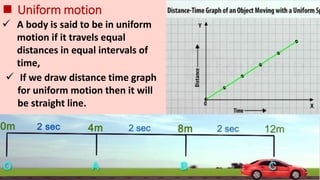
 Uniform motion
 If we draw distance time graph
for uniform motion then it will
be straight line.
 A body is said to be in uniform
motion if it travels equal
distances in equal intervals of
time,
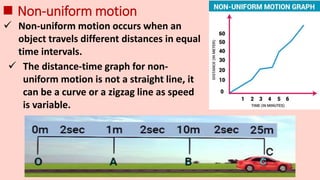
 Non-uniform motion
 Non-uniform motion occurs when an
object travels different distances in equal
time intervals.
 The distance-time graph for non-
uniform motion is not a straight line, it
can be a curve or a zigzag line as speed
is variable.
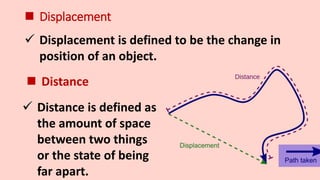
 Displacement
 Displacement is defined to be the change in
position of an object.
 Distance
 Distance is defined as
the amount of space
between two things
or the state of being
far apart.
 Speed
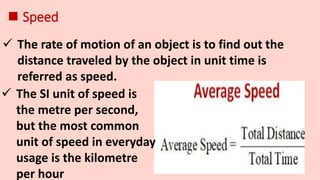
 The rate of motion of an object is to find out the
distance traveled by the object in unit time is
referred as speed.
 The SI unit of speed is
the metre per second,
but the most common
unit of speed in everyday
usage is the kilometre
per hour
 Velocity
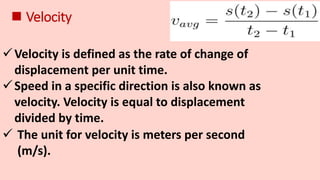
Velocity is defined as the rate of change of
displacement per unit time.
Speed in a specific direction is also known as
velocity. Velocity is equal to displacement
divided by time.
 The unit for velocity is meters per second
(m/s).
 Acceleration
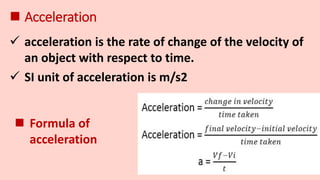
 acceleration is the rate of change of the velocity of
an object with respect to time.
 Formula of
acceleration
 SI unit of acceleration is m/s2
 Uniform acceleration
 Uniform or constant acceleration is a type of motion
in which the velocity of an object changes by an
equal amount in every equal time period.
 If the change in velocity in equal intervals of time is
not the same, then the object is said to be moving
with variable acceleration.
 Non uniform acceleration
Thank You
Science Education

Motion part -1

  • 1.
  • 2.
     What ismotion?  motion is the phenomenon in which an object changes its position over time. Motion is mathematically described in terms of displacement, distance, velocity, acceleration, speed, and time.
  • 3.
     Uniform motion If we draw distance time graph for uniform motion then it will be straight line.  A body is said to be in uniform motion if it travels equal distances in equal intervals of time,
  • 4.
     Non-uniform motion Non-uniform motion occurs when an object travels different distances in equal time intervals.  The distance-time graph for non- uniform motion is not a straight line, it can be a curve or a zigzag line as speed is variable.
  • 5.
     Displacement  Displacementis defined to be the change in position of an object.  Distance  Distance is defined as the amount of space between two things or the state of being far apart.
  • 6.
     Speed  Therate of motion of an object is to find out the distance traveled by the object in unit time is referred as speed.  The SI unit of speed is the metre per second, but the most common unit of speed in everyday usage is the kilometre per hour
  • 7.
     Velocity Velocity isdefined as the rate of change of displacement per unit time. Speed in a specific direction is also known as velocity. Velocity is equal to displacement divided by time.  The unit for velocity is meters per second (m/s).
  • 8.
     Acceleration  accelerationis the rate of change of the velocity of an object with respect to time.  Formula of acceleration  SI unit of acceleration is m/s2
  • 9.
     Uniform acceleration Uniform or constant acceleration is a type of motion in which the velocity of an object changes by an equal amount in every equal time period.  If the change in velocity in equal intervals of time is not the same, then the object is said to be moving with variable acceleration.  Non uniform acceleration
  • 10.