Momentum
 Momentum, product of the mass of a
particle and its velocity. ...
 Momentum is a vector quantity; i.e., it has
both magnitude and direction.
 Isaac Newton's second law of motion states
that the time rate of change of momentum is
equal to the force acting on the particle.
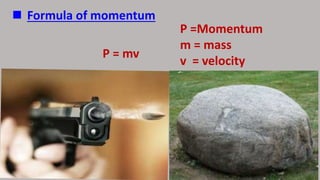
 Momentum
P = mv
P =Momentum
m = mass
v = velocity
 Formula of momentum
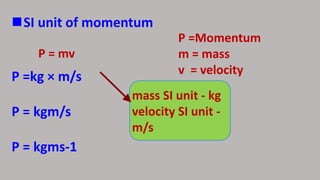
SI unit of momentum
P = mv
P =Momentum
m = mass
v = velocity
mass SI unit - kg
velocity SI unit -
m/s
P =kg × m/s
P = kgm/s
P = kgms-1
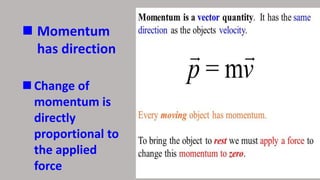
 Momentum
has direction
 Change of
momentum is
directly
proportional to
the applied
force
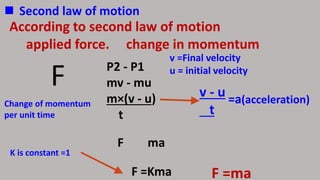
 Second law of motion
According to second law of motion
applied force. change in momentum
P2 - P1
mv - mu
m×(v - u)
t
F
F ma
F =Kma
v =Final velocity
u = initial velocity
v - u
t
=a(acceleration)
K is constant =1
F =ma
Change of momentum
per unit time
Thank You

Momentum

  • 1.
  • 2.
     Momentum, productof the mass of a particle and its velocity. ...  Momentum is a vector quantity; i.e., it has both magnitude and direction.  Isaac Newton's second law of motion states that the time rate of change of momentum is equal to the force acting on the particle.  Momentum
  • 3.
    P = mv P=Momentum m = mass v = velocity  Formula of momentum
  • 4.
    SI unit ofmomentum P = mv P =Momentum m = mass v = velocity mass SI unit - kg velocity SI unit - m/s P =kg × m/s P = kgm/s P = kgms-1
  • 5.
     Momentum has direction Change of momentum is directly proportional to the applied force
  • 6.
     Second lawof motion According to second law of motion applied force. change in momentum P2 - P1 mv - mu m×(v - u) t F F ma F =Kma v =Final velocity u = initial velocity v - u t =a(acceleration) K is constant =1 F =ma Change of momentum per unit time
  • 7.