Whites, EE 320 Lecture 28 Page 1 of 7
© 2016 Keith W. Whites
Lecture 28: MOSFET as an Amplifier.
Small-Signal Equivalent Circuit Models.
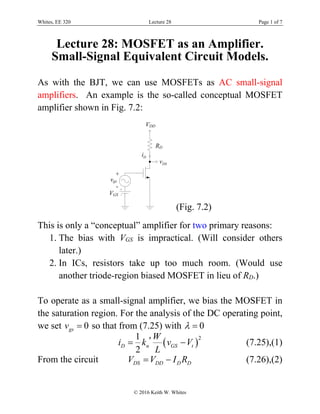
As with the BJT, we can use MOSFETs as AC small-signal
amplifiers. An example is the so-called conceptual MOSFET
amplifier shown in Fig. 7.2:
DSv
Di
(Fig. 7.2)
This is only a “conceptual” amplifier for two primary reasons:
1. The bias with VGS is impractical. (Will consider others
later.)
2. In ICs, resistors take up too much room. (Would use
another triode-region biased MOSFET in lieu of RD.)
To operate as a small-signal amplifier, we bias the MOSFET in
the saturation region. For the analysis of the DC operating point,
we set 0gsv  so that from (7.25) with 0 
 
21
2
D n GS t
W
i k v V
L
  (7.25),(1)
From the circuit DS DD D DV V I R  (7.26),(2)
Whites, EE 320 Lecture 28 Page 2 of 7
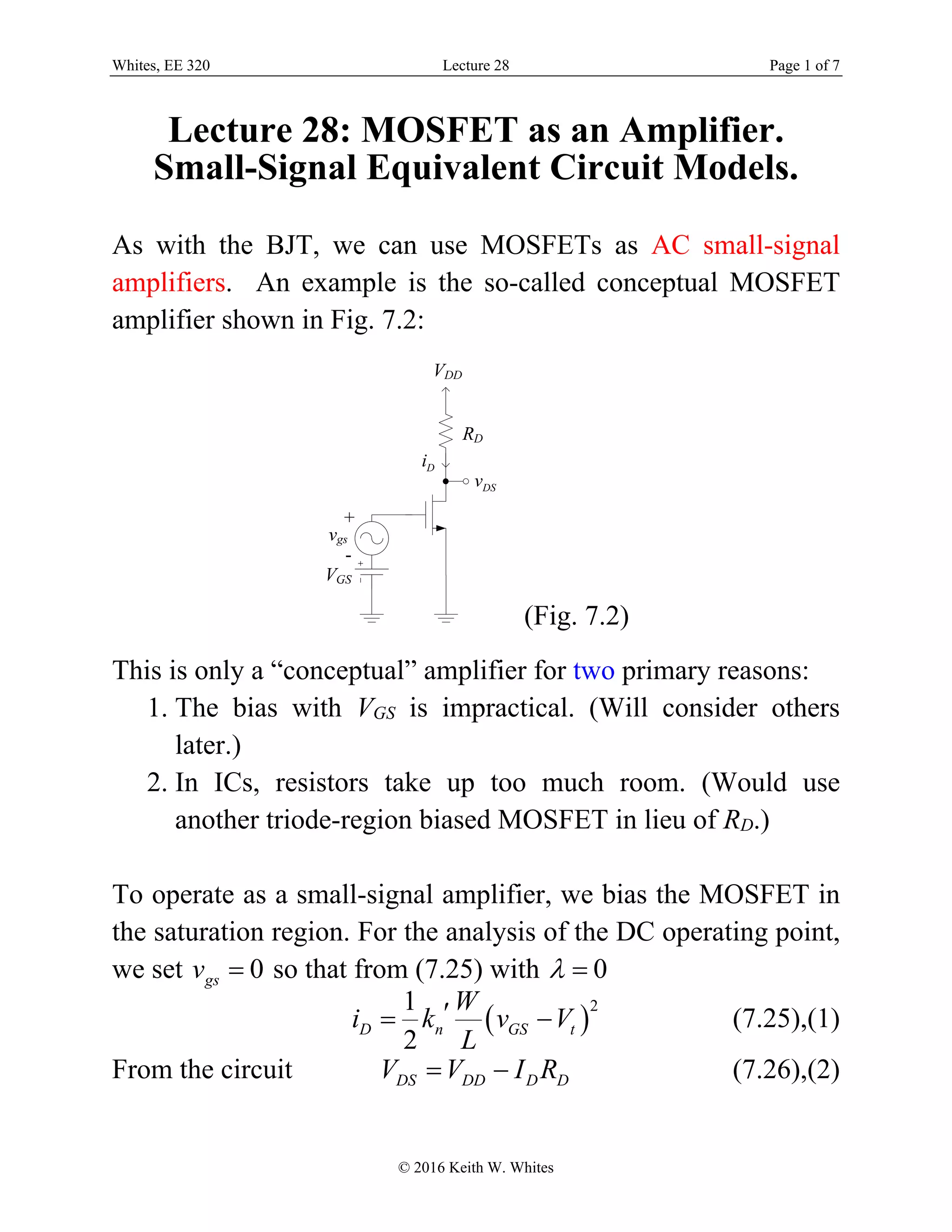
For operation in the saturation region
GD tv V  GS DS tv v V 
or DS GS tv v V  (3)
where the total drain-to-source voltage is
 
bias AC
DS DS dsv V v 
Similar to what we saw with BJT amplifiers, we need make sure
that (3) is satisfied for the entire signal swing of vds.
With an AC signal applied at the gate
GS GS gsv V v  (7.27),(4)
Substituting (4) into (1)
   
221 1
2 2
D n GS gs t n GS t gs
W W
i k V v V k V V v
L L
          (5)
 
21
2
n GS t
W
k V V
L
  +   22 1
2 2
n GS t gs n gs
W W
k V V v k v
L L
   (7.28),(6)
DI (DC) (time varying)
The last term in (6) is nonlinear in vgs, which is undesirable for a
linear amplifier. Consequently, for linear operation we will
require that the last term be “small”:
 21
2
n gs n GS t gs
W W
k v k V V v
L L
  
or  2gs GS tv V V  (7.29),(7)
Whites, EE 320 Lecture 28 Page 3 of 7
If this small-signal condition (7) is satisfied, then from (6) the
total drain current is approximately the linear summation
 
DC AC
D D di I i  (7.31),(8)
where  d n GS t gs
W
i k V V v
L
  . (9)
From this expression (9) we see that the AC drain current id is
related to vgs by the so-called transistor transconductance, gm:
 d
m n GS t
gs
i W
g k V V
v L
   [S] (7.32),(10)
which is sometimes expressed in terms of the overdrive voltage
OV GS tV V V 
m n OV
W
g k V
L
 [S] (7.33),(11)
Because of the VGS term in (10) and (11), this gm depends on the
bias, which is just like a BJT.
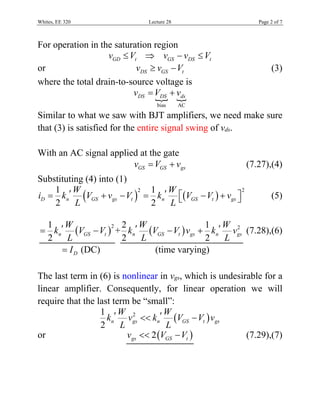
Physically, this transconductance gm equals the slope of the iD-
vGS characteristic curve at the Q point:
GS GS
D
m
GS v V
i
g
v 



(7.34),(12)
Whites, EE 320 Lecture 28 Page 4 of 7
(Fig. 7.11)
Lastly, it can be easily show that for this conceptual amplifier in
Fig. 7.2,
ds
v m D
gs
v
A g R
v
   (7.36),(13)
Consequently, v mA g , which is the same result we found for a
similar BJT conceptual amplifier [see (7.78)].
MOSFET Small-Signal Equivalent Models
For circuit analysis, it is convenient to use equivalent small-
signal models for MOSFETs – as it was with BJTs.
Whites, EE 320 Lecture 28 Page 5 of 7
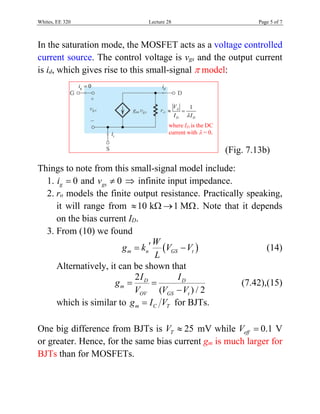
In the saturation mode, the MOSFET acts as a voltage controlled
current source. The control voltage is vgs and the output current
is id, which gives rise to this small-signal  model:
di0gi 
1A
D D
V
I I
 
si
(Fig. 7.13b)
Things to note from this small-signal model include:
1. 0gi  and 0gsv   infinite input impedance.
2. ro models the finite output resistance. Practically speaking,
it will range from 10 k 1 M   . Note that it depends
on the bias current ID.
3. From (10) we found
 m n GS t
W
g k V V
L
  (14)
Alternatively, it can be shown that
2
( ) / 2
D D
m
OV GS t
I I
g
V V V
 

(7.42),(15)
which is similar to m C Tg I V for BJTs.
One big difference from BJTs is 25TV  mV while 0.1effV  V
or greater. Hence, for the same bias current gm is much larger for
BJTs than for MOSFETs.
Whites, EE 320 Lecture 28 Page 6 of 7
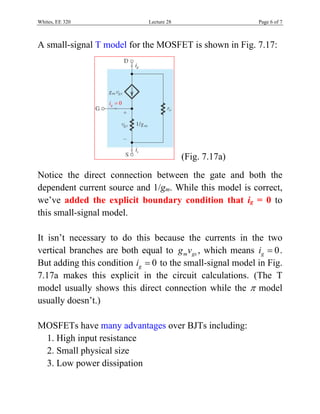
A small-signal T model for the MOSFET is shown in Fig. 7.17:
0gi 
si
di
(Fig. 7.17a)
Notice the direct connection between the gate and both the
dependent current source and 1/gm. While this model is correct,
we’ve added the explicit boundary condition that ig = 0 to
this small-signal model.
It isn’t necessary to do this because the currents in the two
vertical branches are both equal to m gsg v , which means 0gi  .
But adding this condition 0gi  to the small-signal model in Fig.
7.17a makes this explicit in the circuit calculations. (The T
model usually shows this direct connection while the  model
usually doesn’t.)
MOSFETs have many advantages over BJTs including:
1. High input resistance
2. Small physical size
3. Low power dissipation
Whites, EE 320 Lecture 28 Page 7 of 7
4. Relative ease of fabrication.
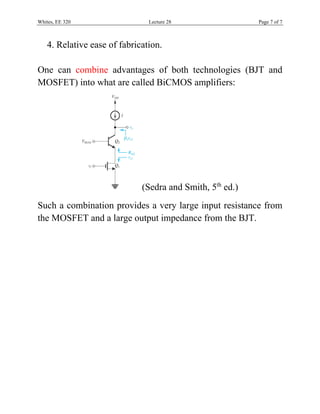
One can combine advantages of both technologies (BJT and
MOSFET) into what are called BiCMOS amplifiers:
(Sedra and Smith, 5th
ed.)
Such a combination provides a very large input resistance from
the MOSFET and a large output impedance from the BJT.

MOSFET as an Amplifier

  • 1.
    Whites, EE 320Lecture 28 Page 1 of 7 © 2016 Keith W. Whites Lecture 28: MOSFET as an Amplifier. Small-Signal Equivalent Circuit Models. As with the BJT, we can use MOSFETs as AC small-signal amplifiers. An example is the so-called conceptual MOSFET amplifier shown in Fig. 7.2: DSv Di (Fig. 7.2) This is only a “conceptual” amplifier for two primary reasons: 1. The bias with VGS is impractical. (Will consider others later.) 2. In ICs, resistors take up too much room. (Would use another triode-region biased MOSFET in lieu of RD.) To operate as a small-signal amplifier, we bias the MOSFET in the saturation region. For the analysis of the DC operating point, we set 0gsv  so that from (7.25) with 0    21 2 D n GS t W i k v V L   (7.25),(1) From the circuit DS DD D DV V I R  (7.26),(2)
  • 2.
    Whites, EE 320Lecture 28 Page 2 of 7 For operation in the saturation region GD tv V  GS DS tv v V  or DS GS tv v V  (3) where the total drain-to-source voltage is   bias AC DS DS dsv V v  Similar to what we saw with BJT amplifiers, we need make sure that (3) is satisfied for the entire signal swing of vds. With an AC signal applied at the gate GS GS gsv V v  (7.27),(4) Substituting (4) into (1)     221 1 2 2 D n GS gs t n GS t gs W W i k V v V k V V v L L           (5)   21 2 n GS t W k V V L   +   22 1 2 2 n GS t gs n gs W W k V V v k v L L    (7.28),(6) DI (DC) (time varying) The last term in (6) is nonlinear in vgs, which is undesirable for a linear amplifier. Consequently, for linear operation we will require that the last term be “small”:  21 2 n gs n GS t gs W W k v k V V v L L    or  2gs GS tv V V  (7.29),(7)
  • 3.
    Whites, EE 320Lecture 28 Page 3 of 7 If this small-signal condition (7) is satisfied, then from (6) the total drain current is approximately the linear summation   DC AC D D di I i  (7.31),(8) where  d n GS t gs W i k V V v L   . (9) From this expression (9) we see that the AC drain current id is related to vgs by the so-called transistor transconductance, gm:  d m n GS t gs i W g k V V v L    [S] (7.32),(10) which is sometimes expressed in terms of the overdrive voltage OV GS tV V V  m n OV W g k V L  [S] (7.33),(11) Because of the VGS term in (10) and (11), this gm depends on the bias, which is just like a BJT. Physically, this transconductance gm equals the slope of the iD- vGS characteristic curve at the Q point: GS GS D m GS v V i g v     (7.34),(12)
  • 4.
    Whites, EE 320Lecture 28 Page 4 of 7 (Fig. 7.11) Lastly, it can be easily show that for this conceptual amplifier in Fig. 7.2, ds v m D gs v A g R v    (7.36),(13) Consequently, v mA g , which is the same result we found for a similar BJT conceptual amplifier [see (7.78)]. MOSFET Small-Signal Equivalent Models For circuit analysis, it is convenient to use equivalent small- signal models for MOSFETs – as it was with BJTs.
  • 5.
    Whites, EE 320Lecture 28 Page 5 of 7 In the saturation mode, the MOSFET acts as a voltage controlled current source. The control voltage is vgs and the output current is id, which gives rise to this small-signal  model: di0gi  1A D D V I I   si (Fig. 7.13b) Things to note from this small-signal model include: 1. 0gi  and 0gsv   infinite input impedance. 2. ro models the finite output resistance. Practically speaking, it will range from 10 k 1 M   . Note that it depends on the bias current ID. 3. From (10) we found  m n GS t W g k V V L   (14) Alternatively, it can be shown that 2 ( ) / 2 D D m OV GS t I I g V V V    (7.42),(15) which is similar to m C Tg I V for BJTs. One big difference from BJTs is 25TV  mV while 0.1effV  V or greater. Hence, for the same bias current gm is much larger for BJTs than for MOSFETs.
  • 6.
    Whites, EE 320Lecture 28 Page 6 of 7 A small-signal T model for the MOSFET is shown in Fig. 7.17: 0gi  si di (Fig. 7.17a) Notice the direct connection between the gate and both the dependent current source and 1/gm. While this model is correct, we’ve added the explicit boundary condition that ig = 0 to this small-signal model. It isn’t necessary to do this because the currents in the two vertical branches are both equal to m gsg v , which means 0gi  . But adding this condition 0gi  to the small-signal model in Fig. 7.17a makes this explicit in the circuit calculations. (The T model usually shows this direct connection while the  model usually doesn’t.) MOSFETs have many advantages over BJTs including: 1. High input resistance 2. Small physical size 3. Low power dissipation
  • 7.
    Whites, EE 320Lecture 28 Page 7 of 7 4. Relative ease of fabrication. One can combine advantages of both technologies (BJT and MOSFET) into what are called BiCMOS amplifiers: (Sedra and Smith, 5th ed.) Such a combination provides a very large input resistance from the MOSFET and a large output impedance from the BJT.