16 April 2024 VLSI Design 1
16 April 2024 1
16 April 2024 1
VLSI Design
CMOS Inverter Analysis
16 April 2024 VLSI Design 2
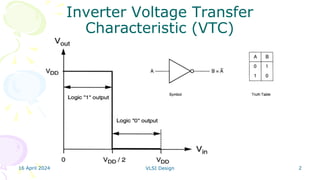
Inverter Voltage Transfer
Characteristic (VTC)
16 April 2024 VLSI Design 3
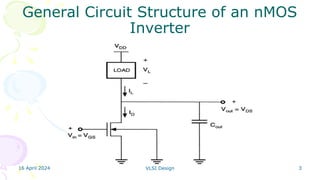
General Circuit Structure of an nMOS
Inverter
16 April 2024 VLSI Design 4
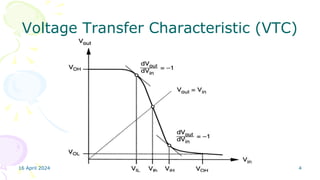
Voltage Transfer Characteristic (VTC)
16 April 2024 VLSI Design 5
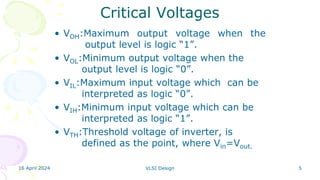
Critical Voltages
• VOH:Maximum output voltage when the
output level is logic “1”.
• VOL:Minimum output voltage when the
output level is logic “0”.
• VIL:Maximum input voltage which can be
interpreted as logic “0”.
• VIH:Minimum input voltage which can be
interpreted as logic “1”.
• VTH:Threshold voltage of inverter, is
defined as the point, where Vin=Vout.
16 April 2024 VLSI Design 6
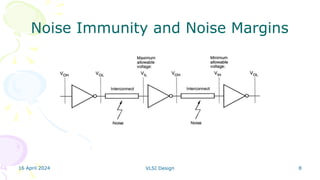
Noise Immunity and Noise
Margins
• The ability of an inverter to interpret
an input signal within a voltage
range as either a logic “0” or as a
logic “1”, allows digitals circuits to
operate with a certain tolerance to
external signal perturbations.
16 April 2024 VLSI Design 7
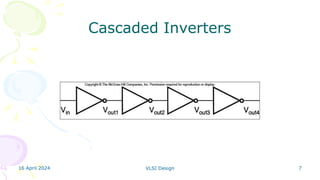
Cascaded Inverters
16 April 2024 VLSI Design 8
Noise Immunity and Noise Margins
16 April 2024 VLSI Design 9
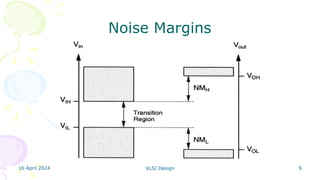
Noise Margins
16 April 2024 VLSI Design 10
Noise Margins
• Noise tolerances for digital circuits, called, Noise
Margin (NM).
• NML=VIL-VOL :Noise Margin Low
• NMH=VOH-VIH :Noise Margin High
• The noise immunity of the circuit increases with
NM
16 April 2024 VLSI Design 11
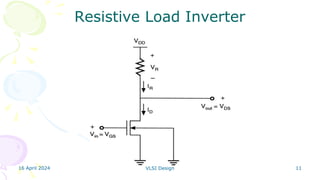
Resistive Load Inverter
16 April 2024 VLSI Design 12
VTC
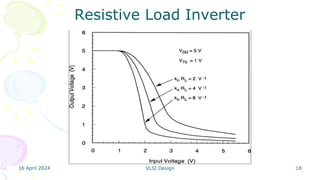
• Applying Kirchhoff’s Current Law
(KCL), the Load current is always
equal to the nMOS drain current.
ID (Vin, Vout)=IL(VL)
• Two critical voltage points (VIL,VIH)
defined on this VTC curve, where the
slope of the Vout (Vin) characteristic
becomes equal to -1.
16 April 2024 VLSI Design 13
Resistive Load Inverter
• Calculation of VOH:
Vout= VDD–RL.IR , where (ID=IR)
• When Vin is low, i.e., smaller than the
threshold voltage of the driver MOSFET,
the driver transistor is cut-off.
• So ID=IR =0
• VOH =VDD
16 April 2024 VLSI Design 14
Resistive Load Inverter
• Calculation of VOL:
• IR= IDLinear
• (VDD-VOUT)/RL= Kn/2[2(VDD-VTO).VOL- VOL
2]
16 April 2024 VLSI Design 15
Resistive Load Inverter
• Calculation of VIL:
• IR= IDSaturation
• (VDD-VOUT)/RL= Kn/2[(Vin-VTO)2]
16 April 2024 VLSI Design 16
Resistive Load Inverter
• Calculation of VIH:
• IR= IDLinear
• (VDD-Vout)/RL= Kn/2[(Vin-VTO).Vout-Vout
2]
• Differenting both sides w.r.t Vin and
substituting the slope=-1
16 April 2024 VLSI Design 17
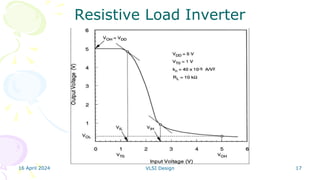
Resistive Load Inverter
16 April 2024 VLSI Design 18
Resistive Load Inverter
16 April 2024 VLSI Design 19
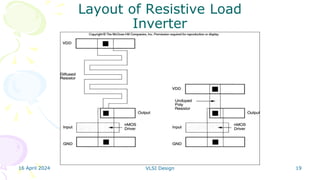
Layout of Resistive Load
Inverter
16 April 2024 VLSI Design 20
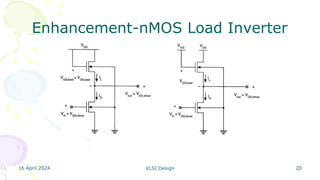
Enhancement-nMOS Load Inverter
16 April 2024 VLSI Design 21
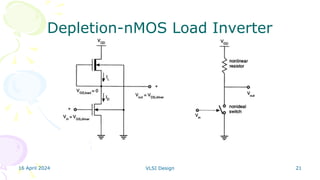
Depletion-nMOS Load Inverter
16 April 2024 VLSI Design 22
Depletion-nMOS Load Inverter
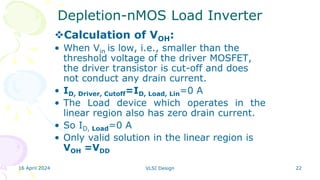
Calculation of VOH:
• When Vin is low, i.e., smaller than the
threshold voltage of the driver MOSFET,
the driver transistor is cut-off and does
not conduct any drain current.
• ID, Driver, Cutoff=ID, Load, Lin=0 A
• The Load device which operates in the
linear region also has zero drain current.
• So ID, Load=0 A
• Only valid solution in the linear region is
VOH =VDD
16 April 2024 VLSI Design 23
Depletion-nMOS Load Inverter
Calculation of VOL:
• ID, Driver, Lin = ID, Load, Sat
• ID, Driver, Lin =(Kdriver/2)[2(VOH-VTO).VOL- VOL
2]
• ID, Load, Sat =(KLoad/2)[-VT, Load (VOL)]2
16 April 2024 VLSI Design 24
Depletion-nMOS Load Inverter
Calculation of VIL:
• ID, Driver, Sat = ID, Load, Lin
• ID, Driver, Sat =(KDriver/2)[Vin-VTO]2
• ID, Load, Sat =(KLoad/2){2[VT, Load (Vout)](VDD-
Vout)- (VDD-Vout)2}
• Differenting both sides w.r.t Vin and
substituting the slope=-1
16 April 2024 VLSI Design 25
Depletion-nMOS Load Inverter
Calculation of VIH:
• ID, Driver, Lin = ID, Load, Sat
• ID, Driver, Lin =(KDriver/2)[2(Vin-VTO) Vout-
Vout
2]
• ID, Load, Sat =(KLoad/2)[-VT, Load (Vout)]2
• Differenting both sides w.r.t Vin and
substituting the slope=-1
16 April 2024 VLSI Design 26
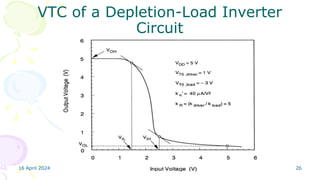
VTC of a Depletion-Load Inverter
Circuit
16 April 2024 VLSI Design 27
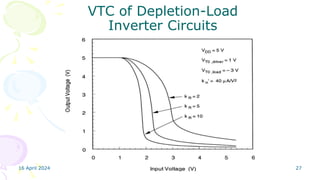
VTC of Depletion-Load
Inverter Circuits
16 April 2024 VLSI Design 28
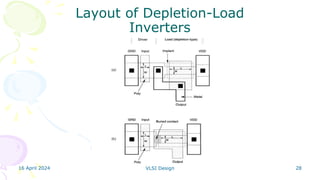
Layout of Depletion-Load
Inverters
16 April 2024 VLSI Design 29
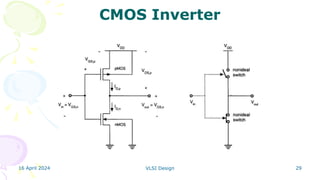
CMOS Inverter
16 April 2024 VLSI Design 30
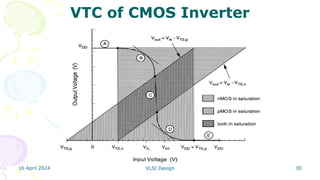
VTC of CMOS Inverter
16 April 2024 VLSI Design 31
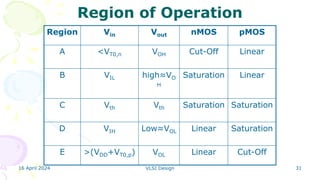
Region of Operation
Region Vin Vout nMOS pMOS
A <VT0,n VOH Cut-Off Linear
B VIL high≈VO
H
Saturation Linear
C Vth Vth Saturation Saturation
D VIH Low≈VOL Linear Saturation
E >(VDD+VT0,p) VOL Linear Cut-Off
16 April 2024 VLSI Design 32
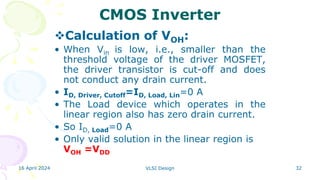
CMOS Inverter
Calculation of VOH:
• When Vin is low, i.e., smaller than the
threshold voltage of the driver MOSFET,
the driver transistor is cut-off and does
not conduct any drain current.
• ID, Driver, Cutoff=ID, Load, Lin=0 A
• The Load device which operates in the
linear region also has zero drain current.
• So ID, Load=0 A
• Only valid solution in the linear region is
VOH =VDD
16 April 2024 VLSI Design 33
CMOS Inverter
Calculation of VOL:
• ID, Driver, Lin = ID, Load, Cut-off
• ID, Driver, Lin =(Kdriver/2)[2(VDD-VTO).VOL- VOL
2]
• ID, Load, Cut-off =0A
• VOL =0 V
16 April 2024 VLSI Design 34
CMOS Inverter
Calculation of VIL:
• ID, nMOS, Sat = ID, pMOS, Lin
• ID, nMOS, Sat=(Kn/2)[VGS,n-VTO,n]2
• ID, pMOS, Lin=(KP/2)[2(VGS,p-VTO,p)VDS,p-VDS,p)2]
• Differenting both sides w.r.t Vin and
substituting the slope=-1
• VIL=(2Vout + VTO,p- VDD+ KRVTO,n)/(1+KR)
• Transconductance Ratio(KR)
• KR = Kn/KP
16 April 2024 VLSI Design 35
CMOS Inverter
Calculation of VIH:
• ID, Driver, Lin= ID, Load, Sat
• ID, nMOS, Lin= (Kn/2)[2(VGS,n-VTO,n)VDS,n-VDS,n)2]
• ID, pMOS, Sat=(Kp/2)[VGS,p-VTO,p]2
• Differenting both sides w.r.t Vin and
substituting the slope=-1
• VIH=(VDD+VTO,p+KR (2Vout+VTO,n))/(1+KR)
• Transconductance Ratio(KR)
• KR = Kn/KP
16 April 2024 VLSI Design 36
CMOS Inverter
Calculation of Vth:
• ID, Driver, Sat= ID, Load, Sat
• ID, nMOS, Sat= (Kn/2)(VGS,n-VTO,n)2
• ID, pMOS, Sat=(Kp/2)[VGS,p-VTO,p]2
• Vth=VTO,n+KR
-1/2(VDD+VTO,p)/(1+KR
-1/2)
• Transconductance Ratio(KR)
• KR=Kn/KP
16 April 2024 VLSI Design 37
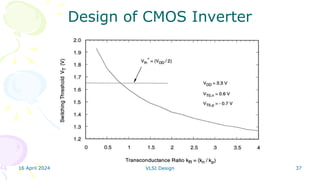
Design of CMOS Inverter
16 April 2024 VLSI Design 38
Design of CMOS Inverter
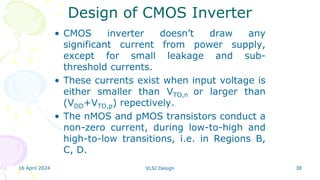
• CMOS inverter doesn’t draw any
significant current from power supply,
except for small leakage and sub-
threshold currents.
• These currents exist when input voltage is
either smaller than VTO,n or larger than
(VDD+VTO,p) repectively.
• The nMOS and pMOS transistors conduct a
non-zero current, during low-to-high and
high-to-low transitions, i.e. in Regions B,
C, D.
16 April 2024 VLSI Design 39
Design of CMOS Inverter
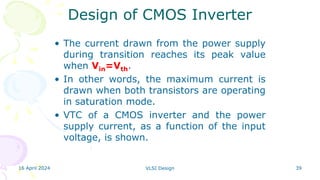
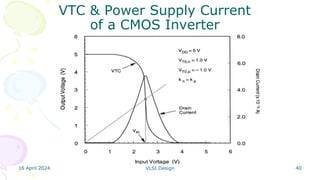
• The current drawn from the power supply
during transition reaches its peak value
when Vin=Vth.
• In other words, the maximum current is
drawn when both transistors are operating
in saturation mode.
• VTC of a CMOS inverter and the power
supply current, as a function of the input
voltage, is shown.
16 April 2024 VLSI Design 40
VTC & Power Supply Current
of a CMOS Inverter
16 April 2024 VLSI Design 41
• The threshold voltage Vth is identified as
one of he most important parameter that
characterize the steady-state input-output
behavior of the CMOS inverter circuit.
• The CMOS inverter, provides a full output
voltage swing between 0 and VDD and
therefore the noise margins (NM) are
relatively wider.
• So, the problem of designing a CMOS
inverter can be reduced to setting the
inverter threshold (Vth) to a desired
voltage value.
Design of CMOS Inverters
16 April 2024 VLSI Design 42
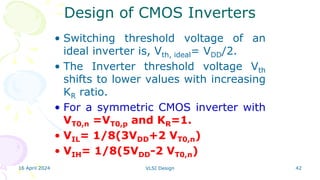
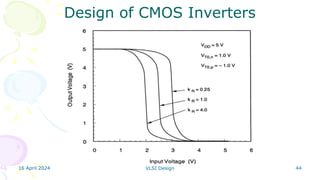
• Switching threshold voltage of an
ideal inverter is, Vth, ideal= VDD/2.
• The Inverter threshold voltage Vth
shifts to lower values with increasing
KR ratio.
• For a symmetric CMOS inverter with
VT0,n =VT0,p and KR=1.
• VIL= 1/8(3VDD+2 VT0,n)
• VIH= 1/8(5VDD-2 VT0,n)
Design of CMOS Inverters
16 April 2024 VLSI Design 43
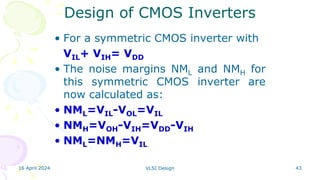
• For a symmetric CMOS inverter with
VIL+ VIH= VDD
• The noise margins NML and NMH for
this symmetric CMOS inverter are
now calculated as:
• NML=VIL-VOL=VIL
• NMH=VOH-VIH=VDD-VIH
• NML=NMH=VIL
Design of CMOS Inverters
16 April 2024 VLSI Design 44
Design of CMOS Inverters
16 April 2024 VLSI Design 45
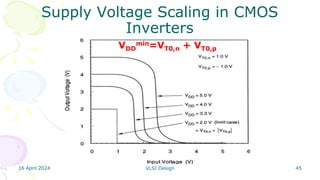
Supply Voltage Scaling in CMOS
Inverters
VDD
min=VT0,n + VT0,p
16 April 2024 VLSI Design 46
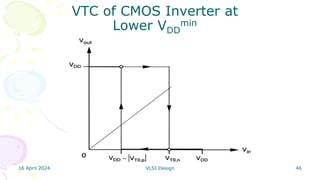
VTC of CMOS Inverter at
Lower VDD
min
16 April 2024 VLSI Design 47
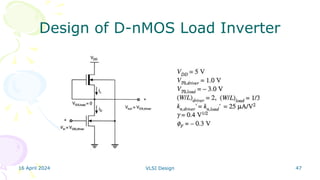
Design of D-nMOS Load Inverter
16 April 2024 VLSI Design 48
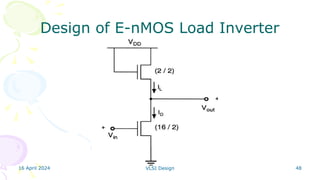
Design of E-nMOS Load Inverter
16 April 2024 VLSI Design 49
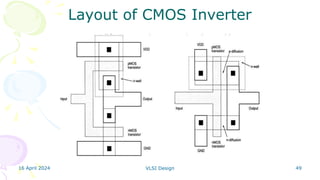
Layout of CMOS Inverter
50
3D Perspective
Polysilicon Aluminum
51
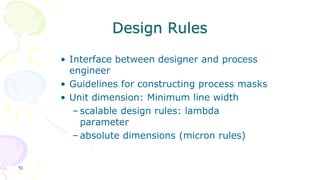
Design Rules
• Interface between designer and process
engineer
• Guidelines for constructing process masks
• Unit dimension: Minimum line width
– scalable design rules: lambda
parameter
– absolute dimensions (micron rules)
52
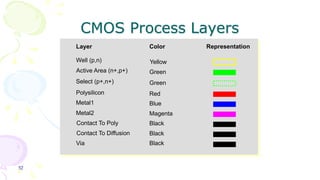
CMOS Process Layers
Layer
Polysilicon
Metal1
Metal2
Contact To Poly
Contact To Diffusion
Via
Well (p,n)
Active Area (n+,p+)
Color Representation
Yellow
Green
Red
Blue
Magenta
Black
Black
Black
Select (p+,n+) Green
53
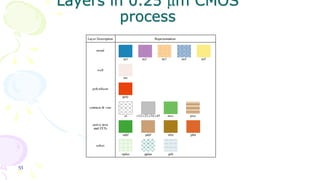
Layers in 0.25 mm CMOS
process
54
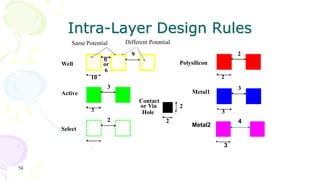
Intra-Layer Design Rules
Metal2
4
3
10
9
0
Well
Active
3
3
Polysilicon
2
2
Different Potential
Same Potential
Metal1
3
3
2
Contact
or Via
Select
2
or
6
2
Hole
55
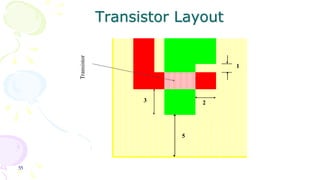
Transistor Layout
1
2
5
3
Transistor
56
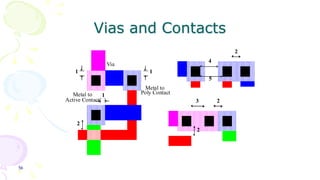
Vias and Contacts
1
2
1
Via
Metal to
Poly Contact
Metal to
Active Contact
1
2
5
4
3 2
2
57
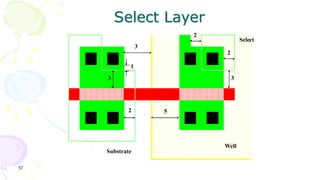
Select Layer
1
3 3
2
2
2
Well
Substrate
Select
3
5
58
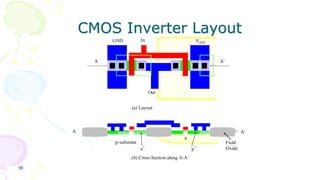
CMOS Inverter Layout
A A’
n
p-substrate Field
Oxide
p+
n+
In
Out
GND VDD
(a) Layout
(b) Cross-Section along A-A’
A A’
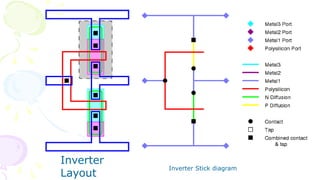
Inverter
Layout
Inverter Stick diagram
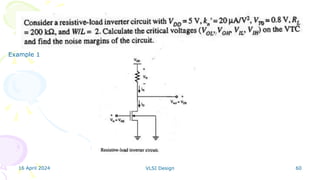
16 April 2024 VLSI Design 60
Example 1
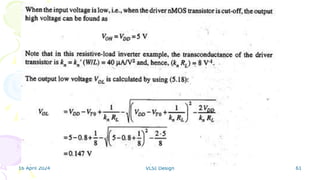
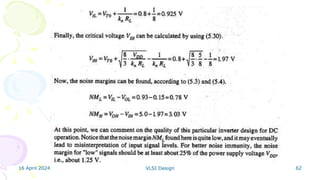
16 April 2024 VLSI Design 61
16 April 2024 VLSI Design 62
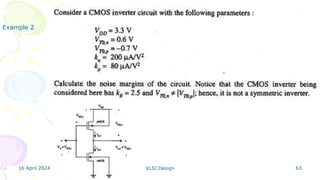
16 April 2024 VLSI Design 63
Example 2
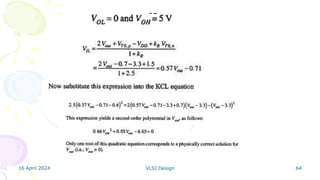
16 April 2024 VLSI Design 64
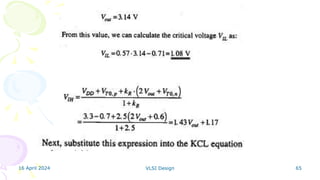
16 April 2024 VLSI Design 65
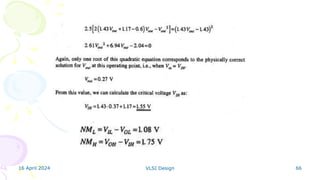
16 April 2024 VLSI Design 66

inveatedpresentationwhich has the details.pptx

  • 1.
    16 April 2024VLSI Design 1 16 April 2024 1 16 April 2024 1 VLSI Design CMOS Inverter Analysis
  • 2.
    16 April 2024VLSI Design 2 Inverter Voltage Transfer Characteristic (VTC)
  • 3.
    16 April 2024VLSI Design 3 General Circuit Structure of an nMOS Inverter
  • 4.
    16 April 2024VLSI Design 4 Voltage Transfer Characteristic (VTC)
  • 5.
    16 April 2024VLSI Design 5 Critical Voltages • VOH:Maximum output voltage when the output level is logic “1”. • VOL:Minimum output voltage when the output level is logic “0”. • VIL:Maximum input voltage which can be interpreted as logic “0”. • VIH:Minimum input voltage which can be interpreted as logic “1”. • VTH:Threshold voltage of inverter, is defined as the point, where Vin=Vout.
  • 6.
    16 April 2024VLSI Design 6 Noise Immunity and Noise Margins • The ability of an inverter to interpret an input signal within a voltage range as either a logic “0” or as a logic “1”, allows digitals circuits to operate with a certain tolerance to external signal perturbations.
  • 7.
    16 April 2024VLSI Design 7 Cascaded Inverters
  • 8.
    16 April 2024VLSI Design 8 Noise Immunity and Noise Margins
  • 9.
    16 April 2024VLSI Design 9 Noise Margins
  • 10.
    16 April 2024VLSI Design 10 Noise Margins • Noise tolerances for digital circuits, called, Noise Margin (NM). • NML=VIL-VOL :Noise Margin Low • NMH=VOH-VIH :Noise Margin High • The noise immunity of the circuit increases with NM
  • 11.
    16 April 2024VLSI Design 11 Resistive Load Inverter
  • 12.
    16 April 2024VLSI Design 12 VTC • Applying Kirchhoff’s Current Law (KCL), the Load current is always equal to the nMOS drain current. ID (Vin, Vout)=IL(VL) • Two critical voltage points (VIL,VIH) defined on this VTC curve, where the slope of the Vout (Vin) characteristic becomes equal to -1.
  • 13.
    16 April 2024VLSI Design 13 Resistive Load Inverter • Calculation of VOH: Vout= VDD–RL.IR , where (ID=IR) • When Vin is low, i.e., smaller than the threshold voltage of the driver MOSFET, the driver transistor is cut-off. • So ID=IR =0 • VOH =VDD
  • 14.
    16 April 2024VLSI Design 14 Resistive Load Inverter • Calculation of VOL: • IR= IDLinear • (VDD-VOUT)/RL= Kn/2[2(VDD-VTO).VOL- VOL 2]
  • 15.
    16 April 2024VLSI Design 15 Resistive Load Inverter • Calculation of VIL: • IR= IDSaturation • (VDD-VOUT)/RL= Kn/2[(Vin-VTO)2]
  • 16.
    16 April 2024VLSI Design 16 Resistive Load Inverter • Calculation of VIH: • IR= IDLinear • (VDD-Vout)/RL= Kn/2[(Vin-VTO).Vout-Vout 2] • Differenting both sides w.r.t Vin and substituting the slope=-1
  • 17.
    16 April 2024VLSI Design 17 Resistive Load Inverter
  • 18.
    16 April 2024VLSI Design 18 Resistive Load Inverter
  • 19.
    16 April 2024VLSI Design 19 Layout of Resistive Load Inverter
  • 20.
    16 April 2024VLSI Design 20 Enhancement-nMOS Load Inverter
  • 21.
    16 April 2024VLSI Design 21 Depletion-nMOS Load Inverter
  • 22.
    16 April 2024VLSI Design 22 Depletion-nMOS Load Inverter Calculation of VOH: • When Vin is low, i.e., smaller than the threshold voltage of the driver MOSFET, the driver transistor is cut-off and does not conduct any drain current. • ID, Driver, Cutoff=ID, Load, Lin=0 A • The Load device which operates in the linear region also has zero drain current. • So ID, Load=0 A • Only valid solution in the linear region is VOH =VDD
  • 23.
    16 April 2024VLSI Design 23 Depletion-nMOS Load Inverter Calculation of VOL: • ID, Driver, Lin = ID, Load, Sat • ID, Driver, Lin =(Kdriver/2)[2(VOH-VTO).VOL- VOL 2] • ID, Load, Sat =(KLoad/2)[-VT, Load (VOL)]2
  • 24.
    16 April 2024VLSI Design 24 Depletion-nMOS Load Inverter Calculation of VIL: • ID, Driver, Sat = ID, Load, Lin • ID, Driver, Sat =(KDriver/2)[Vin-VTO]2 • ID, Load, Sat =(KLoad/2){2[VT, Load (Vout)](VDD- Vout)- (VDD-Vout)2} • Differenting both sides w.r.t Vin and substituting the slope=-1
  • 25.
    16 April 2024VLSI Design 25 Depletion-nMOS Load Inverter Calculation of VIH: • ID, Driver, Lin = ID, Load, Sat • ID, Driver, Lin =(KDriver/2)[2(Vin-VTO) Vout- Vout 2] • ID, Load, Sat =(KLoad/2)[-VT, Load (Vout)]2 • Differenting both sides w.r.t Vin and substituting the slope=-1
  • 26.
    16 April 2024VLSI Design 26 VTC of a Depletion-Load Inverter Circuit
  • 27.
    16 April 2024VLSI Design 27 VTC of Depletion-Load Inverter Circuits
  • 28.
    16 April 2024VLSI Design 28 Layout of Depletion-Load Inverters
  • 29.
    16 April 2024VLSI Design 29 CMOS Inverter
  • 30.
    16 April 2024VLSI Design 30 VTC of CMOS Inverter
  • 31.
    16 April 2024VLSI Design 31 Region of Operation Region Vin Vout nMOS pMOS A <VT0,n VOH Cut-Off Linear B VIL high≈VO H Saturation Linear C Vth Vth Saturation Saturation D VIH Low≈VOL Linear Saturation E >(VDD+VT0,p) VOL Linear Cut-Off
  • 32.
    16 April 2024VLSI Design 32 CMOS Inverter Calculation of VOH: • When Vin is low, i.e., smaller than the threshold voltage of the driver MOSFET, the driver transistor is cut-off and does not conduct any drain current. • ID, Driver, Cutoff=ID, Load, Lin=0 A • The Load device which operates in the linear region also has zero drain current. • So ID, Load=0 A • Only valid solution in the linear region is VOH =VDD
  • 33.
    16 April 2024VLSI Design 33 CMOS Inverter Calculation of VOL: • ID, Driver, Lin = ID, Load, Cut-off • ID, Driver, Lin =(Kdriver/2)[2(VDD-VTO).VOL- VOL 2] • ID, Load, Cut-off =0A • VOL =0 V
  • 34.
    16 April 2024VLSI Design 34 CMOS Inverter Calculation of VIL: • ID, nMOS, Sat = ID, pMOS, Lin • ID, nMOS, Sat=(Kn/2)[VGS,n-VTO,n]2 • ID, pMOS, Lin=(KP/2)[2(VGS,p-VTO,p)VDS,p-VDS,p)2] • Differenting both sides w.r.t Vin and substituting the slope=-1 • VIL=(2Vout + VTO,p- VDD+ KRVTO,n)/(1+KR) • Transconductance Ratio(KR) • KR = Kn/KP
  • 35.
    16 April 2024VLSI Design 35 CMOS Inverter Calculation of VIH: • ID, Driver, Lin= ID, Load, Sat • ID, nMOS, Lin= (Kn/2)[2(VGS,n-VTO,n)VDS,n-VDS,n)2] • ID, pMOS, Sat=(Kp/2)[VGS,p-VTO,p]2 • Differenting both sides w.r.t Vin and substituting the slope=-1 • VIH=(VDD+VTO,p+KR (2Vout+VTO,n))/(1+KR) • Transconductance Ratio(KR) • KR = Kn/KP
  • 36.
    16 April 2024VLSI Design 36 CMOS Inverter Calculation of Vth: • ID, Driver, Sat= ID, Load, Sat • ID, nMOS, Sat= (Kn/2)(VGS,n-VTO,n)2 • ID, pMOS, Sat=(Kp/2)[VGS,p-VTO,p]2 • Vth=VTO,n+KR -1/2(VDD+VTO,p)/(1+KR -1/2) • Transconductance Ratio(KR) • KR=Kn/KP
  • 37.
    16 April 2024VLSI Design 37 Design of CMOS Inverter
  • 38.
    16 April 2024VLSI Design 38 Design of CMOS Inverter • CMOS inverter doesn’t draw any significant current from power supply, except for small leakage and sub- threshold currents. • These currents exist when input voltage is either smaller than VTO,n or larger than (VDD+VTO,p) repectively. • The nMOS and pMOS transistors conduct a non-zero current, during low-to-high and high-to-low transitions, i.e. in Regions B, C, D.
  • 39.
    16 April 2024VLSI Design 39 Design of CMOS Inverter • The current drawn from the power supply during transition reaches its peak value when Vin=Vth. • In other words, the maximum current is drawn when both transistors are operating in saturation mode. • VTC of a CMOS inverter and the power supply current, as a function of the input voltage, is shown.
  • 40.
    16 April 2024VLSI Design 40 VTC & Power Supply Current of a CMOS Inverter
  • 41.
    16 April 2024VLSI Design 41 • The threshold voltage Vth is identified as one of he most important parameter that characterize the steady-state input-output behavior of the CMOS inverter circuit. • The CMOS inverter, provides a full output voltage swing between 0 and VDD and therefore the noise margins (NM) are relatively wider. • So, the problem of designing a CMOS inverter can be reduced to setting the inverter threshold (Vth) to a desired voltage value. Design of CMOS Inverters
  • 42.
    16 April 2024VLSI Design 42 • Switching threshold voltage of an ideal inverter is, Vth, ideal= VDD/2. • The Inverter threshold voltage Vth shifts to lower values with increasing KR ratio. • For a symmetric CMOS inverter with VT0,n =VT0,p and KR=1. • VIL= 1/8(3VDD+2 VT0,n) • VIH= 1/8(5VDD-2 VT0,n) Design of CMOS Inverters
  • 43.
    16 April 2024VLSI Design 43 • For a symmetric CMOS inverter with VIL+ VIH= VDD • The noise margins NML and NMH for this symmetric CMOS inverter are now calculated as: • NML=VIL-VOL=VIL • NMH=VOH-VIH=VDD-VIH • NML=NMH=VIL Design of CMOS Inverters
  • 44.
    16 April 2024VLSI Design 44 Design of CMOS Inverters
  • 45.
    16 April 2024VLSI Design 45 Supply Voltage Scaling in CMOS Inverters VDD min=VT0,n + VT0,p
  • 46.
    16 April 2024VLSI Design 46 VTC of CMOS Inverter at Lower VDD min
  • 47.
    16 April 2024VLSI Design 47 Design of D-nMOS Load Inverter
  • 48.
    16 April 2024VLSI Design 48 Design of E-nMOS Load Inverter
  • 49.
    16 April 2024VLSI Design 49 Layout of CMOS Inverter
  • 50.
  • 51.
    51 Design Rules • Interfacebetween designer and process engineer • Guidelines for constructing process masks • Unit dimension: Minimum line width – scalable design rules: lambda parameter – absolute dimensions (micron rules)
  • 52.
    52 CMOS Process Layers Layer Polysilicon Metal1 Metal2 ContactTo Poly Contact To Diffusion Via Well (p,n) Active Area (n+,p+) Color Representation Yellow Green Red Blue Magenta Black Black Black Select (p+,n+) Green
  • 53.
    53 Layers in 0.25mm CMOS process
  • 54.
    54 Intra-Layer Design Rules Metal2 4 3 10 9 0 Well Active 3 3 Polysilicon 2 2 DifferentPotential Same Potential Metal1 3 3 2 Contact or Via Select 2 or 6 2 Hole
  • 55.
  • 56.
    56 Vias and Contacts 1 2 1 Via Metalto Poly Contact Metal to Active Contact 1 2 5 4 3 2 2
  • 57.
  • 58.
    58 CMOS Inverter Layout AA’ n p-substrate Field Oxide p+ n+ In Out GND VDD (a) Layout (b) Cross-Section along A-A’ A A’
  • 59.
  • 60.
    16 April 2024VLSI Design 60 Example 1
  • 61.
    16 April 2024VLSI Design 61
  • 62.
    16 April 2024VLSI Design 62
  • 63.
    16 April 2024VLSI Design 63 Example 2
  • 64.
    16 April 2024VLSI Design 64
  • 65.
    16 April 2024VLSI Design 65
  • 66.
    16 April 2024VLSI Design 66