UNIT-II
Sheet Resistance(Rs)
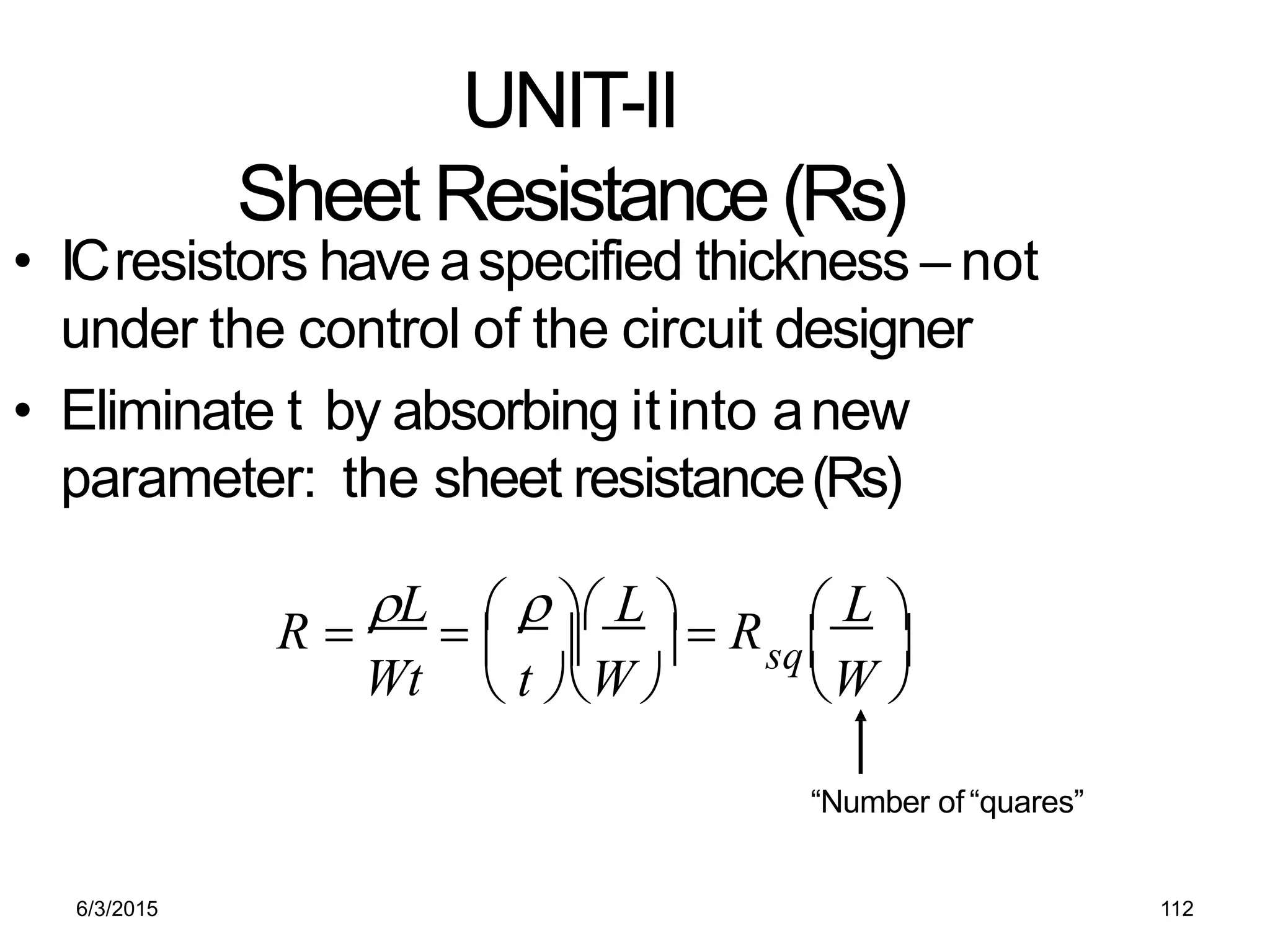
• ICresistors haveaspecified thickness – not
under the control of the circuit designer
• Eliminate t by absorbing itinto anew
parameter: the sheet resistance(Rs)

  
W 
 t W 
Wt
sq
R 
L
    L  R  L 
“Number of “quares”
6/3/2015 112
6/3/2015 129
BASICELECTRICALPROPERTIES
Topics
• Basicelectrical properties of MOSandBiCMOS
circuits:
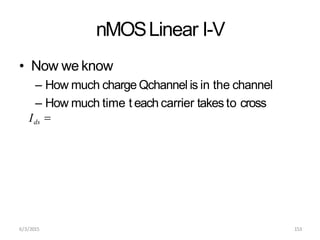
• Ids-Vds relationships
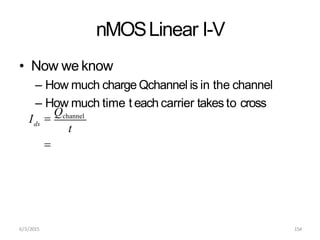
• MOStransistor threshold voltage, gm,gds
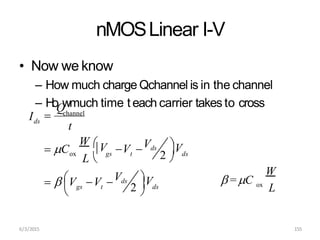
• figure of meritwo
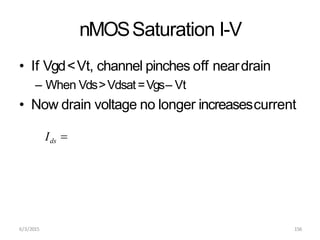
• passtransistor
• NMOSinverter
• Various pull-ups
• CMOSinverter analysis anddesign
• BiCMOSinverters
MOSFETI-VCharacteristics
I-V Plots, Channel Length Modulation
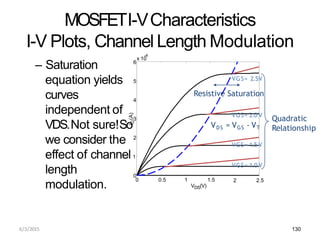
– Saturation
equation yields
curves
independent of
VDS.Not sure!So
Quadratic
Relationship
0 0.5 1 1.5
0
we consider the
effect of channel1
length
modulation.
2
3
4
5
6
x 10
-4
VDS(V)
I
D
(A)
VGS= 1.5 V
VGS= 1.0 V
2 2.5
VGS= 2.5V
Resistive Saturation
VGS= 2.0 V
VDS = VGS - VT
6/3/2015 130
MOSFETI-V Characteristics
Channel Length Modulation
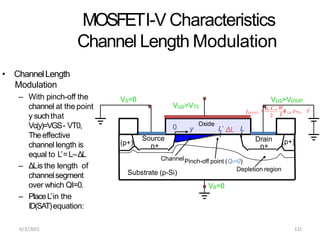
• ChannelLength
Modulation
– With pinch-off the
channel at the point
y suchthat
Vc(y)=VGS- VT0,
Theeffective
channel length is
equal to L’=L–ΔL
– ΔLis the length of
channelsegment
over which QI=0.
– PlaceL’in the
ID(SAT)equation:
)2
2
ID(SAT) 
L

V GS V T 0

n Cox W
(
Source
n+
Drain
n+
Substrate (p-Si)
(p+) (p+)
Oxide
0 y L’ ΔL L
ChannelPinch-off point (QI=0)
Depletion region
VB=0
VS=0
VGS>VT0
VDS>VDSAT
6/3/2015 131
MOSFETI-V Characteristics
Channel Length Modulation
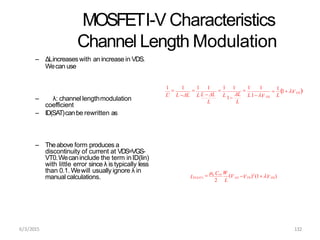
– ΔLincreaseswith an increase in VDS.
Wecan use
– λ: channel lengthmodulation
coefficient
– ID(SAT)canbe rewritten as
– Theabove form produces a
discontinuity of current at VDS=VGS-
VT0.Wecaninclude the term inID(lin)
with little error since λ is typically less
than 0.1. Wewill usually ignore λ in
manual calculations.
L
ΔL
L
L
L
DS
DS

1
1 V 
1

1 1

1 1
L1V

1 1
L L  ΔL
1

1
L' L ΔL
2 L
6/3/2015 132
DS
GS T0
ID(SAT) V )2
(1 V )

n Cox W
(V
MOSFETI-V Characteristics
Substrate BiasEffect
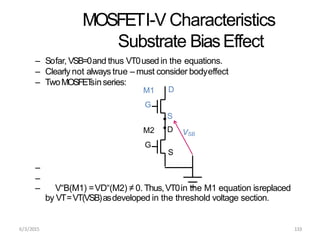
– Sofar, VSB=0and thus VT0used in the equations.
– Clearly not always true – must consider bodyeffect
– TwoMOSFET
sinseries:
–
–
– V“B(M1) =VD“(M2) ≠ 0. Thus,VT0in the M1 equation isreplaced
by VT=VT(VSB)asdeveloped in the threshold voltage section.
D
S
D
M1
G
M2
G
VSB
S
6/3/2015 133
6/3/2015 134
MOSFETI-V Characteristics
Substrate BiasEffect (Cont.)
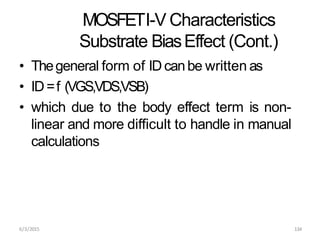
• Thegeneral form of IDcanbe written as
• ID=f (VGS,VDS,VSB)
• which due to the body effect term is non-
linear and more difficult to handle in manual
calculations
MOSFETI-V Characteristics
Summary of AnalyticalEquations
– Thevoltage directions and relationships for thethree
modes of pMOSare in contrast to those ofnMOS.
G
D
B
S
VSB VDS
VGS ID
G
S
VDS
VSB
B
VGS
ID
D
nMOS
Mode ID Voltage Range
Cut-off 0 VGS<VT
Linear (µnCox/2)(W/L)[2(VGS
- VT)VDS-VDS
2]
VGSVT,VDS< VGS
-VT
Saturatio
n
(µnCox/2)(W/L)(VGS-
VT)2(1+hVDS)
VGS  VT,VDS 
VGS -VT
pMOS
Cut-off 0 VGS>VT
Linear (µnCox/2)(W/L)[2(VGS
- VT)VDS-VDS
2]
VGS VT,VDS>
VGS -VT
Saturatio
n
(µnCox/2)(W/L)(VGS-
V )2(1+hV )
VGS  VT,VDS135
V -V
6/3/2015
Pass-TransistorLogicCircuits (1)
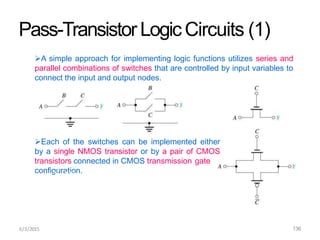
A simple approach for implementing logic functions utilizes series and
parallel combinations of switches that are controlled by input variables to
connect the input and output nodes.
Each of the switches can be implemented either
by a single NMOS transistor or by a pair of CMOS
transistors connected in CMOS transmission gate
configuration.
Y=AC
6/3/2015 136
6/3/2015 137
Pass-TransistorLogicCircuits (2)
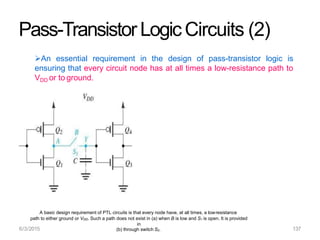
An essential requirement in the design of pass-transistor logic is
ensuring that every circuit node has at all times a low-resistance path to
VDD or to ground.
A basic design requirement of PTL circuits is that every node have, at all times, a lowresistance
path to either ground or VDD. Such a path does not exist in (a) when B is low and S1 is open. It is provided
in
(b) through switch S2.
Pass-TransistorLogicCircuits (3)
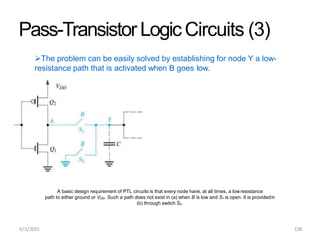
The problem can be easily solved by establishing for node Y a low-
resistance path that is activated when B goes low.
A basic design requirement of PTL circuits is that every node have, at all times, a lowresistance
path to either ground or VDD. Such a path does not exist in (a) when B is low and S1 is open. It is providedin
(b) through switch S2.
6/3/2015 138
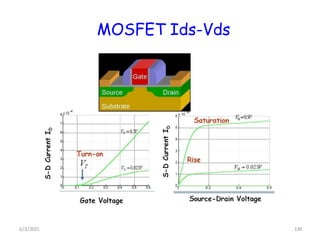
MOSFET Ids-Vds
6/3/2015 139
6/3/2015 144
I-V Characteristics
• In Linear region, Ids dependson
– How much charge is in the channel?
– How fast is the chargemoving?
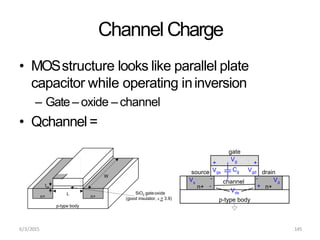
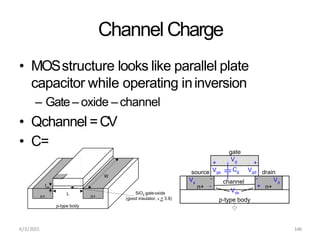
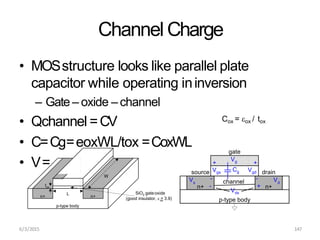
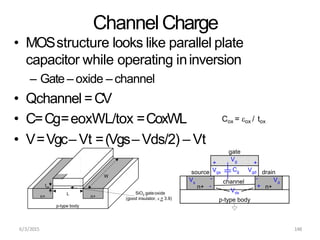
Channel Charge
• MOSstructure looks like parallel plate
capacitor while operating ininversion
– Gate – oxide – channel
• Qchannel =
n+ n+
Vgd
gate
+ +
source Vgs
-
+
drain
Vds
p-type body
channel
-
-
Vg
Vs
Vd
Cg
n+ n+
p-type body
W
L
tox
SiO2 gateoxide
ox
(good insulator,  = 3.9)
polysilicon
gate
6/3/2015 145
Channel Charge
n+ n+
Vgd
• MOSstructure looks like parallel plate
capacitor while operating ininversion
– Gate – oxide – channel
• Qchannel =CV
• C=
gate
+ +
source Vgs
-
+
drain
Vds
p-type body
channel
-
-
Vg
Vs
Vd
Cg
n+ n+
p-type body
W
L
tox
SiO2 gateoxide
ox
(good insulator,  = 3.9)
polysilicon
gate
6/3/2015 146
Channel Charge
• MOSstructure looks like parallel plate
capacitor while operating ininversion
– Gate – oxide – channel
• Qchannel =CV
• C=Cg=eoxWL/tox =CoxWL
• V=
n+ n+
Vgd
gate
+ +
source Vgs
-
+
drain
Vds
p-type body
channel
-
-
Vg
Vs
Vd
Cg
n+ n+
p-type body
W
L
tox
SiO2 gateoxide
ox
(good insulator,  = 3.9)
polysilicon
gate
Cox = ox / tox
6/3/2015 147
Channel Charge
• MOSstructure looks like parallel plate
capacitor while operating ininversion
– Gate – oxide – channel
• Qchannel =CV
• C=Cg=eoxWL/tox =CoxWL
• V=Vgc– Vt =(Vgs– Vds/2) – Vt
n+ n+
Vgd
gate
+ +
source Vgs
-
+
drain
Vds
p-type body
channel
-
-
Vg
Vs
Vd
Cg
n+ n+
p-type body
W
L
tox
SiO2 gateoxide
ox
(good insulator,  = 3.9)
polysilicon
gate
Cox = ox / tox
6/3/2015 148
6/3/2015 149
Carrier velocity
• Chargeis carried by e-
• Carrier velocity v proportional to lateralE-field
between source anddrain
6/3/2015 150
Carrier velocity
• Chargeis carried by e-
• Carrier velocity v proportional to lateralE-field
between source anddrain
• v =mE m called mobility
• E=energy
6/3/2015 151
Carrier velocity
• Chargeiscarried bye-
• Carriervelocity vproportional to lateralE-field
between sourceanddrain
m calledmobility
• v =mE
• E= Vds/L
• Time for carrier to crosschannel:
– t =
6/3/2015 152
Carrier velocity
• Chargeiscarried bye-
• Carriervelocity vproportional to lateralE-field
between sourceanddrain
m calledmobility
• v =mE
• E= Vds/L
• Time for carrier to crosschannel:
– t =L/ v
6/3/2015 153
nMOSLinear I-V
• Now we know
– How much charge Qchannel is in the channel
– How much time t each carrier takes to cross
Ids 
nMOSLinear I-V
• Now we know
– How much charge Qchannel is in the channel
– How much time t each carrier takes to cross
ds
6/3/2015 154
I
t

Qchannel

nMOSLinear I-V
• Now we know
– How much charge Qchannel is in the channel
ox
6/3/2015 155
ds
gs t ds
gs t ds
– H
o
Q
wmuch time t each carrier takes to cross
I  channel
t
 C V Vds
W V 
V
L  2 
V
  V V Vds
 2 
 
ox
W
L
 =C
6/3/2015 156
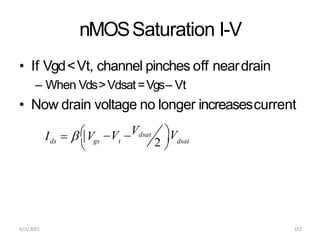
nMOSSaturation I-V
• If Vgd<Vt, channel pinches off neardrain
– When Vds>Vdsat=Vgs– Vt
• Now drain voltage no longer increasescurrent
Ids 
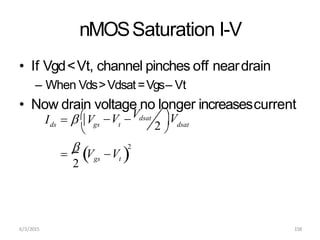
nMOSSaturation I-V
• If Vgd<Vt, channel pinches off neardrain
– When Vds>Vdsat=Vgs– Vt
• Now drain voltage no longer increasescurrent
ds
6/3/2015 157
gs t dsat
V Vdsat
I  V 
V
 2 
nMOSSaturation I-V
• If Vgd<Vt, channel pinches off neardrain
– When Vds>Vdsat=Vgs– Vt
• Now drain voltage no longer increasescurrent

6/3/2015 158
2
2
ds gs t dsat
gs t
V Vdsat
I   V 
V
 2 


V V
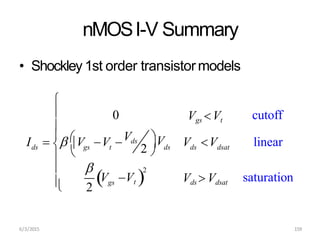
nMOSI-V Summary
• Shockley 1st order transistormodels

6/3/2015 159
2
cutoff
linear
0
2
saturation
ds gs t ds ds dsat
gs
Vgs Vt



V Vds V V
I   V 
V

 2 
V Vt  Vds  Vdsat

 


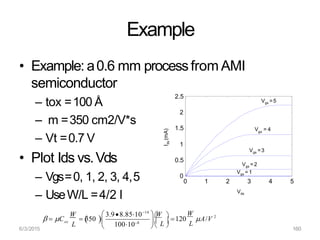
Example
• Example: a0.6 mm processfrom AMI
semiconductor
– tox =100 Å
– m =350 cm2/V*s
– Vt =0.7 V
• Plot Ids vs.Vds
– Vgs=0, 1, 2, 3, 4,5
– UseW/L =4/2 l
  2
ox
W
L
A/V
14
 W
W  3.98.8510
L
 
  C  350 120
   L 
100108
  
0 1 2 3 4 5
0
0.5
1
1.5
2
2.5
Vds
I
ds
(mA)
Vgs =5
gs
V = 4
Vgs =3
Vgs =2
Vgs = 1
6/3/2015 160
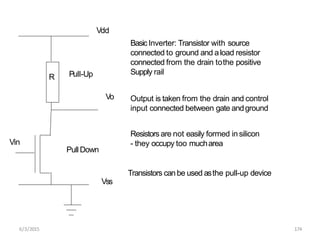
Vdd
Vo
Vin
6/3/2015 174
R Pull-Up
Pull Down
BasicInverter: Transistor with source
connected to ground and aload resistor
connected from the drain tothe positive
Supply rail
Output is taken from the drain and control
input connected between gate andground
Resistors are not easily formed insilicon
- they occupy too mucharea
Transistors canbe used asthe pull-up device
Vss
Vdd
Vss
Vo
Vin
D
S
D
S
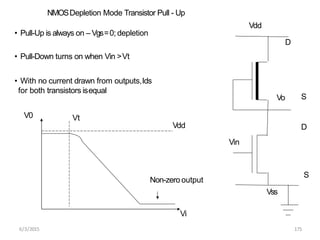
• Pull-Up is always on – Vgs=0; depletion
• Pull-Down turns on when Vin >Vt
NMOSDepletion Mode Transistor Pull - Up
Vt
V0
Vdd
Vi
• With no current drawn from outputs,Ids
for both transistors isequal
6/3/2015 175
Non-zerooutput
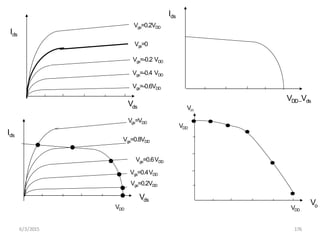
Vgs=0.6VDD
Vgs=0.4VDD
Vgs=0.2VDD
Vgs=0.8VDD
Vgs=VDD
Ids
Vds
VDD
Vo
VDD
VDD
Vin
VDD–Vds
Ids
Vds
Vgs=0
Vgs=-0.2 VDD
Vgs=-0.4 VDD
Vgs=-0.6VDD
6/3/2015 176
Ids
Vgs=0.2VDD
Vo
VDD
VDD
Vin
Vinv
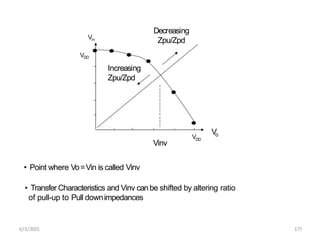
Decreasing
Zpu/Zpd
6/3/2015 177
Increasing
Zpu/Zpd
• Point where Vo=Vin is called Vinv
• Transfer Characteristics and Vinv canbe shifted by altering ratio
of pull-up to Pull downimpedances
6/3/2015 178
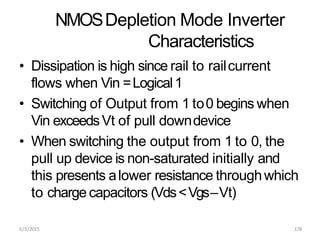
NMOSDepletion Mode Inverter
Characteristics
• Dissipation is high since rail to railcurrent
flows when Vin =Logical1
• Switching of Output from 1 to0 begins when
Vin exceedsVt of pull downdevice
• When switching the output from 1 to 0, the
pull up device is non-saturated initially and
this presents alower resistance throughwhich
to charge capacitors (Vds<Vgs–Vt)
Vss
Vo
Vin
D
S
D
S
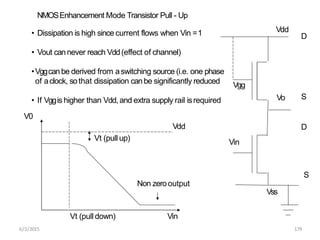
NMOSEnhancement Mode Transistor Pull - Up
Vdd
Vgg
Vt (pull down)
V0
Vdd
Vt (pull up)
6/3/2015 179
Non zerooutput
Vin
• Dissipation is high since current flows when Vin =1
• Vout cannever reach Vdd(effect of channel)
•Vggcanbe derived from aswitching source (i.e. one phase
of aclock, sothat dissipation canbe significantly reduced
• If Vggis higher than Vdd, and extra supply rail isrequired
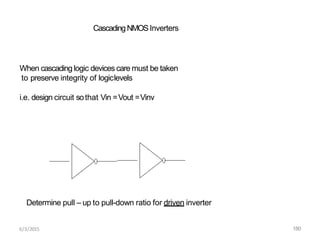
When cascading logic devices care must be taken
to preserve integrity of logiclevels
i.e. design circuit sothat Vin =Vout =Vinv
CascadingNMOSInverters
Determine pull – up to pull-down ratio for driven inverter
6/3/2015 180
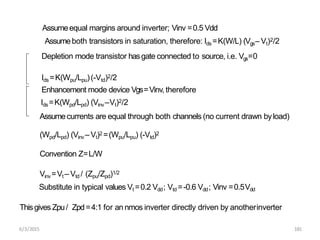
Assumeequal margins around inverter; Vinv =0.5 Vdd
Assumeboth transistors in saturation, therefore: Ids =K(W/L) (Vgs– Vt)2/2
Depletion mode transistor hasgate connected to source, i.e. Vgs=0
Ids =K(Wpu/Lpu)(-Vtd)2/2
Enhancement mode device Vgs=Vinv, therefore
Ids =K(Wpd/Lpd) (Vinv–Vt)2/2
Assumecurrents are equal through both channels (no current drawn byload)
(Wpd/Lpd) (Vinv – Vt)2 =(Wpu/Lpu) (-Vtd)2
Convention Z=L/W
Vinv=Vt – Vtd / (Zpu/Zpd)1/2
Substitute in typical values Vt =0.2 Vdd; Vtd =-0.6 Vdd; Vinv =0.5Vdd
Thisgives Zpu/ Zpd=4:1 for an nmos inverter directly driven by anotherinverter
6/3/2015 181
Vdd
6/3/2015 182
Vdd
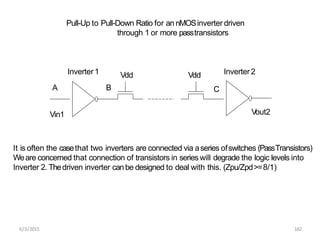
A B C
Inverter1 Inverter2
Vin1 Vout2
Pull-Up to Pull-Down Ratio for an nMOSinverter driven
through 1 or more passtransistors
It is often the casethat two inverters are connected via aseries ofswitches (PassTransistors)
Weare concerned that connection of transistors in series will degrade the logic levels into
Inverter 2. Thedriven inverter canbe designed to deal with this. (Zpu/Zpd>=8/1)
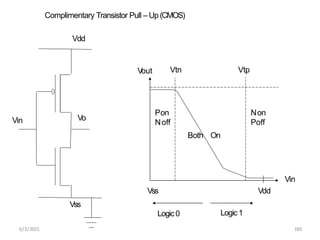
Complimentary Transistor Pull – Up (CMOS)
Vdd
Vss
Vo
Vin
Vout
Vin
Vdd
Vss
Vtn Vtp
Logic0
6/3/2015 183
Logic1
Pon
Noff
Both On
Non
Poff
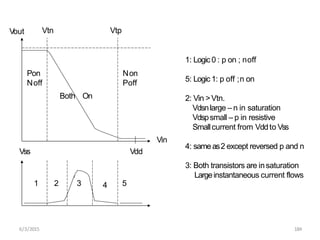
Vout
Vin
Vdd
Vss
Vtn Vtp
Pon
Noff
Both On
Non
Poff
1 2 3 4 5
1: Logic 0 : p on ; noff
6/3/2015 184
5: Logic 1: p off ;n on
2: Vin >Vtn.
Vdsnlarge – n in saturation
Vdspsmall – p in resistive
Smallcurrent from Vddto Vss
4: sameas2 except reversed p and n
3: Both transistors are insaturation
Largeinstantaneous current flows
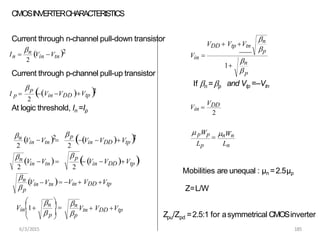
CMOSINVERTERCHARACTERISTICS
Current through n-channel pull-down transistor
2
2
in tn
n
n V V
I 

Current through p-channel pull-up transistor
2
2
p
  Vtp
 Vin VDD
I p 

At logic threshold, In =Ip

p
n
tp
in DD
p
in tn
n
p
n Vin VDD Vtp
Vin Vtn
Vtn  VDD Vtp
 


 Vin  VDD Vtp
Vin Vtn
 V V V 
V V 
 

  
n
p
  p 
 n 




Vin
1
2
2

2

2
2
2
in
n


n
p
VDD  Vtp Vtn
V 
1
If n =p
p
and Vtp =–Vtn
2
VDD
Vin 
 pWp

nWn
Lp Ln
Mobilities are unequal : µn =2.5µp
6/3/2015 185
Z=L/W
pu pd
Z /Z =2.5:1 for asymmetrical CMOSinverter
6/3/2015 186
CMOSInverterCharacteristics
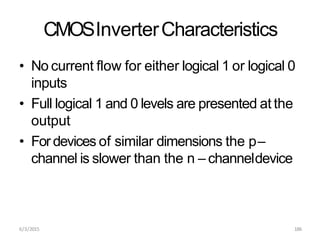
• No current flow for either logical 1 or logical 0
inputs
• Full logical 1 and 0 levels are presented at the
output
• For devices of similar dimensions the p–
channel is slower than the n – channeldevice
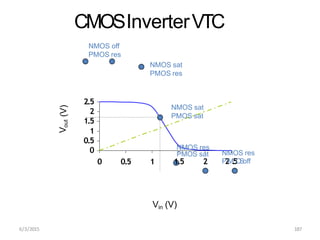
CMOSInverterVTC
1
0.5
0
2
1.5
2.5
0 0.5 1
Vin (V)
V
out
(V)
NMOS off
PMOS res
NMOS sat
PMOS res
NMOS sat
PMOS sat
NMOS res
PMOS sat
1.5 2
NMOS res
P
2
M
.
5
O
Soff
6/3/2015 187
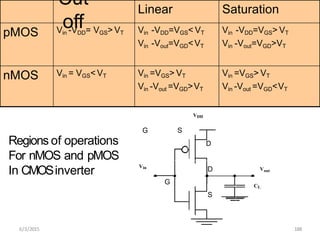
Cut
off
Linear Saturation
pMOS Vin -VDD= VGS> VT Vin -VDD=VGS< VT
Vin -Vout=VGD<VT
Vin -VDD=VGS> VT
Vin -Vout=VGD>VT
nMOS Vin = VGS< VT Vin =VGS> VT
Vin -Vout =VGD>VT
Vin =VGS> VT
Vin -Vout =VGD<VT
VDD
6/3/2015 188
Vin Vout
CL
G S
D
D
G
S
Regions of operations
For nMOS and pMOS
In CMOSinverter
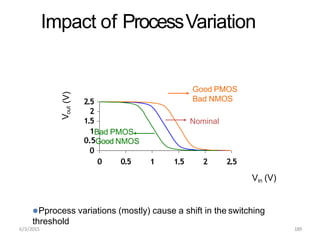
Impact of ProcessVariation
2.5
2
1.5
0 0.5 1 1.5 2 2.5
V
out
(V)
Nominal
Good PMOS
Bad NMOS
1Bad PMOS
0.5Good NMOS
0
Vin (V)
Pprocess variations (mostly) cause a shift in the switching
threshold
6/3/2015 189
6/3/2015 190
CmosInverter
• Look at why our NMOSand PMOSinverters
might not be the best inverterdesigns
• Introduce the CMOSinverter
• Analyze how the CMOSinverterworks
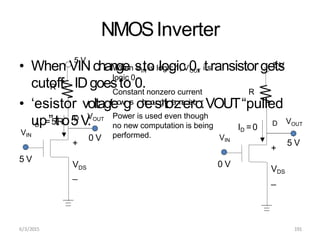
NMOSInverter
• When VINchange
cutoff. IDgoesto 0.
5 V
.
D
D
u
Ip=
”5
/
tR
o
+
VDS
_
R
5 V
VOUT
VIN
5 V
0 V
D
ID =0
+
VDS
_
5 V
V
6/3/2015 191
OUT
VIN
0 V
5 V
When V is logic 1, V
IN OUT
sto logic 0, itsransistorgets
logic 0.
Constant nonzero current R
• ‘esistor voltagf
l
eo
w
gs ot
h
r
eo
u
sg
h
tot
r
a
zn
s
ei
s
rt
o
or
.
.VOUT“pulled
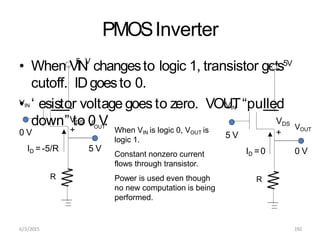
Power is used even though
no new computation is being
performed.
PMOSInverter
OUT
ID =-5/R
down”V
tD
o
S 0
V V
.
+
R
5 V
When VIN is logic 0, VOUT is
logic 1.
Constant nonzero current
flows through transistor.
Power is used even though
no new computation is being
performed.
0 V
• When V
5
I
N
V
changesto logic 1, transistor gets5V
VOUT
ID =0
-
VDS
+
R
0 V
6/3/2015 192
cutoff. IDgoesto 0.
V
•IN ‘ esisto-r voltage goes to zero. VOU
VIT
N “pulled
5 V
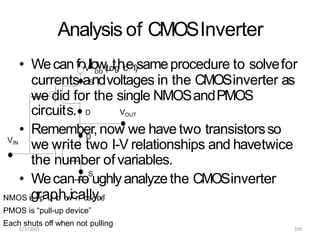
Analysis of CMOSInverter
circuits.
• Remember,now we havetwo transistorsso
we write two I-V relationships and havetwice
D
DD
• WecanfoV
llow(
L
o
tg
hi
c
e1
)sameprocedure to solvefor
D
currents aS
ndvoltages in the CMOSinverter as
we did for the single NMOSandPMOS
VOUT
VIN
the number of variables.
• Wecan roS
ughlyanalyzethe CMOSinverter
NMOS i
s
g“
rp
au
l
pl
-
d
ho
w
icn
ad
le
lv
yi
c
.e
”
PMOS is “pull-up device”
Each shuts off when not pulling
6/3/2015 193
ID(n)
NMOS I-V curve
PMOS I-V curve
(written in terms of
NMOS variables)
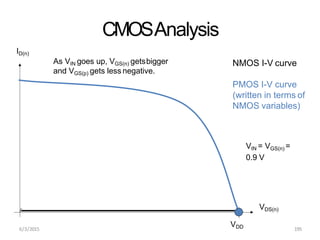
CMOSAnalysis
VIN = VGS(n) =
0.9 V
As VIN goes up, VGS(n) getsbigger
and VGS(p) gets less negative.
VDS(n)
VDD
6/3/2015 195
ID(n)
NMOS I-V curve
PMOS I-V curve
(written in terms of
NMOS variables)
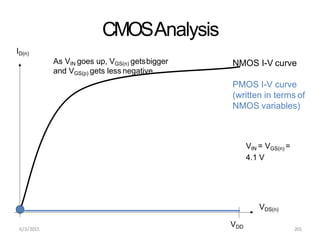
CMOSAnalysis
VIN = VGS(n) =
4.1 V
As VIN goes up, VGS(n) getsbigger
and VGS(p) gets less negative.
VDS(n)
VDD
6/3/2015 201
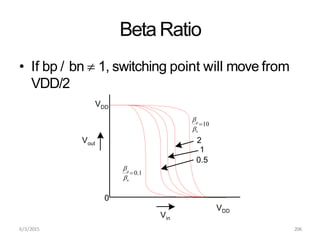
Beta Ratio
• If bp / bn  1, switching point will move from
VDD/2
Vout
0
Vin
VDD
VDD
2
1
0.5
n


p
10
n


p
0.1
6/3/2015 206
6/3/2015 207
VLSICIRCUITDESIGNPROCESSES
Topics
• VLSIdesignflow
• MOSlayers
• Stick diagrams
• DesignRulesand Layout
• 2 um CMOSdesign rules forwires
• Contacts and Transistors
• Layout diagrams for NMOSand
• CMOSinverters and gates, Scalingof MOScircuits
VLSIDesign of
approach of IC
2
6/
03
8/2015
6/3/2015 209
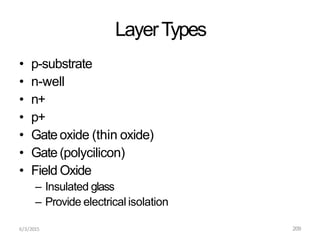
LayerTypes
• p-substrate
• n-well
• n+
• p+
• Gate oxide (thin oxide)
• Gate (polycilicon)
• Field Oxide
– Insulated glass
– Provide electrical isolation
Stick diagram
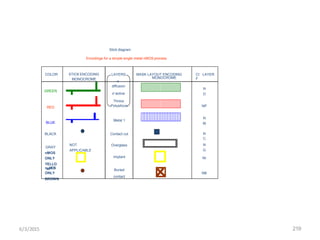
Encodings for a simple single metal nMOS process
BROWN
COLOR STICK ENCODING
MONOCROME
LAYERS MASK LAYOUT ENCODING
MONOCROME
CI
F
LAYER
n-
GREEN
diffusion
n+active
N
D
RED
Thniox
Polysilicon NP
BLUE
Metal 1
N
M
BLACK Contact cut N
C
GRAY
nMOS
ONLY
NOT
APPLICABLE
Overglass
Implant
N
G
NI
YELLO
nWMOS
ONLY
Buried
NB
contact
6/3/2015 219
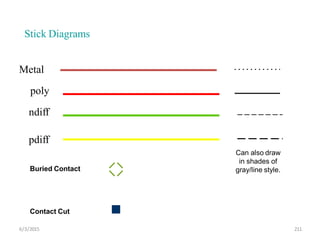
Stick Diagrams
Metal
poly
ndiff
pdiff
Can also draw
in shades of
gray/line style.
Buried Contact
Contact Cut
6/3/2015 211
6/3/2015 212
Stick Diagrams
• VLSIdesign aims to translate circuit concepts
onto silicon.
• Stick diagrams are ameans of capturing
topography and layer information usingsimple
diagrams.
• Stick diagrams convey layer information through
colour codes (or monochromeencoding).
• Acts asan interface between symbolic circuit and
the actuallayout.
6/3/2015 213
Stick Diagrams
• Does show all components/vias.
• It shows relative placement of
components.
• Goes one step closer to the layout
• Helps plan the layout and routing
6/3/2015 214
Stick Diagrams
• Does not show
– Exact placement of components
– Transistor sizes
– Wire lengths, wire widths, tub
boundaries.
– Any other low level details such as
parasitics..
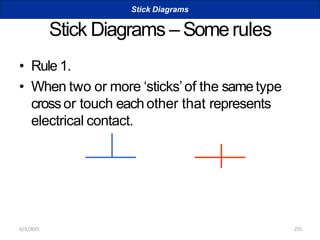
Stick Diagrams – Somerules
• Rule 1.
• When two or more ‘sticks’of the sametype
crossor touch eachother that represents
electrical contact.
Stick Diagrams
6/3/2015 215
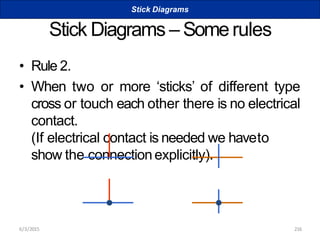
Stick Diagrams – Somerules
• Rule 2.
• When two or more ‘sticks’ of different type
cross or touch each other there is no electrical
contact.
(If electrical contact is needed we haveto
show the connectionexplicitly).
Stick Diagrams
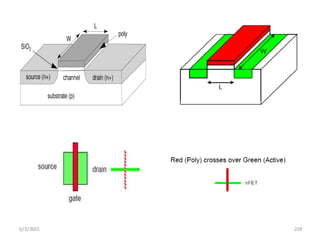
6/3/2015 216
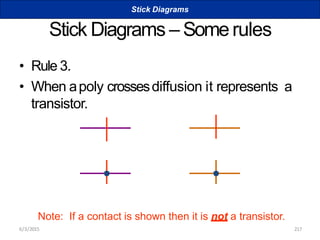
Stick Diagrams – Somerules
• Rule 3.
• When apoly crossesdiffusion it represents a
transistor.
Note: If a contact is shown then it is not a transistor.
Stick Diagrams
6/3/2015 217
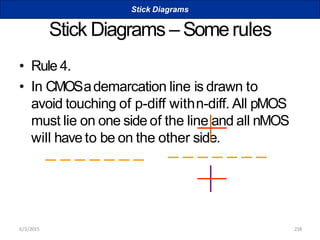
Stick Diagrams – Somerules
• Rule 4.
• In CMOSademarcation line is drawn to
avoid touching of p-diff withn-diff. All pMOS
must lie on one side of the line and all nMOS
will have to be on the other side.
Stick Diagrams
6/3/2015 218
6/3/2015 219
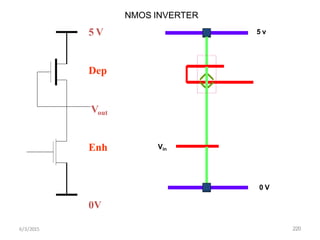
5 V
Dep
Vout
Enh
0V
0 V
Vin
5 v
NMOS INVERTER
6/3/2015 220
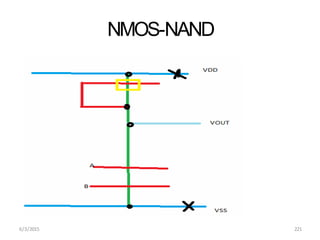
NMOS-NAND
6/3/2015 221
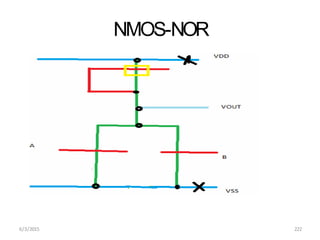
NMOS-NOR
6/3/2015 222
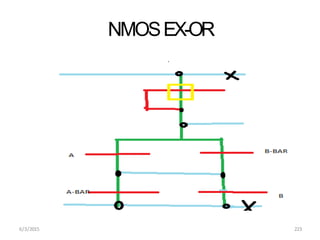
NMOSEX-OR
6/3/2015 223
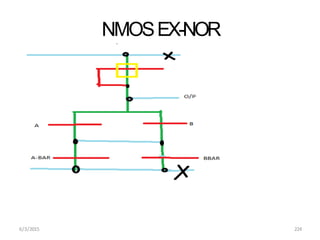
NMOSEX-NOR
6/3/2015 224
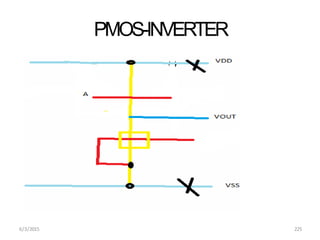
PMOS-INVERTER
6/3/2015 225
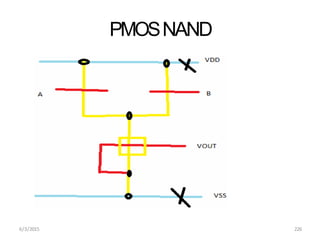
PMOSNAND
6/3/2015 226
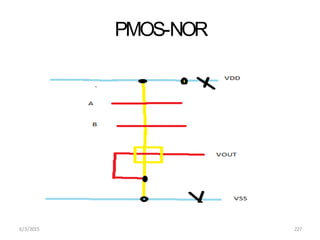
PMOS-NOR
6/3/2015 227
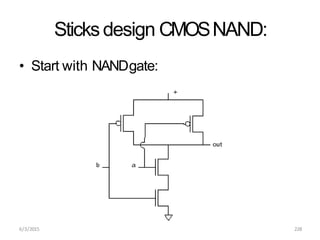
Sticksdesign CMOSNAND:
• Start with NANDgate:
6/3/2015 228
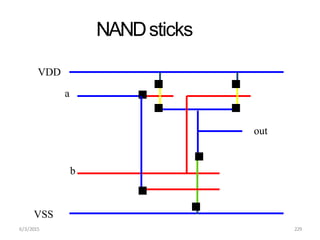
NANDsticks
VDD
a
out
b
VSS
6/3/2015 229
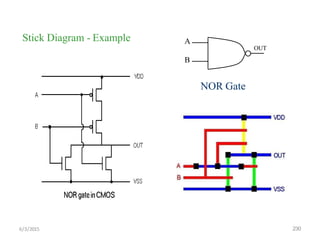
Stick Diagram - Example
OUT
B
NOR Gate
A
6/3/2015 230
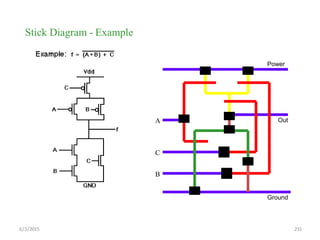
Stick Diagram - Example
Power
6/3/2015 231
Ground
C
B
Out
A
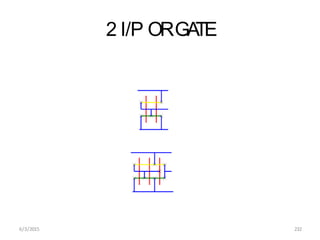
2 I/P ORGA
TE
6/3/2015 232
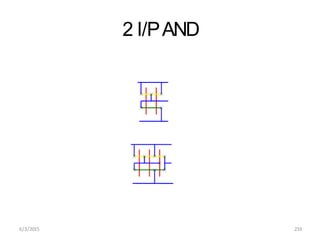
2 I/PAND
6/3/2015 233
6/3/2015 234
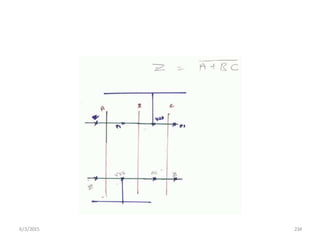
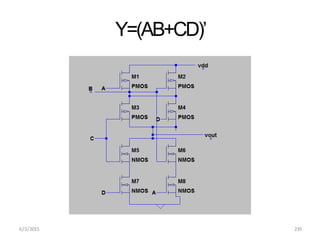
Y=(AB+CD)’
6/3/2015 235
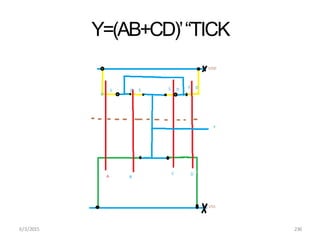
Y=(AB+CD)’“TICK
6/3/2015 236
6/3/2015 237
6/3/2015 238
DesignRules
• Designrules are aset of geometrical
specifications that dictate the design of the layout
masks
• Adesign rule set provides numerical values
– For minimum dimensions
– For minimum line spacings
• Designrules must be followed to insure
functional structures on the fabricatedchip
• Designrules changewith technologicaladvances
(www.mosis.org)

6/3/2015 248
Design Rules
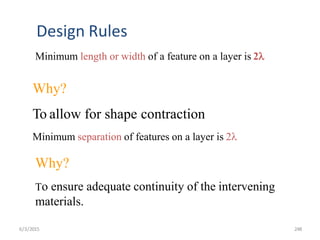
Minimum length or width of a feature on a layer is 2
Why?
To allow for shape contraction
Minimum separation of features on a layer is 2
Why?
To ensure adequate continuity of the intervening
materials.
Design Rules
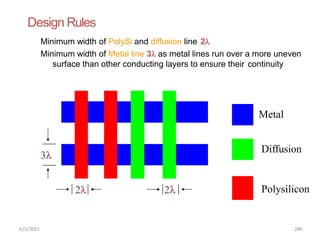
Minimum width of PolySi and diffusion line 2
Minimum width of Metal line 3 as metal lines run over a more uneven
surface than other conducting layers to ensure their continuity

Metal
Diffusion
Polysilicon


6/3/2015 249
Design Rules
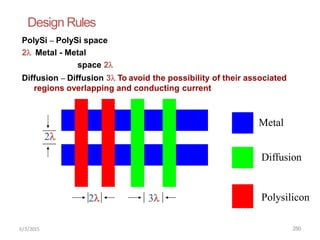
PolySi – PolySi space
2 Metal - Metal
space 2
Diffusion – Diffusion 3 To avoid the possibility of their associated
regions overlapping and conducting current

Metal
Diffusion
Polysilicon


6/3/2015 250
Design Rules
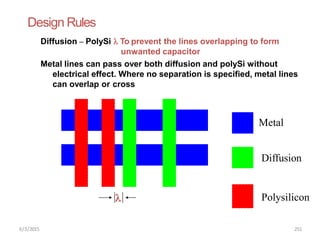
Diffusion – PolySi  To prevent the lines overlapping to form
unwanted capacitor
Metal lines can pass over both diffusion and polySi without
electrical effect. Where no separation is specified, metal lines
can overlap or cross

Metal
Diffusion
Polysilicon
6/3/2015 251
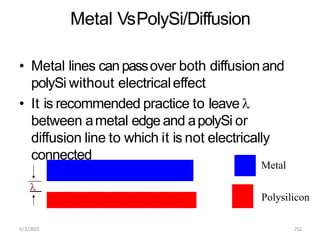
Metal VsPolySi/Diffusion
• Metal lines canpassover both diffusionand
polySi without electricaleffect
• It is recommended practice to leave 
between ametal edge and apolySi or
diffusion line to which it is not electrically
connected

Metal
6/3/2015 252
Polysilicon
6/3/2015 253
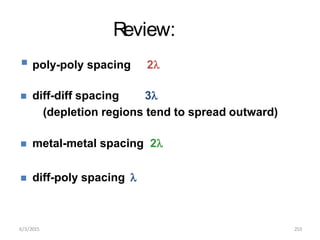
 poly-poly spacing 2
 diff-diff spacing 3
(depletion regions tend to spread outward)
 metal-metal spacing 2
 diff-poly spacing 
Review:
6/3/2015 254
Note
• TwoFeatures on different masklayers canbe
misaligned by amaximum of 2l on thewafer.
• If the overlap of these two different mask
layers canbe catastrophic to the design,they
must be separated by at least2l
• If the overlap is just undesirable, theymust
be separated by at leastl
6/3/2015 255
When a transistor is formed?
Gate is formed where polySi crosses diffusion with
thin oxide between these layers.
Design rules
min. line width of polySi and diffusion 2
drain and source have min. length and width of 2
And
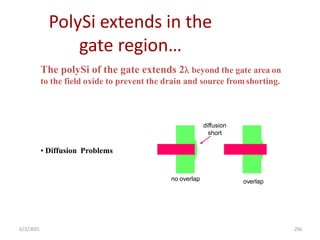
The polySi of the gate extends 2 beyond the gate area on
to the field oxide to prevent the drain and source fromshorting.
no overlap
6/3/2015 256
overlap
diffusion
short
• Diffusion Problems
PolySi extends in the
gate region…
Depletion Transistor
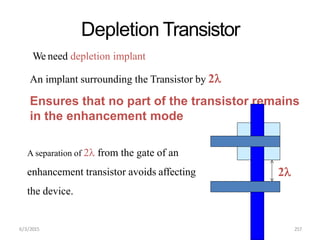
We need depletion implant
An implant surrounding the Transistor by 2
Ensures that no part of the transistor remains
in the enhancement mode
A separation of 2 from the gate of an
enhancement transistor avoids affecting
the device.
2
6/3/2015 257
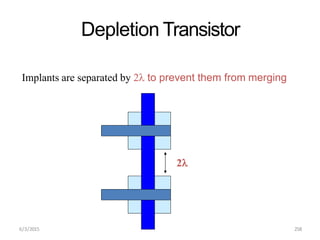
Depletion Transistor
Implants are separated by 2 to prevent them from merging
2
6/3/2015 258
6/3/2015 259
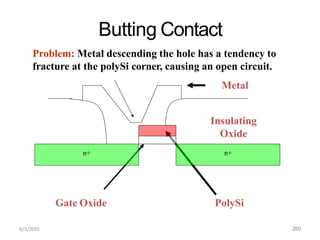
Butting Contact
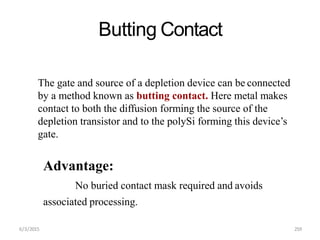
The gate and source of a depletion device can be connected
by a method known as butting contact. Here metal makes
contact to both the diffusion forming the source of the
depletion transistor and to the polySi forming this device’s
gate.
Advantage:
No buried contact mask required and avoids
associated processing.
Butting Contact
n+ n+
Gate Oxide PolySi
Problem: Metal descending the hole has a tendency to
fracture at the polySi corner, causing an open circuit.
Metal
Insulating
Oxide
6/3/2015 260
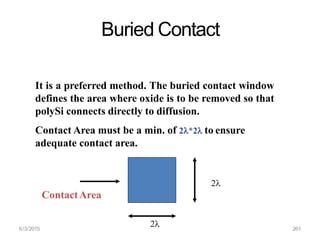
Buried Contact
It is a preferred method. The buried contact window
defines the area where oxide is to be removed so that
polySi connects directly to diffusion.
Contact Area must be a min. of 2*2 to ensure
adequate contact area.
2
ContactArea
2
6/3/2015 261
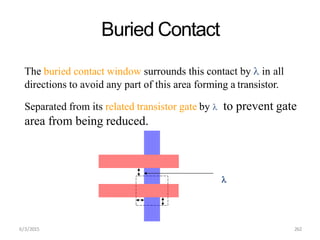
Buried Contact
The buried contact window surrounds this contact by  in all
directions to avoid any part of this area forming a transistor.
Separated from its related transistor gate by  to prevent gate
area from being reduced.

6/3/2015 262
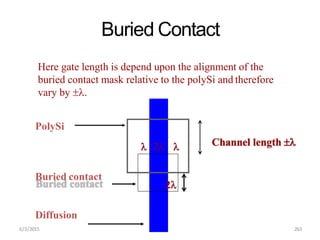
Buried Contact
 2 
2
Here gate length is depend upon the alignment of the
buried contact mask relative to the polySi and therefore
vary by .
PolySi
Channel length 
Buried contact
Diffusion
6/3/2015 263
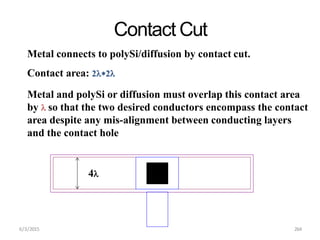
Contact Cut
Metal connects to polySi/diffusion by contact cut.
Contact area: 22
Metal and polySi or diffusion must overlap this contact area
by  so that the two desired conductors encompass the contact
area despite any mis-alignment between conducting layers
and the contact hole
4
6/3/2015 264
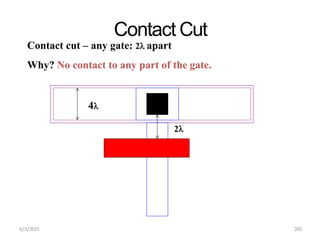
Contact Cut
Contact cut – any gate: 2 apart
Why? No contact to any part of the gate.
4
2
6/3/2015 265
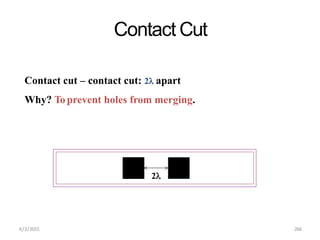
Contact Cut
Contact cut – contact cut: 2 apart
Why? To prevent holes from merging.
2
6/3/2015 266
6/3/2015 267
Rulesfor CMOSlayout
Similar to those for NMOS except No
1. Depletion implant
2. Buried contact
Additional rules
1. Definition of n-well area
2. Threshold implant of two types of transistor
3. Definition of source and drains regions for the
NMOS and PMOS.
Rulesfor CMOSlayout
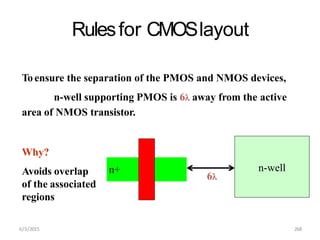
To ensure the separation of the PMOS and NMOS devices,
n-well supporting PMOS is 6 away from the active
area of NMOS transistor.
Why?
Avoids overlap
of the associated
regions
n-well
n+
6
6/3/2015 268
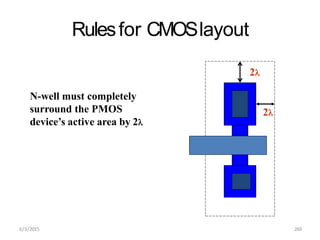
Rulesfor CMOSlayout
2
6/3/2015 269
2
N-well must completely
surround the PMOS
device’s active area by 2
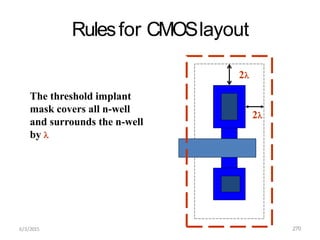
Rulesfor CMOSlayout
2
2
The threshold implant
mask covers all n-well
and surrounds the n-well
by 
6/3/2015 270
Rulesfor CMOSlayout
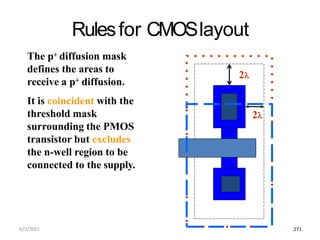
2
2
The p+ diffusion mask
defines the areas to
receive a p+ diffusion.
It is coincident with the
threshold mask
surrounding the PMOS
transistor but excludes
the n-well region to be
connected to the supply.
6/3/2015 271
Rulesfor CMOSlayout
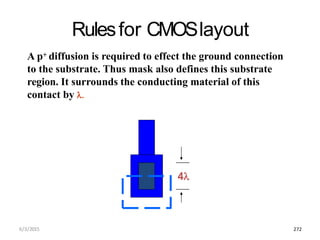
A p+ diffusion is required to effect the ground connection
to the substrate. Thus mask also defines this substrate
region. It surrounds the conducting material of this
contact by 
4
6/3/2015 272
Rulesfor CMOSlayout
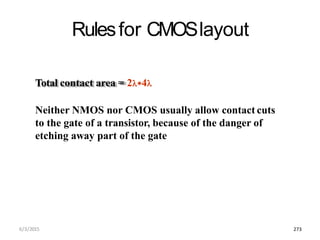
Total contact area = 24
Neither NMOS nor CMOS usually allow contact cuts
to the gate of a transistor, because of the danger of
etching away part of the gate
6/3/2015 273

VLSI-UNIT-2-sheet Resistance and Electrical Properties

  • 1.
    UNIT-II Sheet Resistance(Rs) • ICresistorshaveaspecified thickness – not under the control of the circuit designer • Eliminate t by absorbing itinto anew parameter: the sheet resistance(Rs)     W   t W  Wt sq R  L     L  R  L  “Number of “quares” 6/3/2015 112
  • 2.
    6/3/2015 129 BASICELECTRICALPROPERTIES Topics • Basicelectricalproperties of MOSandBiCMOS circuits: • Ids-Vds relationships • MOStransistor threshold voltage, gm,gds • figure of meritwo • passtransistor • NMOSinverter • Various pull-ups • CMOSinverter analysis anddesign • BiCMOSinverters
  • 3.
    MOSFETI-VCharacteristics I-V Plots, ChannelLength Modulation – Saturation equation yields curves independent of VDS.Not sure!So Quadratic Relationship 0 0.5 1 1.5 0 we consider the effect of channel1 length modulation. 2 3 4 5 6 x 10 -4 VDS(V) I D (A) VGS= 1.5 V VGS= 1.0 V 2 2.5 VGS= 2.5V Resistive Saturation VGS= 2.0 V VDS = VGS - VT 6/3/2015 130
  • 4.
    MOSFETI-V Characteristics Channel LengthModulation • ChannelLength Modulation – With pinch-off the channel at the point y suchthat Vc(y)=VGS- VT0, Theeffective channel length is equal to L’=L–ΔL – ΔLis the length of channelsegment over which QI=0. – PlaceL’in the ID(SAT)equation: )2 2 ID(SAT)  L  V GS V T 0  n Cox W ( Source n+ Drain n+ Substrate (p-Si) (p+) (p+) Oxide 0 y L’ ΔL L ChannelPinch-off point (QI=0) Depletion region VB=0 VS=0 VGS>VT0 VDS>VDSAT 6/3/2015 131
  • 5.
    MOSFETI-V Characteristics Channel LengthModulation – ΔLincreaseswith an increase in VDS. Wecan use – λ: channel lengthmodulation coefficient – ID(SAT)canbe rewritten as – Theabove form produces a discontinuity of current at VDS=VGS- VT0.Wecaninclude the term inID(lin) with little error since λ is typically less than 0.1. Wewill usually ignore λ in manual calculations. L ΔL L L L DS DS  1 1 V  1  1 1  1 1 L1V  1 1 L L  ΔL 1  1 L' L ΔL 2 L 6/3/2015 132 DS GS T0 ID(SAT) V )2 (1 V )  n Cox W (V
  • 6.
    MOSFETI-V Characteristics Substrate BiasEffect –Sofar, VSB=0and thus VT0used in the equations. – Clearly not always true – must consider bodyeffect – TwoMOSFET sinseries: – – – V“B(M1) =VD“(M2) ≠ 0. Thus,VT0in the M1 equation isreplaced by VT=VT(VSB)asdeveloped in the threshold voltage section. D S D M1 G M2 G VSB S 6/3/2015 133
  • 7.
    6/3/2015 134 MOSFETI-V Characteristics SubstrateBiasEffect (Cont.) • Thegeneral form of IDcanbe written as • ID=f (VGS,VDS,VSB) • which due to the body effect term is non- linear and more difficult to handle in manual calculations
  • 8.
    MOSFETI-V Characteristics Summary ofAnalyticalEquations – Thevoltage directions and relationships for thethree modes of pMOSare in contrast to those ofnMOS. G D B S VSB VDS VGS ID G S VDS VSB B VGS ID D nMOS Mode ID Voltage Range Cut-off 0 VGS<VT Linear (µnCox/2)(W/L)[2(VGS - VT)VDS-VDS 2] VGSVT,VDS< VGS -VT Saturatio n (µnCox/2)(W/L)(VGS- VT)2(1+hVDS) VGS  VT,VDS  VGS -VT pMOS Cut-off 0 VGS>VT Linear (µnCox/2)(W/L)[2(VGS - VT)VDS-VDS 2] VGS VT,VDS> VGS -VT Saturatio n (µnCox/2)(W/L)(VGS- V )2(1+hV ) VGS  VT,VDS135 V -V 6/3/2015
  • 9.
    Pass-TransistorLogicCircuits (1) A simpleapproach for implementing logic functions utilizes series and parallel combinations of switches that are controlled by input variables to connect the input and output nodes. Each of the switches can be implemented either by a single NMOS transistor or by a pair of CMOS transistors connected in CMOS transmission gate configuration. Y=AC 6/3/2015 136
  • 10.
    6/3/2015 137 Pass-TransistorLogicCircuits (2) Anessential requirement in the design of pass-transistor logic is ensuring that every circuit node has at all times a low-resistance path to VDD or to ground. A basic design requirement of PTL circuits is that every node have, at all times, a lowresistance path to either ground or VDD. Such a path does not exist in (a) when B is low and S1 is open. It is provided in (b) through switch S2.
  • 11.
    Pass-TransistorLogicCircuits (3) The problemcan be easily solved by establishing for node Y a low- resistance path that is activated when B goes low. A basic design requirement of PTL circuits is that every node have, at all times, a lowresistance path to either ground or VDD. Such a path does not exist in (a) when B is low and S1 is open. It is providedin (b) through switch S2. 6/3/2015 138
  • 12.
  • 13.
    6/3/2015 144 I-V Characteristics •In Linear region, Ids dependson – How much charge is in the channel? – How fast is the chargemoving?
  • 14.
    Channel Charge • MOSstructurelooks like parallel plate capacitor while operating ininversion – Gate – oxide – channel • Qchannel = n+ n+ Vgd gate + + source Vgs - + drain Vds p-type body channel - - Vg Vs Vd Cg n+ n+ p-type body W L tox SiO2 gateoxide ox (good insulator,  = 3.9) polysilicon gate 6/3/2015 145
  • 15.
    Channel Charge n+ n+ Vgd •MOSstructure looks like parallel plate capacitor while operating ininversion – Gate – oxide – channel • Qchannel =CV • C= gate + + source Vgs - + drain Vds p-type body channel - - Vg Vs Vd Cg n+ n+ p-type body W L tox SiO2 gateoxide ox (good insulator,  = 3.9) polysilicon gate 6/3/2015 146
  • 16.
    Channel Charge • MOSstructurelooks like parallel plate capacitor while operating ininversion – Gate – oxide – channel • Qchannel =CV • C=Cg=eoxWL/tox =CoxWL • V= n+ n+ Vgd gate + + source Vgs - + drain Vds p-type body channel - - Vg Vs Vd Cg n+ n+ p-type body W L tox SiO2 gateoxide ox (good insulator,  = 3.9) polysilicon gate Cox = ox / tox 6/3/2015 147
  • 17.
    Channel Charge • MOSstructurelooks like parallel plate capacitor while operating ininversion – Gate – oxide – channel • Qchannel =CV • C=Cg=eoxWL/tox =CoxWL • V=Vgc– Vt =(Vgs– Vds/2) – Vt n+ n+ Vgd gate + + source Vgs - + drain Vds p-type body channel - - Vg Vs Vd Cg n+ n+ p-type body W L tox SiO2 gateoxide ox (good insulator,  = 3.9) polysilicon gate Cox = ox / tox 6/3/2015 148
  • 18.
    6/3/2015 149 Carrier velocity •Chargeis carried by e- • Carrier velocity v proportional to lateralE-field between source anddrain
  • 19.
    6/3/2015 150 Carrier velocity •Chargeis carried by e- • Carrier velocity v proportional to lateralE-field between source anddrain • v =mE m called mobility • E=energy
  • 20.
    6/3/2015 151 Carrier velocity •Chargeiscarried bye- • Carriervelocity vproportional to lateralE-field between sourceanddrain m calledmobility • v =mE • E= Vds/L • Time for carrier to crosschannel: – t =
  • 21.
    6/3/2015 152 Carrier velocity •Chargeiscarried bye- • Carriervelocity vproportional to lateralE-field between sourceanddrain m calledmobility • v =mE • E= Vds/L • Time for carrier to crosschannel: – t =L/ v
  • 22.
    6/3/2015 153 nMOSLinear I-V •Now we know – How much charge Qchannel is in the channel – How much time t each carrier takes to cross Ids 
  • 23.
    nMOSLinear I-V • Nowwe know – How much charge Qchannel is in the channel – How much time t each carrier takes to cross ds 6/3/2015 154 I t  Qchannel 
  • 24.
    nMOSLinear I-V • Nowwe know – How much charge Qchannel is in the channel ox 6/3/2015 155 ds gs t ds gs t ds – H o Q wmuch time t each carrier takes to cross I  channel t  C V Vds W V  V L  2  V   V V Vds  2    ox W L  =C
  • 25.
    6/3/2015 156 nMOSSaturation I-V •If Vgd<Vt, channel pinches off neardrain – When Vds>Vdsat=Vgs– Vt • Now drain voltage no longer increasescurrent Ids 
  • 26.
    nMOSSaturation I-V • IfVgd<Vt, channel pinches off neardrain – When Vds>Vdsat=Vgs– Vt • Now drain voltage no longer increasescurrent ds 6/3/2015 157 gs t dsat V Vdsat I  V  V  2 
  • 27.
    nMOSSaturation I-V • IfVgd<Vt, channel pinches off neardrain – When Vds>Vdsat=Vgs– Vt • Now drain voltage no longer increasescurrent  6/3/2015 158 2 2 ds gs t dsat gs t V Vdsat I   V  V  2    V V
  • 28.
    nMOSI-V Summary • Shockley1st order transistormodels  6/3/2015 159 2 cutoff linear 0 2 saturation ds gs t ds ds dsat gs Vgs Vt    V Vds V V I   V  V   2  V Vt  Vds  Vdsat     
  • 29.
    Example • Example: a0.6mm processfrom AMI semiconductor – tox =100 Å – m =350 cm2/V*s – Vt =0.7 V • Plot Ids vs.Vds – Vgs=0, 1, 2, 3, 4,5 – UseW/L =4/2 l   2 ox W L A/V 14  W W  3.98.8510 L     C  350 120    L  100108    0 1 2 3 4 5 0 0.5 1 1.5 2 2.5 Vds I ds (mA) Vgs =5 gs V = 4 Vgs =3 Vgs =2 Vgs = 1 6/3/2015 160
  • 30.
    Vdd Vo Vin 6/3/2015 174 R Pull-Up PullDown BasicInverter: Transistor with source connected to ground and aload resistor connected from the drain tothe positive Supply rail Output is taken from the drain and control input connected between gate andground Resistors are not easily formed insilicon - they occupy too mucharea Transistors canbe used asthe pull-up device Vss
  • 31.
    Vdd Vss Vo Vin D S D S • Pull-Up isalways on – Vgs=0; depletion • Pull-Down turns on when Vin >Vt NMOSDepletion Mode Transistor Pull - Up Vt V0 Vdd Vi • With no current drawn from outputs,Ids for both transistors isequal 6/3/2015 175 Non-zerooutput
  • 32.
  • 33.
    Vo VDD VDD Vin Vinv Decreasing Zpu/Zpd 6/3/2015 177 Increasing Zpu/Zpd • Pointwhere Vo=Vin is called Vinv • Transfer Characteristics and Vinv canbe shifted by altering ratio of pull-up to Pull downimpedances
  • 34.
    6/3/2015 178 NMOSDepletion ModeInverter Characteristics • Dissipation is high since rail to railcurrent flows when Vin =Logical1 • Switching of Output from 1 to0 begins when Vin exceedsVt of pull downdevice • When switching the output from 1 to 0, the pull up device is non-saturated initially and this presents alower resistance throughwhich to charge capacitors (Vds<Vgs–Vt)
  • 35.
    Vss Vo Vin D S D S NMOSEnhancement Mode TransistorPull - Up Vdd Vgg Vt (pull down) V0 Vdd Vt (pull up) 6/3/2015 179 Non zerooutput Vin • Dissipation is high since current flows when Vin =1 • Vout cannever reach Vdd(effect of channel) •Vggcanbe derived from aswitching source (i.e. one phase of aclock, sothat dissipation canbe significantly reduced • If Vggis higher than Vdd, and extra supply rail isrequired
  • 36.
    When cascading logicdevices care must be taken to preserve integrity of logiclevels i.e. design circuit sothat Vin =Vout =Vinv CascadingNMOSInverters Determine pull – up to pull-down ratio for driven inverter 6/3/2015 180
  • 37.
    Assumeequal margins aroundinverter; Vinv =0.5 Vdd Assumeboth transistors in saturation, therefore: Ids =K(W/L) (Vgs– Vt)2/2 Depletion mode transistor hasgate connected to source, i.e. Vgs=0 Ids =K(Wpu/Lpu)(-Vtd)2/2 Enhancement mode device Vgs=Vinv, therefore Ids =K(Wpd/Lpd) (Vinv–Vt)2/2 Assumecurrents are equal through both channels (no current drawn byload) (Wpd/Lpd) (Vinv – Vt)2 =(Wpu/Lpu) (-Vtd)2 Convention Z=L/W Vinv=Vt – Vtd / (Zpu/Zpd)1/2 Substitute in typical values Vt =0.2 Vdd; Vtd =-0.6 Vdd; Vinv =0.5Vdd Thisgives Zpu/ Zpd=4:1 for an nmos inverter directly driven by anotherinverter 6/3/2015 181
  • 38.
    Vdd 6/3/2015 182 Vdd A BC Inverter1 Inverter2 Vin1 Vout2 Pull-Up to Pull-Down Ratio for an nMOSinverter driven through 1 or more passtransistors It is often the casethat two inverters are connected via aseries ofswitches (PassTransistors) Weare concerned that connection of transistors in series will degrade the logic levels into Inverter 2. Thedriven inverter canbe designed to deal with this. (Zpu/Zpd>=8/1)
  • 39.
    Complimentary Transistor Pull– Up (CMOS) Vdd Vss Vo Vin Vout Vin Vdd Vss Vtn Vtp Logic0 6/3/2015 183 Logic1 Pon Noff Both On Non Poff
  • 40.
    Vout Vin Vdd Vss Vtn Vtp Pon Noff Both On Non Poff 12 3 4 5 1: Logic 0 : p on ; noff 6/3/2015 184 5: Logic 1: p off ;n on 2: Vin >Vtn. Vdsnlarge – n in saturation Vdspsmall – p in resistive Smallcurrent from Vddto Vss 4: sameas2 except reversed p and n 3: Both transistors are insaturation Largeinstantaneous current flows
  • 41.
    CMOSINVERTERCHARACTERISTICS Current through n-channelpull-down transistor 2 2 in tn n n V V I   Current through p-channel pull-up transistor 2 2 p   Vtp  Vin VDD I p   At logic threshold, In =Ip  p n tp in DD p in tn n p n Vin VDD Vtp Vin Vtn Vtn  VDD Vtp      Vin  VDD Vtp Vin Vtn  V V V  V V        n p   p   n      Vin 1 2 2  2  2 2 2 in n   n p VDD  Vtp Vtn V  1 If n =p p and Vtp =–Vtn 2 VDD Vin   pWp  nWn Lp Ln Mobilities are unequal : µn =2.5µp 6/3/2015 185 Z=L/W pu pd Z /Z =2.5:1 for asymmetrical CMOSinverter
  • 42.
    6/3/2015 186 CMOSInverterCharacteristics • Nocurrent flow for either logical 1 or logical 0 inputs • Full logical 1 and 0 levels are presented at the output • For devices of similar dimensions the p– channel is slower than the n – channeldevice
  • 43.
    CMOSInverterVTC 1 0.5 0 2 1.5 2.5 0 0.5 1 Vin(V) V out (V) NMOS off PMOS res NMOS sat PMOS res NMOS sat PMOS sat NMOS res PMOS sat 1.5 2 NMOS res P 2 M . 5 O Soff 6/3/2015 187
  • 44.
    Cut off Linear Saturation pMOS Vin-VDD= VGS> VT Vin -VDD=VGS< VT Vin -Vout=VGD<VT Vin -VDD=VGS> VT Vin -Vout=VGD>VT nMOS Vin = VGS< VT Vin =VGS> VT Vin -Vout =VGD>VT Vin =VGS> VT Vin -Vout =VGD<VT VDD 6/3/2015 188 Vin Vout CL G S D D G S Regions of operations For nMOS and pMOS In CMOSinverter
  • 45.
    Impact of ProcessVariation 2.5 2 1.5 00.5 1 1.5 2 2.5 V out (V) Nominal Good PMOS Bad NMOS 1Bad PMOS 0.5Good NMOS 0 Vin (V) Pprocess variations (mostly) cause a shift in the switching threshold 6/3/2015 189
  • 46.
    6/3/2015 190 CmosInverter • Lookat why our NMOSand PMOSinverters might not be the best inverterdesigns • Introduce the CMOSinverter • Analyze how the CMOSinverterworks
  • 47.
    NMOSInverter • When VINchange cutoff.IDgoesto 0. 5 V . D D u Ip= ”5 / tR o + VDS _ R 5 V VOUT VIN 5 V 0 V D ID =0 + VDS _ 5 V V 6/3/2015 191 OUT VIN 0 V 5 V When V is logic 1, V IN OUT sto logic 0, itsransistorgets logic 0. Constant nonzero current R • ‘esistor voltagf l eo w gs ot h r eo u sg h tot r a zn s ei s rt o or . .VOUT“pulled Power is used even though no new computation is being performed.
  • 48.
    PMOSInverter OUT ID =-5/R down”V tD o S 0 VV . + R 5 V When VIN is logic 0, VOUT is logic 1. Constant nonzero current flows through transistor. Power is used even though no new computation is being performed. 0 V • When V 5 I N V changesto logic 1, transistor gets5V VOUT ID =0 - VDS + R 0 V 6/3/2015 192 cutoff. IDgoesto 0. V •IN ‘ esisto-r voltage goes to zero. VOU VIT N “pulled 5 V
  • 49.
    Analysis of CMOSInverter circuits. •Remember,now we havetwo transistorsso we write two I-V relationships and havetwice D DD • WecanfoV llow( L o tg hi c e1 )sameprocedure to solvefor D currents aS ndvoltages in the CMOSinverter as we did for the single NMOSandPMOS VOUT VIN the number of variables. • Wecan roS ughlyanalyzethe CMOSinverter NMOS i s g“ rp au l pl - d ho w icn ad le lv yi c .e ” PMOS is “pull-up device” Each shuts off when not pulling 6/3/2015 193
  • 50.
    ID(n) NMOS I-V curve PMOSI-V curve (written in terms of NMOS variables) CMOSAnalysis VIN = VGS(n) = 0.9 V As VIN goes up, VGS(n) getsbigger and VGS(p) gets less negative. VDS(n) VDD 6/3/2015 195
  • 51.
    ID(n) NMOS I-V curve PMOSI-V curve (written in terms of NMOS variables) CMOSAnalysis VIN = VGS(n) = 4.1 V As VIN goes up, VGS(n) getsbigger and VGS(p) gets less negative. VDS(n) VDD 6/3/2015 201
  • 52.
    Beta Ratio • Ifbp / bn  1, switching point will move from VDD/2 Vout 0 Vin VDD VDD 2 1 0.5 n   p 10 n   p 0.1 6/3/2015 206
  • 53.
    6/3/2015 207 VLSICIRCUITDESIGNPROCESSES Topics • VLSIdesignflow •MOSlayers • Stick diagrams • DesignRulesand Layout • 2 um CMOSdesign rules forwires • Contacts and Transistors • Layout diagrams for NMOSand • CMOSinverters and gates, Scalingof MOScircuits
  • 54.
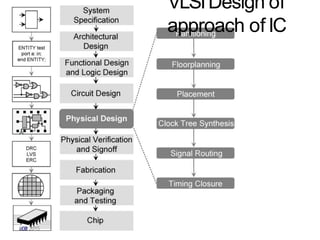
    VLSIDesign of approach ofIC 2 6/ 03 8/2015
  • 55.
    6/3/2015 209 LayerTypes • p-substrate •n-well • n+ • p+ • Gate oxide (thin oxide) • Gate (polycilicon) • Field Oxide – Insulated glass – Provide electrical isolation
  • 56.
    Stick diagram Encodings fora simple single metal nMOS process BROWN COLOR STICK ENCODING MONOCROME LAYERS MASK LAYOUT ENCODING MONOCROME CI F LAYER n- GREEN diffusion n+active N D RED Thniox Polysilicon NP BLUE Metal 1 N M BLACK Contact cut N C GRAY nMOS ONLY NOT APPLICABLE Overglass Implant N G NI YELLO nWMOS ONLY Buried NB contact 6/3/2015 219
  • 57.
    Stick Diagrams Metal poly ndiff pdiff Can alsodraw in shades of gray/line style. Buried Contact Contact Cut 6/3/2015 211
  • 58.
    6/3/2015 212 Stick Diagrams •VLSIdesign aims to translate circuit concepts onto silicon. • Stick diagrams are ameans of capturing topography and layer information usingsimple diagrams. • Stick diagrams convey layer information through colour codes (or monochromeencoding). • Acts asan interface between symbolic circuit and the actuallayout.
  • 59.
    6/3/2015 213 Stick Diagrams •Does show all components/vias. • It shows relative placement of components. • Goes one step closer to the layout • Helps plan the layout and routing
  • 60.
    6/3/2015 214 Stick Diagrams •Does not show – Exact placement of components – Transistor sizes – Wire lengths, wire widths, tub boundaries. – Any other low level details such as parasitics..
  • 61.
    Stick Diagrams –Somerules • Rule 1. • When two or more ‘sticks’of the sametype crossor touch eachother that represents electrical contact. Stick Diagrams 6/3/2015 215
  • 62.
    Stick Diagrams –Somerules • Rule 2. • When two or more ‘sticks’ of different type cross or touch each other there is no electrical contact. (If electrical contact is needed we haveto show the connectionexplicitly). Stick Diagrams 6/3/2015 216
  • 63.
    Stick Diagrams –Somerules • Rule 3. • When apoly crossesdiffusion it represents a transistor. Note: If a contact is shown then it is not a transistor. Stick Diagrams 6/3/2015 217
  • 64.
    Stick Diagrams –Somerules • Rule 4. • In CMOSademarcation line is drawn to avoid touching of p-diff withn-diff. All pMOS must lie on one side of the line and all nMOS will have to be on the other side. Stick Diagrams 6/3/2015 218
  • 65.
  • 66.
    5 V Dep Vout Enh 0V 0 V Vin 5v NMOS INVERTER 6/3/2015 220
  • 67.
  • 68.
  • 69.
  • 70.
  • 71.
  • 72.
  • 73.
  • 74.
    Sticksdesign CMOSNAND: • Startwith NANDgate: 6/3/2015 228
  • 75.
  • 76.
    Stick Diagram -Example OUT B NOR Gate A 6/3/2015 230
  • 77.
    Stick Diagram -Example Power 6/3/2015 231 Ground C B Out A
  • 78.
  • 79.
  • 80.
  • 81.
  • 82.
  • 83.
  • 84.
    6/3/2015 238 DesignRules • Designrulesare aset of geometrical specifications that dictate the design of the layout masks • Adesign rule set provides numerical values – For minimum dimensions – For minimum line spacings • Designrules must be followed to insure functional structures on the fabricatedchip • Designrules changewith technologicaladvances (www.mosis.org)
  • 85.
    6/3/2015 248 Design Rules Minimumlength or width of a feature on a layer is 2 Why? To allow for shape contraction Minimum separation of features on a layer is 2 Why? To ensure adequate continuity of the intervening materials.
  • 86.
    Design Rules Minimum widthof PolySi and diffusion line 2 Minimum width of Metal line 3 as metal lines run over a more uneven surface than other conducting layers to ensure their continuity  Metal Diffusion Polysilicon   6/3/2015 249
  • 87.
    Design Rules PolySi –PolySi space 2 Metal - Metal space 2 Diffusion – Diffusion 3 To avoid the possibility of their associated regions overlapping and conducting current  Metal Diffusion Polysilicon   6/3/2015 250
  • 88.
    Design Rules Diffusion –PolySi  To prevent the lines overlapping to form unwanted capacitor Metal lines can pass over both diffusion and polySi without electrical effect. Where no separation is specified, metal lines can overlap or cross  Metal Diffusion Polysilicon 6/3/2015 251
  • 89.
    Metal VsPolySi/Diffusion • Metallines canpassover both diffusionand polySi without electricaleffect • It is recommended practice to leave  between ametal edge and apolySi or diffusion line to which it is not electrically connected  Metal 6/3/2015 252 Polysilicon
  • 90.
    6/3/2015 253  poly-polyspacing 2  diff-diff spacing 3 (depletion regions tend to spread outward)  metal-metal spacing 2  diff-poly spacing  Review:
  • 91.
    6/3/2015 254 Note • TwoFeatureson different masklayers canbe misaligned by amaximum of 2l on thewafer. • If the overlap of these two different mask layers canbe catastrophic to the design,they must be separated by at least2l • If the overlap is just undesirable, theymust be separated by at leastl
  • 92.
    6/3/2015 255 When atransistor is formed? Gate is formed where polySi crosses diffusion with thin oxide between these layers. Design rules min. line width of polySi and diffusion 2 drain and source have min. length and width of 2 And
  • 93.
    The polySi ofthe gate extends 2 beyond the gate area on to the field oxide to prevent the drain and source fromshorting. no overlap 6/3/2015 256 overlap diffusion short • Diffusion Problems PolySi extends in the gate region…
  • 94.
    Depletion Transistor We needdepletion implant An implant surrounding the Transistor by 2 Ensures that no part of the transistor remains in the enhancement mode A separation of 2 from the gate of an enhancement transistor avoids affecting the device. 2 6/3/2015 257
  • 95.
    Depletion Transistor Implants areseparated by 2 to prevent them from merging 2 6/3/2015 258
  • 96.
    6/3/2015 259 Butting Contact Thegate and source of a depletion device can be connected by a method known as butting contact. Here metal makes contact to both the diffusion forming the source of the depletion transistor and to the polySi forming this device’s gate. Advantage: No buried contact mask required and avoids associated processing.
  • 97.
    Butting Contact n+ n+ GateOxide PolySi Problem: Metal descending the hole has a tendency to fracture at the polySi corner, causing an open circuit. Metal Insulating Oxide 6/3/2015 260
  • 98.
    Buried Contact It isa preferred method. The buried contact window defines the area where oxide is to be removed so that polySi connects directly to diffusion. Contact Area must be a min. of 2*2 to ensure adequate contact area. 2 ContactArea 2 6/3/2015 261
  • 99.
    Buried Contact The buriedcontact window surrounds this contact by  in all directions to avoid any part of this area forming a transistor. Separated from its related transistor gate by  to prevent gate area from being reduced.  6/3/2015 262
  • 100.
    Buried Contact  2 2 Here gate length is depend upon the alignment of the buried contact mask relative to the polySi and therefore vary by . PolySi Channel length  Buried contact Diffusion 6/3/2015 263
  • 101.
    Contact Cut Metal connectsto polySi/diffusion by contact cut. Contact area: 22 Metal and polySi or diffusion must overlap this contact area by  so that the two desired conductors encompass the contact area despite any mis-alignment between conducting layers and the contact hole 4 6/3/2015 264
  • 102.
    Contact Cut Contact cut– any gate: 2 apart Why? No contact to any part of the gate. 4 2 6/3/2015 265
  • 103.
    Contact Cut Contact cut– contact cut: 2 apart Why? To prevent holes from merging. 2 6/3/2015 266
  • 104.
    6/3/2015 267 Rulesfor CMOSlayout Similarto those for NMOS except No 1. Depletion implant 2. Buried contact Additional rules 1. Definition of n-well area 2. Threshold implant of two types of transistor 3. Definition of source and drains regions for the NMOS and PMOS.
  • 105.
    Rulesfor CMOSlayout To ensurethe separation of the PMOS and NMOS devices, n-well supporting PMOS is 6 away from the active area of NMOS transistor. Why? Avoids overlap of the associated regions n-well n+ 6 6/3/2015 268
  • 106.
    Rulesfor CMOSlayout 2 6/3/2015 269 2 N-wellmust completely surround the PMOS device’s active area by 2
  • 107.
    Rulesfor CMOSlayout 2 2 The thresholdimplant mask covers all n-well and surrounds the n-well by  6/3/2015 270
  • 108.
    Rulesfor CMOSlayout 2 2 The p+diffusion mask defines the areas to receive a p+ diffusion. It is coincident with the threshold mask surrounding the PMOS transistor but excludes the n-well region to be connected to the supply. 6/3/2015 271
  • 109.
    Rulesfor CMOSlayout A p+diffusion is required to effect the ground connection to the substrate. Thus mask also defines this substrate region. It surrounds the conducting material of this contact by  4 6/3/2015 272
  • 110.
    Rulesfor CMOSlayout Total contactarea = 24 Neither NMOS nor CMOS usually allow contact cuts to the gate of a transistor, because of the danger of etching away part of the gate 6/3/2015 273