MEASUREMENT OF HEALTH
AND DISEASE
Ms. Jyoti Chand
MSc Nursing
AIIMS RISHIKESH
Objectives
◦ Explain the measurement of health and disease
◦ Define measurement of morbidity
◦ Elaborate measurement of mortality
Tools of measurement
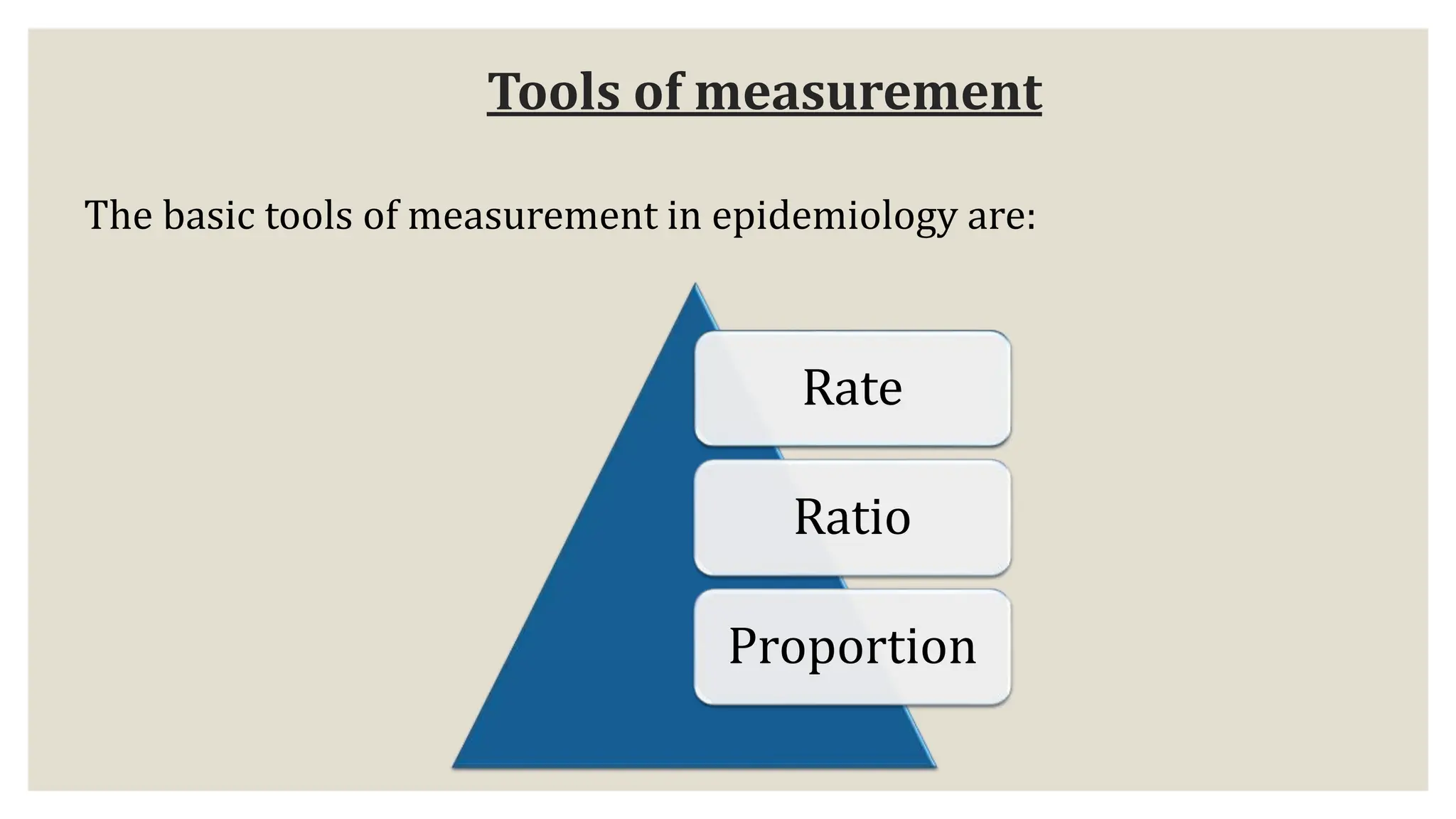
The basic tools of measurement in epidemiology are:
Rate
Ratio
Proportion
Rates
◦ A rate measures the occurrence of some particular event
(development of disease or the occurrence of death) in a population
during a given period of time.
◦ It indicates the change in some event that takes place in a
population over a period of time.
◦ A rate comprises the following elements:
Numerator
 denominator
 time specification and
Multiplier
RATE= Numerator (a) is a part of denominator (b) and multiplier is
1000 or 10,000 or 100,000
Types of rates
Crude rate
Specific Rate
Crude rate
“These are the actual observed rates such as the birth & death rates.”
CDR= No. of deaths in one year in a specified area
× 1000
mid year population of the specified area during the same year
Exercise
If,
total number of deaths is, 4000
Mid year population at that time = 2,000,000
Calculate the crude death rate??
Specific Rates
◦ These are actual observed rates due to specific causes (e.g.
tuberculosis); or occurring in specific rates (e.g. age-sex groups)
or during specific time periods (e.g. annual, monthly or weekly
rates).
Cause specific death rate=
No. of deaths from specific cause in an area during a year
× 1000
mid year population of the same area during the same year
Exercise
Total no of deaths from an age 20-40 = 1500
Mid year population at risk= 5,550
Calculate the specific death rate??
Ratio
◦ Another measure of disease frequency is ‘ratio’.
◦ It expresses a relation in size between two random quantities. The
numerator is not a component of denominator. It is expressed in the
form of x y or x/y
◦ Example: The ratio of white blood cells relative to red cells is 1:600
or 1/600, meaning that for each white cell, there are 600 red cells.
RATIO= Numerator is not a part of denominator and both
numerator and denominator are unrelated
Proportions:
◦ Expressed in percentage
◦ Numerator is a part of denominator.
◦ Multiplier is only 100
Example- in skin OPD, number of patients attended on 24/7/2022
was 60, out of which 48 were female.
= 48/60
=0.8% or 80%
Indicators of health
Mortality indicators
Morbidity indicators
MEASUREMENT OF MORBIDITY
Morbidity has been defined as any departure, subjective or
objective, from a state of physiological well-being. The term is used
equivalent to such terms as sickness, illness, disability, etc.
Three aspects of morbidity are frequency, duration and severity.
Disease frequency is measured by incidence and prevalence rates.
Morbidity
Indicators
1. Incidence rate
2. Prevalence rate
Incidence
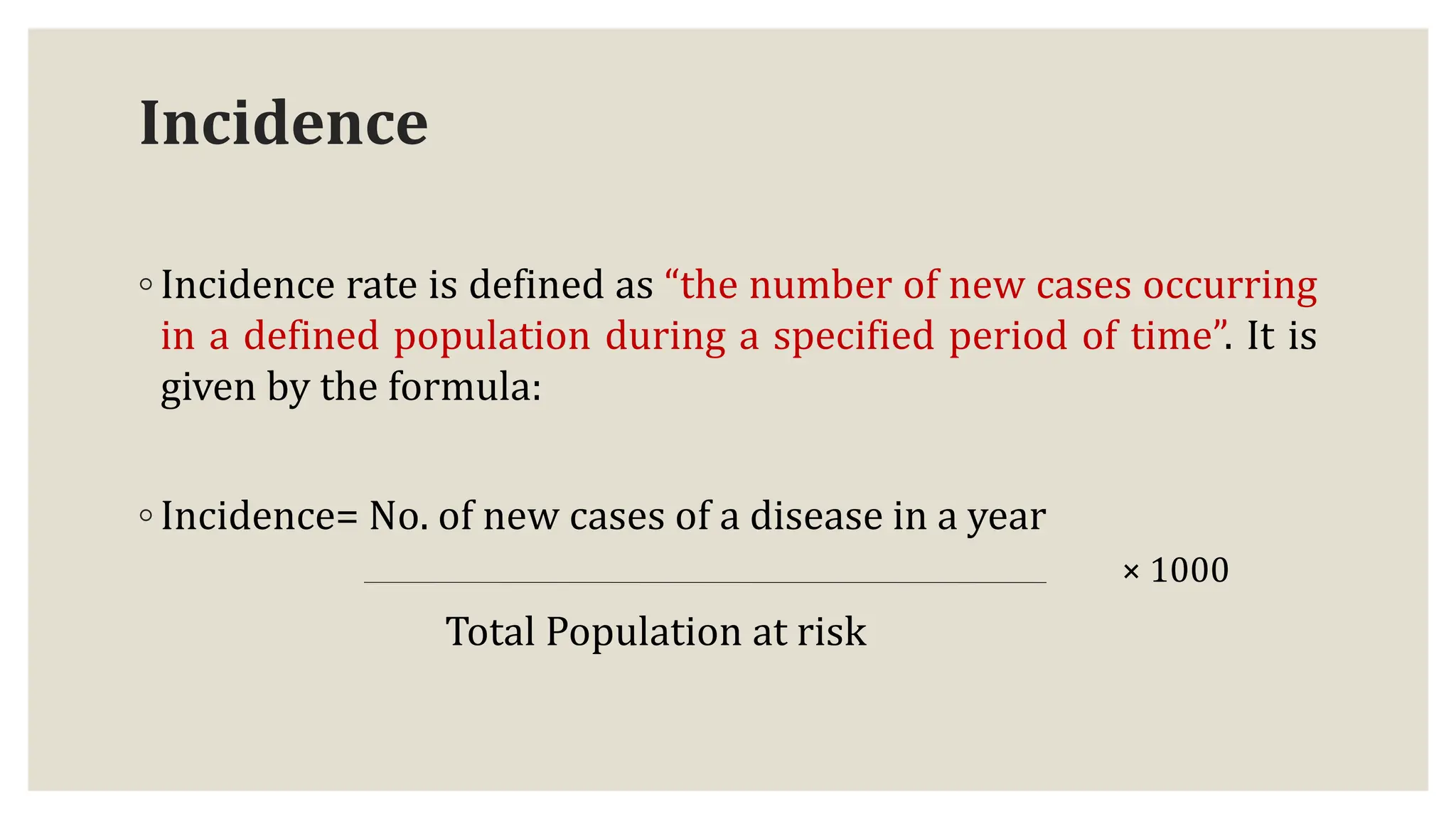
◦ Incidence rate is defined as “the number of new cases occurring
in a defined population during a specified period of time”. It is
given by the formula:
◦ Incidence= No. of new cases of a disease in a year
× 1000
Total Population at risk
if,
There had been 500 new cases of an illness in a population of
30,000 in a year
Calculate the incidence rate?
Prevalence
◦ The term 'disease prevalence' refers specifically to “all the current
cases (old and new) existing at a given point in time, or over period of
time in a given population”.
◦ Prevalence= No. of total(new+old) cases of a disease in a year
× 100
Total population
Types of prevalence
◦ Point prevalence:- number of all cases ( old and new cases)
that exist at a given point in time
◦ Period prevalence: number of all cases that exist in a
population during a specified period of time
Q) In a population of 5000 number of new cases of TB is 500; old
cases in the same population are 150. what is the prevalence of
TB?
Measurement of Mortality
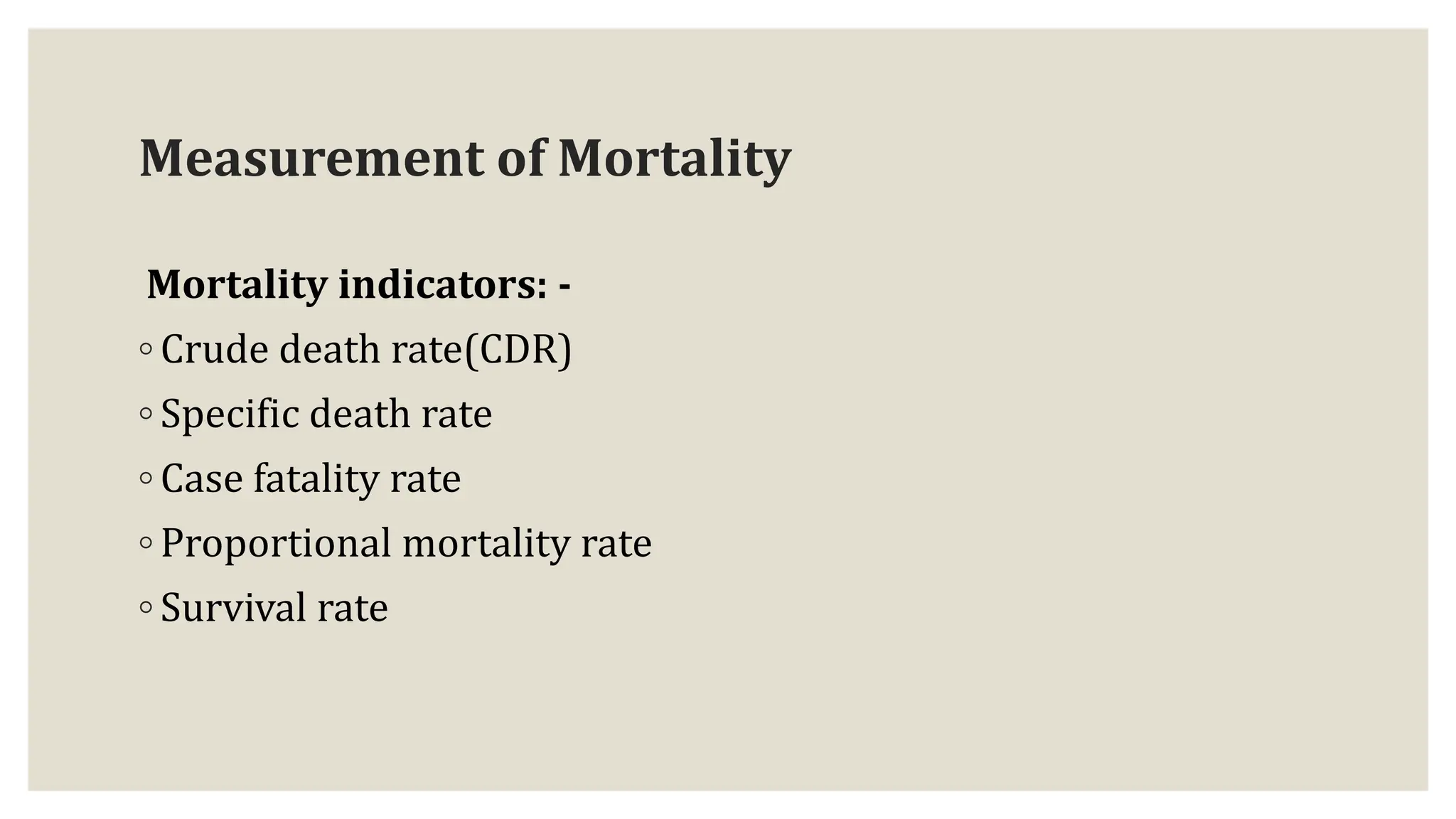
Mortality indicators: -
◦ Crude death rate(CDR)
◦ Specific death rate
◦ Case fatality rate
◦ Proportional mortality rate
◦ Survival rate
Crude Death Rate (CDR)
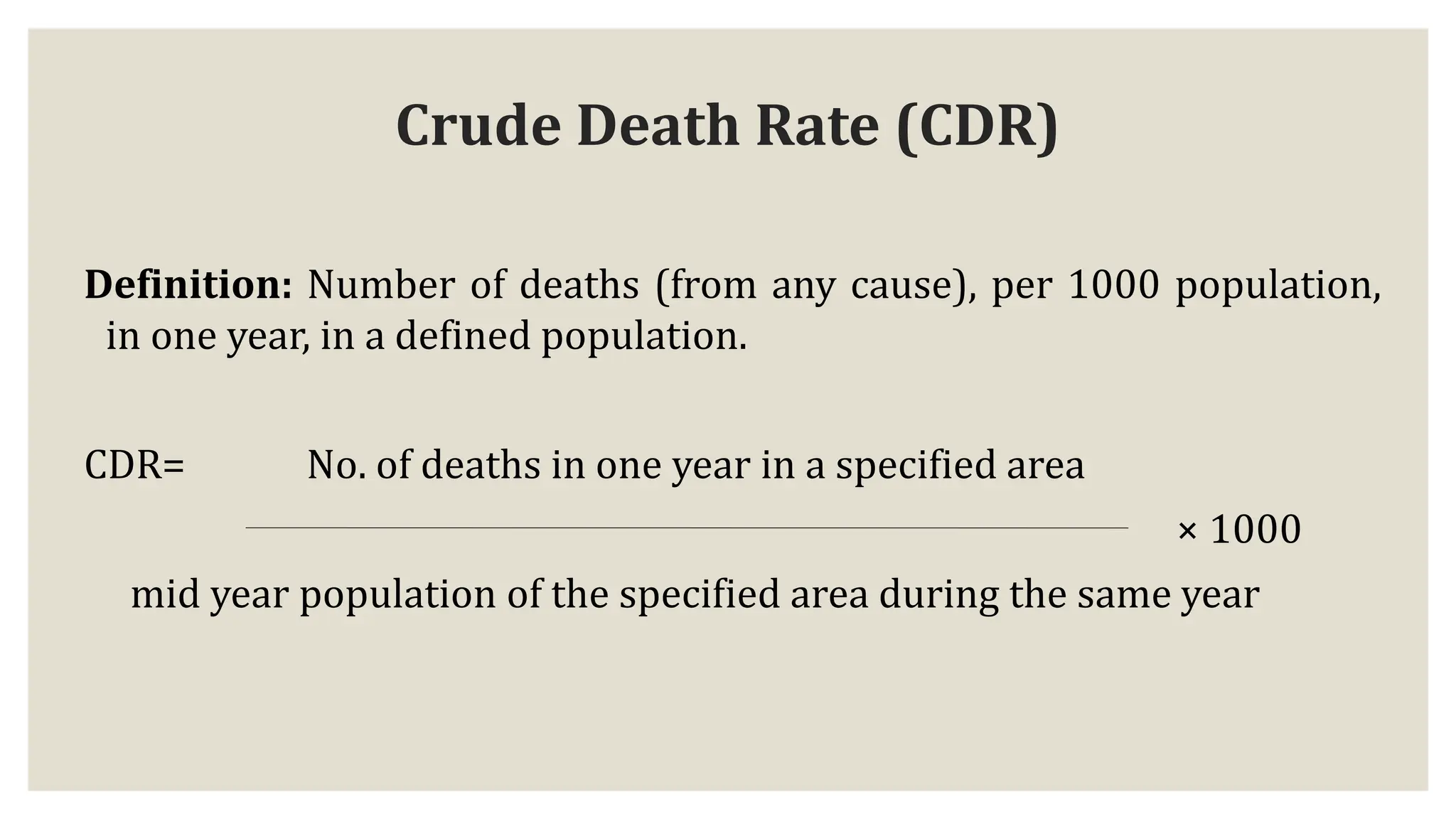
Definition: Number of deaths (from any cause), per 1000 population,
in one year, in a defined population.
CDR= No. of deaths in one year in a specified area
× 1000
mid year population of the specified area during the same year
Specific death rate
a. Cause specific death rates: TB death rate, death rate due to
accidents etc.
b. Group specific death rates: Age specific death rate, sex
Uses of Cause Specific Death Rate
◦ Comparison between different populations
◦ For monitoring the control measures for a disease
◦ Disease surveillance
GROUP SPECIFIC DEATH RATES
Age specific death rate:
No. of deaths in the specific age groups in the defined
population/ midyear population of the same age group in the
same year X 1000
Infant Mortality Rate (IMR):
IMR= number of deaths of infants (0-1yr age) in an year in a specified
population
x1000
No. of live births in the same year in the same population
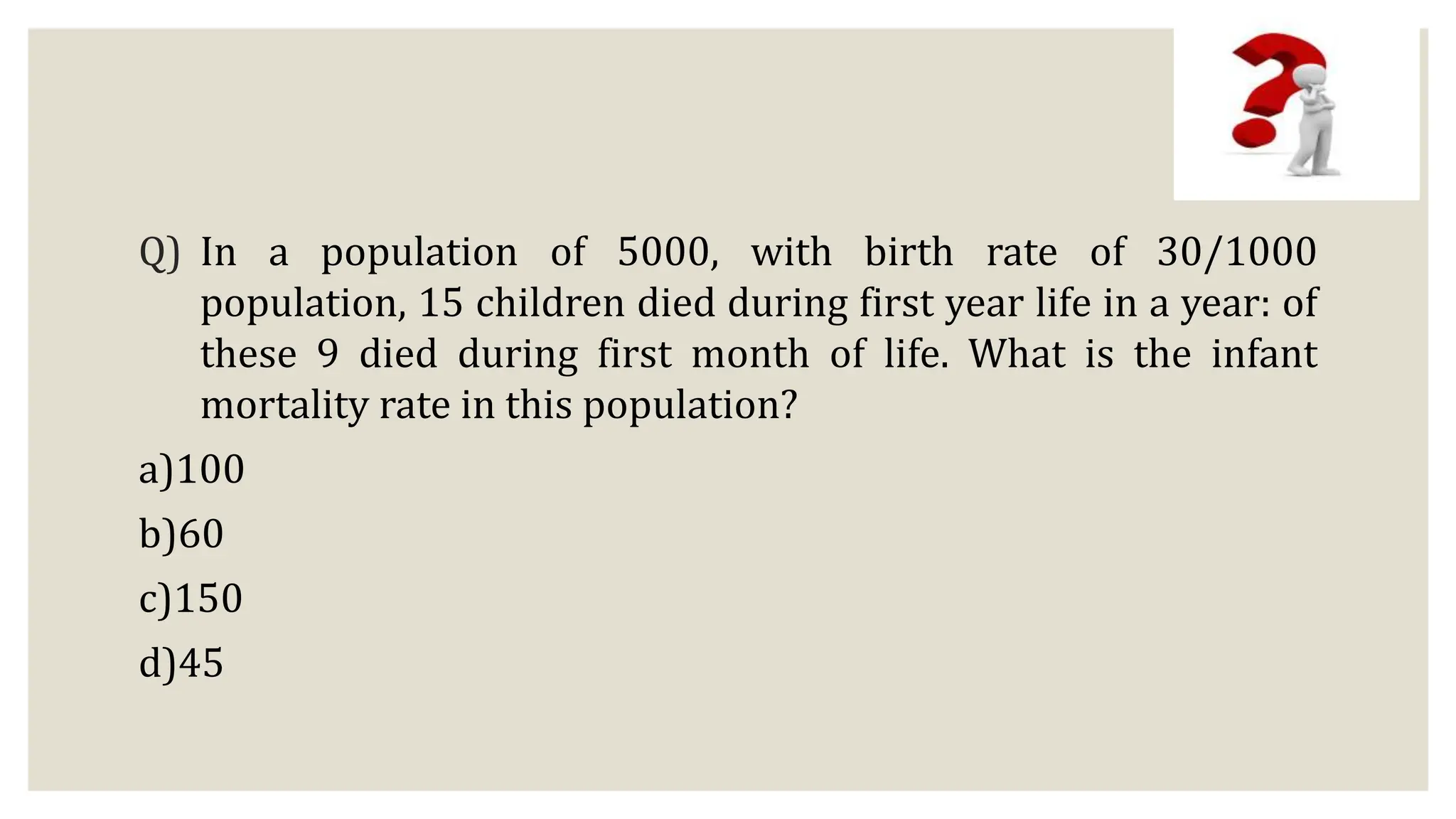
Q) In a population of 5000, with birth rate of 30/1000
population, 15 children died during first year life in a year: of
these 9 died during first month of life. What is the infant
mortality rate in this population?
a)100
b)60
c)150
d)45
Neonatal Mortality Rate (NNMR):
No. of deaths up to 28 days of life in a year in a specified population
x1000
No. of live births in this population in the same year
CASE FATALITY RATE (RATIO):
◦ Total no. of deaths due to a particular disease/Total no. of cases
due to the same disease x100
◦ It measures the 'killing power' of a disease
◦ Case fatality rate is a Proportion : always expressed in
percentage
Proportional mortality rate
◦ Proportional mortality rate (PMR) is defined as "the ratio of
deaths due to a specific cause or in a specific age or sex or sub-
area, to the total number of deaths, multiplied by 100".
◦ Under-5 Proportional Mortality Rate
No. of deaths in 0-4 years of age in one year in a specified
population /Total no. of deaths in the same year in the same
population *100
◦ It is the proportion of survivors in a group (e.g. of patients)
studied and followed over a period (e.g. a 5-year period).
◦ Total number of patients alive after 5 years /Total number of
patients diagnosed or treated× 100
◦ is used to describe prognosis in certain disease conditions
Survival Rate
Practice Exercise
◦ A study was done to assess the health status of a community with
a total population of 50000. it was seen that 1 year:
◦ Live births= 2000
◦ Total deaths= 500
◦ Neonatal deaths= 300
◦ Deaths due to leukemia= 15
◦ Cases of leukemia = 45
Calculate the main fertility, morbidity, and mortality measures of
this community.
Q) The following is true about prevalence and incidence:
a)Both are rates
b)Prevalence is a rate but incidence is not
c)Incidence is a rate but not prevalence
d)Both are not rate
Q) Case fatality rate is a method of measuring:
◦ a) Infectivity
◦ b) Pathogenicity
◦ c) Virulence
◦ d) Average duration of disease
Q) If the prevalence is very low as compared to the incidence for a disease, it
implies:
a) Disease is very fatal and easily curable
b) Disease is non- fatal
c) Calculation of prevalence & incidence is wrong
d) Nothing can be said, as they are independent
Q) Which one of the following is a better indicator of the severity of an acute
disease?
a) Cause specific death rate
b) Case fatality rate
c) Proportional mortality rate
d) Five year survival rate
Q) The mid year population during 2013 was 50,000. the no. of
deaths during this year was 600 out of which 50 died due to
cancer. Calculate:
The crude death rate
Specific death rate due to cancer
Measurement of health and disease.pptx..

Measurement of health and disease.pptx..

  • 1.
    MEASUREMENT OF HEALTH ANDDISEASE Ms. Jyoti Chand MSc Nursing AIIMS RISHIKESH
  • 2.
    Objectives ◦ Explain themeasurement of health and disease ◦ Define measurement of morbidity ◦ Elaborate measurement of mortality
  • 3.
    Tools of measurement Thebasic tools of measurement in epidemiology are: Rate Ratio Proportion
  • 4.
    Rates ◦ A ratemeasures the occurrence of some particular event (development of disease or the occurrence of death) in a population during a given period of time. ◦ It indicates the change in some event that takes place in a population over a period of time.
  • 5.
    ◦ A ratecomprises the following elements: Numerator  denominator  time specification and Multiplier RATE= Numerator (a) is a part of denominator (b) and multiplier is 1000 or 10,000 or 100,000
  • 6.
    Types of rates Cruderate Specific Rate
  • 7.
    Crude rate “These arethe actual observed rates such as the birth & death rates.” CDR= No. of deaths in one year in a specified area × 1000 mid year population of the specified area during the same year
  • 8.
    Exercise If, total number ofdeaths is, 4000 Mid year population at that time = 2,000,000 Calculate the crude death rate??
  • 9.
    Specific Rates ◦ Theseare actual observed rates due to specific causes (e.g. tuberculosis); or occurring in specific rates (e.g. age-sex groups) or during specific time periods (e.g. annual, monthly or weekly rates).
  • 10.
    Cause specific deathrate= No. of deaths from specific cause in an area during a year × 1000 mid year population of the same area during the same year
  • 11.
    Exercise Total no ofdeaths from an age 20-40 = 1500 Mid year population at risk= 5,550 Calculate the specific death rate??
  • 12.
    Ratio ◦ Another measureof disease frequency is ‘ratio’. ◦ It expresses a relation in size between two random quantities. The numerator is not a component of denominator. It is expressed in the form of x y or x/y ◦ Example: The ratio of white blood cells relative to red cells is 1:600 or 1/600, meaning that for each white cell, there are 600 red cells.
  • 13.
    RATIO= Numerator isnot a part of denominator and both numerator and denominator are unrelated
  • 14.
    Proportions: ◦ Expressed inpercentage ◦ Numerator is a part of denominator. ◦ Multiplier is only 100 Example- in skin OPD, number of patients attended on 24/7/2022 was 60, out of which 48 were female. = 48/60 =0.8% or 80%
  • 15.
    Indicators of health Mortalityindicators Morbidity indicators
  • 16.
    MEASUREMENT OF MORBIDITY Morbidityhas been defined as any departure, subjective or objective, from a state of physiological well-being. The term is used equivalent to such terms as sickness, illness, disability, etc. Three aspects of morbidity are frequency, duration and severity. Disease frequency is measured by incidence and prevalence rates.
  • 17.
  • 18.
    Incidence ◦ Incidence rateis defined as “the number of new cases occurring in a defined population during a specified period of time”. It is given by the formula: ◦ Incidence= No. of new cases of a disease in a year × 1000 Total Population at risk
  • 19.
    if, There had been500 new cases of an illness in a population of 30,000 in a year Calculate the incidence rate?
  • 20.
    Prevalence ◦ The term'disease prevalence' refers specifically to “all the current cases (old and new) existing at a given point in time, or over period of time in a given population”. ◦ Prevalence= No. of total(new+old) cases of a disease in a year × 100 Total population
  • 21.
    Types of prevalence ◦Point prevalence:- number of all cases ( old and new cases) that exist at a given point in time ◦ Period prevalence: number of all cases that exist in a population during a specified period of time
  • 22.
    Q) In apopulation of 5000 number of new cases of TB is 500; old cases in the same population are 150. what is the prevalence of TB?
  • 23.
    Measurement of Mortality Mortalityindicators: - ◦ Crude death rate(CDR) ◦ Specific death rate ◦ Case fatality rate ◦ Proportional mortality rate ◦ Survival rate
  • 24.
    Crude Death Rate(CDR) Definition: Number of deaths (from any cause), per 1000 population, in one year, in a defined population. CDR= No. of deaths in one year in a specified area × 1000 mid year population of the specified area during the same year
  • 25.
    Specific death rate a.Cause specific death rates: TB death rate, death rate due to accidents etc. b. Group specific death rates: Age specific death rate, sex
  • 26.
    Uses of CauseSpecific Death Rate ◦ Comparison between different populations ◦ For monitoring the control measures for a disease ◦ Disease surveillance
  • 27.
    GROUP SPECIFIC DEATHRATES Age specific death rate: No. of deaths in the specific age groups in the defined population/ midyear population of the same age group in the same year X 1000
  • 28.
    Infant Mortality Rate(IMR): IMR= number of deaths of infants (0-1yr age) in an year in a specified population x1000 No. of live births in the same year in the same population
  • 29.
    Q) In apopulation of 5000, with birth rate of 30/1000 population, 15 children died during first year life in a year: of these 9 died during first month of life. What is the infant mortality rate in this population? a)100 b)60 c)150 d)45
  • 30.
    Neonatal Mortality Rate(NNMR): No. of deaths up to 28 days of life in a year in a specified population x1000 No. of live births in this population in the same year
  • 31.
    CASE FATALITY RATE(RATIO): ◦ Total no. of deaths due to a particular disease/Total no. of cases due to the same disease x100 ◦ It measures the 'killing power' of a disease ◦ Case fatality rate is a Proportion : always expressed in percentage
  • 32.
    Proportional mortality rate ◦Proportional mortality rate (PMR) is defined as "the ratio of deaths due to a specific cause or in a specific age or sex or sub- area, to the total number of deaths, multiplied by 100". ◦ Under-5 Proportional Mortality Rate No. of deaths in 0-4 years of age in one year in a specified population /Total no. of deaths in the same year in the same population *100
  • 33.
    ◦ It isthe proportion of survivors in a group (e.g. of patients) studied and followed over a period (e.g. a 5-year period). ◦ Total number of patients alive after 5 years /Total number of patients diagnosed or treated× 100 ◦ is used to describe prognosis in certain disease conditions Survival Rate
  • 34.
  • 35.
    ◦ A studywas done to assess the health status of a community with a total population of 50000. it was seen that 1 year: ◦ Live births= 2000 ◦ Total deaths= 500 ◦ Neonatal deaths= 300 ◦ Deaths due to leukemia= 15 ◦ Cases of leukemia = 45 Calculate the main fertility, morbidity, and mortality measures of this community.
  • 36.
    Q) The followingis true about prevalence and incidence: a)Both are rates b)Prevalence is a rate but incidence is not c)Incidence is a rate but not prevalence d)Both are not rate
  • 37.
    Q) Case fatalityrate is a method of measuring: ◦ a) Infectivity ◦ b) Pathogenicity ◦ c) Virulence ◦ d) Average duration of disease
  • 38.
    Q) If theprevalence is very low as compared to the incidence for a disease, it implies: a) Disease is very fatal and easily curable b) Disease is non- fatal c) Calculation of prevalence & incidence is wrong d) Nothing can be said, as they are independent
  • 39.
    Q) Which oneof the following is a better indicator of the severity of an acute disease? a) Cause specific death rate b) Case fatality rate c) Proportional mortality rate d) Five year survival rate
  • 40.
    Q) The midyear population during 2013 was 50,000. the no. of deaths during this year was 600 out of which 50 died due to cancer. Calculate: The crude death rate Specific death rate due to cancer