MORPHOLOGY
DERIVATION
MAHRUKHSHEHZADI
1
Conclusion
DERIVATION
English
Derivational
Affixes
Derivation at
Work Complex
Derivation
Two Classes
Derivational
Affixes
Constraintson
Derivation
2
Derivation/derived
• Derivation is the formation of a new word or
inflect able stem from another word. It typically
occurs bythe addition ofan affix.
• The derived word is often of a different word
class from the original. It may thus take the
inflectionalaffixes ofthenew word class.
3
English Derivational Affixes
• Derivational are usedto make new wordsin the
languageand are oftenused to make words of a
differentgrammatical category from the
stem/root word.
• A derivational affixes usually appliesto words of
onesyntactic category and changes them into
words of another syntactic category.
4
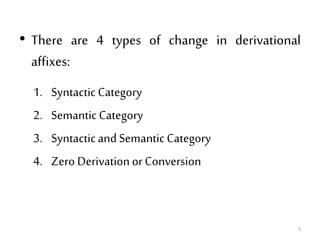
• There are 4 types of change in derivational
affixes:
1. SyntacticCategory
2. SemanticCategory
3. Syntacticand SemanticCategory
4. Zero Derivationor Conversion
5
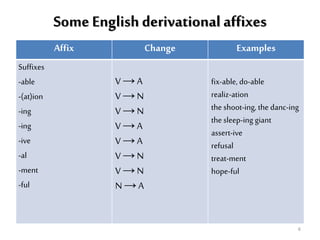
Some English derivational affixes
Affix Change Examples
Suffixes
-able
-(at)ion
-ing
-ing
-ive
-al
-ment
-ful
V → A
V → N
V → N
V →A
V → A
V → N
V → N
N →A
fix-able, do-able
realiz-ation
the shoot-ing, the danc-ing
the sleep-ing giant
assert-ive
refusal
treat-ment
hope-ful
6
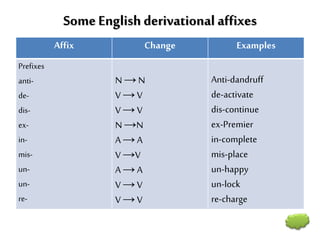
SomeEnglish derivational affixes
Affix Change Examples
Prefixes
anti-
de-
dis-
ex-
in-
mis-
un-
un-
re-
N → N
V → V
V → V
N →N
A →A
V →V
A → A
V → V
V →V
Anti-dandruff
de-activate
dis-continue
ex-Premier
in-complete
mis-place
un-happy
un-lock
re-charge
7
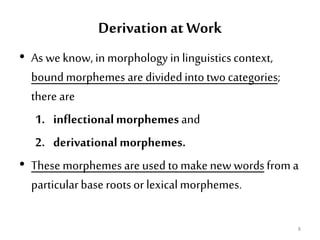
Derivation at Work
• As we know, in morphology in linguisticscontext,
bound morphemes are dividedintotwo categories;
there are
1. inflectionalmorphemes and
2. derivationalmorphemes.
• These morphemes are used to make new wordsfrom a
particularbase roots or lexicalmorphemes.
8
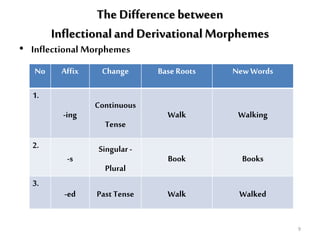
The Differencebetween
Inflectionaland DerivationalMorphemes
• Inflectional Morphemes
No Affix Change BaseRoots New Words
1.
-ing
Continuous
Tense
Walk Walking
2.
-s
Singular -
Plural
Book Books
3.
-ed PastTense Walk Walked
9
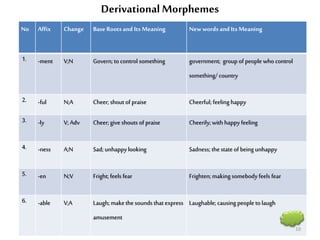
DerivationalMorphemes
No Affix Change Base Roots and Its Meaning New words and Its Meaning
1. -ment V;N Govern; to control something government; group of people who control
something/ country
2. -ful N;A Cheer;shout of praise Cheerful; feeling happy
3. -ly V; Adv Cheer;giveshouts of praise Cheerily;with happy feeling
4. -ness A;N Sad; unhappylooking Sadness; the state of being unhappy
5. -en N;V Fright; feels fear Frighten; makingsomebody feels fear
6. -able V;A Laugh; makethe sounds that express
amusement
Laughable; causing people to laugh
10
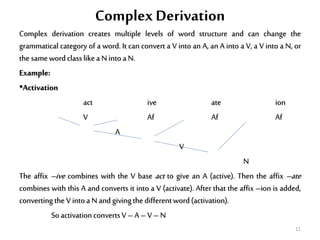
Complex Derivation
Complex derivation creates multiple levels of word structure and can change the
grammatical category of a word. It can convert a V into an A, an A into a V, a V into a N, or
the samewordclasslikea Ninto aN.
Example:
•Activation
act ive ate ion
V Af Af Af
A
V
N
The affix –ive combines with the V base act to give an A (active). Then the affix –ate
combines with this A and converts it into a V (activate). After that the affix –ion is added,
convertingthe V intoa N and givingthe differentword (activation).
So activationconvertsV –A –V –N
11
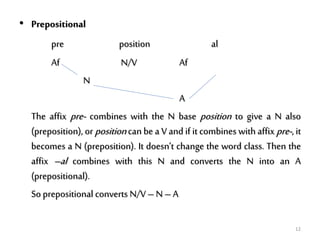
• Prepositional
pre position al
Af N/V Af
N
A
The affix pre- combines with the N base position to give a N also
(preposition), or positioncan be a V and if it combines with affix pre-, it
becomes a N (preposition). It doesn’t change the word class. Then the
affix –al combines with this N and converts the N into an A
(prepositional).
So prepositional converts N/V – N – A
12
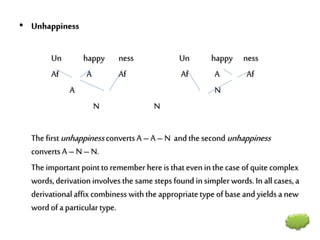
• Unhappiness
Un happy ness Un happy ness
Af A Af Af A Af
A N
N N
The firstunhappiness converts A –A– N andthe second unhappiness
converts A –N – N.
The important pointtorememberhereis that even inthecase ofquite complex
words,derivationinvolvesthe same steps found in simplerwords. Inallcases, a
derivationalaffix combiness withtheappropriatetype of base and yieldsa new
word of a particulartype.
13
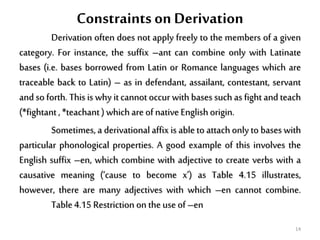
Constraints on Derivation
Derivation often does not apply freely to the members of a given
category. For instance, the suffix –ant can combine only with Latinate
bases (i.e. bases borrowed from Latin or Romance languages which are
traceable back to Latin) – as in defendant, assailant, contestant, servant
and so forth. This is why it cannot occur with bases such as fight and teach
(*fightant , *teachant ) which are of native Englishorigin.
Sometimes, a derivational affix is able to attach only to bases with
particular phonological properties. A good example of this involves the
English suffix –en, which combine with adjective to create verbs with a
causative meaning (‘cause to become x’) as Table 4.15 illustrates,
however, there are many adjectives with which –en cannot combine.
Table4.15 Restriction on the use of –en
14
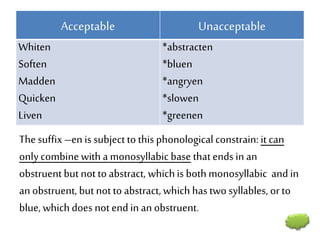
The suffix–en is subject to this phonological constrain: it can
only combine with a monosyllabic base thatends in an
obstruentbut not to abstract, whichis both monosyllabic and in
an obstruent, but notto abstract, which has two syllables, or to
blue, whichdoes not endin an obstruent.
Acceptable Unacceptable
Whiten
Soften
Madden
Quicken
Liven
*abstracten
*bluen
*angryen
*slowen
*greenen
15
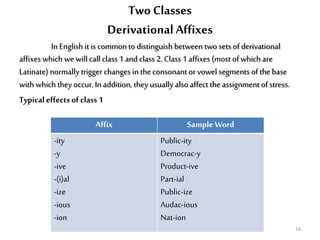
Two Classes
DerivationalAffixes
In English it is common to distinguish between two sets of derivational
affixes which wewill call class 1 and class 2. Class 1 affixes (most of which are
Latinate) normally triggerchanges in the consonant orvowel segments ofthe base
with which they occur.In addition, they usually also affect the assignment of stress.
Typical effects of class 1
Affix Sample Word
-ity
-y
-ive
-(i)al
-ize
-ious
-ion
Public-ity
Democrac-y
Product-ive
Part-ial
Public-ize
Audac-ious
Nat-ion
16
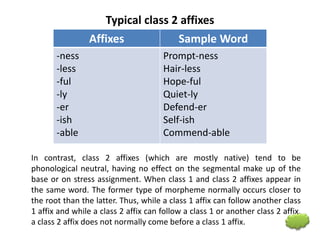
Typical class 2 affixes
In contrast, class 2 affixes (which are mostly native) tend to be
phonological neutral, having no effect on the segmental make up of the
base or on stress assignment. When class 1 and class 2 affixes appear in
the same word. The former type of morpheme normally occurs closer to
the root than the latter. Thus, while a class 1 affix can follow another class
1 affix and while a class 2 affix can follow a class 1 or another class 2 affix,
a class 2 affix does not normally come before a class 1 affix.
Affixes Sample Word
-ness
-less
-ful
-ly
-er
-ish
-able
Prompt-ness
Hair-less
Hope-ful
Quiet-ly
Defend-er
Self-ish
Commend-able
17
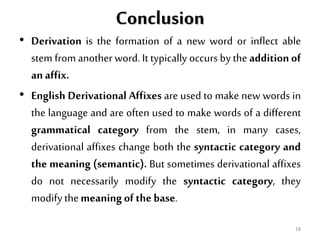
Conclusion
• Derivation is the formation of a new word or inflect able
stem from another word. It typically occurs by the addition of
anaffix.
• English Derivational Affixes are used to make new words in
the language and are often used to make words of a different
grammatical category from the stem, in many cases,
derivational affixes change both the syntactic category and
the meaning (semantic). But sometimes derivational affixes
do not necessarily modify the syntactic category, they
modify themeaning of the base.
18
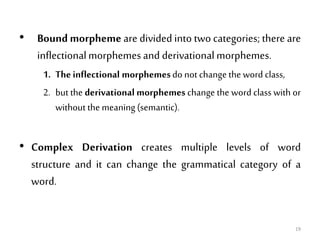
• Bound morpheme are divided into two categories; there are
inflectionalmorphemes and derivational morphemes.
1. Theinflectional morphemesdo not change the word class,
2. but the derivational morphemes change the word class with or
without the meaning (semantic).
• Complex Derivation creates multiple levels of word
structure and it can change the grammatical category of a
word.
19
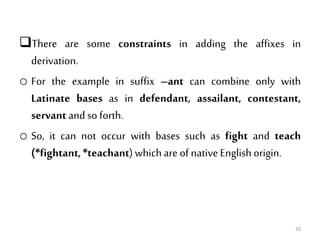
There are some constraints in adding the affixes in
derivation.
o For the example in suffix –ant can combine only with
Latinate bases as in defendant, assailant, contestant,
servant and so forth.
o So, it can not occur with bases such as fight and teach
(*fightant,*teachant)whichare of nativeEnglishorigin.
20
There are two classes in derivational affixes, class 1 and class
2.
o Class 1 affixes (most of which are Latinate) normally trigger
changes in the consonant or vowel segments of the base with
which they occur. In addition, they usually also affect the
assignmentof stress.
o Class 2 affixes (which are mostly native) tend to be
phonological neutral, having no effect on the segmental make
up of thebase or on stress assignment.
21

Morphology derivation

  • 1.
  • 2.
  • 3.
    Derivation/derived • Derivation isthe formation of a new word or inflect able stem from another word. It typically occurs bythe addition ofan affix. • The derived word is often of a different word class from the original. It may thus take the inflectionalaffixes ofthenew word class. 3
  • 4.
    English Derivational Affixes •Derivational are usedto make new wordsin the languageand are oftenused to make words of a differentgrammatical category from the stem/root word. • A derivational affixes usually appliesto words of onesyntactic category and changes them into words of another syntactic category. 4
  • 5.
    • There are4 types of change in derivational affixes: 1. SyntacticCategory 2. SemanticCategory 3. Syntacticand SemanticCategory 4. Zero Derivationor Conversion 5
  • 6.
    Some English derivationalaffixes Affix Change Examples Suffixes -able -(at)ion -ing -ing -ive -al -ment -ful V → A V → N V → N V →A V → A V → N V → N N →A fix-able, do-able realiz-ation the shoot-ing, the danc-ing the sleep-ing giant assert-ive refusal treat-ment hope-ful 6
  • 7.
    SomeEnglish derivational affixes AffixChange Examples Prefixes anti- de- dis- ex- in- mis- un- un- re- N → N V → V V → V N →N A →A V →V A → A V → V V →V Anti-dandruff de-activate dis-continue ex-Premier in-complete mis-place un-happy un-lock re-charge 7
  • 8.
    Derivation at Work •As we know, in morphology in linguisticscontext, bound morphemes are dividedintotwo categories; there are 1. inflectionalmorphemes and 2. derivationalmorphemes. • These morphemes are used to make new wordsfrom a particularbase roots or lexicalmorphemes. 8
  • 9.
    The Differencebetween Inflectionaland DerivationalMorphemes •Inflectional Morphemes No Affix Change BaseRoots New Words 1. -ing Continuous Tense Walk Walking 2. -s Singular - Plural Book Books 3. -ed PastTense Walk Walked 9
  • 10.
    DerivationalMorphemes No Affix ChangeBase Roots and Its Meaning New words and Its Meaning 1. -ment V;N Govern; to control something government; group of people who control something/ country 2. -ful N;A Cheer;shout of praise Cheerful; feeling happy 3. -ly V; Adv Cheer;giveshouts of praise Cheerily;with happy feeling 4. -ness A;N Sad; unhappylooking Sadness; the state of being unhappy 5. -en N;V Fright; feels fear Frighten; makingsomebody feels fear 6. -able V;A Laugh; makethe sounds that express amusement Laughable; causing people to laugh 10
  • 11.
    Complex Derivation Complex derivationcreates multiple levels of word structure and can change the grammatical category of a word. It can convert a V into an A, an A into a V, a V into a N, or the samewordclasslikea Ninto aN. Example: •Activation act ive ate ion V Af Af Af A V N The affix –ive combines with the V base act to give an A (active). Then the affix –ate combines with this A and converts it into a V (activate). After that the affix –ion is added, convertingthe V intoa N and givingthe differentword (activation). So activationconvertsV –A –V –N 11
  • 12.
    • Prepositional pre positional Af N/V Af N A The affix pre- combines with the N base position to give a N also (preposition), or positioncan be a V and if it combines with affix pre-, it becomes a N (preposition). It doesn’t change the word class. Then the affix –al combines with this N and converts the N into an A (prepositional). So prepositional converts N/V – N – A 12
  • 13.
    • Unhappiness Un happyness Un happy ness Af A Af Af A Af A N N N The firstunhappiness converts A –A– N andthe second unhappiness converts A –N – N. The important pointtorememberhereis that even inthecase ofquite complex words,derivationinvolvesthe same steps found in simplerwords. Inallcases, a derivationalaffix combiness withtheappropriatetype of base and yieldsa new word of a particulartype. 13
  • 14.
    Constraints on Derivation Derivationoften does not apply freely to the members of a given category. For instance, the suffix –ant can combine only with Latinate bases (i.e. bases borrowed from Latin or Romance languages which are traceable back to Latin) – as in defendant, assailant, contestant, servant and so forth. This is why it cannot occur with bases such as fight and teach (*fightant , *teachant ) which are of native Englishorigin. Sometimes, a derivational affix is able to attach only to bases with particular phonological properties. A good example of this involves the English suffix –en, which combine with adjective to create verbs with a causative meaning (‘cause to become x’) as Table 4.15 illustrates, however, there are many adjectives with which –en cannot combine. Table4.15 Restriction on the use of –en 14
  • 15.
    The suffix–en issubject to this phonological constrain: it can only combine with a monosyllabic base thatends in an obstruentbut not to abstract, whichis both monosyllabic and in an obstruent, but notto abstract, which has two syllables, or to blue, whichdoes not endin an obstruent. Acceptable Unacceptable Whiten Soften Madden Quicken Liven *abstracten *bluen *angryen *slowen *greenen 15
  • 16.
    Two Classes DerivationalAffixes In Englishit is common to distinguish between two sets of derivational affixes which wewill call class 1 and class 2. Class 1 affixes (most of which are Latinate) normally triggerchanges in the consonant orvowel segments ofthe base with which they occur.In addition, they usually also affect the assignment of stress. Typical effects of class 1 Affix Sample Word -ity -y -ive -(i)al -ize -ious -ion Public-ity Democrac-y Product-ive Part-ial Public-ize Audac-ious Nat-ion 16
  • 17.
    Typical class 2affixes In contrast, class 2 affixes (which are mostly native) tend to be phonological neutral, having no effect on the segmental make up of the base or on stress assignment. When class 1 and class 2 affixes appear in the same word. The former type of morpheme normally occurs closer to the root than the latter. Thus, while a class 1 affix can follow another class 1 affix and while a class 2 affix can follow a class 1 or another class 2 affix, a class 2 affix does not normally come before a class 1 affix. Affixes Sample Word -ness -less -ful -ly -er -ish -able Prompt-ness Hair-less Hope-ful Quiet-ly Defend-er Self-ish Commend-able 17
  • 18.
    Conclusion • Derivation isthe formation of a new word or inflect able stem from another word. It typically occurs by the addition of anaffix. • English Derivational Affixes are used to make new words in the language and are often used to make words of a different grammatical category from the stem, in many cases, derivational affixes change both the syntactic category and the meaning (semantic). But sometimes derivational affixes do not necessarily modify the syntactic category, they modify themeaning of the base. 18
  • 19.
    • Bound morphemeare divided into two categories; there are inflectionalmorphemes and derivational morphemes. 1. Theinflectional morphemesdo not change the word class, 2. but the derivational morphemes change the word class with or without the meaning (semantic). • Complex Derivation creates multiple levels of word structure and it can change the grammatical category of a word. 19
  • 20.
    There are someconstraints in adding the affixes in derivation. o For the example in suffix –ant can combine only with Latinate bases as in defendant, assailant, contestant, servant and so forth. o So, it can not occur with bases such as fight and teach (*fightant,*teachant)whichare of nativeEnglishorigin. 20
  • 21.
    There are twoclasses in derivational affixes, class 1 and class 2. o Class 1 affixes (most of which are Latinate) normally trigger changes in the consonant or vowel segments of the base with which they occur. In addition, they usually also affect the assignmentof stress. o Class 2 affixes (which are mostly native) tend to be phonological neutral, having no effect on the segmental make up of thebase or on stress assignment. 21