By :
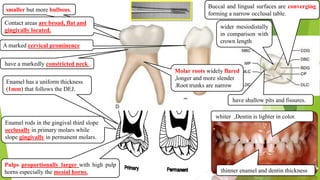
smaller but more bulbous.
whiter ,Dentin is lighter in color.
Enamel rods in the gingival third slope
occlusally in primary molars while
slope gingivally in permanent molars.
wider mesiodistally
in comparison with
crown length
A marked cervical prominence
have a markedly constricted neck .
Pulps proportionally larger with high pulp
horns especially the mesial horns.
Contact areas are broad, flat and
gingivally located.
Buccal and lingual surfaces are converging
forming a narrow occlusal table.
Enamel has a uniform thickness
(1mm) that follows the DEJ.
thinner enamel and dentin thickness
have shallow pits and fissures.
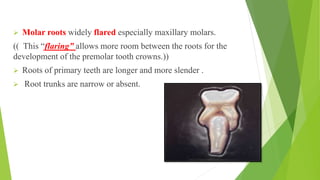
Molar roots widely flared
,longer and more slender
.Root trunks are narrow
 The crowns of the primary teeth are smaller but more
bulbous than the corresponding permanent teeth.
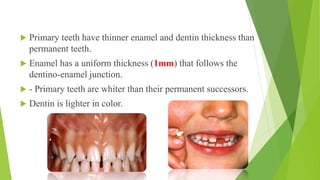
 Primary teeth have thinner enamel and dentin thickness than
permanent teeth.
 Enamel has a uniform thickness (1mm) that follows the
dentino-enamel junction.
 - Primary teeth are whiter than their permanent successors.
 Dentin is lighter in color.
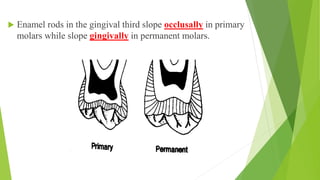
 Enamel rods in the gingival third slope occlusally in primary
molars while slope gingivally in permanent molars.
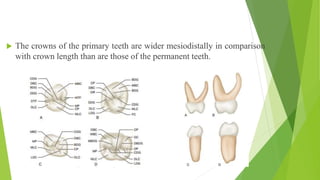
 The crowns of the primary teeth are wider mesiodistally in comparison
with crown length than are those of the permanent teeth.
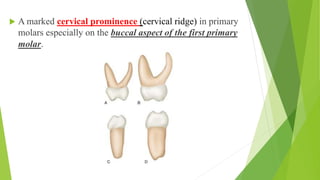
 A marked cervical prominence (cervical ridge) in primary
molars especially on the buccal aspect of the first primary
molar.
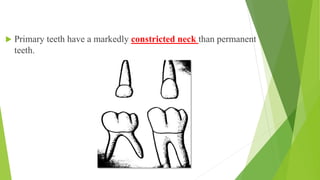
 Primary teeth have a markedly constricted neck than permanent
teeth.
 Contact areas between primary molars are broad, flat and
gingivally located.
 Buccal and lingual surfaces are converging forming a narrow
occlusal table.
 Primary molars have shallow pits and fissures.
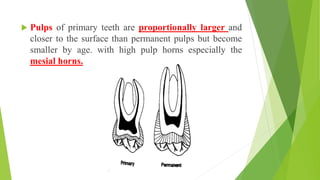
 Pulps of primary teeth are proportionally larger and
closer to the surface than permanent pulps but become
smaller by age. with high pulp horns especially the
mesial horns.
 Molar roots widely flared especially maxillary molars.
(( This “flaring” allows more room between the roots for the
development of the premolar tooth crowns.))
 Roots of primary teeth are longer and more slender .
 Root trunks are narrow or absent.
 Multiple spaces between teeth are present normally in
primary arch.
Anatomic considerations of primary
teeth
Differences in Cavity Preparation
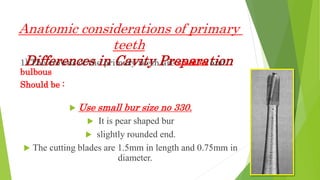
1) The crowns of the primary teeth are smaller and
bulbous
Should be :
 Use small bur size no 330.
 It is pear shaped bur
 slightly rounded end.
 The cutting blades are 1.5mm in length and 0.75mm in
diameter.
Cont……>>>>
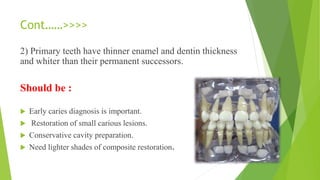
2) Primary teeth have thinner enamel and dentin thickness
and whiter than their permanent successors.
Should be :
 Early caries diagnosis is important.
 Restoration of small carious lesions.
 Conservative cavity preparation.
 Need lighter shades of composite restoration.
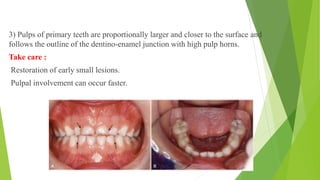
3) Pulps of primary teeth are proportionally larger and closer to the surface and
follows the outline of the dentino-enamel junction with high pulp horns.
Take care :
Restoration of early small lesions.
Pulpal involvement can occur faster.
4) Enamel rods In the gingival third slope occlusally .
Should be :
 No need to bevel the gingival margin
in proximal box of class II restorations.
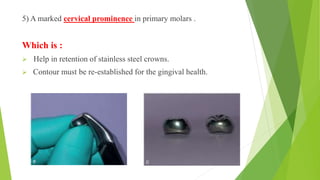
5) A marked cervical prominence in primary molars .
Which is :
 Help in retention of stainless steel crowns.
 Contour must be re-established for the gingival health.
6) Primary teeth have a markedly constricted neck .
That is mean :
 Excessive gingival extension can lead
to loss of gingival floor of preparation.
 Attempt to recover lost gingival floor
increases the risk of pulp exposure.
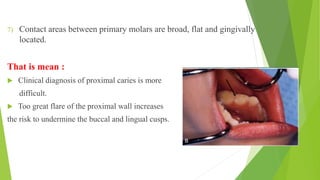
7) Contact areas between primary molars are broad, flat and gingivally
located.
That is mean :
 Clinical diagnosis of proximal caries is more
difficult.
 Too great flare of the proximal wall increases
the risk to undermine the buccal and lingual cusps.
8) Primary molars have a narrow occlusal table and shallow pits and
fissures.
Should be :
 Buccolingual extension of occlusal preparations
is reduced to prevent cuspal weakening.
 Less need to carve extensive occlusal anatomy
Morphological Differences Between Primary And Permanent Teeth 2016.pptx

Morphological Differences Between Primary And Permanent Teeth 2016.pptx

  • 1.
  • 2.
    smaller but morebulbous. whiter ,Dentin is lighter in color. Enamel rods in the gingival third slope occlusally in primary molars while slope gingivally in permanent molars. wider mesiodistally in comparison with crown length A marked cervical prominence have a markedly constricted neck . Pulps proportionally larger with high pulp horns especially the mesial horns. Contact areas are broad, flat and gingivally located. Buccal and lingual surfaces are converging forming a narrow occlusal table. Enamel has a uniform thickness (1mm) that follows the DEJ. thinner enamel and dentin thickness have shallow pits and fissures. Molar roots widely flared ,longer and more slender .Root trunks are narrow
  • 3.
     The crownsof the primary teeth are smaller but more bulbous than the corresponding permanent teeth.
  • 4.
     Primary teethhave thinner enamel and dentin thickness than permanent teeth.  Enamel has a uniform thickness (1mm) that follows the dentino-enamel junction.  - Primary teeth are whiter than their permanent successors.  Dentin is lighter in color.
  • 5.
     Enamel rodsin the gingival third slope occlusally in primary molars while slope gingivally in permanent molars.
  • 6.
     The crownsof the primary teeth are wider mesiodistally in comparison with crown length than are those of the permanent teeth.
  • 7.
     A markedcervical prominence (cervical ridge) in primary molars especially on the buccal aspect of the first primary molar.
  • 8.
     Primary teethhave a markedly constricted neck than permanent teeth.
  • 9.
     Contact areasbetween primary molars are broad, flat and gingivally located.
  • 10.
     Buccal andlingual surfaces are converging forming a narrow occlusal table.  Primary molars have shallow pits and fissures.
  • 11.
     Pulps ofprimary teeth are proportionally larger and closer to the surface than permanent pulps but become smaller by age. with high pulp horns especially the mesial horns.
  • 12.
     Molar rootswidely flared especially maxillary molars. (( This “flaring” allows more room between the roots for the development of the premolar tooth crowns.))  Roots of primary teeth are longer and more slender .  Root trunks are narrow or absent.
  • 13.
     Multiple spacesbetween teeth are present normally in primary arch.
  • 14.
    Anatomic considerations ofprimary teeth Differences in Cavity Preparation 1) The crowns of the primary teeth are smaller and bulbous Should be :  Use small bur size no 330.  It is pear shaped bur  slightly rounded end.  The cutting blades are 1.5mm in length and 0.75mm in diameter.
  • 15.
    Cont……>>>> 2) Primary teethhave thinner enamel and dentin thickness and whiter than their permanent successors. Should be :  Early caries diagnosis is important.  Restoration of small carious lesions.  Conservative cavity preparation.  Need lighter shades of composite restoration.
  • 16.
    3) Pulps ofprimary teeth are proportionally larger and closer to the surface and follows the outline of the dentino-enamel junction with high pulp horns. Take care : Restoration of early small lesions. Pulpal involvement can occur faster.
  • 17.
    4) Enamel rodsIn the gingival third slope occlusally . Should be :  No need to bevel the gingival margin in proximal box of class II restorations.
  • 18.
    5) A markedcervical prominence in primary molars . Which is :  Help in retention of stainless steel crowns.  Contour must be re-established for the gingival health.
  • 19.
    6) Primary teethhave a markedly constricted neck . That is mean :  Excessive gingival extension can lead to loss of gingival floor of preparation.  Attempt to recover lost gingival floor increases the risk of pulp exposure.
  • 20.
    7) Contact areasbetween primary molars are broad, flat and gingivally located. That is mean :  Clinical diagnosis of proximal caries is more difficult.  Too great flare of the proximal wall increases the risk to undermine the buccal and lingual cusps.
  • 21.
    8) Primary molarshave a narrow occlusal table and shallow pits and fissures. Should be :  Buccolingual extension of occlusal preparations is reduced to prevent cuspal weakening.  Less need to carve extensive occlusal anatomy