WIDTH OF
ATTACHED
GINGIVA
K.NARENDHIRAN
I YEAR PG
Width of Attached gingiva
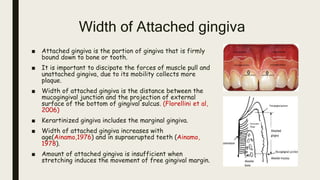
■ Attached gingiva is the portion of gingiva that is firmly
bound down to bone or tooth.
■ It is important to discipate the forces of muscle pull and
unattached gingiva, due to its mobility collects more
plaque.
■ Width of attached gingiva is the distance between the
mucogingival junction and the projection of external
surface of the bottom of gingival sulcus. (Florellini et al,
2006)
■ Kerartinized gingiva includes the marginal gingiva.
■ Width of attached gingiva increases with
age(Ainamo,1976) and in supraerupted teeth (Ainamo,
1978).
■ Amount of attached gingiva is insufficient when
stretching induces the movement of free gingival margin.
How to measure?
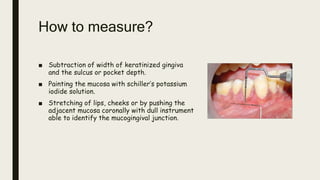
■ Subtraction of width of keratinized gingiva
and the sulcus or pocket depth.
■ Painting the mucosa with schiller’s potassium
iodide solution.
■ Stretching of lips, cheeks or by pushing the
adjacent mucosa coronally with dull instrument
able to identify the mucogingival junction.
Width of attached gingiva and
periodontal health
Lang and loe, 1972 2 mm of keratinized gingiva is adequate to maintain gingival health.
Miyasato, 1977 It is possible to maintain gingival health even in absence of adequate
attached gingiva.
Wenstorm and lindhe, 1983 Gingival unit without attached gingiva may not be more susceptible to
inflammation than one with wide zone of attached gingiva.
Wenstorm, 1987 In presence of good plaque control, lack of attached gingiva did not result
in greater gingival recession.
Friedman et al, 1999 With good oral hygiene, gingival health despite inadequate keratinized
gingiva, may remain stable for long period
Presence of good oral hygiene, the width of attached gingiva or gingival
augmentation is not crucial for maintenance of gingival health.
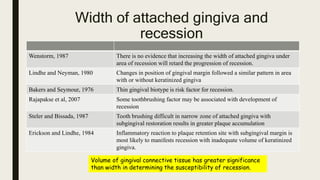
Width of attached gingiva and
recession
Wenstorm, 1987 There is no evidence that increasing the width of attached gingiva under
area of recession will retard the progression of recession.
Lindhe and Neyman, 1980 Changes in position of gingival margin followed a similar pattern in area
with or without keratinized gingiva
Bakers and Seymour, 1976 Thin gingival biotype is risk factor for recession.
Rajapakse et al, 2007 Some toothbrushing factor may be associated with development of
recession
Steler and Bissada, 1987 Tooth brushing difficult in narrow zone of attached gingiva with
subgingival restoration results in greater plaque accumulation
Erickson and Lindhe, 1984 Inflammatory reaction to plaque retention site with subgingival margin is
most likely to manifests recession with inadequate volume of keratinized
gingiva.
Volume of gingival connective tissue has greater significance
than width in determining the susceptibility of recession.
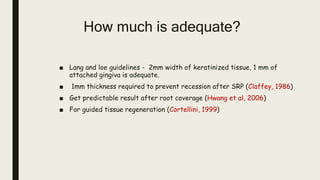
How much is adequate?
■ Lang and loe guidelines - 2mm width of keratinized tissue, 1 mm of
attached gingiva is adequate.
■ 1mm thickness required to prevent recession after SRP (Claffey, 1986)
■ Get predictable result after root coverage (Hwang et al, 2006)
■ For guided tissue regeneration (Cortellini, 1999)
Indications for surgical procedure
■ Patient complains of discomfort while brushing their teeth in area with
inadequate attached gingiva.
■ Orthodontic movement outside alveolus in patient with thin tissue biotype.
■ As a secondary outcome to root coverage in patients complaining of
hypersensitivity or poor aesthetics due to recession
■ In the field of implant dentistry, soft tissue augmentation is indicated in
patients with thin tissue biotype.
conclusion
Current evidence point towards the clinical relevance of the thickness
rather than the width of the keratinized tissue in determining soft
tissue health and recession, the problem arises as it is more difficult
to find out clinically the thickness as compared with measuring the
width of attached gingiva

Width of attached gingiva

  • 1.
  • 2.
    Width of Attachedgingiva ■ Attached gingiva is the portion of gingiva that is firmly bound down to bone or tooth. ■ It is important to discipate the forces of muscle pull and unattached gingiva, due to its mobility collects more plaque. ■ Width of attached gingiva is the distance between the mucogingival junction and the projection of external surface of the bottom of gingival sulcus. (Florellini et al, 2006) ■ Kerartinized gingiva includes the marginal gingiva. ■ Width of attached gingiva increases with age(Ainamo,1976) and in supraerupted teeth (Ainamo, 1978). ■ Amount of attached gingiva is insufficient when stretching induces the movement of free gingival margin.
  • 3.
    How to measure? ■Subtraction of width of keratinized gingiva and the sulcus or pocket depth. ■ Painting the mucosa with schiller’s potassium iodide solution. ■ Stretching of lips, cheeks or by pushing the adjacent mucosa coronally with dull instrument able to identify the mucogingival junction.
  • 4.
    Width of attachedgingiva and periodontal health Lang and loe, 1972 2 mm of keratinized gingiva is adequate to maintain gingival health. Miyasato, 1977 It is possible to maintain gingival health even in absence of adequate attached gingiva. Wenstorm and lindhe, 1983 Gingival unit without attached gingiva may not be more susceptible to inflammation than one with wide zone of attached gingiva. Wenstorm, 1987 In presence of good plaque control, lack of attached gingiva did not result in greater gingival recession. Friedman et al, 1999 With good oral hygiene, gingival health despite inadequate keratinized gingiva, may remain stable for long period Presence of good oral hygiene, the width of attached gingiva or gingival augmentation is not crucial for maintenance of gingival health.
  • 5.
    Width of attachedgingiva and recession Wenstorm, 1987 There is no evidence that increasing the width of attached gingiva under area of recession will retard the progression of recession. Lindhe and Neyman, 1980 Changes in position of gingival margin followed a similar pattern in area with or without keratinized gingiva Bakers and Seymour, 1976 Thin gingival biotype is risk factor for recession. Rajapakse et al, 2007 Some toothbrushing factor may be associated with development of recession Steler and Bissada, 1987 Tooth brushing difficult in narrow zone of attached gingiva with subgingival restoration results in greater plaque accumulation Erickson and Lindhe, 1984 Inflammatory reaction to plaque retention site with subgingival margin is most likely to manifests recession with inadequate volume of keratinized gingiva. Volume of gingival connective tissue has greater significance than width in determining the susceptibility of recession.
  • 6.
    How much isadequate? ■ Lang and loe guidelines - 2mm width of keratinized tissue, 1 mm of attached gingiva is adequate. ■ 1mm thickness required to prevent recession after SRP (Claffey, 1986) ■ Get predictable result after root coverage (Hwang et al, 2006) ■ For guided tissue regeneration (Cortellini, 1999)
  • 7.
    Indications for surgicalprocedure ■ Patient complains of discomfort while brushing their teeth in area with inadequate attached gingiva. ■ Orthodontic movement outside alveolus in patient with thin tissue biotype. ■ As a secondary outcome to root coverage in patients complaining of hypersensitivity or poor aesthetics due to recession ■ In the field of implant dentistry, soft tissue augmentation is indicated in patients with thin tissue biotype.
  • 8.
    conclusion Current evidence pointtowards the clinical relevance of the thickness rather than the width of the keratinized tissue in determining soft tissue health and recession, the problem arises as it is more difficult to find out clinically the thickness as compared with measuring the width of attached gingiva