Dr. J. Jude
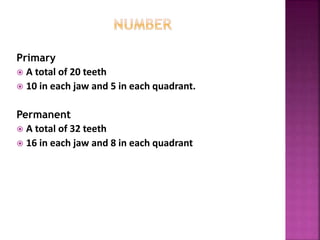
Primary
 A total of 20 teeth
 10 in each jaw and 5 in each quadrant.
Permanent
 A total of 32 teeth
 16 in each jaw and 8 in each quadrant
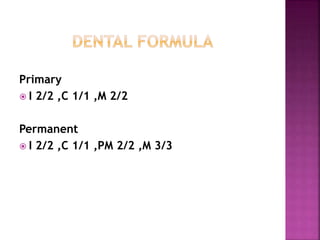
Primary
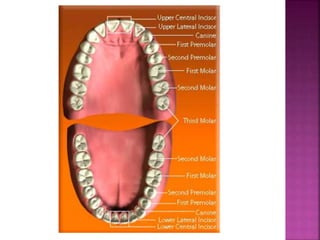
 I 2/2 ,C 1/1 ,M 2/2
Permanent
 I 2/2 ,C 1/1 ,PM 2/2 ,M 3/3
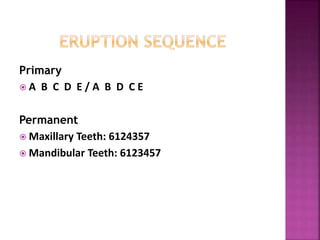
Primary
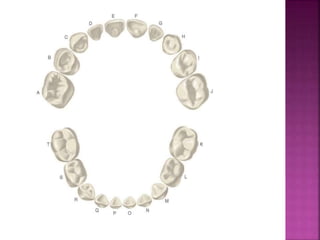
 A B C D E / A B D C E
Permanent
 Maxillary Teeth: 6124357
 Mandibular Teeth: 6123457
Primary
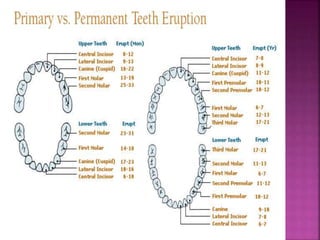
 Lasts from 6months to 6 years
Permanent
 12 years and beyond
Primary
 smaller in over all size and crown dimensions
Permanent
 larger
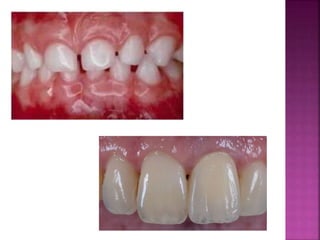
Primary
 lighter. Their refractive index is comparable to
that of milk.
Permanent
 darker. They appear yellowish white
Primary
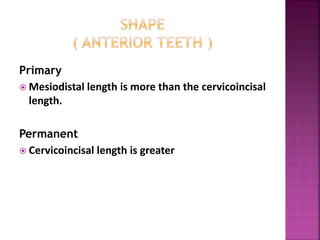
 Mesiodistal length is more than the cervicoincisal
length.
Permanent
 Cervicoincisal length is greater
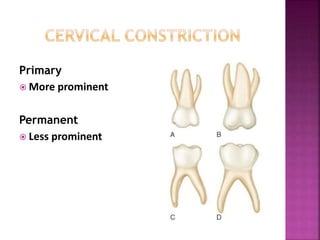
Primary
 More prominent
Permanent
 Less prominent
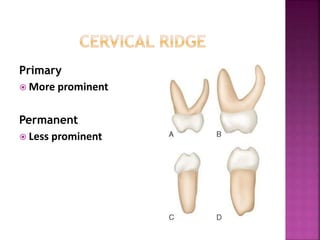
Primary
 More prominent
Permanent
 Less prominent
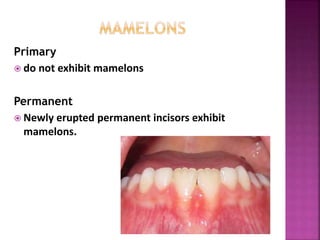
Primary
 do not exhibit mamelons
Permanent
 Newly erupted permanent incisors exhibit
mamelons.
Primary
 More conical in shape and the cusp tip is more
pointed and sharp.
Permanent
 Less conical and cusp tips are less pointed.
Primary
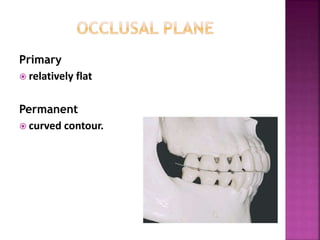
 relatively flat
Permanent
 curved contour.
Primary
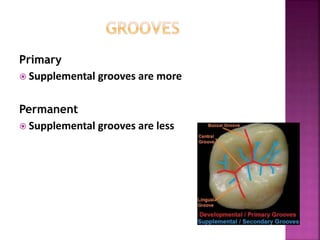
 Supplemental grooves are more
Permanent
 Supplemental grooves are less
Primary
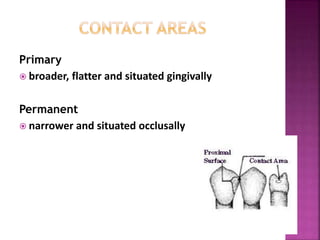
 broader, flatter and situated gingivally
Permanent
 narrower and situated occlusally
Primary
 Crown of second molar is larger than the first
molar.
Permanent
 Crown of first molar are larger than the second
and third molar.
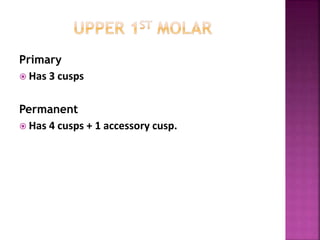
Primary
 Has 3 cusps
Permanent
 Has 4 cusps + 1 accessory cusp.
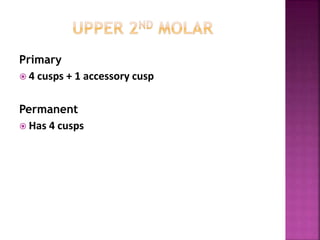
Primary
 4 cusps + 1 accessory cusp
Permanent
 Has 4 cusps
Primary
 4 cusps
Permanent
 Has 5 cusps
Primary
 5 cusps
Permanent
 Has 4 cusps
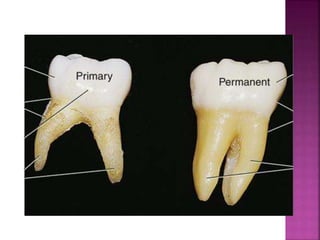
Primary
 narrow and straight
Permanent
 longer and curved
Primary
 Furcation of molar roots is placed more cervically
so that the root trunk is much smaller
Permanent
 Furcation in molars is placed more apically and
thus trunk is larger.
Primary
 undergo physiologic resorption and the primary
teeth are shed naturally
Permanent
 Physiologic resorption is absent
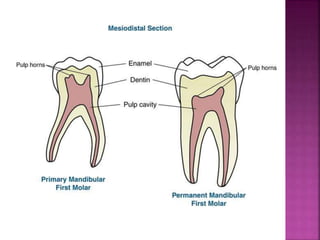
Primary
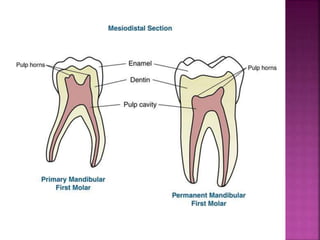
 proportionately larger when compared to crown
size
Permanent
 smaller in relation to crown size
Primary
 follows DEJ more closely
Permanent
 follows DEJ less closely
Primary
 higher and closer to outer surface
Permanent
 lower and away from outer surface
Primary
 thin, tortuous and branching path
Permanent
 well defined and less branching
Primary
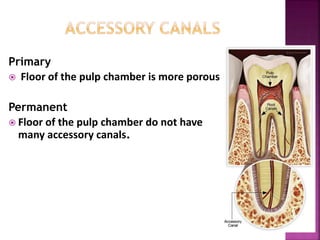
 Floor of the pulp chamber is more porous
Permanent
 Floor of the pulp chamber do not have
many accessory canals.
Primary
 wider
Permanent
 smaller/Narrower
Primary
 Enamel is thinner and is about 1mm of uniform
thickness
Permanent
 Enamel is 2-3 mm thick and is not uniform in
thickness.
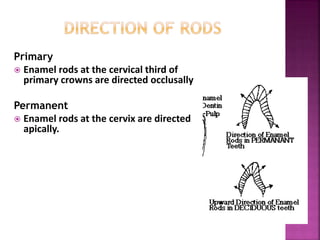
Primary
 Enamel rods at the cervical third of
primary crowns are directed occlusally
Permanent
 Enamel rods at the cervix are directed
apically.
Primary
 half that of permanent teeth.
Permanent
 Greater thickness of dentin
Primary
 less regular.
Permanent
 more regular.
Primary
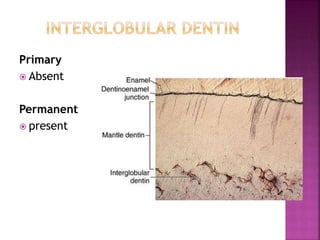
 Absent
Permanent
 present
Primary
 primary teeth have abundant blood supply, poor
localization of infection and inflammation.
Permanent
 reduced blood supply. Thus, infection and
inflammation are comparatively well localized
Primary
 less densely innervated.
Permanent
 more densely innervated
Primary
 Cementum is thin, made up of only primary
cementum
Permanent
 Cementum is thick, both primary and secondary
cementum are present.
Primary
 Both enamel and dentin are less mineralized and
less dense
Permanent
 Both enamel and dentin are more mineralized
and more dense.
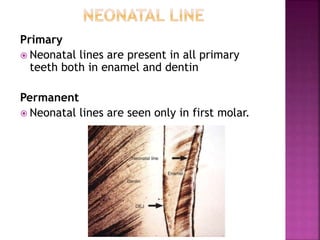
Primary
 Neonatal lines are present in all primary
teeth both in enamel and dentin
Permanent
 Neonatal lines are seen only in first molar.
Difference between Primary and permanent teeth