Moore and Mealy
Machines
Present By:
Munib Habib
Roll No: 6233
What is (Finite State Machine)FSM?
A finite state machine is a machine that has many states and has a logical way
of changing from one state to the other under guiding rules.
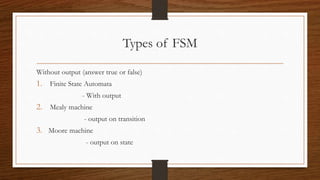
Types of FSM
Without output (answer true or false)
1. Finite State Automata
- With output
2. Mealy machine
- output on transition
3. Moore machine
- output on state
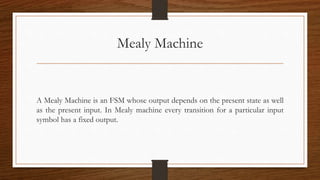
Mealy Machine
A Mealy Machine is an FSM whose output depends on the present state as well
as the present input. In Mealy machine every transition for a particular input
symbol has a fixed output.
Mealy Machine(Cont.)
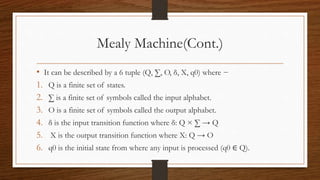
• It can be described by a 6 tuple (Q, ∑, O, δ, X, q0) where −
1. Q is a finite set of states.
2. ∑ is a finite set of symbols called the input alphabet.
3. O is a finite set of symbols called the output alphabet.
4. δ is the input transition function where δ: Q × ∑ → Q
5. X is the output transition function where X: Q → O
6. q0 is the initial state from where any input is processed (q0 ∈ Q).
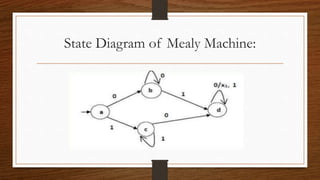
State Diagram of Mealy Machine:
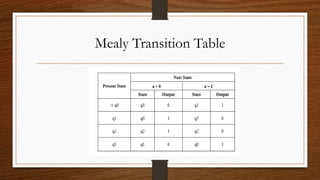
Mealy Transition Table
Moore Machine:
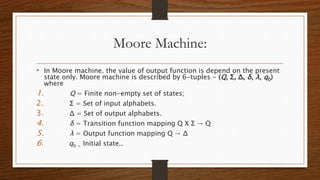
• In Moore machine. the value of output function is depend on the present
state only. Moore machine is described by 6-tuples - (Q, Σ, Δ, δ, λ, q0)
where
1. Q = Finite non-empty set of states;
2. Σ = Set of input alphabets.
3. Δ = Set of output alphabets.
4. δ = Transition function mapping Q X Σ → Q
5. λ = Output function mapping Q → Δ
6. q0 = Initial state..
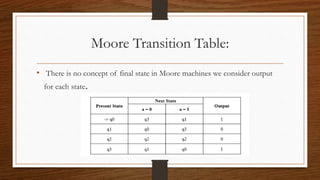
Moore Transition Table:
• There is no concept of final state in Moore machines we consider output
for each state.
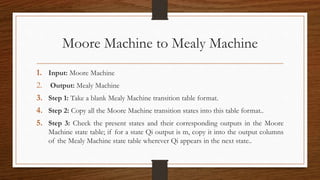
Moore Machine to Mealy Machine
1. Input: Moore Machine
2. Output: Mealy Machine
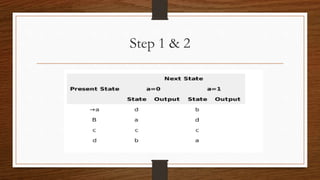
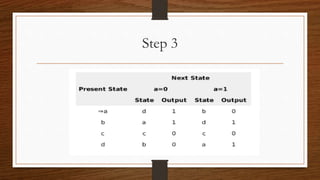
3. Step 1: Take a blank Mealy Machine transition table format.
4. Step 2: Copy all the Moore Machine transition states into this table format..
5. Step 3: Check the present states and their corresponding outputs in the Moore
Machine state table; if for a state Qi output is m, copy it into the output columns
of the Mealy Machine state table wherever Qi appears in the next state..
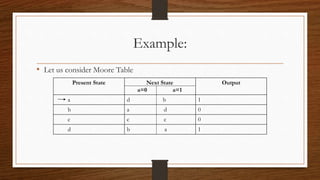
Example:
• Let us consider Moore Table
Present State Next State
a=0 a=1
Output
a d b 1
b a d 0
c c c 0
d b a 1
Step 1 & 2
Step 3
Mealy Machine To Moore Machine
1. Input: Mealy Machine
2. Output: Moore Machine
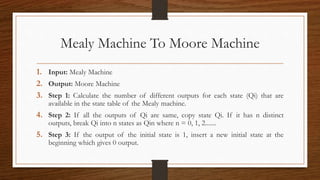
3. Step 1: Calculate the number of different outputs for each state (Qi) that are
available in the state table of the Mealy machine.
4. Step 2: If all the outputs of Qi are same, copy state Qi. If it has n distinct
outputs, break Qi into n states as Qin where n = 0, 1, 2.......
5. Step 3: If the output of the initial state is 1, insert a new initial state at the
beginning which gives 0 output.
Example:
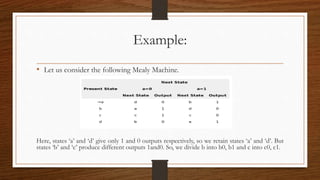
• Let us consider the following Mealy Machine.
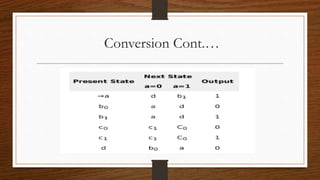
Here, states ‘a’ and ‘d’ give only 1 and 0 outputs respectively, so we retain states ‘a’ and ‘d’. But
states ‘b’ and ‘c’ produce different outputs 1and0. So, we divide b into b0, b1 and c into c0, c1.
Conversion Cont.…
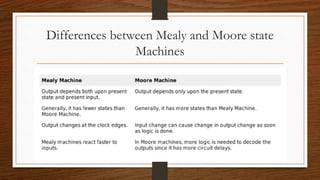
Differences between Mealy and Moore state
Machines
Advantages of Mealy and Moore state
Machines
• Moore machines are cheap
• They are easy to use
• Moore state machines are very fast
• Mealy machines are reactive i.e. they have a low response time (they are fast)
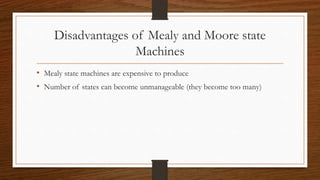
Disadvantages of Mealy and Moore state
Machines
• Mealy state machines are expensive to produce
• Number of states can become unmanageable (they become too many)
Uses of Mealy and Moore state Machines
• Mealy state machines are used in processors due to their property of having
many states
• Mealy state machines are also used to provide a rudimentary mathematical
model for cipher machines
• A Moore state machine is used as a right enable in SRAM because of its
speed.
• It is used in SRAM because SRAM needs a level-sensitive control (signal has
to be asserted for an amount of time)
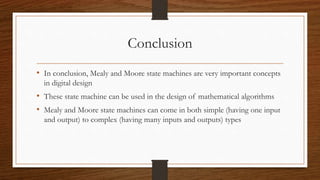
Conclusion
• In conclusion, Mealy and Moore state machines are very important concepts
in digital design
• These state machine can be used in the design of mathematical algorithms
• Mealy and Moore state machines can come in both simple (having one input
and output) to complex (having many inputs and outputs) types

Moore and mealy machine

  • 1.
    Moore and Mealy Machines PresentBy: Munib Habib Roll No: 6233
  • 2.
    What is (FiniteState Machine)FSM? A finite state machine is a machine that has many states and has a logical way of changing from one state to the other under guiding rules.
  • 3.
    Types of FSM Withoutoutput (answer true or false) 1. Finite State Automata - With output 2. Mealy machine - output on transition 3. Moore machine - output on state
  • 4.
    Mealy Machine A MealyMachine is an FSM whose output depends on the present state as well as the present input. In Mealy machine every transition for a particular input symbol has a fixed output.
  • 5.
    Mealy Machine(Cont.) • Itcan be described by a 6 tuple (Q, ∑, O, δ, X, q0) where − 1. Q is a finite set of states. 2. ∑ is a finite set of symbols called the input alphabet. 3. O is a finite set of symbols called the output alphabet. 4. δ is the input transition function where δ: Q × ∑ → Q 5. X is the output transition function where X: Q → O 6. q0 is the initial state from where any input is processed (q0 ∈ Q).
  • 6.
    State Diagram ofMealy Machine:
  • 7.
  • 8.
    Moore Machine: • InMoore machine. the value of output function is depend on the present state only. Moore machine is described by 6-tuples - (Q, Σ, Δ, δ, λ, q0) where 1. Q = Finite non-empty set of states; 2. Σ = Set of input alphabets. 3. Δ = Set of output alphabets. 4. δ = Transition function mapping Q X Σ → Q 5. λ = Output function mapping Q → Δ 6. q0 = Initial state..
  • 9.
    Moore Transition Table: •There is no concept of final state in Moore machines we consider output for each state.
  • 10.
    Moore Machine toMealy Machine 1. Input: Moore Machine 2. Output: Mealy Machine 3. Step 1: Take a blank Mealy Machine transition table format. 4. Step 2: Copy all the Moore Machine transition states into this table format.. 5. Step 3: Check the present states and their corresponding outputs in the Moore Machine state table; if for a state Qi output is m, copy it into the output columns of the Mealy Machine state table wherever Qi appears in the next state..
  • 11.
    Example: • Let usconsider Moore Table Present State Next State a=0 a=1 Output a d b 1 b a d 0 c c c 0 d b a 1
  • 12.
  • 13.
  • 14.
    Mealy Machine ToMoore Machine 1. Input: Mealy Machine 2. Output: Moore Machine 3. Step 1: Calculate the number of different outputs for each state (Qi) that are available in the state table of the Mealy machine. 4. Step 2: If all the outputs of Qi are same, copy state Qi. If it has n distinct outputs, break Qi into n states as Qin where n = 0, 1, 2....... 5. Step 3: If the output of the initial state is 1, insert a new initial state at the beginning which gives 0 output.
  • 15.
    Example: • Let usconsider the following Mealy Machine. Here, states ‘a’ and ‘d’ give only 1 and 0 outputs respectively, so we retain states ‘a’ and ‘d’. But states ‘b’ and ‘c’ produce different outputs 1and0. So, we divide b into b0, b1 and c into c0, c1.
  • 16.
  • 17.
    Differences between Mealyand Moore state Machines
  • 18.
    Advantages of Mealyand Moore state Machines • Moore machines are cheap • They are easy to use • Moore state machines are very fast • Mealy machines are reactive i.e. they have a low response time (they are fast)
  • 19.
    Disadvantages of Mealyand Moore state Machines • Mealy state machines are expensive to produce • Number of states can become unmanageable (they become too many)
  • 20.
    Uses of Mealyand Moore state Machines • Mealy state machines are used in processors due to their property of having many states • Mealy state machines are also used to provide a rudimentary mathematical model for cipher machines • A Moore state machine is used as a right enable in SRAM because of its speed. • It is used in SRAM because SRAM needs a level-sensitive control (signal has to be asserted for an amount of time)
  • 21.
    Conclusion • In conclusion,Mealy and Moore state machines are very important concepts in digital design • These state machine can be used in the design of mathematical algorithms • Mealy and Moore state machines can come in both simple (having one input and output) to complex (having many inputs and outputs) types