
Finite State Machine

    Osama Hussain
Content
•   Concept
•   Mealy & Moore Machines
•   UML State Machines
•   UML State Diagrams
•   Examples
•   Implementation
Concept


A finite state machine (hereinafter called FSM) is
a mathematical model which abstracts the
representation of behavior exhibited by some
systems
Mathematical Model


  Check it by yourself 
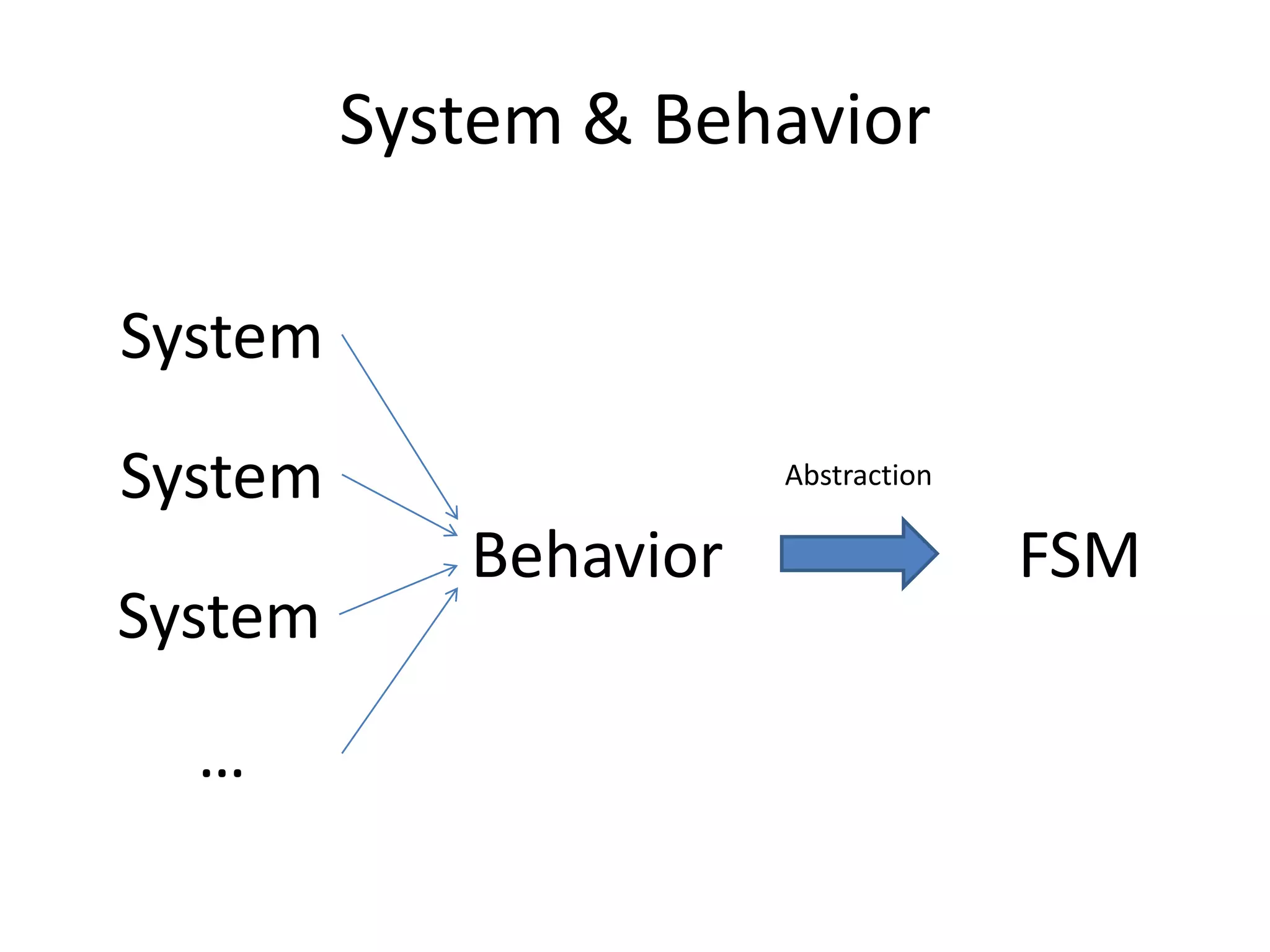
System & Behavior

System
System                 Abstraction

            Behavior                 FSM
System
  …
Examples
• Traffic Light
   – Switching lights on and off
• Text Parsers
   – Detection of certain phrase or word
• Washing Machine
   – Washing, Rinsing, Spinning …
• Mario in Super Mario Game
   – Walk, Run, Jump …
Remarks
• Not all systems can be modeled in FSM
  – Real-time systems for example
  – Memory limitations due to huge number of states
• Not all systems can be easily modeled in FSM
  – Some behaviors are hard to describe in terms of
    states
• Proper FSM design can lead to easier system
  development
Within Game Dev.
• Some Game Developers think
  – FSM is only considered for AI field
  – FSM is only used in abstracting character behavior
  – FSM is only considered for Gameplay
    Programmers
Misconception
• Some Game Developers think
  – FSM is only considered for AI field
  – FSM is only used in abstracting character behavior
  – FSM is only considered for Gameplay
    Programmers

                          
Composition
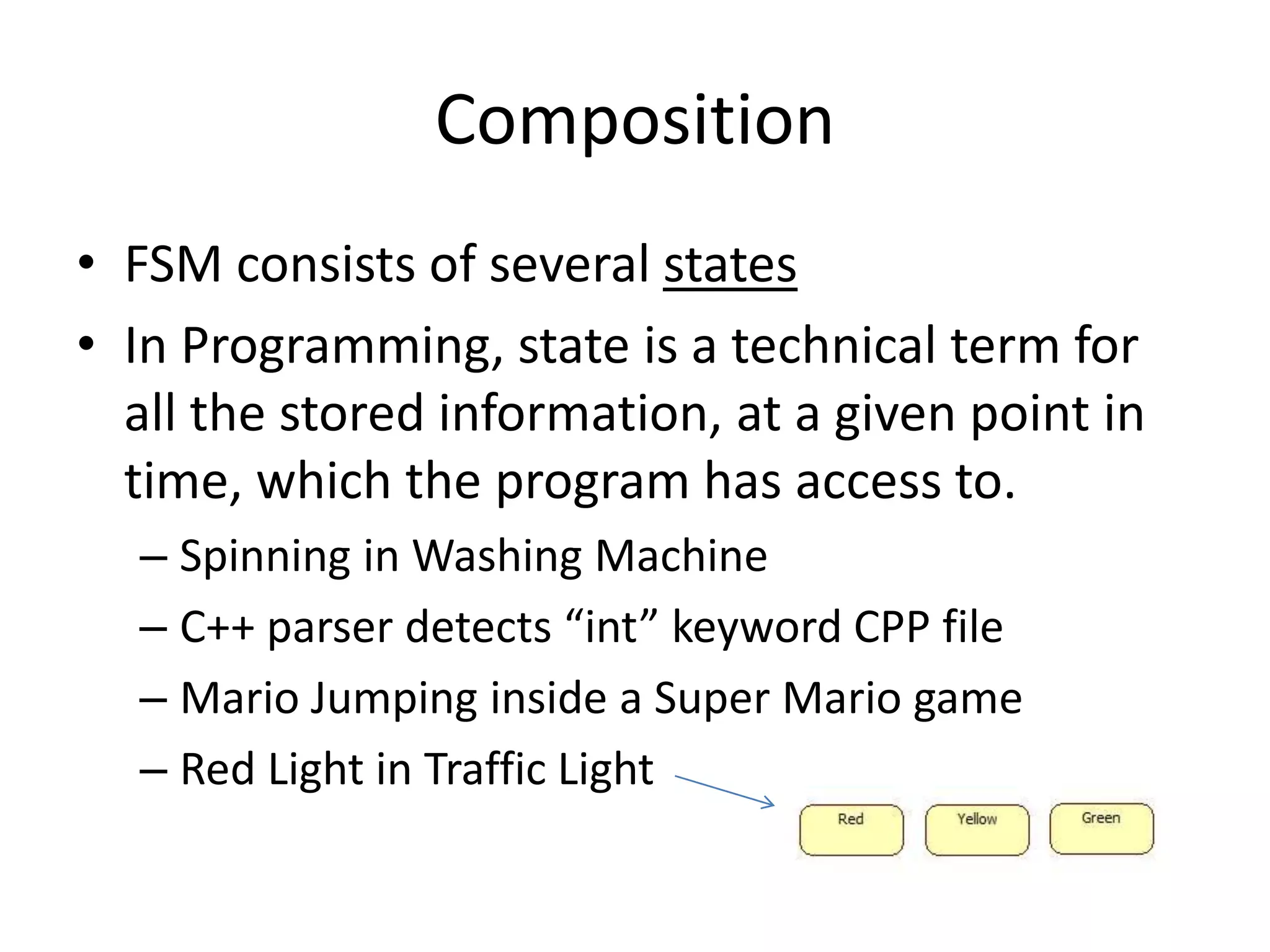
• FSM consists of several states
• In Programming, state is a technical term for
  all the stored information, at a given point in
  time, which the program has access to.
  – Spinning in Washing Machine
  – C++ parser detects “int” keyword CPP file
  – Mario Jumping inside a Super Mario game
  – Red Light in Traffic Light
Composition
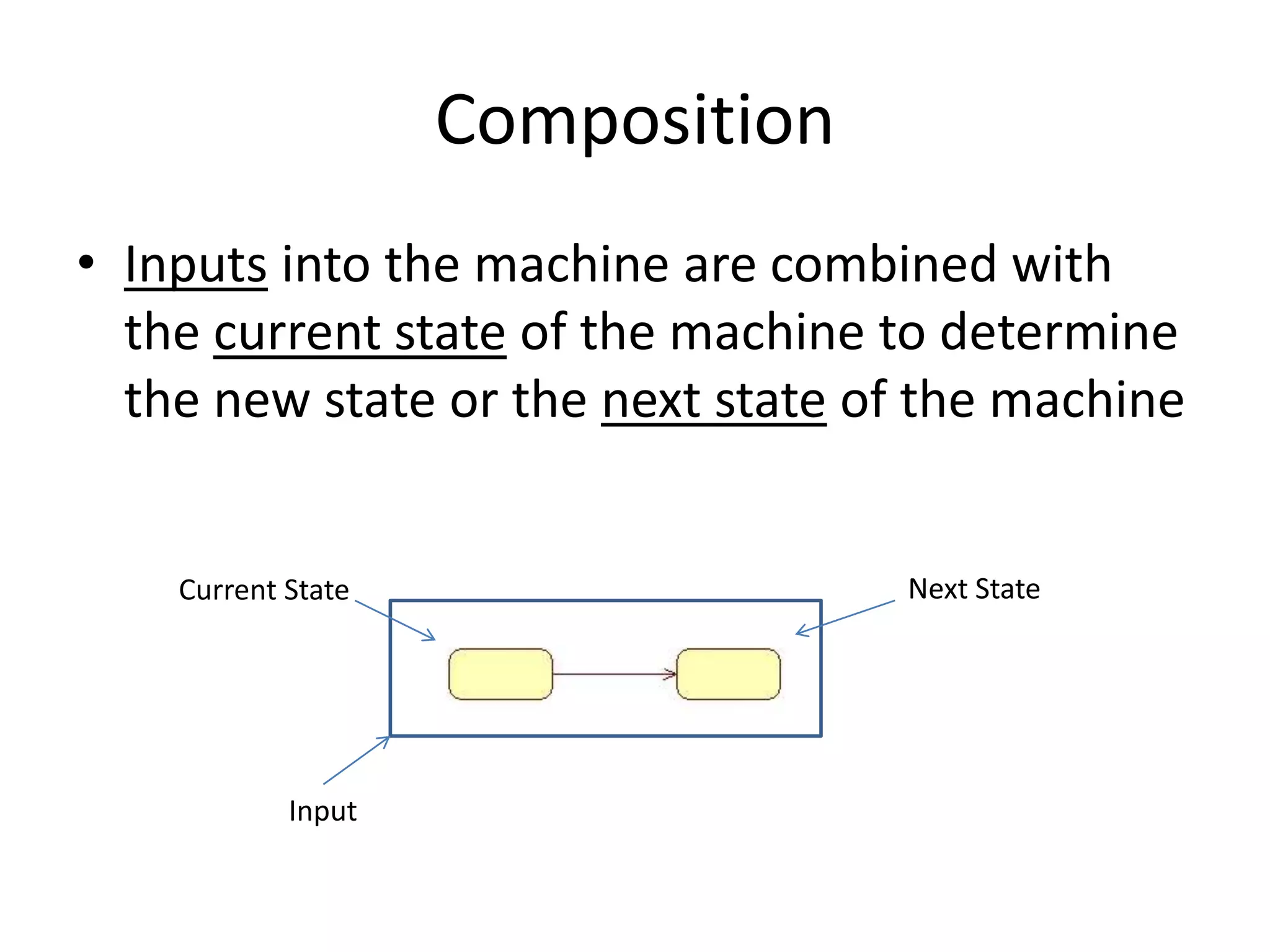
• Inputs into the machine are combined with
  the current state of the machine to determine
  the new state or the next state of the machine


    Current State                  Next State


            Input
State diagram


Donate a graphical representation of an FSM


           UML State diagrams
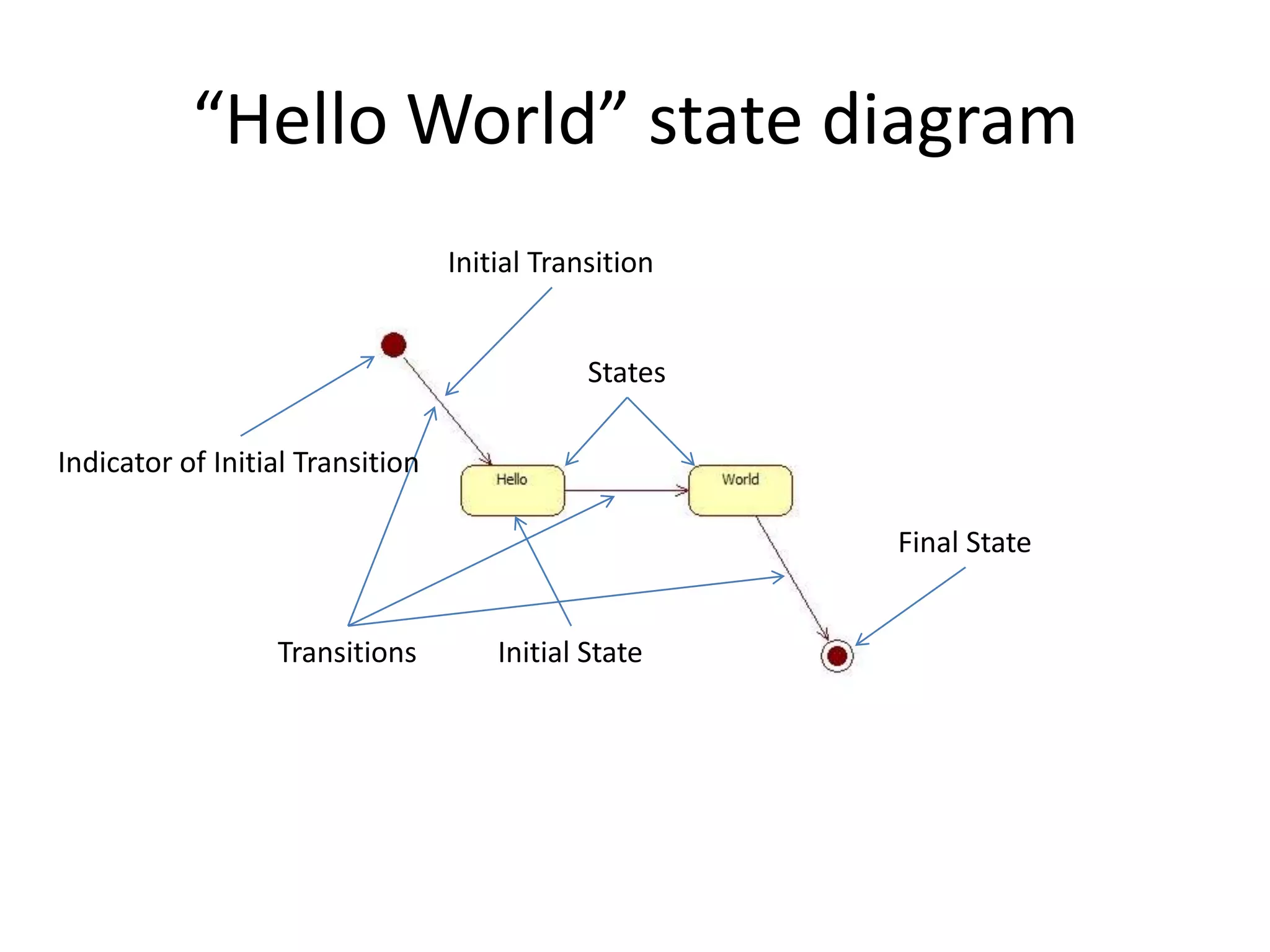
“Hello World” state diagram
                                  Initial Transition


                                              States

Indicator of Initial Transition

                                                       Final State


                  Transitions         Initial State
Composition
• Output … ?
Mealy Machine


Output determined by state and input
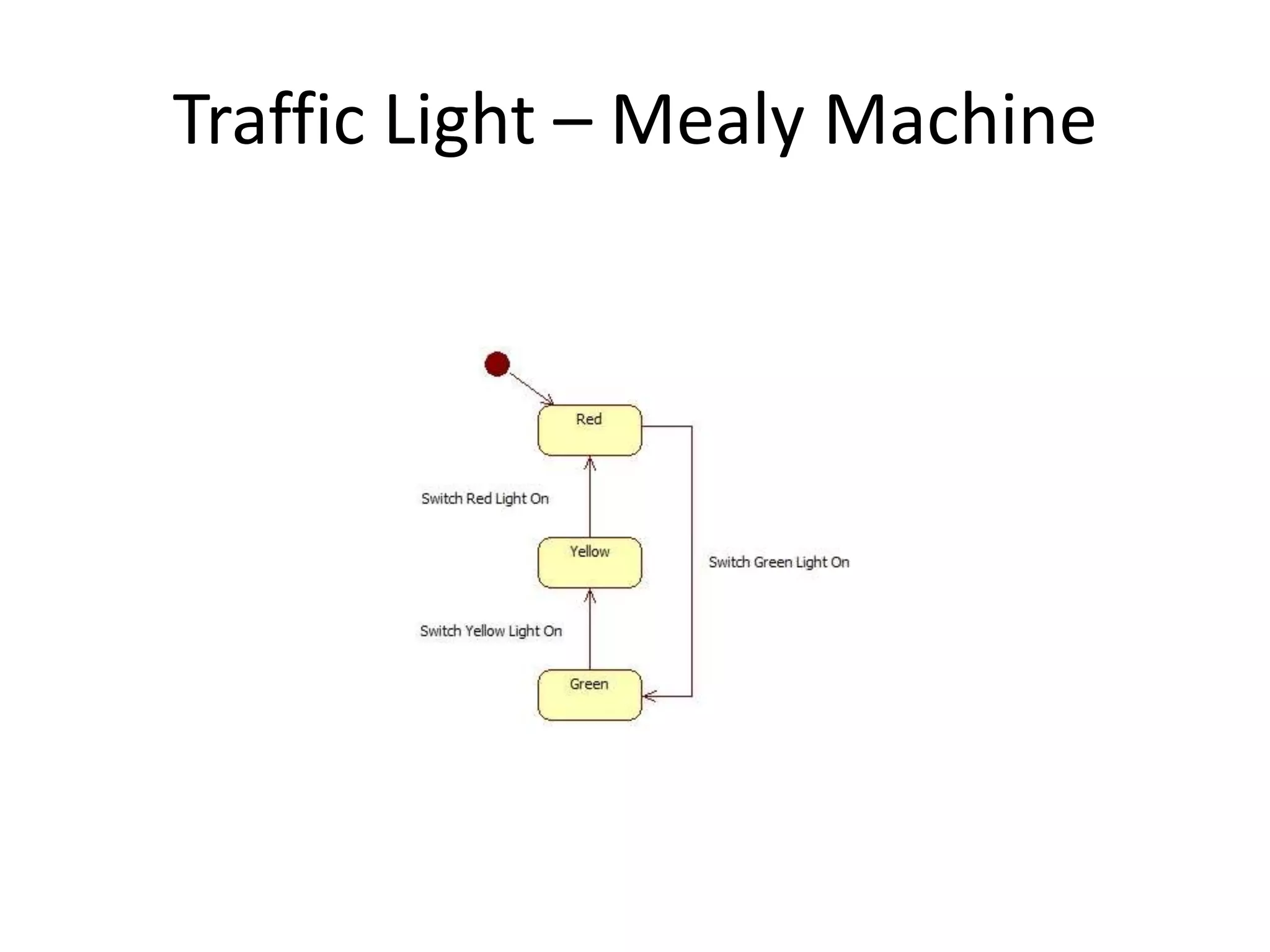
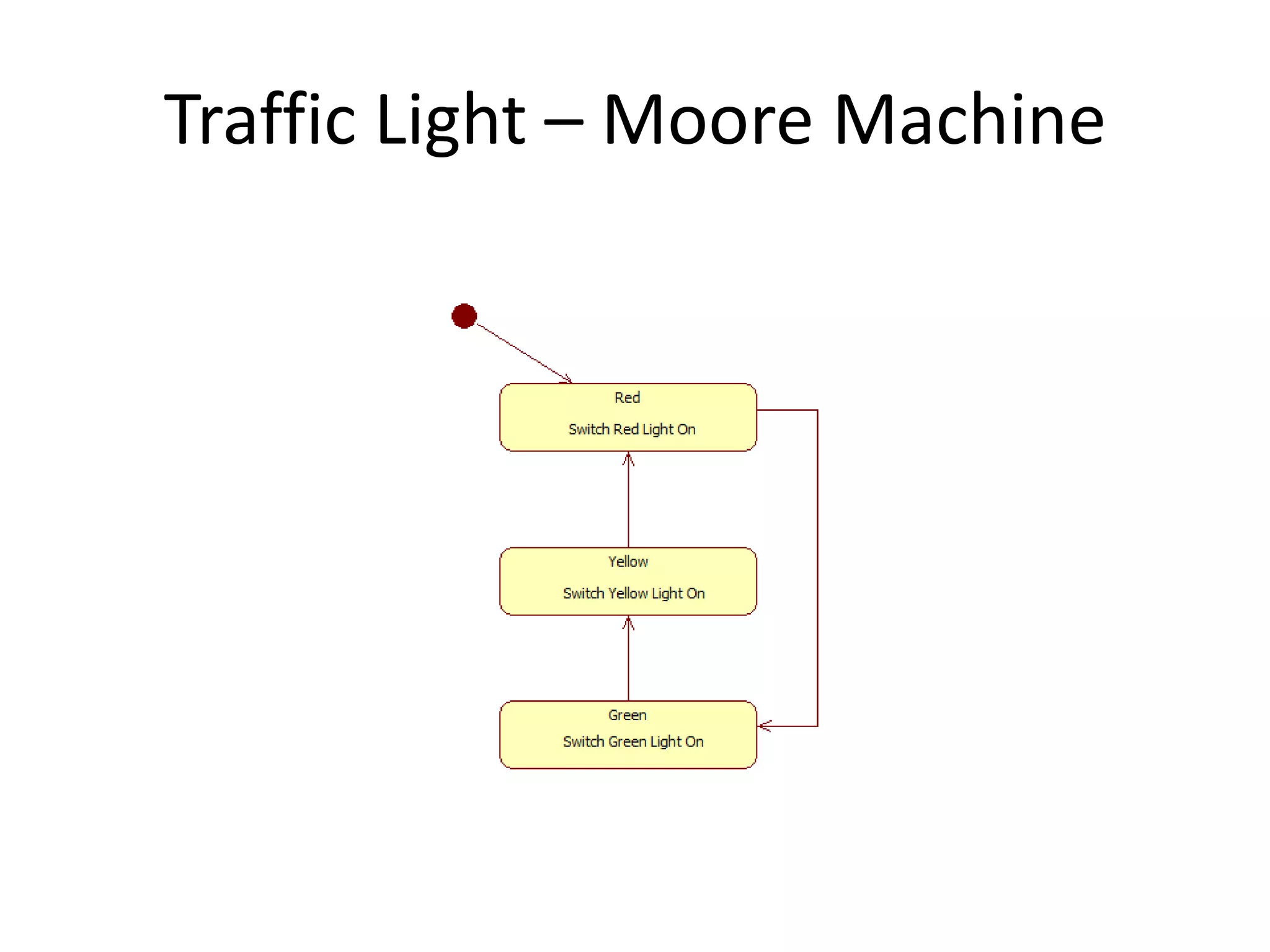
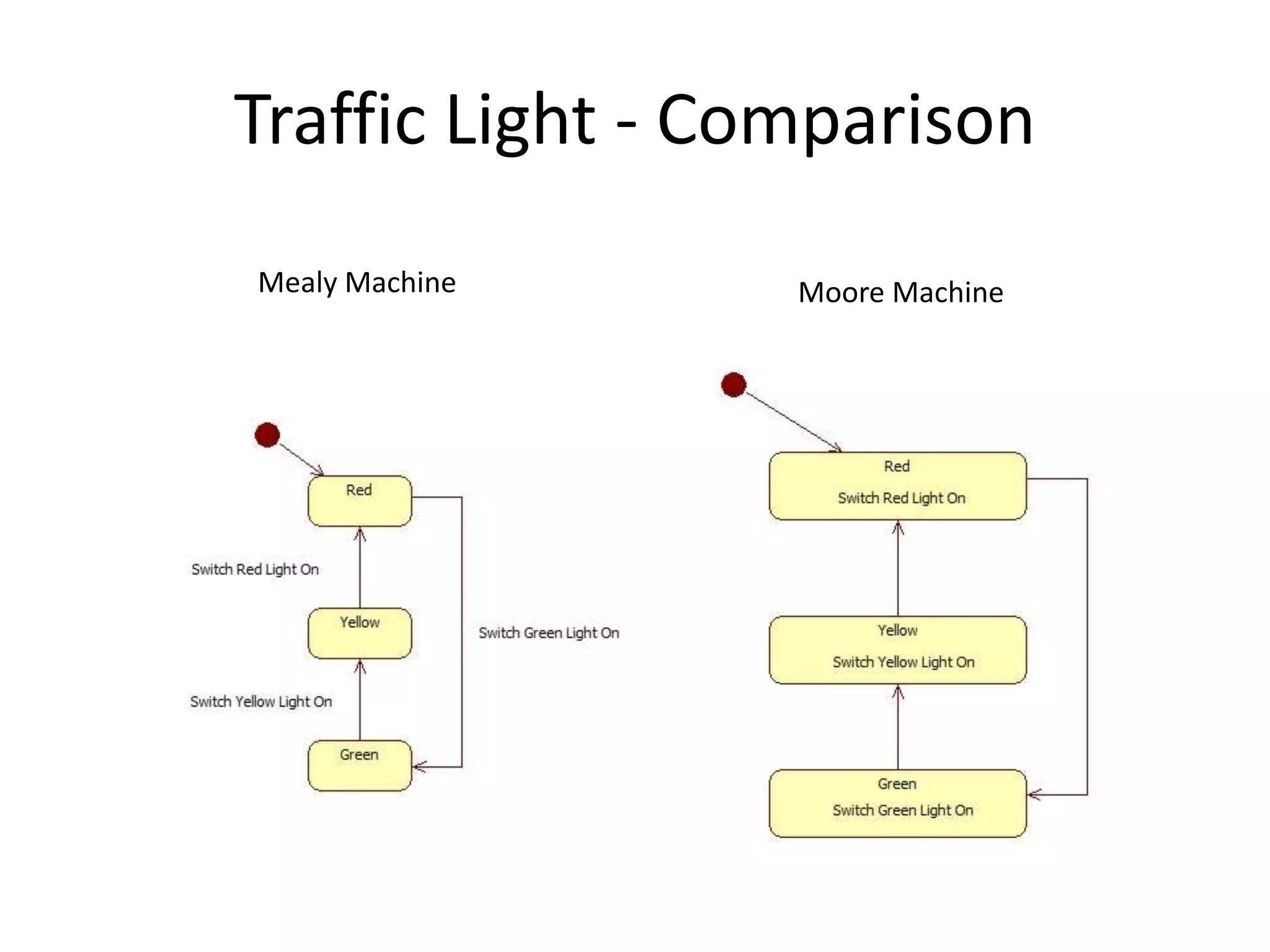
Traffic Light – Concept
• We got 3 lights that can be switched on and off individually,
  they are: Red, Yellow, and Green
• Traffic light contains a timer
• The traffic light starts by turning on the red light and turn
  off the rest
• After timer completes, switch on the green light and turn
  off the rest
• After timer completes, switch on the yellow light and turn
  off the rest
• After timer completes, switch on the red light and turn off
  the rest
• Restart again
Traffic Light – Mealy Machine
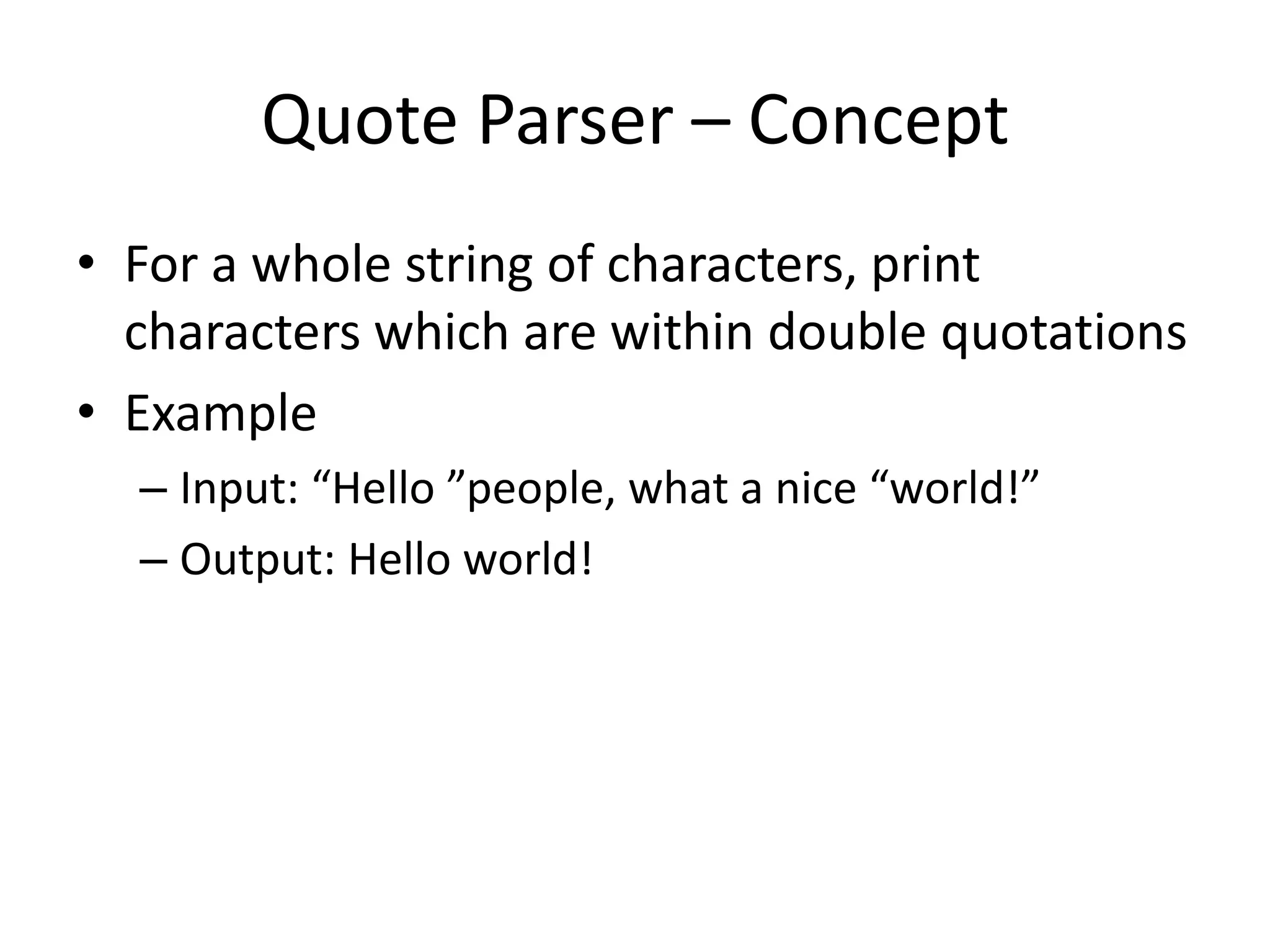
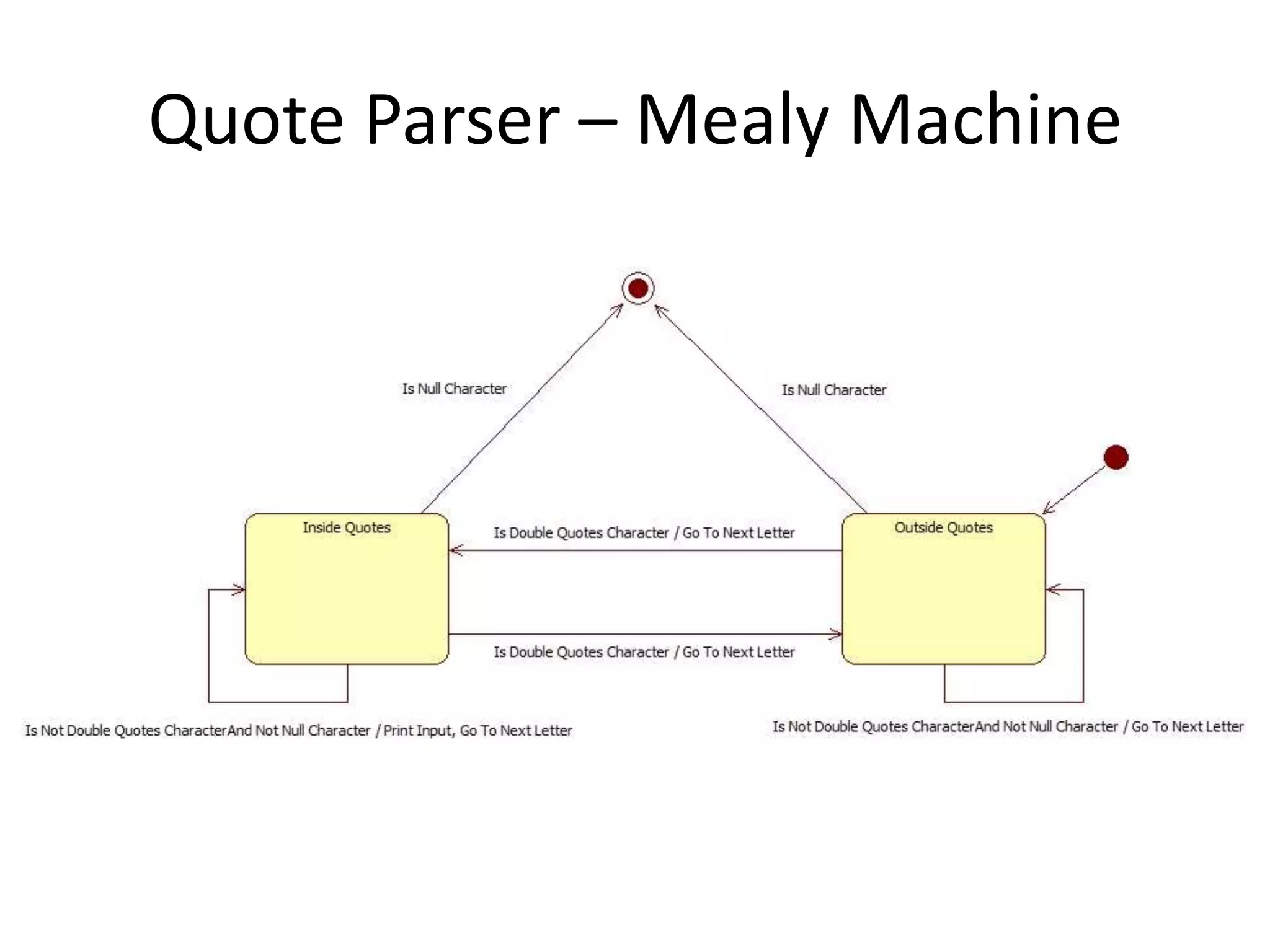
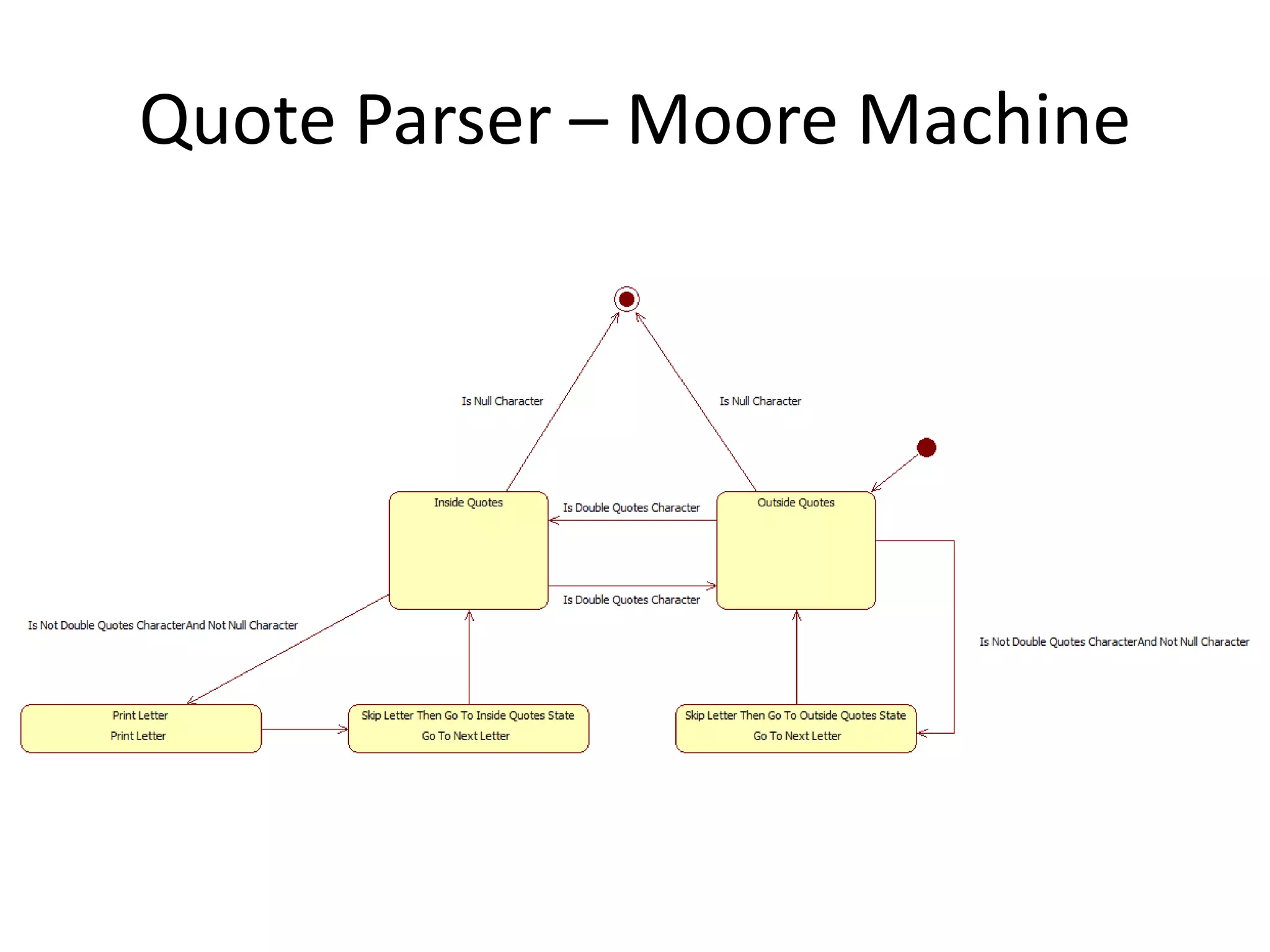
Quote Parser – Concept
• For a whole string of characters, print
  characters which are within double quotations
• Example
  – Input: “Hello ”people, what a nice “world!”
  – Output: Hello world!
Quote Parser – Mealy Machine
Moore Machine


Output determined by state and output
Traffic Light – Moore Machine
Traffic Light - Comparison
Mealy Machine     Moore Machine
Quote Parser – Moore Machine
UML State Machine
Significantly enhanced realization of the
mathematical concept of a finite automaton in
Computer Science applications as expressed in
the Unified Modeling Language notation
  – Object-based variant of Harel statechart (the
    concept of nested states)
  – Combines both Mealy and Moore machines with
    further addition of features
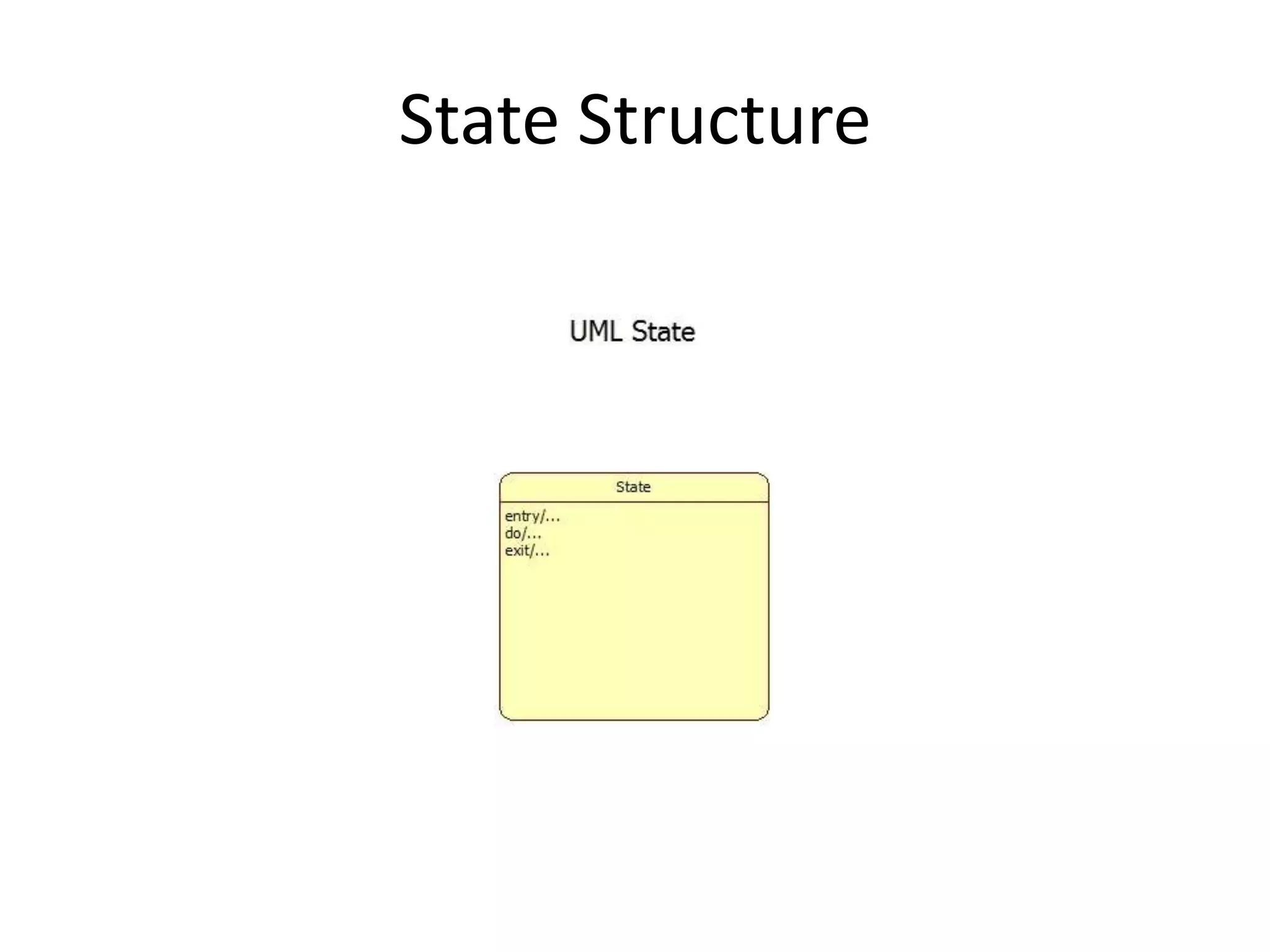
State Structure
Think of your states as objects where you might
need to
• Initialize it through Entry actions
• Update it through Do actions
• Finalize it through Exit actions
State Structure
Advantages
• Less states
• Default control mechanism
• Object oriented style
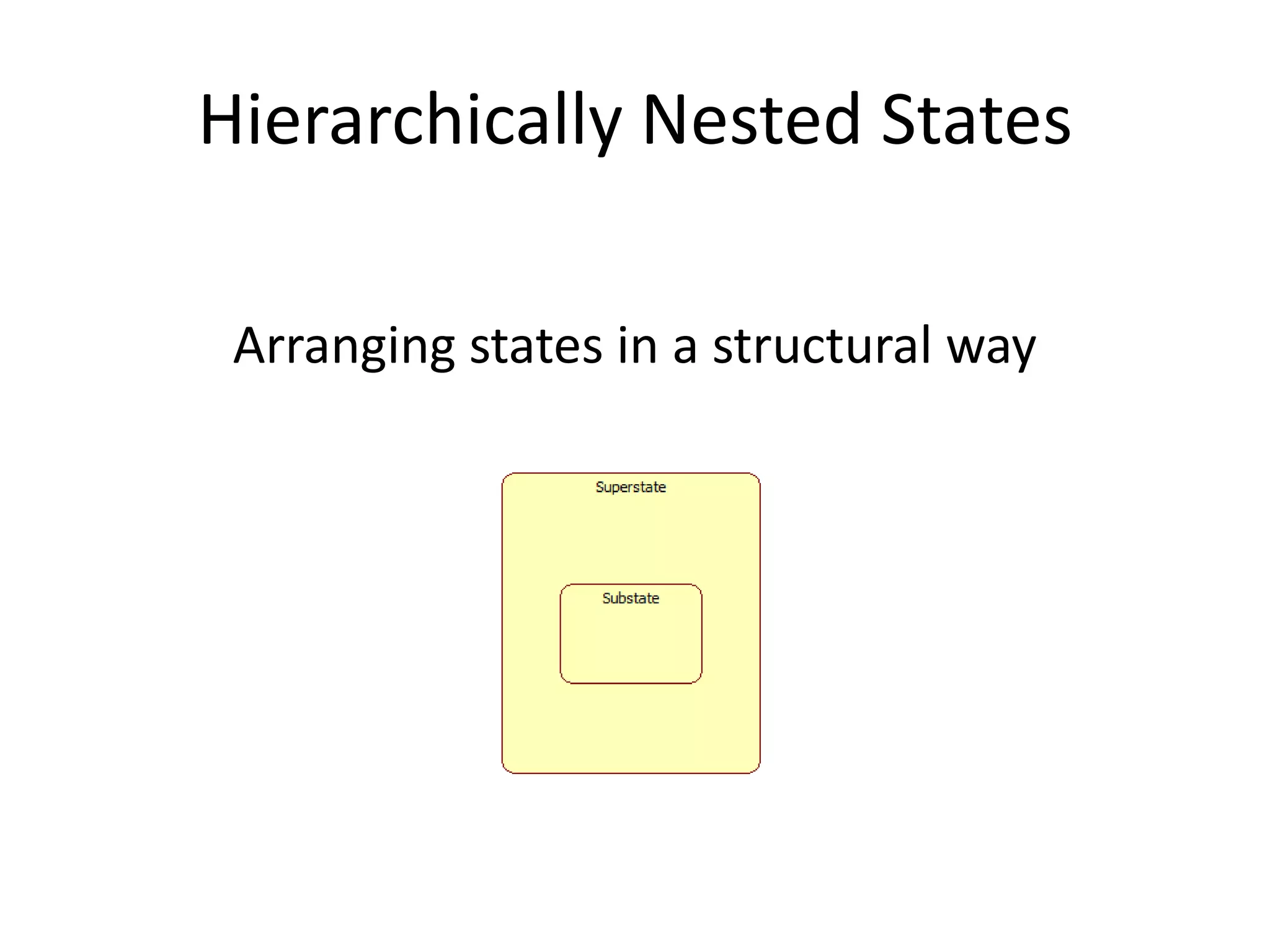
Hierarchically Nested States

 Arranging states in a structural way
Hierarchically Nested States
• The most important innovation of UML state
  machines over the traditional FSMs
• State nesting is not limited to one level only
• TOP state
  – Exist in every state machine
  – Contains all the other elements of the entire state
    machine
  – Optionally to depict it in the diagram
Traffic Light
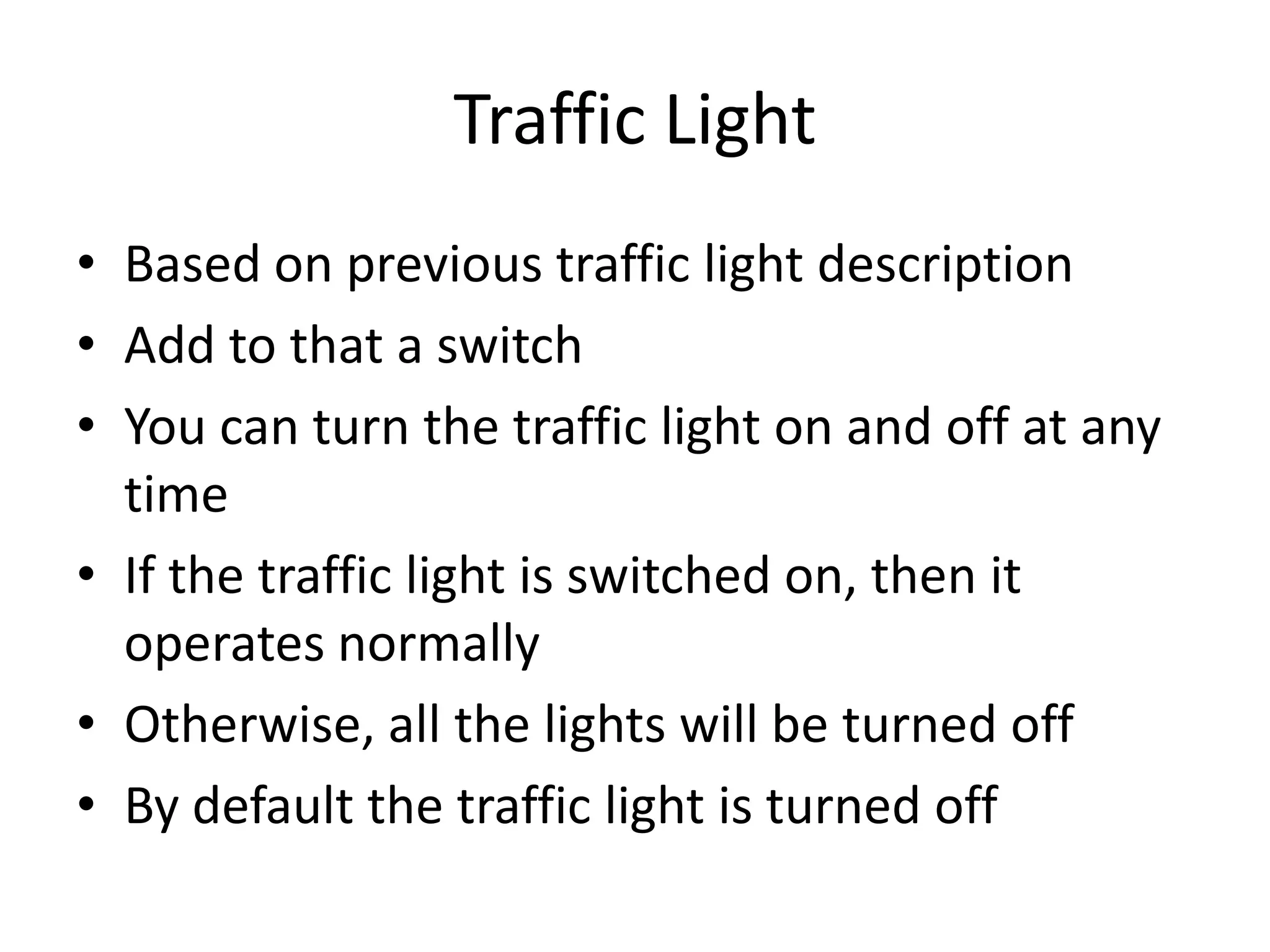
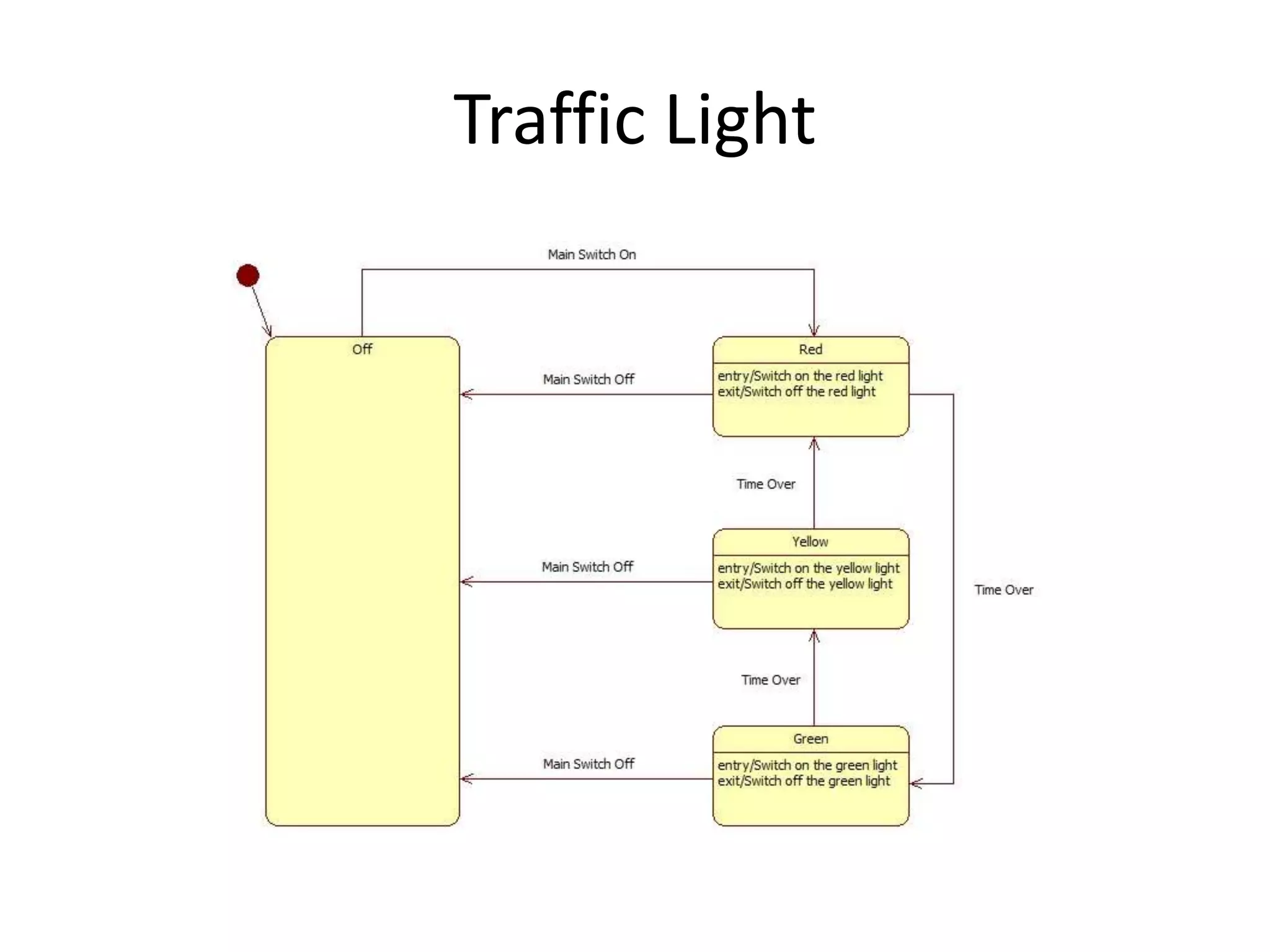
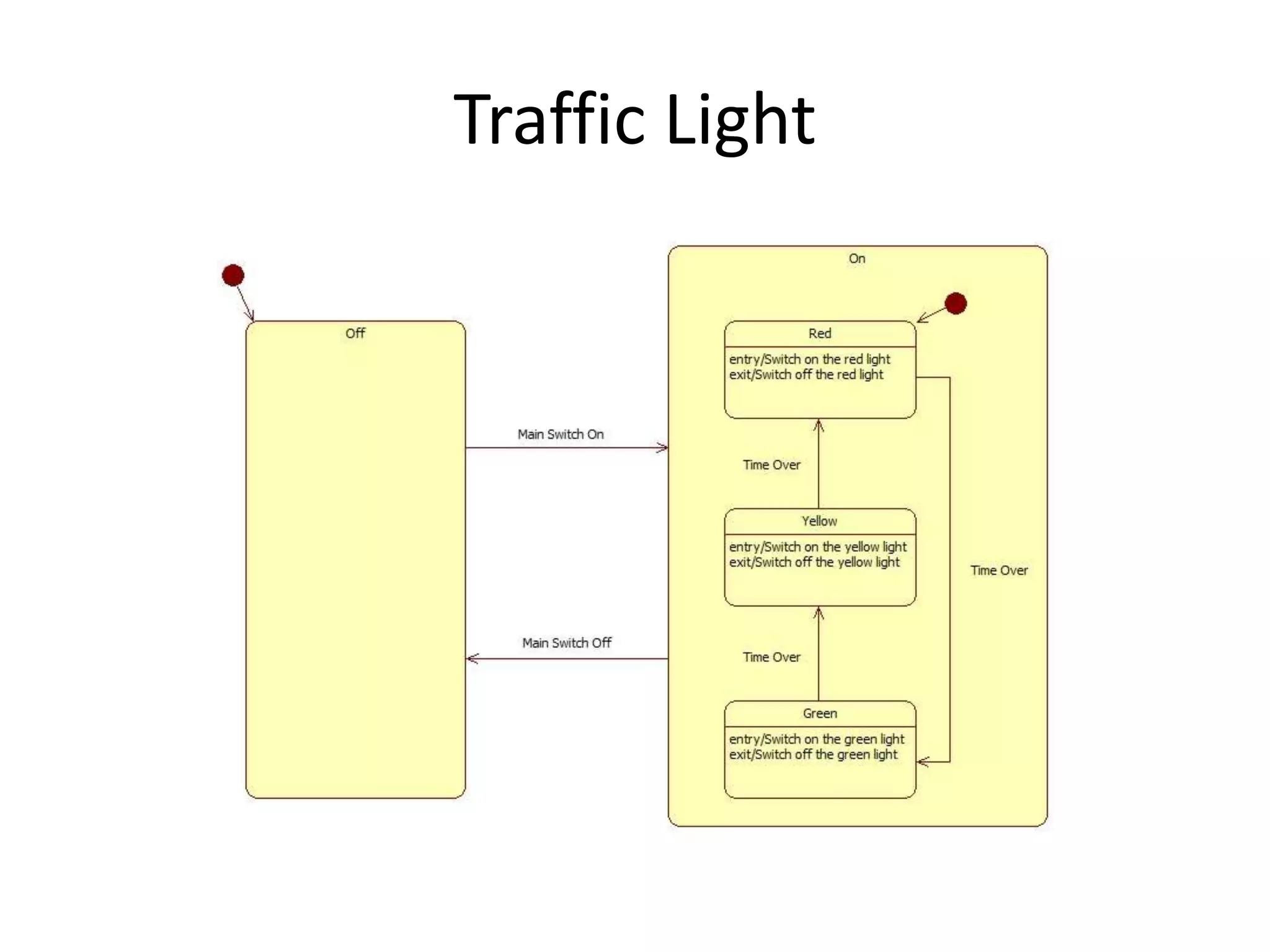
• Based on previous traffic light description
• Add to that a switch
• You can turn the traffic light on and off at any
  time
• If the traffic light is switched on, then it
  operates normally
• Otherwise, all the lights will be turned off
• By default the traffic light is turned off
Traffic Light
Traffic Light
Gain
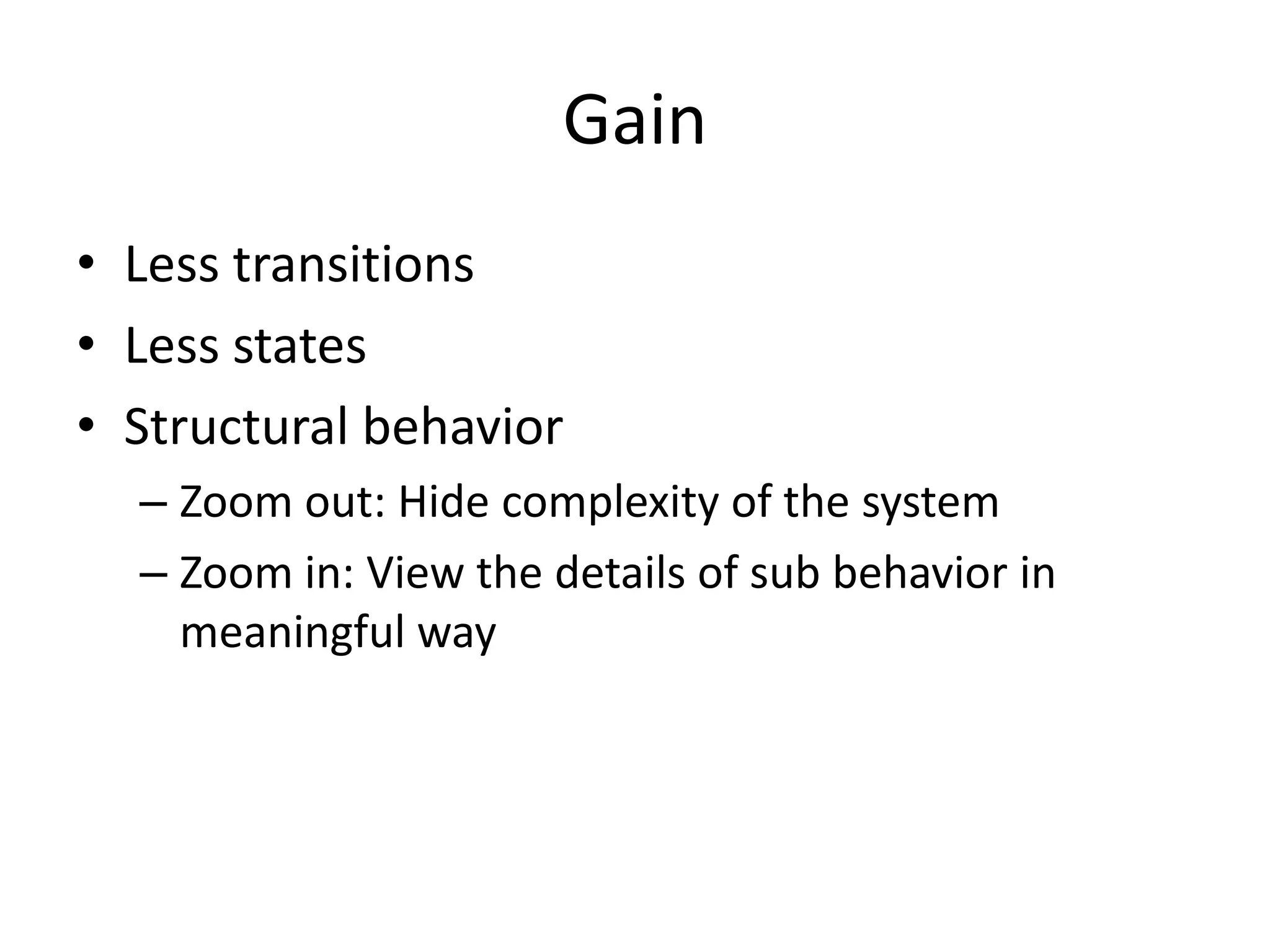
• Less transitions
• Less states
• Structural behavior
  – Zoom out: Hide complexity of the system
  – Zoom in: View the details of sub behavior in
    meaningful way
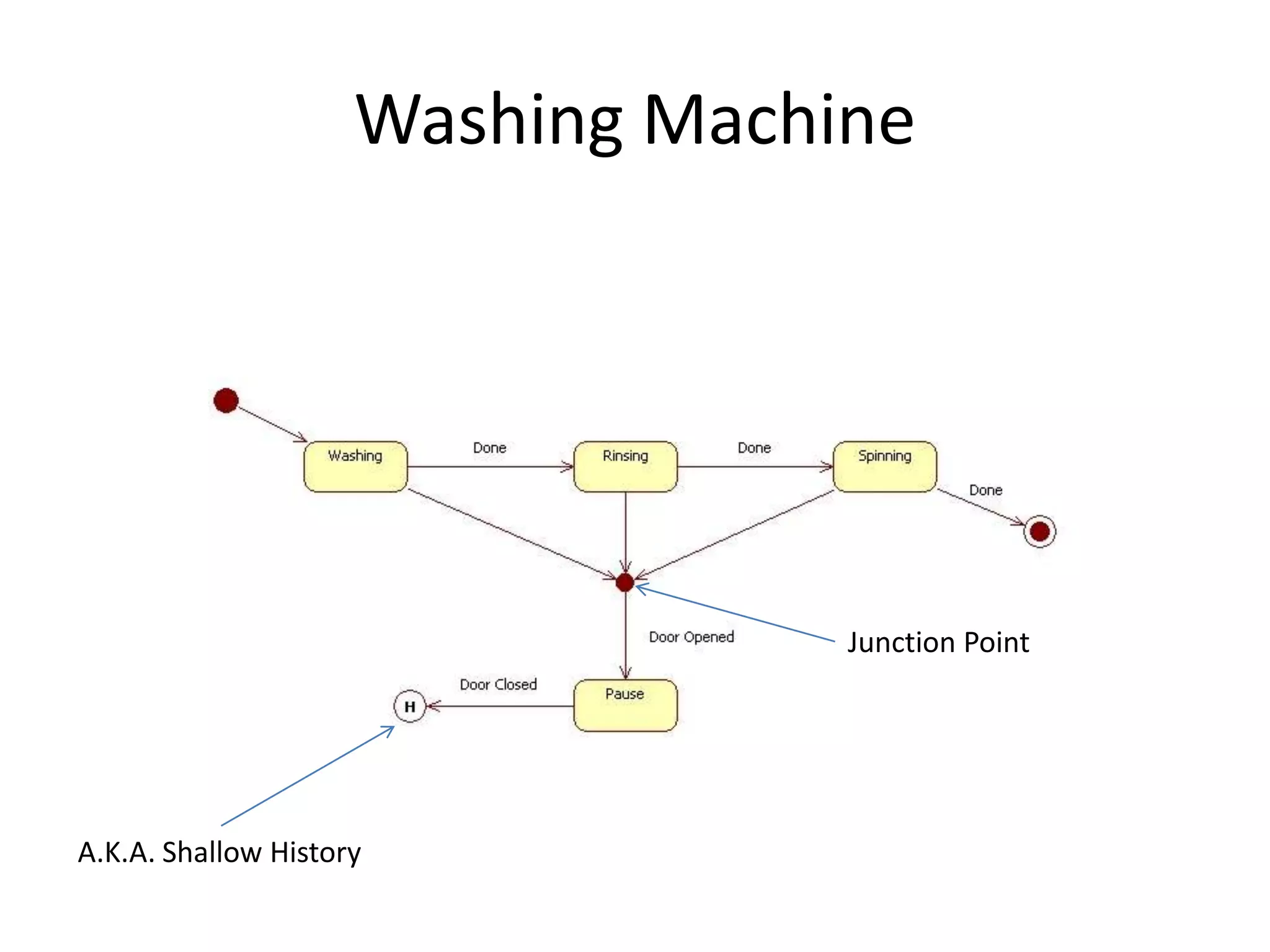
History


A facility to return back to the previous state
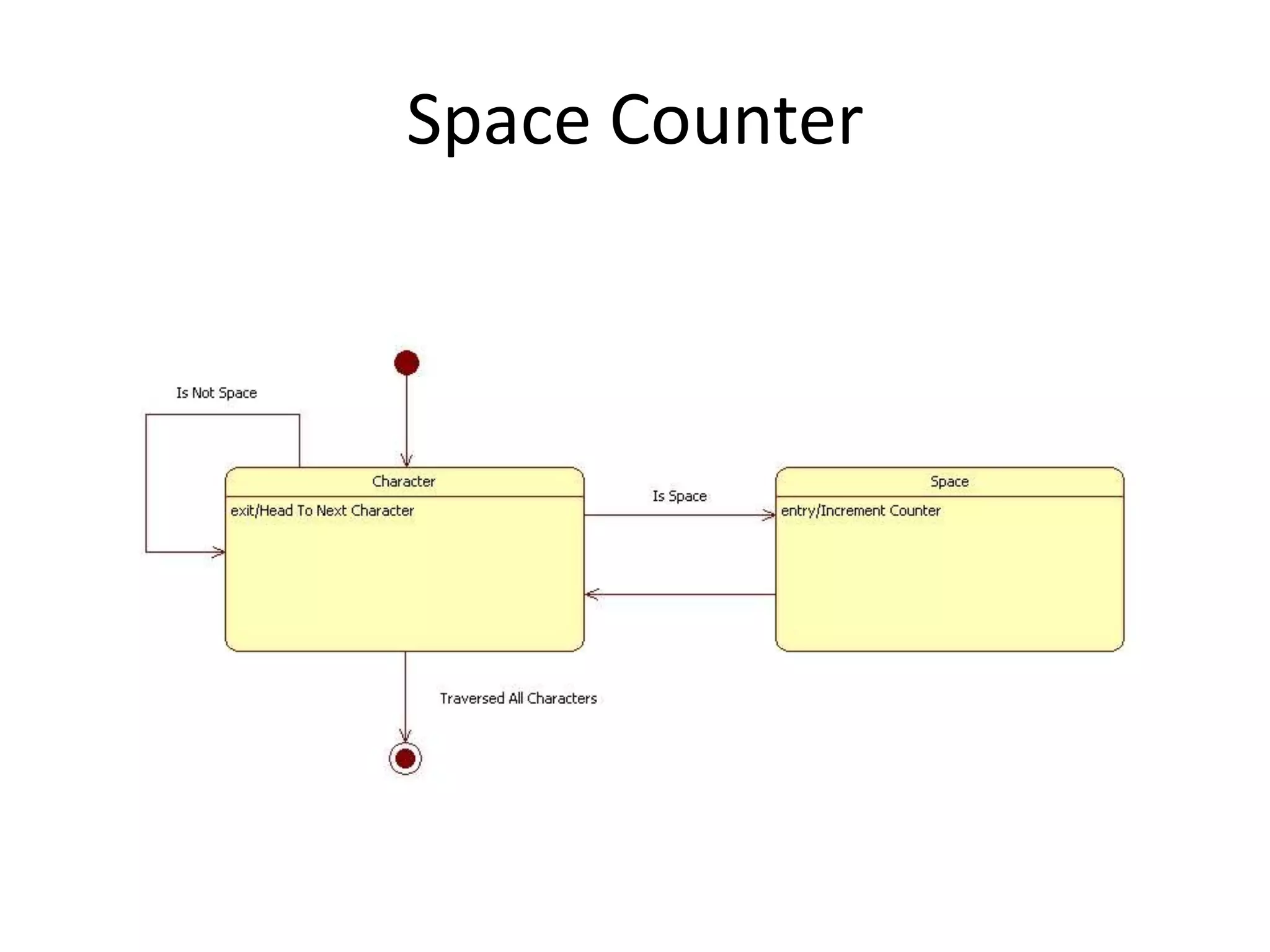
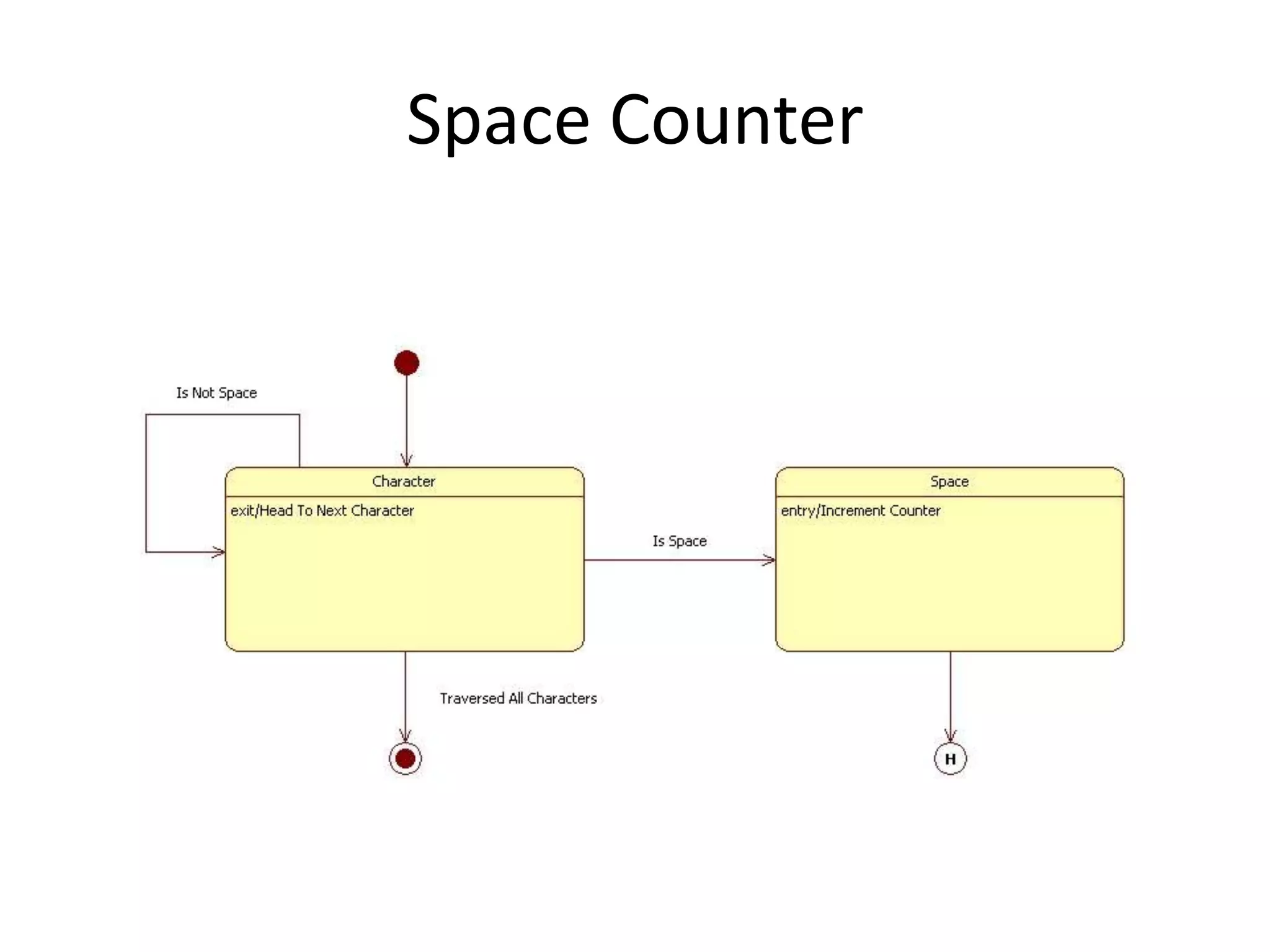
Space Counter
Space Counter
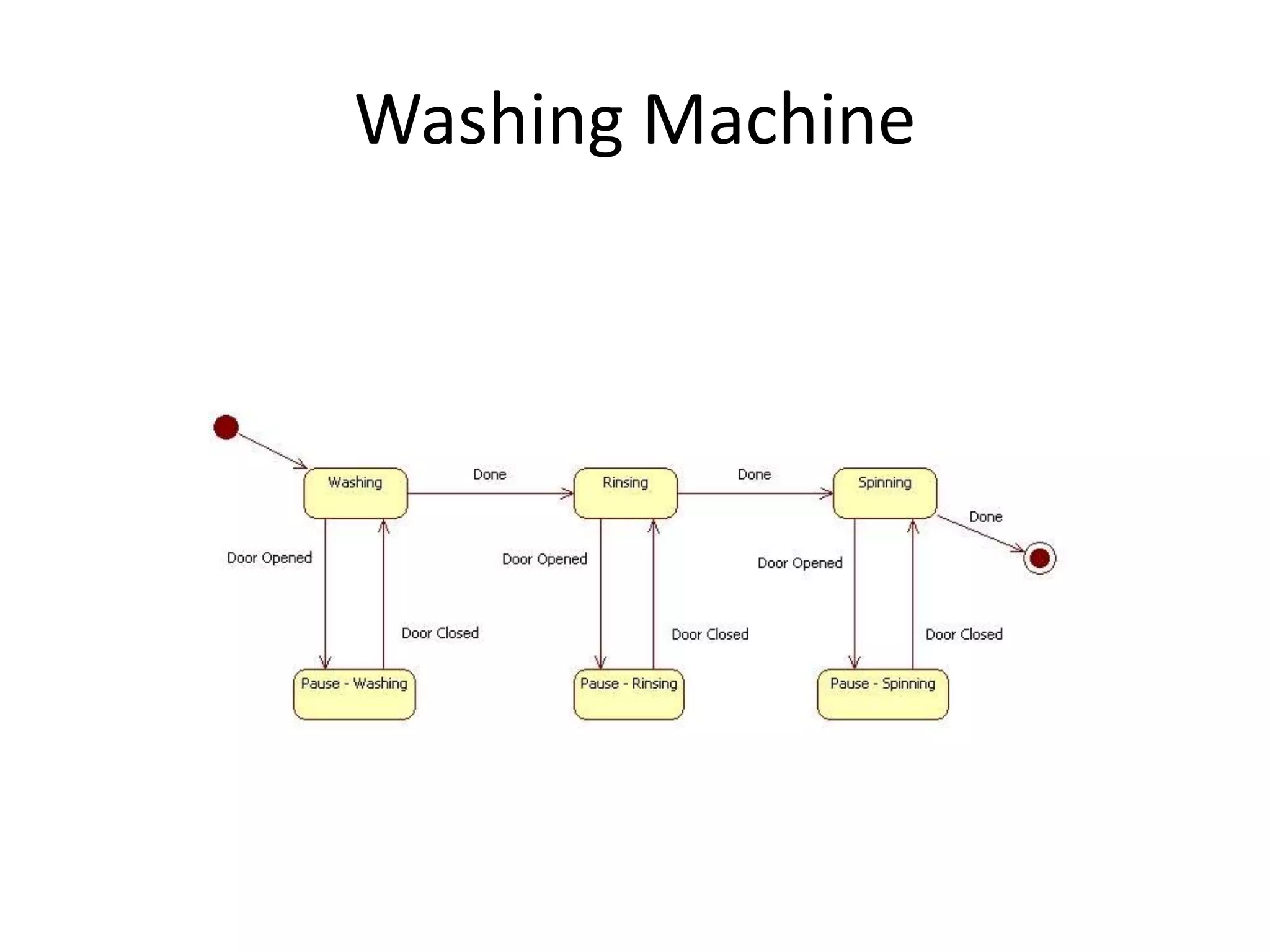
Washing Machine
Washing Machine


                                  Junction Point


A.K.A. Shallow History
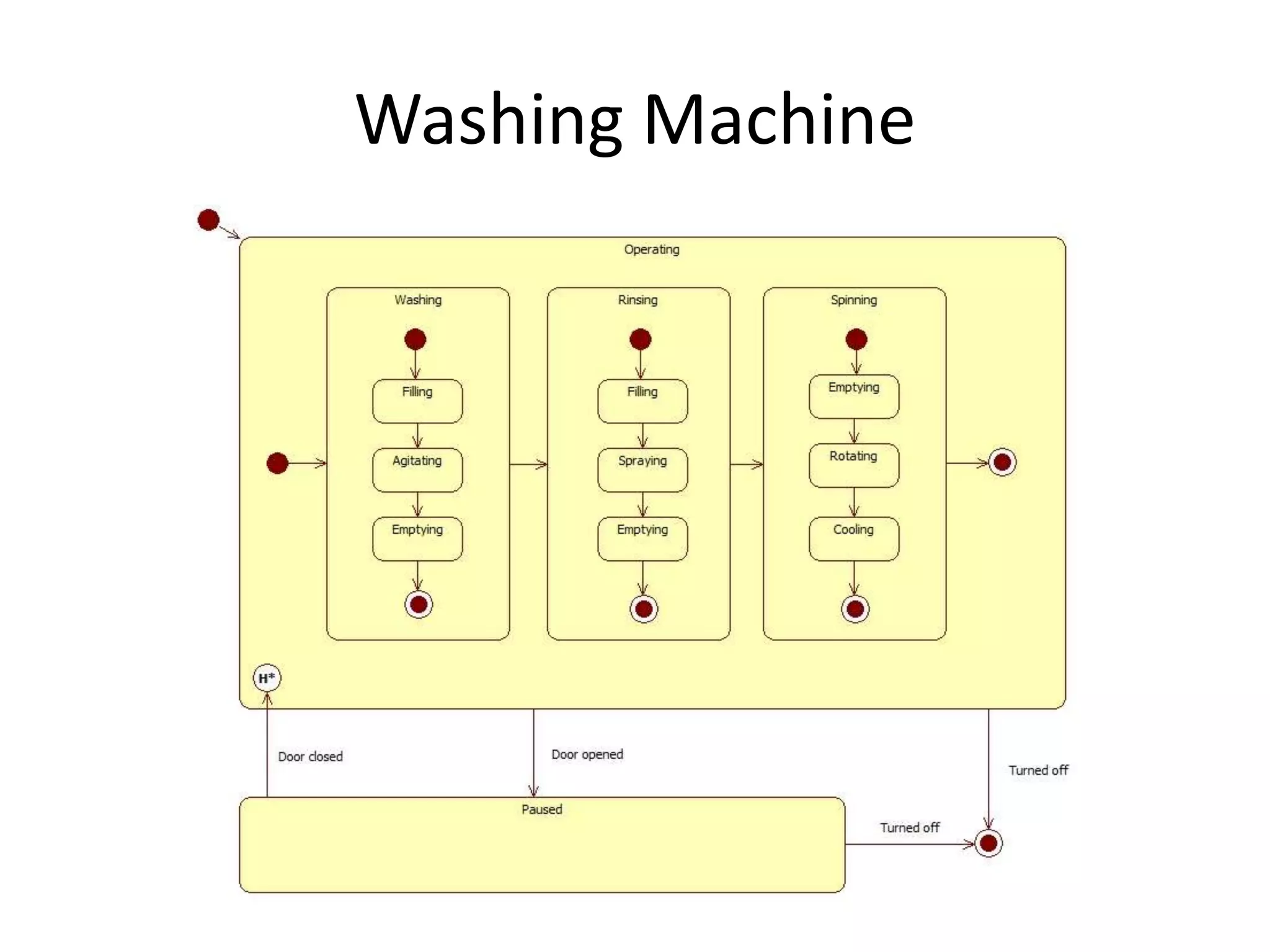
Deep History


Recall the state of every nested substate of the
enclosing substate, down to any level of nesting
Washing Machine
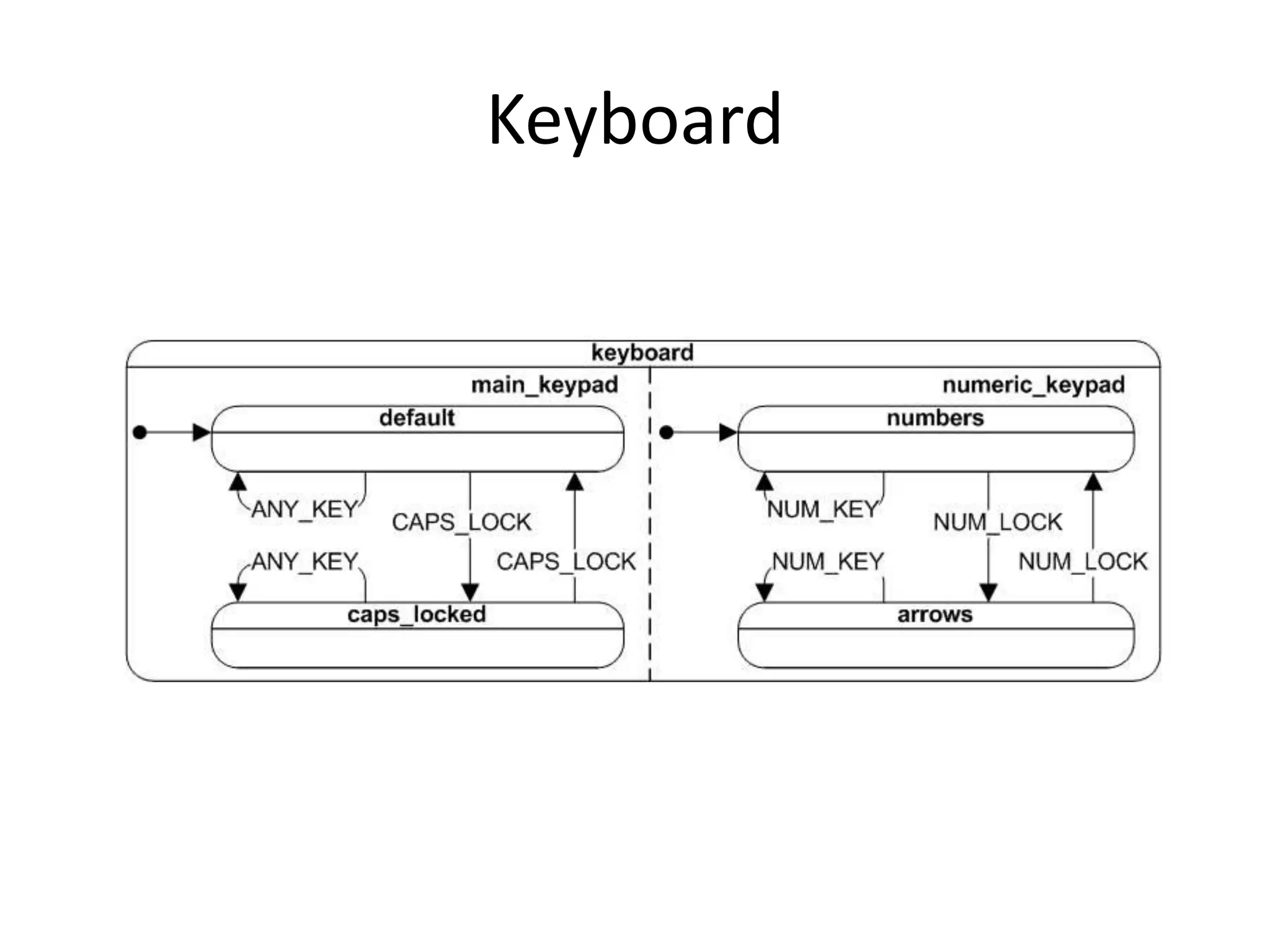
Orthogonal Regions


A state can contain two or more independent
regions runs concurrently
Keyboard
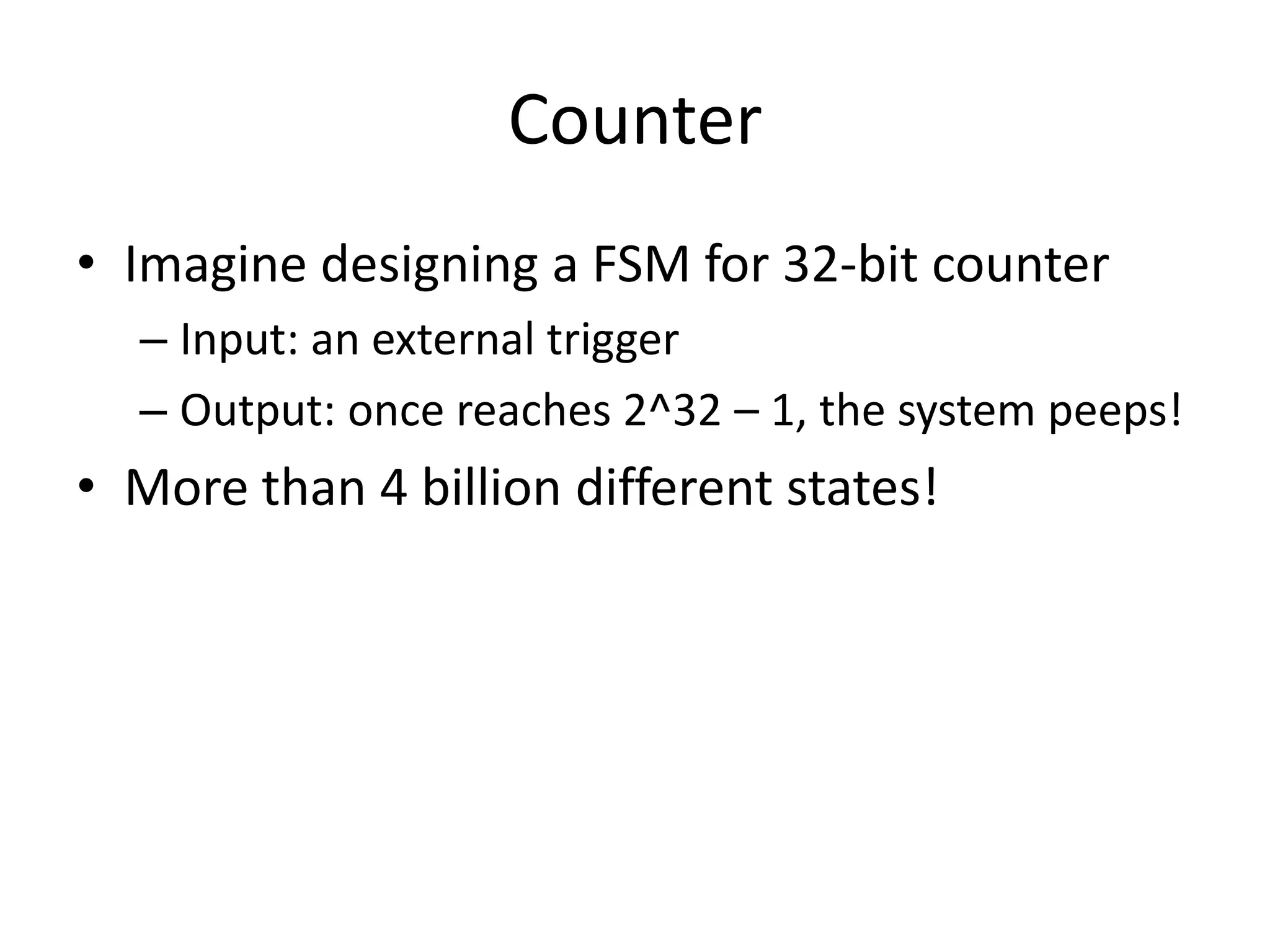
Counter
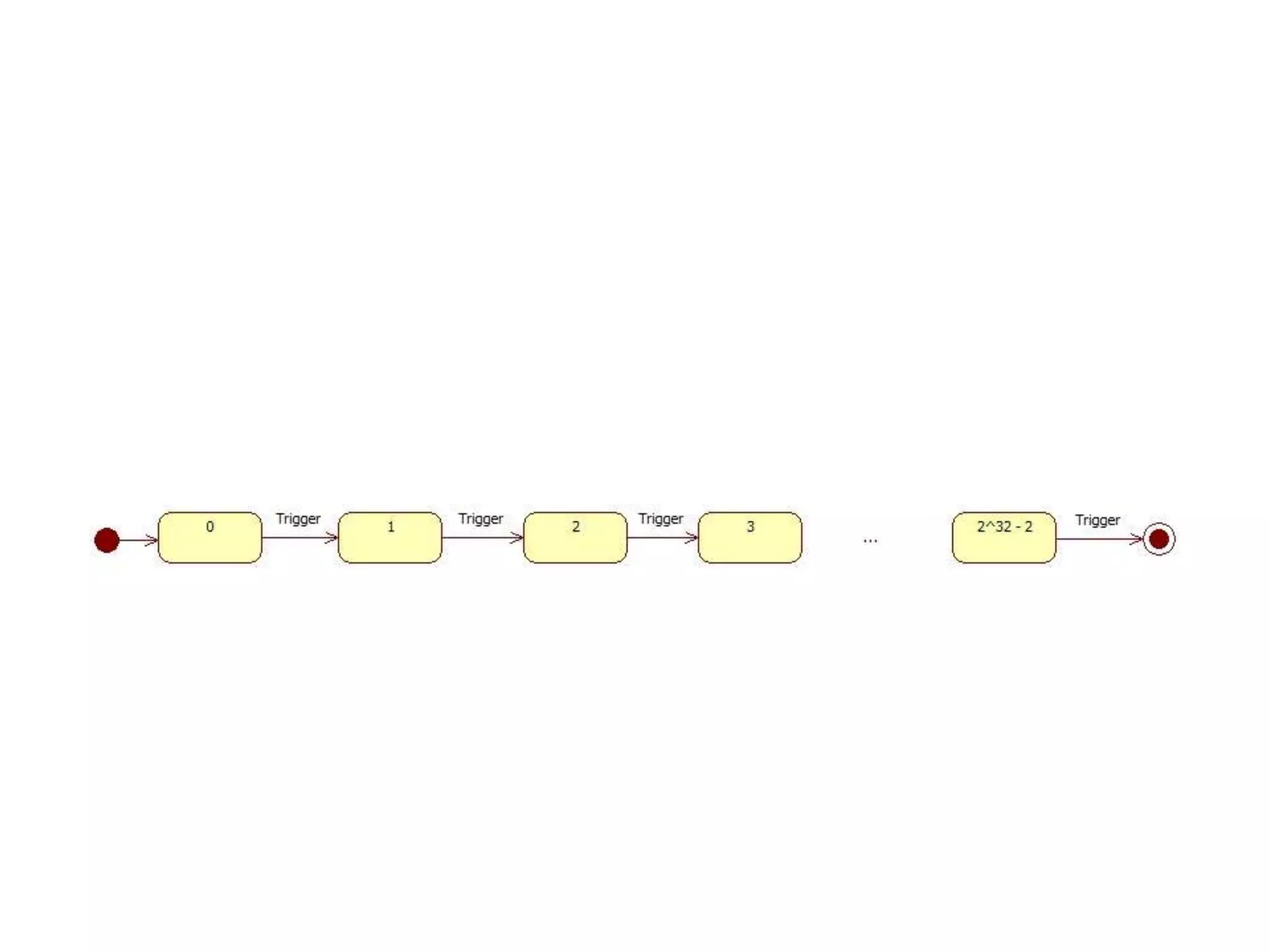
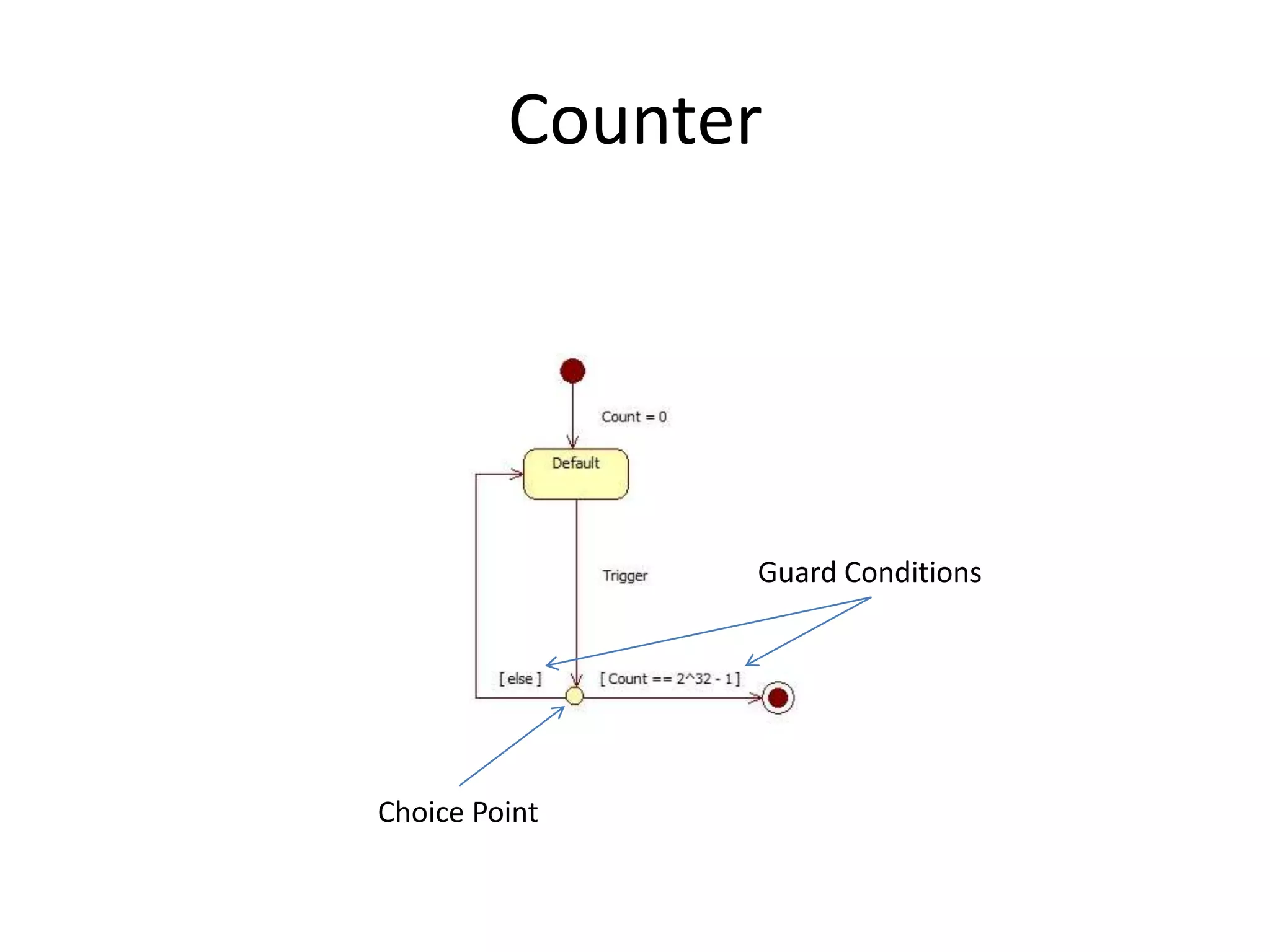
• Imagine designing a FSM for 32-bit counter
  – Input: an external trigger
  – Output: once reaches 2^32 – 1, the system peeps!
• More than 4 billion different states!
Extended states


State machines supplemented with variables
Extended states
• Program variables are commonly dissociated
  from states
• the complete condition of the system (called
  the extended state) is the combination of a
  qualitative aspect (the state) and the
  quantitative aspects (the extended state
  variables)
• UML state machines belong to this category
Counter


               Guard Conditions


Choice Point
Guard Conditions
• Boolean expressions evaluated dynamically
  based on the value of extended state variables
  and event parameters
• Enable actions or transitions only when they
  evaluate to TRUE and disabling them when
  they evaluate to FALSE
• Shown in square brackets “[]”
Guard Conditions
• Good for the design, making it further simpler
• However, do not use it to eliminate states that
  you actually start used to eliminate IF ELSE
  statements!
• If you do … spaghetti code
State Diagrams' Limitations
• Any nontrivial state machine requires a large
  amount of textual information. For example,
  actions
• Depend heavily on the specific programming
  language
• Poorly represent the sequence of processing
• Require a lot of plumbing gear (junction points,
  choice points, etc.) to represent the flow of
  control graphically
• several complementary views of the same state
  machine
Commercial Tools
• Rational Rose
  – Well known tool
  – Bought by IBM in 2003
• Bouml
  – Cross-platform
  – Was free at certain point of time 
Open Source Tools
• StarUML
  – Windows only
  – Have most of the features required for State
    diagrams with only exception of orthogonal
    regions
  – No longer being in development 
  – Many initiatives to re-launch the project again
Questions?
Thank you

Mgd finite statemachine

  • 1.
    Finite State Machine Osama Hussain
  • 2.
    Content • Concept • Mealy & Moore Machines • UML State Machines • UML State Diagrams • Examples • Implementation
  • 3.
    Concept A finite statemachine (hereinafter called FSM) is a mathematical model which abstracts the representation of behavior exhibited by some systems
  • 4.
    Mathematical Model Check it by yourself 
  • 5.
    System & Behavior System System Abstraction Behavior FSM System …
  • 6.
    Examples • Traffic Light – Switching lights on and off • Text Parsers – Detection of certain phrase or word • Washing Machine – Washing, Rinsing, Spinning … • Mario in Super Mario Game – Walk, Run, Jump …
  • 7.
    Remarks • Not allsystems can be modeled in FSM – Real-time systems for example – Memory limitations due to huge number of states • Not all systems can be easily modeled in FSM – Some behaviors are hard to describe in terms of states • Proper FSM design can lead to easier system development
  • 8.
    Within Game Dev. •Some Game Developers think – FSM is only considered for AI field – FSM is only used in abstracting character behavior – FSM is only considered for Gameplay Programmers
  • 9.
    Misconception • Some GameDevelopers think – FSM is only considered for AI field – FSM is only used in abstracting character behavior – FSM is only considered for Gameplay Programmers 
  • 10.
    Composition • FSM consistsof several states • In Programming, state is a technical term for all the stored information, at a given point in time, which the program has access to. – Spinning in Washing Machine – C++ parser detects “int” keyword CPP file – Mario Jumping inside a Super Mario game – Red Light in Traffic Light
  • 11.
    Composition • Inputs intothe machine are combined with the current state of the machine to determine the new state or the next state of the machine Current State Next State Input
  • 12.
    State diagram Donate agraphical representation of an FSM UML State diagrams
  • 13.
    “Hello World” statediagram Initial Transition States Indicator of Initial Transition Final State Transitions Initial State
  • 14.
  • 15.
  • 16.
    Traffic Light –Concept • We got 3 lights that can be switched on and off individually, they are: Red, Yellow, and Green • Traffic light contains a timer • The traffic light starts by turning on the red light and turn off the rest • After timer completes, switch on the green light and turn off the rest • After timer completes, switch on the yellow light and turn off the rest • After timer completes, switch on the red light and turn off the rest • Restart again
  • 17.
    Traffic Light –Mealy Machine
  • 18.
    Quote Parser –Concept • For a whole string of characters, print characters which are within double quotations • Example – Input: “Hello ”people, what a nice “world!” – Output: Hello world!
  • 19.
    Quote Parser –Mealy Machine
  • 20.
  • 21.
    Traffic Light –Moore Machine
  • 22.
    Traffic Light -Comparison Mealy Machine Moore Machine
  • 23.
    Quote Parser –Moore Machine
  • 24.
    UML State Machine Significantlyenhanced realization of the mathematical concept of a finite automaton in Computer Science applications as expressed in the Unified Modeling Language notation – Object-based variant of Harel statechart (the concept of nested states) – Combines both Mealy and Moore machines with further addition of features
  • 25.
    State Structure Think ofyour states as objects where you might need to • Initialize it through Entry actions • Update it through Do actions • Finalize it through Exit actions
  • 26.
  • 27.
    Advantages • Less states •Default control mechanism • Object oriented style
  • 28.
    Hierarchically Nested States Arranging states in a structural way
  • 29.
    Hierarchically Nested States •The most important innovation of UML state machines over the traditional FSMs • State nesting is not limited to one level only • TOP state – Exist in every state machine – Contains all the other elements of the entire state machine – Optionally to depict it in the diagram
  • 30.
    Traffic Light • Basedon previous traffic light description • Add to that a switch • You can turn the traffic light on and off at any time • If the traffic light is switched on, then it operates normally • Otherwise, all the lights will be turned off • By default the traffic light is turned off
  • 31.
  • 32.
  • 33.
    Gain • Less transitions •Less states • Structural behavior – Zoom out: Hide complexity of the system – Zoom in: View the details of sub behavior in meaningful way
  • 34.
    History A facility toreturn back to the previous state
  • 35.
  • 36.
  • 37.
  • 38.
    Washing Machine Junction Point A.K.A. Shallow History
  • 39.
    Deep History Recall thestate of every nested substate of the enclosing substate, down to any level of nesting
  • 40.
  • 41.
    Orthogonal Regions A statecan contain two or more independent regions runs concurrently
  • 42.
  • 43.
    Counter • Imagine designinga FSM for 32-bit counter – Input: an external trigger – Output: once reaches 2^32 – 1, the system peeps! • More than 4 billion different states!
  • 45.
    Extended states State machinessupplemented with variables
  • 46.
    Extended states • Programvariables are commonly dissociated from states • the complete condition of the system (called the extended state) is the combination of a qualitative aspect (the state) and the quantitative aspects (the extended state variables) • UML state machines belong to this category
  • 47.
    Counter Guard Conditions Choice Point
  • 48.
    Guard Conditions • Booleanexpressions evaluated dynamically based on the value of extended state variables and event parameters • Enable actions or transitions only when they evaluate to TRUE and disabling them when they evaluate to FALSE • Shown in square brackets “[]”
  • 49.
    Guard Conditions • Goodfor the design, making it further simpler • However, do not use it to eliminate states that you actually start used to eliminate IF ELSE statements! • If you do … spaghetti code
  • 50.
    State Diagrams' Limitations •Any nontrivial state machine requires a large amount of textual information. For example, actions • Depend heavily on the specific programming language • Poorly represent the sequence of processing • Require a lot of plumbing gear (junction points, choice points, etc.) to represent the flow of control graphically • several complementary views of the same state machine
  • 51.
    Commercial Tools • RationalRose – Well known tool – Bought by IBM in 2003 • Bouml – Cross-platform – Was free at certain point of time 
  • 52.
    Open Source Tools •StarUML – Windows only – Have most of the features required for State diagrams with only exception of orthogonal regions – No longer being in development  – Many initiatives to re-launch the project again
  • 53.
  • 54.