2
Moore Machines
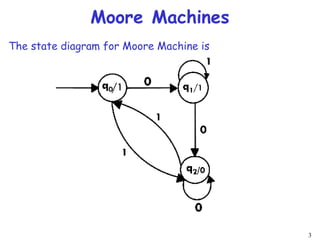
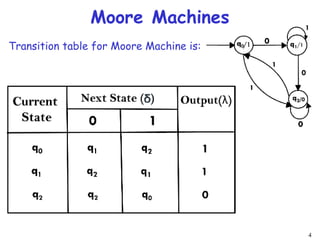
Moore Machinesare finite state machines with
output value and its output depends only on the
present state. It can be defined as (Q,
q0, ∑, O, δ, λ) where:
5
Moore Machines
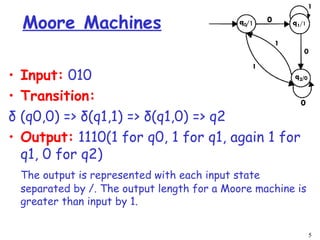
• Input:010
• Transition:
δ (q0,0) => δ(q1,1) => δ(q1,0) => q2
• Output: 1110(1 for q0, 1 for q1, again 1 for
q1, 0 for q2)
The output is represented with each input state
separated by /. The output length for a Moore machine is
greater than input by 1.
6.
6
Example
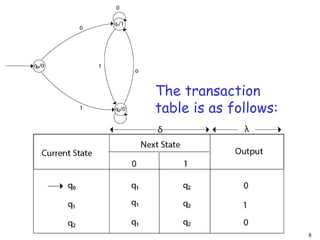
Design a Mooremachine to generate 1's
complement of a given binary number.
Solution:
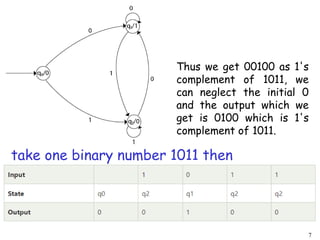
To generate 1's complement of a given binary number the
simple logic is that if the input is 0 then the output will be
1 and if the input is 1 then the output will be 0.
That means there are three states.
One state is start state.
The second state is for taking 0's as input and produces
output as 1.
The third state is for taking 1's as input and producing
output as 0.
7.
7
take one binarynumber 1011 then
Thus we get 00100 as 1's
complement of 1011, we
can neglect the initial 0
and the output which we
get is 0100 which is 1's
complement of 1011.
9
Mealy Machines
Mealy machinesare also finite state machines
with output value and their output depends on
the present state and current input symbol.
It can be defined as (Q, q0, ∑, O, δ, λ’) where:
11
Mealy Machines
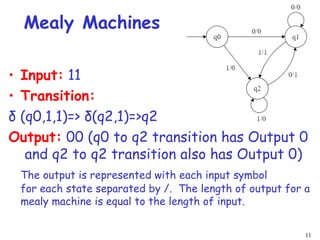
• Input:11
• Transition:
δ (q0,1,1)=> δ(q2,1)=>q2
Output: 00 (q0 to q2 transition has Output 0
and q2 to q2 transition also has Output 0)
The output is represented with each input symbol
for each state separated by /. The length of output for a
mealy machine is equal to the length of input.
12.
12
Mealy Machines
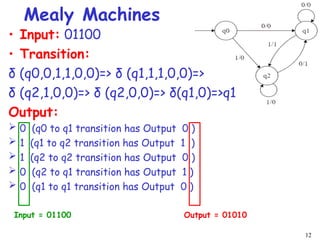
• Input:01100
• Transition:
δ (q0,0,1,1,0,0)=> δ (q1,1,1,0,0)=>
δ (q2,1,0,0)=> δ (q2,0,0)=> δ(q1,0)=>q1
Output:
0 (q0 to q1 transition has Output 0 )
1 (q1 to q2 transition has Output 1 )
1 (q2 to q2 transition has Output 0 )
0 (q2 to q1 transition has Output 1 )
0 (q1 to q1 transition has Output 0 )
Input = 01100 Output = 01010








![MOC2.PPT[1].pptx introduction to mealy machine and moore machine with eample ...](https://cdn.slidesharecdn.com/ss_thumbnails/moc2-240424202053-bd93b085-thumbnail.jpg?width=640&height=640&fit=bounds)


