Moore and Mealy Machines
What is Finite Automata???
Finite Automata(FA) is the simplest machine to recognize
patterns.
A Finite Automata consists of the following :
Q : Finite nonempty set of states.
∑ : set of finite nonempty Input Symbols.
q : Initial state.
F : set of (Multiple) Final States.
δ : Transition Function which maps Q×∑ → Q.
The formal specification of machine is
(Q ∑ q F δ)
5 tuples
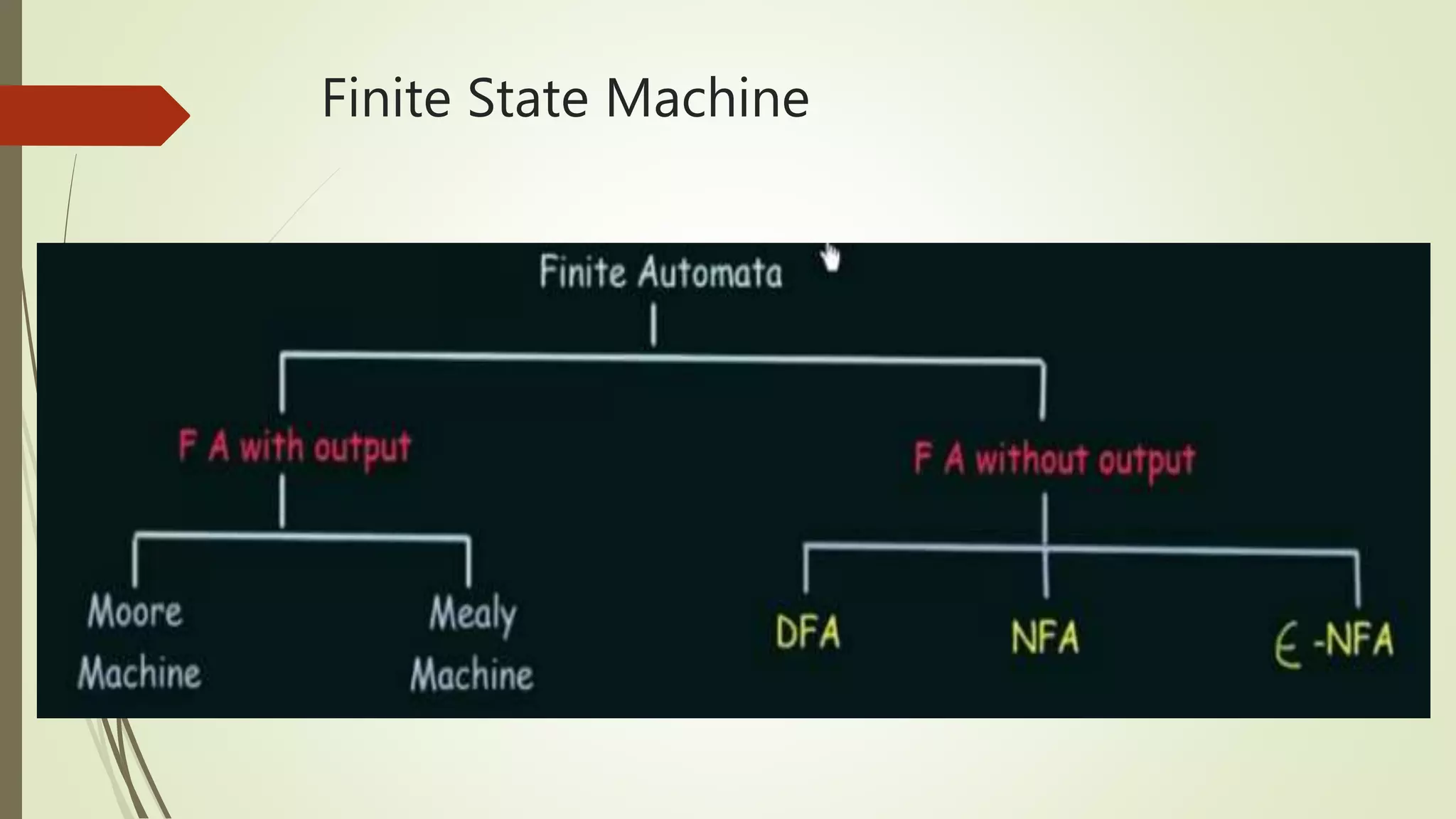
Finite State Machine
Need To understand about Moore and
Mealy
 Both machines must have Initial state but final state is not
mandatory.
Mealy Machine
 Mealy machines are also finite state machines with output value and its output depe
nds on present state and current input symbol.
 t can be defined as (Q, q0, ∑, O, δ, λ’) where:
 Q is finite set of states.
 q0 is the initial state.
 ∑ is the input alphabet.
 O is the output alphabet.
 δ is transition function which maps Q×∑ → Q.
 ‘λ’ is the output function which maps Q×∑→ O.
Mealy Machine
 In the mealy machine shown in Fig, the output is represented with each input symbol for each
state separated by /. Input and Output both are outside the state.
 The length of output for a mealy machine is equal to the length of input.
Mealy Machine
 Input: 11
 Output: 00 (q0 to q2 transition has Output 0 and q2 to q2 transition also
has Output 0)
 So,
size of Input= Size of Output
N=N
Moore Machine
 Moore machines are finite state machines with output value and its output depends only on
present state . For every state output is associated.
 It can be defined as (Q, q0, ∑, O, δ, λ) where:
 Q is finite set of states.
 q0 is the initial state.
 ∑ is the input alphabet.
 O is the output alphabet.
 δ is transition function which maps Q×∑ → Q.
 λ is the output function which maps Q → O.
Moore Machine
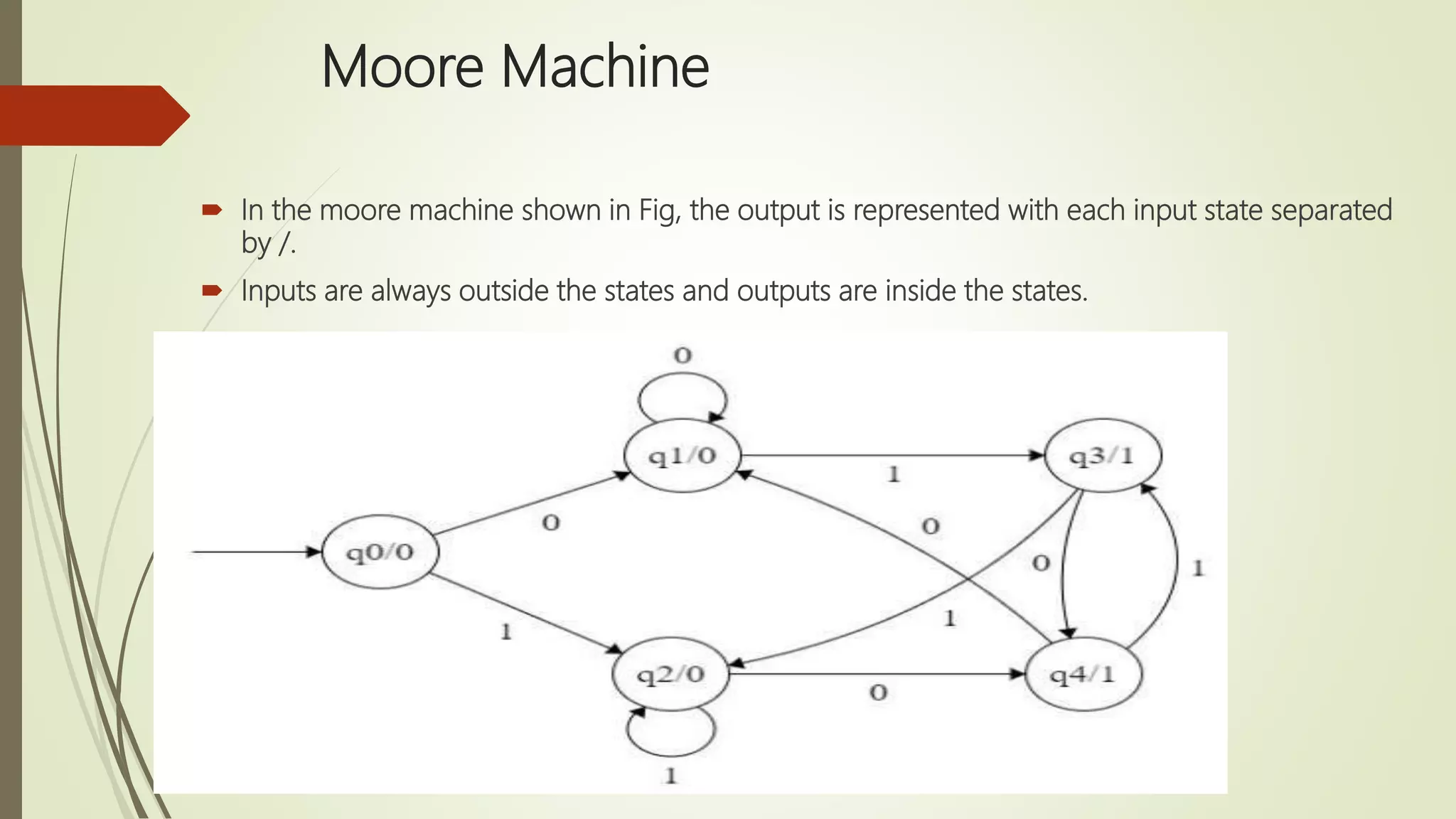
 In the moore machine shown in Fig, the output is represented with each input state separated
by /.
 Inputs are always outside the states and outputs are inside the states.
Moore Machine
 The length of output for a moore machine is greater than input by 1.
 Input: 11
 Output: 000 (0 for q0, 0 for q2 and again 0 for q2)
 so.,
Size of input ≠ Size of Output
N=N+1
Construct Mealy machine from the given
table
Construct a Moore Machine
from the given table
Practical Applications of moore and mealy
machines
 implementation of Elevator functionality
 The lexical analysis part of your compiler/interpreter (yes, even your shell) is
again a finite automaton which matches keywords and other tokens recognized by
the language.
 Moore machine is used in SRAM because of its speed.
 Any vending machine is a finite automaton which takes in coins of different
denominations and recognizes when the correct amount has been entered (OK,
today's vending machines probably have a small CPU inside doing the adding, but
the end result is the same).

Moore and mealy machines

  • 1.
  • 2.
    What is FiniteAutomata??? Finite Automata(FA) is the simplest machine to recognize patterns. A Finite Automata consists of the following : Q : Finite nonempty set of states. ∑ : set of finite nonempty Input Symbols. q : Initial state. F : set of (Multiple) Final States. δ : Transition Function which maps Q×∑ → Q.
  • 3.
    The formal specificationof machine is (Q ∑ q F δ) 5 tuples
  • 4.
  • 5.
    Need To understandabout Moore and Mealy  Both machines must have Initial state but final state is not mandatory.
  • 6.
    Mealy Machine  Mealymachines are also finite state machines with output value and its output depe nds on present state and current input symbol.  t can be defined as (Q, q0, ∑, O, δ, λ’) where:  Q is finite set of states.  q0 is the initial state.  ∑ is the input alphabet.  O is the output alphabet.  δ is transition function which maps Q×∑ → Q.  ‘λ’ is the output function which maps Q×∑→ O.
  • 7.
    Mealy Machine  Inthe mealy machine shown in Fig, the output is represented with each input symbol for each state separated by /. Input and Output both are outside the state.  The length of output for a mealy machine is equal to the length of input.
  • 8.
    Mealy Machine  Input:11  Output: 00 (q0 to q2 transition has Output 0 and q2 to q2 transition also has Output 0)  So, size of Input= Size of Output N=N
  • 9.
    Moore Machine  Mooremachines are finite state machines with output value and its output depends only on present state . For every state output is associated.  It can be defined as (Q, q0, ∑, O, δ, λ) where:  Q is finite set of states.  q0 is the initial state.  ∑ is the input alphabet.  O is the output alphabet.  δ is transition function which maps Q×∑ → Q.  λ is the output function which maps Q → O.
  • 10.
    Moore Machine  Inthe moore machine shown in Fig, the output is represented with each input state separated by /.  Inputs are always outside the states and outputs are inside the states.
  • 11.
    Moore Machine  Thelength of output for a moore machine is greater than input by 1.  Input: 11  Output: 000 (0 for q0, 0 for q2 and again 0 for q2)  so., Size of input ≠ Size of Output N=N+1
  • 12.
    Construct Mealy machinefrom the given table
  • 13.
    Construct a MooreMachine from the given table
  • 14.
    Practical Applications ofmoore and mealy machines  implementation of Elevator functionality  The lexical analysis part of your compiler/interpreter (yes, even your shell) is again a finite automaton which matches keywords and other tokens recognized by the language.  Moore machine is used in SRAM because of its speed.  Any vending machine is a finite automaton which takes in coins of different denominations and recognizes when the correct amount has been entered (OK, today's vending machines probably have a small CPU inside doing the adding, but the end result is the same).