Ed Tech, Moocs and Beyond


Terry Anderson,
Professor,
Centre for Distance Education

Feb. 2013
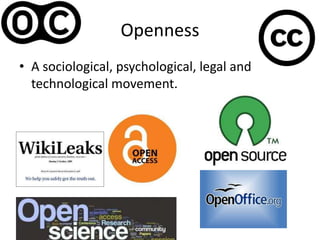
Openness
• A sociological, psychological, legal and
  technological movement.
Definitions of Open on the Web
              (From Google)
• affording unobstructed entrance and exit; not shut or
  closed;
• affording free passage or access;
• open to or in view of all;
• accessible to all;
• assailable: not defended or capable of being defended
• loose: (of textures) full of small openings or gaps;
• start to operate or function
• not brought to a conclusion;
• not sealed or having been unsealed
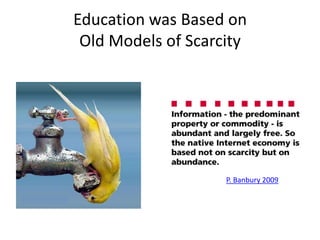
Education was Based on
 Old Models of Scarcity


                    P. Banbury 2009
Ed Tech Today
• Blended Classroom
  – Blending best of classroom and online
• Online Course
  – Access , Time and Place shifting
• Flipped Classroom
  – Content acquisition alone, at home
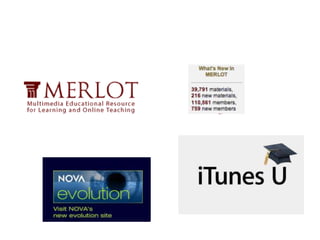
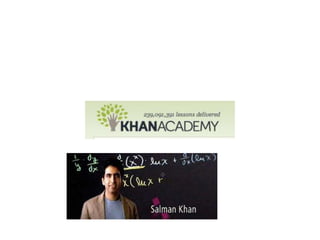
  – Learning objects, Khann Academy, Itune University
  – Classroom for collabortion
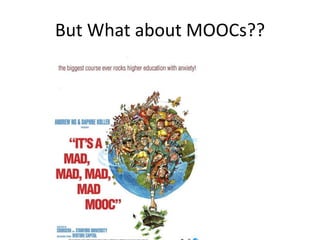
But What about MOOCs??
Moocs

• Massive: - Scaleable,
• Open – Free as in tuition for students, not as
  in editing, reproduction,
• Online – may support F2F MeetUps
• Course – Bounded by topic and time frame
MOOC Features
• Defined Curriculum?
• “Big Data” Mining
• Substitute student-content and perhaps student-
  student for student-teacher inetrcation
• Maybe asynchronous, synchronous, mixed
• Paced or self-paced
• Upsell of auxiliary products
• Emerging credential options
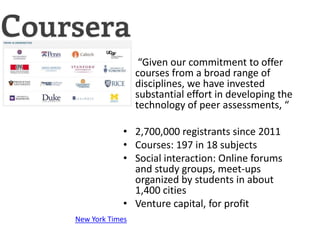
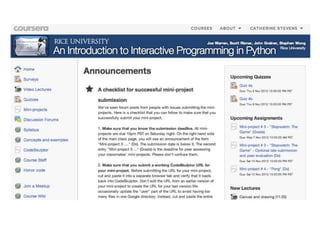
• “Given our commitment to offer
               courses from a broad range of
               disciplines, we have invested
               substantial effort in developing the
               technology of peer assessments, “

             • 2,700,000 registrants since 2011
             • Courses: 197 in 18 subjects
             • Social interaction: Online forums
               and study groups, meet-ups
               organized by students in about
               1,400 cities
             • Venture capital, for profit
New York Times
• Smaller number fo courses, mostly Science
  and Tech
• Continuous Enrollment
• Academic integrity: Proctored final exams at
  Pearson testing centers, for $89.
• Partnering with U of Alberta, machine learning
• Venture Capital, for Profit
                                 New York Times
•   Profile: Nonprofit run out of M.I.T. and Harvard; with the University of
    California at Berkeley and the University of Texas system.
•   8 courses
•   Social interaction: Rudimentary; only one course, given by the Harvard
    School of Public Health in quantitative methods, has regional get-
    togethers.
•   Pacing: Courses have start and end dates. Registration closes two weeks
    after start date. Students may miss a week but lose points if they don’t
    make a deadline for turning in an assignment.
•   What you get: Two certificates available, one designating an honor code,
    one a proctored exam. Both bear the edX and campus name — for
    example, MITx, HarvardX, BerkeleyX, UTAustinX.
•   Foundation Funded, not for profit
•   Research Agenda


                                          New York Times
MOOC Completion Rates??
• Coursera Course Computational Investing,
  January 6, 2013 by Tucker Balch ,
• 53,265 enrolled
• Completed the course:
  – 4.8% of those who enrolled
  – 18% of those who took a quiz.
  – 39% of those who submitted the first project.
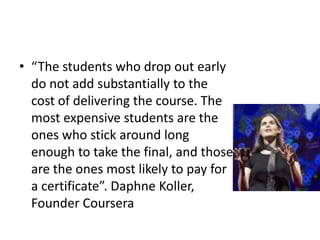
• “The students who drop out early
  do not add substantially to the
  cost of delivering the course. The
  most expensive students are the
  ones who stick around long
  enough to take the final, and those
  are the ones most likely to pay for
  a certificate”. Daphne Koller,
  Founder Coursera
The Interaction Equivalency Theorem
          by Anderson (2003)
• Thesis 1. Deep and meaningful formal learning is supported
  as long as one of the three forms of interaction (student–
  teacher; student–student; student–content) is at a high
  level. The other two may be offered at minimal levels, or even
  eliminated, without degrading the educational experience.

• Thesis 2. High levels of more than one of these three
  modes will likely provide a more satisfying educational
  experience, although these experiences may not be as
  cost- or time effective as less interactive learning
  sequences.


                      Seehttp://equivalencytheorem.info/      17
Conclusions
• Open Content
• MOOCS as one more, low cost, source of
  student-content interaction
• Open Communities?? Open Credit?
• Web Presence, Contributions Artifacts, E-
  portfolios,
• Social networking with and beyond Facebook?
• Slides on SlideShare:
• https://landing.athabascau.ca
                   kz


• terrya@athabascau.ca
• Terrya.edublogs.org

Moocs - Alberta grad students, Feb 2013

  • 1.
    Ed Tech, Moocsand Beyond Terry Anderson, Professor, Centre for Distance Education Feb. 2013
  • 2.
    Openness • A sociological,psychological, legal and technological movement.
  • 3.
    Definitions of Openon the Web (From Google) • affording unobstructed entrance and exit; not shut or closed; • affording free passage or access; • open to or in view of all; • accessible to all; • assailable: not defended or capable of being defended • loose: (of textures) full of small openings or gaps; • start to operate or function • not brought to a conclusion; • not sealed or having been unsealed
  • 4.
    Education was Basedon Old Models of Scarcity P. Banbury 2009
  • 5.
    Ed Tech Today •Blended Classroom – Blending best of classroom and online • Online Course – Access , Time and Place shifting • Flipped Classroom – Content acquisition alone, at home – Learning objects, Khann Academy, Itune University – Classroom for collabortion
  • 8.
  • 9.
    Moocs • Massive: -Scaleable, • Open – Free as in tuition for students, not as in editing, reproduction, • Online – may support F2F MeetUps • Course – Bounded by topic and time frame
  • 10.
    MOOC Features • DefinedCurriculum? • “Big Data” Mining • Substitute student-content and perhaps student- student for student-teacher inetrcation • Maybe asynchronous, synchronous, mixed • Paced or self-paced • Upsell of auxiliary products • Emerging credential options
  • 11.
    • “Given ourcommitment to offer courses from a broad range of disciplines, we have invested substantial effort in developing the technology of peer assessments, “ • 2,700,000 registrants since 2011 • Courses: 197 in 18 subjects • Social interaction: Online forums and study groups, meet-ups organized by students in about 1,400 cities • Venture capital, for profit New York Times
  • 13.
    • Smaller numberfo courses, mostly Science and Tech • Continuous Enrollment • Academic integrity: Proctored final exams at Pearson testing centers, for $89. • Partnering with U of Alberta, machine learning • Venture Capital, for Profit New York Times
  • 14.
    Profile: Nonprofit run out of M.I.T. and Harvard; with the University of California at Berkeley and the University of Texas system. • 8 courses • Social interaction: Rudimentary; only one course, given by the Harvard School of Public Health in quantitative methods, has regional get- togethers. • Pacing: Courses have start and end dates. Registration closes two weeks after start date. Students may miss a week but lose points if they don’t make a deadline for turning in an assignment. • What you get: Two certificates available, one designating an honor code, one a proctored exam. Both bear the edX and campus name — for example, MITx, HarvardX, BerkeleyX, UTAustinX. • Foundation Funded, not for profit • Research Agenda New York Times
  • 15.
    MOOC Completion Rates?? •Coursera Course Computational Investing, January 6, 2013 by Tucker Balch , • 53,265 enrolled • Completed the course: – 4.8% of those who enrolled – 18% of those who took a quiz. – 39% of those who submitted the first project.
  • 16.
    • “The studentswho drop out early do not add substantially to the cost of delivering the course. The most expensive students are the ones who stick around long enough to take the final, and those are the ones most likely to pay for a certificate”. Daphne Koller, Founder Coursera
  • 17.
    The Interaction EquivalencyTheorem by Anderson (2003) • Thesis 1. Deep and meaningful formal learning is supported as long as one of the three forms of interaction (student– teacher; student–student; student–content) is at a high level. The other two may be offered at minimal levels, or even eliminated, without degrading the educational experience. • Thesis 2. High levels of more than one of these three modes will likely provide a more satisfying educational experience, although these experiences may not be as cost- or time effective as less interactive learning sequences. Seehttp://equivalencytheorem.info/ 17
  • 18.
    Conclusions • Open Content •MOOCS as one more, low cost, source of student-content interaction • Open Communities?? Open Credit? • Web Presence, Contributions Artifacts, E- portfolios, • Social networking with and beyond Facebook?
  • 19.
    • Slides onSlideShare: • https://landing.athabascau.ca kz • terrya@athabascau.ca • Terrya.edublogs.org