Massive Open Online Course
Putchong Uthayopas
Department of Computer Engineering, Faculty of
Engineering,
Kasetsart University
Thailand
Introduction
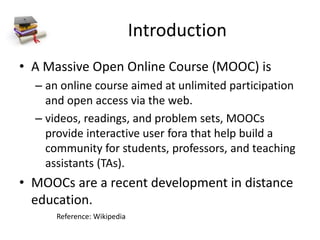
• A Massive Open Online Course (MOOC) is
– an online course aimed at unlimited participation
and open access via the web.
– videos, readings, and problem sets, MOOCs
provide interactive user fora that help build a
community for students, professors, and teaching
assistants (TAs).
• MOOCs are a recent development in distance
education.
Reference: Wikipedia
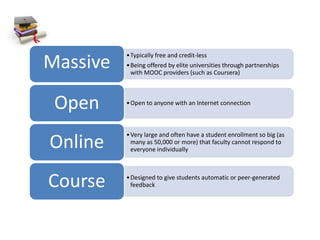
•Typically free and credit-less
•Being offered by elite universities through partnerships
with MOOC providers (such as Coursera)
Massive
•Open to anyone with an Internet connection
Open
•Very large and often have a student enrollment so big (as
many as 50,000 or more) that faculty cannot respond to
everyone individually
Online
•Designed to give students automatic or peer-generated
feedback
Course
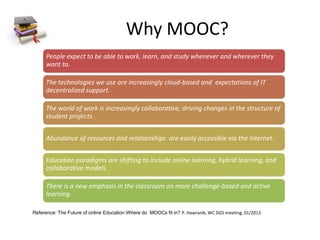
Why MOOC?
People expect to be able to work, learn, and study whenever and wherever they
want to.
The technologies we use are increasingly cloud-based and expectations of IT
decentralized support.
The world of work is increasingly collaborative, driving changes in the structure of
student projects .
Abundance of resources and relationships are easily accessible via the Internet.
Education paradigms are shifting to include online learning, hybrid learning, and
collaborative models.
There is a new emphasis in the classroom on more challenge-based and active
learning.
Reference: The Future of online Education Where do MOOCs fit in? P. Hawranik, WC DGS meeting, 01/2013
MOOC Tools
• Learning Management System
• Content Delivery
– Video
– Presentation
– Document
• Simulation
• All of these usually running on a cloud to be
able to scale!
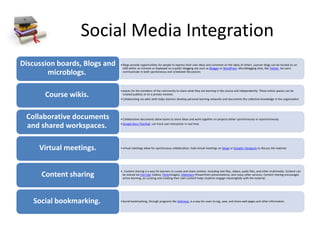
Social Media Integration
• Blogs provide opportunities for people to express their own ideas and comment on the ideas of others. Learner blogs can be hosted on an
LMS within an intranet or displayed on a public blogging site such as Blogger or WordPress. Microblogging sites, like Twitter, let users
communicate in both spontaneous and scheduled discussions
Discussion boards, Blogs and
microblogs.
• places for the members of the community to share what they are learning in the course and independently. These online spaces can be
created publicly or on a private intranet.
• Collaborating via wikis both helps learners develop personal learning networks and documents the collective knowledge in the organization
Course wikis.
• Collaborative documents allow teams to share ideas and work together on projects either synchronously or asynchronously.
• Google Docs,TitanPad can track user interaction in real time
Collaborative documents
and shared workspaces.
• virtual meetings allow for synchronous collaboration. hold virtual meetings on Skype or Google+ Hangouts to discuss the material.
Virtual meetings.
• . Content sharing is a way for learners to curate and share content, including text files, videos, audio files, and other multimedia. Content can
be shared via YouTube (video), Flickr(images), Slideshare (PowerPoint presentations), and many other services. Content sharing encourages
active learning, as curating and creating their own content helps students engage meaningfully with the material.
Content sharing
• Social bookmarking, through programs like Delicious, is a way for users to tag, save, and share web pages and other information.
Social bookmarking.
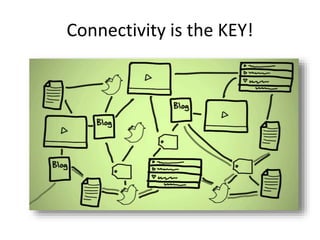
Connectivity is the KEY!
Business Model for MOOC
• certification (students pay for a badge or
certificate)
• secure assessments (students pay to have
their examinations invigilated)
• employee recruitment (companies pay for
access )
• applicant screening (employers/universities
pay for access to records to screen applicants)
Reference: The Future of online Education Where do MOOCs fit in? P. Hawranik, WC DGS meeting, 01/2013
• edX is
– a massive open online course (MOOC)
platform
– founded by the Massachusetts
Institute of Technology and Harvard
University in May 2012
• to host online university-level courses in a
wide range of disciplines to a worldwide
audience at no charge
• to conduct research into learning.
• EdX has nearly 1.6 million users.
– There are currently 29 schools that
offer or plan to offer courses on the
edX website.
• Open edX is the opensource software
platform for MOOC from xConsortium
– http://code.edx.org/
How EdX Works
• The platform uses online learning software that uses interactive
experiences.
• Each week, a new learning sequence is released in an edX course. The
learning sequence is composed of short (an average of 10 minutes each)
videos interspersed with active learning exercises where students can
immediately practice the concepts from the videos.
• They can include illustrations, often on a tablet or slide. There is a sidebar
showing the text; the student can follow the text, and scroll up or down it.
• The courses also often include tutorial videos that are similar to small-
group on-campus discussion groups, an online textbook, and an online
discussion forum where students can post and review questions and
comments to each other and teaching assistants.
• Where applicable, online laboratories are incorporated into the course.
For example, in edX's first MOOC—a circuits and electronics course—
students built virtual circuits in an online lab.[13]
• an educational technology company
offering massive open online courses (MOOCs)
– founded by computer science professors Andrew
Ng and Daphne Koller from Stanford University.
• Coursera works with universities to make some of
their courses available online. offers courses in
– physics, engineering, humanities, medicine, biology, s
ocial sciences, mathematics, business, computer
science, and other areas.
– User 6,280,772 Courserians.
Learn from 595 courses, from our 108 partners.
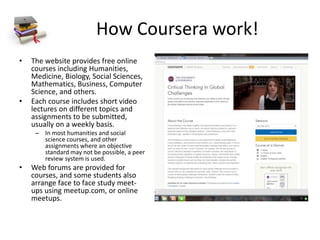
How Coursera work!
• The website provides free online
courses including Humanities,
Medicine, Biology, Social Sciences,
Mathematics, Business, Computer
Science, and others.
• Each course includes short video
lectures on different topics and
assignments to be submitted,
usually on a weekly basis.
– In most humanities and social
science courses, and other
assignments where an objective
standard may not be possible, a peer
review system is used.
• Web forums are provided for
courses, and some students also
arrange face to face study meet-
ups using meetup.com, or online
meetups.
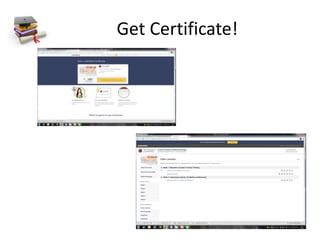
Get Certificate!
Udacity
• Udacity is a for-profit educational organization
founded by Sebastian Thrun, David Stavens,
and Mike Sokolsky offering massive open
online courses (MOOCs)
– Udacity is the outgrowth of free computer science
classes offered in 2011 through Stanford
University.
• As of 30 September 2013, Udacity has 25
active courses.
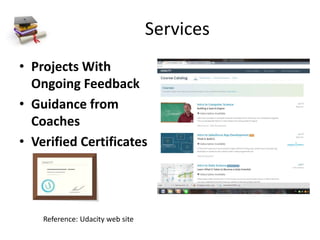
Services
• Projects With
Ongoing Feedback
• Guidance from
Coaches
• Verified Certificates
Reference: Udacity web site
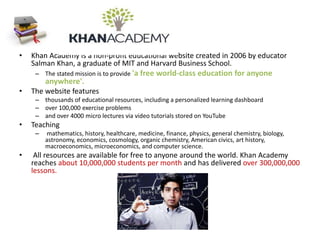
• Khan Academy is a non-profit educational website created in 2006 by educator
Salman Khan, a graduate of MIT and Harvard Business School.
– The stated mission is to provide 'a free world-class education for anyone
anywhere'.
• The website features
– thousands of educational resources, including a personalized learning dashboard
– over 100,000 exercise problems
– and over 4000 micro lectures via video tutorials stored on YouTube
• Teaching
– mathematics, history, healthcare, medicine, finance, physics, general chemistry, biology,
astronomy, economics, cosmology, organic chemistry, American civics, art history,
macroeconomics, microeconomics, and computer science.
• All resources are available for free to anyone around the world. Khan Academy
reaches about 10,000,000 students per month and has delivered over 300,000,000
lessons.
Vision
• Individualizing learning by replacing one-size-fits-all
lectures with self-paced learning
• Taking a mastery-based approach to learning critical
knowledge and skills (every student takes as long as
he/she needs to learn each concept fully)
• Creating collaborative learning environments with
students solving problems together and tutoring one
another
• Using focused coaching by the teacher to address
students' individual needs
• Providing guidance to the teacher through real-time
metrics and reporting on student performance
• All videos (hosted via YouTube) are available through Khan Academy's own website
– progress tracking, practice exercises, and a variety of tools for teachers in public schools.
– Logging into the site can be done via a Google or a Facebook account
– The material can also be accessed with the Khan Academy Modern UI application available free of
charge from Windows Store.
• Khan chose to avoid the standard format of a person standing by a whiteboard,
deciding instead to present the learning concepts as if "popping out of a darkened
universe and into one's mind with a voice out of nowhere" imitate when you're
watching a guy do a problem [while] thinking out loud.
• current content is mainly concerned with pre-college mathematics and physics,
Khan's long-term goal is to provide "tens of thousands of videos in pretty much
every subject”
• Khan Academy also provides a web-based exercise system
– generates problems for students based on skill level and performance.
– The exercise software is available as open source under the MIT license.
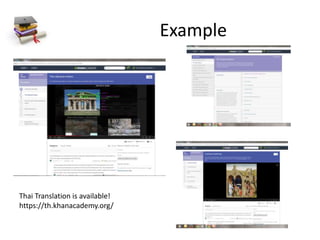
Example
Thai Translation is available!
https://th.khanacademy.org/
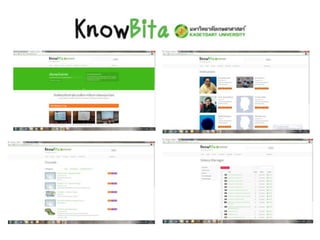
• Knowledge Based Interactive Teaching Assistant
• Basic on-line content management used by
Department of computer engineering, Kasetsart
University
• Co-developed with a local company
• Basic idea
– Simplicity
– Fully automated
– Focus on Video and collaboration
– Social Network capability
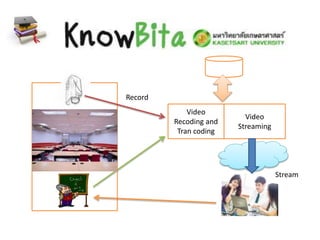
Video
Recoding and
Tran coding
Video
Streaming
Record
Stream
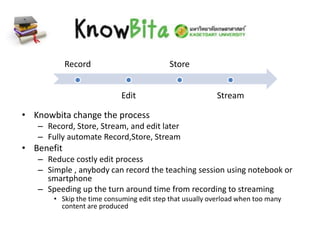
Record
Edit
Store
Stream
• Knowbita change the process
– Record, Store, Stream, and edit later
– Fully automate Record,Store, Stream
• Benefit
– Reduce costly edit process
– Simple , anybody can record the teaching session using notebook or
smartphone
– Speeding up the turn around time from recording to streaming
• Skip the time consuming edit step that usually overload when too many
content are produced
• Next Step
– Leverage existing system
• Google doc and hangout for collaborative space
– Testing system
– Experiment space virtual lab
– User flow and pace control
• Playlist?
MOOC Challenge
• Few typically stick through the duration of
the class
• Engaging students without overwhelming
them
• Student experiences and socializing are
done virtually and without real-world
tangibility
• Students must be responsible for their
own learning
• Students can be ill-prepared for
university-level work
• Credential models are still emerging
• Grading is imperfect
• Cheating is a reality
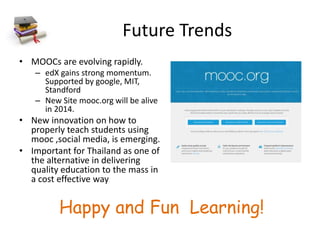
Future Trends
• MOOCs are evolving rapidly.
– edX gains strong momentum.
Supported by google, MIT,
Standford
– New Site mooc.org will be alive
in 2014.
• New innovation on how to
properly teach students using
mooc ,social media, is emerging.
• Important for Thailand as one of
the alternative in delivering
quality education to the mass in
a cost effective way
Happy and Fun Learning!
THE END

MOOC Wunca Talk

  • 1.
    Massive Open OnlineCourse Putchong Uthayopas Department of Computer Engineering, Faculty of Engineering, Kasetsart University Thailand
  • 2.
    Introduction • A MassiveOpen Online Course (MOOC) is – an online course aimed at unlimited participation and open access via the web. – videos, readings, and problem sets, MOOCs provide interactive user fora that help build a community for students, professors, and teaching assistants (TAs). • MOOCs are a recent development in distance education. Reference: Wikipedia
  • 3.
    •Typically free andcredit-less •Being offered by elite universities through partnerships with MOOC providers (such as Coursera) Massive •Open to anyone with an Internet connection Open •Very large and often have a student enrollment so big (as many as 50,000 or more) that faculty cannot respond to everyone individually Online •Designed to give students automatic or peer-generated feedback Course
  • 5.
    Why MOOC? People expectto be able to work, learn, and study whenever and wherever they want to. The technologies we use are increasingly cloud-based and expectations of IT decentralized support. The world of work is increasingly collaborative, driving changes in the structure of student projects . Abundance of resources and relationships are easily accessible via the Internet. Education paradigms are shifting to include online learning, hybrid learning, and collaborative models. There is a new emphasis in the classroom on more challenge-based and active learning. Reference: The Future of online Education Where do MOOCs fit in? P. Hawranik, WC DGS meeting, 01/2013
  • 6.
    MOOC Tools • LearningManagement System • Content Delivery – Video – Presentation – Document • Simulation • All of these usually running on a cloud to be able to scale!
  • 7.
    Social Media Integration •Blogs provide opportunities for people to express their own ideas and comment on the ideas of others. Learner blogs can be hosted on an LMS within an intranet or displayed on a public blogging site such as Blogger or WordPress. Microblogging sites, like Twitter, let users communicate in both spontaneous and scheduled discussions Discussion boards, Blogs and microblogs. • places for the members of the community to share what they are learning in the course and independently. These online spaces can be created publicly or on a private intranet. • Collaborating via wikis both helps learners develop personal learning networks and documents the collective knowledge in the organization Course wikis. • Collaborative documents allow teams to share ideas and work together on projects either synchronously or asynchronously. • Google Docs,TitanPad can track user interaction in real time Collaborative documents and shared workspaces. • virtual meetings allow for synchronous collaboration. hold virtual meetings on Skype or Google+ Hangouts to discuss the material. Virtual meetings. • . Content sharing is a way for learners to curate and share content, including text files, videos, audio files, and other multimedia. Content can be shared via YouTube (video), Flickr(images), Slideshare (PowerPoint presentations), and many other services. Content sharing encourages active learning, as curating and creating their own content helps students engage meaningfully with the material. Content sharing • Social bookmarking, through programs like Delicious, is a way for users to tag, save, and share web pages and other information. Social bookmarking.
  • 8.
  • 9.
    Business Model forMOOC • certification (students pay for a badge or certificate) • secure assessments (students pay to have their examinations invigilated) • employee recruitment (companies pay for access ) • applicant screening (employers/universities pay for access to records to screen applicants) Reference: The Future of online Education Where do MOOCs fit in? P. Hawranik, WC DGS meeting, 01/2013
  • 10.
    • edX is –a massive open online course (MOOC) platform – founded by the Massachusetts Institute of Technology and Harvard University in May 2012 • to host online university-level courses in a wide range of disciplines to a worldwide audience at no charge • to conduct research into learning. • EdX has nearly 1.6 million users. – There are currently 29 schools that offer or plan to offer courses on the edX website. • Open edX is the opensource software platform for MOOC from xConsortium – http://code.edx.org/
  • 11.
    How EdX Works •The platform uses online learning software that uses interactive experiences. • Each week, a new learning sequence is released in an edX course. The learning sequence is composed of short (an average of 10 minutes each) videos interspersed with active learning exercises where students can immediately practice the concepts from the videos. • They can include illustrations, often on a tablet or slide. There is a sidebar showing the text; the student can follow the text, and scroll up or down it. • The courses also often include tutorial videos that are similar to small- group on-campus discussion groups, an online textbook, and an online discussion forum where students can post and review questions and comments to each other and teaching assistants. • Where applicable, online laboratories are incorporated into the course. For example, in edX's first MOOC—a circuits and electronics course— students built virtual circuits in an online lab.[13]
  • 12.
    • an educationaltechnology company offering massive open online courses (MOOCs) – founded by computer science professors Andrew Ng and Daphne Koller from Stanford University. • Coursera works with universities to make some of their courses available online. offers courses in – physics, engineering, humanities, medicine, biology, s ocial sciences, mathematics, business, computer science, and other areas. – User 6,280,772 Courserians. Learn from 595 courses, from our 108 partners.
  • 13.
    How Coursera work! •The website provides free online courses including Humanities, Medicine, Biology, Social Sciences, Mathematics, Business, Computer Science, and others. • Each course includes short video lectures on different topics and assignments to be submitted, usually on a weekly basis. – In most humanities and social science courses, and other assignments where an objective standard may not be possible, a peer review system is used. • Web forums are provided for courses, and some students also arrange face to face study meet- ups using meetup.com, or online meetups.
  • 14.
  • 15.
    Udacity • Udacity isa for-profit educational organization founded by Sebastian Thrun, David Stavens, and Mike Sokolsky offering massive open online courses (MOOCs) – Udacity is the outgrowth of free computer science classes offered in 2011 through Stanford University. • As of 30 September 2013, Udacity has 25 active courses.
  • 16.
    Services • Projects With OngoingFeedback • Guidance from Coaches • Verified Certificates Reference: Udacity web site
  • 17.
    • Khan Academyis a non-profit educational website created in 2006 by educator Salman Khan, a graduate of MIT and Harvard Business School. – The stated mission is to provide 'a free world-class education for anyone anywhere'. • The website features – thousands of educational resources, including a personalized learning dashboard – over 100,000 exercise problems – and over 4000 micro lectures via video tutorials stored on YouTube • Teaching – mathematics, history, healthcare, medicine, finance, physics, general chemistry, biology, astronomy, economics, cosmology, organic chemistry, American civics, art history, macroeconomics, microeconomics, and computer science. • All resources are available for free to anyone around the world. Khan Academy reaches about 10,000,000 students per month and has delivered over 300,000,000 lessons.
  • 18.
    Vision • Individualizing learningby replacing one-size-fits-all lectures with self-paced learning • Taking a mastery-based approach to learning critical knowledge and skills (every student takes as long as he/she needs to learn each concept fully) • Creating collaborative learning environments with students solving problems together and tutoring one another • Using focused coaching by the teacher to address students' individual needs • Providing guidance to the teacher through real-time metrics and reporting on student performance
  • 19.
    • All videos(hosted via YouTube) are available through Khan Academy's own website – progress tracking, practice exercises, and a variety of tools for teachers in public schools. – Logging into the site can be done via a Google or a Facebook account – The material can also be accessed with the Khan Academy Modern UI application available free of charge from Windows Store. • Khan chose to avoid the standard format of a person standing by a whiteboard, deciding instead to present the learning concepts as if "popping out of a darkened universe and into one's mind with a voice out of nowhere" imitate when you're watching a guy do a problem [while] thinking out loud. • current content is mainly concerned with pre-college mathematics and physics, Khan's long-term goal is to provide "tens of thousands of videos in pretty much every subject” • Khan Academy also provides a web-based exercise system – generates problems for students based on skill level and performance. – The exercise software is available as open source under the MIT license.
  • 20.
    Example Thai Translation isavailable! https://th.khanacademy.org/
  • 21.
    • Knowledge BasedInteractive Teaching Assistant • Basic on-line content management used by Department of computer engineering, Kasetsart University • Co-developed with a local company • Basic idea – Simplicity – Fully automated – Focus on Video and collaboration – Social Network capability
  • 22.
  • 23.
    Record Edit Store Stream • Knowbita changethe process – Record, Store, Stream, and edit later – Fully automate Record,Store, Stream • Benefit – Reduce costly edit process – Simple , anybody can record the teaching session using notebook or smartphone – Speeding up the turn around time from recording to streaming • Skip the time consuming edit step that usually overload when too many content are produced
  • 25.
    • Next Step –Leverage existing system • Google doc and hangout for collaborative space – Testing system – Experiment space virtual lab – User flow and pace control • Playlist?
  • 26.
    MOOC Challenge • Fewtypically stick through the duration of the class • Engaging students without overwhelming them • Student experiences and socializing are done virtually and without real-world tangibility • Students must be responsible for their own learning • Students can be ill-prepared for university-level work • Credential models are still emerging • Grading is imperfect • Cheating is a reality
  • 27.
    Future Trends • MOOCsare evolving rapidly. – edX gains strong momentum. Supported by google, MIT, Standford – New Site mooc.org will be alive in 2014. • New innovation on how to properly teach students using mooc ,social media, is emerging. • Important for Thailand as one of the alternative in delivering quality education to the mass in a cost effective way Happy and Fun Learning!
  • 28.