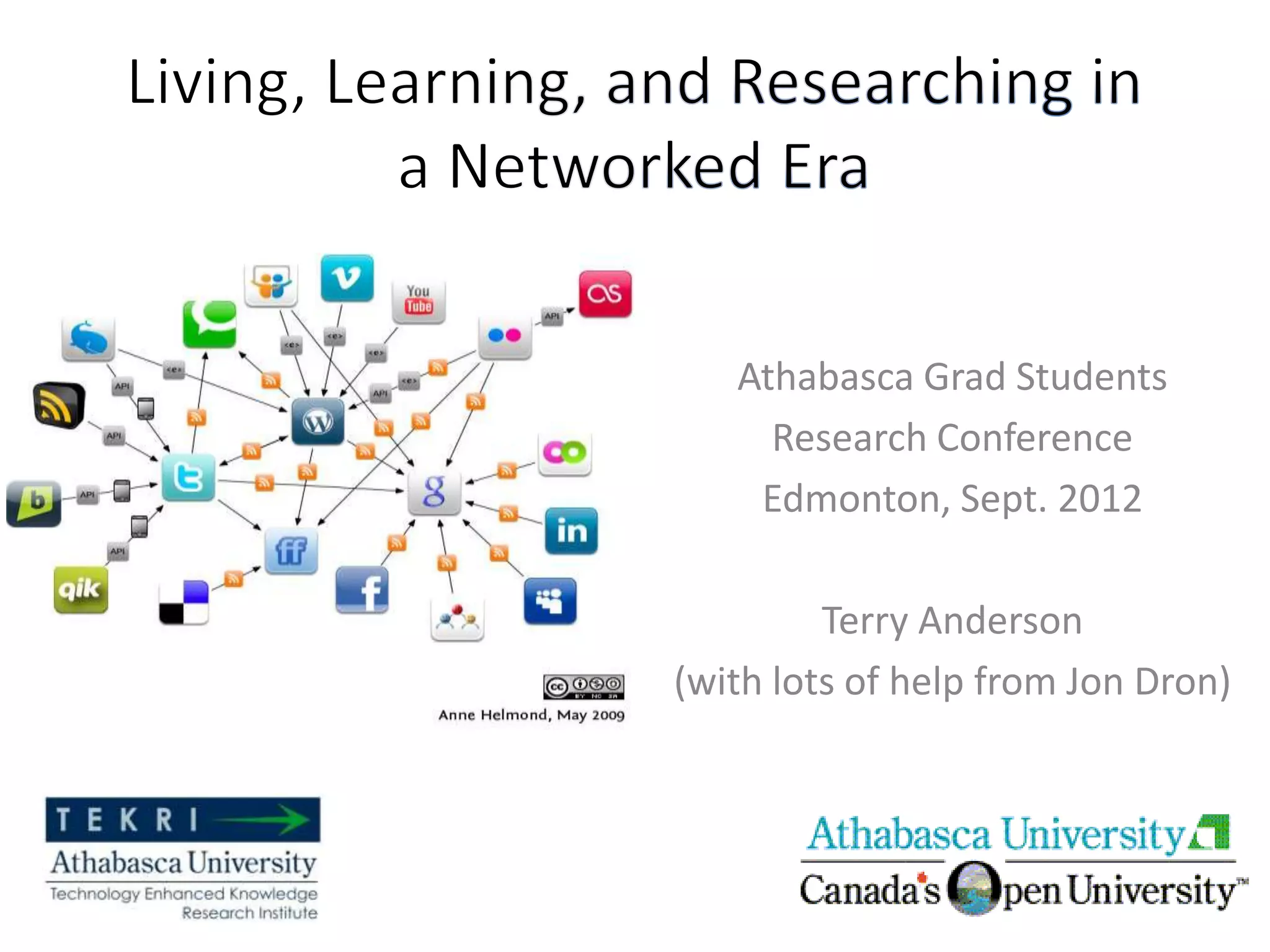
Athabasca Grad Students
     Research Conference
    Edmonton, Sept. 2012

         Terry Anderson
(with lots of help from Jon Dron)
Learning


Living          Researching
• Learning
   – Pedagogies
   – Connectivism
   – MOOCs

• Living
   – PLEs
   – Social Networks
   – Athabasca Landing
• Researching
   – Open Access Press, Journals and Citations
   – Julie’s Blog
Learning in a Networked Era
• Three Generations of Education Pedagogy
 (Anderson &Dron, 2011)
     • Cognitive –Behaviousim
     • Constructivism
     • Connectivism
Behaviourist/Cognitive Knowledge Is:
• Logically coherent, existing independent of
  perspective
• Largely context free
• Capable of being transmitted
• Assumes closed systems with discoverable
  relationships between inputs and outputs
• Readily defined through learning objectives

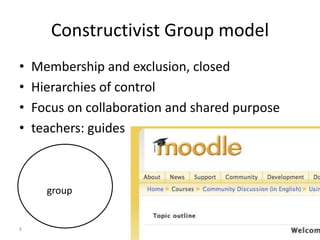
Constructivist Group model
•   Membership and exclusion, closed
•   Hierarchies of control
•   Focus on collaboration and shared purpose
•   teachers: guides


      group


6
Connectivist Learning Principles
          George Siemens, 2004
• Learning is a process of connecting specialized nodes or
  information sources.
• Learning may reside in non-human appliances.
• Capacity to know is more critical than what is currently known.
• Nurturing and maintaining connections is needed to facilitate
  continual learning.
• Ability to see connections between fields, ideas, and concepts
  is a core skill.
• Currency (accurate, up-to-date knowledge) is the intent of all
  connectivist learning activities.
Connectivist Learning is Emergent
• the very uncertainty and lack of predictability
  of learning outcomes will be the key factor
  that adds value to a learning community
• emergent systems will provide the necessary
  triggers to enhance knowledge and
  understanding
• emergent learning will be one of the critical
  triggers to unleash individual creativity (Kays&
  Sims, 2006,p. 411)
Two Genre’s of Moocs
                 cMOOC
• OrigionalSeimen’s – Downes -Cormier
  – Connectivist pedagogy “knowledge is actuated
    through the process of a learner connecting to and
    feeding information into a learning community” Kop &
    Hill 2008
  – Aggregates distributed posts, no centre
  – Large enrollment, many ‘lurkers’ no formal
    assessment
  – Heavy involvement and communication with
    ‘teacher/facilitator”
  – Ex. Change12, CCK08, EduMoo
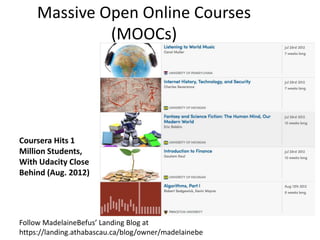
Massive Open Online Courses
              (MOOCs)


Coursera Hits 1
Million Students,
With Udacity Close
Behind (Aug. 2012)


Follow MadelaineBefus’ Landing Blog at
https://landing.athabascau.ca/blog/owner/madelainebe
MITx - Stanford xMOOC
• Structured learning activities, instructivist cognitive behaviourist
  pedagogy
• Heavy content interaction, little to no teacher-student interaction
• Centralized admin via LMS/analytics engines
• 2011 Stanford AI course 160,000 registered, 25,000 completed all
  exercises, -85% drop out?
• some accreditation by institutions – not Stanford
• Udacity, Coursera, venture capital, spin offs
• MITx – adds assessment and certificate of completion from
  MIT/UCLA/Harvard
• Machine Marking and Questions of authenticity?
• Colorado State first to offer credit after challenge exam- Athabasca
  to follow??
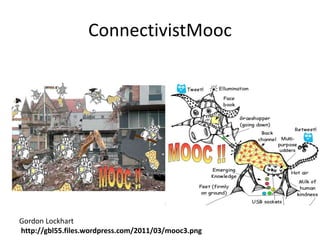
ConnectivistMooc


Gordon Lockhart
http://gbl55.files.wordpress.com/2011/03/mooc3.png
Your opportunity to enroll in an
          Athabasca MOOC
• CDE courses MDDE 622: Openness in Education
  – pay for credit, enroll for free
  – Starts next week
  – Teachers George Siemens and Rory McGreal
• AU removing MOOC barrier by offering credit for
  undergrad courses through PLAR and Challenge
  exams
• Don’t miss Inge de Ward’s session on MOOCs in
  this conference
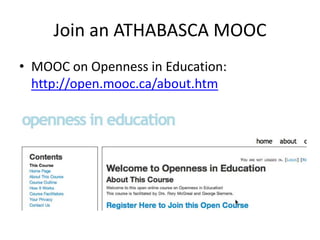
Join an ATHABASCA MOOC
• MOOC on Openness in Education:
  http://open.mooc.ca/about.htm
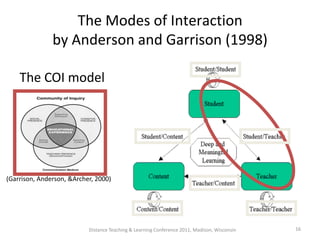
The Modes of Interaction
               by Anderson and Garrison (1998)

    The COI model


(Garrison, Anderson, &Archer, 2000)


                           Distance Teaching & Learning Conference 2011, Madison, Wisconsin   16
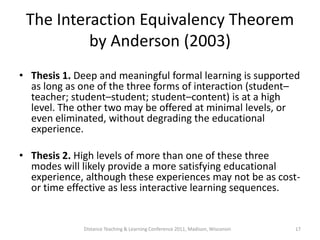
The Interaction Equivalency Theorem
          by Anderson (2003)
• Thesis 1. Deep and meaningful formal learning is supported
  as long as one of the three forms of interaction (student–
  teacher; student–student; student–content) is at a high
  level. The other two may be offered at minimal levels, or
  even eliminated, without degrading the educational
  experience.

• Thesis 2. High levels of more than one of these three
  modes will likely provide a more satisfying educational
  experience, although these experiences may not be as cost-
  or time effective as less interactive learning sequences.


             Distance Teaching & Learning Conference 2011, Madison, Wisconsin   17
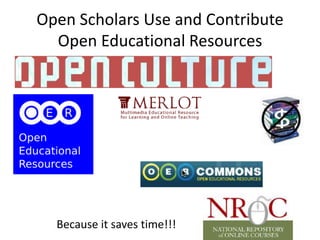
Open Scholars Use and Contribute
  Open Educational Resources


  Because it saves time!!!
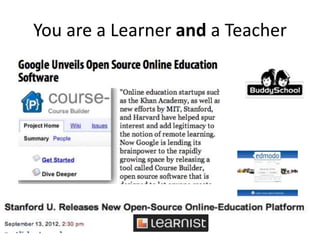
You are a Learner and a Teacher
Promising Signs of Change
• Ubiquity and multi-
  functionality of web 2.0
• Growth of openness and
  online resources, OERs
• Increasingly effective
  pedagogical models and
  learning activities
• Real educational
  alternatives – including
  private sector
• Death and retirement
Learning Summary
• Lifelong Learning options and quality are
  expanding very quickly.
• Is your day expanding as well???
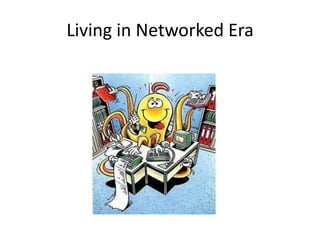
Living in Networked Era
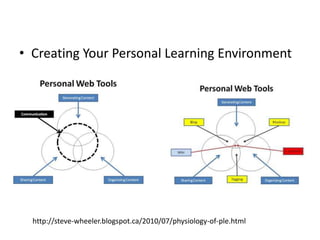
• Creating Your Personal Learning Environment


  http://steve-wheeler.blogspot.ca/2010/07/physiology-of-ple.html
• The Trick is to blend appropriate amounts of
  social, tech, learning, earning and living.
Your Online Networks
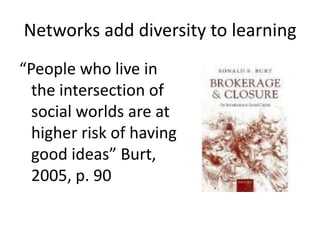
Networks add diversity to learning
“People who live in
  the intersection of
  social worlds are at
  higher risk of having
  good ideas” Burt,
  2005, p. 90
Networks Celebrate and Stimulate
         Cognitive Diversity
Arises when from:
• different types of information and knowledge
  perspectives
• different ways of viewing the world or a specific problem
  interpretations
• different ways of categorizing a problem or partitioning
  perspectives
• heuristics yielding different ways of generating solutions
  to problems
• predictive models - different ways of inferring causes and
  effects (Fisher, L. (2009)
Consumer Reports surveyed 2,002 online
         households, including 1,340 that are active on
         Facebook, for their annual State of the Net
         report.

•Some people are sharing too much.

•Some don't use privacy controls. Almost 13 million users said
they had never set, or didn’t know about, Facebook’s privacy
tools. And 28 percent shared all, or almost all, of their wall
posts with an audience wider than just their friends.

•Facebook collects more data than you may imagine.

•Your data is shared more widely than you may wish.

•Legal protections are spotty

•Problems are on the rise.
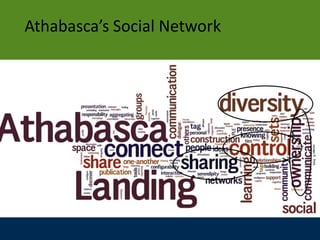
Athabasca’s Social Network
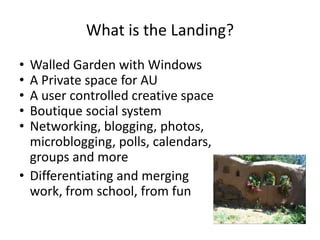
What is the Landing?
• Walled Garden with Windows
• A Private space for AU
• A user controlled creative space
• Boutique social system
• Networking, blogging, photos,
  microblogging, polls, calendars,
  groups and more
• Differentiating and merging
  work, from school, from fun
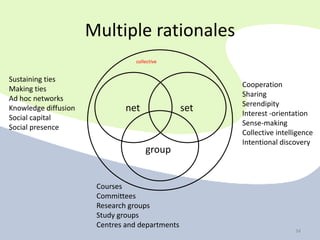
Multiple rationales
                                  collective


Sustaining ties
                                                       Cooperation
Making ties
                                                       Sharing
Ad hoc networks
                                                       Serendipity
Knowledge diffusion            net               set   Interest -orientation
Social capital
                                                       Sense-making
Social presence
                                                       Collective intelligence
                                                       Intentional discovery
                                      group


                       Courses
                       Committees
                       Research groups
                       Study groups
  34
                       Centres and departments
                                                                        34
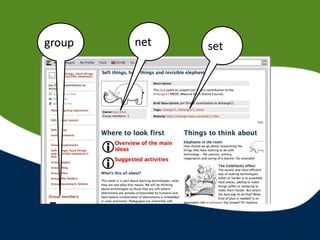
group       net               set


        Where to look first
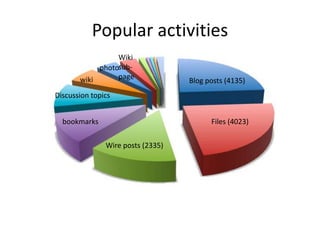
Popular activities
                 Wiki
            photosub-
       wiki      page
                                   Blog posts (4135)
Discussion topics


  bookmarks                              Files (4023)

               Wire posts (2335)
Hard spaces
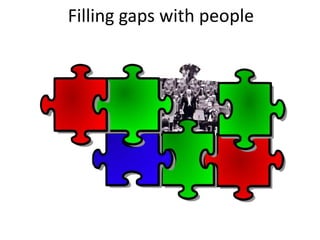
Filling gaps with people
Stretching tools
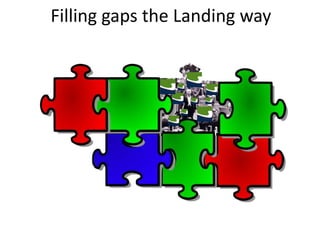
Filling gaps the Landing way
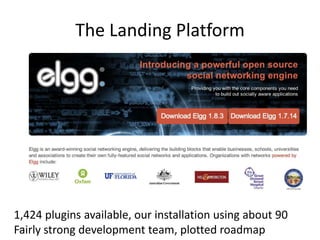
The Landing Platform


1,424 plugins available, our installation using about 90
Fairly strong development team, plotted roadmap
 42
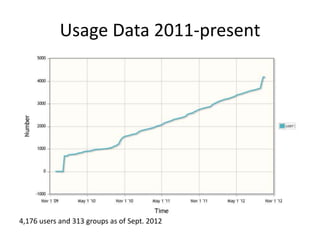
Usage Data 2011-present


4,176 users and 313 groups as of Sept. 2012
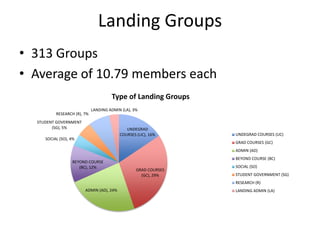
Landing Groups
• 313 Groups
• Average of 10.79 members each
                                      Type of Landing Groups
                             LANDING ADMIN (LA), 3%
          RESEARCH (R), 7%
  STUDENT GOVERNMENT
        (SG), 5%                             UNDEGRAD
                                          COURSES (UC), 16%      UNDEGRAD COURSES (UC)
     SOCIAL (SO), 4%
                                                                 GRAD COURSES (GC)
                                                                 ADMIN (AD)
                                                                 BEYOND COURSE (BC)
                  BEYOND COURSE
                     (BC), 12%                                   SOCIAL (SO)
                                                  GRAD COURSES
                                                    (GC), 29%    STUDENT GOVERNMENT (SG)
                                                                 RESEARCH (R)
                        ADMIN (AD), 24%                          LANDING ADMIN (LA)
Weekly Blog Posts
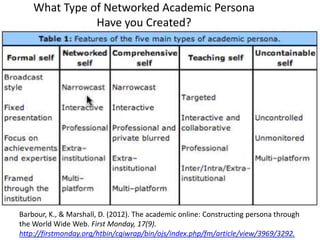
What Type of Networked Academic Persona
               Have you Created?


Barbour, K., & Marshall, D. (2012). The academic online: Constructing persona through
the World Wide Web. First Monday, 17(9).
http://firstmonday.org/htbin/cgiwrap/bin/ojs/index.php/fm/article/view/3969/3292.
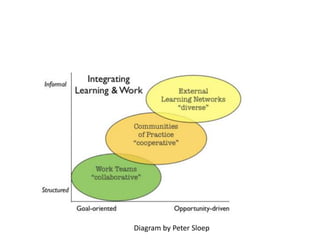
Diagram by Peter Sloep
Summary
        You are Living on the Net
• Need to customize your Net experience for
  your needs and personality
• Networks add diversity to our lifes
• The landing offers a safe way to expand your
  networking within an Athabasca context
3. Researching in Networked World
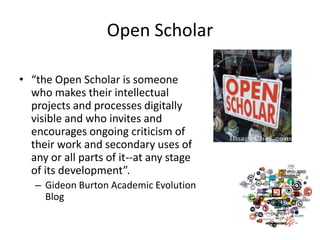
Open Scholar

• “the Open Scholar is someone
  who makes their intellectual
  projects and processes digitally
  visible and who invites and
  encourages ongoing criticism of
  their work and secondary uses of
  any or all parts of it--at any stage
  of its development”.
   – Gideon Burton Academic Evolution
     Blog
Open Scholars Create:
• A new type of education work maximizing:
  – Social learning
  – Media richness
  – Participatory and connectivist pedagogies
  – Ubiquity and persistence
  – Open data collection and research process
  – Creating connections
Open Scholars Self Archive


       Quality scholarship is peer and public
       reviewed, accessible, persistent
       syndicated, commented and
       transparent.
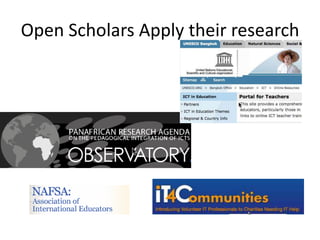
Open Scholars Apply their research
Open Scholars do Open Research
• Open Notebook: a laboratory notebook that is
  freely available and indexed on common
  search engines. …it is essential that all of the
  information available to the researchers to
  make their conclusions is equally available to
  the rest of the world.
• —Jean-Claude Bradley
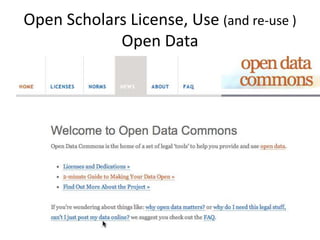
Open Scholars License, Use (and re-use )
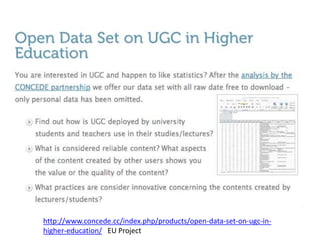
            Open Data
http://www.concede.cc/index.php/products/open-data-set-on-ugc-in-
higher-education/ EU Project
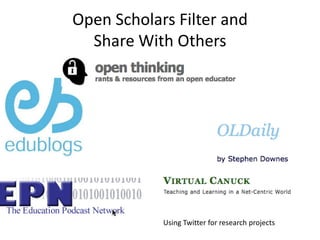
Open Scholars Filter and
  Share With Others


            Using Twitter for research projects
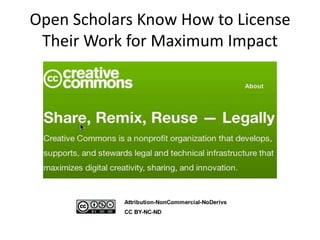
Open Scholars Know How to License
 Their Work for Maximum Impact
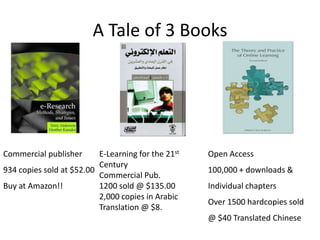
A Tale of 3 Books


Commercial publisher      E-Learning for the 21st   Open Access
                          Century
934 copies sold at $52.00                           100,000 + downloads &
                          Commercial Pub.
Buy at Amazon!!           1200 sold @ $135.00       Individual chapters
                          2,000 copies in Arabic
                                                    Over 1500 hardcopies sold
                          Translation @ $8.
                                                    @ $40 Translated Chinese
Open Scholars Write and Read
Open Access Books


aupress.ca
www.irrodl.org
Open Scholars Publish in
          Open Access Journals
• Open Access Journals have increased citation
  ratings:
  – Zawacki-Richter, O., Anderson, T., &Tuncay, N. (2010).
    The growing impact of open access distance education
    journals – a bibliometric analysis. Journal of Distance
    Education, 24(3)
  – Analysis of Google citations for 12 Distance Education
    Journals (using Harzing’s Publish or Perish tool)
  – 6 open access, 6 commercially published
  – Early results show roughly equal citations/paper, but
    recent gains in citations by open access journals
Are you Ready to Take the Pledge??
• I pledge that:
   – “ I will no longer submit my
     work to closed
     publications, nor participate
     in review or editorial
     functions for closed
     publications.”
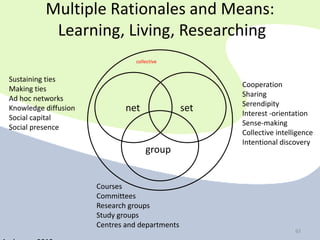
Multiple Rationales and Means:
           Learning, Living, Researching
                                 collective


Sustaining ties
                                                      Cooperation
Making ties
                                                      Sharing
Ad hoc networks
                                                      Serendipity
Knowledge diffusion           net               set   Interest -orientation
Social capital
                                                      Sense-making
Social presence
                                                      Collective intelligence
                                                      Intentional discovery
                                     group


                      Courses
                      Committees
                      Research groups
                      Study groups
  63
                      Centres and departments
                                                                       63
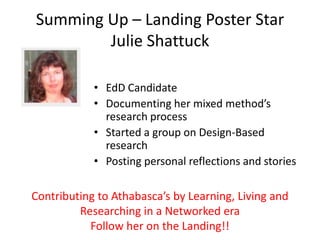
Summing Up – Landing Poster Star
        Julie Shattuck

            • EdD Candidate
            • Documenting her mixed method’s
              research process
            • Started a group on Design-Based
              research
            • Posting personal reflections and stories

Contributing to Athabasca’s by Learning, Living and
         Researching in a Networked era
           Follow her on the Landing!!
CU on the Landing !!


Your comments and questions most
          welcomed!

    Terry Anderson terrya@athabascau.ca
                Blog: terrya.edublogs.org

Learning, Living and researching in a Networked World

  • 1.
    Athabasca Grad Students Research Conference Edmonton, Sept. 2012 Terry Anderson (with lots of help from Jon Dron)
  • 2.
    Learning Living Researching
  • 3.
    • Learning – Pedagogies – Connectivism – MOOCs • Living – PLEs – Social Networks – Athabasca Landing • Researching – Open Access Press, Journals and Citations – Julie’s Blog
  • 4.
    Learning in aNetworked Era • Three Generations of Education Pedagogy (Anderson &Dron, 2011) • Cognitive –Behaviousim • Constructivism • Connectivism
  • 5.
    Behaviourist/Cognitive Knowledge Is: •Logically coherent, existing independent of perspective • Largely context free • Capable of being transmitted • Assumes closed systems with discoverable relationships between inputs and outputs • Readily defined through learning objectives
  • 6.
    Constructivist Group model • Membership and exclusion, closed • Hierarchies of control • Focus on collaboration and shared purpose • teachers: guides group 6
  • 7.
    Connectivist Learning Principles George Siemens, 2004 • Learning is a process of connecting specialized nodes or information sources. • Learning may reside in non-human appliances. • Capacity to know is more critical than what is currently known. • Nurturing and maintaining connections is needed to facilitate continual learning. • Ability to see connections between fields, ideas, and concepts is a core skill. • Currency (accurate, up-to-date knowledge) is the intent of all connectivist learning activities.
  • 8.
    Connectivist Learning isEmergent • the very uncertainty and lack of predictability of learning outcomes will be the key factor that adds value to a learning community • emergent systems will provide the necessary triggers to enhance knowledge and understanding • emergent learning will be one of the critical triggers to unleash individual creativity (Kays& Sims, 2006,p. 411)
  • 10.
    Two Genre’s ofMoocs cMOOC • OrigionalSeimen’s – Downes -Cormier – Connectivist pedagogy “knowledge is actuated through the process of a learner connecting to and feeding information into a learning community” Kop & Hill 2008 – Aggregates distributed posts, no centre – Large enrollment, many ‘lurkers’ no formal assessment – Heavy involvement and communication with ‘teacher/facilitator” – Ex. Change12, CCK08, EduMoo
  • 11.
    Massive Open OnlineCourses (MOOCs) Coursera Hits 1 Million Students, With Udacity Close Behind (Aug. 2012) Follow MadelaineBefus’ Landing Blog at https://landing.athabascau.ca/blog/owner/madelainebe
  • 12.
    MITx - StanfordxMOOC • Structured learning activities, instructivist cognitive behaviourist pedagogy • Heavy content interaction, little to no teacher-student interaction • Centralized admin via LMS/analytics engines • 2011 Stanford AI course 160,000 registered, 25,000 completed all exercises, -85% drop out? • some accreditation by institutions – not Stanford • Udacity, Coursera, venture capital, spin offs • MITx – adds assessment and certificate of completion from MIT/UCLA/Harvard • Machine Marking and Questions of authenticity? • Colorado State first to offer credit after challenge exam- Athabasca to follow??
  • 13.
  • 14.
    Your opportunity toenroll in an Athabasca MOOC • CDE courses MDDE 622: Openness in Education – pay for credit, enroll for free – Starts next week – Teachers George Siemens and Rory McGreal • AU removing MOOC barrier by offering credit for undergrad courses through PLAR and Challenge exams • Don’t miss Inge de Ward’s session on MOOCs in this conference
  • 15.
    Join an ATHABASCAMOOC • MOOC on Openness in Education: http://open.mooc.ca/about.htm
  • 16.
    The Modes ofInteraction by Anderson and Garrison (1998) The COI model (Garrison, Anderson, &Archer, 2000) Distance Teaching & Learning Conference 2011, Madison, Wisconsin 16
  • 17.
    The Interaction EquivalencyTheorem by Anderson (2003) • Thesis 1. Deep and meaningful formal learning is supported as long as one of the three forms of interaction (student– teacher; student–student; student–content) is at a high level. The other two may be offered at minimal levels, or even eliminated, without degrading the educational experience. • Thesis 2. High levels of more than one of these three modes will likely provide a more satisfying educational experience, although these experiences may not be as cost- or time effective as less interactive learning sequences. Distance Teaching & Learning Conference 2011, Madison, Wisconsin 17
  • 18.
    Open Scholars Useand Contribute Open Educational Resources Because it saves time!!!
  • 19.
    You are aLearner and a Teacher
  • 20.
    Promising Signs ofChange • Ubiquity and multi- functionality of web 2.0 • Growth of openness and online resources, OERs • Increasingly effective pedagogical models and learning activities • Real educational alternatives – including private sector • Death and retirement
  • 21.
    Learning Summary • LifelongLearning options and quality are expanding very quickly. • Is your day expanding as well???
  • 22.
  • 23.
    • Creating YourPersonal Learning Environment http://steve-wheeler.blogspot.ca/2010/07/physiology-of-ple.html
  • 26.
    • The Trickis to blend appropriate amounts of social, tech, learning, earning and living.
  • 27.
  • 28.
    Networks add diversityto learning “People who live in the intersection of social worlds are at higher risk of having good ideas” Burt, 2005, p. 90
  • 29.
    Networks Celebrate andStimulate Cognitive Diversity Arises when from: • different types of information and knowledge perspectives • different ways of viewing the world or a specific problem interpretations • different ways of categorizing a problem or partitioning perspectives • heuristics yielding different ways of generating solutions to problems • predictive models - different ways of inferring causes and effects (Fisher, L. (2009)
  • 31.
    Consumer Reports surveyed2,002 online households, including 1,340 that are active on Facebook, for their annual State of the Net report. •Some people are sharing too much. •Some don't use privacy controls. Almost 13 million users said they had never set, or didn’t know about, Facebook’s privacy tools. And 28 percent shared all, or almost all, of their wall posts with an audience wider than just their friends. •Facebook collects more data than you may imagine. •Your data is shared more widely than you may wish. •Legal protections are spotty •Problems are on the rise.
  • 32.
  • 33.
    What is theLanding? • Walled Garden with Windows • A Private space for AU • A user controlled creative space • Boutique social system • Networking, blogging, photos, microblogging, polls, calendars, groups and more • Differentiating and merging work, from school, from fun
  • 34.
    Multiple rationales collective Sustaining ties Cooperation Making ties Sharing Ad hoc networks Serendipity Knowledge diffusion net set Interest -orientation Social capital Sense-making Social presence Collective intelligence Intentional discovery group Courses Committees Research groups Study groups 34 Centres and departments 34
  • 35.
    group net set Where to look first
  • 36.
    Popular activities Wiki photosub- wiki page Blog posts (4135) Discussion topics bookmarks Files (4023) Wire posts (2335)
  • 38.
  • 39.
  • 40.
  • 41.
    Filling gaps theLanding way
  • 42.
    The Landing Platform 1,424plugins available, our installation using about 90 Fairly strong development team, plotted roadmap 42
  • 43.
    Usage Data 2011-present 4,176users and 313 groups as of Sept. 2012
  • 44.
    Landing Groups • 313Groups • Average of 10.79 members each Type of Landing Groups LANDING ADMIN (LA), 3% RESEARCH (R), 7% STUDENT GOVERNMENT (SG), 5% UNDEGRAD COURSES (UC), 16% UNDEGRAD COURSES (UC) SOCIAL (SO), 4% GRAD COURSES (GC) ADMIN (AD) BEYOND COURSE (BC) BEYOND COURSE (BC), 12% SOCIAL (SO) GRAD COURSES (GC), 29% STUDENT GOVERNMENT (SG) RESEARCH (R) ADMIN (AD), 24% LANDING ADMIN (LA)
  • 45.
  • 46.
    What Type ofNetworked Academic Persona Have you Created? Barbour, K., & Marshall, D. (2012). The academic online: Constructing persona through the World Wide Web. First Monday, 17(9). http://firstmonday.org/htbin/cgiwrap/bin/ojs/index.php/fm/article/view/3969/3292.
  • 47.
  • 48.
    Summary You are Living on the Net • Need to customize your Net experience for your needs and personality • Networks add diversity to our lifes • The landing offers a safe way to expand your networking within an Athabasca context
  • 49.
    3. Researching inNetworked World
  • 50.
    Open Scholar • “theOpen Scholar is someone who makes their intellectual projects and processes digitally visible and who invites and encourages ongoing criticism of their work and secondary uses of any or all parts of it--at any stage of its development”. – Gideon Burton Academic Evolution Blog
  • 51.
    Open Scholars Create: •A new type of education work maximizing: – Social learning – Media richness – Participatory and connectivist pedagogies – Ubiquity and persistence – Open data collection and research process – Creating connections
  • 52.
    Open Scholars SelfArchive Quality scholarship is peer and public reviewed, accessible, persistent syndicated, commented and transparent.
  • 53.
    Open Scholars Applytheir research
  • 54.
    Open Scholars doOpen Research • Open Notebook: a laboratory notebook that is freely available and indexed on common search engines. …it is essential that all of the information available to the researchers to make their conclusions is equally available to the rest of the world. • —Jean-Claude Bradley
  • 55.
    Open Scholars License,Use (and re-use ) Open Data
  • 56.
  • 57.
    Open Scholars Filterand Share With Others Using Twitter for research projects
  • 58.
    Open Scholars KnowHow to License Their Work for Maximum Impact
  • 59.
    A Tale of3 Books Commercial publisher E-Learning for the 21st Open Access Century 934 copies sold at $52.00 100,000 + downloads & Commercial Pub. Buy at Amazon!! 1200 sold @ $135.00 Individual chapters 2,000 copies in Arabic Over 1500 hardcopies sold Translation @ $8. @ $40 Translated Chinese
  • 60.
    Open Scholars Writeand Read Open Access Books aupress.ca www.irrodl.org
  • 61.
    Open Scholars Publishin Open Access Journals • Open Access Journals have increased citation ratings: – Zawacki-Richter, O., Anderson, T., &Tuncay, N. (2010). The growing impact of open access distance education journals – a bibliometric analysis. Journal of Distance Education, 24(3) – Analysis of Google citations for 12 Distance Education Journals (using Harzing’s Publish or Perish tool) – 6 open access, 6 commercially published – Early results show roughly equal citations/paper, but recent gains in citations by open access journals
  • 62.
    Are you Readyto Take the Pledge?? • I pledge that: – “ I will no longer submit my work to closed publications, nor participate in review or editorial functions for closed publications.”
  • 63.
    Multiple Rationales andMeans: Learning, Living, Researching collective Sustaining ties Cooperation Making ties Sharing Ad hoc networks Serendipity Knowledge diffusion net set Interest -orientation Social capital Sense-making Social presence Collective intelligence Intentional discovery group Courses Committees Research groups Study groups 63 Centres and departments 63
  • 64.
    Summing Up –Landing Poster Star Julie Shattuck • EdD Candidate • Documenting her mixed method’s research process • Started a group on Design-Based research • Posting personal reflections and stories Contributing to Athabasca’s by Learning, Living and Researching in a Networked era Follow her on the Landing!!
  • 65.
    CU on theLanding !! Your comments and questions most welcomed! Terry Anderson terrya@athabascau.ca Blog: terrya.edublogs.org

Editor's Notes

  • #3 Blended Solutions