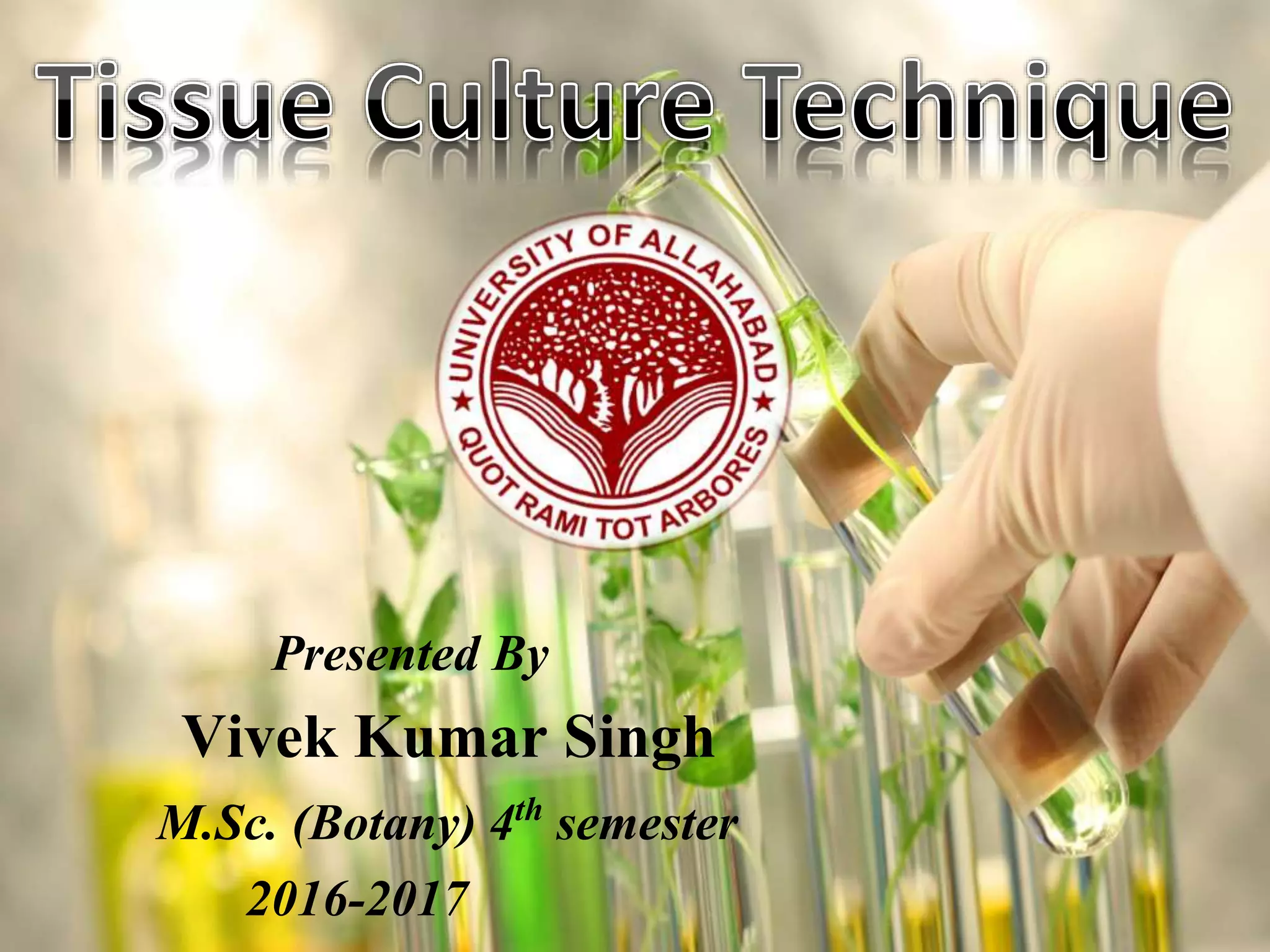
Presented By
Vivek Kumar Singh
M.Sc. (Botany) 4th semester
2016-2017
• The term tissue culture is commonly used in a
very wide sense to include in vitro culture of
plant cells, tissues as well as organs.
• Tissue Culture denotes the in vitro cultivation
of plant cells in an unorganized mass, e.g.
Callus Culture.
• Another term, cell culture is used for in vitro
culture of single or relatively small group of
plant cells, e.g. suspension culture.
18/04/2017 2
The culture of plant cells,
tissue, and organs such as root,
shoot tips and leaves in
artificial nutrient media
aseptically under defined physical
and chemical condition is referred
to as “Plant Tissue Culture”.
18/04/2017 3
• “Tissue Culture” is commonly
used as a broad term to describe
all type of plant cultures,
namely callus, cell, protoplast,
anther, meristem, embryo and
organ cultures.
18/04/2017 4
• The in vitro technique were
developed initially to demonstrate
the totipotency of plant cells
predicted by Gottlieb Haberlandt in
1902.
• Totipotency- is the ability of a
plant cell to perform all the
function of development which are
characteristic of zygote.
18/04/2017 5
• The first embryo culture was carried out
by Hanning in 1904; he cultured nearly
mature embryo of certain crucifer and
grew them to maturity.
• Haploid plants from pollen grain was
first produced by Maheshwari and Guha in
1964 by culturing the anther of Datura.
This marked the beginning of anther and
pollen culture for production of haploid
plant.
18/04/2017 6
• Plant protoplast are naked cells from
which cell wall has been removed. In
1960, Cocking produced large
quantities of protoplast by using
cell wall degradation enzyme.
• In 1972 Carlson and coworkers
produced the first somatic hybrid
plant by fusion the protoplast of
Nicotiana glauca and Nicotiana
longsdorfii.
18/04/2017 7
• The first continuously growing callus
culture were established from cambium
tissue in 1939 independently by
Gautheret, White and Nobecart.
18/04/2017 8
• The technique of in vitro cultivation of
plant cells or organ is –
1. Keep the plant cell free from microbes.
2. Suitable nutrient media
3. Environmental condition
18/04/2017 9
• Laboratory Space-
In general space for the following is
needed.
1. Washing, Drying and Storage of
Vessels
2. Preparation, Sterilization and
Storage of Media
3. Aseptic handling of explant and
cultures
4. Maintains of culture
5. Observation of culture
18/04/2017 10
• The culture room should have the
following facilities:
1. Controlled temperature (usually 25°±
2°C).
2. Culture racks fitted with light.
3. A shaker for agitation of liquid
cultures.
18/04/2017 11
• Generally, glass culture vessels are
used as they are cheaper, reusable and
autoclavable.
• It is desirable to use only borosilicate
or pyrex glassware as ordinary soda
glass may be toxic to some tissue.
• Tissue are generally cultured in culture
tube, flasks and Petri plate but many
specially designed dishes are also used.
18/04/2017 12
• Culture vessels and other labware are
generally soaked in a suitable nontoxic
detergent solution overnight, washed with
a suitable brush, thoroughly rinsed clean
with tap water, followed by rinse with
distilled water and dried in a hot air
oven 70 - 80° C.
• Washed culture vessels should be stored
in a dust proof cabinet.
18/04/2017 13
• All the material used in culture work must
be freed from microbes. This is done by
one of the following method.
1. Dry heat
2. Autoclaving
3. Filter Sterilization
4. Wiping with 70% Ethanol
5. Surface Sterilization
18/04/2017 14
• Glassware and Teflon plasticware, and
instruments may be sterilized by dry
heat in an oven at 160 - 180°C for 3
hours.
18/04/2017 15
• Culture vessels, (both empty and
containing media) are generally
sterilized by heating in autoclave or a
pressure cooker to 121° C at 15 pound
per square inch for 15 to 40 minutes the
time being longer for larger medium
volume.
• Sterilization during autoclaving depends
mainly on temperature.
18/04/2017 16
• Some growth regulators, e.g. GA3, urea,
certain vitamins, and enzyme are heat
labile. Such compound are filter
sterilized by passing their solution
through a membrane filter of 0.45 micron
or lower pore size.
• Laminar air flow cabinets are used to
create an aseptic working space by
blowing filter – sterilized air through
an enclosed space.
18/04/2017 17
• The surface that can not be
sterilized by other techniques
are sterilized by wiping them
thoroughly with 70% ethyl alcohol
and the alcohol is allowed to
dry.
18/04/2017 18
• All plant materials to be used for culture
are treated with an appropriate
sterilizing agent to inactive the microbes
present on their surface, this is called
Surface Sterilization.
• It depends mainly on the source and type
of tissue of the explant which will
determine the contamination load and
tolerance of the sterilizing agent.
18/04/2017 19
• The sterilizing Agent used for surface
disinfection are-
• Calcium Hypochlorite (9-10%)
• Sodium Hypochlorite (2%)
• Mercuric Chloride (0.1-1%)
• Silver nitrate (1%)
• Bromine water (1-2%)
• H2O2 (10-12%)
• Antibiotic (4-50 mg/l)
commonly used
18/04/2017 20
• A synthetic medium consist of only
chemically defined compounds.
Inorganic Nutrients- In addition to C, H,
and O, all nutrient media provide the 12
element essential for plant growth, viz., N,
P, K, Ca, S, Mg ( These are macronutrients).
Fe, Zn, Mn, Cu, B, Mo (these are
micronutrients).
The different nutrients media provide
different concentration of the inorganic
nutrients.
18/04/2017 21
Vitamins- For the optimum callus
growth, The following Vitamins are
required-
Inositol (B-8), thiamine (B-1),
pyridoxine (B-6) and nicotinic acid
(B-3) of which thiamine is essential
and the rest are promotory.
Pantothenic acid is also known to be
promotory.
18/04/2017 22
Carbon Source- Sucrose (20-25 g/l) is
the most commonly used carbon source
for all culture material, including
even green shoots. Autoclaving
hydrolyses sucrose, which enhances
its availability to plants. In some
System such as in monocots Glucose
may be superior to sucrose.
18/04/2017 23
Growth Regulators- The following growth
regulators are used in plant tissue culture.
Auxin e.g. IAA, (indole-3-acetic acid)
IBA, (indole-3-butyric acid) NAA,
(naphthalene acetic acid) NOA, (naphthoxy
acetic acid),
2,4-D, (2,4- dichlorophenoxy acetic acid)
are commonly used to support cell division
and callus growth (especially 2,4-D)
,somatic embryo induction, rooting etc.
18/04/2017 24
• Cytokinins like kinetin (furfurylamino
purine), BAP (benzylamino purine), Zeatin,
2-ip (isopentenyl adenine), TZD (
Thidiazuron, a compound having cytokinin
activity) are employed to promote cell
division, regeneration of shoots, often
somatic embryo induction and to enhance
proliferation and growth of auxillary
buds.
18/04/2017 25
• Abscisic acid promotes somatic embryo and
shoot bud regeneration in many species and
markedly improves somatic embryo
maturation.
• Gibberellins (over 20 types known), GA3 is
almost exclusively used; it promote shoot
elongation and somatic embryo germination.
• Concentration are as follows- auxin, 0.1-3
mg/l; cytokinins, 0.1-3mg/l; ABA,
0.2mg/l; and GA3 , 0.1-1mg/l.
18/04/2017 26
Complex Organic Additives – Complex additive
like-
1. Yeast extract,
2. Coconut milk,
3. Casein hydrolysate,
4. Corn milk,
5. Malt extract and
6. Tomato juice
-were used to support plant tissue
growth.
Such additive should be used only when
synthetic media fail.
18/04/2017 27
• A simple process is to first test several
concentration of auxin and cytokinin to
identify a suitable combination of the two.
• Now check the ½, full, even higher salt
conc. of the selected medium as well as
different sucrose conc.
• Alternatively worker find the various conc.
Of low, medium and high conc. of four
solution viz; minerals, organics, auxin &
cytokinin.
18/04/2017 28
• BIOTECHNOLOGY- B. D. SINGH
• Plant Tissue Culture- M. K. Razdan
• Plant Tissue Culture –P. K.Gupta
18/04/2017 29
18/04/2017 30

Tissue culture technique

  • 1.
    Presented By Vivek KumarSingh M.Sc. (Botany) 4th semester 2016-2017
  • 2.
    • The termtissue culture is commonly used in a very wide sense to include in vitro culture of plant cells, tissues as well as organs. • Tissue Culture denotes the in vitro cultivation of plant cells in an unorganized mass, e.g. Callus Culture. • Another term, cell culture is used for in vitro culture of single or relatively small group of plant cells, e.g. suspension culture. 18/04/2017 2
  • 3.
    The culture ofplant cells, tissue, and organs such as root, shoot tips and leaves in artificial nutrient media aseptically under defined physical and chemical condition is referred to as “Plant Tissue Culture”. 18/04/2017 3
  • 4.
    • “Tissue Culture”is commonly used as a broad term to describe all type of plant cultures, namely callus, cell, protoplast, anther, meristem, embryo and organ cultures. 18/04/2017 4
  • 5.
    • The invitro technique were developed initially to demonstrate the totipotency of plant cells predicted by Gottlieb Haberlandt in 1902. • Totipotency- is the ability of a plant cell to perform all the function of development which are characteristic of zygote. 18/04/2017 5
  • 6.
    • The firstembryo culture was carried out by Hanning in 1904; he cultured nearly mature embryo of certain crucifer and grew them to maturity. • Haploid plants from pollen grain was first produced by Maheshwari and Guha in 1964 by culturing the anther of Datura. This marked the beginning of anther and pollen culture for production of haploid plant. 18/04/2017 6
  • 7.
    • Plant protoplastare naked cells from which cell wall has been removed. In 1960, Cocking produced large quantities of protoplast by using cell wall degradation enzyme. • In 1972 Carlson and coworkers produced the first somatic hybrid plant by fusion the protoplast of Nicotiana glauca and Nicotiana longsdorfii. 18/04/2017 7
  • 8.
    • The firstcontinuously growing callus culture were established from cambium tissue in 1939 independently by Gautheret, White and Nobecart. 18/04/2017 8
  • 9.
    • The techniqueof in vitro cultivation of plant cells or organ is – 1. Keep the plant cell free from microbes. 2. Suitable nutrient media 3. Environmental condition 18/04/2017 9
  • 10.
    • Laboratory Space- Ingeneral space for the following is needed. 1. Washing, Drying and Storage of Vessels 2. Preparation, Sterilization and Storage of Media 3. Aseptic handling of explant and cultures 4. Maintains of culture 5. Observation of culture 18/04/2017 10
  • 11.
    • The cultureroom should have the following facilities: 1. Controlled temperature (usually 25°± 2°C). 2. Culture racks fitted with light. 3. A shaker for agitation of liquid cultures. 18/04/2017 11
  • 12.
    • Generally, glassculture vessels are used as they are cheaper, reusable and autoclavable. • It is desirable to use only borosilicate or pyrex glassware as ordinary soda glass may be toxic to some tissue. • Tissue are generally cultured in culture tube, flasks and Petri plate but many specially designed dishes are also used. 18/04/2017 12
  • 13.
    • Culture vesselsand other labware are generally soaked in a suitable nontoxic detergent solution overnight, washed with a suitable brush, thoroughly rinsed clean with tap water, followed by rinse with distilled water and dried in a hot air oven 70 - 80° C. • Washed culture vessels should be stored in a dust proof cabinet. 18/04/2017 13
  • 14.
    • All thematerial used in culture work must be freed from microbes. This is done by one of the following method. 1. Dry heat 2. Autoclaving 3. Filter Sterilization 4. Wiping with 70% Ethanol 5. Surface Sterilization 18/04/2017 14
  • 15.
    • Glassware andTeflon plasticware, and instruments may be sterilized by dry heat in an oven at 160 - 180°C for 3 hours. 18/04/2017 15
  • 16.
    • Culture vessels,(both empty and containing media) are generally sterilized by heating in autoclave or a pressure cooker to 121° C at 15 pound per square inch for 15 to 40 minutes the time being longer for larger medium volume. • Sterilization during autoclaving depends mainly on temperature. 18/04/2017 16
  • 17.
    • Some growthregulators, e.g. GA3, urea, certain vitamins, and enzyme are heat labile. Such compound are filter sterilized by passing their solution through a membrane filter of 0.45 micron or lower pore size. • Laminar air flow cabinets are used to create an aseptic working space by blowing filter – sterilized air through an enclosed space. 18/04/2017 17
  • 18.
    • The surfacethat can not be sterilized by other techniques are sterilized by wiping them thoroughly with 70% ethyl alcohol and the alcohol is allowed to dry. 18/04/2017 18
  • 19.
    • All plantmaterials to be used for culture are treated with an appropriate sterilizing agent to inactive the microbes present on their surface, this is called Surface Sterilization. • It depends mainly on the source and type of tissue of the explant which will determine the contamination load and tolerance of the sterilizing agent. 18/04/2017 19
  • 20.
    • The sterilizingAgent used for surface disinfection are- • Calcium Hypochlorite (9-10%) • Sodium Hypochlorite (2%) • Mercuric Chloride (0.1-1%) • Silver nitrate (1%) • Bromine water (1-2%) • H2O2 (10-12%) • Antibiotic (4-50 mg/l) commonly used 18/04/2017 20
  • 21.
    • A syntheticmedium consist of only chemically defined compounds. Inorganic Nutrients- In addition to C, H, and O, all nutrient media provide the 12 element essential for plant growth, viz., N, P, K, Ca, S, Mg ( These are macronutrients). Fe, Zn, Mn, Cu, B, Mo (these are micronutrients). The different nutrients media provide different concentration of the inorganic nutrients. 18/04/2017 21
  • 22.
    Vitamins- For theoptimum callus growth, The following Vitamins are required- Inositol (B-8), thiamine (B-1), pyridoxine (B-6) and nicotinic acid (B-3) of which thiamine is essential and the rest are promotory. Pantothenic acid is also known to be promotory. 18/04/2017 22
  • 23.
    Carbon Source- Sucrose(20-25 g/l) is the most commonly used carbon source for all culture material, including even green shoots. Autoclaving hydrolyses sucrose, which enhances its availability to plants. In some System such as in monocots Glucose may be superior to sucrose. 18/04/2017 23
  • 24.
    Growth Regulators- Thefollowing growth regulators are used in plant tissue culture. Auxin e.g. IAA, (indole-3-acetic acid) IBA, (indole-3-butyric acid) NAA, (naphthalene acetic acid) NOA, (naphthoxy acetic acid), 2,4-D, (2,4- dichlorophenoxy acetic acid) are commonly used to support cell division and callus growth (especially 2,4-D) ,somatic embryo induction, rooting etc. 18/04/2017 24
  • 25.
    • Cytokinins likekinetin (furfurylamino purine), BAP (benzylamino purine), Zeatin, 2-ip (isopentenyl adenine), TZD ( Thidiazuron, a compound having cytokinin activity) are employed to promote cell division, regeneration of shoots, often somatic embryo induction and to enhance proliferation and growth of auxillary buds. 18/04/2017 25
  • 26.
    • Abscisic acidpromotes somatic embryo and shoot bud regeneration in many species and markedly improves somatic embryo maturation. • Gibberellins (over 20 types known), GA3 is almost exclusively used; it promote shoot elongation and somatic embryo germination. • Concentration are as follows- auxin, 0.1-3 mg/l; cytokinins, 0.1-3mg/l; ABA, 0.2mg/l; and GA3 , 0.1-1mg/l. 18/04/2017 26
  • 27.
    Complex Organic Additives– Complex additive like- 1. Yeast extract, 2. Coconut milk, 3. Casein hydrolysate, 4. Corn milk, 5. Malt extract and 6. Tomato juice -were used to support plant tissue growth. Such additive should be used only when synthetic media fail. 18/04/2017 27
  • 28.
    • A simpleprocess is to first test several concentration of auxin and cytokinin to identify a suitable combination of the two. • Now check the ½, full, even higher salt conc. of the selected medium as well as different sucrose conc. • Alternatively worker find the various conc. Of low, medium and high conc. of four solution viz; minerals, organics, auxin & cytokinin. 18/04/2017 28
  • 29.
    • BIOTECHNOLOGY- B.D. SINGH • Plant Tissue Culture- M. K. Razdan • Plant Tissue Culture –P. K.Gupta 18/04/2017 29
  • 30.