General Methods of Teaching (GMT)
METHODS
OF
TEACHING
General Methods of Teaching (GMT)
Teaching Method
Teaching Method is a style of the presentation of content in classroom. It has presented
broad meaning of the term ‘method’. According to this matter is important for determining
method. The common teaching matter may be of three types hence all the methods can be
classified under three heads.
1. Telling Method- Lecture, questioning, Discussion etc.
2. Showing Method- Demonstration, Excursion, etc.
3. Doing Method- Project, Role playing, Practical Method, etc.
General Methods of Teaching (GMT)
Teaching Method
 Broudy has stated that ‘Method refers to the formal structure of the sequence acts
commonly denoted by instruction. The term ‘method’ covers both strategies and
tactics of teaching and involves the choice of what is to be taught, and in which order
is it to be presented.
 Method is more general; it includes techniques also. The teaching are ways of
implementing method. Different techniques may be employed withing one method of
teaching.
General Methods of Teaching (GMT)
Lecture Method
 The lecture method of teaching is one of the most common and traditional forms of
teaching. It involves a teacher or instructor delivering a speech or presentation to a
group of students, typically in a classroom setting.
 The goal of the lecture is to provide students with an overview of a particular topic, to
clarify complex concepts, and to share the instructor's knowledge and expertise with
the students.
General Methods of Teaching (GMT)
Objectives of Lecture Method
 To Clarify
 To Extend Contents
 For the purpose of review
General Methods of Teaching (GMT)
Principles of Lecture Method
 Preparation: The instructor must carefully prepare the lecture content and structure, including
any visual aids, examples, and activities to be used during the lecture.
 Clarity: The instructor must communicate clearly and effectively, using appropriate language,
tone, and pacing to engage the students.
 Relevance: The lecture content should be relevant to the students' learning goals and objectives.
 Interaction: The instructor should engage the students in the lecture through questions,
discussions, and other interactive activities.
 Evaluation: The instructor should evaluate students' understanding of the lecture content and
provide feedback on their learning progress.
General Methods of Teaching (GMT)
Steps of Lecture Method
A. Planning
B. Presentation of a Lecture
I. Introduction of a Lecture
II. Development Phase
C. Evaluation Phase
General Methods of Teaching (GMT)
Merits of Lecture Method
 Economical / Cost effective
 Saves time
 Attractive
 Teacher’s work become easier
 Useful for factual information’s
 Helps in developing own style
 Maintain sequence
 Motivating
 Developing Listening skills
 Useful for brilliant students
 Assist other methods
General Methods of Teaching (GMT)
Demerits of Lecture Method
 Students are passive
 No surety of student understanding
 Weak student cannot follow
 Not favorable for development of mental faculties
 No learning by doing
 No feedback
 Individual differences are not cared
 Authoritarian method
General Methods of Teaching (GMT)
Discussion Method
 The discussion method of teaching is a student-
centered approach that emphasizes active
participation and collaboration.
 In this method, the teacher acts as a facilitator or
moderator, guiding the students through the
discussion and encouraging them to share their
ideas, thoughts, and experiences on a particular
topic.
General Methods of Teaching (GMT)
Discussion Method
 “The discussion method of teaching is
characterized as a positive process that involves
student’s ability to listen, observe, read, thinking,
and talks, records, express, react”.
 “The teacher and student participate in group
activity called discussion method of teaching to
define the problem and look for a solution”.
General Methods of Teaching (GMT)
Discussion Method
 The discussion method is particularly effective
in fostering critical thinking, problem-solving,
and decision-making skills, as well as
promoting deeper learning and retention of
information.
 It is also a great way to encourage students to
express their opinions and viewpoints, to
develop communication and interpersonal
skills, and to learn from each other.
General Methods of Teaching (GMT)
Principles of Discussion Method
Encouraging active participation
Focusing on the process, not just the content
 Promoting critical thinking
 Providing guidance and feedback
 Evaluating the learning outcomes:
General Methods of Teaching (GMT)
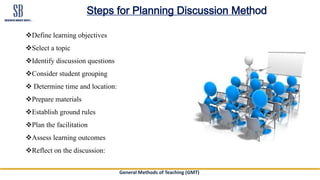
Steps for Planning Discussion Method
Define learning objectives
Select a topic
Identify discussion questions
Consider student grouping
 Determine time and location:
Prepare materials
Establish ground rules
Plan the facilitation
Assess learning outcomes
Reflect on the discussion:
General Methods of Teaching (GMT)
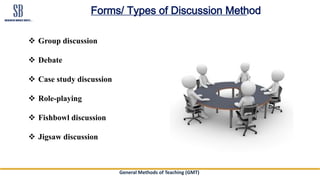
Forms/ Types of Discussion Method
 Group discussion
 Debate
 Case study discussion
 Role-playing
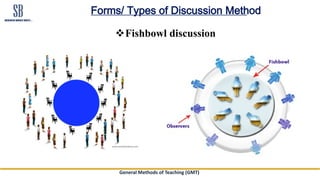
 Fishbowl discussion
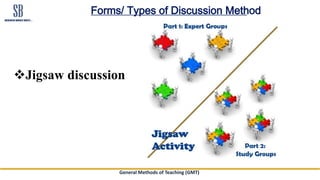
 Jigsaw discussion
General Methods of Teaching (GMT)
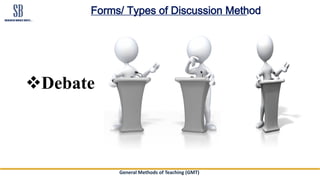
Forms/ Types of Discussion Method
Debate
General Methods of Teaching (GMT)
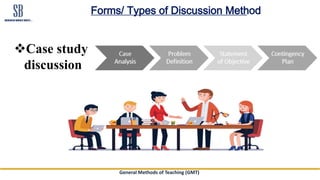
Forms/ Types of Discussion Method
Case study
discussion
General Methods of Teaching (GMT)
Forms/ Types of Discussion Method
Fishbowl discussion
General Methods of Teaching (GMT)
Forms/ Types of Discussion Method
Jigsaw discussion
General Methods of Teaching (GMT)
Merits of Discussion Method
 Encourages active learning
 Develops critical thinking skills
 Promotes collaboration
 Fosters communication skills
 Provides formative feedback:
General Methods of Teaching (GMT)
Demerits of Discussion Method
Time-consuming
Unequal participation
May lack structure
Limited coverage of material
Difficulty in assessing learning
General Methods of Teaching (GMT)
Textbook Reading Method
Meaning
A textbook is referred to as a book with extensive content
that is read or taught in order to teach a specific subject (for
example, science, chemistry, or history topics). In other
words, textbooks are also known as school books since they
contain the information that is taught in classrooms.
General Methods of Teaching (GMT)
Textbook Reading Method
 The textbook method of teaching is one of the oldest methods of
teaching. Simply put, this entails using a textbook as the primary
source of knowledge for a class.
 Typically, the teacher reads aloud from the textbook, explaining
each page as they go. This can be accomplished either through a
lecture format or just by having the students read the content and
engage in class discussion.
General Methods of Teaching (GMT)
Textbook Reading Method
 The textbook is not just a book. It is a tool, medium, and instrument that the teacher uses
to present the subject matter to the pupils. It is the basis for planning the course of study,
for lesson planning, and for evaluating pupil progress.
 Textbooks are also an essential influence on pupils. They provide pupils with a ready-
made source of information and ideas about the world around them. They present a given
view of life, of people, of events, and of problems.
General Methods of Teaching (GMT)
Definition of Textbook Reading Method
 “A textbook is, technically, a teaching tool that offers activities and
resources for students in all subjects. The textbook serves as the central
focus of all curriculum learning activities”.
 The textbook method of teaching is the most psychologically
advantageous for kids because it is both teachers- and kid-centered and
allows for activities.
 In the textbook method, a teacher begins the learning process based on
the student’s interests and mental capacities as well as their age.
General Methods of Teaching (GMT)
Three
-Phase Textbook Reading Method
To meet the needs of teaching and strategies, three phases of teaching
methods are suggested.
1.Before reading the textbook
2.While reading the textbook
3.After reading the textbook
General Methods of Teaching (GMT)
Guidelines for Effective Textbook Reading Method
1.Textbooks should be utilized to instruct pupils, but they shouldn’t be
the only source of information.
2.Textbooks should not be regarded as the main source of instruction
but rather as a guide.
3.One should always be prepared to modify, eliminate, or add to any
topic in the textbook.
4.There should be other educational resources employed in addition to
textbooks.
General Methods of Teaching (GMT)
Advantages of Textbook Reading Method
1.Straightforward Way to Teach
2.Short Amount of Time
3.Well Defined
4.Textbook Method is Concise
5.The textbook method is adaptable
6.Effective Method
7.Affordable
8.Explanation of Objectives
General Methods of Teaching (GMT)
Disadvantages of Textbook Reading Method
1.Boring
2.Less Engaging
3.Step down ineffectively
4.Outdated
5.Stressful for Students
General Methods of Teaching (GMT)
Demonstration Method
Meaning
 The Word ‘Demonstration’ is derived from the word ‘demonstrate’, which means,
“Show how to do”.
 Talking About Abstract ideas is not easy to grasp. While concrete things get fixed up in
minds of Students. Thus, from “Concrete to Abstract” is followed in this technique.
General Methods of Teaching (GMT)
Definition of Demonstration Method
“The Demonstration Method of teaching is a
pedagogical approach that involves showing students
how to do something, and then having them practice it
themselves. This approach is most commonly used in
disciplines such as the sciences and trades”.
General Methods of Teaching (GMT)
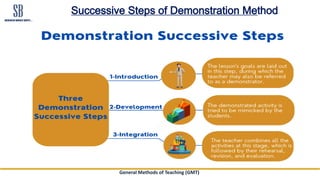
Successive Steps of Demonstration Method
General Methods of Teaching (GMT)
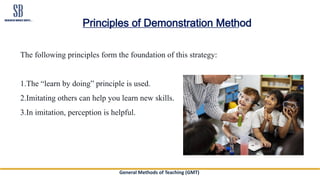
Principles of Demonstration Method
The following principles form the foundation of this strategy:
1.The “learn by doing” principle is used.
2.Imitating others can help you learn new skills.
3.In imitation, perception is helpful.
General Methods of Teaching (GMT)
Application of Demonstration Method
1.Generally speaking, this method is used at technical or
training institutions. It is used in teacher-education
programs to help student teachers enhance their skills.
2.A teacher uses it when teaching students in science,
biology, nature study, and arts & crafts at the school level.
General Methods of Teaching (GMT)
Guidelines for Demonstration Method
1.Good Planning.
2.Intentional.
3.Systematic.
4.Functional Structure.
5.Deliberate.
6.Purposeful.
7.Organized.
8.Applicable.
9.Relevant.
10.Challenging for students.
11.Mastery over what he demonstrates.
12.Clear and concise.
13.Participation of students.
14.Connected to everyday circumstances.
General Methods of Teaching (GMT)
Advantages of Demonstration Method
1.Introduce fresh ideas
2.Providing Tasks
3.Experiencing It Firsthand
4.Group Exercise
5.Effective Method
6.Student Involvement
7.Easy Assessment
General Methods of Teaching (GMT)
Disadvantages of Demonstration Method
1.Time-Taking Method
2.Repetition in instruction
3.Overwhelmed
4.Expensive Approach
5.Rarely Dangerous Method
General Methods of Teaching
Thank you!

Lecture Method of Teaching - Discussion Method of Teaching -Demonstration Method of Teaching - Text Book Reading Method

  • 1.
    General Methods ofTeaching (GMT) METHODS OF TEACHING
  • 2.
    General Methods ofTeaching (GMT) Teaching Method Teaching Method is a style of the presentation of content in classroom. It has presented broad meaning of the term ‘method’. According to this matter is important for determining method. The common teaching matter may be of three types hence all the methods can be classified under three heads. 1. Telling Method- Lecture, questioning, Discussion etc. 2. Showing Method- Demonstration, Excursion, etc. 3. Doing Method- Project, Role playing, Practical Method, etc.
  • 3.
    General Methods ofTeaching (GMT) Teaching Method  Broudy has stated that ‘Method refers to the formal structure of the sequence acts commonly denoted by instruction. The term ‘method’ covers both strategies and tactics of teaching and involves the choice of what is to be taught, and in which order is it to be presented.  Method is more general; it includes techniques also. The teaching are ways of implementing method. Different techniques may be employed withing one method of teaching.
  • 4.
    General Methods ofTeaching (GMT) Lecture Method  The lecture method of teaching is one of the most common and traditional forms of teaching. It involves a teacher or instructor delivering a speech or presentation to a group of students, typically in a classroom setting.  The goal of the lecture is to provide students with an overview of a particular topic, to clarify complex concepts, and to share the instructor's knowledge and expertise with the students.
  • 5.
    General Methods ofTeaching (GMT) Objectives of Lecture Method  To Clarify  To Extend Contents  For the purpose of review
  • 6.
    General Methods ofTeaching (GMT) Principles of Lecture Method  Preparation: The instructor must carefully prepare the lecture content and structure, including any visual aids, examples, and activities to be used during the lecture.  Clarity: The instructor must communicate clearly and effectively, using appropriate language, tone, and pacing to engage the students.  Relevance: The lecture content should be relevant to the students' learning goals and objectives.  Interaction: The instructor should engage the students in the lecture through questions, discussions, and other interactive activities.  Evaluation: The instructor should evaluate students' understanding of the lecture content and provide feedback on their learning progress.
  • 7.
    General Methods ofTeaching (GMT) Steps of Lecture Method A. Planning B. Presentation of a Lecture I. Introduction of a Lecture II. Development Phase C. Evaluation Phase
  • 8.
    General Methods ofTeaching (GMT) Merits of Lecture Method  Economical / Cost effective  Saves time  Attractive  Teacher’s work become easier  Useful for factual information’s  Helps in developing own style  Maintain sequence  Motivating  Developing Listening skills  Useful for brilliant students  Assist other methods
  • 9.
    General Methods ofTeaching (GMT) Demerits of Lecture Method  Students are passive  No surety of student understanding  Weak student cannot follow  Not favorable for development of mental faculties  No learning by doing  No feedback  Individual differences are not cared  Authoritarian method
  • 10.
    General Methods ofTeaching (GMT) Discussion Method  The discussion method of teaching is a student- centered approach that emphasizes active participation and collaboration.  In this method, the teacher acts as a facilitator or moderator, guiding the students through the discussion and encouraging them to share their ideas, thoughts, and experiences on a particular topic.
  • 11.
    General Methods ofTeaching (GMT) Discussion Method  “The discussion method of teaching is characterized as a positive process that involves student’s ability to listen, observe, read, thinking, and talks, records, express, react”.  “The teacher and student participate in group activity called discussion method of teaching to define the problem and look for a solution”.
  • 12.
    General Methods ofTeaching (GMT) Discussion Method  The discussion method is particularly effective in fostering critical thinking, problem-solving, and decision-making skills, as well as promoting deeper learning and retention of information.  It is also a great way to encourage students to express their opinions and viewpoints, to develop communication and interpersonal skills, and to learn from each other.
  • 13.
    General Methods ofTeaching (GMT) Principles of Discussion Method Encouraging active participation Focusing on the process, not just the content  Promoting critical thinking  Providing guidance and feedback  Evaluating the learning outcomes:
  • 14.
    General Methods ofTeaching (GMT) Steps for Planning Discussion Method Define learning objectives Select a topic Identify discussion questions Consider student grouping  Determine time and location: Prepare materials Establish ground rules Plan the facilitation Assess learning outcomes Reflect on the discussion:
  • 15.
    General Methods ofTeaching (GMT) Forms/ Types of Discussion Method  Group discussion  Debate  Case study discussion  Role-playing  Fishbowl discussion  Jigsaw discussion
  • 16.
    General Methods ofTeaching (GMT) Forms/ Types of Discussion Method Debate
  • 17.
    General Methods ofTeaching (GMT) Forms/ Types of Discussion Method Case study discussion
  • 18.
    General Methods ofTeaching (GMT) Forms/ Types of Discussion Method Fishbowl discussion
  • 19.
    General Methods ofTeaching (GMT) Forms/ Types of Discussion Method Jigsaw discussion
  • 20.
    General Methods ofTeaching (GMT) Merits of Discussion Method  Encourages active learning  Develops critical thinking skills  Promotes collaboration  Fosters communication skills  Provides formative feedback:
  • 21.
    General Methods ofTeaching (GMT) Demerits of Discussion Method Time-consuming Unequal participation May lack structure Limited coverage of material Difficulty in assessing learning
  • 22.
    General Methods ofTeaching (GMT) Textbook Reading Method Meaning A textbook is referred to as a book with extensive content that is read or taught in order to teach a specific subject (for example, science, chemistry, or history topics). In other words, textbooks are also known as school books since they contain the information that is taught in classrooms.
  • 23.
    General Methods ofTeaching (GMT) Textbook Reading Method  The textbook method of teaching is one of the oldest methods of teaching. Simply put, this entails using a textbook as the primary source of knowledge for a class.  Typically, the teacher reads aloud from the textbook, explaining each page as they go. This can be accomplished either through a lecture format or just by having the students read the content and engage in class discussion.
  • 24.
    General Methods ofTeaching (GMT) Textbook Reading Method  The textbook is not just a book. It is a tool, medium, and instrument that the teacher uses to present the subject matter to the pupils. It is the basis for planning the course of study, for lesson planning, and for evaluating pupil progress.  Textbooks are also an essential influence on pupils. They provide pupils with a ready- made source of information and ideas about the world around them. They present a given view of life, of people, of events, and of problems.
  • 25.
    General Methods ofTeaching (GMT) Definition of Textbook Reading Method  “A textbook is, technically, a teaching tool that offers activities and resources for students in all subjects. The textbook serves as the central focus of all curriculum learning activities”.  The textbook method of teaching is the most psychologically advantageous for kids because it is both teachers- and kid-centered and allows for activities.  In the textbook method, a teacher begins the learning process based on the student’s interests and mental capacities as well as their age.
  • 26.
    General Methods ofTeaching (GMT) Three -Phase Textbook Reading Method To meet the needs of teaching and strategies, three phases of teaching methods are suggested. 1.Before reading the textbook 2.While reading the textbook 3.After reading the textbook
  • 27.
    General Methods ofTeaching (GMT) Guidelines for Effective Textbook Reading Method 1.Textbooks should be utilized to instruct pupils, but they shouldn’t be the only source of information. 2.Textbooks should not be regarded as the main source of instruction but rather as a guide. 3.One should always be prepared to modify, eliminate, or add to any topic in the textbook. 4.There should be other educational resources employed in addition to textbooks.
  • 28.
    General Methods ofTeaching (GMT) Advantages of Textbook Reading Method 1.Straightforward Way to Teach 2.Short Amount of Time 3.Well Defined 4.Textbook Method is Concise 5.The textbook method is adaptable 6.Effective Method 7.Affordable 8.Explanation of Objectives
  • 29.
    General Methods ofTeaching (GMT) Disadvantages of Textbook Reading Method 1.Boring 2.Less Engaging 3.Step down ineffectively 4.Outdated 5.Stressful for Students
  • 30.
    General Methods ofTeaching (GMT) Demonstration Method Meaning  The Word ‘Demonstration’ is derived from the word ‘demonstrate’, which means, “Show how to do”.  Talking About Abstract ideas is not easy to grasp. While concrete things get fixed up in minds of Students. Thus, from “Concrete to Abstract” is followed in this technique.
  • 31.
    General Methods ofTeaching (GMT) Definition of Demonstration Method “The Demonstration Method of teaching is a pedagogical approach that involves showing students how to do something, and then having them practice it themselves. This approach is most commonly used in disciplines such as the sciences and trades”.
  • 32.
    General Methods ofTeaching (GMT) Successive Steps of Demonstration Method
  • 33.
    General Methods ofTeaching (GMT) Principles of Demonstration Method The following principles form the foundation of this strategy: 1.The “learn by doing” principle is used. 2.Imitating others can help you learn new skills. 3.In imitation, perception is helpful.
  • 34.
    General Methods ofTeaching (GMT) Application of Demonstration Method 1.Generally speaking, this method is used at technical or training institutions. It is used in teacher-education programs to help student teachers enhance their skills. 2.A teacher uses it when teaching students in science, biology, nature study, and arts & crafts at the school level.
  • 35.
    General Methods ofTeaching (GMT) Guidelines for Demonstration Method 1.Good Planning. 2.Intentional. 3.Systematic. 4.Functional Structure. 5.Deliberate. 6.Purposeful. 7.Organized. 8.Applicable. 9.Relevant. 10.Challenging for students. 11.Mastery over what he demonstrates. 12.Clear and concise. 13.Participation of students. 14.Connected to everyday circumstances.
  • 36.
    General Methods ofTeaching (GMT) Advantages of Demonstration Method 1.Introduce fresh ideas 2.Providing Tasks 3.Experiencing It Firsthand 4.Group Exercise 5.Effective Method 6.Student Involvement 7.Easy Assessment
  • 37.
    General Methods ofTeaching (GMT) Disadvantages of Demonstration Method 1.Time-Taking Method 2.Repetition in instruction 3.Overwhelmed 4.Expensive Approach 5.Rarely Dangerous Method
  • 38.
    General Methods ofTeaching Thank you!