Phylum Mollusca Examples
General Information Coelom  (Mollusca = space around heart) 90,000 living species (aquatic & terrestrial) 8 living classes Mostly marine, but found from bottom of the oceans to 7000 meters above sea level in ponds, lakes, streams, forests, grasslands, & other environments.  Microscopic to 20 meters and 2000 pounds Terrestrial forms need humidity, shelter, and calcium rich soils.
More general info Fundamentally bilaterally symmetric,  torsion   Head-foot & visceral mass ,  more about forms   Gills, open/closed circ.,  hemocyanin Protective mantle (secretes shell) Mantle cavity houses gills (ctenidia) or lungs Most cephalization @ anterior end Complete digestive system Radula (most mollusca other than bivalves which have labial palps & filter feed)
& more… Foot Shell (3 layers) Periostracum - outer, conchiolin (protein) Prismatic layer - middle, CaCO 3 Nacreous layer - inner, CaCO 3  (crystalline)  m.o.p. Reproduction Most dioecious (some monoecious - protandrous) Egg - Juvenile (cephalopoda) Egg -Trochophore - Juvenile (Chitons) Egg -Trochophore - Veliger - Juvenile (bivalvia, gastropoda)
Generalized  Trochophore  Larva
Human impact Food Jewelry ( pearls , shells, mother of pearl) Pests  Agricultural damage: Snails Wood destruction:  Ship worms  Fouling:  Zebra mussels Parasite intermediate hosts (e.g. Flukes)
Classes Caudofoviata Solenogastres Monoplacophora Polyplacophora Scaphopoda Gastopoda Bivalvia Cephalopoda
Caudofoveata Primitive wormlike molluscs 120 species 2 to 140 mm long Benthic, living in sediment Feed on microorganisms & detritus Calcareous scales Radula Dioecious
Solenogastres Wormlike Shelless with scales or spicules 250 Marine species Reduced head, No radula, No gills  No nephridia Monoecious Bottom dwelling without burrows Feed on cnidarians
Class Monoplacophora Small, low, rounded shell  & Creeping foot Serial repetition of organs (segmentation) 25 species Dioecious Sea floor 3 - 6 pairs of gills 3 - 7 pairs of metanephridia Ladder-like nervous system Radula
Polyplacophora (plate bearers) Flattened dorsoventrally with 8  articulating plates  - roll up for protection About 1000 species ( Chitons ) Most 2 - 5 cm, One species 30 cm. Reduced head/cephalic structures Photosensitive esthetes Chemoreceptive osphradia in mantle groove Most rocky intertidal regions (some deep) Feed on algae with radula (magnetite) 3-chambered heart, kidneys, long. nerve cord  Dioecious, Egg-Trochophore-Juvenile. No veliger.
Class Gastropoda Largest class (70,000) Snails, slugs, whelks, conchs, periwinkles, sea slugs, sea hares, &  sea butterflies One piece shell (when present) Coiled or not (whorls) Dextral or Sinistral (genetic) Asymmetric due to torsion Microscopic to 60 cm. long Marine, freshwater, terrestrial Climb, swim, burrow
Gastropoda contd. Defense Shell (most) Operculum (aperture) Venom Cnidocytes Toxic secretions Slugs Foot (Strombus sp.) Like hammer Feeding Usually with  radula Venom (conotoxins) External stomach
Gastropod Groups Prosobranchs 1   Marine snails, some fw & terrestrial sp. E.g. abalones, limpets, conchs To 24” Torsion Anterior mantle cavity Waste exits holes (abalone, limpet) to avoid fouling gills Opisthobranchs 1   Marine Sea slugs, s. hares, s. butterflies, &  bubble shells Complete detorsion Shell reduced or absent Monoecious 2 pr. Tentacles (rhinophores)
Gastropods cont. Pulmonates 1º Terrestrial snails & slugs Lungs rather than ctenidia Pneumostome Waste expelled forcibly from anus & Nephridiopore Monoecious 2 pr. Tentacles Eyes on second pr.
Class Bivalvia Mussels, clams, scallops & shipworms 1mm to 1M and 500+ pounds (Tridacna) Sedentary  filter feeders  (No radula) fig. 16-31 Posterior siphons Little cephalization 1º marine, some brackish & fw species Two shells, laterally compressed, hinged dorsally Produce pearls (Nacre) Usually dioecious, some Monoecious (protandrous) Egg, trochophore, veliger (glochidium), juvenile
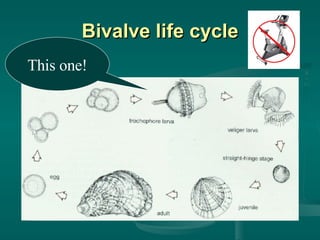
Bivalvia contd. Reproduction Marine bivalves: most dioecious, ext. fertilization  E.G… (oyster) Egg - trochophore - veliger - spat - juvenile Freshwater clams: dioecious, int. fertilization Egg -  glochidia larvae (parasite)  - juvenile;  Lure Boring bivalves, e.g.. Teredo, Bankia Small anterior valves @ anterior end = rasp Bacteria digest cellulose & fix nitrogen! Some rock boring species!
Bivalve life cycle This one!
Class Cephalopoda Squids , octopuses, nautiluses, & cuttlefish 2 cm to almost 60 ft. Large head, conspicuous eyes; 10” (giant squid) Nautilus  - external shell;  siphuncle   more Up to 90 tentacles!  Sticky no suckers Cuttlefish, squid - internal shell (pen) 8 arms, 2 tentacles Octopus - no shell 8 arms Organs Locomotion by siphon (ventral funnel) & arms
Class Cephalopoda contd. Closed circulatory system, hemocyanin Accessory (branchial) hearts pressurize blood to gills NS: Large brain, Giant axons, eyes, statocysts, tactile sense, no hearing Learning by observation! Communication by primarily by vision ( chromatophores ) and tactile sense
… and more cephalopods Defense: camouflage, ink gland (sepia) Separate sexes Male hectocotylus (modified arm) for Transmittal of spermatophore near oviduct (Nautilus = spadix) Eggs fertilized on the way out Octopuses brood eggs,  squid  eggs, nautilus, cuttlefish eggs

molluscs

  • 1.
  • 2.
    General Information Coelom (Mollusca = space around heart) 90,000 living species (aquatic & terrestrial) 8 living classes Mostly marine, but found from bottom of the oceans to 7000 meters above sea level in ponds, lakes, streams, forests, grasslands, & other environments. Microscopic to 20 meters and 2000 pounds Terrestrial forms need humidity, shelter, and calcium rich soils.
  • 3.
    More general infoFundamentally bilaterally symmetric, torsion Head-foot & visceral mass , more about forms Gills, open/closed circ., hemocyanin Protective mantle (secretes shell) Mantle cavity houses gills (ctenidia) or lungs Most cephalization @ anterior end Complete digestive system Radula (most mollusca other than bivalves which have labial palps & filter feed)
  • 4.
    & more… FootShell (3 layers) Periostracum - outer, conchiolin (protein) Prismatic layer - middle, CaCO 3 Nacreous layer - inner, CaCO 3 (crystalline) m.o.p. Reproduction Most dioecious (some monoecious - protandrous) Egg - Juvenile (cephalopoda) Egg -Trochophore - Juvenile (Chitons) Egg -Trochophore - Veliger - Juvenile (bivalvia, gastropoda)
  • 5.
  • 6.
    Human impact FoodJewelry ( pearls , shells, mother of pearl) Pests Agricultural damage: Snails Wood destruction: Ship worms Fouling: Zebra mussels Parasite intermediate hosts (e.g. Flukes)
  • 7.
    Classes Caudofoviata SolenogastresMonoplacophora Polyplacophora Scaphopoda Gastopoda Bivalvia Cephalopoda
  • 8.
    Caudofoveata Primitive wormlikemolluscs 120 species 2 to 140 mm long Benthic, living in sediment Feed on microorganisms & detritus Calcareous scales Radula Dioecious
  • 9.
    Solenogastres Wormlike Shellesswith scales or spicules 250 Marine species Reduced head, No radula, No gills No nephridia Monoecious Bottom dwelling without burrows Feed on cnidarians
  • 10.
    Class Monoplacophora Small,low, rounded shell & Creeping foot Serial repetition of organs (segmentation) 25 species Dioecious Sea floor 3 - 6 pairs of gills 3 - 7 pairs of metanephridia Ladder-like nervous system Radula
  • 11.
    Polyplacophora (plate bearers)Flattened dorsoventrally with 8 articulating plates - roll up for protection About 1000 species ( Chitons ) Most 2 - 5 cm, One species 30 cm. Reduced head/cephalic structures Photosensitive esthetes Chemoreceptive osphradia in mantle groove Most rocky intertidal regions (some deep) Feed on algae with radula (magnetite) 3-chambered heart, kidneys, long. nerve cord Dioecious, Egg-Trochophore-Juvenile. No veliger.
  • 12.
    Class Gastropoda Largestclass (70,000) Snails, slugs, whelks, conchs, periwinkles, sea slugs, sea hares, & sea butterflies One piece shell (when present) Coiled or not (whorls) Dextral or Sinistral (genetic) Asymmetric due to torsion Microscopic to 60 cm. long Marine, freshwater, terrestrial Climb, swim, burrow
  • 13.
    Gastropoda contd. DefenseShell (most) Operculum (aperture) Venom Cnidocytes Toxic secretions Slugs Foot (Strombus sp.) Like hammer Feeding Usually with radula Venom (conotoxins) External stomach
  • 14.
    Gastropod Groups Prosobranchs1  Marine snails, some fw & terrestrial sp. E.g. abalones, limpets, conchs To 24” Torsion Anterior mantle cavity Waste exits holes (abalone, limpet) to avoid fouling gills Opisthobranchs 1  Marine Sea slugs, s. hares, s. butterflies, & bubble shells Complete detorsion Shell reduced or absent Monoecious 2 pr. Tentacles (rhinophores)
  • 15.
    Gastropods cont. Pulmonates1º Terrestrial snails & slugs Lungs rather than ctenidia Pneumostome Waste expelled forcibly from anus & Nephridiopore Monoecious 2 pr. Tentacles Eyes on second pr.
  • 16.
    Class Bivalvia Mussels,clams, scallops & shipworms 1mm to 1M and 500+ pounds (Tridacna) Sedentary filter feeders (No radula) fig. 16-31 Posterior siphons Little cephalization 1º marine, some brackish & fw species Two shells, laterally compressed, hinged dorsally Produce pearls (Nacre) Usually dioecious, some Monoecious (protandrous) Egg, trochophore, veliger (glochidium), juvenile
  • 17.
    Bivalvia contd. ReproductionMarine bivalves: most dioecious, ext. fertilization E.G… (oyster) Egg - trochophore - veliger - spat - juvenile Freshwater clams: dioecious, int. fertilization Egg - glochidia larvae (parasite) - juvenile; Lure Boring bivalves, e.g.. Teredo, Bankia Small anterior valves @ anterior end = rasp Bacteria digest cellulose & fix nitrogen! Some rock boring species!
  • 18.
  • 19.
    Class Cephalopoda Squids, octopuses, nautiluses, & cuttlefish 2 cm to almost 60 ft. Large head, conspicuous eyes; 10” (giant squid) Nautilus - external shell; siphuncle more Up to 90 tentacles! Sticky no suckers Cuttlefish, squid - internal shell (pen) 8 arms, 2 tentacles Octopus - no shell 8 arms Organs Locomotion by siphon (ventral funnel) & arms
  • 20.
    Class Cephalopoda contd.Closed circulatory system, hemocyanin Accessory (branchial) hearts pressurize blood to gills NS: Large brain, Giant axons, eyes, statocysts, tactile sense, no hearing Learning by observation! Communication by primarily by vision ( chromatophores ) and tactile sense
  • 21.
    … and morecephalopods Defense: camouflage, ink gland (sepia) Separate sexes Male hectocotylus (modified arm) for Transmittal of spermatophore near oviduct (Nautilus = spadix) Eggs fertilized on the way out Octopuses brood eggs, squid eggs, nautilus, cuttlefish eggs