


Submitted by: seema
Class: M.Sc. Bioinformatics
Roll no. 1010
M.D.University Rohtak
Some general feature of molecular
mechanics force field
 Must specify functional form and parameters
 Should be constructed as single entity
 Some terms sufficiently independent of the others (bond
and bond angle)
 Primarily designed to reproduce structural properties but
can also used to predict other properties, such as molecular
spectra
 Transferability of functional form and parameters
 Comprise between accuracy of functional form and
computational efficiency
 Atom type
MMFF: A Class II force field designed to be a transferable
force field for pharmaceutical compounds that accurately
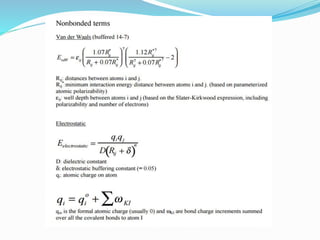
treats conformational energetic and non bonded
interactions. This would, ideally, produce a force field that
was adequate for both gas phase and condensed phase
calculations.
Classes of force field:
Class I: Simplicity of form of the potential energy function
limits transferability.
Class II: Extended potential energy function, including cross
terms, increases transferability.
 MMFF Total energy
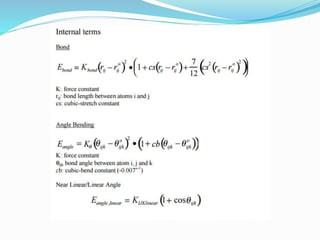
 Internal terms: bonds, angles, stretch-bend, out-of-
plane bending and dihedrals
 Nonbonded terms: van der Waals and Electrostatic.
 initial published version is "MMFF94”.
 MMFF93 collaborate in CHARMm and are working to
make MMFF94 available in CHARMM
 currently being implemented in the BatchMin module
of the MacroModel program suite.
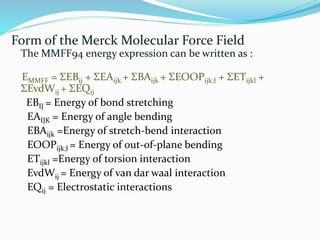
Form of the Merck Molecular Force Field
The MMFF94 energy expression can be written as :
EMMFF = ΣEBij + ΣEAijk + ΣBAijk + ΣEOOPijk;l + ΣETijkl +
ΣEvdWij + ΣEQij
EBIJ = Energy of bond stretching
EAIJK = Energy of angle bending
EBAijk =Energy of stretch-bend interaction
EOOPijk;l = Energy of out-of-plane bending
ETijkl =Energy of torsion interaction
EvdWij = Energy of van dar waal interaction
EQij = Electrostatic interactions
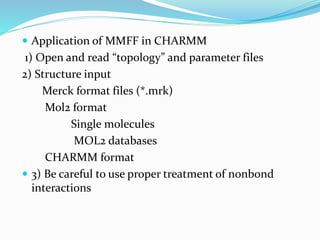
 Application of MMFF in CHARMM
1) Open and read “topology” and parameter files
2) Structure input
Merck format files (*.mrk)
Mol2 format
Single molecules
MOL2 databases
CHARMM format
 3) Be careful to use proper treatment of nonbond
interactions
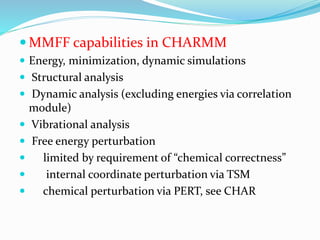
 MMFF capabilities in CHARMM
 Energy, minimization, dynamic simulations
 Structural analysis
 Dynamic analysis (excluding energies via correlation
module)
 Vibrational analysis
 Free energy perturbation
 limited by requirement of “chemical correctness”
 internal coordinate perturbation via TSM
 chemical perturbation via PERT, see CHAR

Merck molecular force field ppt

  • 1.
    Submitted by: seema Class:M.Sc. Bioinformatics Roll no. 1010 M.D.University Rohtak
  • 2.
    Some general featureof molecular mechanics force field  Must specify functional form and parameters  Should be constructed as single entity  Some terms sufficiently independent of the others (bond and bond angle)  Primarily designed to reproduce structural properties but can also used to predict other properties, such as molecular spectra  Transferability of functional form and parameters  Comprise between accuracy of functional form and computational efficiency  Atom type
  • 3.
    MMFF: A ClassII force field designed to be a transferable force field for pharmaceutical compounds that accurately treats conformational energetic and non bonded interactions. This would, ideally, produce a force field that was adequate for both gas phase and condensed phase calculations. Classes of force field: Class I: Simplicity of form of the potential energy function limits transferability. Class II: Extended potential energy function, including cross terms, increases transferability.
  • 4.
     MMFF Totalenergy  Internal terms: bonds, angles, stretch-bend, out-of- plane bending and dihedrals  Nonbonded terms: van der Waals and Electrostatic.  initial published version is "MMFF94”.  MMFF93 collaborate in CHARMm and are working to make MMFF94 available in CHARMM  currently being implemented in the BatchMin module of the MacroModel program suite.
  • 5.
    Form of theMerck Molecular Force Field The MMFF94 energy expression can be written as : EMMFF = ΣEBij + ΣEAijk + ΣBAijk + ΣEOOPijk;l + ΣETijkl + ΣEvdWij + ΣEQij EBIJ = Energy of bond stretching EAIJK = Energy of angle bending EBAijk =Energy of stretch-bend interaction EOOPijk;l = Energy of out-of-plane bending ETijkl =Energy of torsion interaction EvdWij = Energy of van dar waal interaction EQij = Electrostatic interactions
  • 9.
     Application ofMMFF in CHARMM 1) Open and read “topology” and parameter files 2) Structure input Merck format files (*.mrk) Mol2 format Single molecules MOL2 databases CHARMM format  3) Be careful to use proper treatment of nonbond interactions
  • 10.
     MMFF capabilitiesin CHARMM  Energy, minimization, dynamic simulations  Structural analysis  Dynamic analysis (excluding energies via correlation module)  Vibrational analysis  Free energy perturbation  limited by requirement of “chemical correctness”  internal coordinate perturbation via TSM  chemical perturbation via PERT, see CHAR