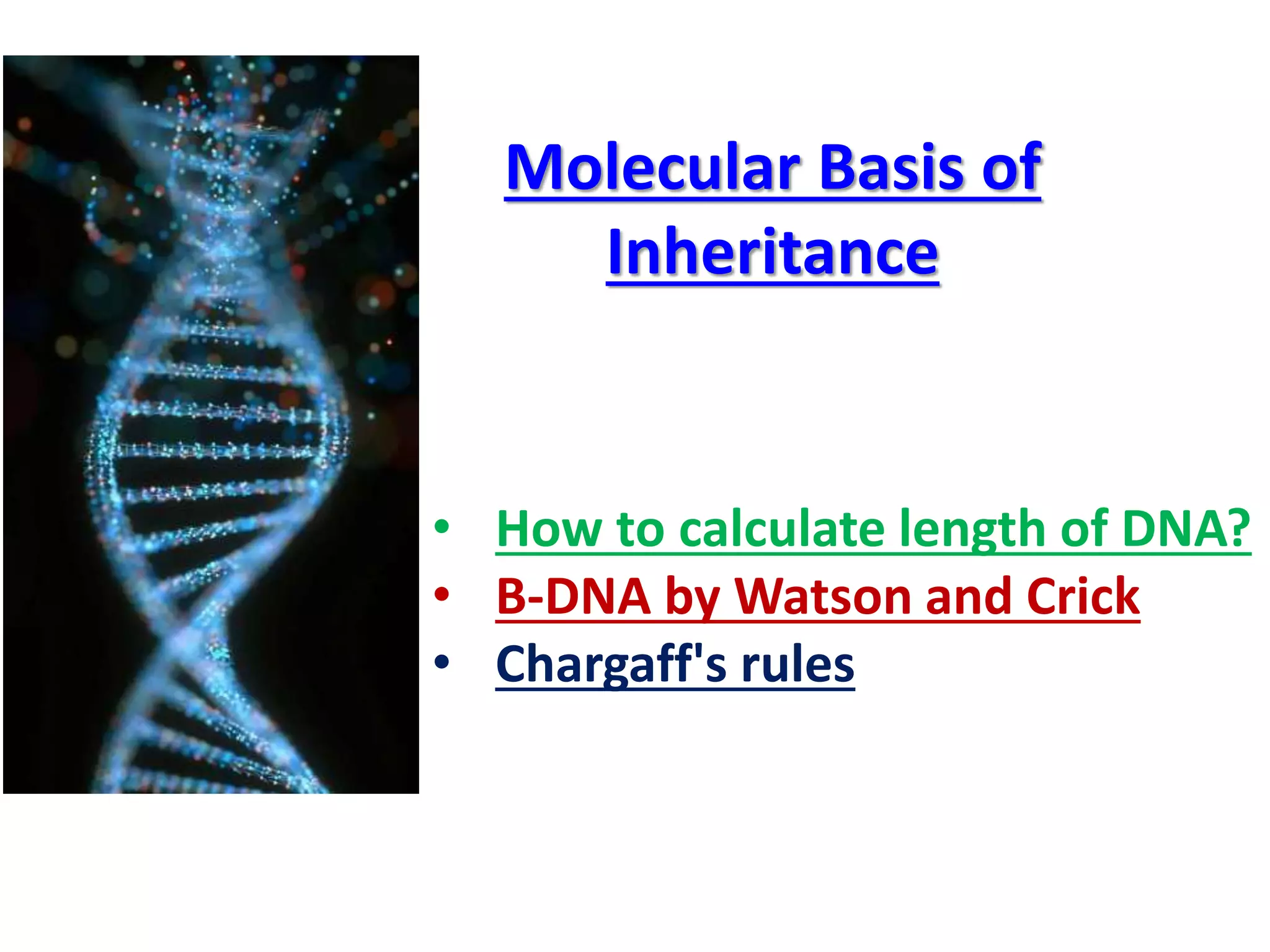


Molecular Basis of
Inheritance
• How to calculate length of DNA?
• B-DNA by Watson and Crick
• Chargaff's rules
DNA and RNA are Genetic materials
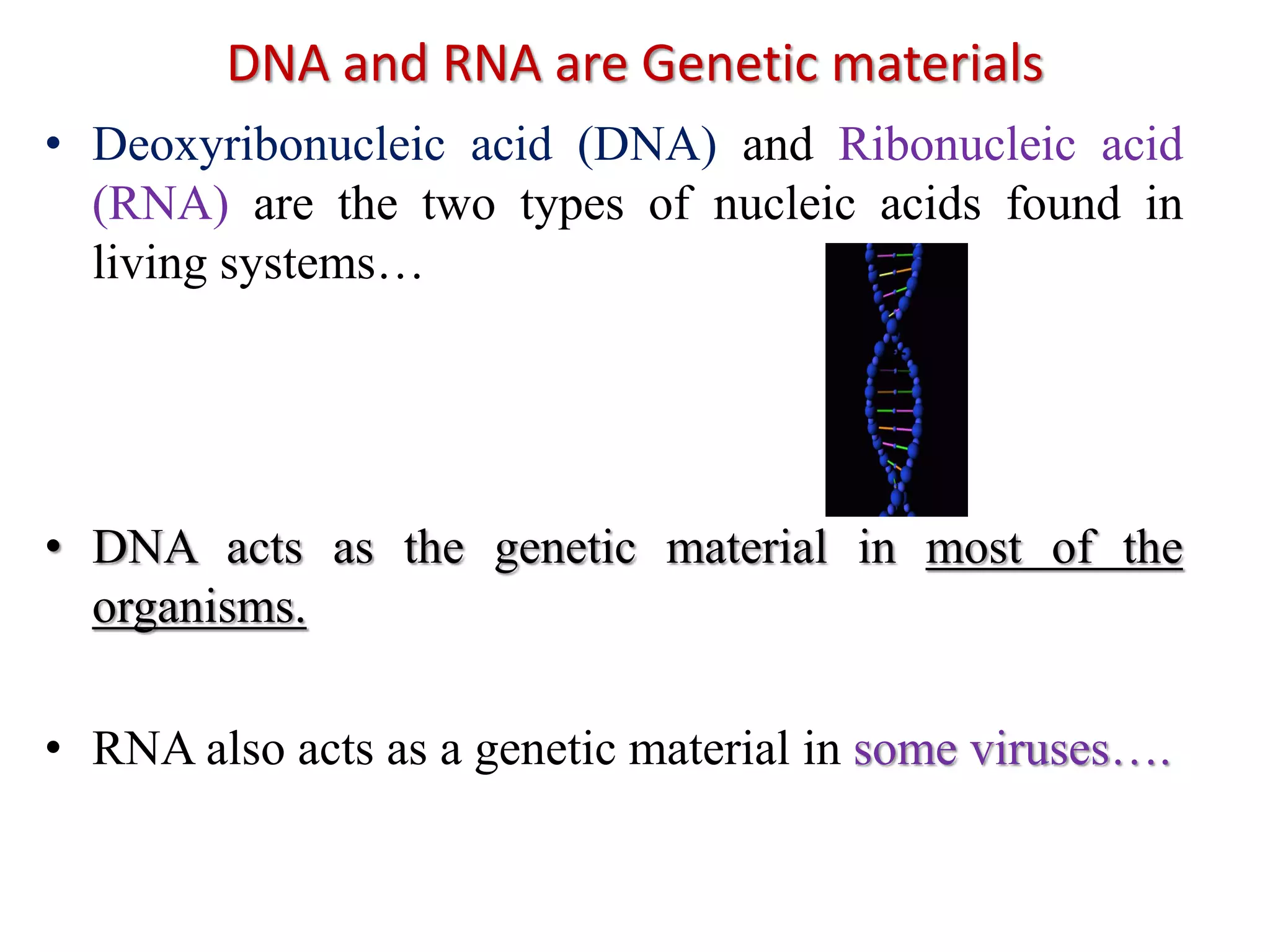
• Deoxyribonucleic acid (DNA) and Ribonucleic acid
(RNA) are the two types of nucleic acids found in
living systems…
• DNA acts as the genetic material in most of the
organisms.
• RNA also acts as a genetic material in some viruses….
RNA has additional roles..
• Mostly RNA functions as a messenger RNA (m-RNA).
• RNA functions as adapter (t-RNA/transfer RNA).
• RNA functions as Structural RNA (r-RNA/ Ribosomal RNA).
• In some cases function as a catalytic molecule
(Enzyme/Ribozyme).
Nucleic acids (DNA/RNA) are polymers
nucleotides
• Nucleotides  DNA DNA+ Histone proteins 
Nucleosomes Chromatin  Chromosomes Genome
In this chapter we are going to discuss
• the structure of DNA.
• DNA replication,
• the process of making RNA from DNA (transcription).
• the genetic code that determines the sequences of amino
acids in proteins.
• the process of protein synthesis (translation).
• Gene regulation.
THE DNA
• DNA is a long polymer of deoxyribonucleotides.
• A nucleotide has three components:
• a nitrogenous base,
• a pentose sugar (ribose in case of RNA, and deoxyribose
for DNA),
• A phosphate group.
The length of the DNA
• The length of DNA is usually defined as number of
nucleotides..
• or a pair of nucleotide referred to as base pairs present in
it.
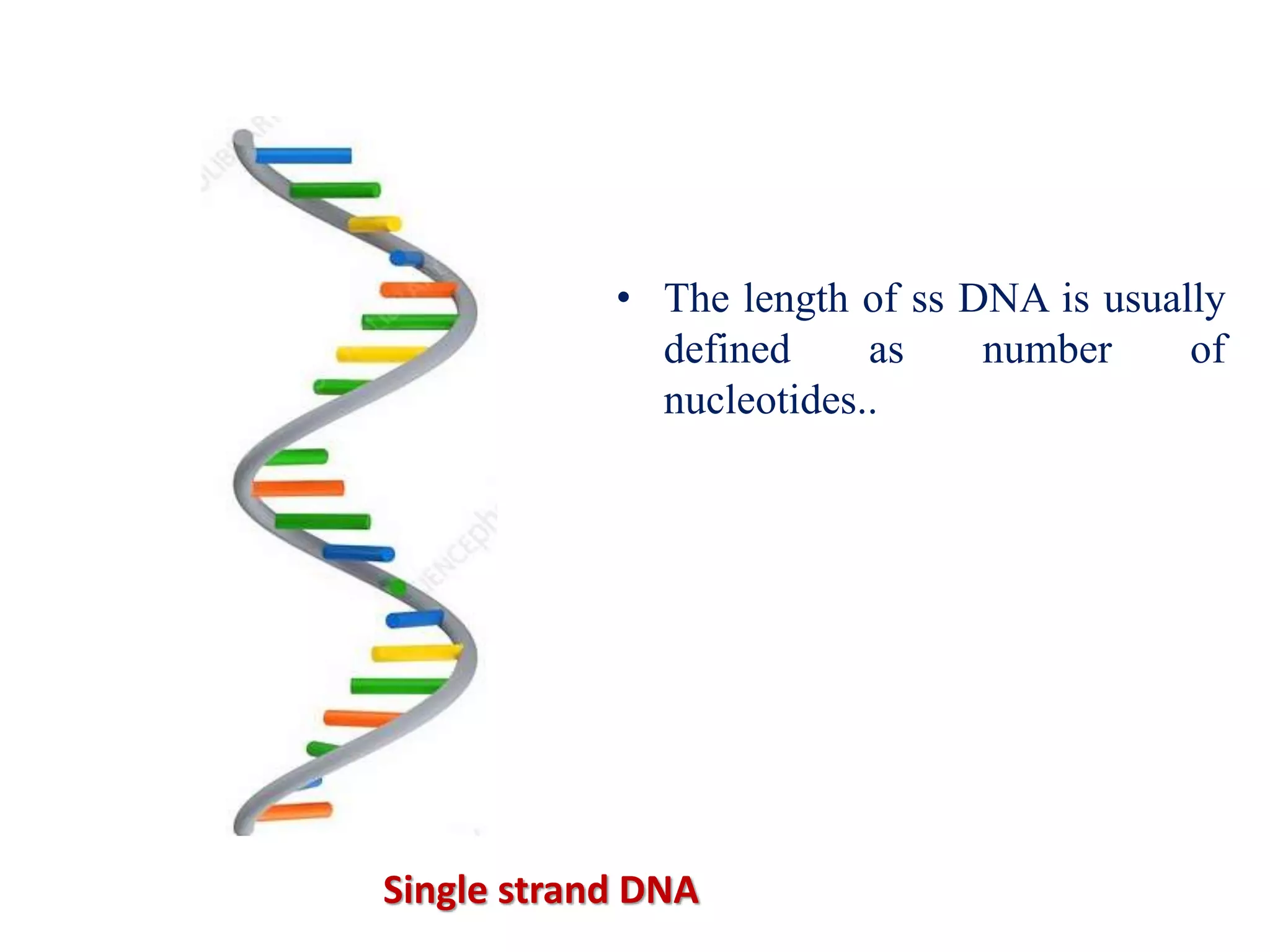
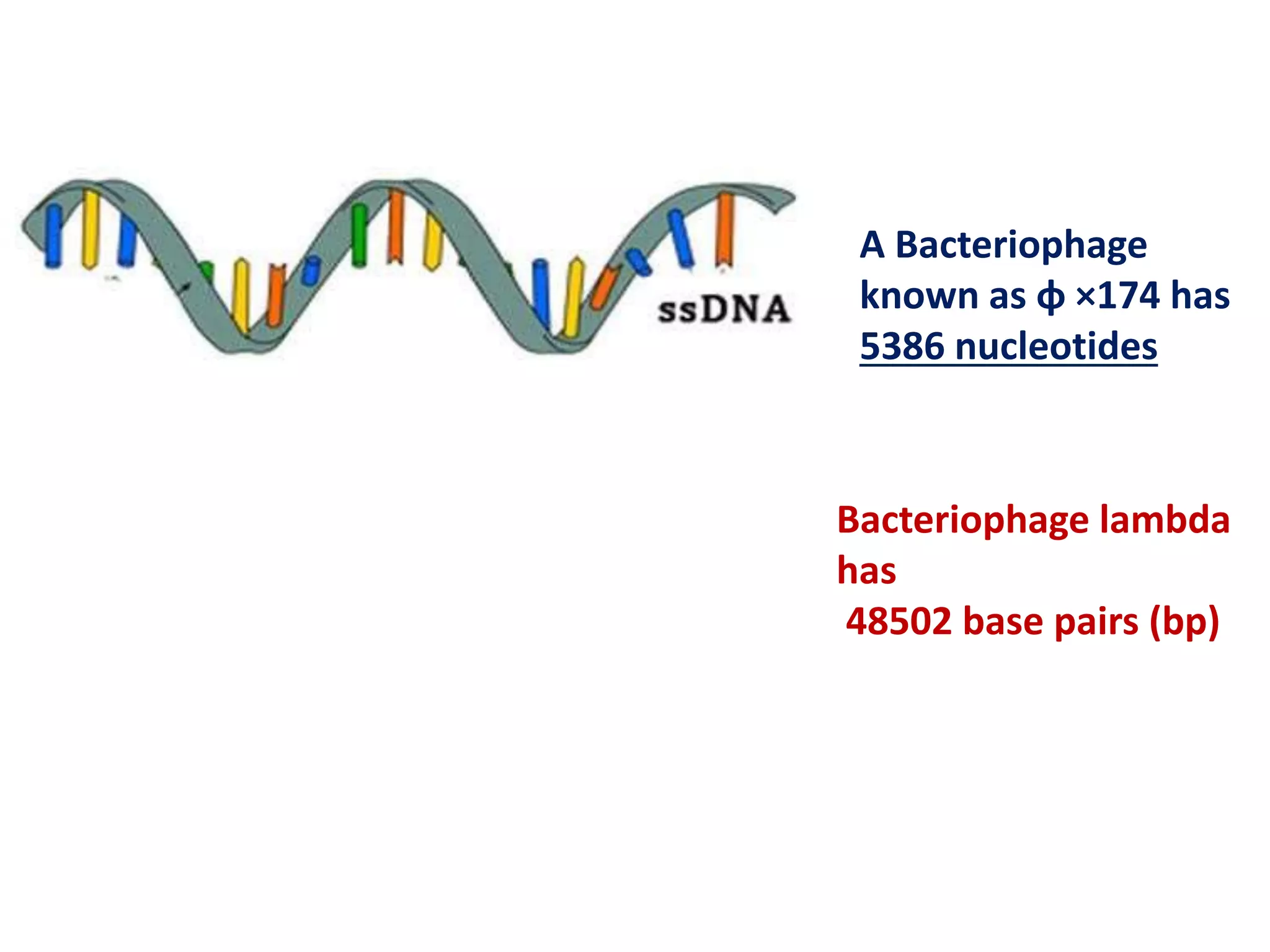
Single strand DNA
• The length of ss DNA is usually
defined as number of
nucleotides..
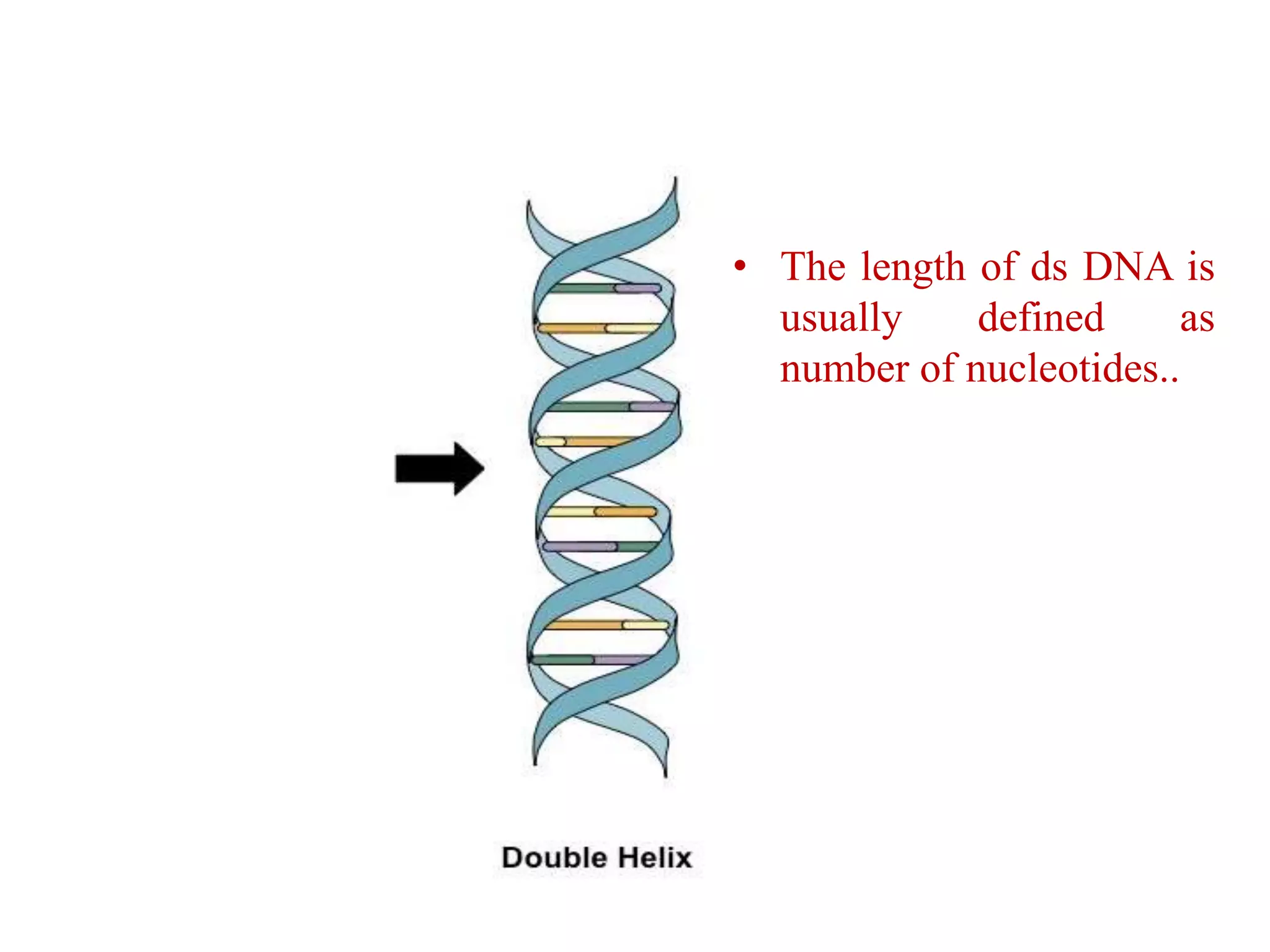
• The length of ds DNA is
usually defined as
number of nucleotides..
A Bacteriophage
known as φ ×174 has
5386 nucleotides
Bacteriophage lambda
has
48502 base pairs (bp)
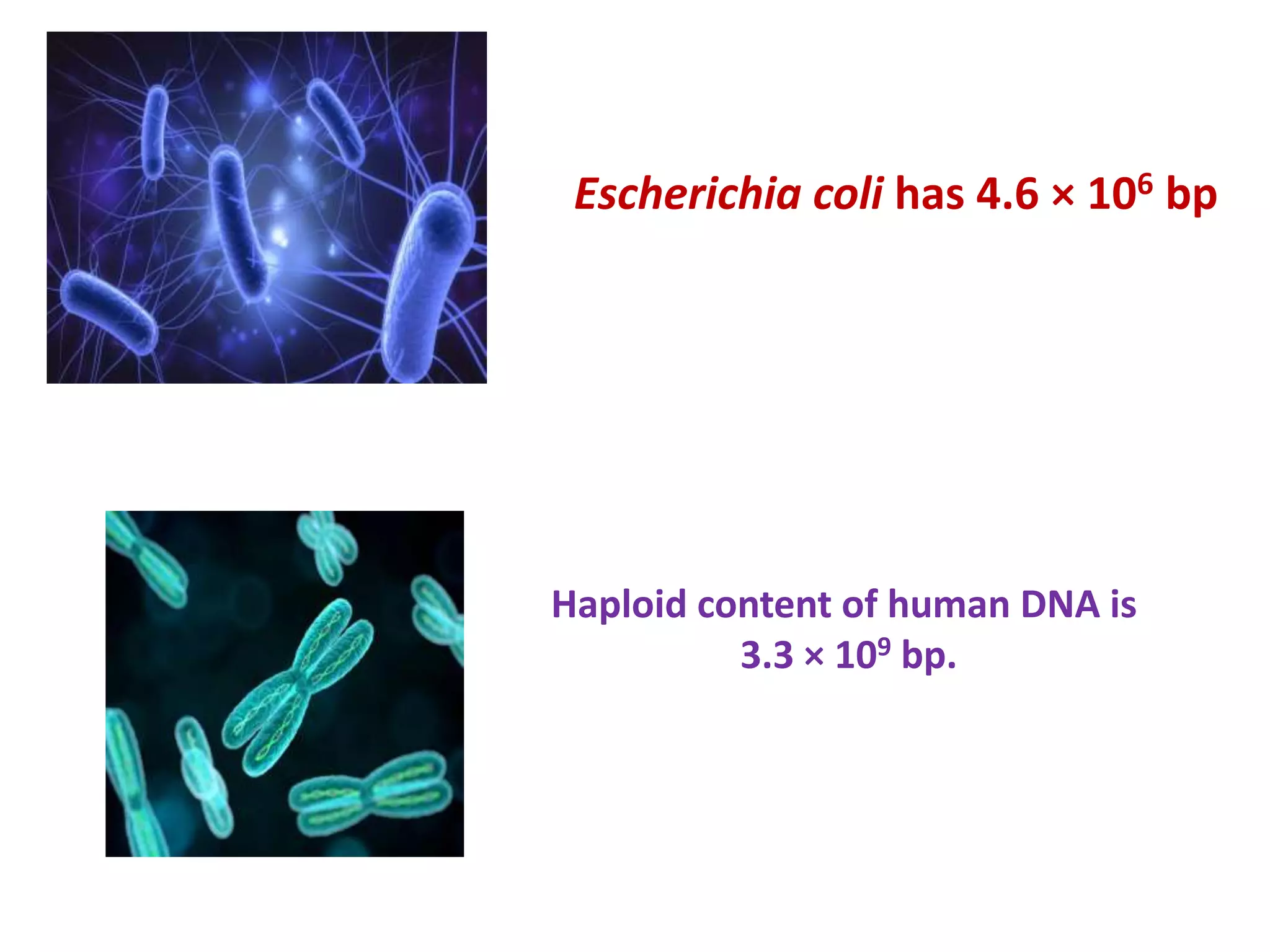
Haploid content of human DNA is
3.3 × 10⁹ bp.
Escherichia coli has 4.6 × 10⁶ bp
Structure of Polynucleotide Chain
• DNA is a polynucleotide chain.
• A nucleotide has three components:
1. a nitrogenous base,
2. a pentose sugar (ribose in case of RNA, and
deoxyribose for DNA),
3. A phosphate group.
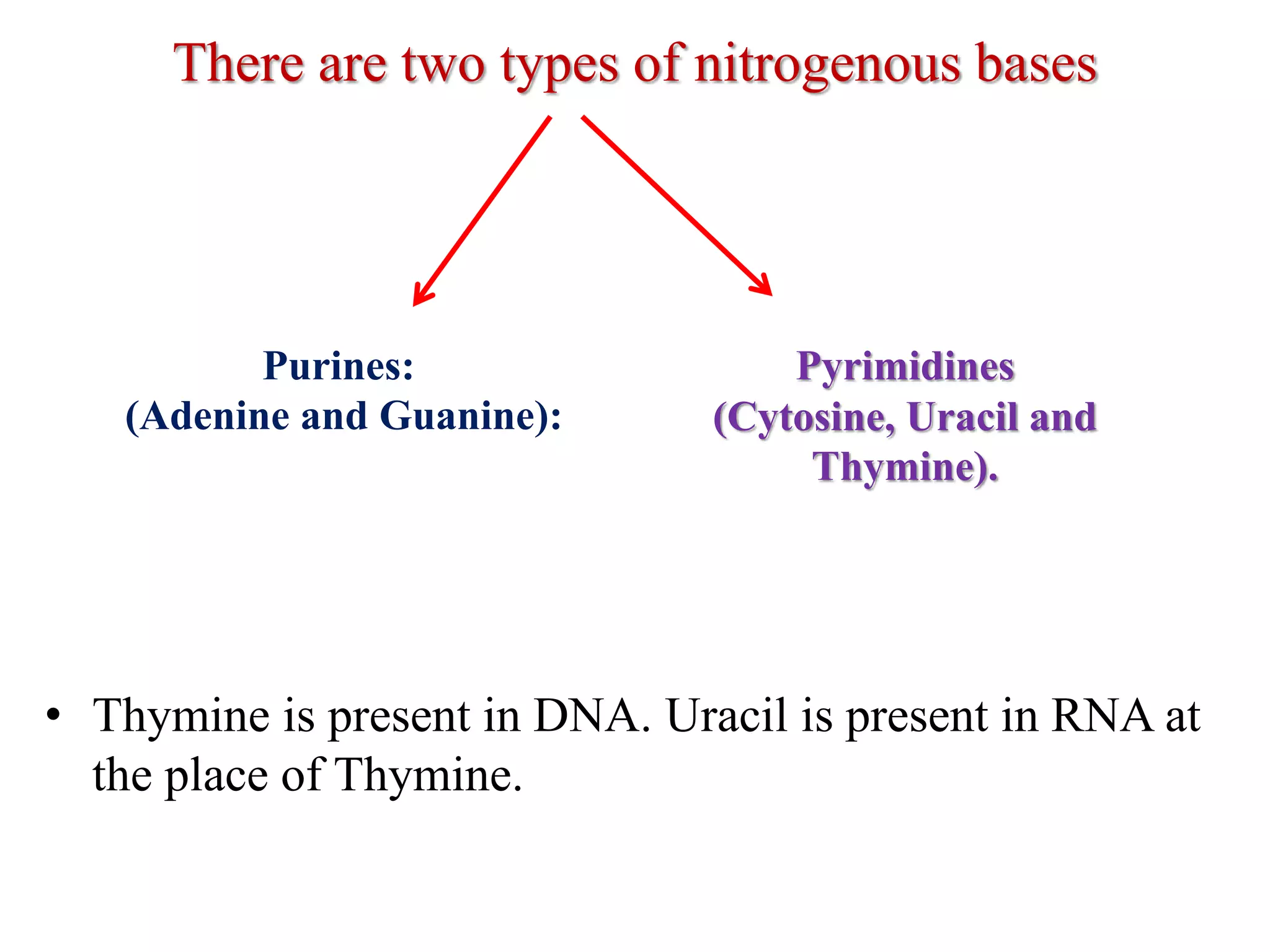
There are two types of nitrogenous bases
• Thymine is present in DNA. Uracil is present in RNA at
the place of Thymine.
Purines:
(Adenine and Guanine):
Pyrimidines
(Cytosine, Uracil and
Thymine).
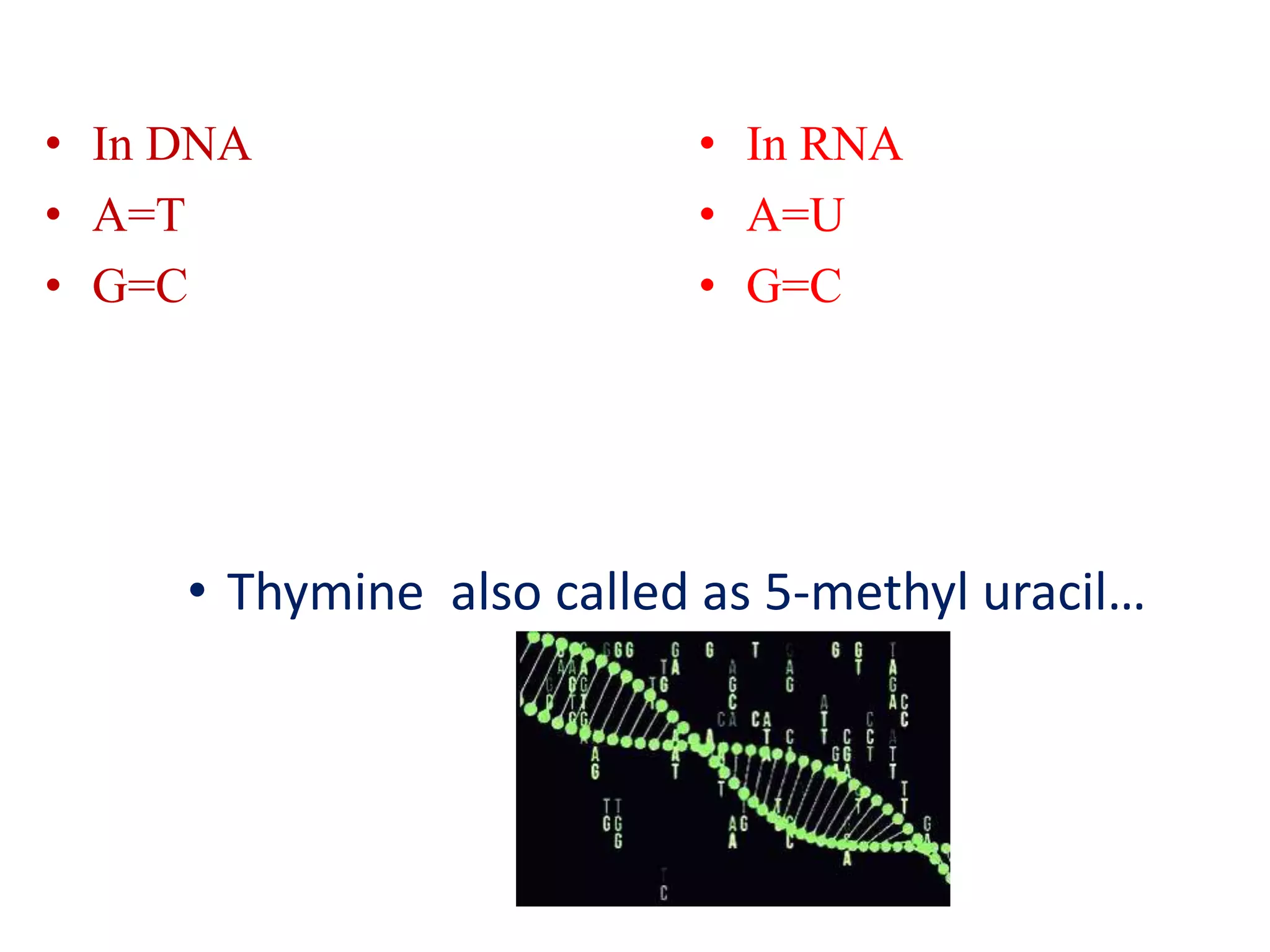
• In DNA
• A=T
• G=C
• In RNA
• A=U
• G=C
• Thymine also called as 5-methyl uracil…
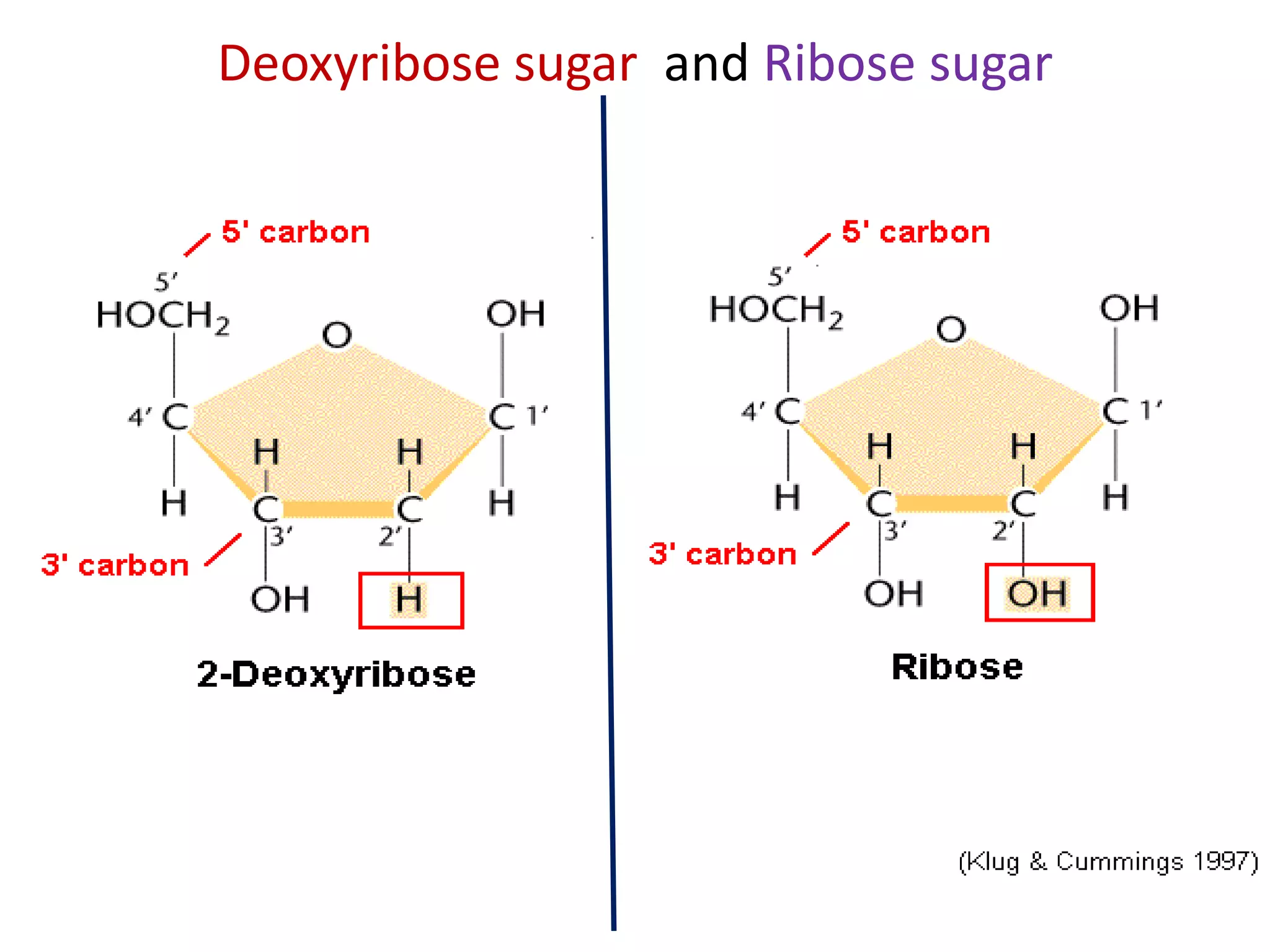
Deoxyribose sugar and Ribose sugar
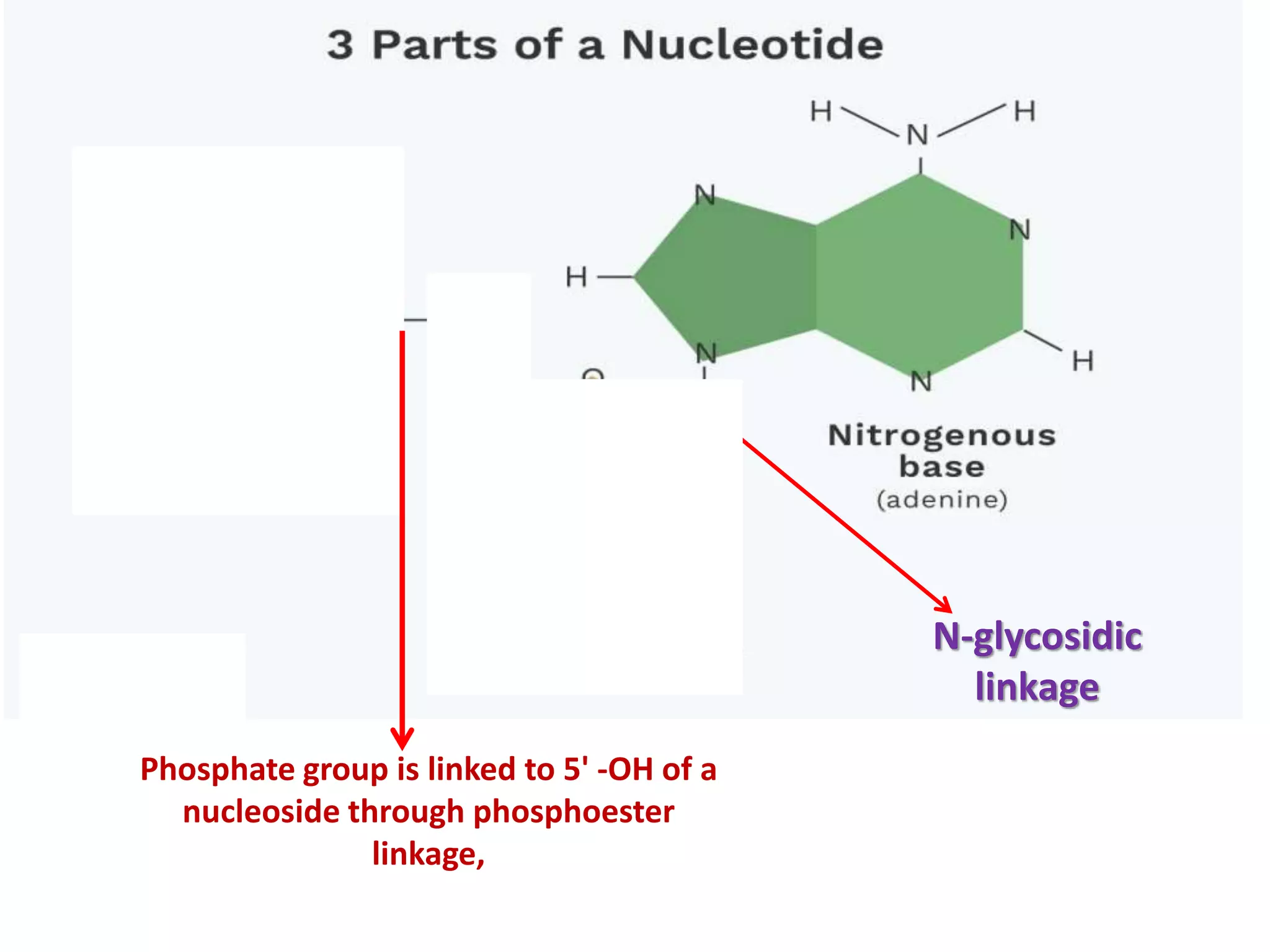
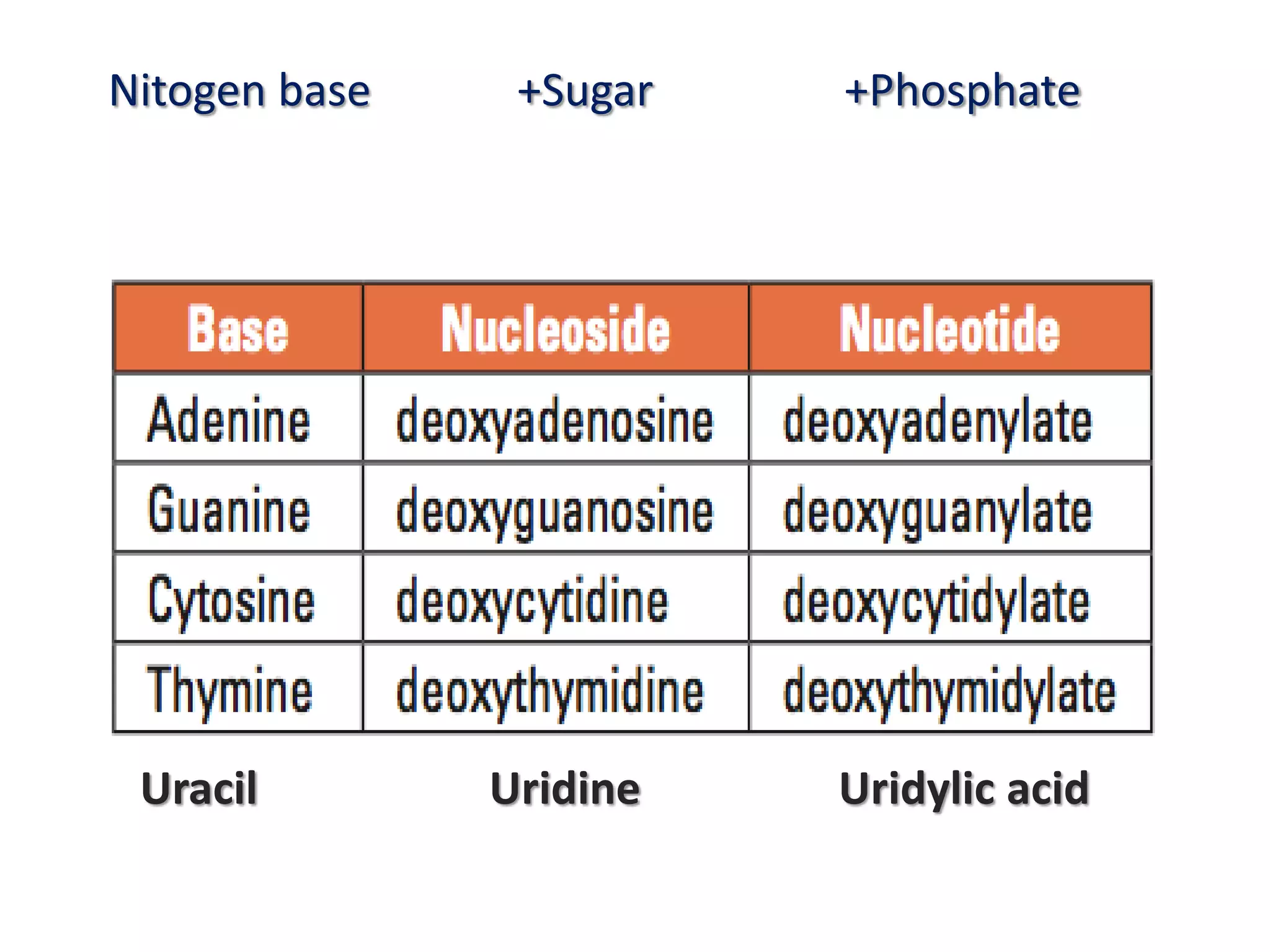
N-glycosidic
linkage
Phosphate group is linked to 5' -OH of a
nucleoside through phosphoester
linkage,
Uracil Uridine Uridylic acid
Nitogen base +Sugar +Phosphate
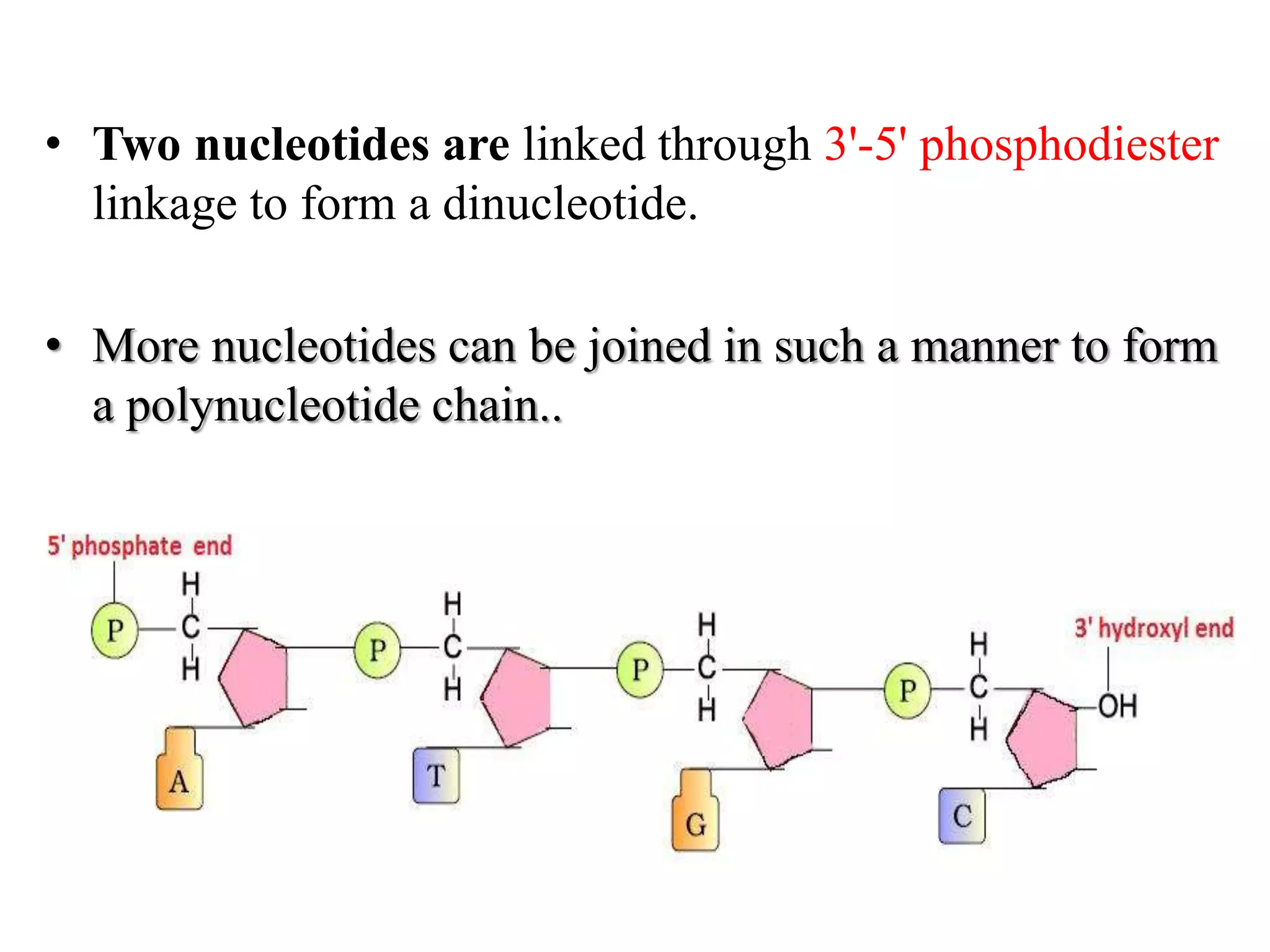
• Two nucleotides are linked through 3'-5' phosphodiester
linkage to form a dinucleotide.
• More nucleotides can be joined in such a manner to form
a polynucleotide chain..
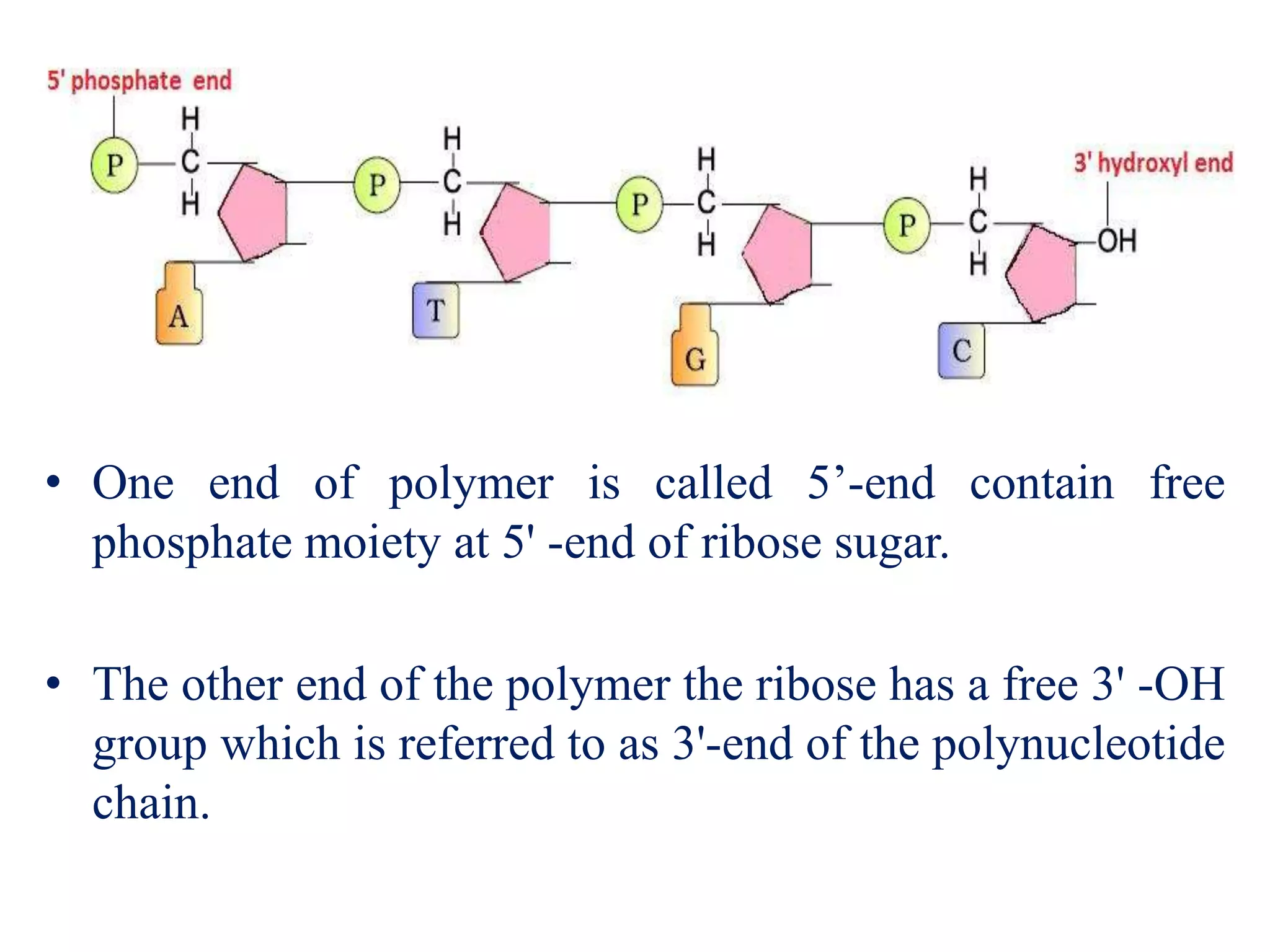
• One end of polymer is called 5’-end contain free
phosphate moiety at 5' -end of ribose sugar.
• The other end of the polymer the ribose has a free 3' -OH
group which is referred to as 3'-end of the polynucleotide
chain.
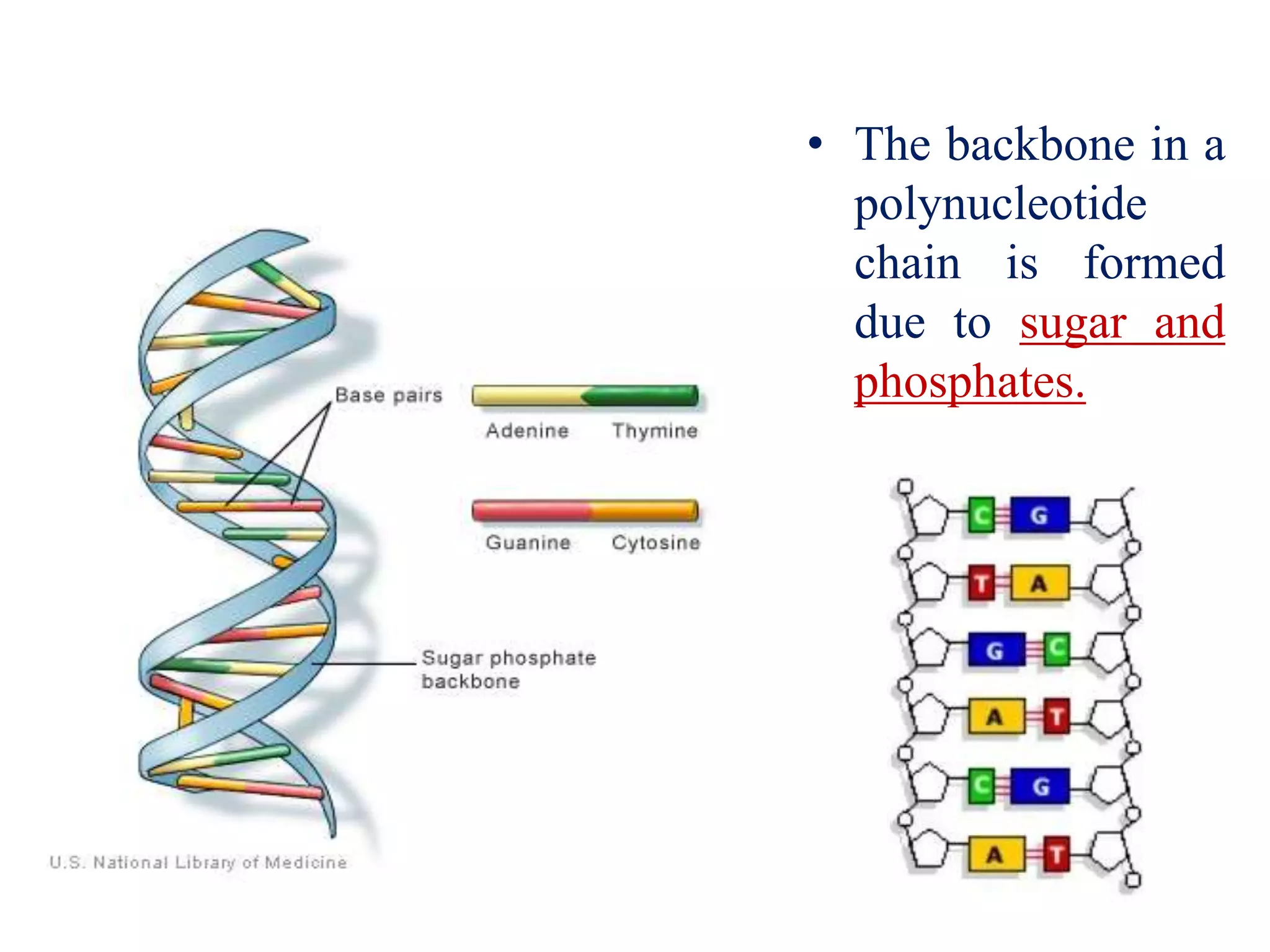
• The backbone in a
polynucleotide
chain is formed
due to sugar and
phosphates.
• DNA as an acidic substance present in nucleus was first
identified by Friedrich Meischer in 1869.
• He named it as ‘Nuclein’.
Who DNA First discovered?
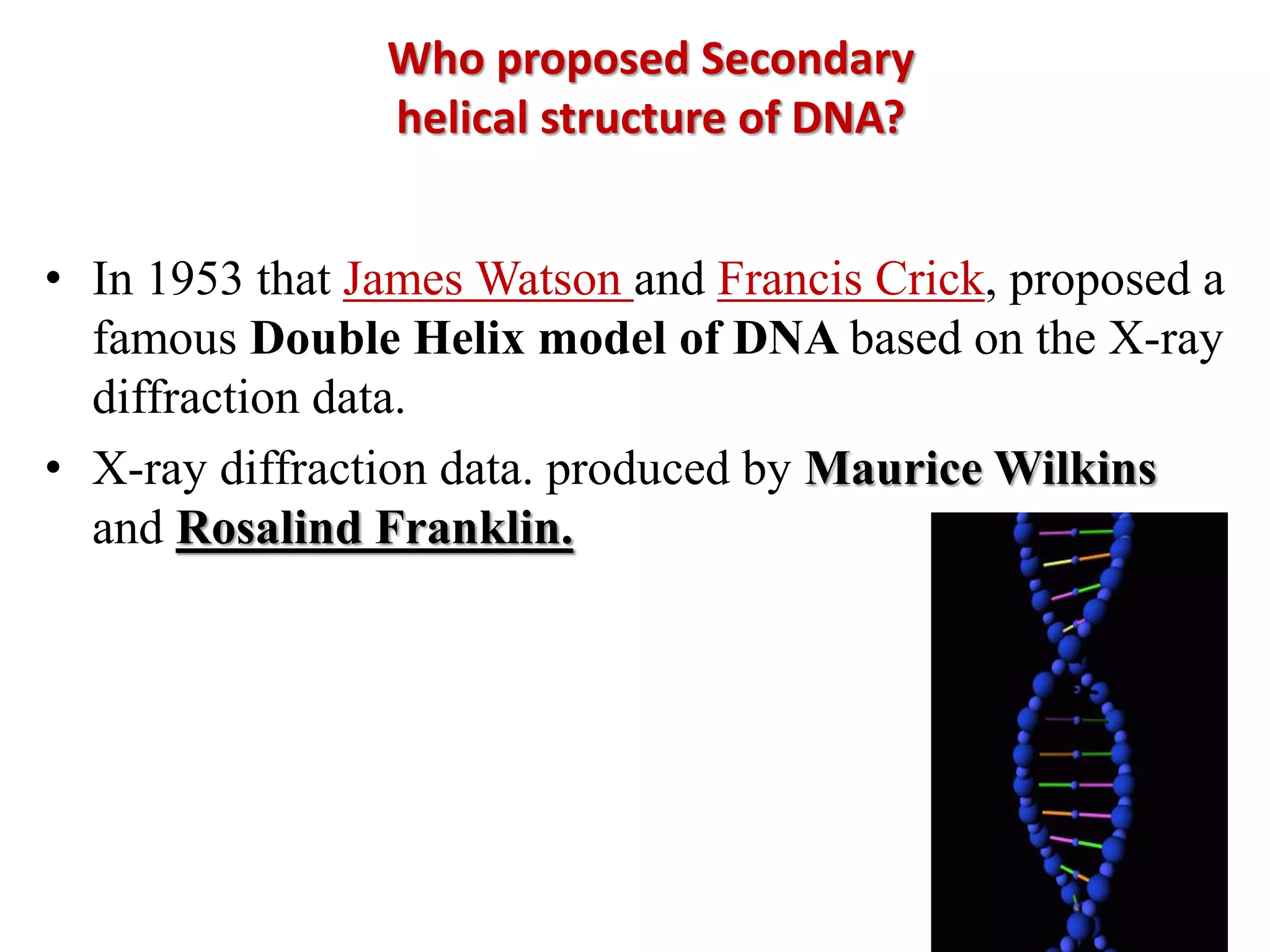
• In 1953 that James Watson and Francis Crick, proposed a
famous Double Helix model of DNA based on the X-ray
diffraction data.
• X-ray diffraction data. produced by Maurice Wilkins
and Rosalind Franklin.
Who proposed Secondary
helical structure of DNA?
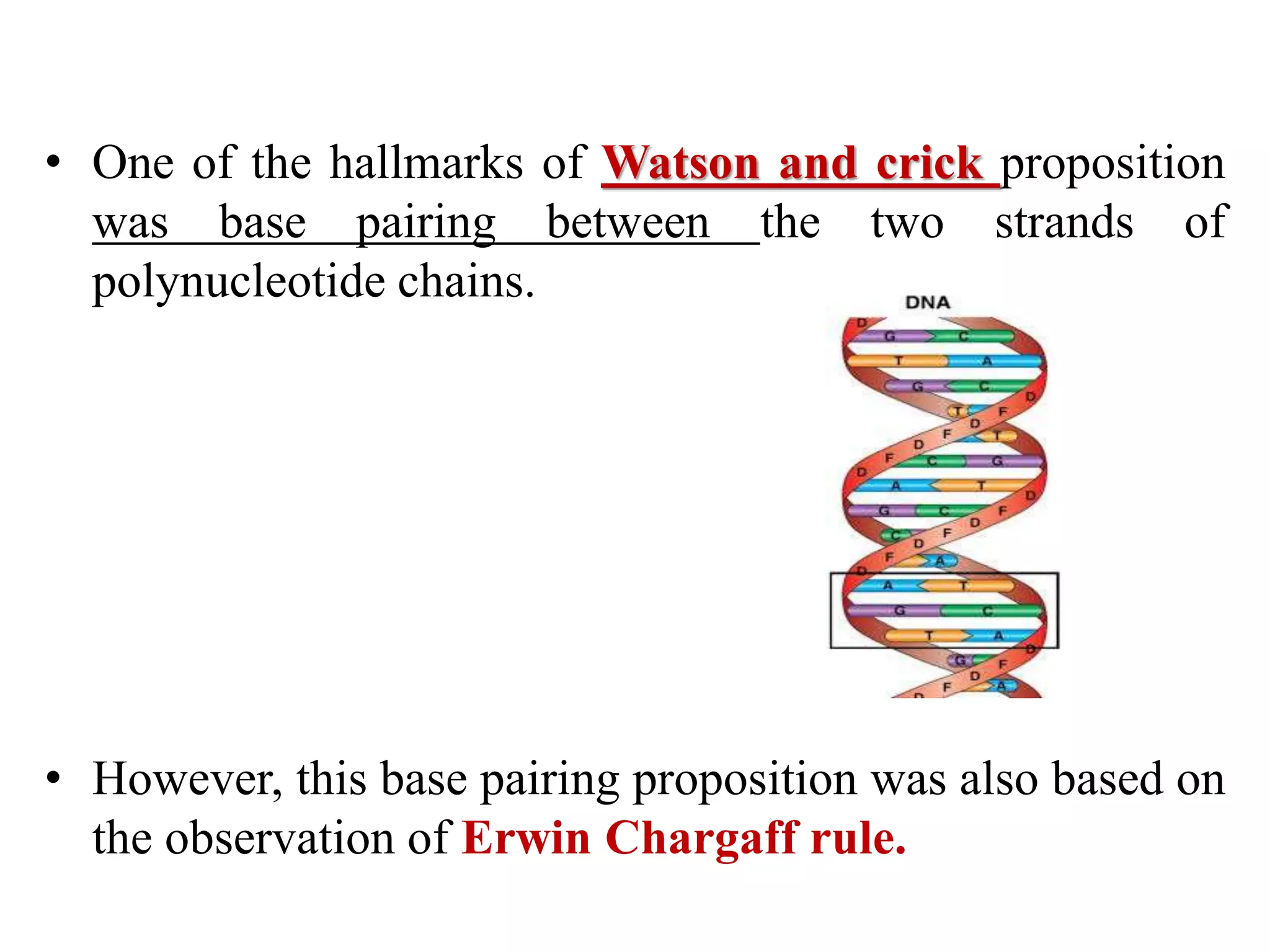
• One of the hallmarks of Watson and crick proposition
was base pairing between the two strands of
polynucleotide chains.
• However, this base pairing proposition was also based on
the observation of Erwin Chargaff rule.
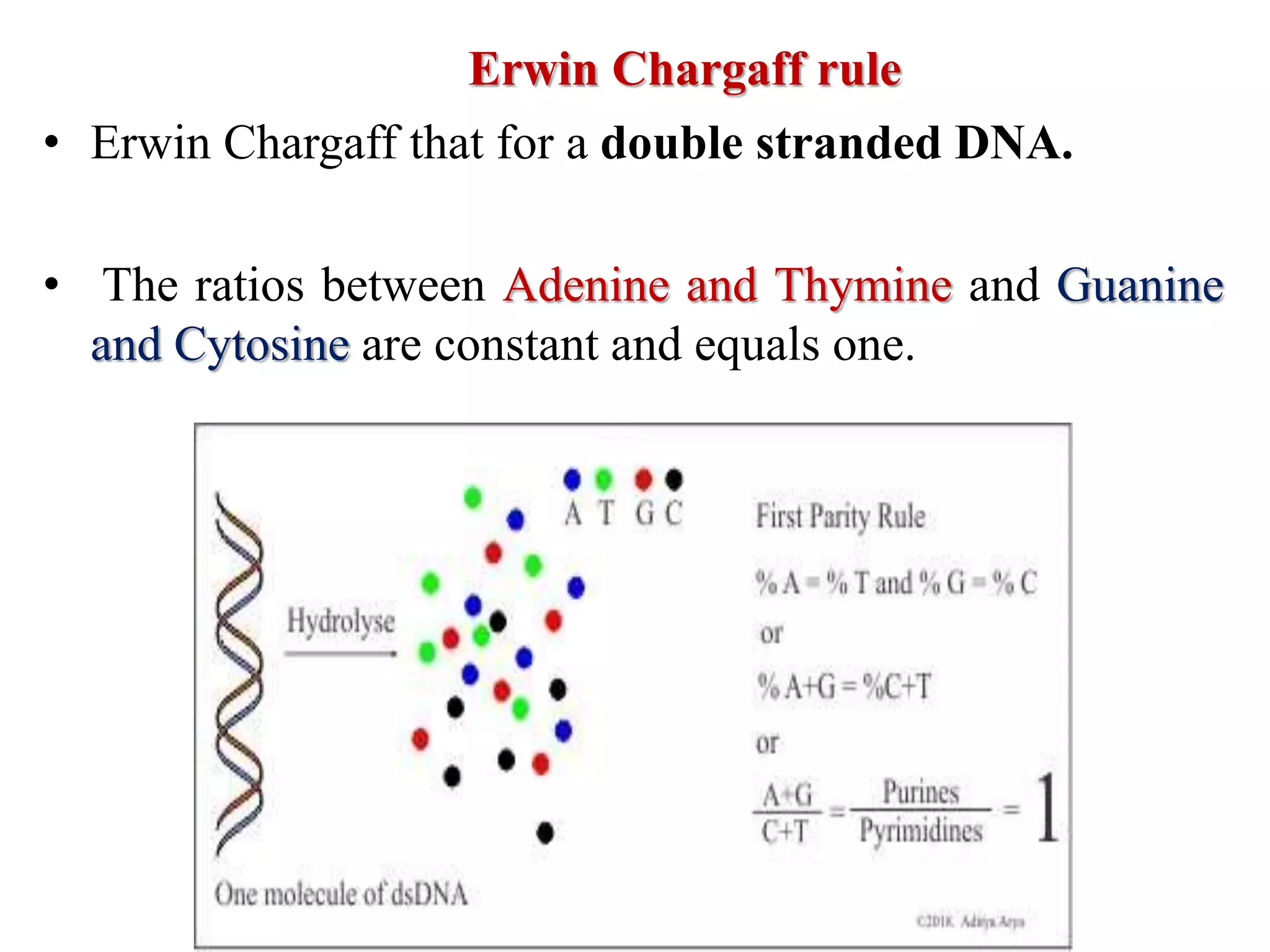
• Erwin Chargaff that for a double stranded DNA.
• The ratios between Adenine and Thymine and Guanine
and Cytosine are constant and equals one.
Erwin Chargaff rule
• The base pairing confers a very unique property to the
polynucleotide chains..
• DNA strands are complementary to each other.
• During replication each DNA
strand acts as a template for
synthesis of a new strand.
• After replication the two double
stranded DNA produced would
be identical to the parental DNA
molecule.
The salient features of the Double-helix structure of
DNA
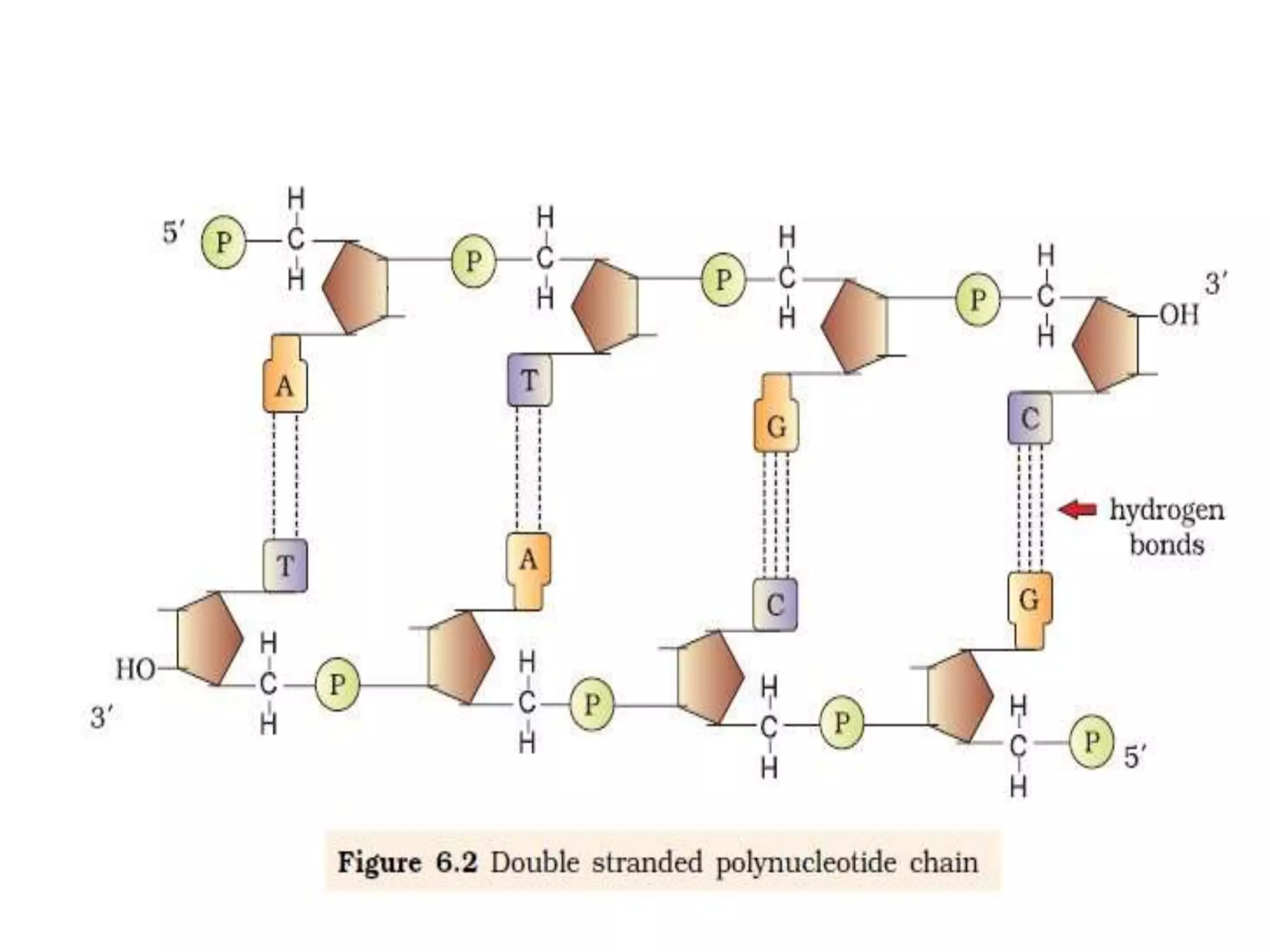
• The two chains are complementary and anti-parallel
polarity each other.
• It means, if one chain has the polarity 5‘3', the other
has 35‘.
• Hydrogen bonds generates uniform distance between the
two strands of the helix..
• The plane of one base pair stacks over the other in
double helix.
• This, in addition to H-bonds, confers stability of the
helical structure..
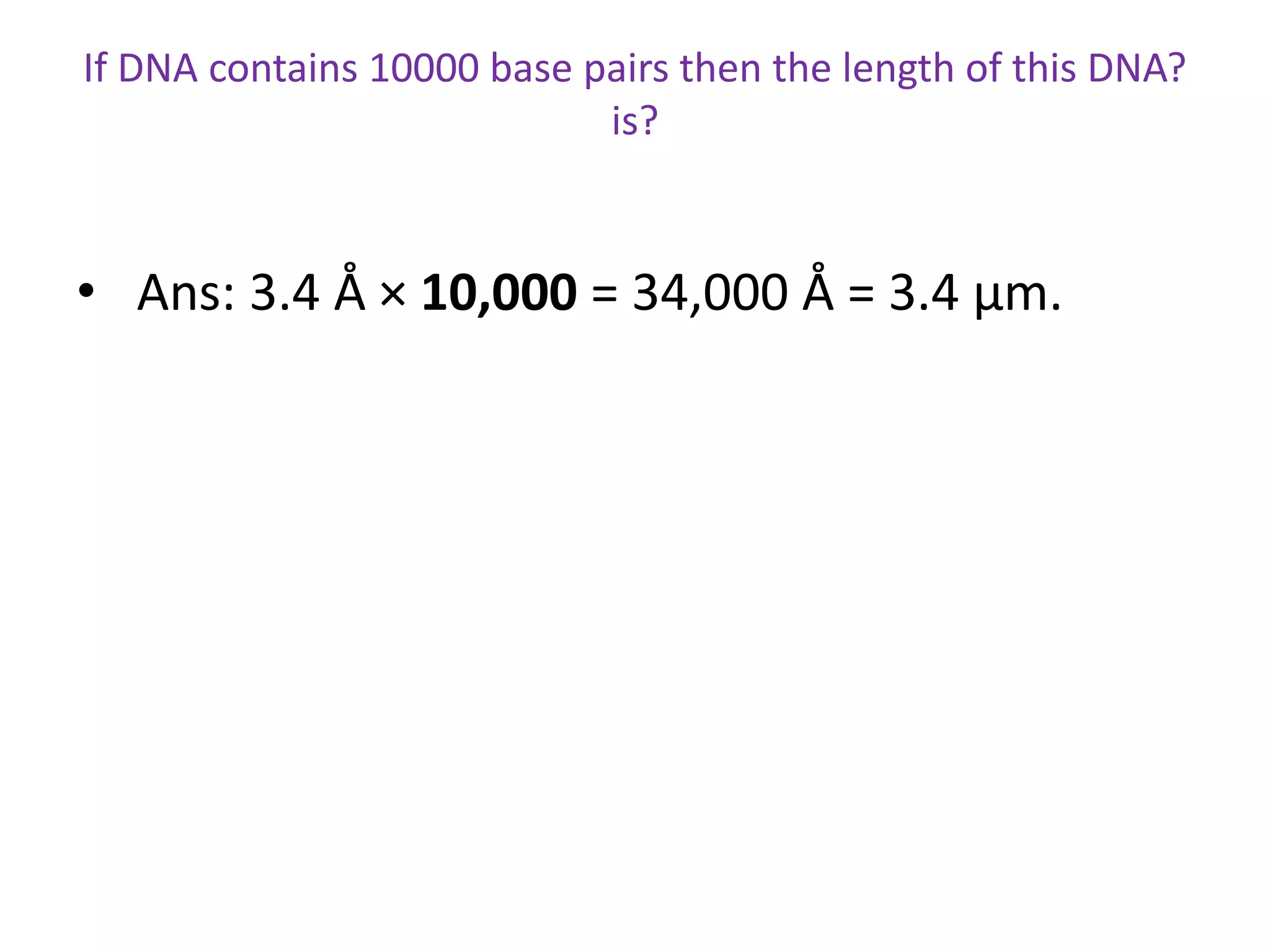
If DNA contains 10000 base pairs then the length of this DNA?
is?
• Ans: 3.4 Å × 10,000 = 34,000 Å = 3.4 µm.
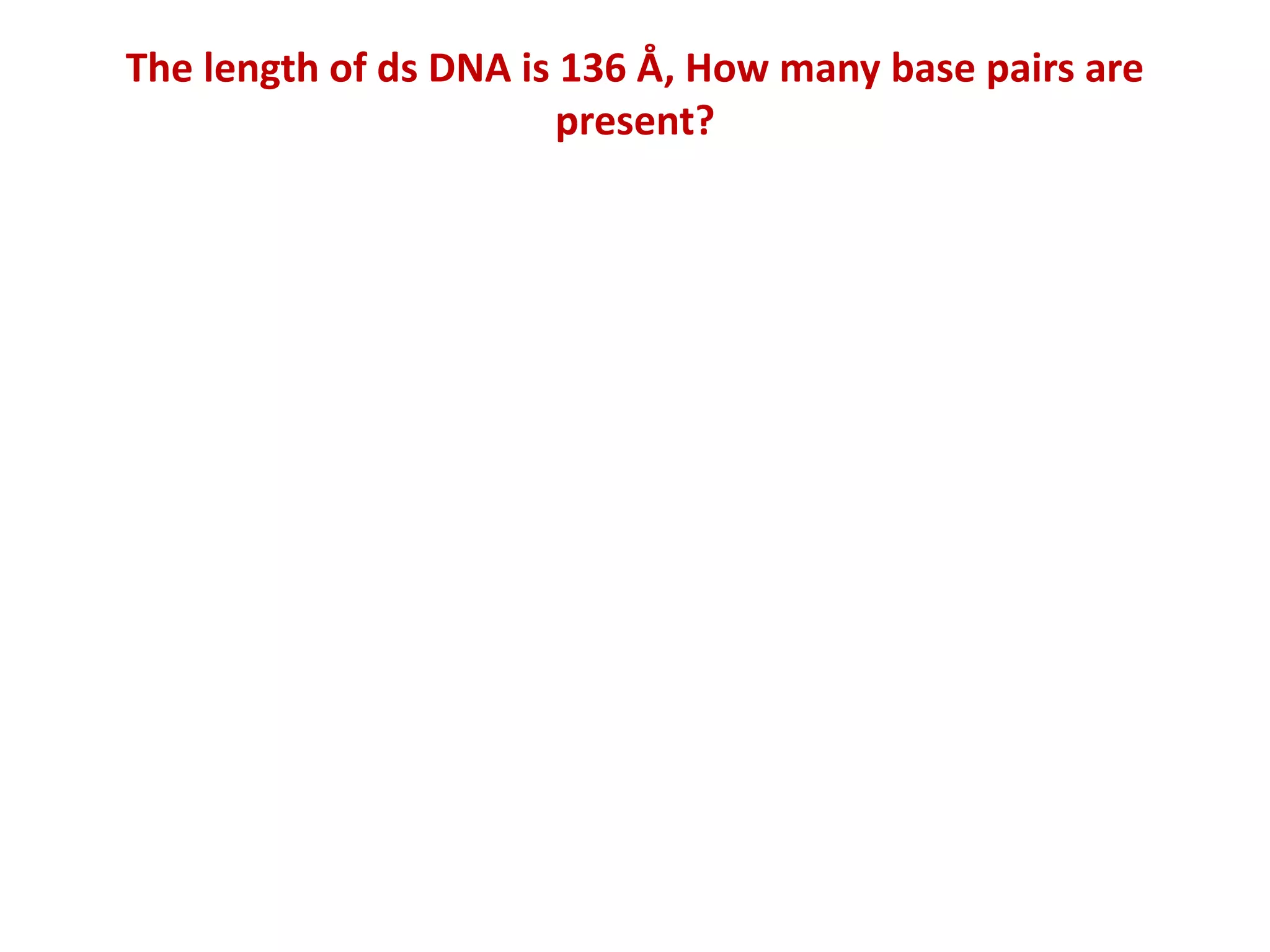
The length of ds DNA is 136 Å, How many base pairs are
present?
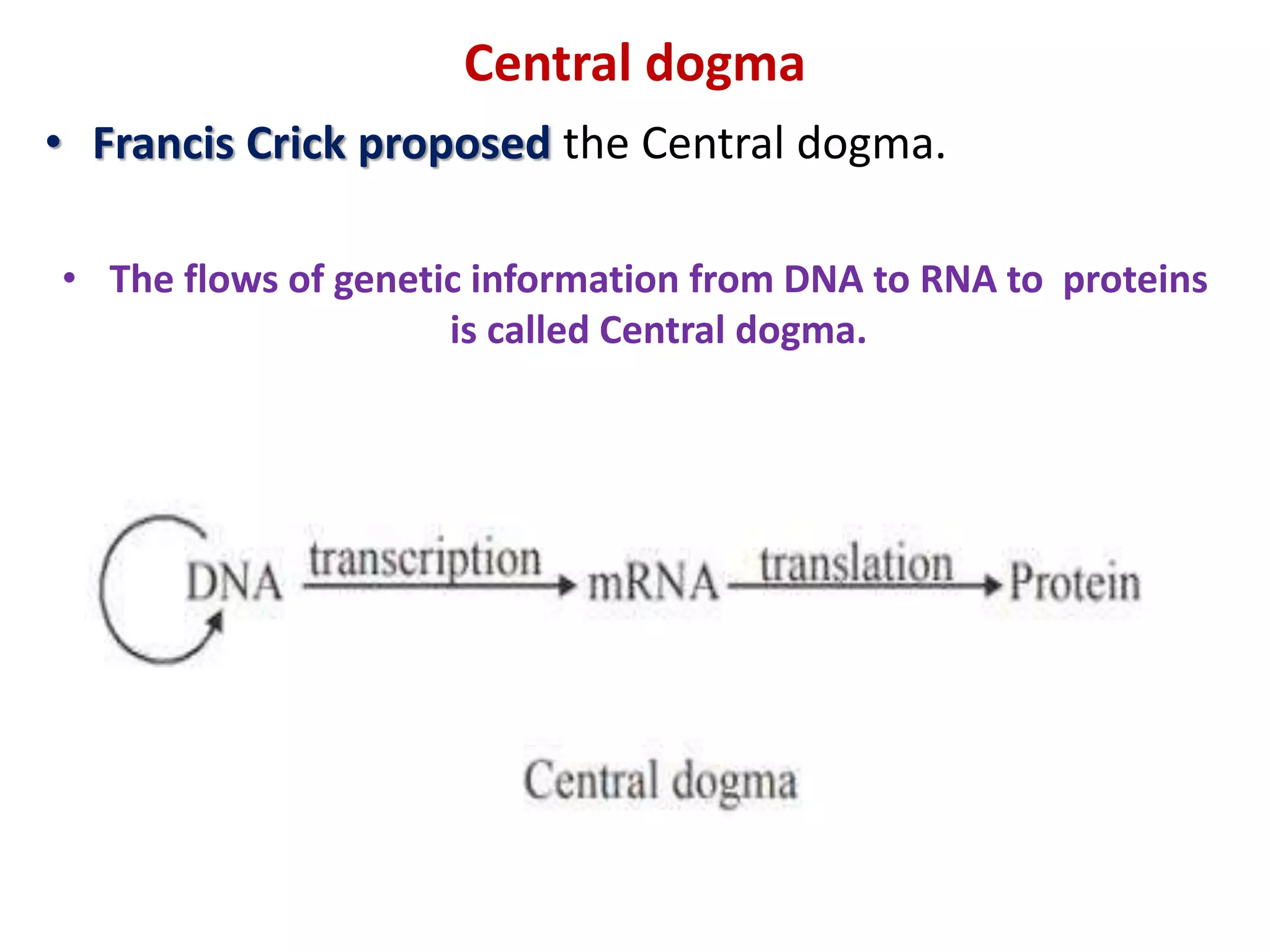
Central dogma
• Francis Crick proposed the Central dogma.
• The flows of genetic information from DNA to RNA to proteins
is called Central dogma.
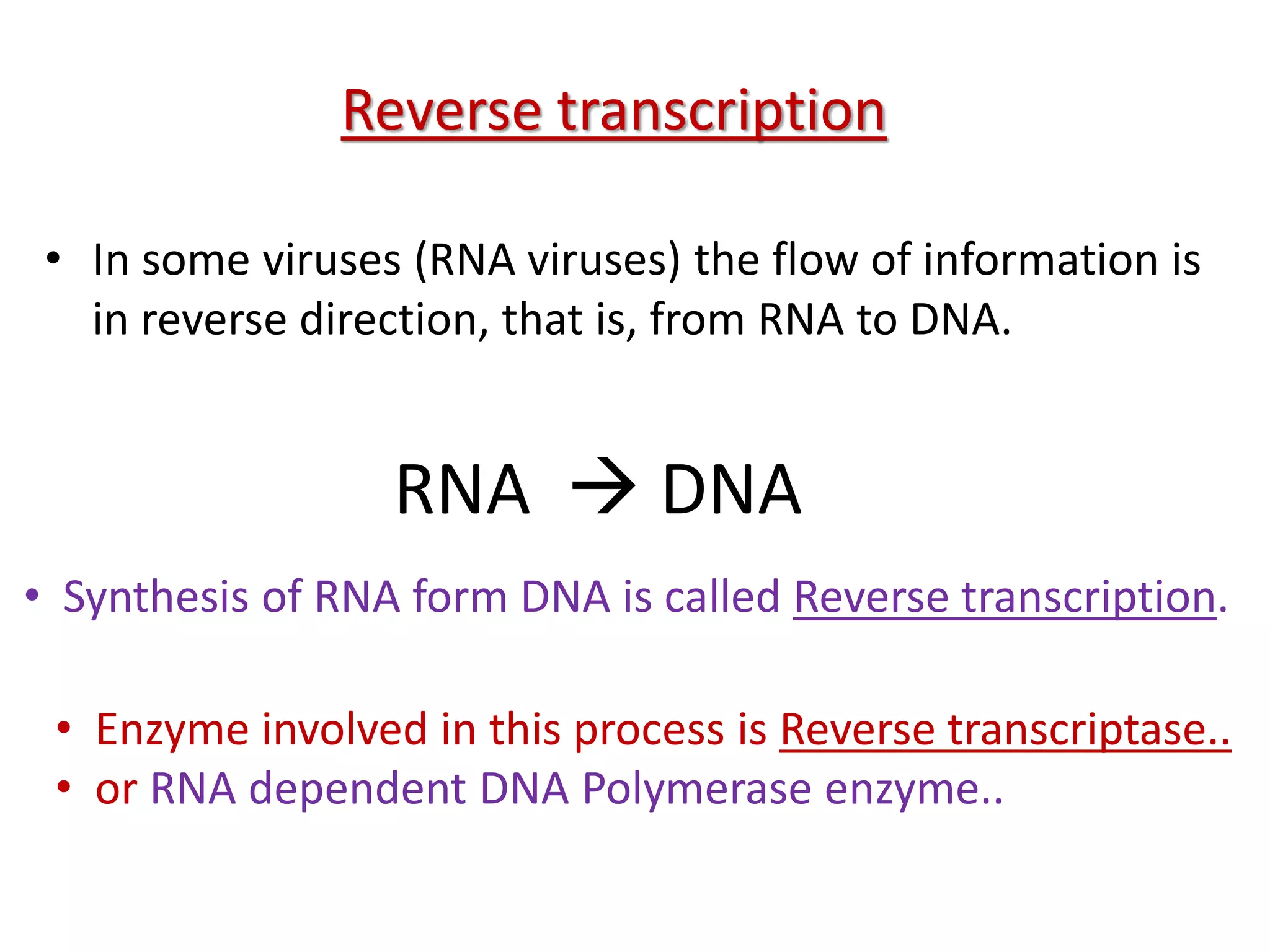
• In some viruses (RNA viruses) the flow of information is
in reverse direction, that is, from RNA to DNA.
RNA  DNA
• Synthesis of RNA form DNA is called Reverse transcription.
• Enzyme involved in this process is Reverse transcriptase..
• or RNA dependent DNA Polymerase enzyme..
Reverse transcription
Packaging of DNA Helix
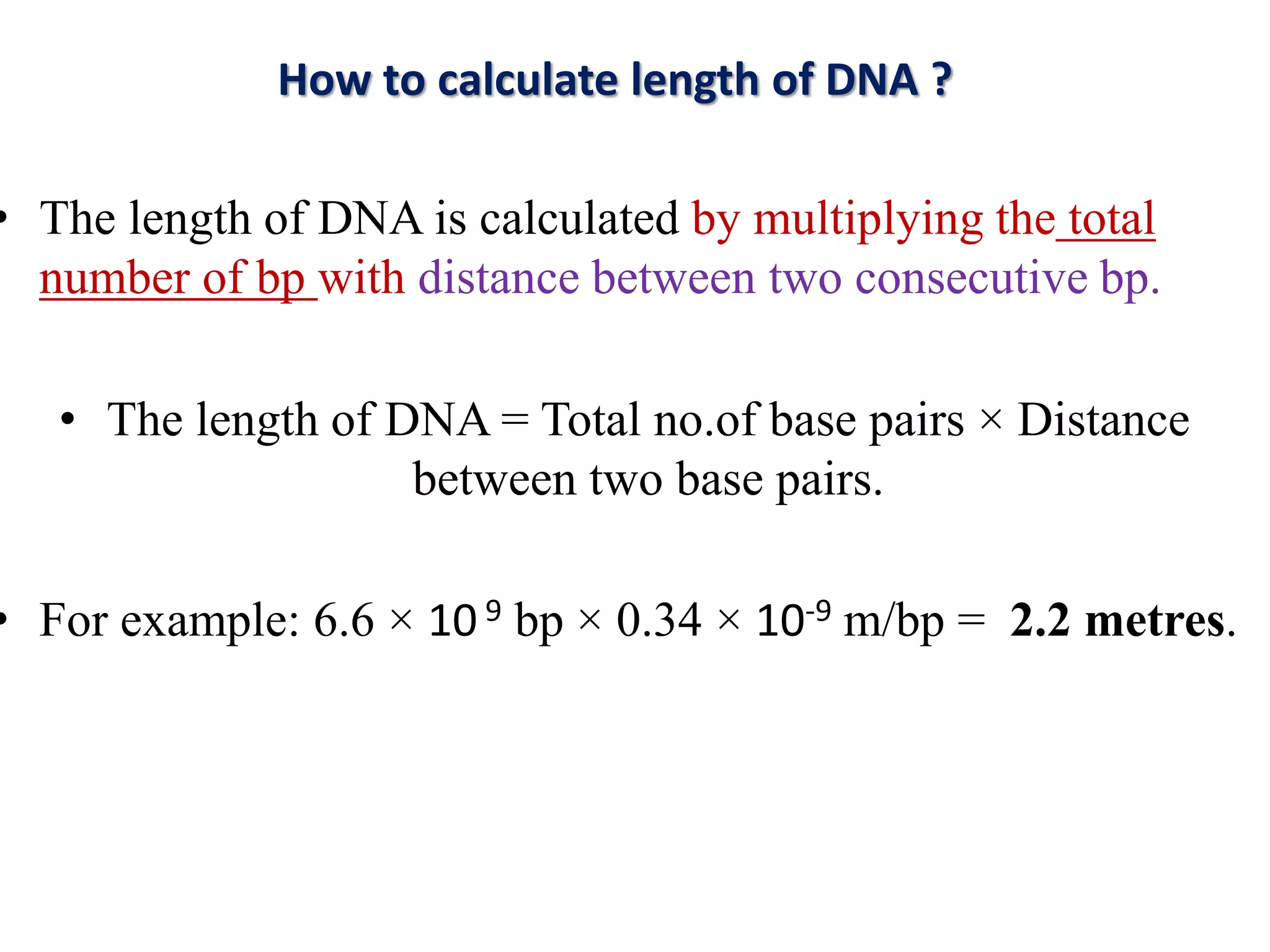
• The length of DNA is calculated by multiplying the total
number of bp with distance between two consecutive bp.
• The length of DNA = Total no.of base pairs × Distance
between two base pairs.
• For example: 6.6 × 10 9 bp × 0.34 × 10-9 m/bp = 2.2 metres.
How to calculate length of DNA ?
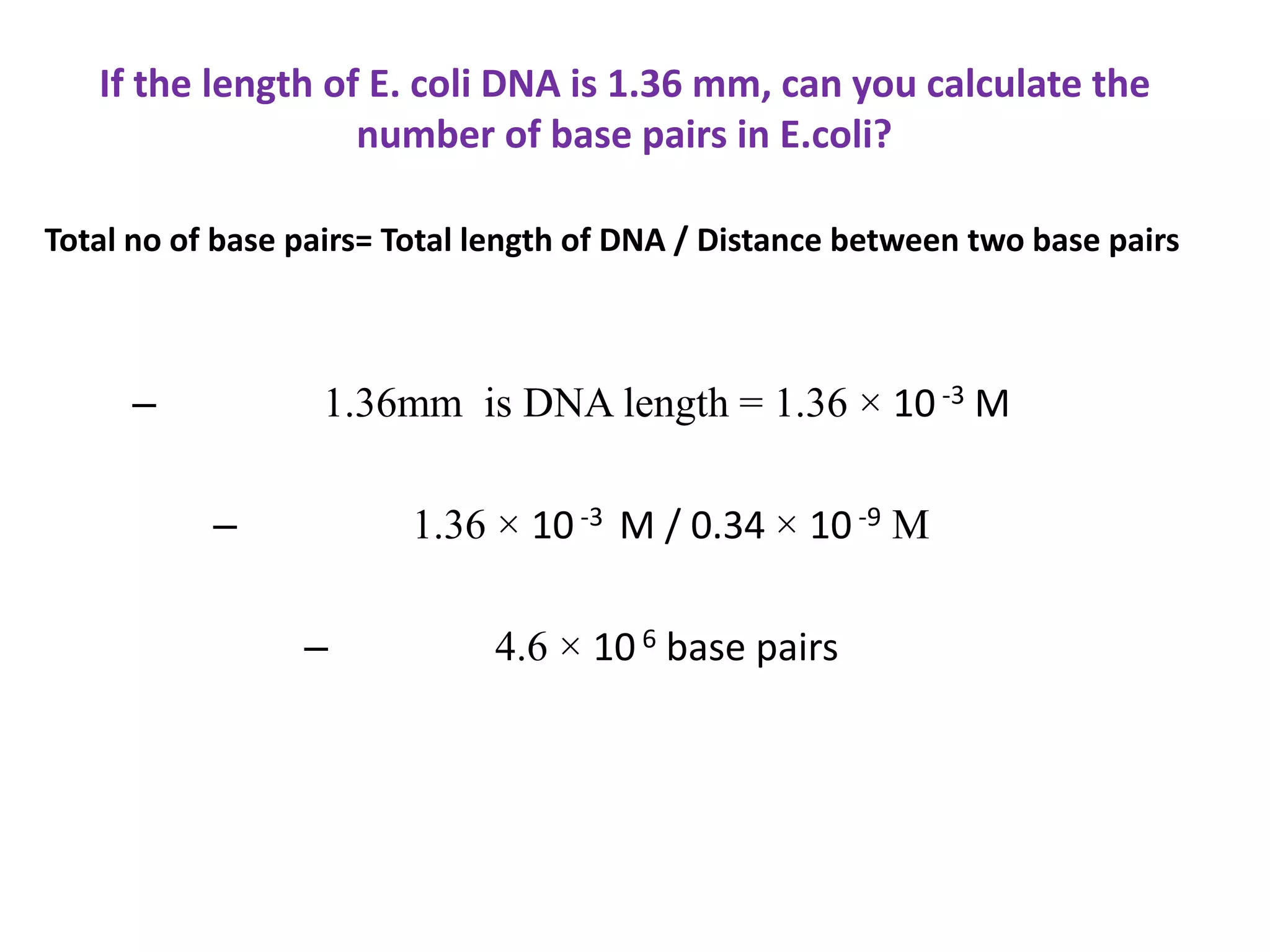
If the length of E. coli DNA is 1.36 mm, can you calculate the
number of base pairs in E.coli?
– 1.36mm is DNA length = 1.36 × 10⁻³ M
– 1.36 × 10⁻³ M / 0.34 × 10⁻⁹ M
– 4.6 × 10 6 base pairs
Total no of base pairs= Total length of DNA / Distance between two base pairs
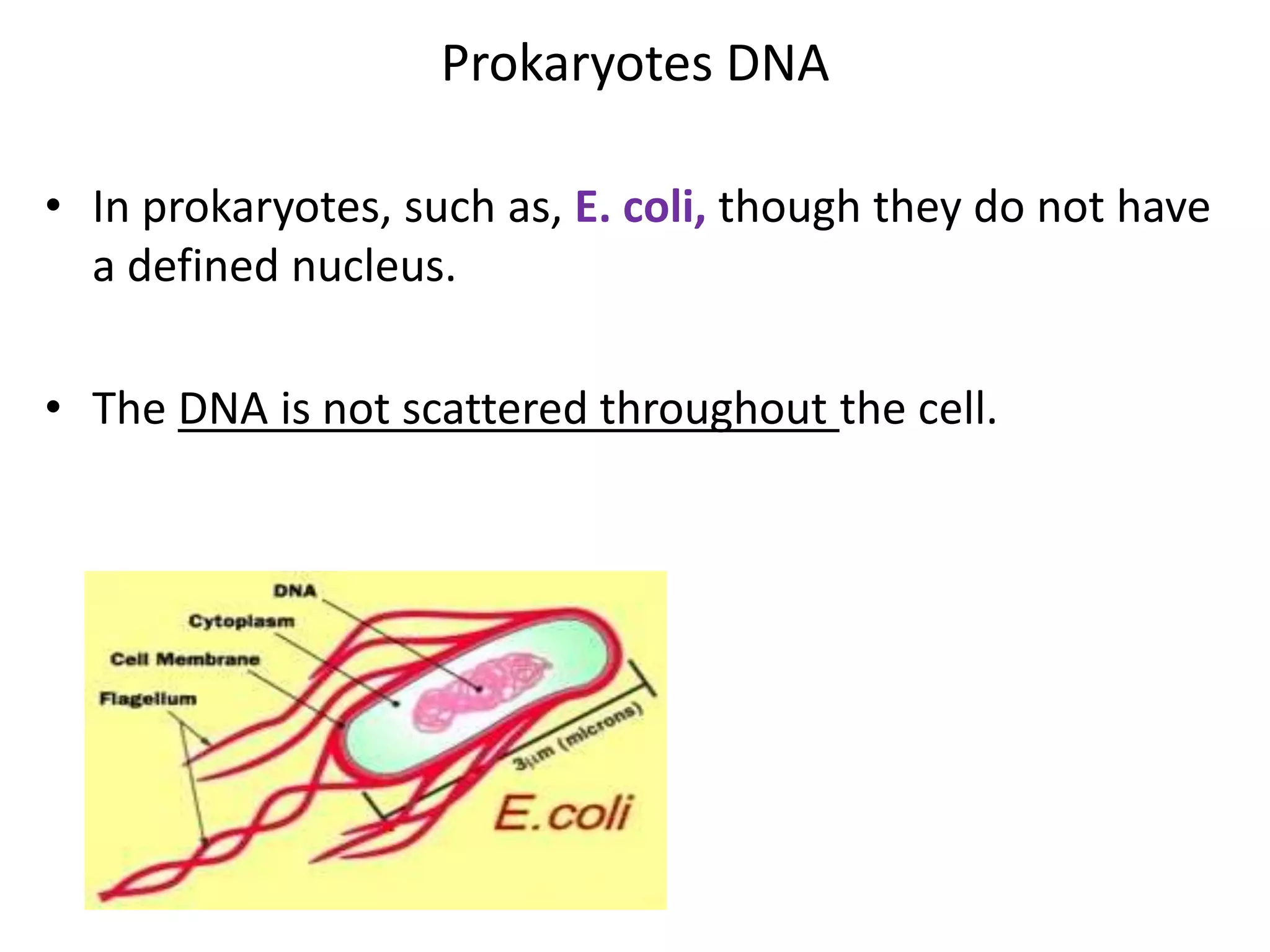
Prokaryotes DNA
• In prokaryotes, such as, E. coli, though they do not have
a defined nucleus.
• The DNA is not scattered throughout the cell.
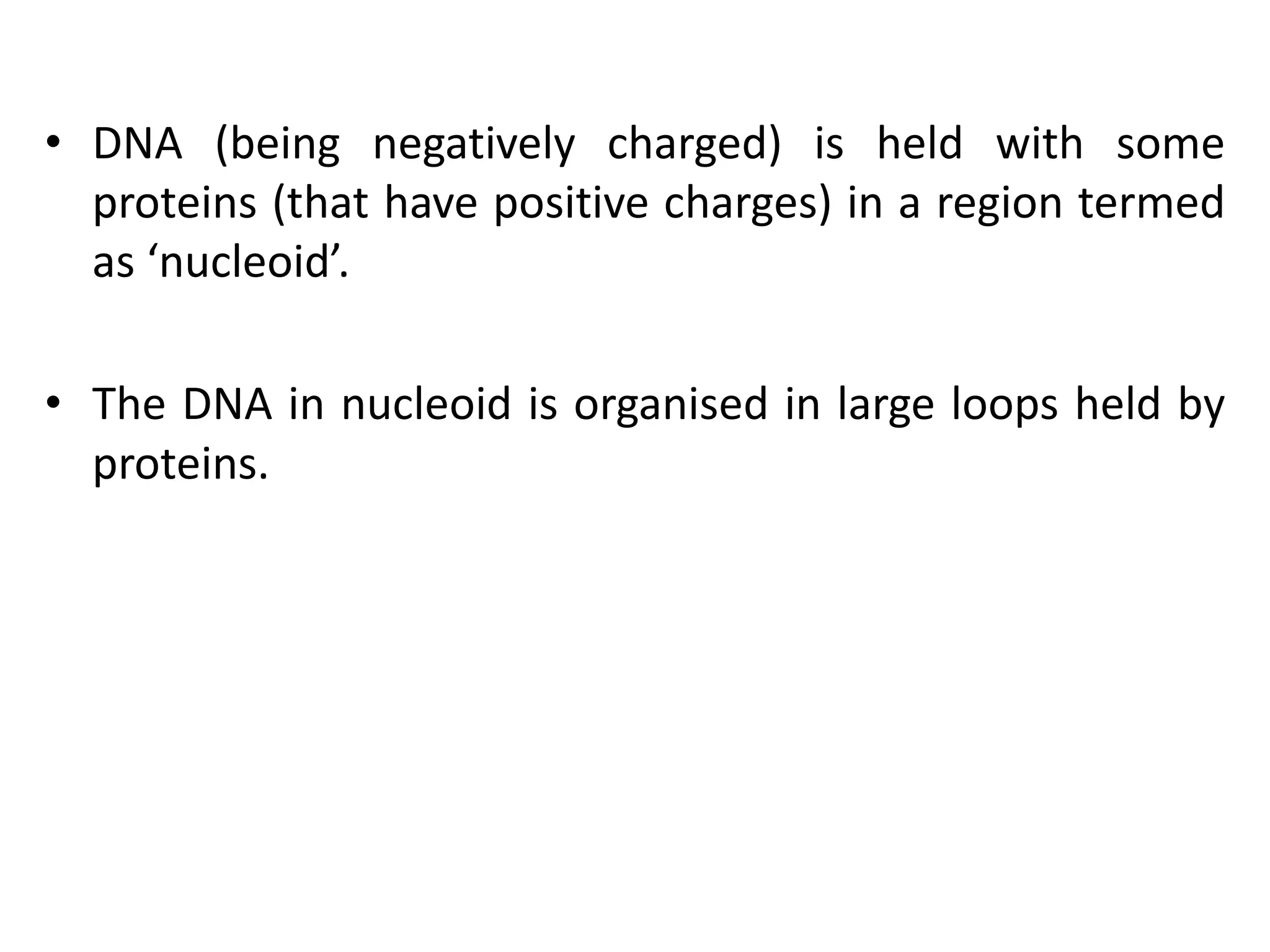
• DNA (being negatively charged) is held with some
proteins (that have positive charges) in a region termed
as ‘nucleoid’.
• The DNA in nucleoid is organised in large loops held by
proteins.
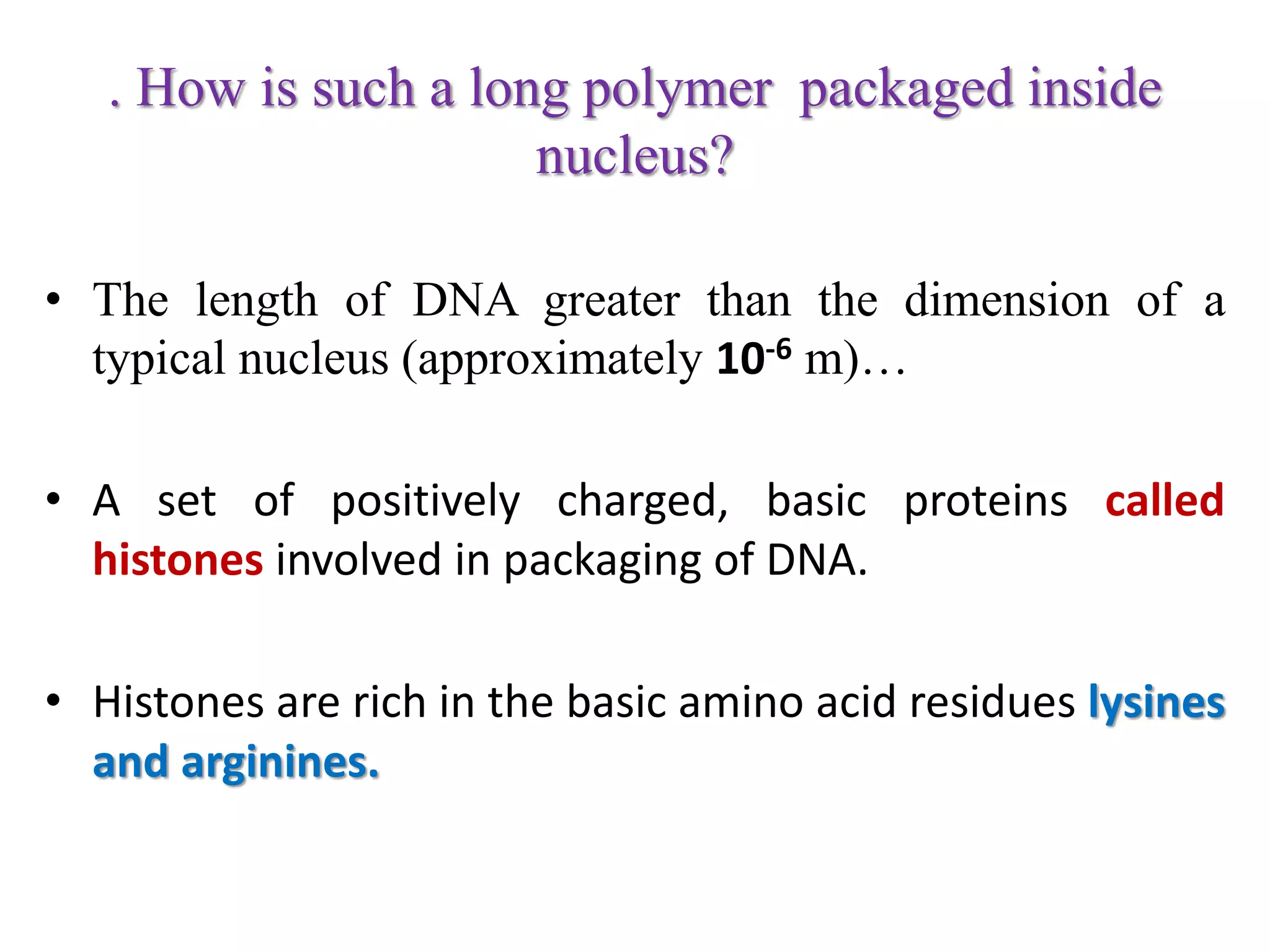
. How is such a long polymer packaged inside
nucleus?
• The length of DNA greater than the dimension of a
typical nucleus (approximately 10-6 m)…
• A set of positively charged, basic proteins called
histones involved in packaging of DNA.
• Histones are rich in the basic amino acid residues lysines
and arginines.
Dr. HarinathaReddy Aswartha
Assistant professor
Department of Microbiology
ANDHRAPRADESH
INDIA
Molecular basis of inheritance ..The DNA

Molecular basis of inheritance ..The DNA

  • 1.
    Molecular Basis of Inheritance •How to calculate length of DNA? • B-DNA by Watson and Crick • Chargaff's rules
  • 2.
    DNA and RNAare Genetic materials • Deoxyribonucleic acid (DNA) and Ribonucleic acid (RNA) are the two types of nucleic acids found in living systems… • DNA acts as the genetic material in most of the organisms. • RNA also acts as a genetic material in some viruses….
  • 3.
    RNA has additionalroles.. • Mostly RNA functions as a messenger RNA (m-RNA). • RNA functions as adapter (t-RNA/transfer RNA). • RNA functions as Structural RNA (r-RNA/ Ribosomal RNA). • In some cases function as a catalytic molecule (Enzyme/Ribozyme).
  • 4.
    Nucleic acids (DNA/RNA)are polymers nucleotides • Nucleotides  DNA DNA+ Histone proteins  Nucleosomes Chromatin  Chromosomes Genome
  • 5.
    In this chapterwe are going to discuss • the structure of DNA. • DNA replication, • the process of making RNA from DNA (transcription). • the genetic code that determines the sequences of amino acids in proteins. • the process of protein synthesis (translation). • Gene regulation.
  • 6.
    THE DNA • DNAis a long polymer of deoxyribonucleotides. • A nucleotide has three components: • a nitrogenous base, • a pentose sugar (ribose in case of RNA, and deoxyribose for DNA), • A phosphate group.
  • 7.
    The length ofthe DNA • The length of DNA is usually defined as number of nucleotides.. • or a pair of nucleotide referred to as base pairs present in it.
  • 8.
    Single strand DNA •The length of ss DNA is usually defined as number of nucleotides..
  • 9.
    • The lengthof ds DNA is usually defined as number of nucleotides..
  • 10.
    A Bacteriophage known asφ ×174 has 5386 nucleotides Bacteriophage lambda has 48502 base pairs (bp)
  • 11.
    Haploid content ofhuman DNA is 3.3 × 10⁹ bp. Escherichia coli has 4.6 × 10⁶ bp
  • 12.
    Structure of PolynucleotideChain • DNA is a polynucleotide chain. • A nucleotide has three components: 1. a nitrogenous base, 2. a pentose sugar (ribose in case of RNA, and deoxyribose for DNA), 3. A phosphate group.
  • 13.
    There are twotypes of nitrogenous bases • Thymine is present in DNA. Uracil is present in RNA at the place of Thymine. Purines: (Adenine and Guanine): Pyrimidines (Cytosine, Uracil and Thymine).
  • 14.
    • In DNA •A=T • G=C • In RNA • A=U • G=C • Thymine also called as 5-methyl uracil…
  • 15.
  • 16.
    N-glycosidic linkage Phosphate group islinked to 5' -OH of a nucleoside through phosphoester linkage,
  • 17.
    Uracil Uridine Uridylicacid Nitogen base +Sugar +Phosphate
  • 18.
    • Two nucleotidesare linked through 3'-5' phosphodiester linkage to form a dinucleotide. • More nucleotides can be joined in such a manner to form a polynucleotide chain..
  • 19.
    • One endof polymer is called 5’-end contain free phosphate moiety at 5' -end of ribose sugar. • The other end of the polymer the ribose has a free 3' -OH group which is referred to as 3'-end of the polynucleotide chain.
  • 20.
    • The backbonein a polynucleotide chain is formed due to sugar and phosphates.
  • 21.
    • DNA asan acidic substance present in nucleus was first identified by Friedrich Meischer in 1869. • He named it as ‘Nuclein’. Who DNA First discovered?
  • 22.
    • In 1953that James Watson and Francis Crick, proposed a famous Double Helix model of DNA based on the X-ray diffraction data. • X-ray diffraction data. produced by Maurice Wilkins and Rosalind Franklin. Who proposed Secondary helical structure of DNA?
  • 23.
    • One ofthe hallmarks of Watson and crick proposition was base pairing between the two strands of polynucleotide chains. • However, this base pairing proposition was also based on the observation of Erwin Chargaff rule.
  • 24.
    • Erwin Chargaffthat for a double stranded DNA. • The ratios between Adenine and Thymine and Guanine and Cytosine are constant and equals one. Erwin Chargaff rule
  • 25.
    • The basepairing confers a very unique property to the polynucleotide chains.. • DNA strands are complementary to each other.
  • 26.
    • During replicationeach DNA strand acts as a template for synthesis of a new strand. • After replication the two double stranded DNA produced would be identical to the parental DNA molecule.
  • 27.
    The salient featuresof the Double-helix structure of DNA
  • 28.
    • The twochains are complementary and anti-parallel polarity each other. • It means, if one chain has the polarity 5‘3', the other has 35‘.
  • 29.
    • Hydrogen bondsgenerates uniform distance between the two strands of the helix.. • The plane of one base pair stacks over the other in double helix. • This, in addition to H-bonds, confers stability of the helical structure..
  • 30.
    If DNA contains10000 base pairs then the length of this DNA? is? • Ans: 3.4 Å × 10,000 = 34,000 Å = 3.4 µm.
  • 31.
    The length ofds DNA is 136 Å, How many base pairs are present?
  • 32.
    Central dogma • FrancisCrick proposed the Central dogma. • The flows of genetic information from DNA to RNA to proteins is called Central dogma.
  • 33.
    • In someviruses (RNA viruses) the flow of information is in reverse direction, that is, from RNA to DNA. RNA  DNA • Synthesis of RNA form DNA is called Reverse transcription. • Enzyme involved in this process is Reverse transcriptase.. • or RNA dependent DNA Polymerase enzyme.. Reverse transcription
  • 35.
  • 36.
    • The lengthof DNA is calculated by multiplying the total number of bp with distance between two consecutive bp. • The length of DNA = Total no.of base pairs × Distance between two base pairs. • For example: 6.6 × 10 9 bp × 0.34 × 10-9 m/bp = 2.2 metres. How to calculate length of DNA ?
  • 37.
    If the lengthof E. coli DNA is 1.36 mm, can you calculate the number of base pairs in E.coli? – 1.36mm is DNA length = 1.36 × 10⁻³ M – 1.36 × 10⁻³ M / 0.34 × 10⁻⁹ M – 4.6 × 10 6 base pairs Total no of base pairs= Total length of DNA / Distance between two base pairs
  • 38.
    Prokaryotes DNA • Inprokaryotes, such as, E. coli, though they do not have a defined nucleus. • The DNA is not scattered throughout the cell.
  • 39.
    • DNA (beingnegatively charged) is held with some proteins (that have positive charges) in a region termed as ‘nucleoid’. • The DNA in nucleoid is organised in large loops held by proteins.
  • 40.
    . How issuch a long polymer packaged inside nucleus? • The length of DNA greater than the dimension of a typical nucleus (approximately 10-6 m)… • A set of positively charged, basic proteins called histones involved in packaging of DNA. • Histones are rich in the basic amino acid residues lysines and arginines.
  • 41.
    Dr. HarinathaReddy Aswartha Assistantprofessor Department of Microbiology ANDHRAPRADESH INDIA