By Leliso H..
Mettu University
Faculty of Engineering and Technology
Department of Mechanical engineering
Engineering Material
HISTORICAL PERSPECTIVE
 Materials are probably more deep-seated in our
culture than most of us realize.
 Transportation, housing, clothing, communication,
recreation, and food production—virtually every
segment of our everyday lives is influenced to one
degree or another by materials.
 Historically, the development and advancement of
societies have been intimately tied to the members’
ability to produce and manipulate materials to fill
their needs.
 In fact, early civilizations have been designated by
the level of their materials development and the
historians have identified early periods of civilization
by the name of most significantly used material
(Stone Age, Bronze Age, Iron Age).
Contd.
 Stone →Bronze →Iron →Advanced materials
 From the historical point of view, it can be said that
human civilization started with Stone Age where
people used only natural materials, like stone, clay,
skin, and wood for the purposes like to make
weapons, instruments, shelter, etc.
 Thus the sites of deposits for better quality stones
became early colonies of human civilization.
Contd.
 However, the increasing need for better quality tools
brought forth exploration that led to Bronze Age.
 The Stone Age ended about 5000 years ago with
introduction of Bronze in the Far East.
 When people found copper and how to make it
harder by alloying, the Bronze Age started about
3000 BC
 Bronze is an alloy (a metal made up of more than
one element), copper + < 25% of tin + other
elements.
 Bronze: can be hammered or cast into a variety of
shapes, can be made harder by alloying, corrode
only slowly after a surface oxide film forms.
Contd.
 The Iron Age began about 3000 years ago and
continues today. Use of iron and steel, a stronger
and cheaper material changed drastically daily life of
a common person.
 The use of iron and steel, a stronger material that
gave advantage in wars started at about 1200 BC.
 Iron was abundant and thus availability is not limited
to the affluent.
 This commonness of the material affected every
person in many aspects, gaining the name
democratic material.
Contd.
 Age of Advanced materials: throughout the Iron
Age many new types of materials have been
introduced (ceramic, semiconductors, polymers,
composites…).
 This age is marked by many technological
developments towards development materials
resulting in stronger and light materials like
composites, electronic materials like
semiconductors, materials for space voyage like high
temperature ceramics, biomaterials, etc.
MATERIALS SCIENCE AND
ENGINEERING
 Sometimes it is useful to subdivide the discipline of
materials science and engineering into materials
science and materials engineering sub disciplines.
 Strictly speaking, “materials science” involves
investigating the relationships that exist between the
structures and properties of materials.
 In contrast, “materials engineering” is, on the basis of
these structure–property correlations, designing or
engineering the structure of a material to produce a
predetermined set of properties.
 From a functional perspective, the role of a materials
scientist is to develop or synthesize new materials,
 whereas a materials engineer is called upon to create
new products or systems using existing materials,
and/or to develop techniques for processing materials.
Contd.
 Four Major Components of Material Science and
Engineering:
 Structure of Materials
 Properties of Materials
 Processing of Materials
 Performance of Materials
 “Structure” is at this point a nebulous term that deserves
some explanation.
 In brief, the structure of a material usually relates to
the arrangement of its internal components.
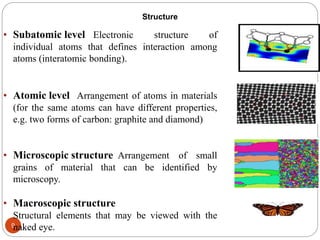
 Subatomic structure involves electrons within the
individual atoms and interactions with their nuclei.
 On an atomic level, structure encompasses the
organization of atoms or molecules relative to one
another.
 The next larger structural realm, which contains large
groups of atoms that are normally agglomerated together,
is termed “microscopic,” meaning that which is subject to
direct observation using some type of microscope.
 Finally, structural elements that may be viewed with the
naked eye are termed “macroscopic.”
9
• Subatomic level Electronic structure of
individual atoms that defines interaction among
atoms (interatomic bonding).
• Atomic level Arrangement of atoms in materials
(for the same atoms can have different properties,
e.g. two forms of carbon: graphite and diamond)
• Microscopic structure Arrangement of small
grains of material that can be identified by
microscopy.
• Macroscopic structure
Structural elements that may be viewed with the
naked eye.
Structure
Annealing of a polycrystalline grain structure
2D simulation using Monte Carlo Potts model.
2D simulations involve 40,000 sites and takes a day to run on a fast
workstation, 3D simulations involve 64 million sites, runs on 1000
processors of ASCI-Red.
Monarch butterfly
~ 0.1 m
10
Properties are the way the material responds to the environment and
external forces.
Mechanical properties – response to mechanical forces, strength, etc.
Electrical and magnetic properties - response electrical and magnetic
fields, conductivity, etc.
Thermal properties are related to transmission of heat and heat capacity.
Optical properties include to absorption, transmission and scattering of
light.
Chemical stability in contact with the environment - corrosion
resistance.
Properties
Contd.
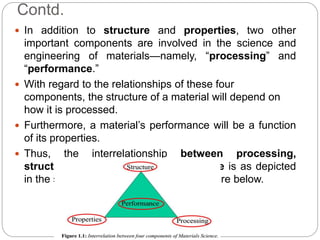
 In addition to structure and properties, two other
important components are involved in the science and
engineering of materials—namely, “processing” and
“performance.”
 With regard to the relationships of these four
components, the structure of a material will depend on
how it is processed.
 Furthermore, a material’s performance will be a function
of its properties.
 Thus, the interrelationship between processing,
structure, properties, and performance is as depicted
in the schematic illustration shown in Figure below.
Contd.
We now present an example of these processing-structure-properties-
performance principles with Figure below
Contd.
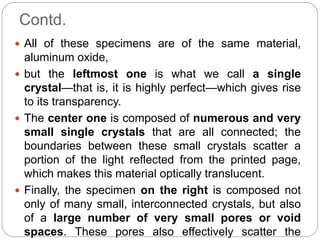
 From the above photograph of three thin disk
specimens of aluminum oxide, which have been
placed over a printed page in order to demonstrate
their differences in light-transmittance characteristics.
 The disk on the left is transparent (that is, virtually all
light that is reflected from the page passes through it),
 whereas the one in the center is translucent
(meaning that some of this reflected light is
transmitted through the disk).
 And, the disk on the right is opaque—i.e., none of
the light passes through it. These differences in
optical properties are a consequence of differences in
structure of these materials, which have resulted from
the way the materials were processed.
Contd.
single crystal
polycrystal:
low porosity
polycrystal:
high porosity
Contd.
 All of these specimens are of the same material,
aluminum oxide,
 but the leftmost one is what we call a single
crystal—that is, it is highly perfect—which gives rise
to its transparency.
 The center one is composed of numerous and very
small single crystals that are all connected; the
boundaries between these small crystals scatter a
portion of the light reflected from the printed page,
which makes this material optically translucent.
 Finally, the specimen on the right is composed not
only of many small, interconnected crystals, but also
of a large number of very small pores or void
spaces. These pores also effectively scatter the
Contd.
 Thus, the structures of these three specimens are
different in terms of crystal boundaries and pores,
which affect the optical transmittance properties.
 Furthermore, each material was produced using a
different processing technique.
 And, of course, if optical transmittance is an
important parameter relative to the ultimate in-
service application, the performance of each material
will be different.
Why Study Materials Science and
Engineering?
 Innovation in engineering often means the clever use
of a new material for a specific application. For
example: plastic containers in place of age-old
metallic containers.
 It is well learnt lesion that engineering disasters are
frequently caused by the misuse of materials.
 So it is vital that the professional engineer should
know how to select materials which best fit the
demands of the design - economic and aesthetic
demands, as well as demands of strength and
durability.
Contd.
 Beforehand the designer must understand the
properties of materials, and their limitations.
 Thus it is very important that every engineer must
study and understand the concepts of Materials
Science and Engineering.
 This enables the engineer
 • To select a material for a given use based on
considerations of cost and performance.
 • To understand the limits of materials and the
change of their properties with use.
 • To be able to create a new material that will have
some desirable properties.
 • To be able to use the material for different
Classification of Engineering
Materials
 Solid materials have been conveniently grouped into
three basic classifications: metals, ceramics, and
polymers.
 This scheme is based primarily on chemical makeup
and atomic structure, and most materials fall into one
distinct grouping or another, although there are some
intermediates.
 In addition, there are the composites, combinations
of two or more of the above three basic material
classes.
 Another classification is advanced materials—those
used in high-technology applications—viz.
semiconductors, biomaterials, smart materials, and
Contd.
Metals
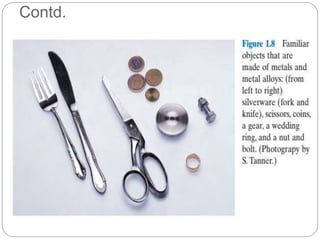
 Materials in this group are composed of one or more
metallic elements (such as iron, aluminum, copper,
titanium, gold, and nickel), and often also nonmetallic
elements (for example, carbon, nitrogen, and oxygen) in
relatively small amounts.
 The term metal alloy is used in reference to a metallic
substance that is composed of twoor more elements.
 Atoms in metals and their alloys are arranged in a very
orderly manner and in comparison to the ceramics and
polymers, are relatively dense.
 With regard to mechanical characteristics, these
materials are relatively stiff and strong, yet are ductile
(i.e., capable of large amounts of deformation without
fracture), and are resistant to fracture, which accounts for
their widespread use in structural applications.
Contd.
 These materials are characterized by high thermal
and electrical conductivity; strong yet deformable
under applied mechanical loads; opaque to light
(shiny if polished).
 These characteristics are due to valence electrons
that are detached from atoms, and spread in an
electron sea that glues the ions together, i.e. atoms
are bound together by metallic bonds and weaker
van der Waalls forces.
 In addition, some of the metals (viz., Fe, Co, and Ni)
have desirable magnetic properties.
Contd.
Contd.
Contd.
Contd.
Ceramics
 Ceramics are compounds between metallic and
nonmetallic elements; they are most frequently oxides,
nitrides, and carbides.
 For example, some of the common ceramic materials
include aluminum oxide (or alumina,Al2O3), silicon
dioxide (or silica,SiO2), silicon carbide (SiC), silicon
nitride (Si3N4), and, in addition, what some refer to as
the traditional ceramics—those composed of clay
minerals (i.e., porcelain), as well as cement, and glass.
 With regard to mechanical behavior, ceramic materials
are relatively stiff and strong—stiffnesses and strengths
are comparable to those of the metals. In addition,
ceramics are typically very hard.
 On the other hand, they are extremely brittle (lack
Contd.
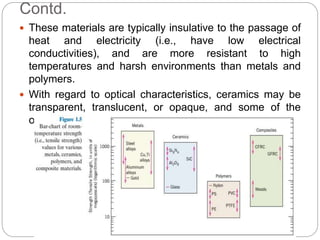
 These materials are typically insulative to the passage of
heat and electricity (i.e., have low electrical
conductivities), and are more resistant to high
temperatures and harsh environments than metals and
polymers.
 With regard to optical characteristics, ceramics may be
transparent, translucent, or opaque, and some of the
oxide ceramics (e.g., Fe3O4) exhibit magnetic behavior.
Contd.
Contd.
Contd.
Contd.
Polymers
 Polymers include the familiar plastic and rubber materials.
 Many of them are organic compounds that are chemically
based on carbon, hydrogen, and other nonmetallic
elements (viz. O, N, and Si).
 Furthermore, they have very large molecular structures,
often chain-like in nature that have a backbone of carbon
atoms.
 Some of the common and familiar polymers are
polyethylene (PE), nylon, poly(vinyl chloride) (PVC),
polycarbonate (PC), polystyrene (PS), and silicone rubber.
 These materials typically have low densities, whereas their
mechanical characteristics are generally dissimilar to the
metallic and ceramic materials—they are not as stiff nor as
strong as these other material types
Contd.
 In addition, many of the polymers are extremely
ductile and pliable (i.e., plastic), which means they
are easily formed into complex shapes.
 In general, they are relatively inert chemically and
unreactive in a large number of environments.
 One major drawback to the polymers is their
tendency to soften and/or decompose at modest
temperatures, which, in some instances, limits their
use.
 Furthermore, they have low electrical conductivities
and are nonmagnetic.
Contd.
Contd.
Composites
 A composite is composed of two (or more) individual
materials, which come from the categories discussed
above—viz., metals, ceramics, and polymers.
 The design goal of a composite is to achieve a
combination of properties that is not displayed by any
single material, and also to incorporate the best
characteristics of each of the component materials.
 A large number of composite types exist that are
represented by different combinations of metals,
ceramics, and polymers.
 Furthermore, some naturally-occurring materials are also
considered to be composites—for example, wood and
bone. However, most of those we consider in our
discussions are synthetic (or man-made) composites.
Contd.
 One of the most common and familiar composites is
fiberglass, in which small glass fibers are embedded
within a polymeric material (normally an epoxy or
polyester).
 The glass fibers are relatively strong and stiff (but also
brittle), where as the polymer is ductile (but also weak
and flexible). Thus, the resulting fiberglass is relatively
stiff, strong, (Figures 1.4 and 1.5) flexible, and ductile. In
addition, it has a low density (Figure 1.3).
 Another of these technologically important materials is
the “carbon fiber reinforced polymer” (or “CFRP”)
composite—carbon fibers that are embedded within a
polymer.
 These materials are stiffer and stronger than the glass
fiber-reinforced materials (Figures 1.4 and 1.5), yet they
are more expensive. The CFRP composites are used in
some aircraft and aerospace applications, as well as
high-tech porting equipment (e.g., bicycles, golf clubs,
ADVANCED MATERIALS
 Materials that are utilized in high-technology (or high-tech)
applications are sometimes termed advanced materials.
 By high technology we mean a device or product that operates
or functions using relatively intricate and sophisticated
principles; examples include electronic equipment
(camcorders, CD/DVD players, etc.), computers, fiber-optic
systems, spacecraft, aircraft, and military rocketry.
 These advanced materials are typically traditional materials
whose properties have been enhanced, and, also newly
developed, high-performance materials.
 Furthermore, they may be of all material types (e.g., metals,
ceramics, polymers), and are normally expensive.
 Advanced materials include semiconductors, biomaterials, and
what we may term “materials of the future” (that is, smart
materials and nano engineered materials).
 The properties and applications of a number of these
advanced materials—for example, materials that are used for
lasers, integrated circuits, magnetic information storage, liquid
Contd.
Semiconductors
 Semiconductors have electrical properties that are
intermediate between the electrical conductors (viz.
metals and metal alloys) and insulators (viz.
ceramics and polymers)—Figure 1.7.
 Furthermore, the electrical characteristics of these
materials are extremely sensitive to the presence of
minute concentrations of impurity atoms, for which
the concentrations may be controlled over very small
spatial regions.
 Semiconductors have made possible the advent of
integrated circuitry that has totally revolutionized the
electronics and computer industries (not to mention
our lives) over the past three decades.
Contd.
Biomaterials
 Biomaterials are employed in components implanted
into the human body for replacement of diseased or
damaged body parts.
 These materials must not produce toxic substances
and must be compatible with body tissues (i.e., must
not cause adverse biological reactions).
 All of the above materials—metals, ceramics,
polymers, composites, and semiconductors—may be
used as biomaterials.
 For example, some of the biomaterials that are
utilized in artificial hip replacements
Contd.
Advanced Materials
 These are materials used in High-Techdevices those
operate based on relatively intricate and sophisticated
principles (e.g. computers, air/space-crafts, electronic
gadgets, etc.).
 These materials are either traditional materials with
enhanced properties or newly developed materials with
high-performance capabilities.
 Hence these are relatively expensive. Typical
applications: integrated circuits, lasers, LCDs, fiber
optics, thermal protection for space shuttle, etc.
Examples: Metallic foams, inter-metallic compounds,
multi-component alloys, magnetic alloys, special
Future Materials
Smart materials
 Group of new and state-of-the-art materials now being
developed, and expected to have significant influence on
present-day technologies, especially in the fields of medicine,
manufacturing and defense. Smart/Intelligent material system
consists some type of sensor (detects an input) and an actuator
(performs responsive and adaptive function).
 Actuators may be called upon to change shape, position, natural
frequency, mechanical characteristics in response to changes in
temperature, electric/magnetic fields, moisture, pH, etc.
 Four types of materials used as actuators: Shape memory
alloys, Piezo-electric ceramics, Magnetostrictive materials,
Electro-/Magneto-rheological fluids.
Contd.
Nanoengineered Materials
 With the advent of scanning probe microscopes,
which permit observation of individual atoms and
molecules, it has become possible to manipulate and
move atoms and molecules to form new structures
and, thus, design new materials that are built from
simple atomic-level constituents (i.e., “materials by
design”).
 This ability to carefully arrange atoms provides
opportunities to develop mechanical, electrical,
magnetic, and other properties that are not otherwise
possible.
 The study of the properties of these materials is
termed “nanotechnology”; the “nano” prefix denotes
that the dimensions of these structural entities are on
THANK
YOU

Engg mat chapter 1

  • 1.
    By Leliso H.. MettuUniversity Faculty of Engineering and Technology Department of Mechanical engineering Engineering Material
  • 2.
    HISTORICAL PERSPECTIVE  Materialsare probably more deep-seated in our culture than most of us realize.  Transportation, housing, clothing, communication, recreation, and food production—virtually every segment of our everyday lives is influenced to one degree or another by materials.  Historically, the development and advancement of societies have been intimately tied to the members’ ability to produce and manipulate materials to fill their needs.  In fact, early civilizations have been designated by the level of their materials development and the historians have identified early periods of civilization by the name of most significantly used material (Stone Age, Bronze Age, Iron Age).
  • 3.
    Contd.  Stone →Bronze→Iron →Advanced materials  From the historical point of view, it can be said that human civilization started with Stone Age where people used only natural materials, like stone, clay, skin, and wood for the purposes like to make weapons, instruments, shelter, etc.  Thus the sites of deposits for better quality stones became early colonies of human civilization.
  • 4.
    Contd.  However, theincreasing need for better quality tools brought forth exploration that led to Bronze Age.  The Stone Age ended about 5000 years ago with introduction of Bronze in the Far East.  When people found copper and how to make it harder by alloying, the Bronze Age started about 3000 BC  Bronze is an alloy (a metal made up of more than one element), copper + < 25% of tin + other elements.  Bronze: can be hammered or cast into a variety of shapes, can be made harder by alloying, corrode only slowly after a surface oxide film forms.
  • 5.
    Contd.  The IronAge began about 3000 years ago and continues today. Use of iron and steel, a stronger and cheaper material changed drastically daily life of a common person.  The use of iron and steel, a stronger material that gave advantage in wars started at about 1200 BC.  Iron was abundant and thus availability is not limited to the affluent.  This commonness of the material affected every person in many aspects, gaining the name democratic material.
  • 6.
    Contd.  Age ofAdvanced materials: throughout the Iron Age many new types of materials have been introduced (ceramic, semiconductors, polymers, composites…).  This age is marked by many technological developments towards development materials resulting in stronger and light materials like composites, electronic materials like semiconductors, materials for space voyage like high temperature ceramics, biomaterials, etc.
  • 7.
    MATERIALS SCIENCE AND ENGINEERING Sometimes it is useful to subdivide the discipline of materials science and engineering into materials science and materials engineering sub disciplines.  Strictly speaking, “materials science” involves investigating the relationships that exist between the structures and properties of materials.  In contrast, “materials engineering” is, on the basis of these structure–property correlations, designing or engineering the structure of a material to produce a predetermined set of properties.  From a functional perspective, the role of a materials scientist is to develop or synthesize new materials,  whereas a materials engineer is called upon to create new products or systems using existing materials, and/or to develop techniques for processing materials.
  • 8.
    Contd.  Four MajorComponents of Material Science and Engineering:  Structure of Materials  Properties of Materials  Processing of Materials  Performance of Materials  “Structure” is at this point a nebulous term that deserves some explanation.  In brief, the structure of a material usually relates to the arrangement of its internal components.  Subatomic structure involves electrons within the individual atoms and interactions with their nuclei.  On an atomic level, structure encompasses the organization of atoms or molecules relative to one another.  The next larger structural realm, which contains large groups of atoms that are normally agglomerated together, is termed “microscopic,” meaning that which is subject to direct observation using some type of microscope.  Finally, structural elements that may be viewed with the naked eye are termed “macroscopic.”
  • 9.
    9 • Subatomic levelElectronic structure of individual atoms that defines interaction among atoms (interatomic bonding). • Atomic level Arrangement of atoms in materials (for the same atoms can have different properties, e.g. two forms of carbon: graphite and diamond) • Microscopic structure Arrangement of small grains of material that can be identified by microscopy. • Macroscopic structure Structural elements that may be viewed with the naked eye. Structure Annealing of a polycrystalline grain structure 2D simulation using Monte Carlo Potts model. 2D simulations involve 40,000 sites and takes a day to run on a fast workstation, 3D simulations involve 64 million sites, runs on 1000 processors of ASCI-Red. Monarch butterfly ~ 0.1 m
  • 10.
    10 Properties are theway the material responds to the environment and external forces. Mechanical properties – response to mechanical forces, strength, etc. Electrical and magnetic properties - response electrical and magnetic fields, conductivity, etc. Thermal properties are related to transmission of heat and heat capacity. Optical properties include to absorption, transmission and scattering of light. Chemical stability in contact with the environment - corrosion resistance. Properties
  • 11.
    Contd.  In additionto structure and properties, two other important components are involved in the science and engineering of materials—namely, “processing” and “performance.”  With regard to the relationships of these four components, the structure of a material will depend on how it is processed.  Furthermore, a material’s performance will be a function of its properties.  Thus, the interrelationship between processing, structure, properties, and performance is as depicted in the schematic illustration shown in Figure below.
  • 12.
    Contd. We now presentan example of these processing-structure-properties- performance principles with Figure below
  • 13.
    Contd.  From theabove photograph of three thin disk specimens of aluminum oxide, which have been placed over a printed page in order to demonstrate their differences in light-transmittance characteristics.  The disk on the left is transparent (that is, virtually all light that is reflected from the page passes through it),  whereas the one in the center is translucent (meaning that some of this reflected light is transmitted through the disk).  And, the disk on the right is opaque—i.e., none of the light passes through it. These differences in optical properties are a consequence of differences in structure of these materials, which have resulted from the way the materials were processed.
  • 14.
  • 15.
    Contd.  All ofthese specimens are of the same material, aluminum oxide,  but the leftmost one is what we call a single crystal—that is, it is highly perfect—which gives rise to its transparency.  The center one is composed of numerous and very small single crystals that are all connected; the boundaries between these small crystals scatter a portion of the light reflected from the printed page, which makes this material optically translucent.  Finally, the specimen on the right is composed not only of many small, interconnected crystals, but also of a large number of very small pores or void spaces. These pores also effectively scatter the
  • 16.
    Contd.  Thus, thestructures of these three specimens are different in terms of crystal boundaries and pores, which affect the optical transmittance properties.  Furthermore, each material was produced using a different processing technique.  And, of course, if optical transmittance is an important parameter relative to the ultimate in- service application, the performance of each material will be different.
  • 17.
    Why Study MaterialsScience and Engineering?  Innovation in engineering often means the clever use of a new material for a specific application. For example: plastic containers in place of age-old metallic containers.  It is well learnt lesion that engineering disasters are frequently caused by the misuse of materials.  So it is vital that the professional engineer should know how to select materials which best fit the demands of the design - economic and aesthetic demands, as well as demands of strength and durability.
  • 18.
    Contd.  Beforehand thedesigner must understand the properties of materials, and their limitations.  Thus it is very important that every engineer must study and understand the concepts of Materials Science and Engineering.  This enables the engineer  • To select a material for a given use based on considerations of cost and performance.  • To understand the limits of materials and the change of their properties with use.  • To be able to create a new material that will have some desirable properties.  • To be able to use the material for different
  • 19.
    Classification of Engineering Materials Solid materials have been conveniently grouped into three basic classifications: metals, ceramics, and polymers.  This scheme is based primarily on chemical makeup and atomic structure, and most materials fall into one distinct grouping or another, although there are some intermediates.  In addition, there are the composites, combinations of two or more of the above three basic material classes.  Another classification is advanced materials—those used in high-technology applications—viz. semiconductors, biomaterials, smart materials, and
  • 20.
    Contd. Metals  Materials inthis group are composed of one or more metallic elements (such as iron, aluminum, copper, titanium, gold, and nickel), and often also nonmetallic elements (for example, carbon, nitrogen, and oxygen) in relatively small amounts.  The term metal alloy is used in reference to a metallic substance that is composed of twoor more elements.  Atoms in metals and their alloys are arranged in a very orderly manner and in comparison to the ceramics and polymers, are relatively dense.  With regard to mechanical characteristics, these materials are relatively stiff and strong, yet are ductile (i.e., capable of large amounts of deformation without fracture), and are resistant to fracture, which accounts for their widespread use in structural applications.
  • 21.
    Contd.  These materialsare characterized by high thermal and electrical conductivity; strong yet deformable under applied mechanical loads; opaque to light (shiny if polished).  These characteristics are due to valence electrons that are detached from atoms, and spread in an electron sea that glues the ions together, i.e. atoms are bound together by metallic bonds and weaker van der Waalls forces.  In addition, some of the metals (viz., Fe, Co, and Ni) have desirable magnetic properties.
  • 22.
  • 23.
  • 24.
  • 25.
    Contd. Ceramics  Ceramics arecompounds between metallic and nonmetallic elements; they are most frequently oxides, nitrides, and carbides.  For example, some of the common ceramic materials include aluminum oxide (or alumina,Al2O3), silicon dioxide (or silica,SiO2), silicon carbide (SiC), silicon nitride (Si3N4), and, in addition, what some refer to as the traditional ceramics—those composed of clay minerals (i.e., porcelain), as well as cement, and glass.  With regard to mechanical behavior, ceramic materials are relatively stiff and strong—stiffnesses and strengths are comparable to those of the metals. In addition, ceramics are typically very hard.  On the other hand, they are extremely brittle (lack
  • 26.
    Contd.  These materialsare typically insulative to the passage of heat and electricity (i.e., have low electrical conductivities), and are more resistant to high temperatures and harsh environments than metals and polymers.  With regard to optical characteristics, ceramics may be transparent, translucent, or opaque, and some of the oxide ceramics (e.g., Fe3O4) exhibit magnetic behavior.
  • 27.
  • 28.
  • 29.
  • 30.
    Contd. Polymers  Polymers includethe familiar plastic and rubber materials.  Many of them are organic compounds that are chemically based on carbon, hydrogen, and other nonmetallic elements (viz. O, N, and Si).  Furthermore, they have very large molecular structures, often chain-like in nature that have a backbone of carbon atoms.  Some of the common and familiar polymers are polyethylene (PE), nylon, poly(vinyl chloride) (PVC), polycarbonate (PC), polystyrene (PS), and silicone rubber.  These materials typically have low densities, whereas their mechanical characteristics are generally dissimilar to the metallic and ceramic materials—they are not as stiff nor as strong as these other material types
  • 31.
    Contd.  In addition,many of the polymers are extremely ductile and pliable (i.e., plastic), which means they are easily formed into complex shapes.  In general, they are relatively inert chemically and unreactive in a large number of environments.  One major drawback to the polymers is their tendency to soften and/or decompose at modest temperatures, which, in some instances, limits their use.  Furthermore, they have low electrical conductivities and are nonmagnetic.
  • 32.
  • 33.
    Contd. Composites  A compositeis composed of two (or more) individual materials, which come from the categories discussed above—viz., metals, ceramics, and polymers.  The design goal of a composite is to achieve a combination of properties that is not displayed by any single material, and also to incorporate the best characteristics of each of the component materials.  A large number of composite types exist that are represented by different combinations of metals, ceramics, and polymers.  Furthermore, some naturally-occurring materials are also considered to be composites—for example, wood and bone. However, most of those we consider in our discussions are synthetic (or man-made) composites.
  • 34.
    Contd.  One ofthe most common and familiar composites is fiberglass, in which small glass fibers are embedded within a polymeric material (normally an epoxy or polyester).  The glass fibers are relatively strong and stiff (but also brittle), where as the polymer is ductile (but also weak and flexible). Thus, the resulting fiberglass is relatively stiff, strong, (Figures 1.4 and 1.5) flexible, and ductile. In addition, it has a low density (Figure 1.3).  Another of these technologically important materials is the “carbon fiber reinforced polymer” (or “CFRP”) composite—carbon fibers that are embedded within a polymer.  These materials are stiffer and stronger than the glass fiber-reinforced materials (Figures 1.4 and 1.5), yet they are more expensive. The CFRP composites are used in some aircraft and aerospace applications, as well as high-tech porting equipment (e.g., bicycles, golf clubs,
  • 35.
    ADVANCED MATERIALS  Materialsthat are utilized in high-technology (or high-tech) applications are sometimes termed advanced materials.  By high technology we mean a device or product that operates or functions using relatively intricate and sophisticated principles; examples include electronic equipment (camcorders, CD/DVD players, etc.), computers, fiber-optic systems, spacecraft, aircraft, and military rocketry.  These advanced materials are typically traditional materials whose properties have been enhanced, and, also newly developed, high-performance materials.  Furthermore, they may be of all material types (e.g., metals, ceramics, polymers), and are normally expensive.  Advanced materials include semiconductors, biomaterials, and what we may term “materials of the future” (that is, smart materials and nano engineered materials).  The properties and applications of a number of these advanced materials—for example, materials that are used for lasers, integrated circuits, magnetic information storage, liquid
  • 36.
    Contd. Semiconductors  Semiconductors haveelectrical properties that are intermediate between the electrical conductors (viz. metals and metal alloys) and insulators (viz. ceramics and polymers)—Figure 1.7.  Furthermore, the electrical characteristics of these materials are extremely sensitive to the presence of minute concentrations of impurity atoms, for which the concentrations may be controlled over very small spatial regions.  Semiconductors have made possible the advent of integrated circuitry that has totally revolutionized the electronics and computer industries (not to mention our lives) over the past three decades.
  • 37.
    Contd. Biomaterials  Biomaterials areemployed in components implanted into the human body for replacement of diseased or damaged body parts.  These materials must not produce toxic substances and must be compatible with body tissues (i.e., must not cause adverse biological reactions).  All of the above materials—metals, ceramics, polymers, composites, and semiconductors—may be used as biomaterials.  For example, some of the biomaterials that are utilized in artificial hip replacements
  • 38.
    Contd. Advanced Materials  Theseare materials used in High-Techdevices those operate based on relatively intricate and sophisticated principles (e.g. computers, air/space-crafts, electronic gadgets, etc.).  These materials are either traditional materials with enhanced properties or newly developed materials with high-performance capabilities.  Hence these are relatively expensive. Typical applications: integrated circuits, lasers, LCDs, fiber optics, thermal protection for space shuttle, etc. Examples: Metallic foams, inter-metallic compounds, multi-component alloys, magnetic alloys, special
  • 39.
    Future Materials Smart materials Group of new and state-of-the-art materials now being developed, and expected to have significant influence on present-day technologies, especially in the fields of medicine, manufacturing and defense. Smart/Intelligent material system consists some type of sensor (detects an input) and an actuator (performs responsive and adaptive function).  Actuators may be called upon to change shape, position, natural frequency, mechanical characteristics in response to changes in temperature, electric/magnetic fields, moisture, pH, etc.  Four types of materials used as actuators: Shape memory alloys, Piezo-electric ceramics, Magnetostrictive materials, Electro-/Magneto-rheological fluids.
  • 40.
    Contd. Nanoengineered Materials  Withthe advent of scanning probe microscopes, which permit observation of individual atoms and molecules, it has become possible to manipulate and move atoms and molecules to form new structures and, thus, design new materials that are built from simple atomic-level constituents (i.e., “materials by design”).  This ability to carefully arrange atoms provides opportunities to develop mechanical, electrical, magnetic, and other properties that are not otherwise possible.  The study of the properties of these materials is termed “nanotechnology”; the “nano” prefix denotes that the dimensions of these structural entities are on
  • 41.