1
Module 2
Imperfections in Crystals
2
3
4
5
2. Introduction to Crystal Geometry
Materials may be classified as Crystalline or Non-Crystalline
structures
Crystalline solid can be either Single Crystal Solid (crystal
lattice of entire sample is continuous and unbroken to edges of
sample with no grain boundary) or Poly Crystal Solid (aggregate
of many crystals separated by well-defined boundaries)
Cluster of crystals with identical structure (same
crystallographic planes & directions) are known as Grains
separated by Grain Boundaries
X-ray diffraction analysis shows that atoms in metal crystal are
arranged in a regular, repeated 3-D Pattern known as Crystalline
Structure
6
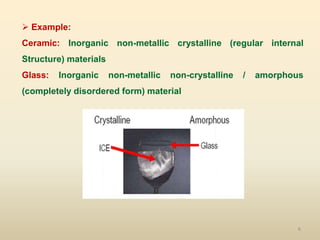
 Example:
Ceramic: Inorganic non-metallic crystalline (regular internal
Structure) materials
Glass: Inorganic non-metallic non-crystalline / amorphous
(completely disordered form) material
7
Arrangement of atoms can be most simply portrayed by
Crystal Lattice, in which atoms are visualized as, Hard Balls
located at particular locations
Space Lattice / Lattice: Periodic arrangement of points in
space with respect to three dimensional network of lines
Each atom in lattice when replaced by a point is called Lattice
Point, which are the intersections of above network of lines
Arrangement of such points in 3-D space is called Lattice
Array and 3-D space is called Lattice Space
8
Tiny block formed by arrangement of small group of atoms is
called Unit Cell. It is chosen to represent the symmetry of
crystal structure, and may be defined as:
 Finite representation of infinite lattice
 Small repeat entity
 Basic structural unit
 Building block of crystal structure
 Can generate entire crystal by translation
9
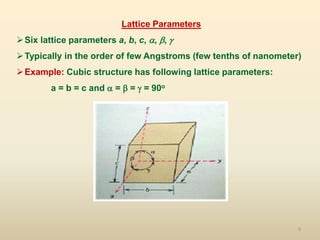
Lattice Parameters
Six lattice parameters a, b, c, , , 
Typically in the order of few Angstroms (few tenths of nanometer)
Example: Cubic structure has following lattice parameters:
a = b = c and  =  =  = 90o
10
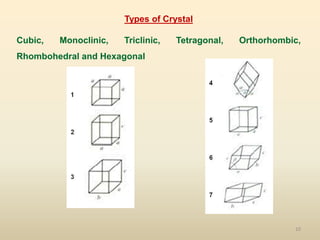
Types of Crystal
Cubic, Monoclinic, Triclinic, Tetragonal, Orthorhombic,
Rhombohedral and Hexagonal
11
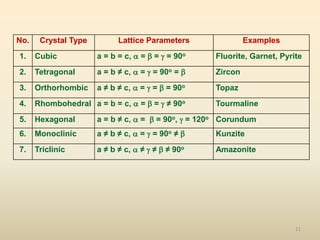
No. Crystal Type Lattice Parameters Examples
1. Cubic a = b = c,  =  =  = 90o Fluorite, Garnet, Pyrite
2. Tetragonal a = b ≠ c,  =  = 90o =  Zircon
3. Orthorhombic a ≠ b ≠ c,  =  =  = 90o Topaz
4. Rhombohedral a = b = c,  =  =  ≠ 90o Tourmaline
5. Hexagonal a = b ≠ c,  =  = 90o,  = 120o Corundum
6. Monoclinic a ≠ b ≠ c,  =  = 90o ≠  Kunzite
7. Triclinic a ≠ b ≠ c,  ≠  ≠  ≠ 90o Amazonite
12
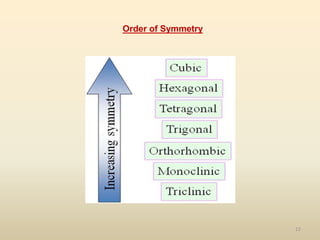
Order of Symmetry
13
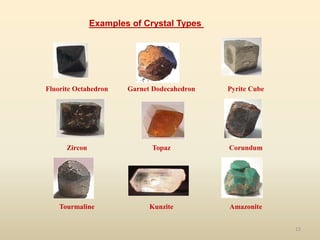
Fluorite Octahedron Garnet Dodecahedron Pyrite Cube
Zircon Topaz Corundum
Tourmaline Kunzite Amazonite
Examples of Crystal Types
14
Principal Metal Crystal Structures
 Simple Cubic Lattice Structure
 Body Centered Cubic (BCC) Structure
 Face Centered Cubic (FCC) Structure
15
Simple Cubic Lattice
Most elementary crystal structure with three mutually
perpendicular axes arbitrarily placed through one of the
corners of a cell
Each corners occupied with one atom
16
(i). Aggregate of atoms (ii). Hard Sphere Unit Cell
SC Structure
17
Body Centered Cubic (BCC) Structure
BCC cell has an atom at each corner and another atom at body
center of cube
Each atom at corner is surrounded by eight adjacent atoms
Example: alpha iron, chromium, molybdenum & tungsten
18
(i). Aggregate of atoms (ii). Hard Sphere Unit Cell
BCC Structure
19
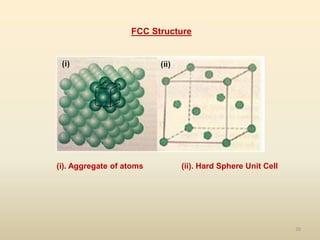
Face Centered Cubic (FCC) Structure
Atoms at each corner of cube, and in addition there is an atom at
the center of each cube’s face
Example: aluminium, copper, gold, lead, silver and nickel
20
(i). Aggregate of atoms (ii). Hard Sphere Unit Cell
FCC Structure
21
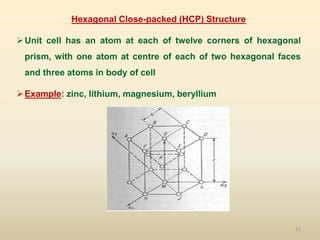
Hexagonal Close-packed (HCP) Structure
Unit cell has an atom at each of twelve corners of hexagonal
prism, with one atom at centre of each of two hexagonal faces
and three atoms in body of cell
Example: zinc, lithium, magnesium, beryllium
22
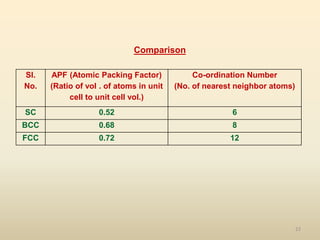
Sl.
No.
APF (Atomic Packing Factor)
(Ratio of vol . of atoms in unit
cell to unit cell vol.)
Co-ordination Number
(No. of nearest neighbor atoms)
SC 0.52 6
BCC 0.68 8
FCC 0.72 12
Comparison
23
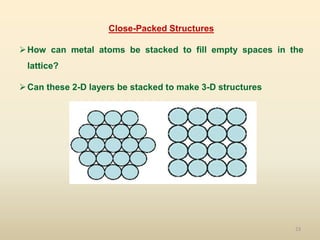
Close-Packed Structures
How can metal atoms be stacked to fill empty spaces in the
lattice?
Can these 2-D layers be stacked to make 3-D structures
24
Example: Close-Packed FCC Structure
ABC Stacking Sequence
25
Example: Close-Packed HCP Structure
ABC Stacking Sequence
AB Stacking Sequence
26
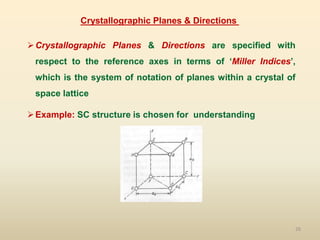
Crystallographic Planes & Directions are specified with
respect to the reference axes in terms of ‘Miller Indices’,
which is the system of notation of planes within a crystal of
space lattice
Example: SC structure is chosen for understanding
Crystallographic Planes & Directions
27
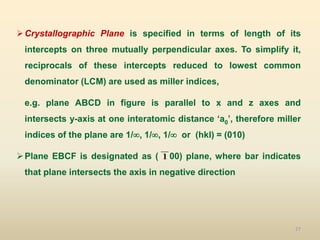
Crystallographic Plane is specified in terms of length of its
intercepts on three mutually perpendicular axes. To simplify it,
reciprocals of these intercepts reduced to lowest common
denominator (LCM) are used as miller indices,
e.g. plane ABCD in figure is parallel to x and z axes and
intersects y-axis at one interatomic distance ‘a0’, therefore miller
indices of the plane are 1/, 1/, 1/ or (hkl) = (010)
Plane EBCF is designated as ( 00) plane, where bar indicates
that plane intersects the axis in negative direction
1
28
Crystallographic Directions are indicated by integers in
brackets like [uvw], where reciprocals are never used, e.g.
direction ‘FD’ is obtained by moving out from origin, a
distance ‘a0’ along positive x-axis and moving same distance
along positive y-axis also, therefore, the crystallographic
direction will be given as [110]
Example: Ionic crystals like NaCl, LiF (not for metals)
Note: For simple cubic lattice only, direction is always
perpendicular the plane having same indices
29
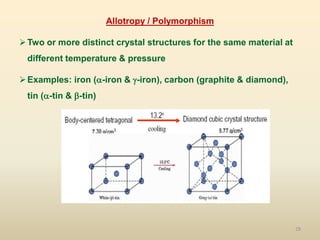
Allotropy / Polymorphism
Two or more distinct crystal structures for the same material at
different temperature & pressure
Examples: iron (-iron & -iron), carbon (graphite & diamond),
tin (-tin & -tin)
30
3. Imperfection / Defects In Crystals
In actual crystals, imperfection or defects are always present, which are
important to understand, as they influence the properties of material
Classifications of Defects
(i). Point Defects (Zero Dimensional Defects)
(a). Vacancy
(b). Schottky Imperfections
(c). Interstitialcy
(d). Frenkel Defect
(e). Compositional Defect
Substitutional Defect
Interstitial Impurity
(f). Electronic Defect
31
(ii). Line Defects / Dislocations (One Dimensional Defects)
(a). Edge Dislocations
(b). Screw Dislocations
(iii). Surface / Plane Defects (Two Dimensional Defects)
(a). External Defects
(b). Internal Defects
 Grain Boundary Defect
 Tilt Boundary Defect
 Twin Boundary Defect
 Stacking Fault
(iv). Volume Defects (Three Dimensional Defects)
32
(I). Point Defects (Zero Dimensional Defects)
Imperfect point like regions in crystal (size is one or two atomic
diameter)
Completely local in effect, i.e. vacant lattice site
Always present in crystals
Created by thermal fluctuations, quenching (high rate of cooling),
severe deformation of crystal lattice (hammering or rolling) or
external bombardment by atoms / high energy particles
33
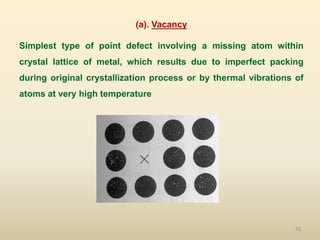
(a). Vacancy
Simplest type of point defect involving a missing atom within
crystal lattice of metal, which results due to imperfect packing
during original crystallization process or by thermal vibrations of
atoms at very high temperature
34
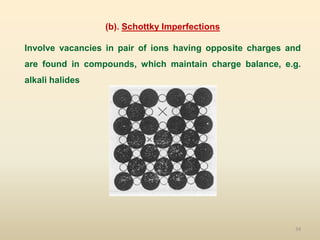
(b). Schottky Imperfections
Involve vacancies in pair of ions having opposite charges and
are found in compounds, which maintain charge balance, e.g.
alkali halides
35
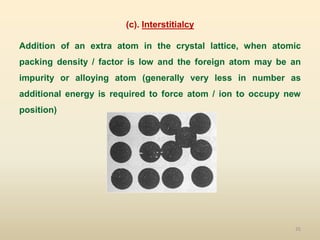
(c). Interstitialcy
Addition of an extra atom in the crystal lattice, when atomic
packing density / factor is low and the foreign atom may be an
impurity or alloying atom (generally very less in number as
additional energy is required to force atom / ion to occupy new
position)
36
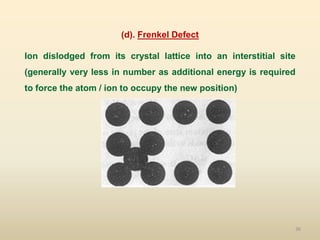
(d). Frenkel Defect
Ion dislodged from its crystal lattice into an interstitial site
(generally very less in number as additional energy is required
to force the atom / ion to occupy the new position)
37
(e). Compositional Defect
Arises due to presence of impurity atom in crystal lattice of metal
during original crystallization process (responsible for functioning
of semi-conductor devices)
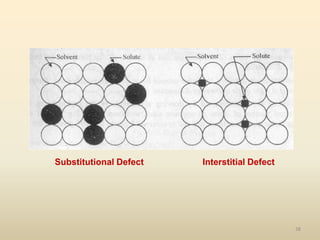
 Substitutional Defect: Original parent atom from its lattice is replaced
 Interstitial Impurity: Small impurity occupies interstitial spaces in
lattice
(f). Electronic Defect
Errors in charge distribution in solids, e.g. diodes and transistors
devices, where charges diffuse in opposite regions leading to
change of their concentration in that region
38
Substitutional Defect Interstitial Defect
39
(ii). Line Defects (One Dimensional Defects)
Linear disturbance of atomic arrangement, which can move very
easily on slip plane through crystal
Occurs during recrystallization process or during slip
Created along a line, which is also boundary between slipped
and unslipped regions of crystals
Defect is known as ‘dislocation’ and boundary is known as
‘Dislocation Line’
Region near dislocation, where distortion is extremely large is
called ‘Core of Dislocation’ (very high local strain)
40
(a). Edge Dislocation
Any extra plane of atoms within a crystal structure is edge
dislocation
Accompanied by zones of compression and tension and there
is a net increase in energy along dislocation
Displacement distance for atoms around dislocation is called
‘Burger Vector’, which is at right angle to edge dislocation
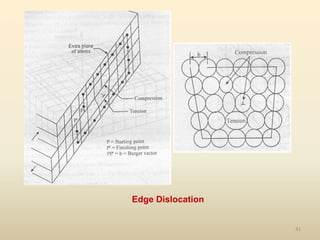
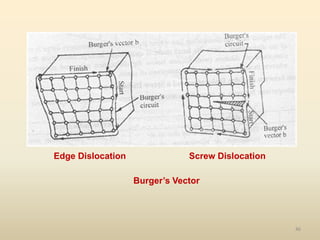
Berger vector is determined by drawing a rectangle in region by
connecting an equal number of atoms on opposite sides (circuit
fails to complete), i.e. PP’ as shown in figure
41
Edge Dislocation
42
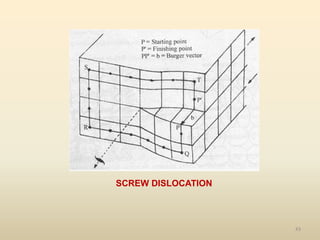
(b). Screw Dislocation
Originate from partial slipping of a section of crystal plane
Shear stresses are associated with adjacent atoms and extra
energy is involved along the dislocation
Successive atom planes are transformed into the Surface of
Helix of Screw (plane is distorted), which accounts for its name
as screw dislocation
Displacement vector is parallel to the line defect
43
SCREW DISLOCATION
44
Edge Dislocation Screw Dislocation
Arise due to introduction or
elimination of an extra row of atoms
Arise due to partial slipping of
section of crystal plane, where
planes of atoms are transformed
into surface of helix of screw
Tensile, compressive or shear
stress field may be present
Only shear stress field is present
Lattice disturbance extends along
an edge inside crystal
Lattice disturbance extends into two
separate planes at right angles to
each other
Burger’s vector is always
perpendicular to dislocation line
Burger’s vector is parallel to
dislocation line
Dislocations can climb and glide Dislocation can only glide
Force required is less as compared
to that for screw dislocation
Force required is more as compared
to that of edge dislocation
Comparison
45
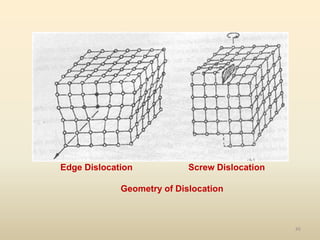
Geometry of Dislocation
Edge Dislocation Screw Dislocation
46
Edge Dislocation Screw Dislocation
Burger’s Vector
47
Formation of Step on Crystal Surface
Edge Dislocation Screw Dislocation
48
(iii). Surface / Plane Defects (Two Dimensional Defects)
Two-dimensional regions in crystal and arise from change in
stacking of atomic planes on or across boundary
(a). External Defects
Defects or imperfections represented by a boundary
External surface of material itself is an imperfection because
atomic bonds do not extend beyond it
Surface atoms do not have neighboring atoms on one side (as
compared to atoms inside the material) and thus, have high
energy (in the order of 1 J/m2)
49
(b). Internal Defects
 Grain Boundary Defect
Imperfections, which separate crystals or grains of different
orientation in polycrystalline aggregation during nucleation or
crystallization
Individual crystals with different orientation are called as ‘Grains’,
and boundary separating grains are called as ‘Interface / Interface
Boundary’
Example: copper metal
50
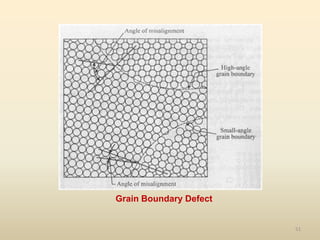
Atoms within a grain are arranged with one orientation and
pattern, which does not aligns with orientation of atoms in
neighboring grains
Misalignment between adjacent grains may be of various
degrees (small or high angle grain boundaries)
Always a transition zones between two neighboring grains
Leads to less efficient packing of atoms at boundary and thus,
atoms at boundary have higher energy as compared to those at
inside of grain boundaries
51
Grain Boundary Defect
52
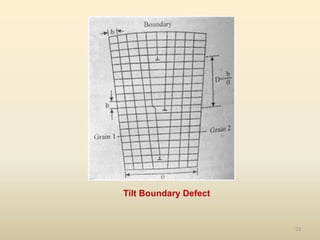
 Tilt Boundary Defect
Series of aligned dislocations, which tend to anchor (fasten)
dislocation movements normally contributing to plastic
deformation
Associated with little energy
Orientation difference between two neighboring grains is less
than 100, thus, it may be called as small / low angle grain
boundary
53
Tilt Boundary Defect
54
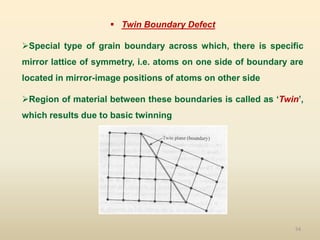
 Twin Boundary Defect
Special type of grain boundary across which, there is specific
mirror lattice of symmetry, i.e. atoms on one side of boundary are
located in mirror-image positions of atoms on other side
Region of material between these boundaries is called as ‘Twin’,
which results due to basic twinning
55
 Stacking Fault
Arise due to stacking of one atomic plane out of sequence on
another, while lattice on either side of fault is perfect, i.e. one or
more than one atomic plane may be missing from usual
conventional style of stacking
(iv). Volume Defects (Three Dimensional Defects)
Bulk defects, which includes pores, cracks, foreign inclusions
or other phases
56
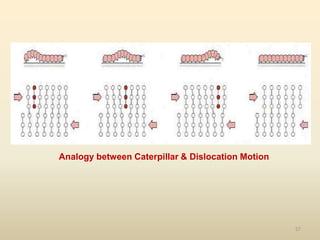
Slip by Dislocation Motion
Slip is plastic deformation process produced by dislocation
motion (Note: Dislocations Can Move)
Dislocation motion is analogous to the mode of locomotion
employed by caterpillar
Caterpillar forms a hump near its posterior (later) end by pulling
in its pair of legs unit leg distance and then this hump is
propelled forward by repeating lifting and shifting of leg pairs
When a hump moves forward, entire caterpillar moves forward
by leg separation distance corresponding to extra half plane of
atoms in its dislocation model of plastic deformation
57
Analogy between Caterpillar & Dislocation Motion
58
4. Concept of Elastic & Plastic Deformation
Introduction:
Change in dimensions of material under action of applied
forces
Caused by mechanical action or by various physical and
physio-chemical processes
Deformed components are superior to cast components in
performance
Types: Elastic & Plastic deformations
59
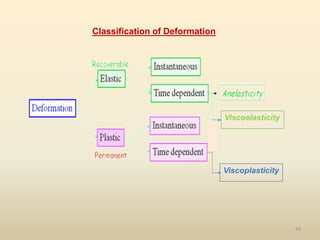
Viscoelasticity
Viscoplasticity
Classification of Deformation
60
Elastic Deformation
Disappears, when load is removed & takes place before plastic
deformation
Strain is proportional to stress (Hooke’s Law)
Ratio of stress to strain is Young’s Modulus of Elasticity (E),
which is a material characteristic (magnitude depends upon force
of attraction between atoms of metal)
Shear stress produces shear strains and ratio of shear stress to
shear strain is Shear Modulus of Rigidity (G)
Ratio of volumetric stress to volumetric stain is Bulk Modulus of
Elasticity (K)
61
Young’s Modulus of Elasticity
Shear Modulus of Elasticity
Bulk Modulus of Elasticity
l
t


 
)1(2 

E
G
)21(3 

E
K
62
Perfect elastic material is one which regains back its original
shape and size completely, after deforming force is removed
During elastic deformation, material stores energy (strain or
elastic energy), which is recovered, when load is removed
Elastic strain energy is area under stress-strain curve (up to
elastic limit)
63
 Materials subjected to tension shrink laterally & those
subjected to compression, bulge
 Ratio of lateral and axial strains is called the Poisson's ratio
(), which is a dimensionless quantity (sign shows that lateral
strain is in opposite sense to longitudinal strain)
 Theoretical value is 0.25 & maximum value is 0.50 (typical
value lies in between 0.24 to 0.30
64
Plastic Deformation
Permanent deformation, which persists even when deforming
load is removed (function of stress, temperature & rate of
straining)
Caused by loads exceeding elastic limit & occurs after elastic
deformation
Non-linear relation between stress and strain (nature varies with
material & deformation condition)
Exhibit yield point phenomenon (yield stress)
Continued plastic deformation leads to fracture (instantaneous
fracture for brittle material & necking followed by fracture for
ductile material)
65
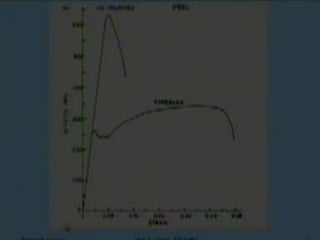
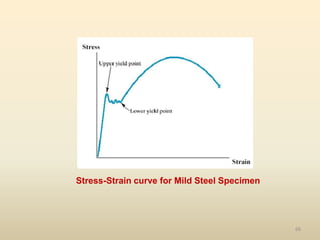
Yield Point Phenomenon
Yielding starts at 1st higher point known as Upper Yield Point
and 2nd lower point is known as Lower Yield Point
Stress required to deform metal after yield point is always
higher due to strain hardening, which causes curve to gradually
rise upwards uptill ultimate tensile point (corresponding stress
known as Ultimate Tensile Strength). After this specimen fails by
fracture
66
Stress-Strain curve for Mild Steel Specimen
67
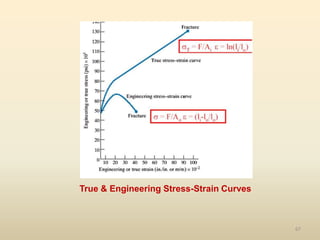
True & Engineering Stress-Strain Curves
68
Strain Hardening
Increase in yield stress of material when loaded subsequently in
same direction again and again below recrystallization
temperature
When material is loaded in any direction (say tensile direction), it
experiences linear elastic deformation till elastic limit. If load is
removed, material comes back to its original shape and size and
curve will retrace back loading path
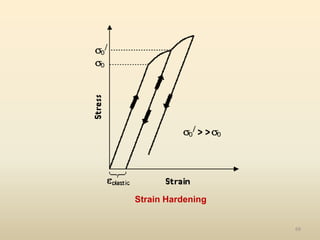
If material is further loaded (beyond yield stress ‘0’), slight
plastic deformation occurs leading to small permanent
deformation. Now, if load is removed, material will retail this
small plastic / permanent deformation and curve will not retrace
original path, but will follow path parallel to original loading path
69
Strain Hardening
70
If same material is loaded in same (tensile) direction again, it will
start yielding at new yield stress ‘0
/’, which will be higher than
initial yield stress of material ‘0’.
This is because material becomes harder during plastic
deformation by storing strain energy (some % of total
deformation energy)
Reduces ductility and plasticity of material
At micro level, dislocation piles up during plastic deformation at
slip planes, which interact with each other and create barriers to
further motion / movement of dislocations through crystal lattice
71
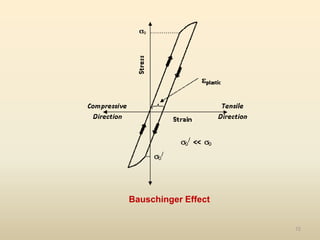
Bauschinger Effect / Elastic Hysteresis
Decrease in yield stress of material when loaded initially in one
direction (tensile) and then subsequently in opposite direction
(compressive) below recrystallization temperature
When a material is loaded in any direction (say tensile direction),
it experiences linear elastic deformation till elastic limit. If it is
further loaded (beyond yield stress ‘0’), slight plastic
deformation will occur leading to small permanent deformation
Now, even if load is removed, material will retail this small
plastic / permanent deformation and curve will not retrace
original path, but will follow path parallel to original loading path
72
Bauschinger Effect
73
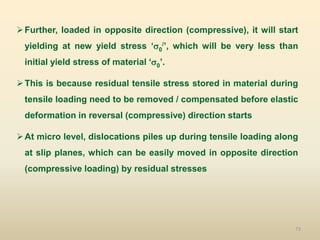
Further, loaded in opposite direction (compressive), it will start
yielding at new yield stress ‘0
/’, which will be very less than
initial yield stress of material ‘0’.
This is because residual tensile stress stored in material during
tensile loading need to be removed / compensated before elastic
deformation in reversal (compressive) direction starts
At micro level, dislocations piles up during tensile loading along
at slip planes, which can be easily moved in opposite direction
(compressive loading) by residual stresses
74
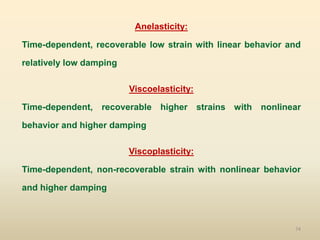
Anelasticity:
Time-dependent, recoverable low strain with linear behavior and
relatively low damping
Viscoelasticity:
Time-dependent, recoverable higher strains with nonlinear
behavior and higher damping
Viscoplasticity:
Time-dependent, non-recoverable strain with nonlinear behavior
and higher damping
75
Superplasticity:
Materials demonstrate remarkably high strain to failure (strain
rate around 0.001/s), generally at high temperatures (T > 0.5 Tm).
It is used to form complex shapes, which are impossible to
obtain using traditional methods like rolling, forging, extrusion
or drawing processes, e.g. fuel tank of pulsar motorcycle
76
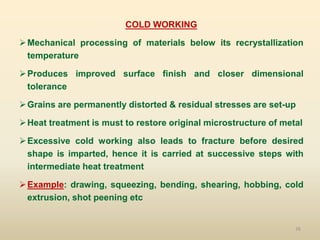
COLD WORKING
Mechanical processing of materials below its recrystallization
temperature
Produces improved surface finish and closer dimensional
tolerance
Grains are permanently distorted & residual stresses are set-up
Heat treatment is must to restore original microstructure of metal
Excessive cold working also leads to fracture before desired
shape is imparted, hence it is carried at successive steps with
intermediate heat treatment
Example: drawing, squeezing, bending, shearing, hobbing, cold
extrusion, shot peening etc
77
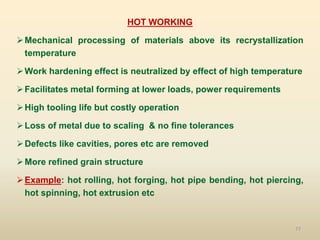
HOT WORKING
Mechanical processing of materials above its recrystallization
temperature
Work hardening effect is neutralized by effect of high temperature
Facilitates metal forming at lower loads, power requirements
High tooling life but costly operation
Loss of metal due to scaling & no fine tolerances
Defects like cavities, pores etc are removed
More refined grain structure
Example: hot rolling, hot forging, hot pipe bending, hot piercing,
hot spinning, hot extrusion etc
78
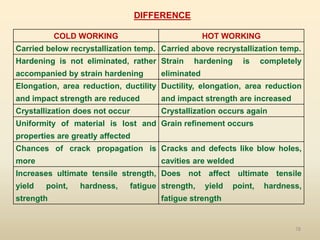
COLD WORKING HOT WORKING
Carried below recrystallization temp. Carried above recrystallization temp.
Hardening is not eliminated, rather
accompanied by strain hardening
Strain hardening is completely
eliminated
Elongation, area reduction, ductility
and impact strength are reduced
Ductility, elongation, area reduction
and impact strength are increased
Crystallization does not occur Crystallization occurs again
Uniformity of material is lost and
properties are greatly affected
Grain refinement occurs
Chances of crack propagation is
more
Cracks and defects like blow holes,
cavities are welded
Increases ultimate tensile strength,
yield point, hardness, fatigue
strength
Does not affect ultimate tensile
strength, yield point, hardness,
fatigue strength
DIFFERENCE
79
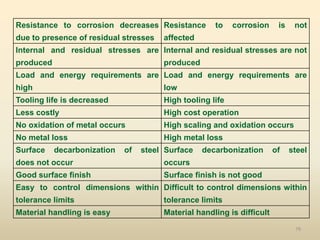
Resistance to corrosion decreases
due to presence of residual stresses
Resistance to corrosion is not
affected
Internal and residual stresses are
produced
Internal and residual stresses are not
produced
Load and energy requirements are
high
Load and energy requirements are
low
Tooling life is decreased High tooling life
Less costly High cost operation
No oxidation of metal occurs High scaling and oxidation occurs
No metal loss High metal loss
Surface decarbonization of steel
does not occur
Surface decarbonization of steel
occurs
Good surface finish Surface finish is not good
Easy to control dimensions within
tolerance limits
Difficult to control dimensions within
tolerance limits
Material handling is easy Material handling is difficult
80
1.Thermal Expansion
Tendency of a matter to change in volume in response to change
in temperature
When a substance is heated, its constituent particles begin
moving and become active, thus maintaining a greater average
separation
Degree of expansion divided by change in temperature is
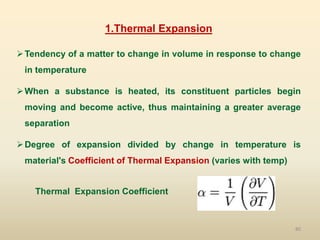
material's Coefficient of Thermal Expansion (varies with temp)
Thermal Expansion Coefficient
81
 Common engineering solids usually have thermal
expansion coefficients that do not vary significantly over
the range of temp where they are designed to be used
 Materials with anisotropic structures, such as crystals
and composites, will generally have different expansion
coefficients in different orientations

inmperfections in crystals

  • 1.
  • 2.
  • 3.
  • 4.
  • 5.
    5 2. Introduction toCrystal Geometry Materials may be classified as Crystalline or Non-Crystalline structures Crystalline solid can be either Single Crystal Solid (crystal lattice of entire sample is continuous and unbroken to edges of sample with no grain boundary) or Poly Crystal Solid (aggregate of many crystals separated by well-defined boundaries) Cluster of crystals with identical structure (same crystallographic planes & directions) are known as Grains separated by Grain Boundaries X-ray diffraction analysis shows that atoms in metal crystal are arranged in a regular, repeated 3-D Pattern known as Crystalline Structure
  • 6.
    6  Example: Ceramic: Inorganicnon-metallic crystalline (regular internal Structure) materials Glass: Inorganic non-metallic non-crystalline / amorphous (completely disordered form) material
  • 7.
    7 Arrangement of atomscan be most simply portrayed by Crystal Lattice, in which atoms are visualized as, Hard Balls located at particular locations Space Lattice / Lattice: Periodic arrangement of points in space with respect to three dimensional network of lines Each atom in lattice when replaced by a point is called Lattice Point, which are the intersections of above network of lines Arrangement of such points in 3-D space is called Lattice Array and 3-D space is called Lattice Space
  • 8.
    8 Tiny block formedby arrangement of small group of atoms is called Unit Cell. It is chosen to represent the symmetry of crystal structure, and may be defined as:  Finite representation of infinite lattice  Small repeat entity  Basic structural unit  Building block of crystal structure  Can generate entire crystal by translation
  • 9.
    9 Lattice Parameters Six latticeparameters a, b, c, , ,  Typically in the order of few Angstroms (few tenths of nanometer) Example: Cubic structure has following lattice parameters: a = b = c and  =  =  = 90o
  • 10.
    10 Types of Crystal Cubic,Monoclinic, Triclinic, Tetragonal, Orthorhombic, Rhombohedral and Hexagonal
  • 11.
    11 No. Crystal TypeLattice Parameters Examples 1. Cubic a = b = c,  =  =  = 90o Fluorite, Garnet, Pyrite 2. Tetragonal a = b ≠ c,  =  = 90o =  Zircon 3. Orthorhombic a ≠ b ≠ c,  =  =  = 90o Topaz 4. Rhombohedral a = b = c,  =  =  ≠ 90o Tourmaline 5. Hexagonal a = b ≠ c,  =  = 90o,  = 120o Corundum 6. Monoclinic a ≠ b ≠ c,  =  = 90o ≠  Kunzite 7. Triclinic a ≠ b ≠ c,  ≠  ≠  ≠ 90o Amazonite
  • 12.
  • 13.
    13 Fluorite Octahedron GarnetDodecahedron Pyrite Cube Zircon Topaz Corundum Tourmaline Kunzite Amazonite Examples of Crystal Types
  • 14.
    14 Principal Metal CrystalStructures  Simple Cubic Lattice Structure  Body Centered Cubic (BCC) Structure  Face Centered Cubic (FCC) Structure
  • 15.
    15 Simple Cubic Lattice Mostelementary crystal structure with three mutually perpendicular axes arbitrarily placed through one of the corners of a cell Each corners occupied with one atom
  • 16.
    16 (i). Aggregate ofatoms (ii). Hard Sphere Unit Cell SC Structure
  • 17.
    17 Body Centered Cubic(BCC) Structure BCC cell has an atom at each corner and another atom at body center of cube Each atom at corner is surrounded by eight adjacent atoms Example: alpha iron, chromium, molybdenum & tungsten
  • 18.
    18 (i). Aggregate ofatoms (ii). Hard Sphere Unit Cell BCC Structure
  • 19.
    19 Face Centered Cubic(FCC) Structure Atoms at each corner of cube, and in addition there is an atom at the center of each cube’s face Example: aluminium, copper, gold, lead, silver and nickel
  • 20.
    20 (i). Aggregate ofatoms (ii). Hard Sphere Unit Cell FCC Structure
  • 21.
    21 Hexagonal Close-packed (HCP)Structure Unit cell has an atom at each of twelve corners of hexagonal prism, with one atom at centre of each of two hexagonal faces and three atoms in body of cell Example: zinc, lithium, magnesium, beryllium
  • 22.
    22 Sl. No. APF (Atomic PackingFactor) (Ratio of vol . of atoms in unit cell to unit cell vol.) Co-ordination Number (No. of nearest neighbor atoms) SC 0.52 6 BCC 0.68 8 FCC 0.72 12 Comparison
  • 23.
    23 Close-Packed Structures How canmetal atoms be stacked to fill empty spaces in the lattice? Can these 2-D layers be stacked to make 3-D structures
  • 24.
    24 Example: Close-Packed FCCStructure ABC Stacking Sequence
  • 25.
    25 Example: Close-Packed HCPStructure ABC Stacking Sequence AB Stacking Sequence
  • 26.
    26 Crystallographic Planes &Directions are specified with respect to the reference axes in terms of ‘Miller Indices’, which is the system of notation of planes within a crystal of space lattice Example: SC structure is chosen for understanding Crystallographic Planes & Directions
  • 27.
    27 Crystallographic Plane isspecified in terms of length of its intercepts on three mutually perpendicular axes. To simplify it, reciprocals of these intercepts reduced to lowest common denominator (LCM) are used as miller indices, e.g. plane ABCD in figure is parallel to x and z axes and intersects y-axis at one interatomic distance ‘a0’, therefore miller indices of the plane are 1/, 1/, 1/ or (hkl) = (010) Plane EBCF is designated as ( 00) plane, where bar indicates that plane intersects the axis in negative direction 1
  • 28.
    28 Crystallographic Directions areindicated by integers in brackets like [uvw], where reciprocals are never used, e.g. direction ‘FD’ is obtained by moving out from origin, a distance ‘a0’ along positive x-axis and moving same distance along positive y-axis also, therefore, the crystallographic direction will be given as [110] Example: Ionic crystals like NaCl, LiF (not for metals) Note: For simple cubic lattice only, direction is always perpendicular the plane having same indices
  • 29.
    29 Allotropy / Polymorphism Twoor more distinct crystal structures for the same material at different temperature & pressure Examples: iron (-iron & -iron), carbon (graphite & diamond), tin (-tin & -tin)
  • 30.
    30 3. Imperfection /Defects In Crystals In actual crystals, imperfection or defects are always present, which are important to understand, as they influence the properties of material Classifications of Defects (i). Point Defects (Zero Dimensional Defects) (a). Vacancy (b). Schottky Imperfections (c). Interstitialcy (d). Frenkel Defect (e). Compositional Defect Substitutional Defect Interstitial Impurity (f). Electronic Defect
  • 31.
    31 (ii). Line Defects/ Dislocations (One Dimensional Defects) (a). Edge Dislocations (b). Screw Dislocations (iii). Surface / Plane Defects (Two Dimensional Defects) (a). External Defects (b). Internal Defects  Grain Boundary Defect  Tilt Boundary Defect  Twin Boundary Defect  Stacking Fault (iv). Volume Defects (Three Dimensional Defects)
  • 32.
    32 (I). Point Defects(Zero Dimensional Defects) Imperfect point like regions in crystal (size is one or two atomic diameter) Completely local in effect, i.e. vacant lattice site Always present in crystals Created by thermal fluctuations, quenching (high rate of cooling), severe deformation of crystal lattice (hammering or rolling) or external bombardment by atoms / high energy particles
  • 33.
    33 (a). Vacancy Simplest typeof point defect involving a missing atom within crystal lattice of metal, which results due to imperfect packing during original crystallization process or by thermal vibrations of atoms at very high temperature
  • 34.
    34 (b). Schottky Imperfections Involvevacancies in pair of ions having opposite charges and are found in compounds, which maintain charge balance, e.g. alkali halides
  • 35.
    35 (c). Interstitialcy Addition ofan extra atom in the crystal lattice, when atomic packing density / factor is low and the foreign atom may be an impurity or alloying atom (generally very less in number as additional energy is required to force atom / ion to occupy new position)
  • 36.
    36 (d). Frenkel Defect Iondislodged from its crystal lattice into an interstitial site (generally very less in number as additional energy is required to force the atom / ion to occupy the new position)
  • 37.
    37 (e). Compositional Defect Arisesdue to presence of impurity atom in crystal lattice of metal during original crystallization process (responsible for functioning of semi-conductor devices)  Substitutional Defect: Original parent atom from its lattice is replaced  Interstitial Impurity: Small impurity occupies interstitial spaces in lattice (f). Electronic Defect Errors in charge distribution in solids, e.g. diodes and transistors devices, where charges diffuse in opposite regions leading to change of their concentration in that region
  • 38.
  • 39.
    39 (ii). Line Defects(One Dimensional Defects) Linear disturbance of atomic arrangement, which can move very easily on slip plane through crystal Occurs during recrystallization process or during slip Created along a line, which is also boundary between slipped and unslipped regions of crystals Defect is known as ‘dislocation’ and boundary is known as ‘Dislocation Line’ Region near dislocation, where distortion is extremely large is called ‘Core of Dislocation’ (very high local strain)
  • 40.
    40 (a). Edge Dislocation Anyextra plane of atoms within a crystal structure is edge dislocation Accompanied by zones of compression and tension and there is a net increase in energy along dislocation Displacement distance for atoms around dislocation is called ‘Burger Vector’, which is at right angle to edge dislocation Berger vector is determined by drawing a rectangle in region by connecting an equal number of atoms on opposite sides (circuit fails to complete), i.e. PP’ as shown in figure
  • 41.
  • 42.
    42 (b). Screw Dislocation Originatefrom partial slipping of a section of crystal plane Shear stresses are associated with adjacent atoms and extra energy is involved along the dislocation Successive atom planes are transformed into the Surface of Helix of Screw (plane is distorted), which accounts for its name as screw dislocation Displacement vector is parallel to the line defect
  • 43.
  • 44.
    44 Edge Dislocation ScrewDislocation Arise due to introduction or elimination of an extra row of atoms Arise due to partial slipping of section of crystal plane, where planes of atoms are transformed into surface of helix of screw Tensile, compressive or shear stress field may be present Only shear stress field is present Lattice disturbance extends along an edge inside crystal Lattice disturbance extends into two separate planes at right angles to each other Burger’s vector is always perpendicular to dislocation line Burger’s vector is parallel to dislocation line Dislocations can climb and glide Dislocation can only glide Force required is less as compared to that for screw dislocation Force required is more as compared to that of edge dislocation Comparison
  • 45.
    45 Geometry of Dislocation EdgeDislocation Screw Dislocation
  • 46.
    46 Edge Dislocation ScrewDislocation Burger’s Vector
  • 47.
    47 Formation of Stepon Crystal Surface Edge Dislocation Screw Dislocation
  • 48.
    48 (iii). Surface /Plane Defects (Two Dimensional Defects) Two-dimensional regions in crystal and arise from change in stacking of atomic planes on or across boundary (a). External Defects Defects or imperfections represented by a boundary External surface of material itself is an imperfection because atomic bonds do not extend beyond it Surface atoms do not have neighboring atoms on one side (as compared to atoms inside the material) and thus, have high energy (in the order of 1 J/m2)
  • 49.
    49 (b). Internal Defects Grain Boundary Defect Imperfections, which separate crystals or grains of different orientation in polycrystalline aggregation during nucleation or crystallization Individual crystals with different orientation are called as ‘Grains’, and boundary separating grains are called as ‘Interface / Interface Boundary’ Example: copper metal
  • 50.
    50 Atoms within agrain are arranged with one orientation and pattern, which does not aligns with orientation of atoms in neighboring grains Misalignment between adjacent grains may be of various degrees (small or high angle grain boundaries) Always a transition zones between two neighboring grains Leads to less efficient packing of atoms at boundary and thus, atoms at boundary have higher energy as compared to those at inside of grain boundaries
  • 51.
  • 52.
    52  Tilt BoundaryDefect Series of aligned dislocations, which tend to anchor (fasten) dislocation movements normally contributing to plastic deformation Associated with little energy Orientation difference between two neighboring grains is less than 100, thus, it may be called as small / low angle grain boundary
  • 53.
  • 54.
    54  Twin BoundaryDefect Special type of grain boundary across which, there is specific mirror lattice of symmetry, i.e. atoms on one side of boundary are located in mirror-image positions of atoms on other side Region of material between these boundaries is called as ‘Twin’, which results due to basic twinning
  • 55.
    55  Stacking Fault Arisedue to stacking of one atomic plane out of sequence on another, while lattice on either side of fault is perfect, i.e. one or more than one atomic plane may be missing from usual conventional style of stacking (iv). Volume Defects (Three Dimensional Defects) Bulk defects, which includes pores, cracks, foreign inclusions or other phases
  • 56.
    56 Slip by DislocationMotion Slip is plastic deformation process produced by dislocation motion (Note: Dislocations Can Move) Dislocation motion is analogous to the mode of locomotion employed by caterpillar Caterpillar forms a hump near its posterior (later) end by pulling in its pair of legs unit leg distance and then this hump is propelled forward by repeating lifting and shifting of leg pairs When a hump moves forward, entire caterpillar moves forward by leg separation distance corresponding to extra half plane of atoms in its dislocation model of plastic deformation
  • 57.
    57 Analogy between Caterpillar& Dislocation Motion
  • 58.
    58 4. Concept ofElastic & Plastic Deformation Introduction: Change in dimensions of material under action of applied forces Caused by mechanical action or by various physical and physio-chemical processes Deformed components are superior to cast components in performance Types: Elastic & Plastic deformations
  • 59.
  • 60.
    60 Elastic Deformation Disappears, whenload is removed & takes place before plastic deformation Strain is proportional to stress (Hooke’s Law) Ratio of stress to strain is Young’s Modulus of Elasticity (E), which is a material characteristic (magnitude depends upon force of attraction between atoms of metal) Shear stress produces shear strains and ratio of shear stress to shear strain is Shear Modulus of Rigidity (G) Ratio of volumetric stress to volumetric stain is Bulk Modulus of Elasticity (K)
  • 61.
    61 Young’s Modulus ofElasticity Shear Modulus of Elasticity Bulk Modulus of Elasticity l t     )1(2   E G )21(3   E K
  • 62.
    62 Perfect elastic materialis one which regains back its original shape and size completely, after deforming force is removed During elastic deformation, material stores energy (strain or elastic energy), which is recovered, when load is removed Elastic strain energy is area under stress-strain curve (up to elastic limit)
  • 63.
    63  Materials subjectedto tension shrink laterally & those subjected to compression, bulge  Ratio of lateral and axial strains is called the Poisson's ratio (), which is a dimensionless quantity (sign shows that lateral strain is in opposite sense to longitudinal strain)  Theoretical value is 0.25 & maximum value is 0.50 (typical value lies in between 0.24 to 0.30
  • 64.
    64 Plastic Deformation Permanent deformation,which persists even when deforming load is removed (function of stress, temperature & rate of straining) Caused by loads exceeding elastic limit & occurs after elastic deformation Non-linear relation between stress and strain (nature varies with material & deformation condition) Exhibit yield point phenomenon (yield stress) Continued plastic deformation leads to fracture (instantaneous fracture for brittle material & necking followed by fracture for ductile material)
  • 65.
    65 Yield Point Phenomenon Yieldingstarts at 1st higher point known as Upper Yield Point and 2nd lower point is known as Lower Yield Point Stress required to deform metal after yield point is always higher due to strain hardening, which causes curve to gradually rise upwards uptill ultimate tensile point (corresponding stress known as Ultimate Tensile Strength). After this specimen fails by fracture
  • 66.
    66 Stress-Strain curve forMild Steel Specimen
  • 67.
    67 True & EngineeringStress-Strain Curves
  • 68.
    68 Strain Hardening Increase inyield stress of material when loaded subsequently in same direction again and again below recrystallization temperature When material is loaded in any direction (say tensile direction), it experiences linear elastic deformation till elastic limit. If load is removed, material comes back to its original shape and size and curve will retrace back loading path If material is further loaded (beyond yield stress ‘0’), slight plastic deformation occurs leading to small permanent deformation. Now, if load is removed, material will retail this small plastic / permanent deformation and curve will not retrace original path, but will follow path parallel to original loading path
  • 69.
  • 70.
    70 If same materialis loaded in same (tensile) direction again, it will start yielding at new yield stress ‘0 /’, which will be higher than initial yield stress of material ‘0’. This is because material becomes harder during plastic deformation by storing strain energy (some % of total deformation energy) Reduces ductility and plasticity of material At micro level, dislocation piles up during plastic deformation at slip planes, which interact with each other and create barriers to further motion / movement of dislocations through crystal lattice
  • 71.
    71 Bauschinger Effect /Elastic Hysteresis Decrease in yield stress of material when loaded initially in one direction (tensile) and then subsequently in opposite direction (compressive) below recrystallization temperature When a material is loaded in any direction (say tensile direction), it experiences linear elastic deformation till elastic limit. If it is further loaded (beyond yield stress ‘0’), slight plastic deformation will occur leading to small permanent deformation Now, even if load is removed, material will retail this small plastic / permanent deformation and curve will not retrace original path, but will follow path parallel to original loading path
  • 72.
  • 73.
    73 Further, loaded inopposite direction (compressive), it will start yielding at new yield stress ‘0 /’, which will be very less than initial yield stress of material ‘0’. This is because residual tensile stress stored in material during tensile loading need to be removed / compensated before elastic deformation in reversal (compressive) direction starts At micro level, dislocations piles up during tensile loading along at slip planes, which can be easily moved in opposite direction (compressive loading) by residual stresses
  • 74.
    74 Anelasticity: Time-dependent, recoverable lowstrain with linear behavior and relatively low damping Viscoelasticity: Time-dependent, recoverable higher strains with nonlinear behavior and higher damping Viscoplasticity: Time-dependent, non-recoverable strain with nonlinear behavior and higher damping
  • 75.
    75 Superplasticity: Materials demonstrate remarkablyhigh strain to failure (strain rate around 0.001/s), generally at high temperatures (T > 0.5 Tm). It is used to form complex shapes, which are impossible to obtain using traditional methods like rolling, forging, extrusion or drawing processes, e.g. fuel tank of pulsar motorcycle
  • 76.
    76 COLD WORKING Mechanical processingof materials below its recrystallization temperature Produces improved surface finish and closer dimensional tolerance Grains are permanently distorted & residual stresses are set-up Heat treatment is must to restore original microstructure of metal Excessive cold working also leads to fracture before desired shape is imparted, hence it is carried at successive steps with intermediate heat treatment Example: drawing, squeezing, bending, shearing, hobbing, cold extrusion, shot peening etc
  • 77.
    77 HOT WORKING Mechanical processingof materials above its recrystallization temperature Work hardening effect is neutralized by effect of high temperature Facilitates metal forming at lower loads, power requirements High tooling life but costly operation Loss of metal due to scaling & no fine tolerances Defects like cavities, pores etc are removed More refined grain structure Example: hot rolling, hot forging, hot pipe bending, hot piercing, hot spinning, hot extrusion etc
  • 78.
    78 COLD WORKING HOTWORKING Carried below recrystallization temp. Carried above recrystallization temp. Hardening is not eliminated, rather accompanied by strain hardening Strain hardening is completely eliminated Elongation, area reduction, ductility and impact strength are reduced Ductility, elongation, area reduction and impact strength are increased Crystallization does not occur Crystallization occurs again Uniformity of material is lost and properties are greatly affected Grain refinement occurs Chances of crack propagation is more Cracks and defects like blow holes, cavities are welded Increases ultimate tensile strength, yield point, hardness, fatigue strength Does not affect ultimate tensile strength, yield point, hardness, fatigue strength DIFFERENCE
  • 79.
    79 Resistance to corrosiondecreases due to presence of residual stresses Resistance to corrosion is not affected Internal and residual stresses are produced Internal and residual stresses are not produced Load and energy requirements are high Load and energy requirements are low Tooling life is decreased High tooling life Less costly High cost operation No oxidation of metal occurs High scaling and oxidation occurs No metal loss High metal loss Surface decarbonization of steel does not occur Surface decarbonization of steel occurs Good surface finish Surface finish is not good Easy to control dimensions within tolerance limits Difficult to control dimensions within tolerance limits Material handling is easy Material handling is difficult
  • 80.
    80 1.Thermal Expansion Tendency ofa matter to change in volume in response to change in temperature When a substance is heated, its constituent particles begin moving and become active, thus maintaining a greater average separation Degree of expansion divided by change in temperature is material's Coefficient of Thermal Expansion (varies with temp) Thermal Expansion Coefficient
  • 81.
    81  Common engineeringsolids usually have thermal expansion coefficients that do not vary significantly over the range of temp where they are designed to be used  Materials with anisotropic structures, such as crystals and composites, will generally have different expansion coefficients in different orientations