Message Model
and
Inferential Model
Prepared by
Dr. T. Lilly Golda
Assistant Professor of English
A.P.C. Mahalaxmi College for Women
Thoothukudi - 2
•A code is a system which pairs signals
•Languages work like a code
•To study how processes work, scholars create models
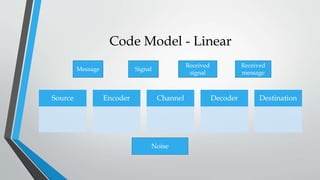
Code Model - Linear
Source Encoder Channel Decoder Destination
Message Signal
Received
signal
Received
message
Noise
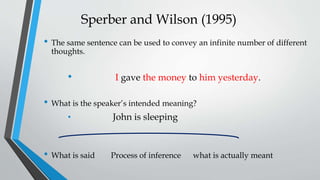
Sperber and Wilson (1995)
• The same sentence can be used to convey an infinite number of different
thoughts.
• I gave the money to him yesterday.
• What is the speaker’s intended meaning?
• John is sleeping
• What is said Process of inference what is actually meant
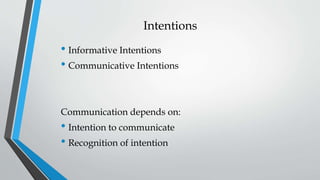
Intentions
• Informative Intentions
• Communicative Intentions
Communication depends on:
• Intention to communicate
• Recognition of intention
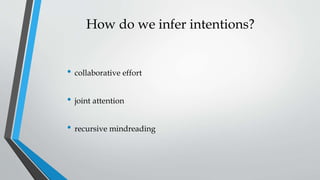
How do we infer intentions?
• collaborative effort
• joint attention
• recursive mindreading
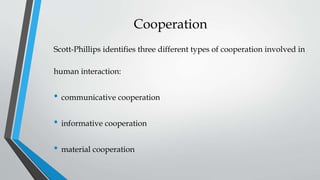
Cooperation
Scott-Phillips identifies three different types of cooperation involved in
human interaction:
• communicative cooperation
• informative cooperation
• material cooperation
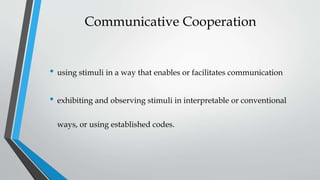
Communicative Cooperation
• using stimuli in a way that enables or facilitates communication
• exhibiting and observing stimuli in interpretable or conventional
ways, or using established codes.
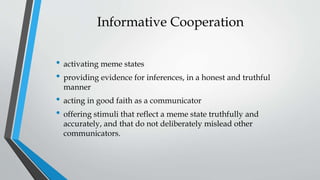
Informative Cooperation
• activating meme states
• providing evidence for inferences, in a honest and truthful
manner
• acting in good faith as a communicator
• offering stimuli that reflect a meme state truthfully and
accurately, and that do not deliberately mislead other
communicators.
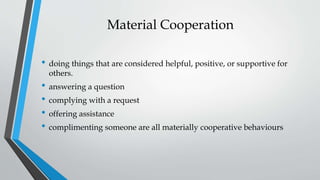
Material Cooperation
• doing things that are considered helpful, positive, or supportive for
others.
• answering a question
• complying with a request
• offering assistance
• complimenting someone are all materially cooperative behaviours
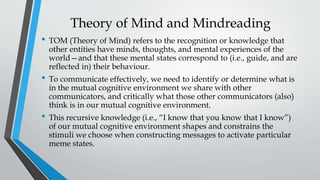
Theory of Mind and Mindreading
• TOM (Theory of Mind) refers to the recognition or knowledge that
other entities have minds, thoughts, and mental experiences of the
world—and that these mental states correspond to (i.e., guide, and are
reflected in) their behaviour.
• To communicate effectively, we need to identify or determine what is
in the mutual cognitive environment we share with other
communicators, and critically what those other communicators (also)
think is in our mutual cognitive environment.
• This recursive knowledge (i.e., “I know that you know that I know”)
of our mutual cognitive environment shapes and constrains the
stimuli we choose when constructing messages to activate particular
meme states.
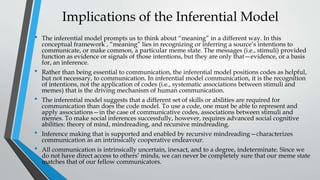
Implications of the Inferential Model
• The inferential model prompts us to think about “meaning” in a different way. In this
conceptual framework , “meaning” lies in recognizing or inferring a source’s intentions to
communicate, or make common, a particular meme state. The messages (i.e., stimuli) provided
function as evidence or signals of those intentions, but they are only that—evidence, or a basis
for, an inference.
• Rather than being essential to communication, the inferential model positions codes as helpful,
but not necessary, to communication. In inferential model communication, it is the recognition
of intentions, not the application of codes (i.e., systematic associations between stimuli and
memes) that is the driving mechanism of human communication.
• The inferential model suggests that a different set of skills or abilities are required for
communication than does the code model. To use a code, one must be able to represent and
apply associations—in the case of communicative codes, associations between stimuli and
memes. To make social inferences successfully, however, requires advanced social cognitive
abilities: theory of mind, mindreading, and recursive mindreading.
• Inference making that is supported and enabled by recursive mindreading—characterizes
communication as an intrinsically cooperative endeavour.
• All communication is intrinsically uncertain, inexact, and to a degree, indeterminate. Since we
do not have direct access to others’ minds, we can never be completely sure that our meme state
matches that of our fellow communicators.
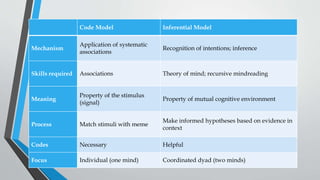
Code Model Inferential Model
Mechanism
Application of systematic
associations
Recognition of intentions; inference
Skills required Associations Theory of mind; recursive mindreading
Meaning
Property of the stimulus
(signal)
Property of mutual cognitive environment
Process Match stimuli with meme
Make informed hypotheses based on evidence in
context
Codes Necessary Helpful
Focus Individual (one mind) Coordinated dyad (two minds)
Models of Communication.pptx

Models of Communication.pptx

  • 1.
    Message Model and Inferential Model Preparedby Dr. T. Lilly Golda Assistant Professor of English A.P.C. Mahalaxmi College for Women Thoothukudi - 2
  • 2.
    •A code isa system which pairs signals •Languages work like a code •To study how processes work, scholars create models
  • 3.
    Code Model -Linear Source Encoder Channel Decoder Destination Message Signal Received signal Received message Noise
  • 4.
    Sperber and Wilson(1995) • The same sentence can be used to convey an infinite number of different thoughts. • I gave the money to him yesterday. • What is the speaker’s intended meaning? • John is sleeping • What is said Process of inference what is actually meant
  • 5.
    Intentions • Informative Intentions •Communicative Intentions Communication depends on: • Intention to communicate • Recognition of intention
  • 6.
    How do weinfer intentions? • collaborative effort • joint attention • recursive mindreading
  • 7.
    Cooperation Scott-Phillips identifies threedifferent types of cooperation involved in human interaction: • communicative cooperation • informative cooperation • material cooperation
  • 8.
    Communicative Cooperation • usingstimuli in a way that enables or facilitates communication • exhibiting and observing stimuli in interpretable or conventional ways, or using established codes.
  • 9.
    Informative Cooperation • activatingmeme states • providing evidence for inferences, in a honest and truthful manner • acting in good faith as a communicator • offering stimuli that reflect a meme state truthfully and accurately, and that do not deliberately mislead other communicators.
  • 10.
    Material Cooperation • doingthings that are considered helpful, positive, or supportive for others. • answering a question • complying with a request • offering assistance • complimenting someone are all materially cooperative behaviours
  • 11.
    Theory of Mindand Mindreading • TOM (Theory of Mind) refers to the recognition or knowledge that other entities have minds, thoughts, and mental experiences of the world—and that these mental states correspond to (i.e., guide, and are reflected in) their behaviour. • To communicate effectively, we need to identify or determine what is in the mutual cognitive environment we share with other communicators, and critically what those other communicators (also) think is in our mutual cognitive environment. • This recursive knowledge (i.e., “I know that you know that I know”) of our mutual cognitive environment shapes and constrains the stimuli we choose when constructing messages to activate particular meme states.
  • 12.
    Implications of theInferential Model • The inferential model prompts us to think about “meaning” in a different way. In this conceptual framework , “meaning” lies in recognizing or inferring a source’s intentions to communicate, or make common, a particular meme state. The messages (i.e., stimuli) provided function as evidence or signals of those intentions, but they are only that—evidence, or a basis for, an inference. • Rather than being essential to communication, the inferential model positions codes as helpful, but not necessary, to communication. In inferential model communication, it is the recognition of intentions, not the application of codes (i.e., systematic associations between stimuli and memes) that is the driving mechanism of human communication. • The inferential model suggests that a different set of skills or abilities are required for communication than does the code model. To use a code, one must be able to represent and apply associations—in the case of communicative codes, associations between stimuli and memes. To make social inferences successfully, however, requires advanced social cognitive abilities: theory of mind, mindreading, and recursive mindreading. • Inference making that is supported and enabled by recursive mindreading—characterizes communication as an intrinsically cooperative endeavour. • All communication is intrinsically uncertain, inexact, and to a degree, indeterminate. Since we do not have direct access to others’ minds, we can never be completely sure that our meme state matches that of our fellow communicators.
  • 13.
    Code Model InferentialModel Mechanism Application of systematic associations Recognition of intentions; inference Skills required Associations Theory of mind; recursive mindreading Meaning Property of the stimulus (signal) Property of mutual cognitive environment Process Match stimuli with meme Make informed hypotheses based on evidence in context Codes Necessary Helpful Focus Individual (one mind) Coordinated dyad (two minds)